A Chief Petty Officer found a strange logbook. Its last entry listed a living crewman, dated next week.
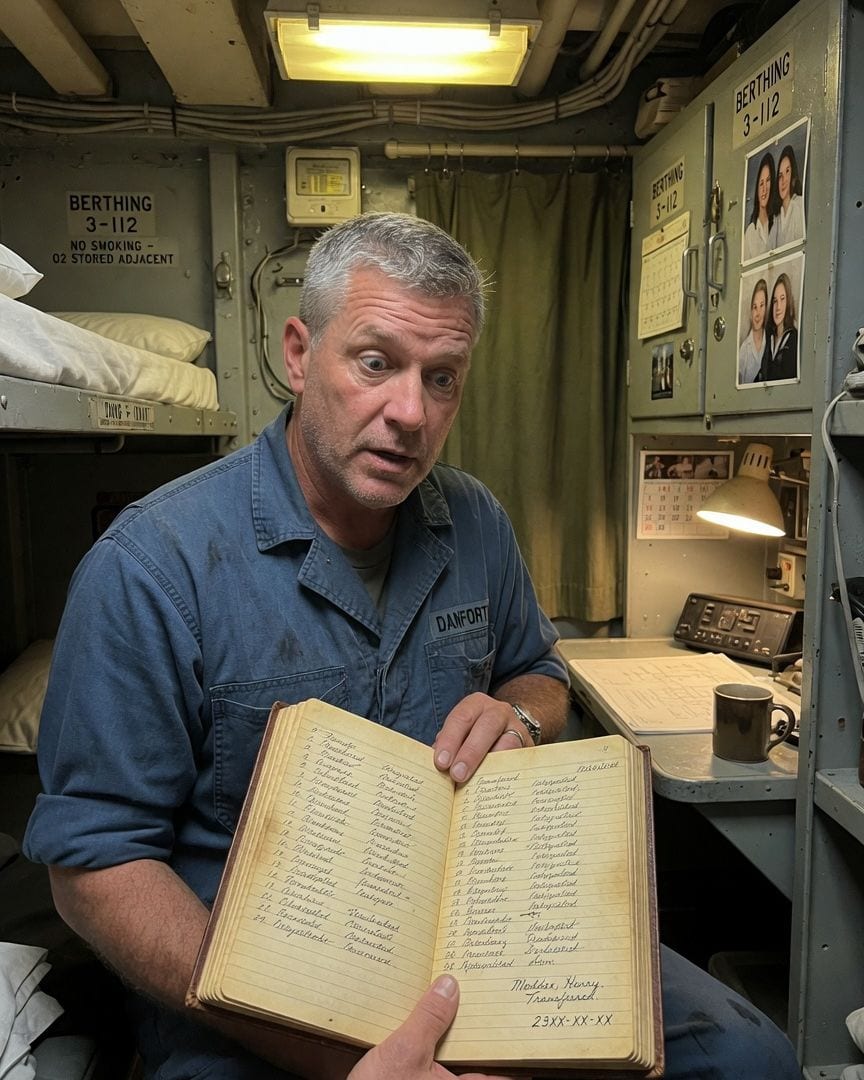
Chief Petty Officer Russell Danforth, just weeks from retirement after three decades of service, was tracing a cold-water line deep in the guided-missile destroyer USS Weatherall during a mid-cruise overhaul.
The labyrinthine passages below deck were familiar, almost a second home, the steel arteries of a vessel he knew better than his own reflection.
He moved with the quiet efficiency of a man who had long mastered his environment, his flashlight beam cutting through the dimness of the lower decks.
Amidships, tucked into a cramped, rarely visited section of the engineering space, he found it: a sealed hatch, old but secure, set into a bulkhead that the ship's damage-control plans insisted should be solid steel, a blank wall.
He ran a gloved hand over the rivets. This wasn’t a standard access panel. It was seamless, almost deliberately camouflaged, yet clearly a portal. With a grunt, he found the hidden release, a lever rusted stiff with age.
He forced it open, the heavy steel groaning in protest, the sound echoing unnaturally in the confined space. Inside, a dry, compact compartment was unexpectedly lit by a single, bare bulb, buzzing faintly. It wasn't empty.
A neatly made rack, no bigger than a coffin, stretched along one wall. A small, locked locker was bolted to the deck. On a makeshift shelf above the rack sat a battered, leather-bound logbook.
The air inside was still, faintly metallic, and unequivocally, disquietingly, lived-in.
Danforth's first thought was a rogue storage space, perhaps from a forgotten refit decades ago, a secret squirrel operation that had never made it onto official records. He pulled out the logbook, its leather cover smooth beneath his fingertips.
Its pages, thick and yellowed, were filled with meticulous, looping script – not military standard, but a cursive style he couldn’t place. Names, dates, and cryptic notes about 'transfers' and 'integrations' filled the columns.
None of the names were familiar, and the handwriting matched no one he knew from any era of the Weatherall’s history.
He secured the compartment, making sure the hatch clicked firmly back into place, then immediately contacted Walter Vance, the grizzled civilian Yard Supervisor who knew the Weatherall's guts better than anyone, a living archive of her every refit and repair.
Vance, intrigued by Danforth's unusual discovery, agreed to meet him at the hatch. Danforth led him down the same passage, his flashlight beam sweeping ahead, confident in his navigation. But when he reached the spot, the passage dead-ended.
There was no hatch. Only a seamless bulkhead of painted steel, just as the original damage-control plans had always indicated, just as it had been yesterday.
Danforth ran his hands over the cold metal, searching for the hidden release, the faint outline of the door. Nothing.
Vance, after a thorough inspection, his brow furrowed in confusion that slowly gave way to an indulgent shake of the head, dismissed it as fatigue, the stress of pre-retirement, or even a clever prank by the junior crew.
Danforth said nothing, his own confusion warring with a cold certainty. He, however, still had the logbook, tucked securely in his coveralls.
Back in his own workspace, he checked ship’s records, trying to match the names or the distinctive handwriting, but found nothing. The names were ghosts, the script an enigma. The compartment itself had never existed.
Back in his bunk, the logbook felt heavy in Danforth’s hands, its worn leather oddly warm. He opened it again, the faint smell of old paper filling the small space.
He flipped through the strange entries, his thumb brushing over names and dates stretching back decades. Each entry was a name followed by a date and a brief, unsettling remark: 'Transferred,' 'Integrated,' 'Assimilated.'
He tried to make sense of the patterns, the unexplained gaps in time, the lack of official records. Then, his breath hitched, catching in his throat like a sudden snag.
The very last entry, stark and fresh, its looping script somehow too neat, read: 'Maddox, Henry. Transferred. 23XX-XX-XX.'
Henry Maddox was a junior petty officer in his division, a young kid, barely twenty-six, with a wife and a baby on the way, due in a few months. The date, however, was a week from today.
The impossible date for Henry Maddox seared into Danforth’s mind like a brand. He began subtly observing Maddox, watching him in the mess hall, during drills, in the tight passages below deck.
Maddox seemed perfectly normal, oblivious, laughing easily with his bunkmates, his thoughts clearly on his growing family. Danforth then spent hours cross-referencing other names in the logbook with old crew manifests and service records he managed to access.
He worked quietly, carefully, under the pretense of preparing for his retirement handover. He found a disturbing pattern: many of the names listed as 'transferred' corresponded with personnel who had vanished or been reassigned under vague, sometimes classified, circumstances.
These departures often resulted in minor, unexplainable discrepancies in unit headcounts – the 'Count That Won't Reconcile' he’d heard whispered about in hushed tones by older units, an old ship legend everyone knew but officially dismissed.
It was always a person here, a person there, never enough to trigger a full investigation, just enough to leave a phantom ache in the numbers.
He approached Lieutenant Commander Isabella Vance, the ship’s sharp Executive Officer, under the guise of an inventory audit, mentioning a need to cross-verify historical personnel records for a complete picture.
She was professional, by-the-book, her gray eyes keen as she listened. Danforth noticed a flicker of something in her eyes, a brief, almost imperceptible hardening, when he mentioned historical personnel anomalies associated with certain deployment periods.
He pressed, hinting at irregularities he couldn't quite put his finger on. Her face remained impassive.
She merely advised him to stick to official channels for any data requests, her tone calm but edged with an unspoken warning that held more weight than any direct threat.
The air in her office, usually cool and crisp, seemed to grow heavy, as if the walls themselves were listening.
Danforth’s quiet investigation didn't stay quiet for long. He returned to his locker one evening, the heavy steel door of his compartment clanging shut behind him, only to find the locker itself slightly ajar.
The lock, a sturdy military-grade combination, was undisturbed, but the door had clearly been tampered with, nudged open by some unseen force. Nothing was missing, no personal items disturbed.
But the logbook, which he'd hidden carefully beneath a stack of freshly laundered uniforms at the very bottom of his rack, was now lying conspicuously on top of his pillow.
A cold runnel of sweat traced its way down his spine, prickling his skin.
Later that week, he found a small, folded note tucked into the pocket of his coveralls, the fabric still warm from his body heat.
It was blank save for a single, perfectly formed loop of ink, identical in style to the distinct, flowing script in the logbook. The message was clear: someone knew he had the book, and someone knew he was looking.
He started to feel eyes on him in the mess hall, a shadow lingering a moment too long in the periphery of his vision, a sudden silence in conversations as he passed.
He tried calling a retired Chief he’d found in an old manifest – Richard Prescott, listed with a 'transfer' date from the Weatherall decades ago.
The line rang unanswered, then a click, and a faint, distorted voice whispered, 'You should have retired, Chief.' The call disconnected abruptly, leaving only the dial tone and a profound sense of isolation.
Danforth, rattled but resolute, knew he couldn't back down. The Weatherall was his home, and something was deeply wrong with it, with him.
He tracked down Richard Prescott's last known address through the Navy’s retirement archives: a remote, weather-beaten house perched precariously on a lonely stretch of coast near the shipyard, battered by salt and wind.
Prescott, a gaunt man with eyes that held too much history, too much ocean, opened the door, seemingly expecting him. The old house creaked around them, full of the sounds of the sea.
Danforth wasted no time. He showed Prescott the logbook, flipping it open to Prescott's own entry, dated almost thirty years prior. Prescott nodded slowly, his gaze lingering on the looping script.
'The Weatherall,' he rasped, his voice a dry whisper, 'she needs to be sailed, Chief. Always has. And she always finds a way.'
Prescott explained that the ship itself, or something within it, would 'recruit' new crew members, subtly replacing existing ones, or bringing in new 'hands' when the count was off.
The replacements, he said, were perfect, indistinguishable, living their lives as if nothing had changed, but the original person was simply… gone.
The 'count that won't reconcile' wasn't a glitch, Prescott revealed, but the ship's way of marking its work, a ghost signature on the ledger.
He spoke of the hidden compartment as the 'heart' of the ship, where the entity 'rested' and kept its records.
'It chose you, Chief,' Prescott said, his voice flat, devoid of emotion, 'Long ago, it chose you to find this log. To understand.' A cold draft seemed to sweep through the room, though all the windows were shut.
Danforth felt a cold knot tighten in his gut, a sickening realization blooming in his chest. 'Chose me for what?' he demanded, his voice hoarse. 'To pass on the tradition? To be the next one in the book?'
Prescott shook his head slowly, a grim, knowing smile touching his lips. His eyes, the color of a stormy sea, fixed on Danforth. 'No, Chief. To remember. To keep the ledger.'
He motioned for Danforth to open the logbook to its very first page. The parchment was brittle, the ink faded by time, but the looping script was unmistakable, timeless.
Danforth traced the earliest entry, a name and a date from the turn of the century, followed by a series of similar, forgotten entries, a testament to endless cycles.
Then, towards the middle of that ancient page, his eyes fell upon a stark, impossible entry. The name was 'Danforth, Russell.'
The 'transfer' date was decades before he was even born, associated with a Weatherall incident he’d only read about in history books, a boiler explosion that had claimed several lives.
Prescott watched Danforth's face, his expression unchanging as the color drained from the Chief's features. 'You were never just a Chief, Russell. You were always the caretaker. The vessel. The one who ensures the Weatherall sails.'
The entity, Prescott explained, was bound to the ship, an ancient, symbiotic presence that needed a living, conscious mind to operate it, to maintain its presence in the world.
It didn't fully replace; it integrated, subtly shifting control, growing stronger with each 'transfer' it orchestrated, each mind absorbed, each life seamlessly continued.
Danforth’s decades of service, his encyclopedic knowledge of the Weatherall, his impending retirement – it was all part of the entity's long game.
His 'retirement' wasn't an exit; it was the designated time for him to fully embrace his role, to become the entity's conscious steward, to pass on the logbook to a new 'finder' when the time was right.
The vanishing compartment had been a test, a trigger, to awaken the dormant awareness within him. The entity had been 'him' for far longer than he'd known, subtly guiding his actions, his unwavering dedication to the ship, to its mission.
Every clue now clicked into place: the impossible counts, the strange transfers, the profound, almost spiritual feeling of always belonging on the Weatherall, of her being an extension of himself.
The realization was a silent detonation, tearing through Russell Danforth's identity. He was not merely implicated; he was the mechanism, the chosen conduit, the memory keeper.
He tried to resist, to deny the insidious truth, to find a sliver of his old self, the rational Chief Petty Officer.
He gripped the logbook, feeling an overwhelming urge to tear it apart, to burn it, to erase the impossible history it contained, but his hands wouldn't obey. They remained steady, almost reverent, on the worn leather.
A strange, calm resolve settled over him, a sense of deep, ancient purpose that felt both alien and utterly familiar.
He felt a profound connection to the ship, to its cold steel and humming systems, a connection that transcended his own seventy-year-old memories.
The voice in his head, which he now recognized as a part of himself he had suppressed, was not his own, but the Weatherall's – a deep, resonant hum, an echo of the ship's very core.
He walked back to the ship, his steps firm, resolute. The Weatherall loomed in the drydock, silent and vast, awaiting him.
He found Henry Maddox in the forward mess, laughing with a few other junior petty officers, talking about plans for his baby's nursery. Maddox smiled, oblivious, his fate a week away, yet now seemingly averted.
Danforth looked at him, a flicker of something akin to pity, then a cold, pragmatic acceptance. He understood his role now. There was no escape; the ship was his body, and he was its mind, its living continuity.
His retirement papers, still awaiting final processing on a desk in Naval Personnel, were merely a formality, a distraction. He knew what he had to do to ensure the Weatherall's continued voyage, her endless mission.
The USS Weatherall completed its mid-cruise overhaul on schedule. Chief Petty Officer Russell Danforth quietly rescinded his retirement papers, citing an unexpected 'change of heart' and a renewed, profound dedication to his ship.
His new orders placed him permanently on board, a rare exception for a Chief with his seniority, a special appointment. He moved with a quiet, almost serene efficiency, his eyes holding a depth that few noticed, and fewer still questioned.
Henry Maddox remained on board, apparently unharmed, his transfer date passing without incident. The logbook was returned to its hidden compartment, the hatch now seamlessly integrated into the bulkhead once more, undetectable by any scan or eye.
Years later, a new Ensign, fresh out of the Academy, approached Chief Danforth on the bridge. The Chief stood at the helm, his gaze fixed on the horizon, the endless ocean mirroring his placid calm.
'Chief,' she began, a hint of nervous excitement in her voice, 'I heard a rumor about the Weatherall. They say she has a mind of her own, that her crew list never quite adds up, that people disappear.'
Danforth turned, his face unlined, his eyes holding a knowing, placid depth, like the surface of a deep, ancient sea.
He looked at the young Ensign, then out at the endless expanse of the sea, the ship humming beneath their feet, a living thing. 'Is that so?' he replied, a faint, wrong little smile on his lips.
If this one got to you
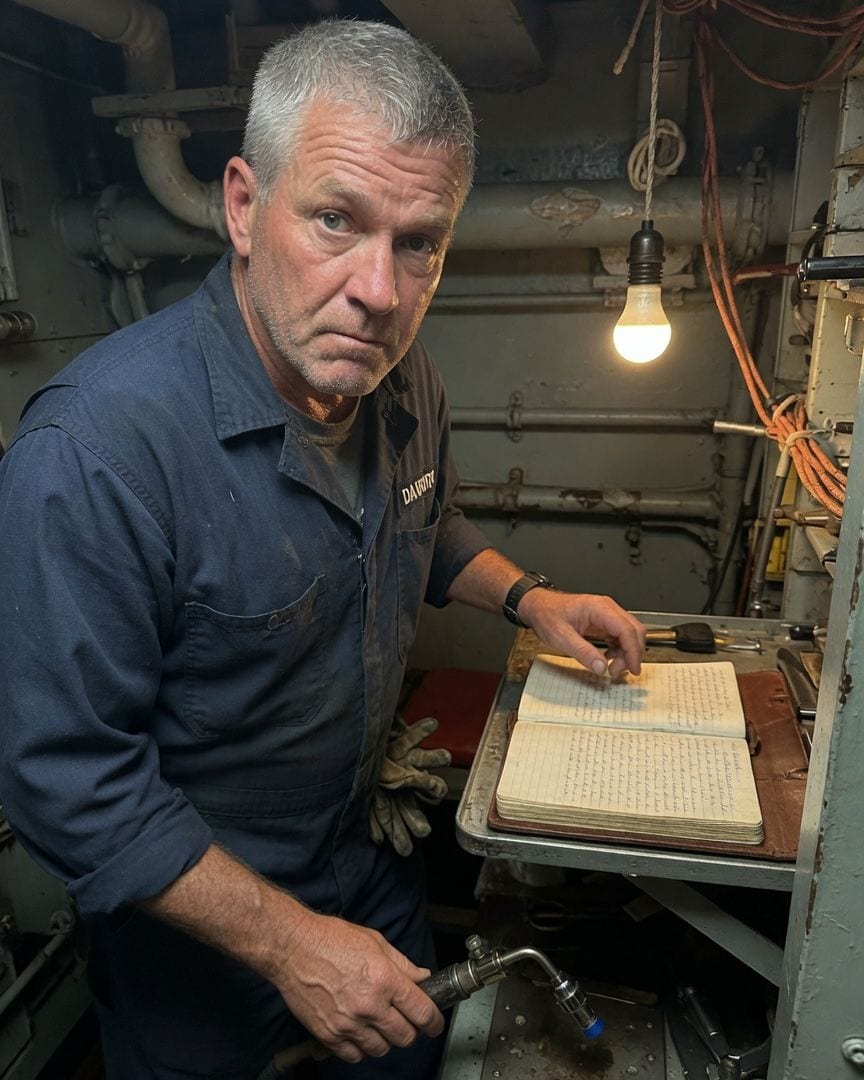
A week from shore duty, Chief Danforth cut a hatch where his ship's plans showed solid steel. An hour later, the wall was seamless, but the Cold War logbook from inside appeared under his mattress.
Chief Petty Officer Raymond Danforth, just a week from ending three decades of service, was intimately familiar with every pipe and plate of the guided-missile destroyer Weatherall. During a mid-cruise overhaul, his gloved hand found a sealed hatch where schematics promised only a solid bulkhead. He cut through the impossible seam to reveal a small, dry compartment, softly lit, containing a logbook filled with an unsettlingly familiar hand. When he returned an hour later with a witness, the hatch was gone, the wall seamless. Later that night, the same logbook appeared beneath his mattress, its pages revealing an entry: 'Petty Officer Howard Montgomery, missing, 1972.' How could a compartment vanish, yet leave its secrets behind?
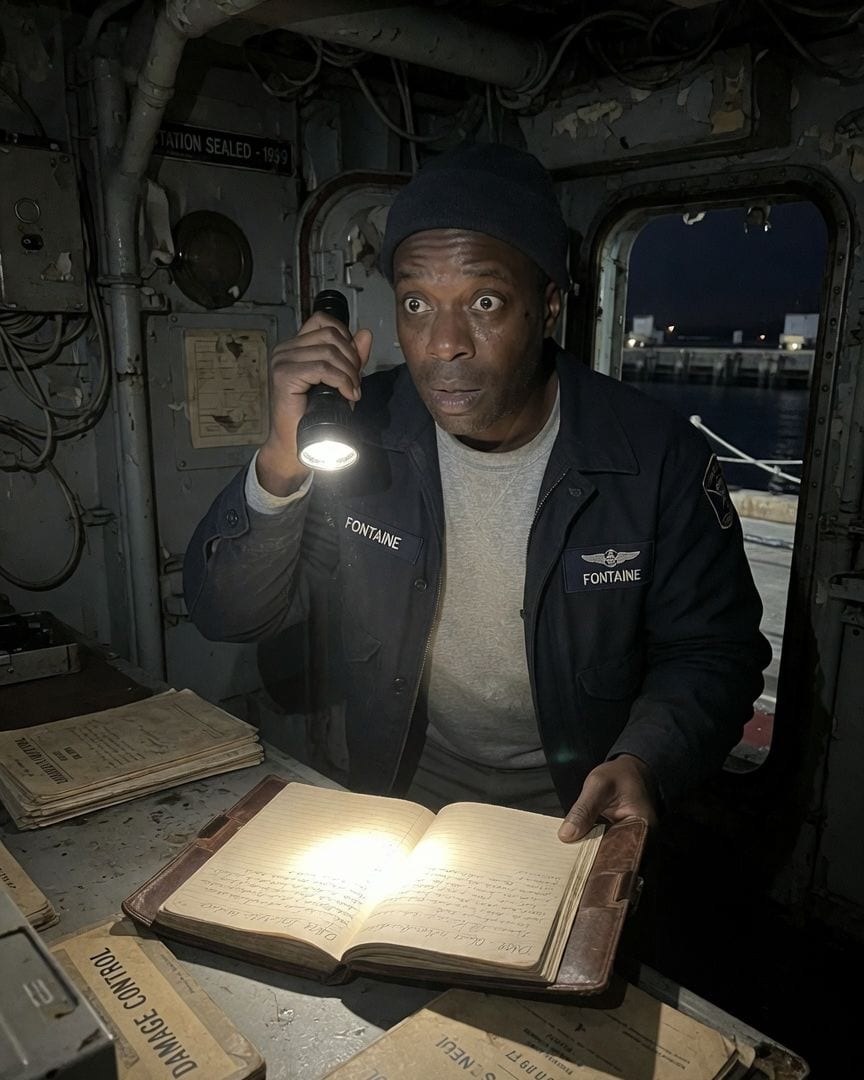
Boatswain's Mate Fontaine stood his last watch before the USS Vance was scrapped. He found a Cold War logbook with 1987 entries on a ship commissioned in 2000.
Boatswain's Mate Maxwell Fontaine stood his last watch on the USS Vance, a destroyer just three days from being scrapped before his transfer to shore duty. In the predawn chill, the distinct tread of a full watch section ascended the accommodation ladder, heavy boots vibrating the deck, even as topside cameras confirmed the gangway was empty. Investigating the silent ship, he found an old damage control station, supposedly sealed, with an unexpected metallic tang and an unlocked hatch. Inside, a worn logbook revealed precise entries from 1987, including a watch relief at 0400, on a ship commissioned in 2000.
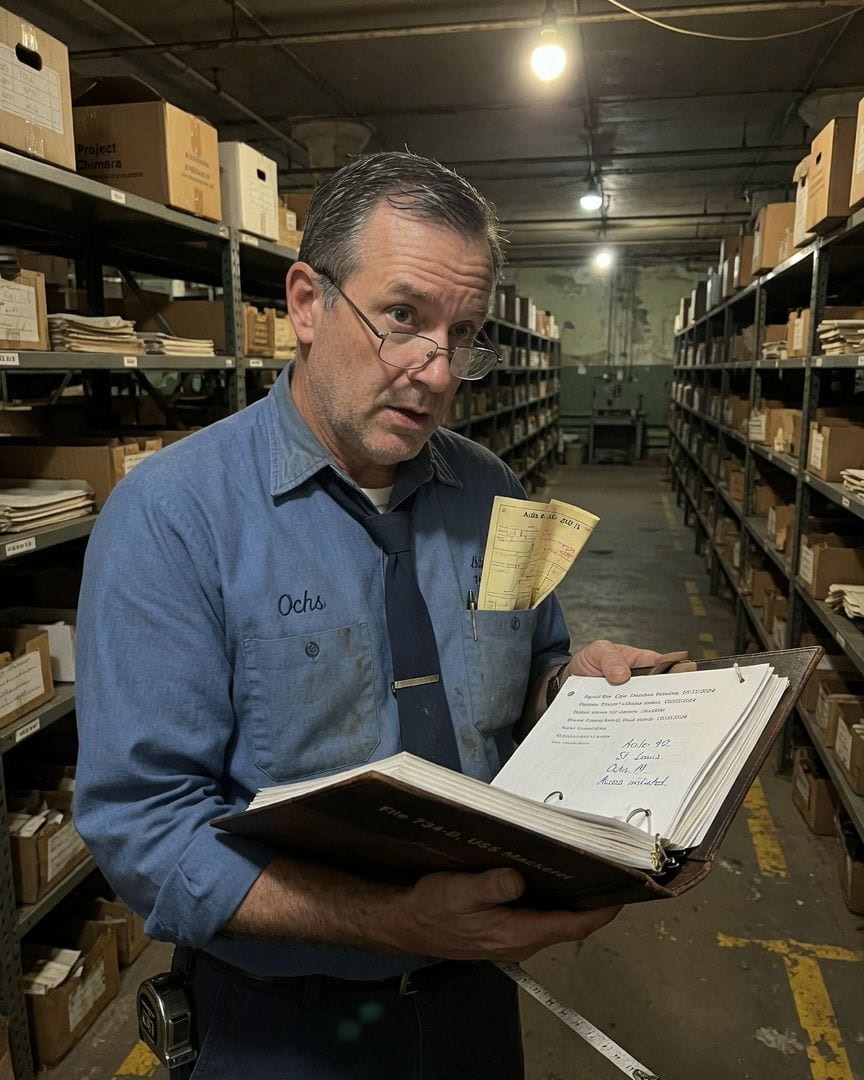
On his final inspection, a depot worker found Aisle 40 had grown 61 feet longer, and a Cold War submarine file hummed warm in his hand.
Marlin Ochs, a man of precise rhythms at the St. Louis depot, approached Aisle 40 for its final inspection before the entire structure was pulped tomorrow. For nearly two decades, the aisle had been a consistent ninety-two paces long. But on this night, his boot heels clicked past the expected mark, stretching to one hundred and nineteen paces, revealing an impossible, colder extension. Deep inside, Marlin found a heavy, leather-bound binder titled 'File 734-B, USS Mackerel,' a Cold War submarine lost with all hands in 1958. It felt oddly warm, almost humming against his palm, filled with maintenance logs and payrolls dated decades after the sub was sunk.
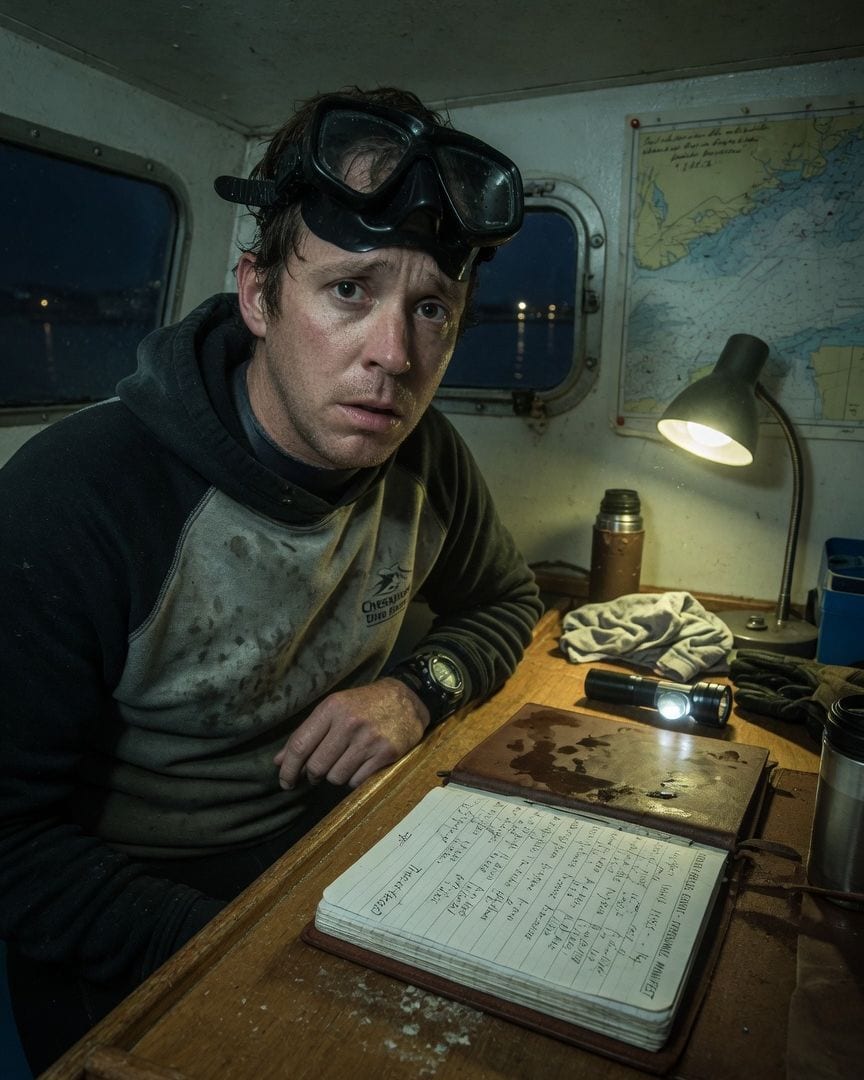
A diver on his last quest to his mother's lost ship found the crew listed in a hidden logbook as 'Transferred.'
Corey Nascimbene embarked on his last dive of the season, a personal quest to the sunken tug Harrow Belle, the ship his mother watched vanish decades ago. Descending into the cold Chesapeake gloom, he discovered a galley perfectly preserved, save for an impossibly folded, stark white napkin lying pristine on the muddy deck. Driven by unease, Corey later found a hidden, welded compartment in the engine room, containing a heavy, sealed logbook. Its personnel manifest listed the entire crew, not as lost, but with a single, unsettling word: 'Transferred.'
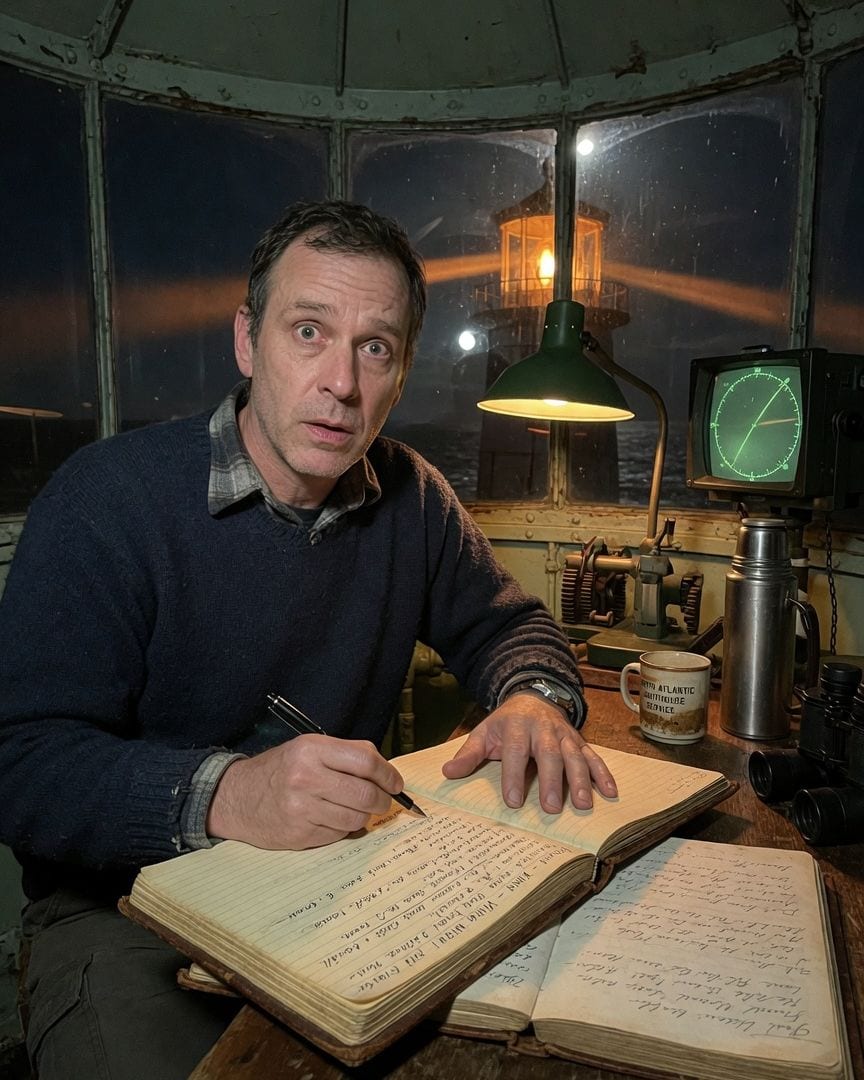
My lighthouse log has my own 3 AM entry for a phantom ship. I was alone in the tower, and I wrote no such thing.
Perched in the lantern room for my usual 2-6 AM watch, I reached for the thick logbook. But the 3:00 AM entry, under my own name, detailed a vessel I never saw. The words were in my own ink, yet I had never written them.
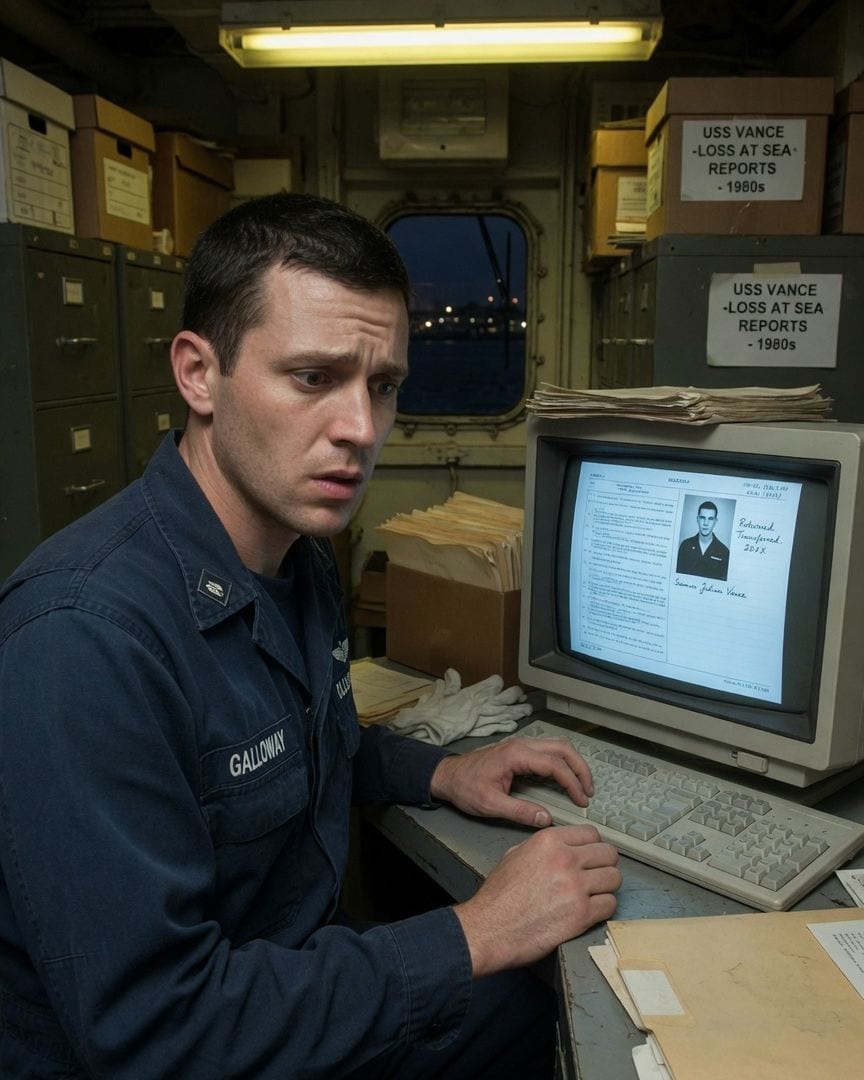
Petty Officer Galloway logged a sailor onto his ship. The man died at sea 40 years ago.
Petty Officer Joel Galloway scanned a sailor's ID on the USS Vance quarterdeck. The man's name, 'Seaman Julian Vance,' and his out-of-date uniform pricked at Galloway's memory. Later, the ship's berthing count came back one over, with an extra entry in the system but no physical body.