At a Cold War kaserne days from demolition, inventory clerk Delia Straub found a missing photo frame for a unit that never existed. Every soldier on the wall stared directly at its empty space.
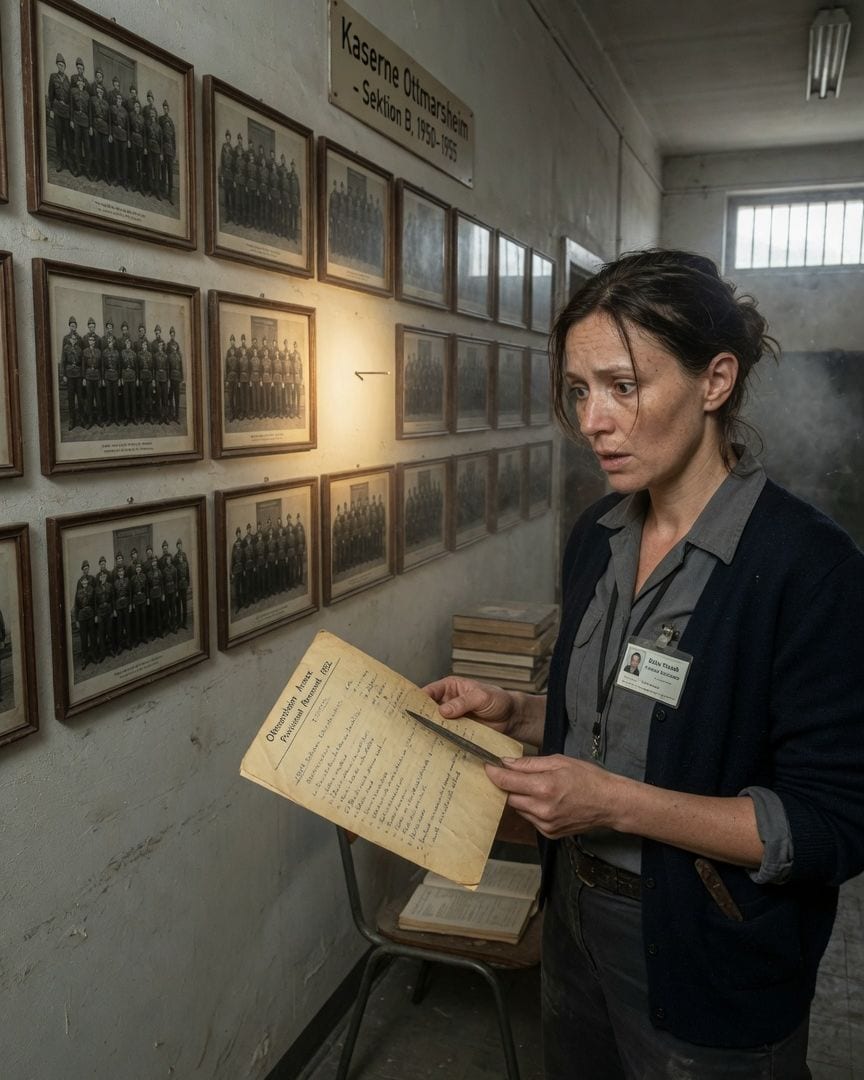
The hall at Kaserne Ottmarsheim smelled of coal smoke and floor wax, a scent Delia Straub had come to associate with the ghosts of forgotten regulations.
She had eleven days left to inventory the entire facility before the wrecking crews came, a deadline that felt less like a job and more like an eviction notice for history itself.
Forty-one framed photographs, dull with age, hung along the long corridor. They depicted various units, formations, and official ceremonies from the base’s long tenure. Delia moved methodically, logging each one, until she reached a stark, unsettling anomaly.
Between the ninth and the tenth frame, a gap existed, exactly one frame wide.
The paint behind it was unfaded, a brighter, cleaner rectangle against the grimy wall, and the nail holding the phantom picture was still bright, glinting as if polished yesterday.
She consulted the 1952 property book, its brittle pages crackling under her touch. Line 107.4.B clearly listed the missing photograph, down to its official caption: '604th Ordnance Detachment, Formation, All Present.'
Delia frowned. She had processed hundreds of military records in her career, but the 604th Ordnance Detachment was entirely unknown to her.
A quick cross-reference with the base's master unit list confirmed it: there had never been a 604th Ordnance Detachment stationed at Kaserne Ottmarsheim. As she looked back at the surrounding photos, a chill ran through her.
Every single man in the nine frames to the left, and the thirty-two frames to the right, was looking not at the camera, but slightly to his left, directly into the empty space where the missing photograph should have been.
Delia tried to rationalize it. A clerical error? A temporary unit, perhaps, never formally recorded? But the bright nail and unfaded paint suggested recent removal, not a decades-old oversight.
The collective gaze of the soldiers, a silent accusation pointed at nothing, was impossible to dismiss.
She spent the next few hours digging through dusty archives in the base’s records office, cross-referencing every unit, every deployment log from 1950 to 1955. Nothing. No 604th. It was as if the unit had been scrubbed from existence.
As her deadline loomed, the pressure mounted. She moved to the oldest section of the administrative building, a forgotten wing slated for immediate demolition, feeling the rumbling vibrations of heavy machinery starting up outside. The floor hummed beneath her boots.
In a back room, behind a stack of rusted filing cabinets, she found a small, unmarked wooden desk, its drawers warped and stuck.
Prying one open with a rusted letter opener, she found not official records, but a stack of yellowed, brittle paper, bound with twine. It was a handwritten manifest, dated 1952, labeled 'Ottmarsheim Annex - Provisional Personnel.'
The first entry read: '604th Ordnance Detachment - 37 men.'
Her breath hitched. The list contained names, ranks, and serial numbers. She pulled out a more recent official roster for a completely different unit, the 28th Infantry, and cross-referenced the first name on the unofficial list: Sergeant Nathaniel Prescott.
According to the 28th's records, Prescott had been killed in action in Korea in 1951. Yet, here he was, listed as 'active' with the 604th in 1952.
The second name, David Romano, was listed as having transferred to a command in Alaska in 1950, never returning to Germany. Delia felt a cold certainty take root. This wasn't a clerical error. This was deliberate.
Someone had gone to great lengths to make these men both present and absent, alive and dead. The paper trembled slightly in her hands, a ghost unit brought back to life by a single, impossible record.
Delia spent the rest of the day in a blur, cross-referencing more names from the unofficial 604th manifest against official military service records she could access.
The pattern held: every single man on the list either had conflicting service dates, records of being KIA or transferred years before 1952, or simply vanished from all official records after that year.
It was a unit made of phantoms, assembled from men who couldn't possibly be there.
The kaserne grew quiet as the sun set, the only sound the distant rumble of the wrecking crews who would soon tear down these walls, obliterating any trace.
Delia looked at the names, then back at the empty space on the wall, the bright nail still glinting. The property book said 'All Present.' The official records said 'Never Existed.' The unofficial roster said 'Here.'
It was a perfect, chilling contradiction. She knew then that the missing photograph wasn't just a picture; it was the key to something far more profound, a secret so dangerous it had warped reality itself.
Delia held the yellowed, unofficial roster for the 604th Ordnance Detachment, her finger tracing a name listed as 'KIA 1948' on one line, and '604th Ordnance Detachment, active 1952' on another, the dread tightening in her chest as the coal dust settles around her.
The next morning, with only nine days left, Delia shifted her focus from inventory to investigation. She photographed the manifest pages, secured the original in a fireproof safe, and began to work from her small, rented apartment off-base.
Her first call was to the National Archives and Records Administration (NARA), requesting any declassified files pertaining to 'Kaserne Ottmarsheim' or '604th Ordnance Detachment' between 1950 and 1955.
The archivist, a patient man named Harold Foster, confirmed there were no public records for the 604th, but a few Ottmarsheim files existed. He promised to send what he could.
While she waited, Delia called her grandmother, Maureen Caldwell. Maureen had worked as a civilian administrative assistant at Ottmarsheim in the early 50s. Delia delicately asked about any unusual events or units from that time.
Maureen's voice, usually sharp, grew hesitant. She remembered a 'brief, strange period' where a section of the base was cordoned off, and a 'rough-looking' group of men arrived for a 'special exercise' that no one was allowed to ask about.
'They didn't look like regular soldiers, Delia,' Maureen said, her voice dropping. 'Too quiet. And they had this… equipment. Big tarps over everything. Then, just as quickly, they were gone. And the official word was, it never happened.'
Maureen quickly changed the subject, a clear signal to Delia that she was treading on old, buried ground.
When Foster’s email arrived, it contained heavily redacted documents: logistical reports, base expenditures, and personnel transfers.
One memo, dated a week after the 1952 property book entry, listed a sudden, unscheduled 'reassignment' of several base personnel, including the original photographer and the officer who signed off on the property book, to 'classified duties overseas.'
There was no further trace of them. The dread solidified. This wasn't just a phantom unit; it was a deliberate erasure, extending to anyone who might have witnessed it.
The missing photograph wasn't just missing; it had been actively suppressed, and its suppression had consequences for those who knew too much.
The next day, Delia returned to the Kaserne, her skin prickling with unease. The demolition crews were already tearing down the outer barracks, the air thick with dust and the groaning of steel.
As she worked in the main administrative building, she noticed a black sedan, an older model, parked conspicuously across the street, its tinted windows opaque.
It was still there when she left for lunch, and again when she finished for the day. Her phone, usually reliable, kept dropping calls, and her internet connection at the apartment flickered erratically.
She dismissed it as old infrastructure, but the feeling of being watched intensified. The old building itself felt colder, the silence deeper in the untouched parts.
That evening, Harold Foster called, his voice tight. 'Ms. Straub, I… I think I made a mistake. After I sent you those files, I had an inquiry. From a very senior office.
They wanted to know why I was accessing 'dormant classified assets' related to Kaserne Ottmarsheim. They seemed… very interested in your request.' Foster sounded genuinely rattled. 'They asked specifically about you. Your current assignment. Your family.' Delia’s blood ran cold.
'My family? Who are 'they,' Mr. Foster?' He stammered, 'I don't know, a 'Special Records Oversight' office. Never heard of them. But they were very clear: cease and desist all inquiries. And they mentioned your grandmother by name, Maureen Caldwell.
Asked if she was still... 'available for consultation.' Delia hung up, her hands shaking. They knew. Not just about her current investigation, but about her family's connection to the Kaserne, decades ago.
The black sedan, the phone glitches – it wasn't coincidence. She was no longer just an inventory clerk pulling a thread; she was being watched, her every move monitored by an unseen, powerful entity that had been active for generations.
The idea that her grandmother had been 'available for consultation' sent a shiver down her spine, implying a level of ongoing knowledge and surveillance that felt utterly invasive.
The demolition outside, once a deadline, now felt like a desperate race against time to uncover the truth before the 'oversight office' decided she too was a 'dormant classified asset' that needed to be managed.
Delia knew she couldn't outrun them, not with her phone and internet compromised. She needed to act fast, to find the full truth before they silenced her.
She drove to Maureen's retirement community, a quiet, leafy place, hoping her grandmother could provide answers beyond veiled hints. Maureen, frail but still sharp, poured Delia tea. 'So, they finally came sniffing around, did they?' Maureen asked, her eyes distant.
'I wondered how long it would take.'
Delia pressed her. 'Grandma, what happened in 1952? What was the 604th Ordnance Detachment?' Maureen took a slow sip of tea. 'It wasn't ordnance, Delia. It was… a cleanup. Something fell.
Near the old training grounds, just beyond the base perimeter. Not a plane. Not a satellite. Something… else.' Maureen described the immediate lockdown, the arrival of the 'special exercise' men, who were not in standard uniform, their faces grim.
'They brought in strange equipment, like nothing I'd ever seen. Big cranes, but silent. They worked day and night, under massive tarps. And the smell… metallic, but sweet, like ozone and something burnt.
The photo… they took it the day before the thing was fully removed. It was a formal formation, but the men were all looking at… what was under the tarp. The 604th was just a code.
A cover story for the paperwork. A way to account for all the men, the resources, the… unusual cargo.'
Delia felt a cold wave wash over her. 'And the photo? The one that's missing?' Maureen nodded slowly. 'It showed it. The thing. Just its edge, but enough. They gathered every copy, every negative.
Anyone who saw it, or saw the thing itself, was debriefed, reassigned, or… worse. My file was opened then. 'Civilian Witness, Low Exposure.' They came to me again in the '70s, after another… incident. Not a crash, that time.
A signal. A contact. They wanted to know if I’d ever discussed the first event. If I’d seen anything unusual since. They were very polite, but very thorough. They told me my family would be… periodically checked. For 'legacy exposure.'
Delia felt the pieces click into place. The men looking left, the phantom unit, the sudden reassignments. It all pointed to a Cold War UFO recovery, meticulously buried by an institution that knew exactly what it was doing.
The 'thing on the scope' from the niche DNA was the thing under the tarp, captured in the missing photograph. The horror wasn't in the unknown, but in the chillingly precise, decades-long cover-up.
Maureen then reached into a small, locked wooden box beside her chair. 'I kept one thing,' she whispered, her voice raspy. 'A copy of my own file, from the '70s.
A friend in records slipped it to me before he disappeared.' She handed Delia a thin, heavily redacted folder. Inside, among the 'Civilian Witness' reports and psychological evaluations, was a single, typed page: 'Legacy Contacts - Ottmarsheim Incident, 1952.'
It listed names, dates of birth, and familial relationships. Delia scanned the page, seeing Maureen Caldwell's entry, then her own mother's name, and then, at the very bottom, in a chilling addendum, a new line: 'Straub, Delia. DOB: 1973.
Relationship: Granddaughter. Status: Engaged. Location: Kaserne Ottmarsheim, DE. Date: 2005.' Delia stared at the last page of the 'Legacy Contacts' index, her own name, 'Straub, Delia,' typed chillingly beneath her grandmother's, followed by 'Status: Engaged. Location: Kaserne Ottmarsheim, DE.
Date: 2005.' The line hums in her hands, a faint, cold static reaching out from the page.
The word 'Engaged' on the file page burned into Delia's mind. It wasn't 'aware' or 'investigating.' It implied she was a subject, actively involved. Maureen squeezed Delia’s hand. 'They don't forget, Delia. They just wait.
They watch the bloodlines, for any 'inherited exposure.' Anyone who might stumble on the truth, or worse, carry some… latent connection.'
Maureen explained that the 'Special Records Oversight' office wasn't just about secrecy; it was about managing a long-term, multi-generational situation.
The 1952 incident wasn't isolated; it was the first documented recovery of a series, a pattern of contact and containment that spanned the Cold War and beyond.
The '604th Ordnance Detachment' was merely the first in a long line of phantom units, black sites, and 'special exercises' used to compartmentalize and erase similar events.
Each time, a new set of records was created, a new cover story spun, and a new list of 'legacy contacts' was begun. The missing photograph at Kaserne Ottmarsheim was the template for every subsequent erasure.
It was the original sin in a vast, patient bureaucracy of the impossible. The 'Thing on the Scope' wasn't just an object; it was an ongoing phenomenon, and the military's response was a living, breathing machine of denial.
Every clue Delia had found — the empty frame, the men looking left, the impossible manifest, the reassigned personnel, the pattern of disappearances, Maureen's vague recollections — now clicked into a terrifyingly coherent picture.
The horror was not that something alien had crashed, but that an institution had known about it for over fifty years, filed it away, and built an entire shadow system around its continued existence, patiently watching for any flicker of awareness in those connected to it.
Delia knew she couldn't fight an organization that had been operating in the shadows for decades. Her only option was to get out, to vanish before 'Engaged' became 'Compromised.'
But before she could leave, she had to ensure the truth, or at least a trace of it, survived the Kaserne's demolition. She returned to the base, the black sedan noticeably absent from its usual spot.
The wrecking crews were deep inside the main administrative building now, the sounds of splintering wood and groaning metal echoing through the empty halls. Her time was running out.
She went directly to the empty frame, the bright nail still there.
She took a small, digital camera from her bag and began to document everything: the empty space, the surrounding photos of men looking left, the property book entry, the unofficial manifest, even Maureen's 'Legacy Contacts' page.
She would upload it all, anonymously, to a secure server, a digital time capsule for anyone else who might someday stumble upon a similar wrongness. As she worked, the building groaned around her, the floor vibrating.
A section of the ceiling plaster fell, narrowly missing her. The air was thick with dust and the smell of old concrete being pulverized. She knew she was pushing her luck, but she couldn't leave without leaving a trail.
She took a final photograph of the bright nail, stark against the unfaded paint, then turned to leave. Just as she reached the main exit, a figure stepped out from behind a pile of rubble.
It was a man in a dark suit, his face unreadable, his eyes fixed on her. He held no weapon, made no sudden movements, but his presence was a clear, silent warning.
'Ms. Straub,' he said, his voice calm, almost sympathetic. 'We've been expecting you to conclude your inventory.' Delia didn't answer. She knew what 'conclude' meant.
She bolted, not back into the building, but out into the open, towards the main gate. The man made no move to follow, simply watched her go, a faint, knowing smile on his face.
She felt their eyes on her back, not just his, but the eyes of an entire institution, watching her join the ranks of the 'legacy contacts' who knew too much.
Delia Straub disappeared from Kaserne Ottmarsheim that afternoon, leaving her inventory unfinished, her rented apartment packed, and her old life behind. Her car was found abandoned at a train station hours later.
The digital cache of files and photos she uploaded was quickly scrubbed from the internet, a phantom echo of a phantom unit.
Maureen Caldwell received a visit from two polite, dark-suited individuals a week later, asking about her granddaughter's 'sudden relocation.' Maureen offered no information, her silence a defiant act.
The Kaserne Ottmarsheim was fully demolished within the week, its physical secrets buried under tons of rubble and fresh earth, the faint scent of coal smoke giving way to the sterile smell of concrete dust.
No one questioned the missing inventory clerk. No one remembered the missing photograph. The institution had closed its file, and the world moved on.
The world had a way of smoothing over anomalies, of forgetting what didn't fit. Delia found herself in a small town in rural America, working a mundane job, living under a new name.
She checked her secure connection to the internet every day, but the digital ghost of her uploaded files remained stubbornly absent. She knew the institution hadn't forgotten her. They hadn't 'caught' her, but they hadn't 'lost' her either.
She was simply… filed. Another entry in a vast, cold ledger. She saw the black sedans sometimes, parked unobtrusively down the street, or glimpsed a familiar, unreadable face in a crowd.
They were just checking in, a quiet reminder that her freedom was conditional, her knowledge a permanent burden. She was free to live, but not to speak. Free to exist, but always under a distant, patient gaze.
The truth had been answered, but safety remained an illusion. The price of knowing was a permanent, quiet surveillance. She was not lost. She was merely accounted for.
She walked past a local history museum once, seeing an exhibit on the Cold War. A chill ran through her. Somewhere, in some unseen archive, her own story was being written, its pages still being signed.
The next morning, the Kaserne wrecking crews began their work, the air thick with dust and the smell of disturbed earth. Delia Straub was not among them. Her file, however, had just been updated.
If this one got to you
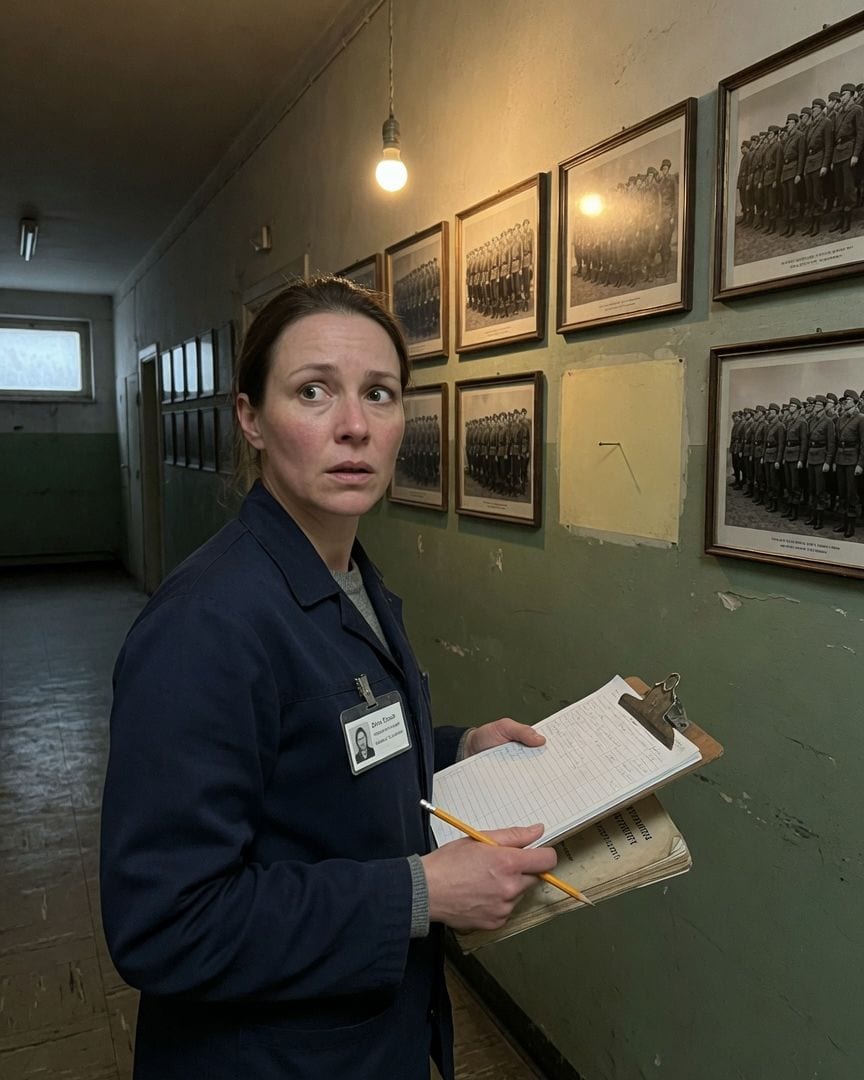
On a closing Cold War base, an inventory clerk finds every soldier in old photos staring at an empty wall. Her own name is on a hidden footlocker holding the missing picture: a dark, blurred figure among them.
Delia Straub has eleven days to inventory Kaserne Ottmarsheim, a former German base slated for demolition. The air in its echoing, abandoned halls smells of coal smoke and old wax as she races against the clock. Her task takes an unsettling turn when she discovers a phantom unit, the '604th Ordnance Detachment,' explicitly listed in old records despite never existing. Even more unnerving, every soldier in adjacent photos stares fixedly at the empty space where its picture should be. But why does a hidden footlocker, bearing Delia's own name, hold the missing photograph, revealing a dark, blurred figure among the men?
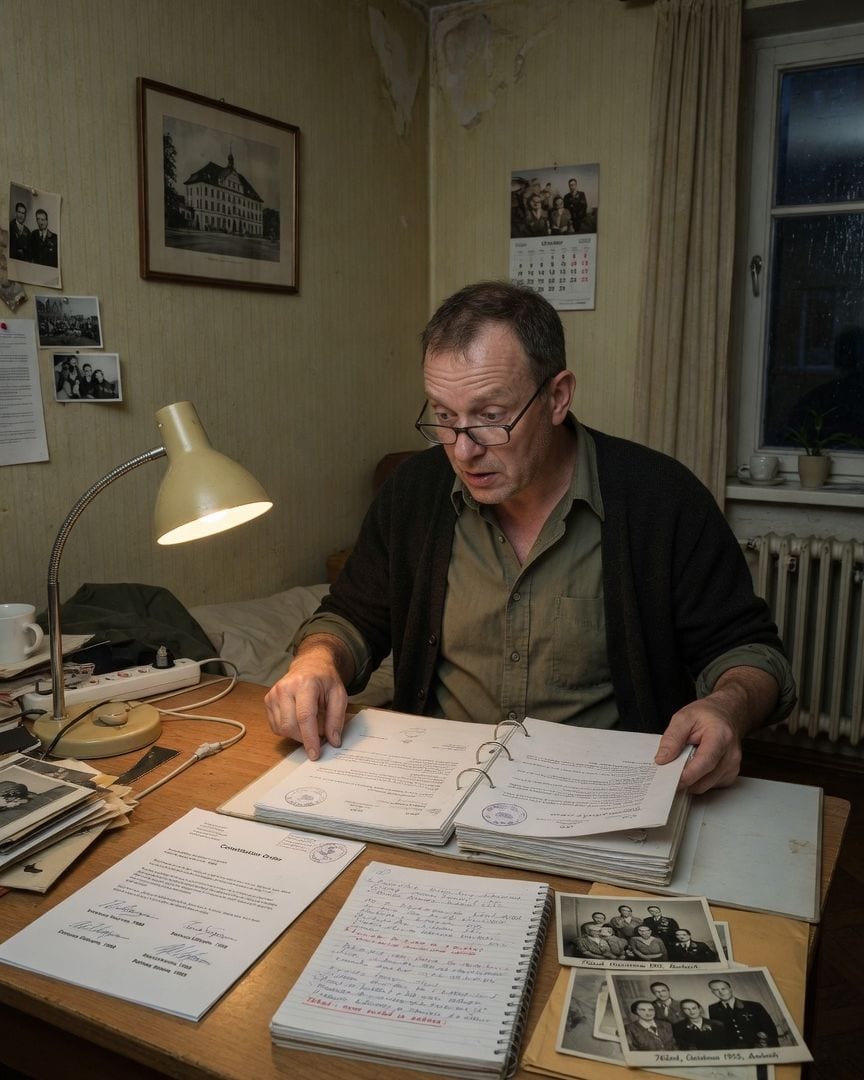
A historian discovered a Cold War US Army unit's dissolution order from 1954. It was signed by names from 1988 and 1995, decades in its future.
Historian Willem Achterberg arrived in Ansbach's crisp fall air, aiming to unearth the forgotten history of a US Army kaserne. He expected forgotten tales, but the town vividly recalled the 762nd unit, detailing their lives as if they'd left yesterday—a unit the Army swore never existed. Willem meticulously collected sixty affidavits, marriage certificates, and faded photos proving the 762nd's tangible presence, directly contradicting every official record. Then, he found the unit's dissolution order, dated 1954, yet bearing impossible signatures from 1988 and 1995. How could ghosts from the future sign a document decades before their birth?
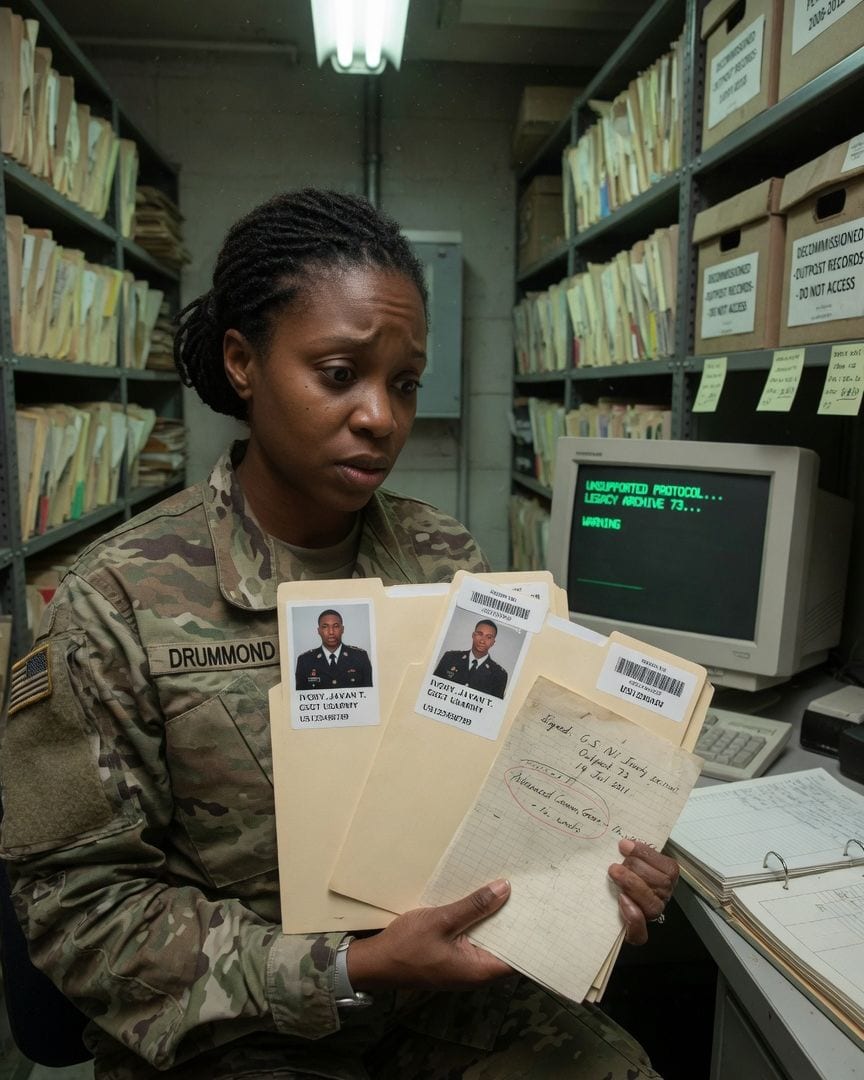
A records NCO found two files for one soldier; the second had his face, older, on a tour to a base that never existed.
Sergeant Camille Drummond, a meticulous records NCO, was deep in the US Army archives, methodically auditing personnel files. Her routine task was interrupted when she found a second, thicker folder tucked behind Gunnery Sergeant Javan Ivory’s official record, bearing identical service numbers. This duplicate file, however, detailed combat tours he never held, awards under a name one letter off, and showed an older, weary version of his face. As the cold dread bloomed, she discovered a physical supply requisition from a decommissioned outpost, signed 'N. Ivory,' matching the phantom tour. How could a ghost in the system leave such a real, handwritten trace?
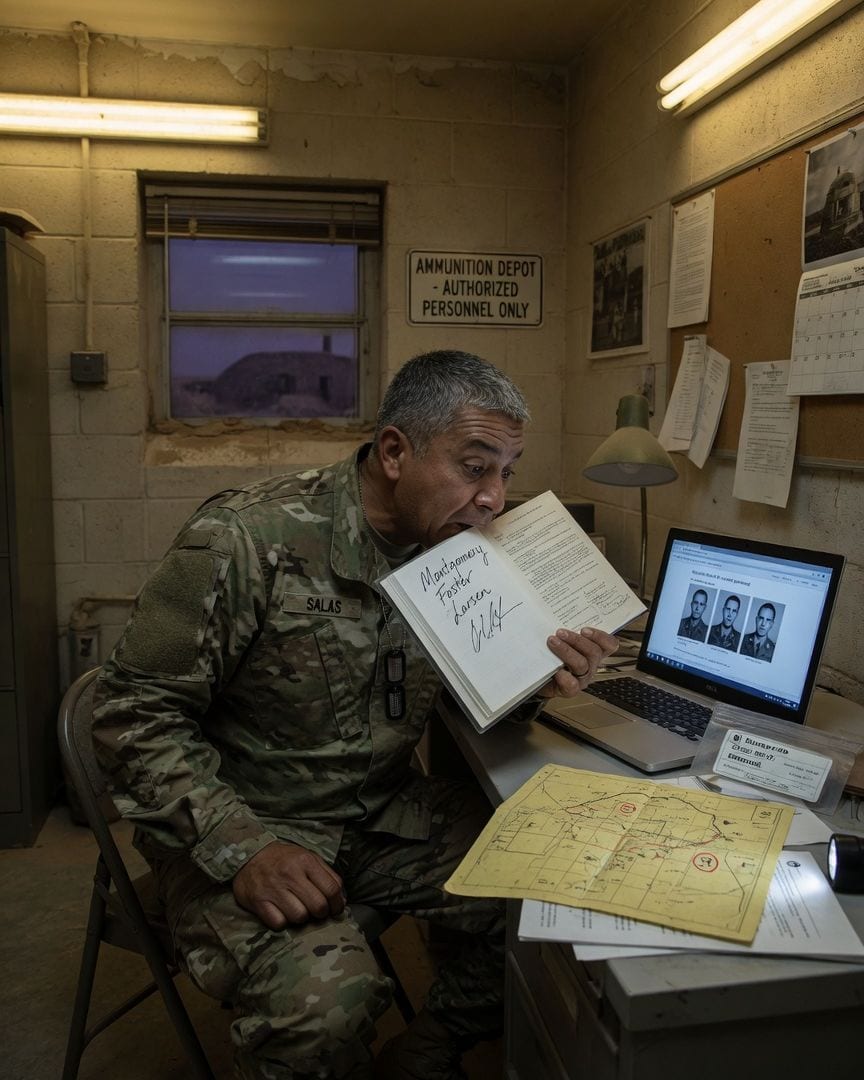
Chief Salas finds a new bunker seal signed by men d*ad or discharged decades ago.
Chief Warrant Officer Curtis Salas completes a final inventory at a desert munitions depot, finding an impossible fortieth bunker not on any map. Its fresh security seal bears signatures from three men: two officially K*lled in Action, and one honorably discharged, all decades ago. Someone, or something, just signed d*ad men's names to a new Army seal.
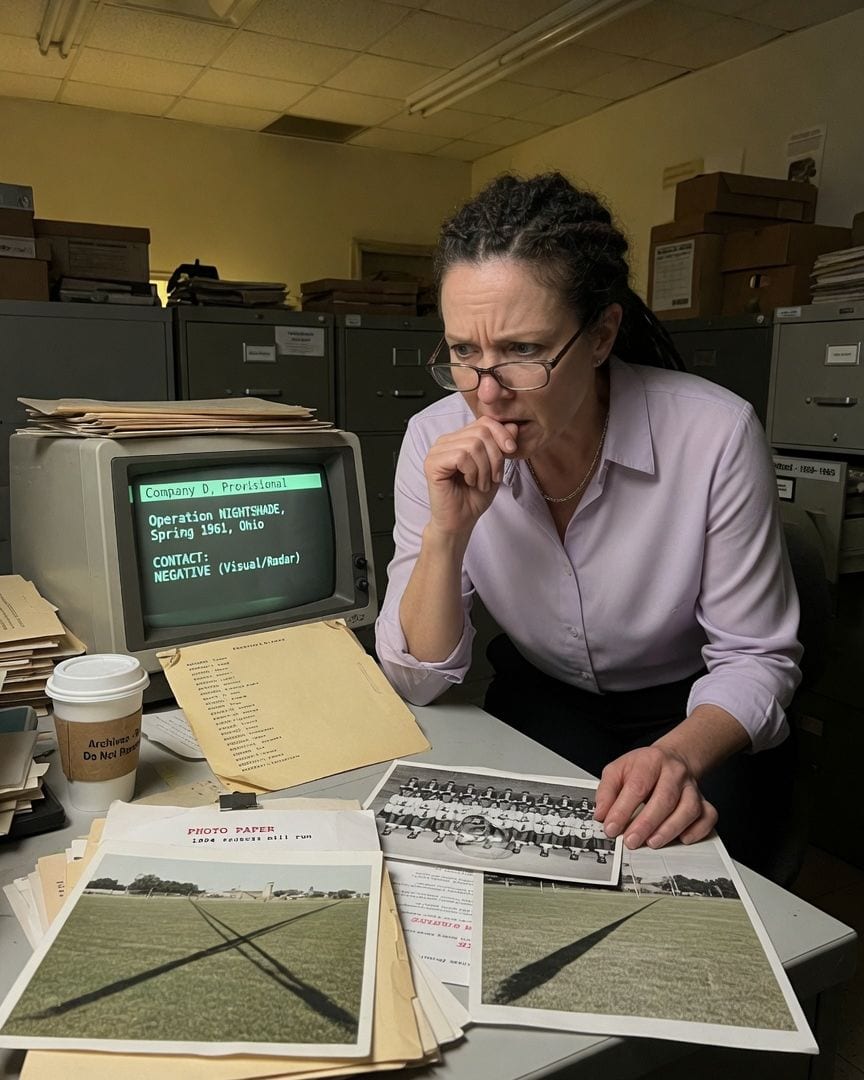
A declassification reviewer finds a 1961 Cold War photo of soldiers. The field was empty, only an impossibly long shadow.
Declassification reviewer Cynthia Walsh had until Friday to verify the existence of Company D, a military unit slated for official erasure. Her initial evidence, a 1961 photo of sixty-two uniformed men, quickly dissolved under scrutiny: lab reports dated the paper to 1994. Worse, an aerial survey from that same 1961 afternoon showed only empty Ohio grass – save for one impossibly long, slender shadow stretching across the field. Hours spent sifting microfiche then uncovered a roster for 'Company D, Provisional,' detailing their 'Operation NIGHTSHADE' and listing a man officially still alive.
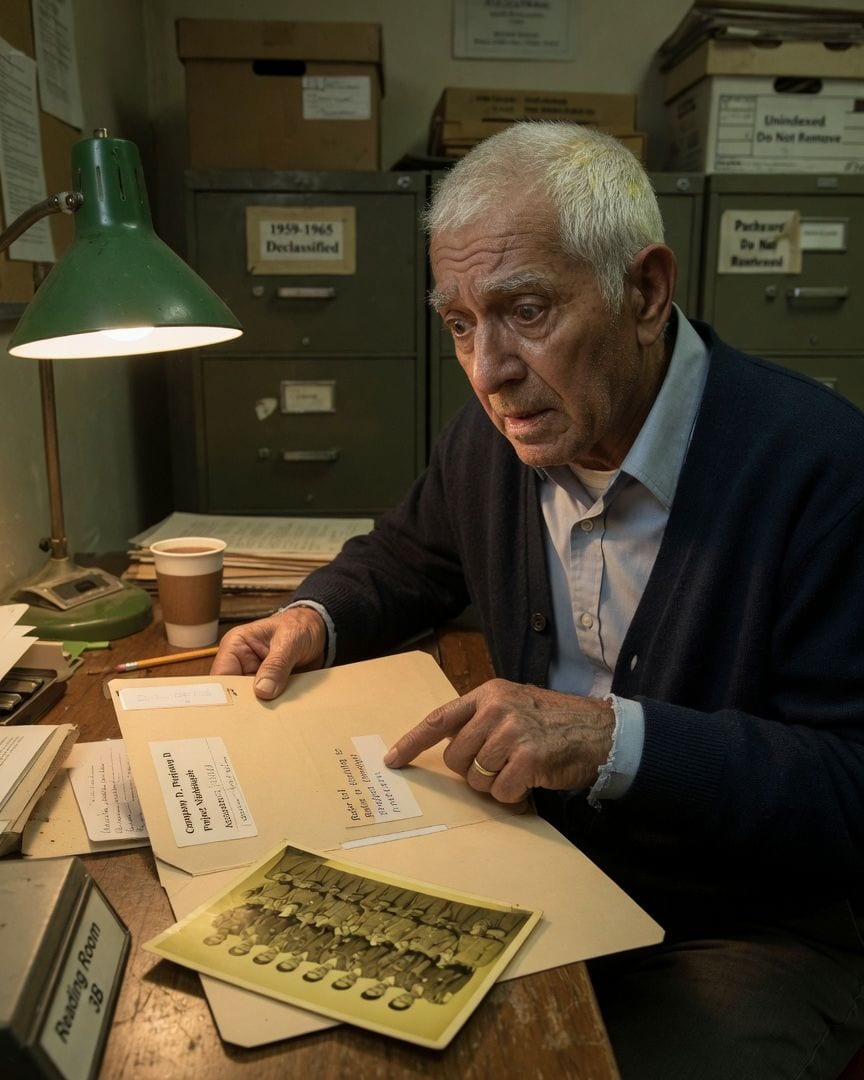
An archivist found her own name on a Cold War military record — dated decades before she was even born.
Eighty-four-year-old Trevor Machado clutched a yellowed photograph, his last hope to prove Company D existed before Friday's lineage board meeting. He knew the 1961 aerial survey of his unit’s parade field showed only grass and an impossibly sharp shadow with no object casting it. At the National Archives, a methodical archivist named Lorraine Sterling initially found no trace of Company D, but an unindexed sub-basement held a forgotten folder. Inside, Trevor's service record detailed his discharge from a unit officially deactivated the very year he joined, but a chilling handwritten note at the bottom, dated decades before Lorraine was born, bore her own name.