My drone's return footage shows a man standing in the empty field looking up. I was alone out there, the field clear when it launched.
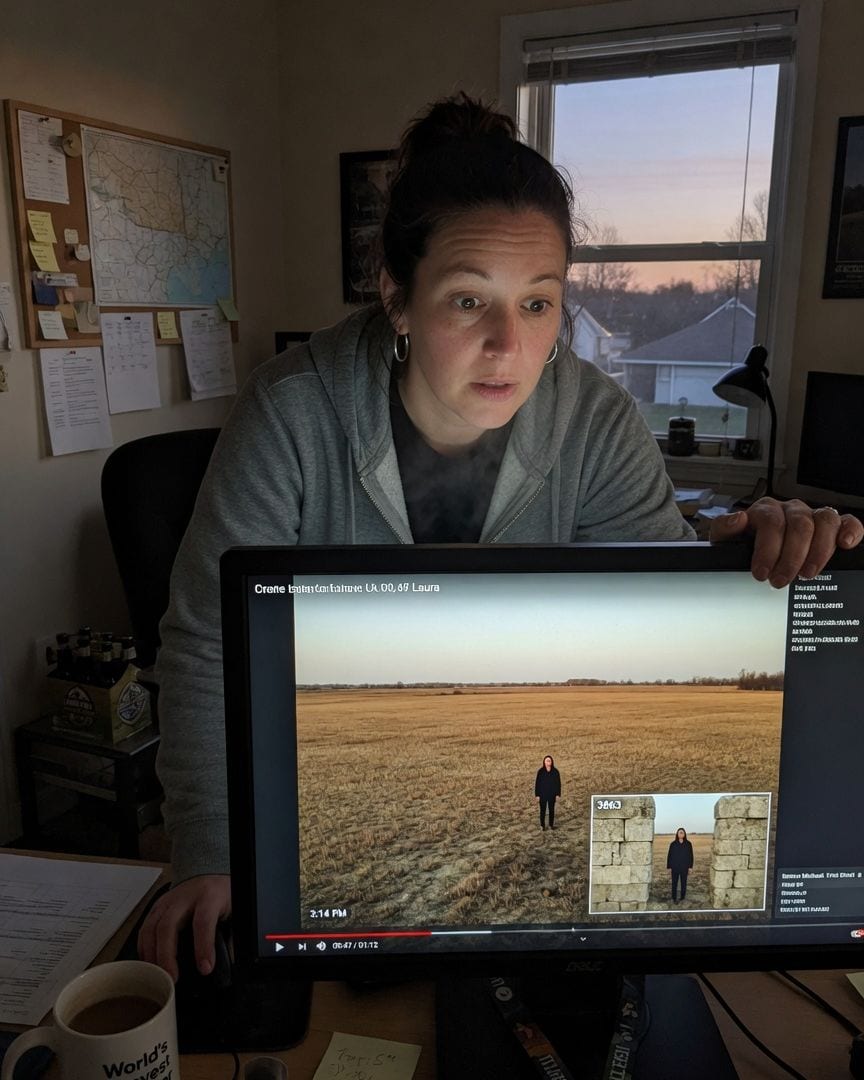
The raw footage from Harold Fairfax’s field survey loaded slowly, a progress bar inching across my screen. It was late afternoon, the light outside my office window fading, mirroring the dull, flat light in the video.
Just another job: a routine landscape survey for a new solar farm proposal, miles from any paved road.
I’d driven out there myself, alone, the air crisp and cold, the field a vast, empty expanse of fallow earth under a wide, indifferent sky. Nothing but me, my drone, and the endless horizon.
Now, as the drone’s return-home segment played, its wide-angle lens capturing the ground receding below, something flickered. I leaned closer to the monitor. The drone was gaining altitude, spinning slowly, showing the vast, unbroken expanse. And then, there. A figure.
I froze. He stood in the exact center of the field, a dark, vertical line against the brown earth. Motionless. Looking directly up at the ascending drone. A man. Tall and slender, dressed in dark, nondescript clothing.
My breath hitched. I scrubbed back the footage, the mouse wheel cold under my finger. Rewind. Play. There. He’s there. The drone hovered for a moment at 100 feet, then turned to come home. The figure didn’t move. Didn’t wave.
Just stood, watching.
I checked the flight logs. GPS coordinates: perfect. Altitude: consistent. Timestamp: 3:14 PM, just before I packed up. Everything normal. The field, as I remembered it, had been utterly, profoundly empty when I’d launched the drone.
I would have seen him. I had seen it empty. I play the clip again, my heart thumping against my ribs. The man’s silent, upward gaze, a dark anchor in that empty landscape, pulled at something impossible in my mind.
I called Michael Davenport that evening, my voice tighter than I intended. He’s a GIS specialist, an old friend from college, with a knack for picking apart anomalies in data.
He arrived an hour later, a six-pack of craft beer in hand, skeptical but intrigued by my agitated tone. He sat in my editing chair, rotating it to face the monitor.
“Alright, Laura, let’s see this ghost,” he’d said, his confident smirk still in place.
I played the footage. The drone ascended. The field, then the figure. Michael’s smirk slowly drained away. His eyes narrowed, then widened. He leaned closer, running his own analysis software, zooming, enhancing, trying every filter he had.
He muttered to himself, words like “artifact” and “compression error” and “lens flare,” all dying on his tongue.
“It’s… clean,” he finally said, baffled, the beer forgotten beside him. “No pixelation, no distortion. It’s just… there.”
We spent the next hour isolating frame by frame, methodically moving through the drone’s recorded return. The man remained, a perfect, unmoving sentinel.
And then, as we hit a specific point, roughly two-thirds of the way through the segment where the drone had reached its highest point before turning home, Michael let out a sharp intake of breath.
For a flicker, no more than two frames, an impossible detail emerged around the figure. A low, weathered stone structure, like a section of an ancient wall or a rough-hewn pillar, seemed to rise from the earth, encircling him.
It wasn’t a shadow. It wasn’t an illusion. It was solid. Then, as abruptly as it appeared, it vanished in the next frame, leaving only the man, then the empty field as the drone continued its flight.
We rewound, slowing it down to fractions of a second. Frame 3862: man, empty field. Frame 3863: man, stone structure. Frame 3864: man, stone structure. Frame 3865: man, empty field.
It was there. Clearly defined. Then gone.
“I never saw that,” I whispered, the words catching in my throat. “Never. There’s nothing like it on any map. Nothing even close.”
Michael frantically cross-referenced with high-resolution satellite imagery. He pulled up geological surveys, checked old topographical maps from the county archives. The field was just flat, empty land. Nothing.
The structure simply did not exist anywhere but in those two impossible frames.
Michael stared at the screen, his face pale, as the enhanced frame flickered on the monitor: a brief, impossible structure of weathered stone, clearly defined around the figure in the field, before the next frame reverted to an empty expanse.
He checked the drone’s telemetry logs one more time, his fingers shaking slightly, and found a micro-second anomaly in the GPS data that suggested a momentary, impossible geographical shift at that exact point.
It wasn’t just the man, or the structure. The very ground beneath them, for an instant, wasn’t where it was supposed to be.
Driven by a cold, unsettling certainty, I tried to return to the field the next morning. It was a clear, bitter day, the kind that promised snow. My car rattled down the familiar dirt track that led to the property.
But new signs had appeared overnight: rough-hewn planks of wood, crudely painted with “NO TRESPASSING” in faded red. They hadn’t been there a week ago. As I slowed, a figure emerged from a rusted barn near the property line.
It was an elderly man, gruff-looking, with a shotgun held casually across his lap. Harold Fairfax, the landowner.
He didn't need to ask why I was there. "You got no business out here, young woman," he drawled, his voice raspy with age and something else I couldn't place. He motioned vaguely with the shotgun. "This here land's private.
Always has been. And some things are best left alone."
I tried to show him my drone footage, to explain what I’d seen. He squinted at my phone screen, then shook his head, a dismissive gesture. "Old stories. People don't know when to leave things alone.
You got your pictures, now move on." There was a finality in his tone, a quiet threat in his steady gaze, that made my stomach clench.
Undeterred, I shifted my investigation to the local historical society, a musty old building downtown that smelled of aged paper and dust.
Edith Langford, the archivist, was a kind woman in her seventies with soft eyes and an encyclopedic knowledge of local history. I spent days there, poring over dusty land deeds, brittle newspaper clippings, and obscure local folklore pamphlets.
I found vague, fragmented mentions of 'boundary stones' or 'crossing points' in the area, often associated with inexplicable disappearances or unusual weather patterns.
But these mentions were always just outside the official records, whispered in annotations or marginalia, never tied to a specific, identifiable landmark. They felt like scraps of old superstitions, nothing concrete.
I cross-referenced the coordinates from my drone footage with every historical map I could find, from ancient surveyors’ notes to mid-century aerial photographs. Nothing matched.
The spot where the man and the impossible structure had appeared was, consistently, just an empty field. It was as if the recorded anomaly was a ghost, leaving no trace in the physical world, yet stubbornly present in the digital.
The lack of any concrete explanation only deepened my dread, making the footage feel less like a glitch and more like a deliberate, impossible revelation.
A few days later, an anonymous email landed in my inbox. The subject line was blank. The sender was a string of random characters, untraceable.
The body contained a single, low-resolution photograph of the very field I'd surveyed, taken from a distance. It was a recent photo; the fall colors were the same, the bare trees along the distant ridge identical to those I remembered.
The field was utterly empty, but if I zoomed in, almost imperceptibly, a faint smudge of darkness was visible in the distance, near the center, mimicking the exact position of the man in my drone footage.
Below the photo, in plain text, were five words: 'Some things are best left undisturbed.'
My blood ran cold. Someone knew. Someone knew I’d been digging, knew I hadn't left it alone. Someone had taken this photo. It wasn't a random warning; it was my warning.
I tried to trace the email, running every reverse lookup and IP trace Michael taught me, but it was a dead end, routed through multiple anonymous servers, disappearing into the digital ether. The implication was clear: I was being watched.
The dread shifted from an abstract puzzle to a personal threat, a cold hand reaching from the shadows.
I checked my own home, the locks on my doors, the windows. I felt eyes on me in public, in the grocery store, pulling out of my driveway.
The rational part of me screamed 'prank,' a local trying to scare off a curious drone pilot. But the image, the timing, the eerie echo of the drone footage, made my skin crawl.
The message wasn't a threat of violence, but of knowing, of observation, of a quiet, unseen hand guiding me away from the truth. I knew, with chilling certainty, that this wasn't over.
I confronted Harold Fairfax again, this time armed with the drone footage, the satellite images, and the anonymous email on my phone. I found him in his usual spot, whittling wood on his porch, the shotgun leaning against the railing.
I played the clip of the impossible structure, holding the phone up to his face.
His gruff demeanor, for the first time, cracked. The casual dismissal gone, replaced by a deep-set weariness that etched new lines around his eyes. "You shouldn't have seen that," he stated, his voice low, no longer threatening, just tired.
"My family… we've watched that field for generations. Kept people away from it. Always have." The words were heavy, carrying the weight of centuries.
I pressed him, my voice tight. "Watched it for what, Harold? What is that thing in the footage? The stone? The man?"
Harold sighed, rubbing his temples, his gaze fixed on the distant field. "It… comes and goes. The old ones called them ‘thin places.’ Places where the world isn't quite solid. Where things can… slip through. They aren't always open.
Mostly, they sleep. But sometimes, they stir." He paused, taking a slow, shaky breath. "The man you saw, he's a Fairfax. Always has been. My cousin, Gideon. He’s a watcher."
My mind reeled, connecting the dots I hadn't even realized were there. "A watcher? Like, a guardian?"
Harold nodded slowly. "A guardian against intrusion. A guardian of the covenant. Your drone… it was an intrusion. An unexpected one. It stirred something. It showed you what you weren’t meant to see."
He explained that the Fairfax family, and others, have quietly maintained these 'thin places,' ensuring they remain unobserved, unmolested, from generation to generation.
The fleeting structure, he said, was a 'marker,' a brief manifestation of the gate itself, caught by the drone's unexpected presence at the wrong, or perhaps right, moment.
His words, though incredible, resonated with a horrifying clarity. The vague, fragmented historical whispers I'd found. The unexplainable drone anomaly. The chilling, precise warning in my inbox. All of it.
The pieces of the puzzle began to snap together, forming a coherent, terrifying picture. I wasn't just observing an anomaly; I was stumbling into a legacy.
Shaken but resolute, I shared Harold’s confession with Edith Langford, the local archivist. We met in her cluttered office after hours, the only light from a single desk lamp illuminating stacks of ancient, dusty books.
Edith listened, her expression surprisingly calm, as if this wasn't the first time she’d heard such a tale. She offered no skepticism, only a quiet understanding that chilled me more than disbelief ever could.
“Harold’s family are good stewards,” Edith said softly, her hands resting on a pile of brittle parish records. “They’ve kept the peace here for centuries. It’s a heavy burden, but an important one.”
She then rose, walking slowly to a hidden alcove in the library. Behind a sliding panel, masked by a shelf of forgotten local histories, was a locked, unmarked cabinet. She retrieved a heavy, leather-bound ledger from inside.
It was clearly ancient, its covers worn smooth, its pages brittle with age, tied with a fraying leather cord.
“There are things… not meant for public record,” Edith explained, her voice barely a whisper, the room suddenly feeling colder, the shadows deeper. “Records of the true geography, kept by those who understand. For when the need arises.”
She laid the ledger open on a polished oak table. The pages inside were filled with meticulous, hand-drawn maps of the local area, far more detailed and precise than any modern survey.
Her finger traced a small, impossible stone structure drawn with meticulous detail in the middle of a familiar field – my field. Beside it, etched in an archaic script I didn’t recognize, was a symbol I’d never seen.
And then, a single, faded name: 'Stratton.' The name of my own family.
Edith explained the ledger’s true purpose. It wasn’t just a collection of maps; it was a chronicle of ‘gates’ and the lineages tasked with their guardianship.
The ‘Stratton’ entry, she revealed, signified my own family as one of the original ‘watcher’ bloodlines, tied to this specific gate, this exact field.
“Your drone didn’t just intrude, Laura,” Edith said, her eyes meeting mine with an unsettling intensity. “It resonated. Your presence, your lineage, activated it. The gate recognized you.
The figure, Gideon Fairfax, was there not just to guard, but to witness the awakening of a new watcher.”
The pattern clicked into place with horrifying clarity, each scattered piece of data, every unsettling encounter, falling into its preordained slot. The vague dates in old documents, the impossible structure flickering into existence, Harold’s evasions, the anonymous warning.
All of them were parts of an ancient, intricate system. The ‘gates,’ Edith explained, were points of delicate balance, where the fabric of reality was thin.
And the watchers, including my own ancestors, ensured they remained stable, unmolested by a world that would never understand. I wasn’t just an accidental witness; I was always inside the pattern, a dormant piece of the puzzle, now activated.
My drone, by capturing the impossible, had pulled me irrevocably into my family’s hidden legacy. I wasn’t just a drone photographer; I was a Stratton, and the field was now, in a terrifying, ancient way, mine to watch.
I returned to the field, alone this time, armed with knowledge that felt impossibly heavy. The air was different here, not just cold, but heavy, humming with an almost imperceptible vibration that seemed to settle deep in my bones.
I walked to the center, towards the exact spot marked in the ancient ledger and captured in my drone footage. There, faintly, at the edge of my perception, the impossible stone structure flickered, like a mirage.
It wasn't solid, not quite real, but undeniably present, a ghost of stone shimmering in the autumn light.
And then, I saw him. Gideon Fairfax, the watcher, stood as before, a dark silhouette stark against the horizon, but this time, he faced me.
He didn't move, didn't speak, but his gaze, even from this distance, felt like a physical touch, acknowledging, assessing.
I didn't confront him. I didn't scream or run. Instead, I walked slowly towards the flickering structure, towards Gideon, my steps deliberate, each footfall heavy with ancient purpose. I reached the perimeter of the faint, impossible stones.
They were cold, not with temperature, but with an absence of warmth, a wrongness that resonated with the hum in the air. Gideon inclined his head, a silent acknowledgment that contained no judgment, only acceptance.
I looked at the ground, at the stones that weren't quite there, and then back at Gideon, at the man who has watched this place his entire life, his entire lineage dedicated to this silent vigil. I understood.
I could walk away, bury the footage, try to forget. Try to go back to the world I knew. Or I could accept the burden of knowing, of seeing, of becoming what my ancestors were.
I closed my eyes, took a deep breath of the cold, humming air, and then opened them, a profound, unsettling calm settling over me. I did not escape. I watched.
I continue my drone photography business, but I never again fly over that particular field. I maintain a quiet correspondence with Edith, exchanging coded notes about 'land stability' and 'ancient markers.'
I start to notice things: subtle shifts in light, faint echoes of impossible geometry at the periphery of my vision in other remote locations my drone captures.
The world, once solid and predictable, now hums with a hidden, fragile network, a vast system of 'thin places.' I have survived, but a piece of me has been irrevocably altered, my perception permanently tuned to the unseen.
I sit in my office, editing new drone footage from a remote mountain range, the familiar hum of my computer a constant companion.
A familiar flicker catches my eye in the distant corner of a frame, a fleeting impossible detail that lasts for a single, perfect second.
I pause the footage, zoom in, and then calmly, almost ritualistically, add the coordinates to a new, private file on my computer, labeled 'Stratton Ledger.'
Years later, Michael, clearing out Laura's old office after she quietly relocated, found a strange, heavy ledger hidden in a locked drawer.
Its pages were filled with meticulous, hand-drawn maps and archaic symbols, and on the final page, a faint, newly added entry read: 'Davenport.'
If this one got to you
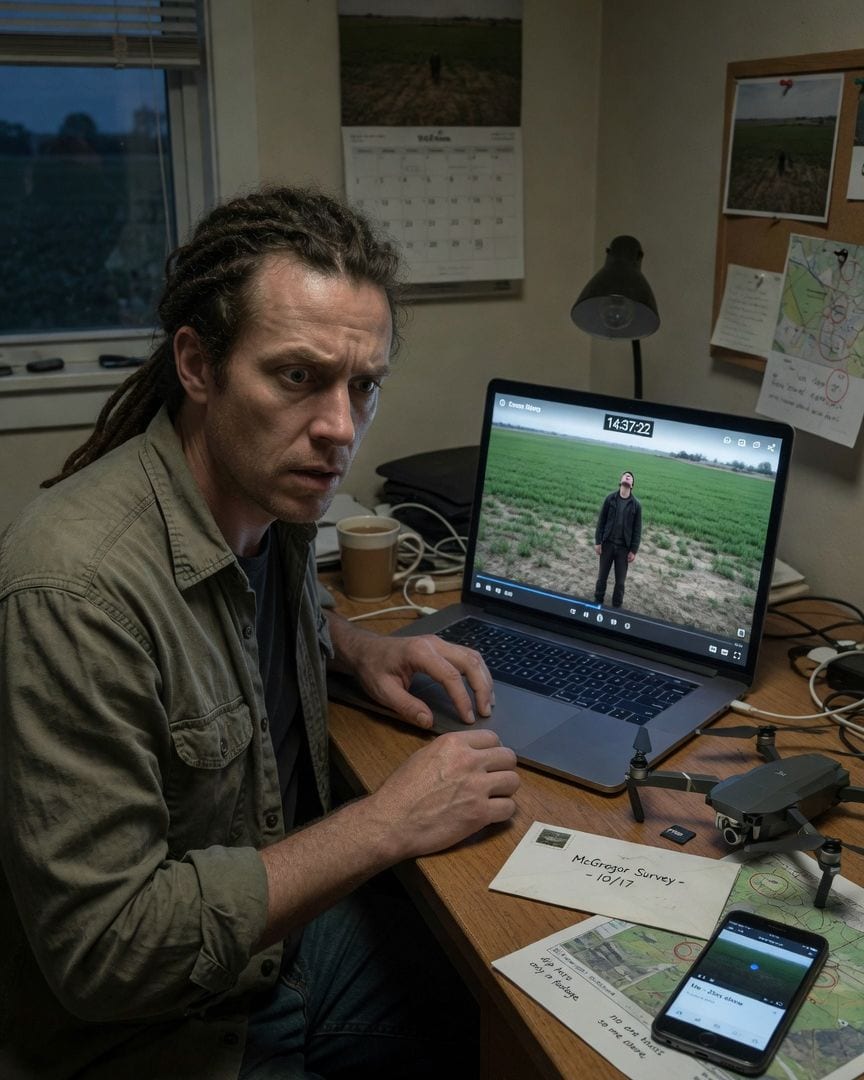
My drone's return footage shows a man standing alone in the field, looking up. The field was empty when I flew out, and I was alone.
I sent my drone for a routine agricultural survey, mapping crop health across a farmer's property. But reviewing the footage, a man materialized, standing perfectly still in the middle of a field I knew was completely empty. He was looking straight up at my drone, a solid figure where no one should have been.
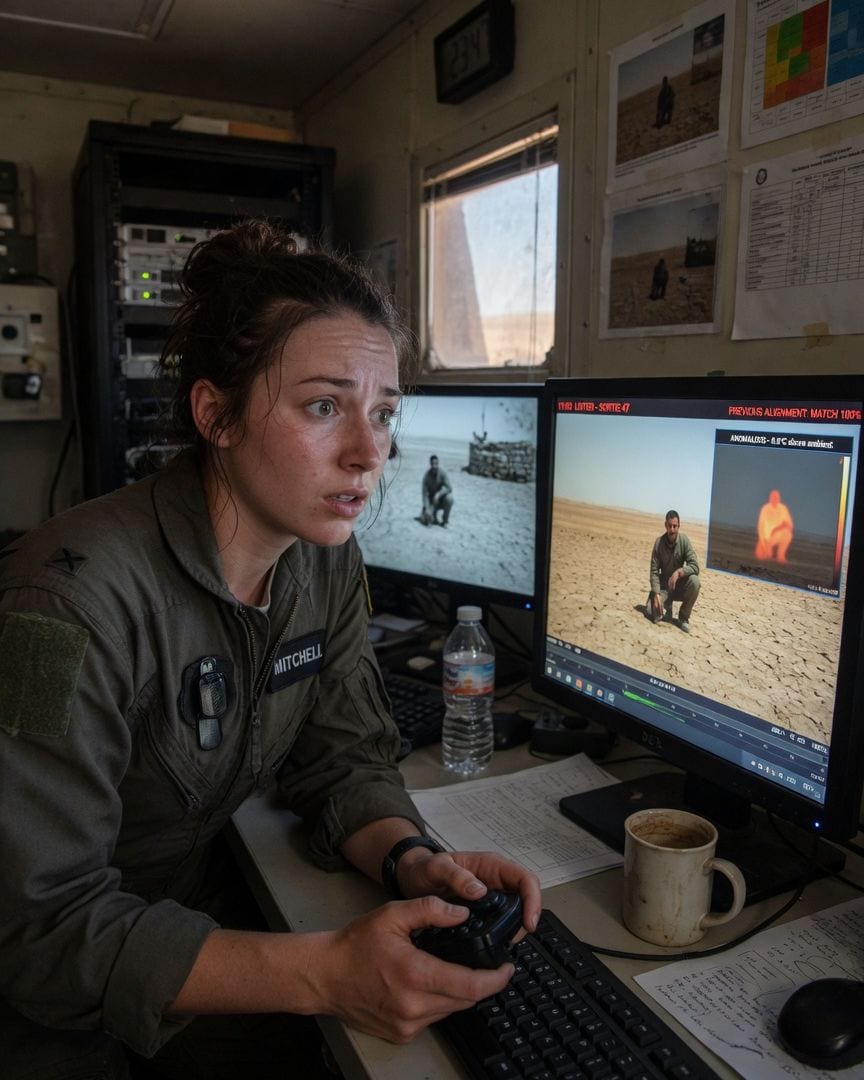
A drone operator spotted a kneeling man in the desert, unseen by her team. Then she found his duplicate, hundreds of yards away, in old footage.
Airman Laura Mitchell prepared for one of her squadron’s final sorties at Forward Operating Location Sandstone, the desert sun beating down. On her drone display, a lone man knelt, impossibly still, at the edge of a dry field, his form perfectly outlined. Her ground team searched for forty minutes below, finding nothing but dust, yet the figure remained in sharp, unwavering focus on Mitchell's screen. She later discovered this same unseen man had appeared across three previous sorties, always at the eleventh minute of loiter, his faint heat signature slowly shifting inches across the parched ground. What was this impossible presence in the desolate desert?
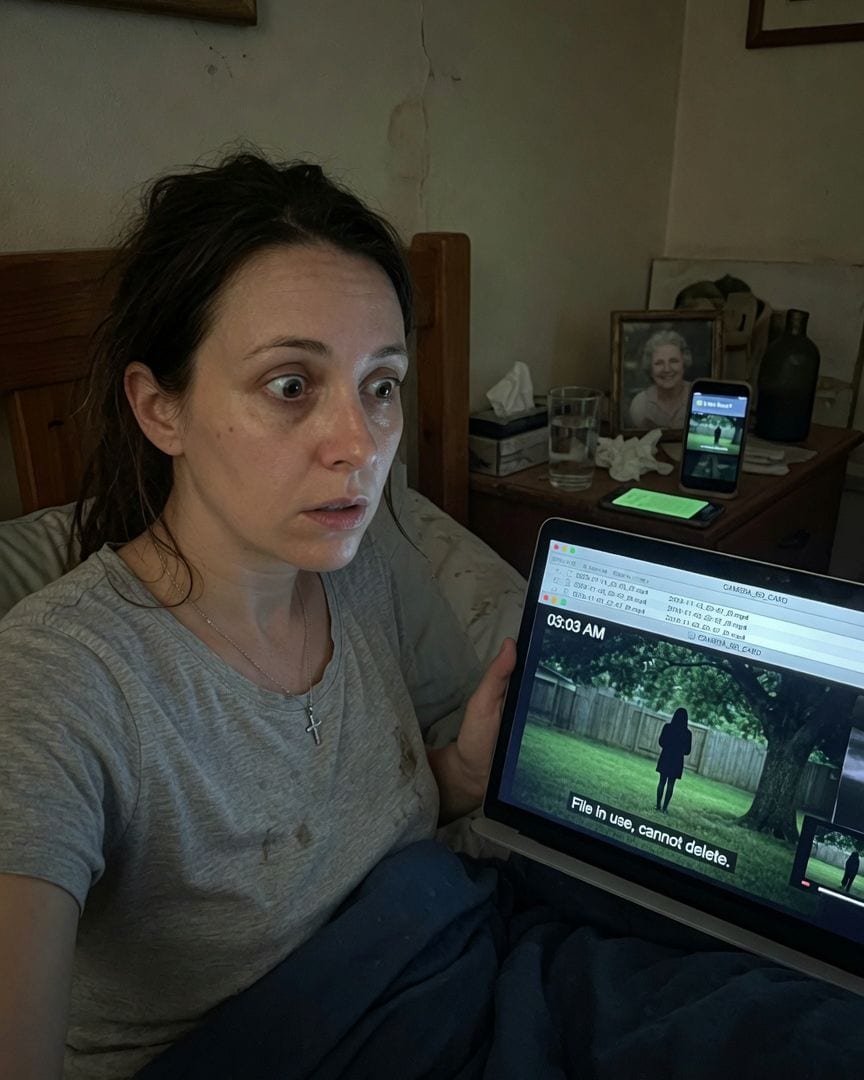
My security camera emailed a clip at 3:03am: a woman stood in the garden, back to the house. The subject line read 'Is this Mum?' My mother died in March. I can't delete the file.
My security camera sent an alert at 3 AM: 'Is this Mum?' But my mother, Constance, died in March. The grainy clip showed a woman in the garden, perfectly still, her back to the camera. The impossible question coiled a sick dread in my gut.
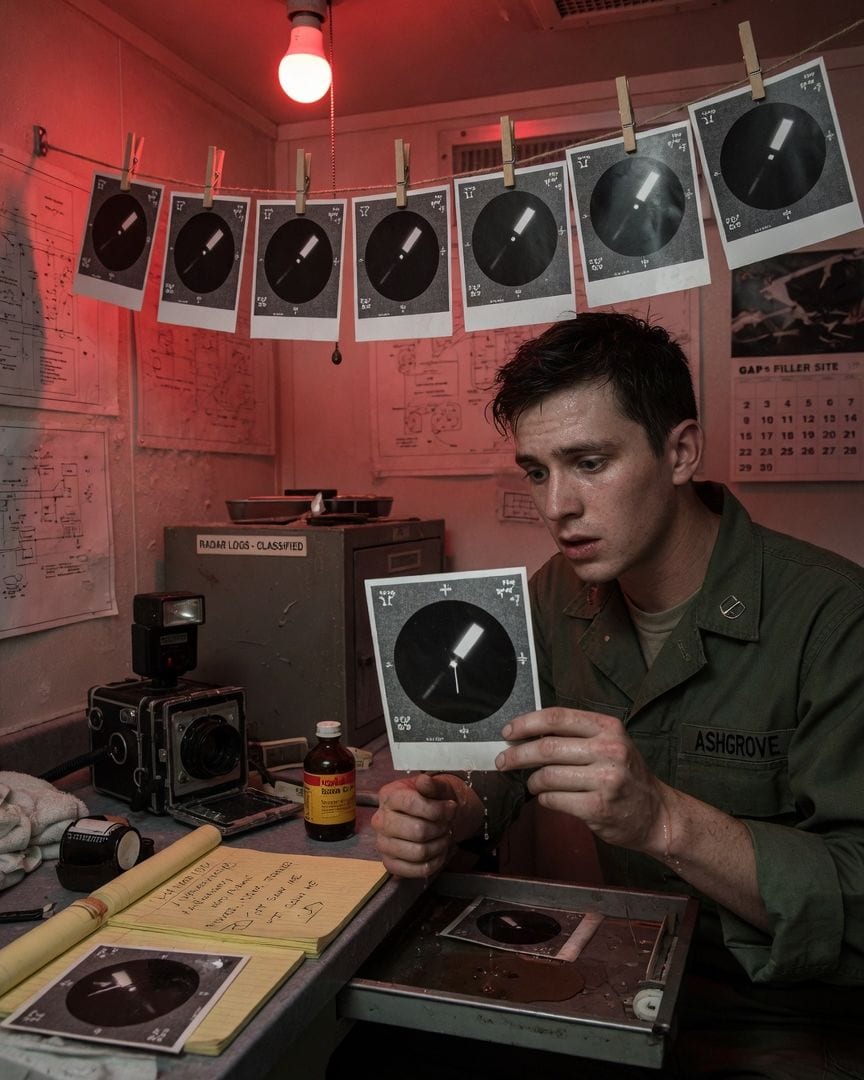
A Cold War Airman watched his radar display: a hangar-sized blip from the empty Montana prairie turned to face him.
Airman First Class Tobin Ashgrove knew his radar scope, the constant drone of the dish, the ground clutter that smeared the screen like ink. For two years at the Montana gap-filler site, he'd memorized its lies and truths. But one day, the familiar clutter vanished, leaving a single, hard-edged return: a stationary, hangar-sized blip at eleven miles on the empty prairie. He photographed it for nine hours, until it moved two miles closer, its hard edges angled precisely toward his camera lens, an undeniable, deliberate turn. What impossible thing had just seen him and responded from the desolate plains?
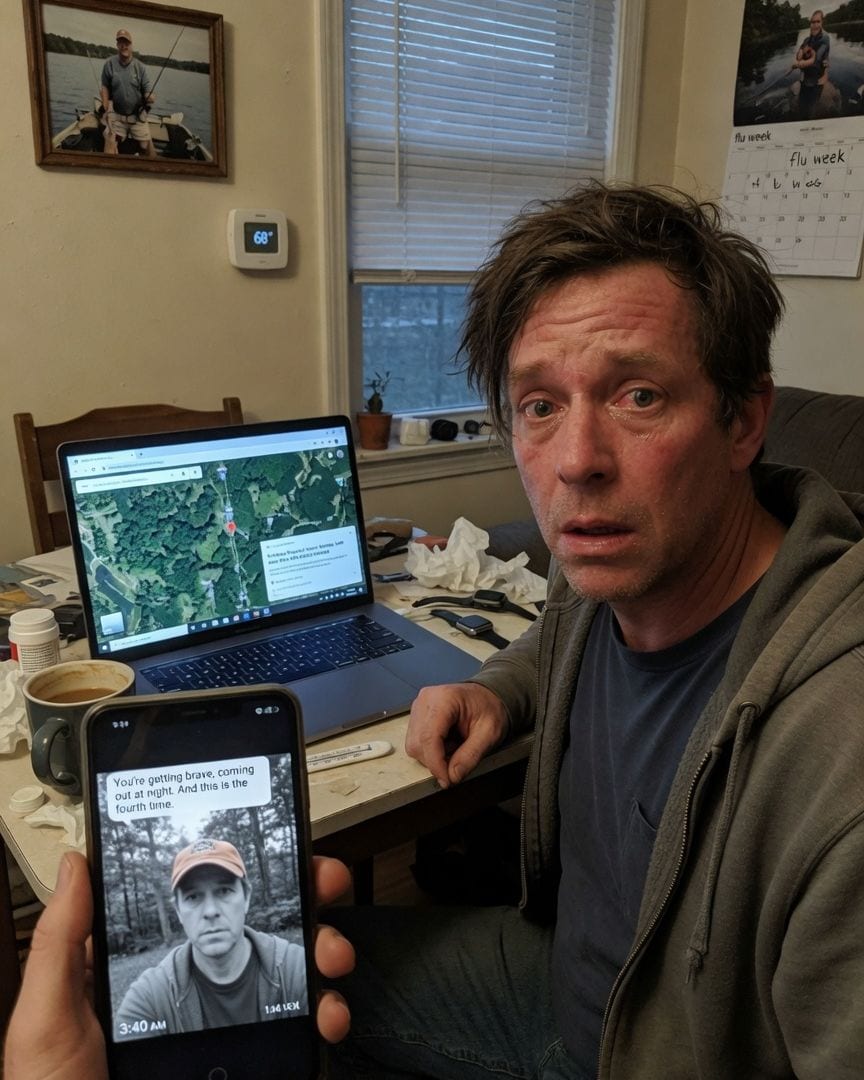
My brother-in-law's camera caught my face in Montana at 3:40 AM. I was asleep in Ohio, but it's the exact orange cap I lost, and he's seen me there four nights running.
I was just making coffee when my brother-in-law sent a photo from his Montana hunting land. It showed my face, wearing my lost baseball cap, timestamped 3:40 AM. I was home in Ohio, sick in bed, and hadn't been to Montana in years. And this was the fourth time.
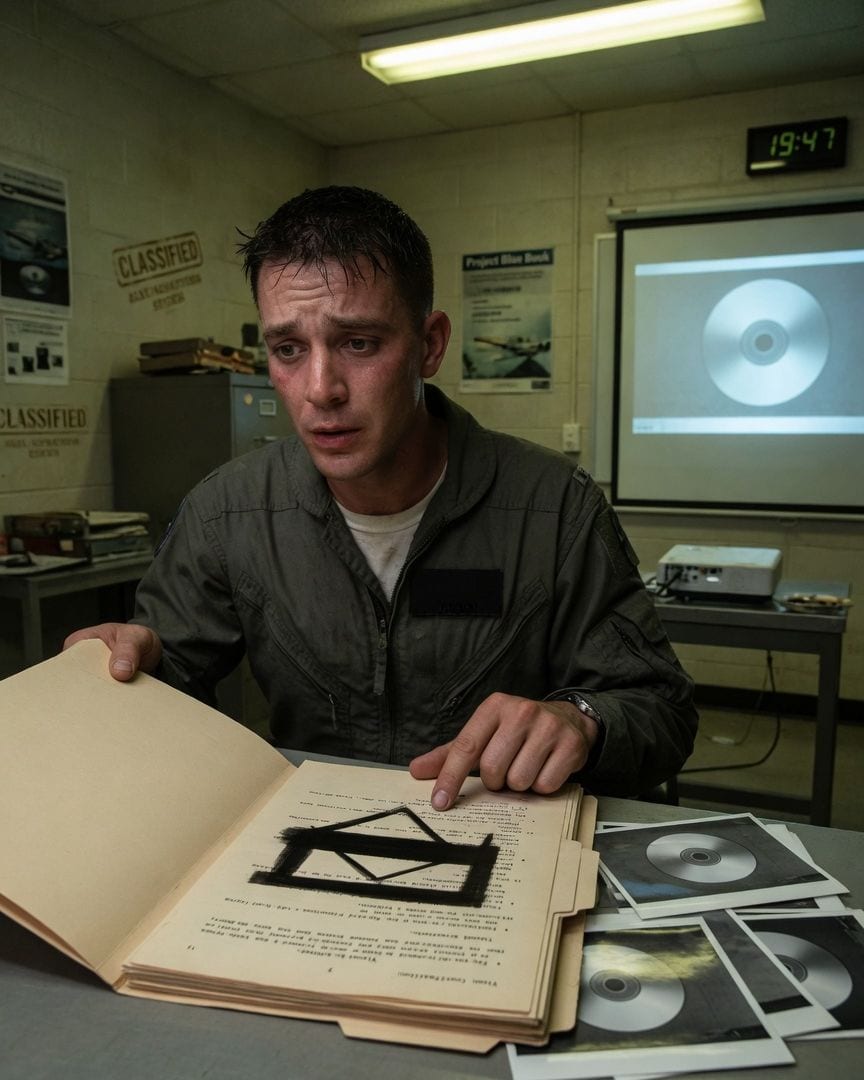
Returning to his newborn daughter, a Cold War pilot found a perfect diamond shape hidden within his classified report's redactions.
Captain Merle Vachon had one last intercept before he could return home to his newborn daughter Nora. High over the Nevada ranges in his F-86 Sabre, he encountered a disc that moved with impossible, silent displacement, defying all known physics. Days later, the official gun camera film showed the object impossibly close, directly contradicting Vachon’s own telemetry and eyewitness account. But the true chilling detail emerged when he found a perfect diamond shape outlined by redacted black ink within his classified incident report.