My ferry crossed the estuary three times yesterday, and each time we landed back at our own dock. The far shore simply wasn't there.
The 7:15 ferry to Oakhaven town quay is usually the calmest part of my day. Eight minutes across the estuary, then a short walk to the local archives where I work. Routine. Sacred, almost.
Yesterday morning, it started like any other Tuesday. The salt tang on the air, the rhythmic thrum of the engine, the familiar groan of the ropes as Curtis Bishop, the skipper, cast us off.
Curtis has been doing this run for over thirty years. He knows every current, every whisper of the wind on this stretch of water.
We pulled away from the village slipway, the whitewashed cottages shrinking behind us.
I was half-reading a report on 19th-century land deeds, half-watching the far shore come into focus: the Oakhaven town church spire, the clustered rooftops, the cranes of the distant fishing port.
But as we got closer, I felt a faint unease. Something about the curve of the coastline looked wrong. Too familiar.
The silhouette of the fishmonger's shed, the specific angle of the gulls circling above it—it was our shed, our gulls, our village slipway.
Curtis Bishop, a man whose face usually looked like it was carved from granite, had gone pale. He cut the engine, letting the ferry drift for a moment. He looked at me, then at the shore, then back at me.
“Eleanor,” he said, his voice a strained whisper, “you seein’ what I’m seein’?”
I saw it. The weathered planks of our own dock, the precise gouges on the wooden pilings. We were back where we started. Curtis backed us off, a slow, deliberate maneuver. The engine coughed, then settled into a determined growl.
He turned the boat, aiming for the town quay again. The water churned, the ferry cut a confident path.
I watched the far shore, trying to rationalize it away: a rogue current, a trick of the light, an early morning haze. But as we approached, the same impossible geometry resolved itself. The distant spire became the near cottages.
The town quay became our quay. Again.
Curtis swore under his breath, a low, guttural sound I’d never heard from him. He tried a third time.
The tide pulled, the engine hummed, and for a third time, after a full eight minutes of crossing, we nosed into the exact same spot we’d left. The far shore simply wasn’t there.
It was like looking at a mirror image, except the reflection was our own reality.
The ferry eventually 'corrected' itself after the fourth attempt. We arrived late, everyone on board shaken, muttering about sunspots or a failing compass. I tried to dismiss it, too. A fluke. Something about the engine, maybe. But the memory gnawed.
It was too precise, too impossible to be a mere malfunction.
That evening, back in my family home – one of the oldest houses in Oakhaven, built in the late 1800s – the unsettling image of the ferry’s futile journey wouldn’t leave me.
My house usually felt like a solid, comforting anchor. Tonight, it felt subtly off-kilter. My gaze kept drifting to a small, windowless annex off the kitchen.
It’s always been there, a cramped space piled with old canning jars and forgotten tools, a utility closet I’d always assumed was a later, rather clumsy addition to the original structure.
Tonight, for some reason, I couldn’t shake the feeling that it didn't belong.
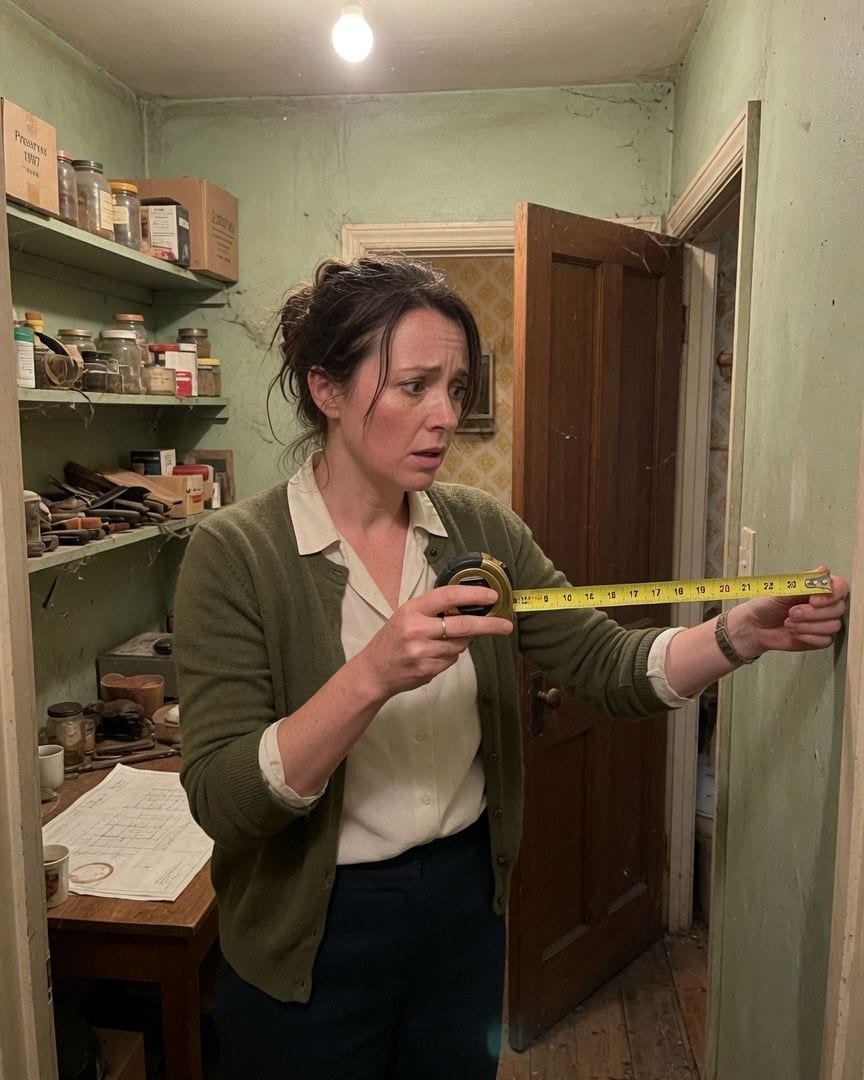
I grabbed my old architect's tape measure from the bottom of a kitchen drawer – a relic from a brief, misguided career path I’d abandoned years ago. The brass casing was tarnished, the tape stiff, but it was still accurate.
I started in the kitchen, meticulously measuring the main walls, checking them against the house’s original blueprint, a copy I’d pulled from the local archives years ago. Every dimension, every angle, aligned perfectly.
The pantry, the back door, the short hallway – all exact.
Then I moved to the annex. I opened the heavy, creaking wooden door and stepped inside. The air was cool and still, smelling faintly of dust and damp earth. I stretched the tape across its width, then its length.
I noted the numbers, then went outside. I paced the exterior wall of the house, carefully measuring the footprint of that same annex section. I did it twice, then a third time, each time marking the points with my heel.
My hands started to tremble.
The numbers didn’t match. Not even close. Its internal dimensions, especially its depth, simply did not fit the external footprint of the house.
It was a room that, by all architectural logic, was one dimension too long for the space it occupied. A ghost of a room within solid brick. I went back inside, re-measured. Then outside again. The discrepancy was undeniable.
I stood in the small, windowless room, my measuring tape stretched across its width. The number on the tape was exactly 12 feet.
I stepped outside, paced the exterior wall, and the same section measured only 8 feet, a discrepancy so stark and impossible that my mind refused to reconcile it, even as I re-measured, again and again.
I spent the next few days lost in the archives, my usual workplace, staring at old blueprints of my house until my eyes burned. The official records, the architectural plans filed in 1887, showed no such anomaly.
The annex, depicted clearly on those faded sheets, perfectly matched the external structure I’d measured from the outside. Yet, the room remained, stubbornly impossible, a testament to a physical world that clearly wasn’t playing by its own rules.
The rational explanations had all failed. It wasn't my tape measure; I’d checked it against a known length. It wasn't my math; I’d had a colleague double-check my calculations without telling her what they were for.
It wasn’t a trick of perspective or bad lighting. The discrepancy was absolute, undeniable.
I expanded my search. I sifted through old village planning documents, property deeds, tax assessments. Anything that detailed the physical layout of Oakhaven.
That’s when I started noticing a pattern of subtle inconsistencies, small things I’d previously dismissed as clerical errors or cartographic quirks.
A road described on a 1920s map that abruptly dead-ended into a field where it clearly should have continued, according to later maps. A property boundary that shifted inexplicably between two surveys decades apart, a line that had simply… moved.
An old stone marker near the estuary, meant to denote a historical boundary, that appeared on some maps, vanished on others. Each anomaly was tiny, easily ignored in isolation, but together they formed a constellation of geometric misbehavior.
A sense that the very ground beneath Oakhaven wasn't quite stable.
It made me think of Benjamin Hale. Benjamin was a retired local historian, an eccentric fixture of the village known for his obsessive collection of Oakhaven's more obscure lore.
He’d always had a reputation for 'seeing things' others didn't, for believing in local legends that everyone else wrote off as old wives' tales. I'd always found him a bit much, his theories too wild, his interests too esoteric.
Now, I wondered if he'd seen this. If he’d seen these subtle, impossible shifts in the physical fabric of our village.
I found Benjamin Hale’s number in an old community directory. He answered on the second ring, his voice surprisingly robust for a man in his late sixties.
We arranged to meet at his cluttered home, a small cottage on the edge of the village, overflowing with dusty books, antique maps, and stacks of yellowed local newspapers. The air inside smelled of old paper and something vaguely metallic.
He greeted me at the door with a quiet, almost knowing expression. His eyes, sharp and intelligent behind thick spectacles, seemed to take in more than just my face.
As I began to explain the ferry incident, trying to make it sound as detached and professional as possible, then moving on to the impossible dimensions of my house's annex, he listened intently. His gaze never wavered.
There was no surprise in his eyes, only a deep, unsettling attentiveness. He didn't interrupt, but he asked pointed questions: "The specific location of the annex, you say? Which wall? The depth, you measured?
And the ferry… tell me again about the gulls." He wanted details, granular specifics, as if he were trying to fit them into a puzzle he’d been working on for years.
I left his house feeling both unnerved and a flicker of hope. He hadn’t dismissed me. He hadn't even looked surprised.
Later that week, I found a handwritten note tucked under my car's windshield wiper. It wasn't raining, so the paper was perfectly dry, the ink unsmudged. Just a small, folded square of parchment-like paper.
On it, in neat, almost elegant script, was a single, cryptic sentence: 'Some things are better left uncounted.' No signature, no address. No clue who left it. My hands started to shake. The dread deepened, cold and sharp.
Someone knew I was digging. Someone was watching.
The note confirmed it. I wasn't imagining things, and I wasn't alone in noticing them. Someone knew what was happening in Oakhaven, and they knew I was getting close. I drove straight back to Benjamin Hale's.
The parchment note was clutched so tightly in my hand it was almost crumpled. I practically burst through his door. “You know something,” I demanded, holding out the note. “You know what this is about, don’t you?”
Hale sighed, a deep, weary sound that seemed to carry the weight of years. He didn’t reach for the note. He just looked at it, then at me. “Come in, Eleanor. Let me pour you some tea.”
He led me into his study, where a large, rolled-up map lay on his main table. It was unlike any official document I’d ever seen: hand-drawn, filled with intricate, almost artistic details, faded but meticulously preserved.
“Oakhaven,” he began, his voice soft but firm, “has always been a peculiar place. Not haunted by spirits, no. But by its own foundations.”
He unrolled the map with a reverence that made the air itself seem to hum. “For generations,” he explained, tracing a line with a gnarled finger, “the geometry of this village has… shifted.
Like a poorly drawn blueprint that sometimes corrects itself, sometimes warps. The world tries to impose order, to build straight lines, but the ground itself refuses to cooperate.”
He pointed to a section of the estuary, marked with a faint, looping arrow. “The ferry incident? A classic manifestation. The space folds back on itself. The journey is made, but the destination is merely a return to the origin.
A shortcut that loops you around your own shadow.” He tapped the map. “It’s a localized anomaly. Usually subtle, easily dismissed. A road that dead-ends, a boundary that shifts. But sometimes, when the conditions are just right, it becomes… undeniable.”
He then traced a line to a cluster of buildings, including what was unmistakably my house, drawn with an unusual degree of detail.
“And certain anchors,” he continued, his finger resting on a small, recessed square in the map's depiction of my home, “like your annex, are particularly susceptible.
They are, as you put it, the rooms that cannot be counted, because in a true sense, they don't always fully exist in the way we understand space.
They are the folds within the fold, the spaces that temporarily absorb the discrepancies.”
My mind reeled, trying to reconcile his calm words with the impossible reality he was describing. It wasn't a glitch. It was the fundamental nature of the place.
The village wasn't haunted by ghosts; it was haunted by its own impossible shape.
Hale then pulled out another, even older document from a locked drawer beneath his table. It was fragile, parchment-like, covered in a fine layer of dust. The edges were browned, the ink faded, but still clear.
“This,” he whispered, his voice catching, “is a copy of an original survey, dated 1898. Not an official one. This was suppressed.”
He unrolled it carefully. Its details were starkly different from any record I’d ever seen. He pointed to my house. “Look at this, Eleanor. Your family home, as it was originally surveyed.”
The map showed the house with a significantly different footprint than what I knew. The annex, the impossible room, was depicted as a prominent, normal-looking wing, seamlessly integrated into a larger, more sprawling structure.
But other parts of the house, wings I knew existed, were missing or reconfigured. And the surrounding streets, the lines of the estuary itself, were subtly, unsettlingly, out of place.
“This map,” Hale whispered, his voice dropping to a near-inaudible level, “was suppressed. Because it tells the truth about Oakhaven, the truth about your family’s house.
They tried to fix it, to make it conform, to erase the proof of the shifts. But the underlying pattern… it always returns. And your family,” he added, his eyes meeting mine, grave and unwavering, “they knew.
They were always inside it. This isn't just happening to the village, Eleanor. It’s happening through you now, because you’ve woken it up.”
Benjamin Hale points a trembling finger at the faded ink drawing of Eleanor's house on the old map. Next to it, an annotation in tiny, archaic script details a 'temporal alignment event' and a 'structural correction' in the year 1903.
He looks up, his eyes grave. 'Your family,' he says, 'they didn't just live here, Eleanor. They were part of it. And it's coming for you now, just like it came for them.'
The air in Benjamin Hale’s study felt heavy with unspoken history. “The Kowalski family,” he continued, his voice softer now, “for generations, were not just residents, but unwitting guardians.
That impossible room in your house, Eleanor, it acts as a sort of ‘pressure valve’ for the spatial anomaly.
Your ancestors, having discovered these shifting geometries, tried to contain its more violent manifestations by subtly influencing the ‘fold’ within their own property, essentially absorbing the discrepancies into that single room. They were like a living buffer.”
He gestured back to the suppressed map. “This wasn't just a record of the anomaly. It was a ledger of their attempts to manage it. To force the world, however temporarily, to behave as it should.
They’d record the shifts, the corrections they made, the energies they tried to divert. The official records, of course, were always ‘corrected’ to match the stable reality they imposed.”
The ferry incident, the misaligned roads, the disappearing stone marker – these were all signs that the ‘valve’ was failing. “The anomaly is growing stronger,” Hale said, his brow furrowed.
“Perhaps because you, unknowingly, have ceased the family’s traditional, subtle ‘maintenance’ of the room. This phenomenon has recurred for centuries, periodically ‘rewriting’ parts of Oakhaven.
It's built atop a specific geological fault line that, in rare conjunctions with lunar and tidal forces, causes localized distortions in spacetime.” He leaned forward, his eyes intense. “Your family knew this.
They tried to keep the village whole by taking the impossible into their own home. You have to finish what they started.”
Horrified but resolute, I realized what I had to do. I had to reactivate the 'valve.' I had to find a way to stabilize the geometry.
Hale believed the key lay in a specific, ritualistic ‘anchoring’ within the impossible room itself, a method passed down through the Kowalski line, though the exact details had been lost over time.
He had a few cryptic notes, gleaned from his decades of research into my family’s obscure history, and pointed me to a specific, unusual stone marker near the estuary that seemed to correspond with symbols on the suppressed map.
I returned home, Hale’s cryptic notes clutched in one hand, the memory of his grave words burning in my mind. Inside the annex, the room felt colder than usual, the air thicker, heavy with an almost palpable presence.
It wasn’t a haunting, not in the traditional sense, but a sense of displaced reality, of geometry protesting its confinement. I ran my hands over the rough plaster, searching.
Behind a loose stone in the hearth, just as Hale had hinted, I found a hidden compartment. Inside was a small, intricately carved stone marker, identical in pattern and material to the one Hale had described near the estuary.
Its surface felt unnaturally cool.
I pulled out my great-grandmother's journal, its leather cover cracked and brittle, its pages filled with elegant, looping script. Faded diagrams, barely legible, detailed a complex pattern, a ritualistic placement.
Following one such diagram, I placed the newly found marker in the exact center of the impossible room.
As the stone settled into place, the room shuddered. A low hum filled the air, vibrating through the floorboards, up into my teeth. The walls seemed to ripple, the plaster blurring for a terrifying moment.
It was like looking at water, but it was solid brick. The air distorted, expanding then contracting, the dimensions violently snapping into place around me.
A blinding flash of pure, white light erupted from the stone, momentarily overwhelming my senses, and then, silence.
The room was still. The air was clear. The temperature was normal. The impossible room felt solid, real, its dimensions suddenly matching the exterior measurements I’d taken. For the first time, it was simply a room.
The next morning, the village seemed normal. The foot-ferry crossed without incident, its horn sounding its arrival at the town quay exactly on time. The local paper reported nothing unusual – no strange weather, no unexplained phenomena.
I checked the annex; its dimensions were now perfectly rational, the room no longer an architectural impossibility.
The stone marker, still sitting in the center of the room, was cool to the touch, its carvings now faintly glowing with a soft, internal light, almost imperceptible unless you looked for it.
But a subtle shift had occurred. The air felt... quieter. Too quiet.
A sense of something vast having been put to sleep, rather than truly banished, lingered like a faint echo, a memory of a discordant note that had just been resolved.
I walked past the old stone marker near the estuary, the one identical to the one in my annex. It, too, now bore a faint, almost imperceptible luminescence, a silent twin to the one in my house.
A tourist stood nearby, taking a photo of the scenic view, pointing his phone across the water. He frowned at his screen, then shook his head, muttering about 'bad reception' as he tried to delete the image.
I glanced at his phone. On the screen, a small, distant village on the far side of the estuary appeared, its spire visible, but subtly, impossibly, duplicated, one slightly out of sync with the other.
A faint, shimmering outline of a second spire, ghosting the first. The man sighed, tried again. The image flashed, then corrected. The anomaly, for him, was gone. He shrugged, walked on.
I watched him go, a cold certainty settling in my bones.
She knows it wasn't just Oakhaven.
If this one got to you
Our ferry returned to the same slipway three times yesterday, the town quay dissolving to our village shore. The crossing was never made.
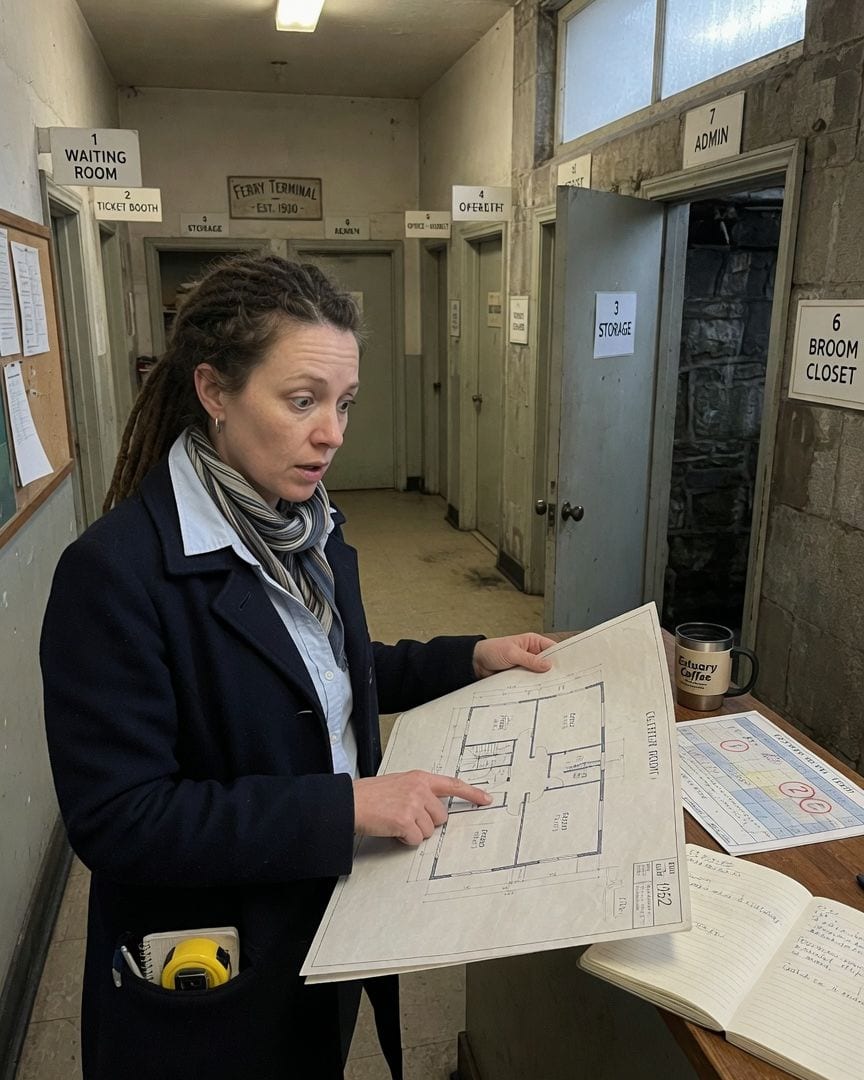
After our ferry inexplicably kept returning to shore, I investigated the old office building. Its architectural plans clearly showed six rooms, but when I walked the hallway, I found a seventh door. That extra room was undeniably there, an impossible presence.
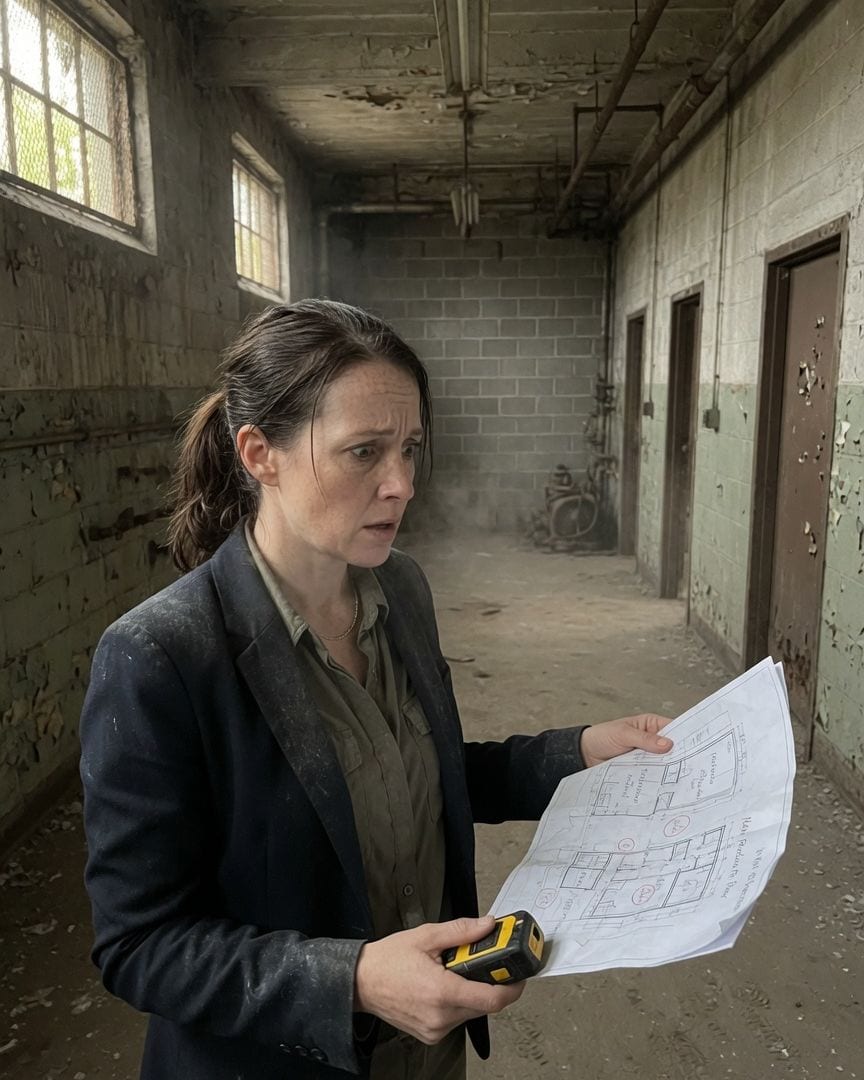
One room is missing from this factory floor. My blueprints show four, but I only found three doors.
Intrigued by an abandoned industrial complex, I secured its old blueprints and entered the cold, silent building. Pacing a long corridor, I meticulously counted doors, comparing them to the detailed plan. The blueprint clearly showed four distinct rooms, but the corridor's length, and my own count, revealed only three doors.
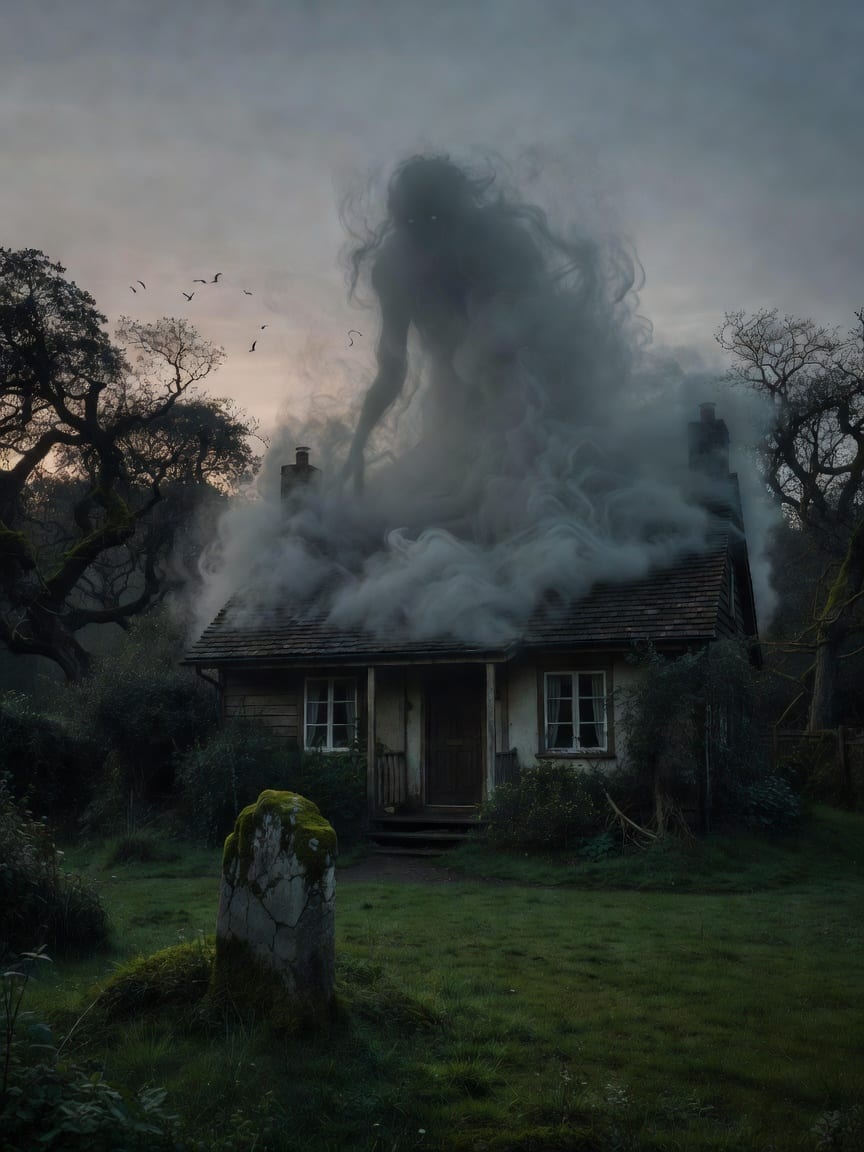
My cottage is now outside the parish, says the vicar. I moved one boundary stone into my ditch, and now I'm outside the line.
I loved my new cottage, with its sprawling garden and ancient oak. But after I moved an old, mossy stone at the edge of my property, Vicar Vance arrived with grave news: my cottage was now outside the parish line, and he could no longer keep me 'on the right side.'
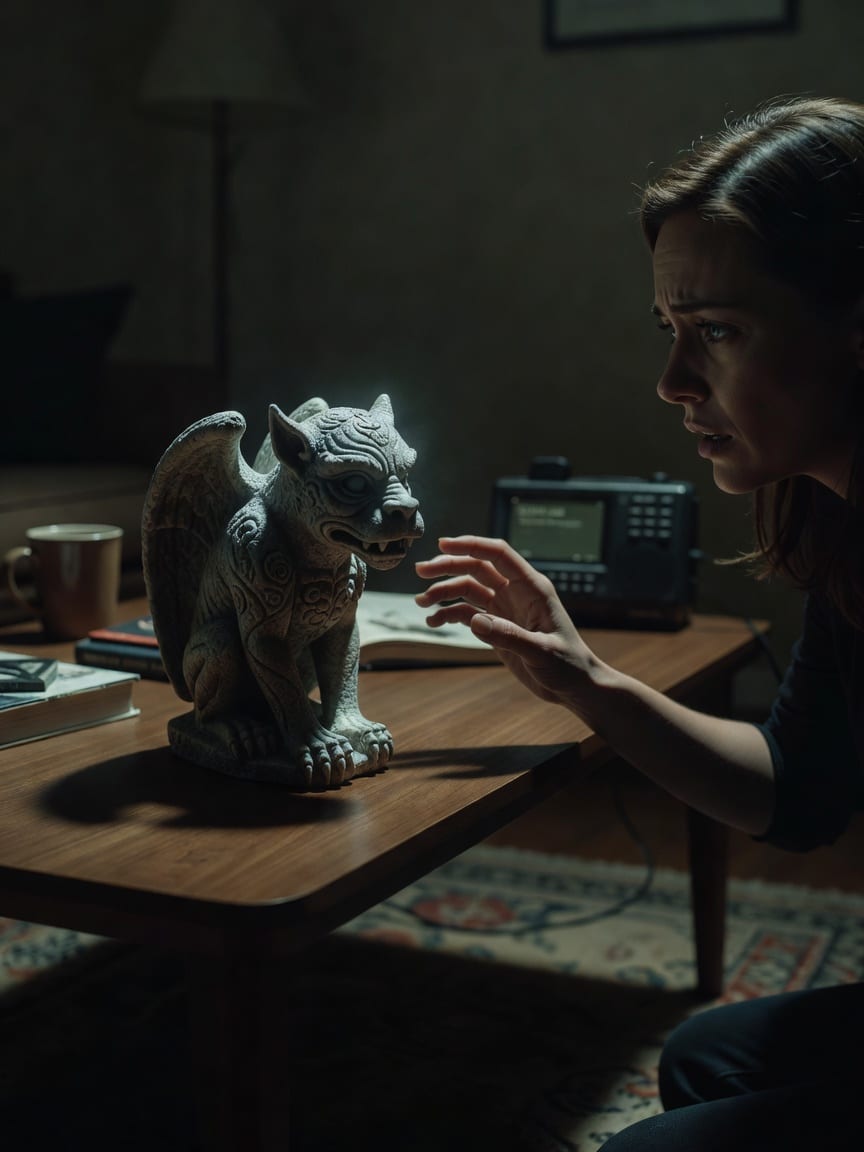
My radio scanner spoke my address at 2 AM. A flat voice read local homes, all with past dates. Mine was the only one in the future.
It was two in the morning, and my quiet house was filled with the usual hum of my weather scanner. But the static broke, replaced by a flat, synthesized voice reading a list of local addresses and dates. My hand froze when it spoke my own address, 181 Foster Drive, followed by a date: October 27th. That date was three weeks from now.
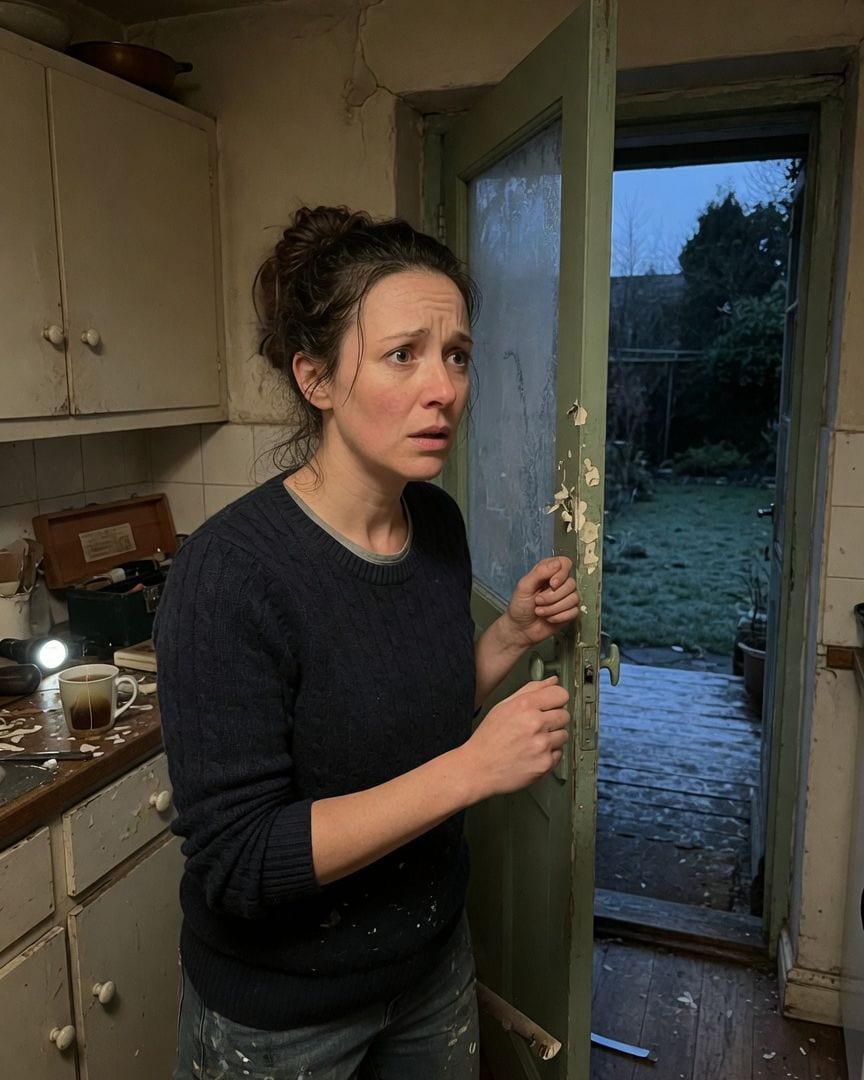
My 1950s cottage doorframe has '1923' carved into it, a date that simply cannot exist here.
I'd poured my heart into renovating my new cottage, especially the back door to my patio. But when I opened it, I wasn't looking at my frost-kissed garden. Instead, a cramped, reeking scullery with a bone-chilling dampness stared back, an impossible image that wouldn't leave my mind, even after the door closed.
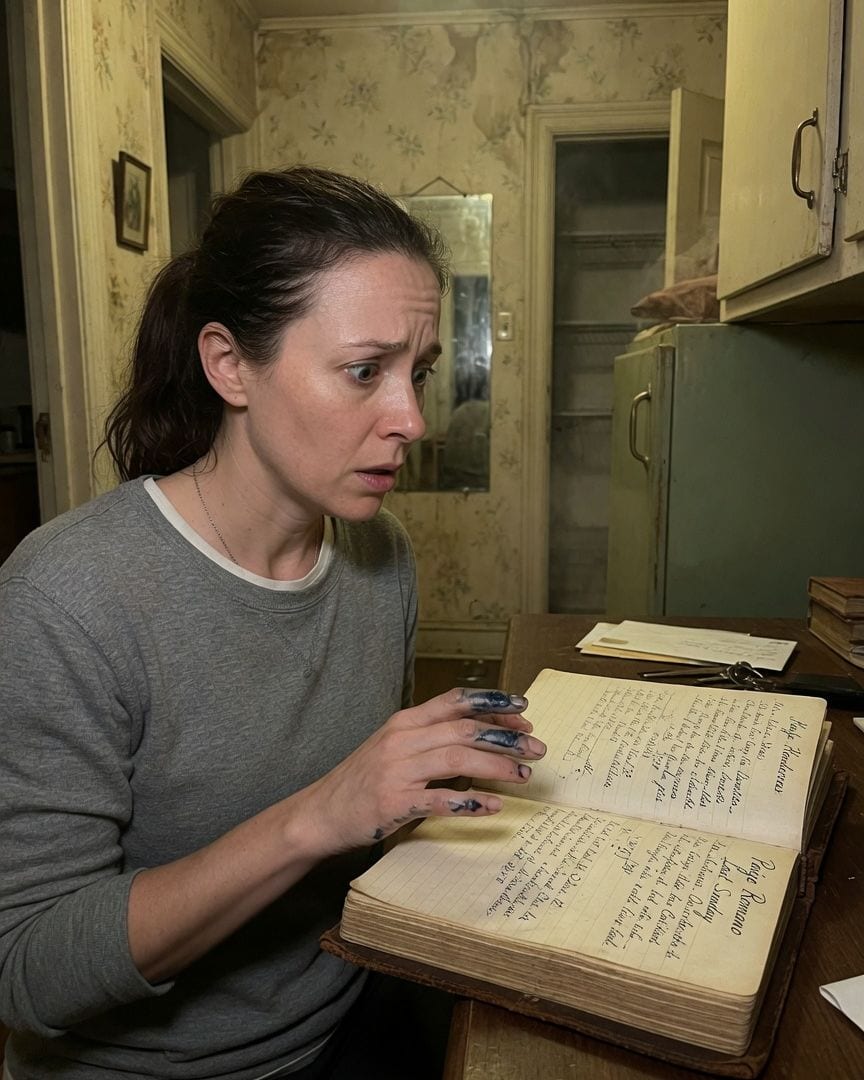
My visitors' book records guests who arrive in the future. Last Sunday, my own name appeared at the bottom, the ink still wet.
I bought an old house last March, complete with a dusty, leather-bound visitors' book. It seemed a charming relic, until I found new entries appearing, dated months into the future, the ink still wet. Then, my own name, Paige Romano, appeared, dated 'Last Sunday,' with a bead of ink shimmering at the 'R'.