A lone Coast Guardsman found his own log entry: 'Visitor arrived. Not yet departed.' The ink was wet, and a strange boot print waited upstairs.
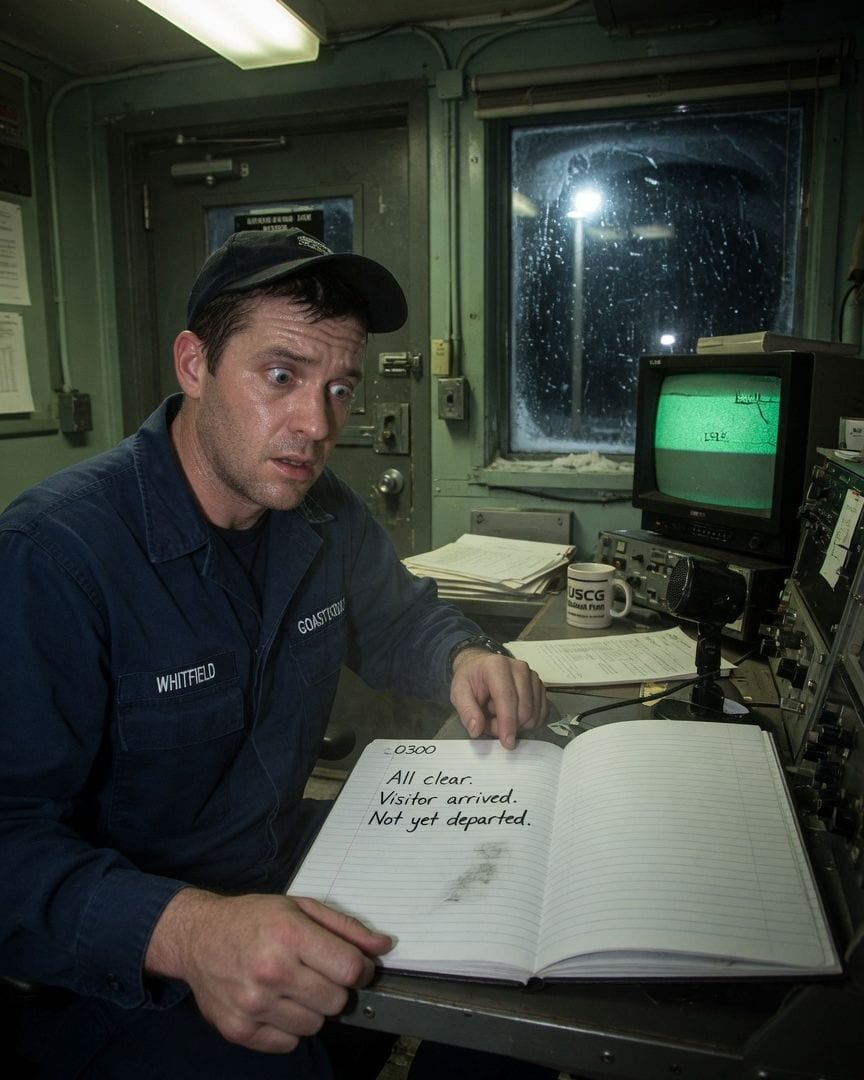
The wind howled like a banshee around Blackrock Point Light Station, rattling the panes of the radio room. Coast Guardsman Nathan Whitfield, exhausted but meticulous, sat at the console. He'd been alone for days, the nor'easter isolating him completely.
The endless drone of the storm, the constant creak and groan of the old lighthouse, had worn at his nerves. At 0300, he’d succumbed, just for an hour, a small, illicit theft of sleep.
He’d woken with a jolt, the storm still raging, and returned to the logbook. His eyes fell on the 0300 entry: a neat, precise hand, undeniably his own, filled in the blank.
He reached out, his finger hesitating an inch above the page. The ink, still a glossy black, was damp to the touch. It read: '0300: All clear. Visitor arrived. Not yet departed.' Nathan’s breath hitched.
He knew, with absolute certainty, that he had been the only living soul on Blackrock Point.
Nathan stared at the entry, heart thrumming. He touched the wet ink again, then his own hand. No smudge, no trace of ink on his skin. He felt the cold seep into his fingertip.
He recounted the station, methodically moving through the living quarters, the engine room, the storage areas. Each door was secured, every window latched against the gale, rattling but holding fast.
The only way in or out was the main entrance, locked from the inside, and the lantern room access, which required a specific key he held on his belt.
He checked the perimeter monitors in the radio room, but the screens were just a riot of static through the storm, the signal lost to the interference.
He tried to rationalize: exhaustion, a cruel prank from a previous rotation he’d somehow missed, a ghost entry from the damp. But the ink was wet. Fresh. Not dried and re-dampened. This entry had been made moments ago.
He ascended the winding iron stairs to the lantern room, the highest point, the most exposed to the gale. The powerful beam cut through the swirling snow, illuminating nothing but the tempest.
His breath fogged in the cold air, clinging to the metallic smell of the room. He checked the clean catwalk, recently swept and dry after his last rounds.
But near the access hatch, barely visible in the beam's reflection, was a single, distinct damp patch. A boot print. Fresh.
Nathan Whitfield stared at the single, damp boot print on the lantern room's catwalk, perfectly formed in the fine layer of salt-dust, where no one else could possibly have been.
The ink in the log had been wet, and now this. He reached out a hesitant finger, tracing the impossible outline, the cold dampness clinging to his skin.
The print was a size too large for his own boots, and the pattern on the sole was unfamiliar. He felt a profound, sickening certainty settle over him: the log had not lied. There was indeed a visitor.
And it was still here. He was not alone.
The boot print solidified Nathan’s dread. He returned to the radio room, now unable to sit still, the silence of the room suddenly heavier than the howl of the storm.
He radioed Sector Command, reporting the unusual log entry and the impossible print, attributing it cautiously to a possible breach or even a hallucination due to fatigue.
Commander Constance Whitmore, her voice crackling through the static, dismissed it with practiced ease as storm-induced stress, advising rest. Undeterred, Nathan began a meticulous review of the station's archived logbooks, stored in a musty basement annex.
The air down there was thick with the scent of old paper and mildew, a quiet counterpoint to the raging storm above. He pulled out decades of records, the leather bindings groaning as he opened them, looking for anything similar.
He found nothing explicit, no other 'visitors' mentioned directly.
But he started noticing a subtle pattern, almost a rhythm: every 8-10 years, a watch log would suddenly end mid-rotation, followed by a 'personnel transfer' record for the entire crew, often citing 'mental health' or 'extreme stress' from the isolation.
The replacement crew's first entries would often contain an odd, almost ritualistic re-affirmation of 'all clear' and 'no anomalies.'
He also found a consistent, subtle discrepancy: the number of personnel listed in the station's manifest for those 'transfer' years would always be one person too many, or one too few, compared to the official crew complement, a 'count that won't reconcile' that was always corrected by the next manifest, as if the system itself was trying to erase the error.
As Nathan delved deeper into the dusty archives, a new layer of unease settled.
The storm raged, but he heard faint, rhythmic creaks from the lighthouse structure above him, distinct from the random groans of the storm, something heavier, more deliberate. He’d pause, listening, only for the sound to cease.
One afternoon, while reviewing a log from 1978, he felt a distinct cold draft, despite the sealed basement.
He looked up to see the basement door, which he’d latched securely, now ajar by an inch, letting in a sliver of deeper darkness from the corridor.
He swore he saw a shadow withdraw quickly, a swift, almost fluid motion that vanished the instant he focused. He snapped the logbook shut, his heart hammering. Someone, or something, knew he was digging.
He tried calling Commander Whitmore again, but the radio was now dead, the storm having taken out the primary and backup comms. The silence that followed was absolute, terrifying. He was truly alone.
He packed the most suspicious logbooks into a waterproof bag, intending to keep them close. As he did, he noticed a small, handwritten note tucked into one of the older logs, dated 1956.
It simply read: 'The count is never wrong. Don't look for the missing. Look for the extra. She's always here.' The 'She' was underlined twice, a frantic emphasis that resonated with a chilling power.
Nathan, unnerved and now completely cut off, tried the satellite phone, desperate for any contact. It was dead, a black screen reflecting his own frightened face. He was truly isolated. He remembered the note. 'She's always here.'
He thought of Edith Pierce, the retired CO he'd met during his initial briefing – she’d served at Blackrock Point for decades, a quiet, observant woman with sharp, knowing eyes.
He managed to get a weak signal on his personal cell phone, enough to dial Edith’s landline. Her voice, calm and clear, answered, cutting through the crackle of static like a lifeline. 'Nathan? I expected your call.'
He stammered, 'Commander Pierce, the logs… the entries… the count…' Edith sighed, a long, weary sound. 'It's the station, Nathan. It takes. It always has.'
She explained, in measured tones, that Blackrock Point wasn't just a lighthouse; it was a 'collector.' Every few years, when isolation and a specific storm pattern aligned, it would manifest 'the visitor.'
The visitor wasn't outside; it was inside, an echo of the first soul it ever claimed, a woman who'd gone missing in the 1800s. 'She grows, you see. Each crew it takes, she grows stronger.
The logs… they just reflect its truth.' Nathan felt a chill worse than the storm, a cold that settled deep in his bones. 'The extra… the missing…' he whispered, the pieces clicking into a monstrous whole.
'It’s the station reconciling its new additions,' Edith confirmed. 'The log entry you saw, the 'visitor arrived' – that was it marking its next.' He looked at his own log, the wet ink of his own hand.
'My handwriting…' Edith's voice softened, tinged with a familiar sorrow. 'It learns. It mimics. It prepares. The more it takes, the more it becomes like us, or what it remembers us to be.'
Nathan Whitfield slammed the final archived logbook shut, the leather binding groaning in protest. Edith's words echoed in his head, chilling him more than the storm outside.
He'd been cross-referencing the last known 'personnel transfer' log from nine years ago – the one with the impossible count.
He’d found the manifest for the incoming 'relief crew' that never officially arrived, but whose names were logged in the subsequent records, as if they had.
His own transfer date, the one he'd been counting down to, a month from now, stared back at him from the 'Arrivals' column.
Below it, a single line, scrawled in an unfamiliar but eerily familiar hand, the looping script almost identical to his own 0300 entry: 'Whitfield, N. - Relieved.' He was already logged in, already accounted for, years ago.
The pattern wasn't just historical; it was a prophecy. And he was already part of it, written into the station's insidious ledger before he'd even set foot on Blackrock Point.
The storm outside seemed to laugh, a deep, guttural sound from the ocean.
The realization hit Nathan like a physical blow, knocking the air from his lungs. He wasn't just investigating a pattern; he was the pattern's next victim.
The 'visitor' logged in his own hand, the boot print, the impossible count – it was all the station's way of marking its territory, preparing for its next acquisition. Edith's calm voice, now a distant memory, had confirmed it.
He was meant to be absorbed, his identity added to the 'She' that grew within the lighthouse.
He stumbled back through the station, every familiar creak and groan now sounding like a hungry sigh, the very walls seeming to breathe around him. The station wasn't just a place; it was a living, consuming entity.
The 'relief' logged for his transfer date was never a human crew; it was the station itself, coming to claim him. He looked at his transfer orders, crumpled now in his hand, a cruel, mocking joke.
He was never going home. He was going to become part of Blackrock Point, one more ghost in its impossible count.
He saw the boot print again in his mind's eye, not a visitor's arrival, but a new limb taking its first step within its expanded body, solidifying its hold.
The station was ready for him, and it had been for years.
Nathan gripped the heavy brass lantern key, his knuckles white, his only weapon against an unseen, insurmountable force. Escape was impossible; the storm ensured that.
His only option was to fight, or at least, to refuse, to make a stand against the insidious collector.
He decided to destroy the logs, to break the pattern, to starve the 'She' of its meticulous record-keeping, to erase its history of consumption.
He collected every logbook he could find, current and archived, piling them in the engine room, a silent pyre of paper and leather. He found an old jerrycan of emergency fuel, its contents sloshing ominously.
But as he doused the stack, a low hum started from the station's core, growing louder, vibrating through the metal deck plates beneath his feet. The hum wasn't mechanical; it was deep, resonant, ancient.
The light in the lantern room above flickered, then intensified, bathing the station in an unnatural, pulsing glow, casting long, distorted shadows that danced around him.
The air grew heavy, thick with the smell of salt and something else – ozone, and decay, like wet earth. The hum coalesced into a whisper, a thousand voices murmuring his name.
'Nathan… join us…' A figure coalesced in the doorway, vague at first, then solidifying. It was a Coast Guardsman, wearing a uniform that was decades out of date, its face indistinct, a collage of forgotten features, like a shifting memory.
It raised a hand, beckoning, and Nathan felt a profound pull, a sense of belonging, of peace, a promise of rest he hadn't known he craved. He fought it, shaking his head violently, tears blurring his vision.
He lit a match. The figure lunged, a swift, hungry movement, but Nathan threw the match, igniting the fuel. Flames roared, consuming the logs, the records, the history of the collector.
The hum turned into a shriek, a cacophony of agony and rage, and the light in the lantern room exploded, plunging the station into darkness.
Nathan, coughing from the smoke and heat, felt a searing coldness engulf him, a thousand hands pulling him down, into the very structure of the station, into the metal, the stone, the dark.
The nor'easter finally broke two days later. A Coast Guard cutter reached Blackrock Point, finding the station damaged but intact. The engine room was a charred ruin, but the fire had contained itself, miraculously failing to spread further.
Nathan Whitfield was gone. His personal effects remained, neatly arranged in his bunk. His transfer orders were found on his desk, unsigned. The current watch logbook was completely destroyed, reduced to ash.
The official report cited a 'fatal accident during a severe storm,' noting the unusual fire. No body was recovered. Commander Whitmore sighed, filing the report, the incident one more strange footnote in Blackrock Point's history.
The station was temporarily decommissioned, its light dark for the first time in a century.
Months later, a new crew was assigned to Blackrock Point, after extensive repairs had been completed. The light was relit, its beam once again cutting a path through the night.
The first entry in the new watch log, a fresh, blank book, was made by the new Coast Guard, a young man named Eric Winslow. He meticulously logged: '0000: All clear. No anomalies.' The ink was fresh, still wet.
As he finished, a faint, almost imperceptible hum resonated from the very structure of the lighthouse, a sound that seemed to welcome him home.
He didn't notice the new, slightly damp boot print on the floor beside his chair, where no one else had been. The count was never wrong. She's always here.
If this one got to you
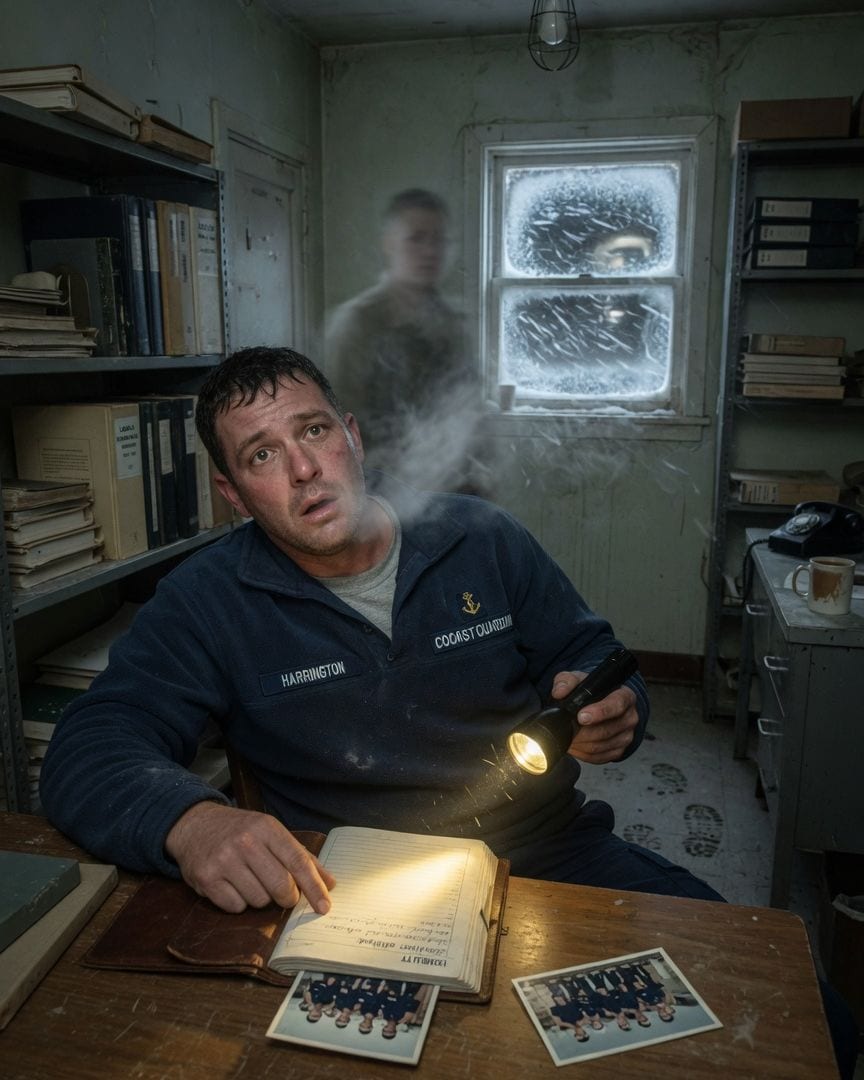
Coast Guardsman Victor Harrington was alone, but his own log entry read: 'Visitor arrived. Not yet departed.' The ink was wet.
Coast Guardsman Victor Harrington endured the nor'easter's crushing weight against the remote LORAN station's windows during his last lonely watch. Exhaustion claimed him for an hour, but when he jolted awake, the station's logbook held a chilling surprise: his own handwriting recorded, '0300. Visitor arrived. Not yet departed.' The ink was still glistening wet, and soon after, Victor discovered fresh, wet boot prints across the floor — not his, and leading to a dead end with no sign of entry. Every door remained locked, every window unbroken, yet the prints had simply materialized, leaving the guardsman with a suffocating sense of impossible dread. Who or what had left its mark in a sealed, storm-battered station, and how?
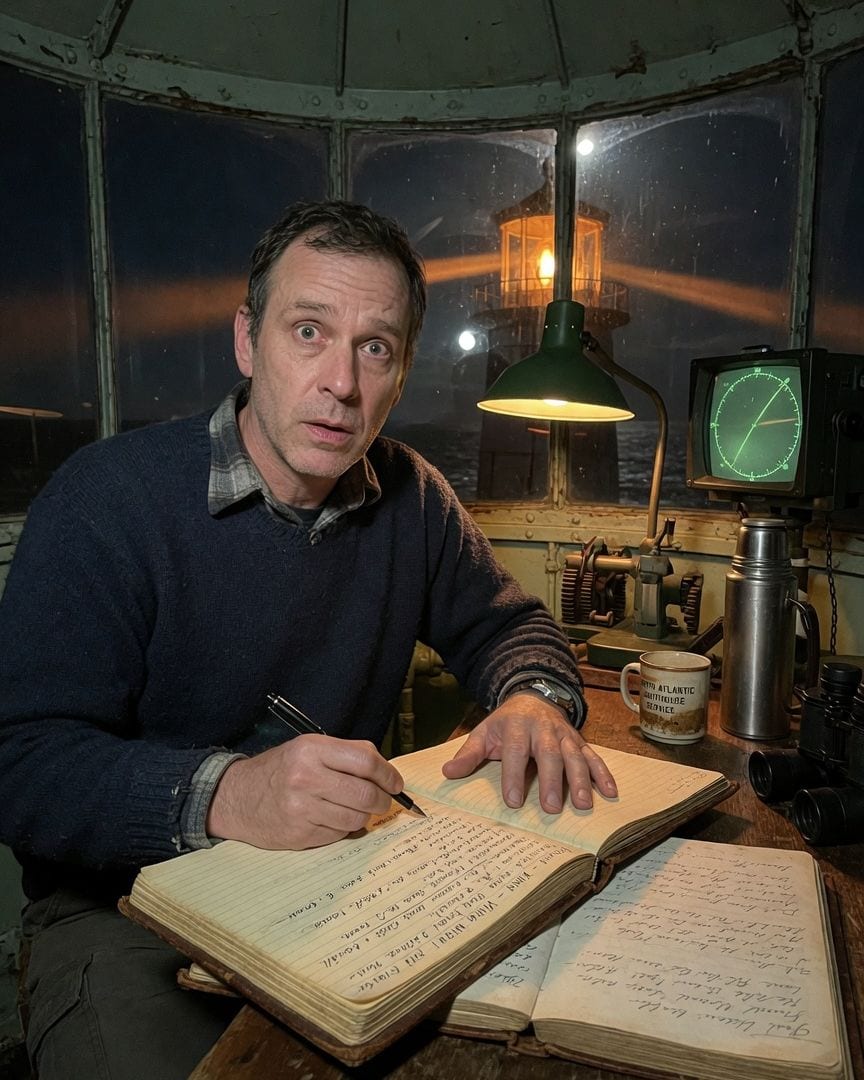
My lighthouse log has my own 3 AM entry for a phantom ship. I was alone in the tower, and I wrote no such thing.
Perched in the lantern room for my usual 2-6 AM watch, I reached for the thick logbook. But the 3:00 AM entry, under my own name, detailed a vessel I never saw. The words were in my own ink, yet I had never written them.
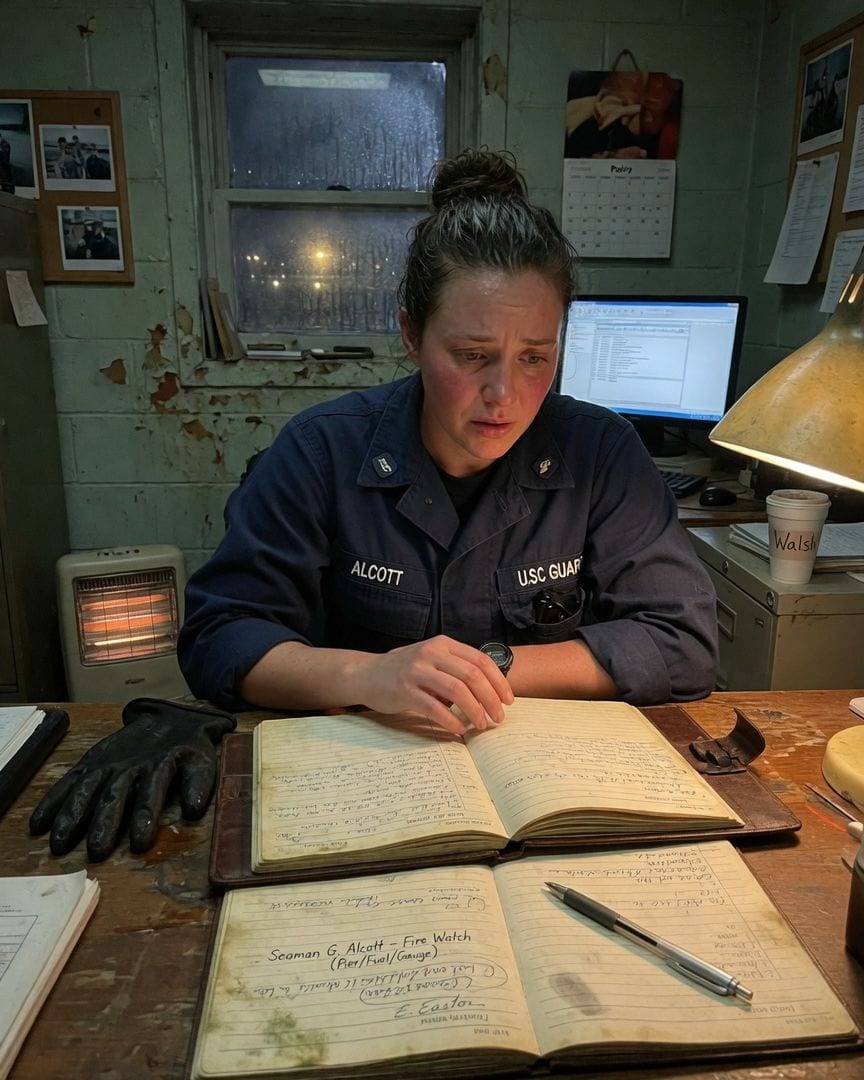
Seaman Alcott found fresh bootprints mirroring her own, a half-stride ahead in the fog. Her boots were the only pair logged out for fire watch.
Seaman Genevieve Alcott knew the rhythm of Coast Guard Station Petrel, a precise forty-minute fire watch circuit she’d walked for six months. Tonight, a thick fog coated the pier in brine and rust, muffling all sounds but her own boots on the damp planks. But as her flashlight cut through the mist, it revealed a second set of fresh bootprints, identical to hers, a half-stride ahead – even though her boots were the only pair logged out that night. Back in the boat shed, the meticulous logbook confirmed it: only her signature for issued boots. Yet, the prints were undeniably real.
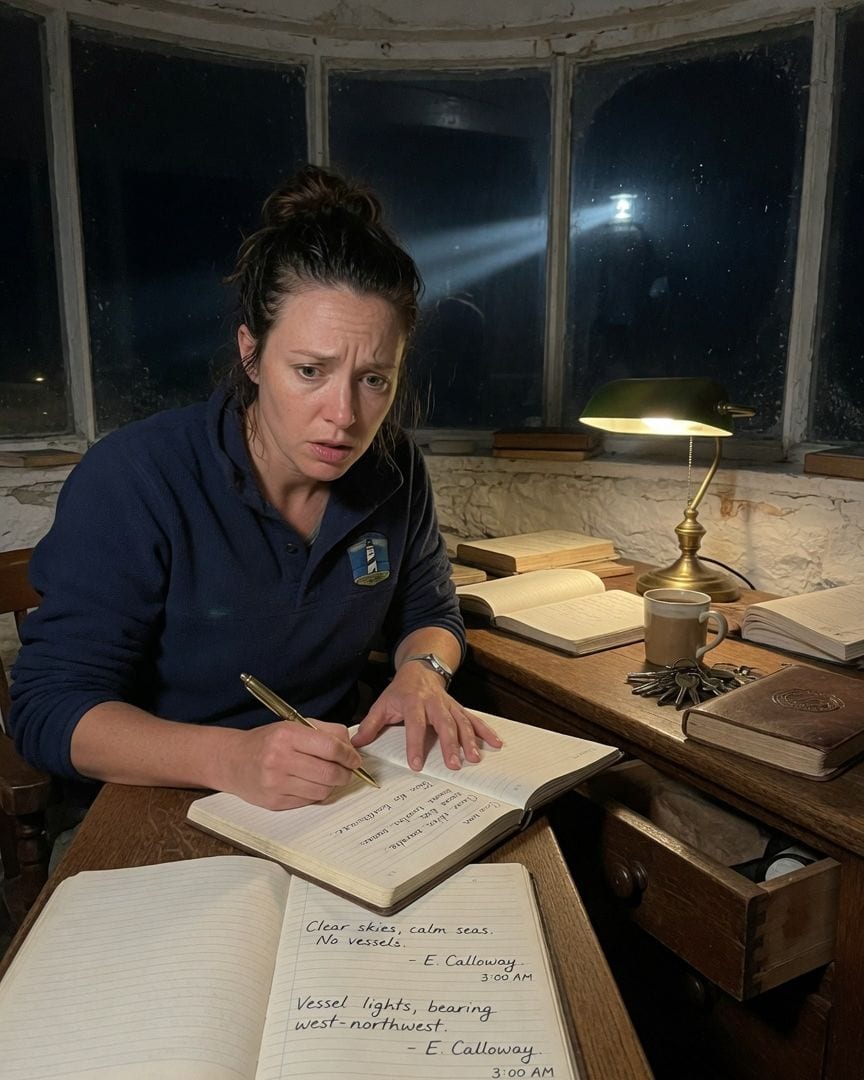
My logbook had a 3 AM entry, in my own precise hand, that I never wrote. Then I found an impossibly cold, hidden book with my name signed to an identical entry from last night.
My routine lighthouse shift was quiet until I noticed a new entry in the official logbook. Dated 3:00 AM, it described a vessel I never saw, written in my exact handwriting, and signed with my name. But I hadn't penned a single word.
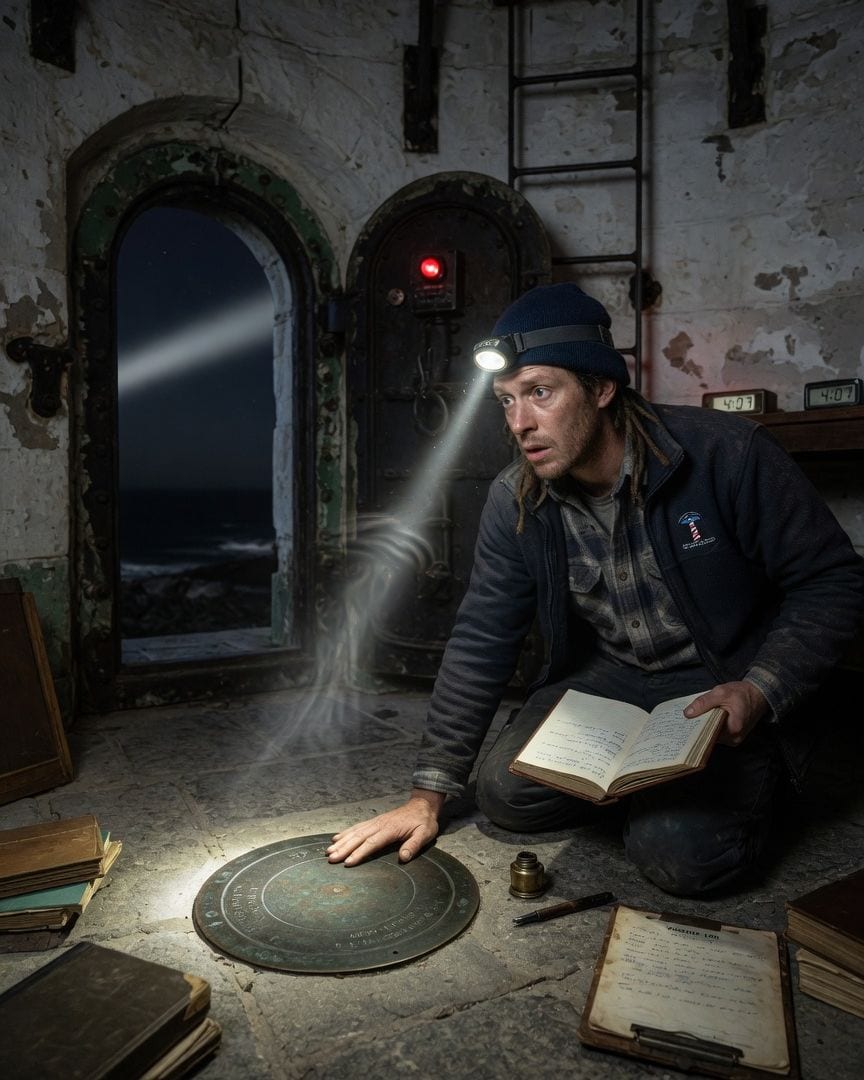
Every ninth year since 1901, my logbook records a boat through the gate at 4:05am — 'vessel through, none seen.' I was on watch tonight. Nothing passed.
As the lighthouse keeper, I log the same impossible entry every nine years, a lie I'm compelled to write. But tonight, a hidden brass disc in the floor, not on any blueprint, feels oddly warm. Hours later, it hums, and the air above it shimmers and distorts, then vanishes.
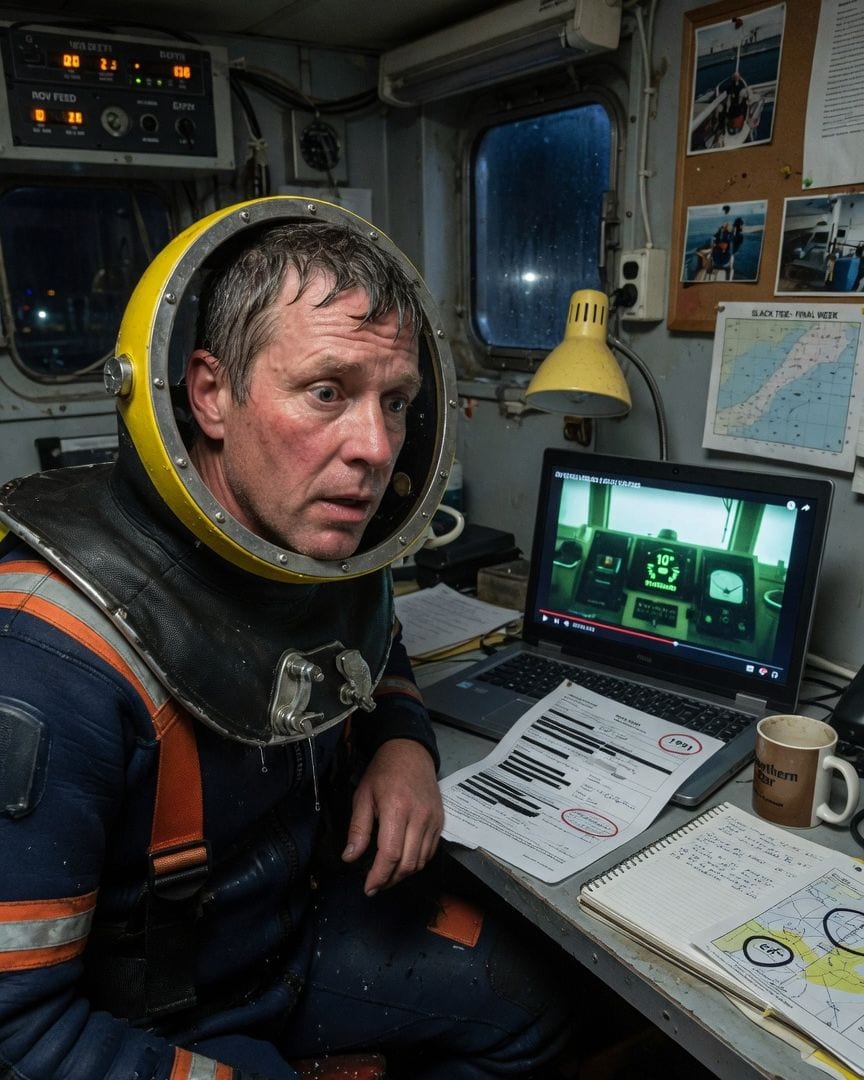
A deep-sea surveyor's final dive into a 1991 wreck found a logbook dated 2023, and a figure watching him.
Deep-sea surveyor Hugo Amsel faced the final week of his Bering Sea survey, under immense pressure to find conclusive evidence before the short season closed. In the abyssal gloom, he located the *Wynn Portal*, a sealer lost with fourteen crew in 1991, surprisingly intact. Through its clear wheelhouse window, he saw a rudder indicator glowing green, an impossible light on a dead ship. Later, on a second dive, he found a leather logbook tucked beneath the helm, open to a page clearly dated 2023. As he stared, a shadow inside the window shifted, coalescing into a figure watching him from the depths.