Technical Sergeant Ada Ilsley had two weeks left when a handprint appeared on her sealed window, unnervingly warm and pressed from the *inside*.
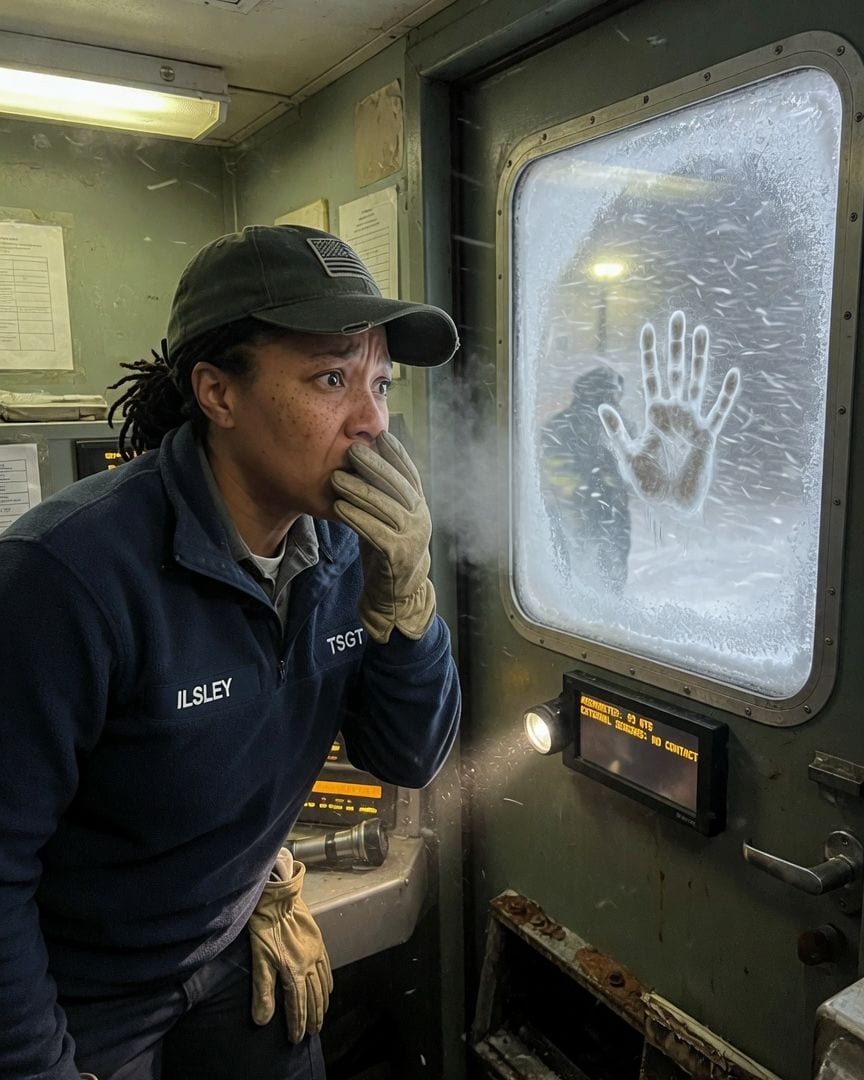
Technical Sergeant Ada Ilsley had two weeks left on the Greenland ice-cap before Thule-Gamma Station shut for good and the last crew flew south.
Tonight, with the wind past ninety knots and the station hunkered down under a fresh blanket of snow, her only job was monitoring the anemometer feed and ensuring the integrity of the sealed main door.
The interior hummed with the steady thrum of life support, a comforting drone against the howl outside, even as the wind clawed at the insulated walls.
Through the small, triple-paned port set into the door, she watched the swirling whiteout, a canvas of pure, obliterating chaos. Her breath fogged the glass, then cleared, leaving a temporary circle of clarity. That’s when she saw it.
A figure, dark against the blizzard, walked with an impossible calm directly out of the roiling white.
It moved across the fifty yards no man could cross in that wind and live, its shape indistinct but undeniably human, a silhouette carved from the storm.
It stopped with its face pressed against the outer pane, a featureless, dark oval, like a void peering in. Ada recoiled, a sharp gasp catching in her throat, her hand flying to her mouth, fingers cold against her lips.
When she dared to look again, squeezing her eyes shut for a second, then opening them wide, the figure was gone.
But on the frost-covered outside of the port, a single, perfectly clear handprint now stood, stark against the rime, pressed from the inside.
Ada’s heart hammered against her ribs, a frantic drumbeat in the silent control room, the only sound the distant shriek of the wind. She pressed her own palm to the inside of the glass, a cold, smooth surface.
It was impossible. The door was sealed, the triple panes forming an impenetrable barrier against the Arctic elements, designed to withstand a direct hit from a small jet.
No one could have been on the inside of that glass to press outward. She tried to rationalize it: a trick of the light, a buildup of condensation, the sheer fatigue of a sixteen-hour shift.
But the print was too distinct, too human in its proportions, every finger and palm line rendered with chilling clarity.
She pulled up the external perimeter sensors on her console. Nothing. No heat signature, no movement beyond the frantic dance of snow. The wind, however, was still registered at 93 knots.
A human being would have been shredded, frozen solid in minutes, or simply blown away like a discarded sheet of paper. She checked the internal security cameras, reviewing the last hour. Every corridor was empty, every access point secured.
The station’s manifest accounted for every soul, each dot on the digital map showing someone in their bunk, or in the mess hall, or on their own shift.
She called out to Station Chief Drummond on the comms, her voice tight, a nervous tremor she couldn’t quite control. “Chief, I just saw something at the main port. And there’s a handprint. From the inside.”
Drummond’s voice, rough with sleep and annoyance, crackled back. “Ilsley? What in God’s name are you talking about? Nothing gets through that wind. Go get some rest.” He dismissed it as a hallucination, another casualty of the long Arctic winter.
Ada, however, knew what she had seen. She grabbed her flashlight and a heavy-duty multi-tool from her belt, her training kicking in, overriding the rising fear. If something was inside, she needed to find out how.
The only explanation that made sense was that something was wrong with the door itself, a flaw in the system. She ran her gloved hand over the door’s inner frame, checking seals, bolts, thermal readings from her scanner.
Everything was locked down, cold, and solid. The handprint, however, felt unnervingly warm against her fingertip through the glass, a faint residual heat that shouldn't have been there, not in this cold.
Determined, Ada began a meticulous inspection of the door's lower frame, searching for any anomaly. Her flashlight beam slid over the heavy-gauge steel, past the reinforced hinges, and then, a faint, almost imperceptible seam caught her eye.
It wasn’t a structural flaw, but a barely visible access panel, painted over and sealed with rusted bolts that clearly hadn’t been touched in decades.
It was too low to be part of any standard maintenance, positioned almost at floor level. Driven by a cold certainty that this was connected, she used her multi-tool to pry at the ancient screws.
They groaned, a high, metallic shriek, then gave way with a series of pops.
Behind the panel, she found not wiring or pipes, but a narrow, dark opening leading down into what looked like a forgotten crawlspace, a hidden sub-level beneath the main operations floor.
A musty, metallic smell wafted up, cold and sharp, like old iron and damp rock. Her beam pierced the gloom, revealing a stack of old, leather-bound logbooks, thick with dust and frost.
She pulled one out, its cover cracked and brittle with age, and flipped it open.
The first page she saw was a crude, hand-drawn sketch of a triple-paned port window, identical to her own, with the faint, unmistakable outline of a handprint pressed from the inside.
Ada scrambled back, the ancient logbook clutched in her hands, its pages feeling impossibly cold, as if radiating the Arctic chill from within.
The sketch was undeniable, a mirror image of the impossible print on her own port, down to the last finger.
This logbook wasn’t official; its entries were scrawled in different hands, dated inconsistently, and filled with cryptic remarks about 'the internal cold' and 'figures in the deep white.'
She rushed back to the comms room, her mind racing, a thousand possibilities, each more terrifying than the last, colliding in her head. She needed help, but Chief Drummond had already dismissed her.
Daphne Ellison, the comms specialist, was her best bet—Daphne had a reputation for digging into historical data, for finding things others missed.
Ada found Daphne in the comms lounge, nursing a lukewarm coffee, her eyes a little too bright from a night of staring at screens. “Daphne, I need your help. Something’s wrong with this station, something they’re not telling us.”
Ada explained about the figure and the handprint, then shoved the logbook into Daphne’s hands. Daphne’s usual sardonic smirk vanished as she scanned the brittle pages.
The logbook described events eerily similar to Ada's sighting, mentioning 'anomalous heat signatures within the structure' and 'manifestations at sealed points.' One entry, dated 1985, read: 'The count came out one too many today. And the cold came from inside.'
Ada and Daphne, fueled by a shared sense of dread, began cross-referencing the logbook’s vague dates with official station records.
They found a chilling pattern: every 10-15 years, usually during the last two weeks before winter shutdown, there were reports of 'equipment malfunctions' or 'unexplained cold spots' throughout the station.
More disturbingly, these periods correlated with a spike in 'personnel transfers' – not rotations to another base, but sudden, unexplained transfers of individual crew members, often marked 'urgent' and 'classified.'
The names listed in these 'transfer' files were never seen again; their service records simply ended at Thule-Gamma, as if they had ceased to exist.
The air in the comms room grew heavy, the hum of the servers a sinister drone as the pieces began to align.
As Ada and Daphne delved deeper, the atmosphere in the station shifted. They found themselves under increased scrutiny.
Chief Drummond, usually aloof and distant, started making unexpected rounds, lingering near the comms room, his gaze resting a moment too long on their faces.
Walter Bennett, the logistics specialist, a quiet man who kept to himself and rarely left his post, began observing them with an unnerving stillness from the mess hall entrance or the end of a corridor, his presence an almost physical weight.
One evening, Ada returned to her bunk to find the unofficial logbook, which she had carefully hidden beneath her mattress, now sitting conspicuously on her pillow, its cracked leather cover gleaming under the harsh fluorescent light.
No one else knew about it. A chill, colder than the Arctic air outside, snaked down her spine. The bunk room felt too large, the silence too loud.
The next day, while Ada was downloading an old weather satellite feed, an encrypted message flashed across her screen, overriding her active window. It was short, anonymous, and stark: 'Some truths are best left frozen, Ilsley. Two weeks.'
The message vanished as quickly as it appeared, leaving no trace in the system logs, no sender ID, no timestamp. Daphne, who had been looking over her shoulder at the time, turned pale, her coffee mug rattling against the console.
“That’s… that’s a direct terminal command,” she whispered, her voice tight. “Only Chief Drummond has that access, or anyone with Level 4 system admin privileges.”
The implication hung heavy in the air between them: Drummond knew they were digging, and he was actively warning them off, perhaps even threatening. Ada, however, felt a surge of grim resolve, not fear. The warning confirmed their suspicions.
Someone was actively trying to stop them. The real danger wasn’t the storm outside, but whatever was being protected inside the station, and whoever was protecting it. They decided to confront Drummond, but not before they had undeniable proof.
They focused their search on the 'transfer' files, looking for a deeper connection, a pattern that couldn’t be ignored, something personal.
Ada and Daphne confronted Chief Drummond in his office, the stack of 'transfer' files and the unofficial logbook laid out on his desk like damning evidence. “Chief,” Ada began, her voice steady despite her racing pulse, “we’ve found something.
This unofficial logbook, these 'transfers'… it’s too much to ignore.” Drummond’s face, usually impassive, tightened around his mouth. He didn’t deny the logbook’s existence. He simply looked at it, then at them, a profound weariness in his eyes.
“It’s a relic,” he said, his voice low and flat. “A morbid tradition. Old stories passed down by those who stayed too long.”
“Stories that match my sighting,” Ada countered, tapping the logbook. “Stories that line up with unexplained disappearances. These aren’t transfers, Chief. These people vanished.”
Drummond sighed, a deep, weary sound that seemed to carry the weight of decades. “This station… it’s not just a weather outpost, Ilsley. It was built over something. An anomaly. Geological, maybe. Ancient. It… it takes.
Not often, but it takes.”
He explained in a clipped, almost rehearsed tone that the anomaly was cyclical, manifesting during extreme cold and isolation, particularly during the final shutdown weeks, when the ice cap itself seemed to press down on the fragile human outpost.
It absorbed personnel, he said, leaving behind only faint traces, sometimes a 'figure' that was merely an echo, a distorted memory. The handprint, he admitted, was a signature. “It’s part of the station now. It’s inside the structure.
And when it takes, the paperwork has to be… managed. To maintain operational continuity. To keep the project funded.”
He pointed to a 'transfer' file from 2010. “Sergeant Holloway. Saw a figure. Reported a cold spot. Disappeared a week later. On paper, transferred to a base in Alaska, living out his days in quiet retirement.”
Ada’s blood ran cold as she looked at the file, then back at the unofficial logbook.
The pieces clicked into place with horrifying precision: the impossible handprint, the figure in the whiteout, the unnatural warm spot on the door, the 'cold spots' detailed in the logbook, the sudden, unexplained transfers. It all fit.
The anomaly wasn’t trying to get in; it was already in, a living part of the station’s very fabric, claiming its next victim from within the system.
The 'system' was designed not to stop it, but to cover it up, to maintain the illusion of order.
“Why are you telling us this now?” Daphne asked, her voice barely a whisper, echoing the chilling reality that had settled over them.
Drummond’s gaze was heavy, filled with a terrible, resigned knowledge. “Because you’re close to finding the real truth. And because… it’s happening again.”
He pushed a final, thicker folder across the desk, its pristine cover stark against the worn 'transfer' files. “This is the 'Proposed Transfers' list for this rotation.”
Ada’s hands trembled as she opened it. The file contained a series of names, dates, and service numbers, meticulously typed out. The first few matched crew members who had already left on an early flight south.
Her eyes scanned down the list, past Walter Bennett’s name, marked for a 'lateral move' to a remote Alaskan outpost, past several others she recognized. Her breath hitched, lodging in her throat like a shard of ice.
Her own service number, her assigned call sign 'Polaris-7,' and a date exactly two weeks from now, were meticulously listed under 'Projected Transfer, Thule-Gamma Station.'
She was looking at her own fate, written in the cold, bureaucratic hand of a system designed to erase its own failures. She was not just investigating a horror; she was part of it, and always had been.
Ada stared at the file, the words blurring, then sharpening into stark, agonizing reality. Her name. Her date. Two weeks. Drummond watched her, his face etched with a terrible resignation, a man long past fighting.
“The anomaly doesn’t just take,” he said, his voice flat, devoid of any inflection. “It absorbs. Replicates. Sometimes, it sends back… a version. A placeholder. To keep the numbers right. To keep the station running.”
He explained that the 'figures' Ada had seen were not just echoes, but distorted manifestations of those previously absorbed, drawn back to the station in a cyclical pull, specters of what they once were.
The handprint from the inside was the anomaly’s way of marking its next host, preparing the 'vessel' for assimilation.
The current 'transfer' list wasn’t a prediction; it was a manifest of those who would be assimilated into the station’s living structure, woven into its very being.
The 'cold spots' were points where the station’s ancient, geological anomaly was strongest, where the boundary between human and structure thinned, where the membrane was weakest.
Ada remembered the unnatural warmth of the handprint on the door, a warmth that had unnerved her even before she understood. It wasn’t residual heat from a human.
It was the heat of a living, hungry structure, marking its next meal, its presence a fever beneath the ice.
Every clue, every strange detail, twisted into a coherent, monstrous shape: the station wasn’t just a place; it was a hungry entity, an extension of the anomaly, and its 'personnel' were merely fuel, their identities subsumed to maintain its chilling facade.
And now, she was next on the menu. Drummond revealed that the station’s final crew, the ones flying south, were meticulously screened, those with any psychic sensitivity or 'anomalous energy signatures' weeded out.
But Ada, it seemed, had slipped through the cracks, or perhaps, as the list implied, she was never meant to slip through at all. Her name had been on a list, somewhere, for a long time, waiting its turn.
Ada felt a primal terror clawing at her throat, but her military training kicked in, overriding the panic, channeling it into a cold resolve. She wouldn’t go quietly.
“There has to be a way out,” she said, her voice strained but firm.
Drummond shook his head slowly. “There isn’t. Not once it’s marked you. The system protects itself.” He gestured vaguely to the records spread across his desk. “The 'transferred' personnel… they’re still here, Ilsley. They’re part of the station.
That hum you hear? It’s not just life support.”
Ada looked at Daphne, whose face was pale with horror, her eyes wide. “We have to warn the others. We have to shut it down.”
Drummond grabbed Ada’s arm, his grip surprisingly strong. “You can’t. The anomaly has already started. Shutting it down… it would just accelerate the process. The figures would come for everyone, immediately.”
He pulled out a small, worn metallic device from his desk drawer. “This is a scrambler. It might buy you a few hours, disrupt its… focus, where the connection is thinnest. But it won’t stop it.”
He pushed it into her hand, the cold metal jarring. “Get on the last flight. Don’t look back.”
Ada knew he was lying, or at least, withholding the complete truth. He was part of the cover-up, part of the system that fed the anomaly.
She looked at the scrambler in her palm, then at the port window, the ghost of the handprint still visible on the frost-covered glass. She wouldn’t run. She had to try to fight, to expose it. She grabbed Daphne’s arm.
“We’re not going to let this happen. We’re going to expose it.”
They raced through the station’s corridors, the scrambler emitting a low, pulsing hum, a faint shimmer of static in the air around them.
As they approached the main hangar, where the last transport plane was preparing for takeoff, the lights flickered violently, plunging the corridor into momentary darkness before sputtering back to life.
A chill swept through the corridor, making Ada’s teeth ache, a cold that seeped into her very bones. The anomaly was reacting, growing stronger. She saw Walter Bennett standing by the manifest, his back to them, meticulously checking names.
He turned as they approached, and his eyes, usually placid and unremarkable, were wide and strangely blank, reflecting the flickering lights like polished glass. He smiled, a faint, wrong twist at the corner of his mouth, devoid of any warmth.
“Going somewhere, Ilsley?” His voice was flat, devoid of its usual quiet humanity. Ada instinctively raised the scrambler, but it was too late.
Walter, or whatever wore his skin, moved with impossible speed, his hand closing over her wrist, his grip like iron. The cold seeped into her bones, not the Arctic cold, but something far deeper, far more ancient, consuming her.
She felt herself being pulled, not physically, but from within, a terrible emptying, a merging of her essence. Her last coherent thought was of the handprint, pressing, pressing, from the inside.
The last transport plane lifted off the ice-cap, its engines roaring into the whiteout, a violent churning of snow and ice. The final manifest listed all personnel accounted for.
Station Chief Drummond oversaw the last checks, his face grim, his movements stiff. Daphne Ellison was among the last to board, her eyes scanning the departing crew, a haunted, hollow look in them.
She thought she saw Ada Ilsley among the faces, a figure bundled against the wind, waving faintly, but the light was poor, and the face seemed… wrong.
The station was officially shut down for the winter, a silent sentinel on the vast, empty ice.
The anomaly, for now, returned to its slumber, its systems maintaining the illusion of a closed, accounted-for facility, its pulse a low, deep thrum beneath the frozen ground.
Two months later, back in the lower forty-eight, Ada Ilsley’s parents picked her up from the debriefing center. She seemed quieter, thinner, they thought.
But she was home, and that was all that mattered, even if her eyes seemed too wide, too blue, like the ice-cap sky.
If this one got to you
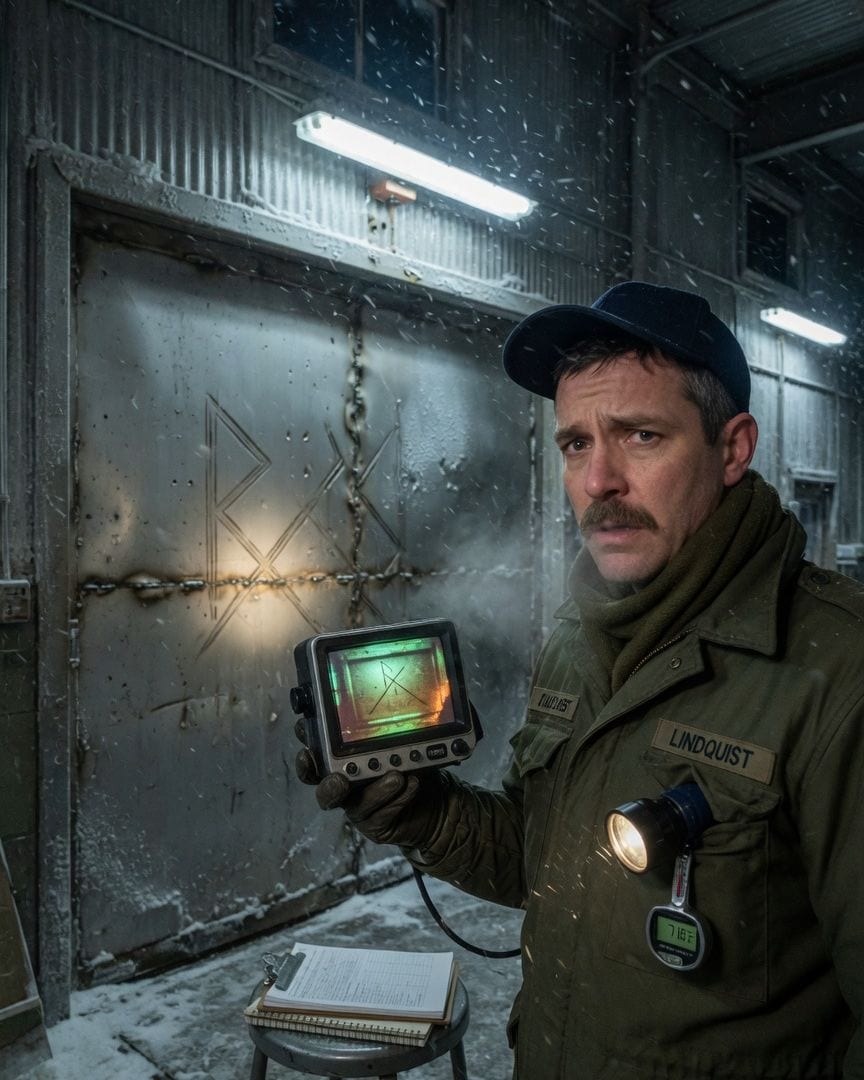
A methodical Cold War sergeant found a strange symbol etched into his sealed hangar bay. He then saw the exact same mark glowing *inside* it.
Technical Sergeant Wes Lindquist endured Alaskan winters, his duty in the vast, frigid hangar simple: log Bay Two’s temperature. The bay, sealed shut for months, inexplicably ran nine degrees warmer than the icy building for 111 straight nights in 1978. Despite official dismissal, the numbers kept climbing, forcing Lindquist to keep a secret log as the bay’s internal heat reached an impossible 72 degrees. Driven by cold certainty, he discovered a faint, unsettling symbol etched along the door's weld. Later, peering through a tiny seam with a borescope, he saw the identical mark shimmering with a fresh, orange glow from *inside* the supposedly empty, sealed bay.
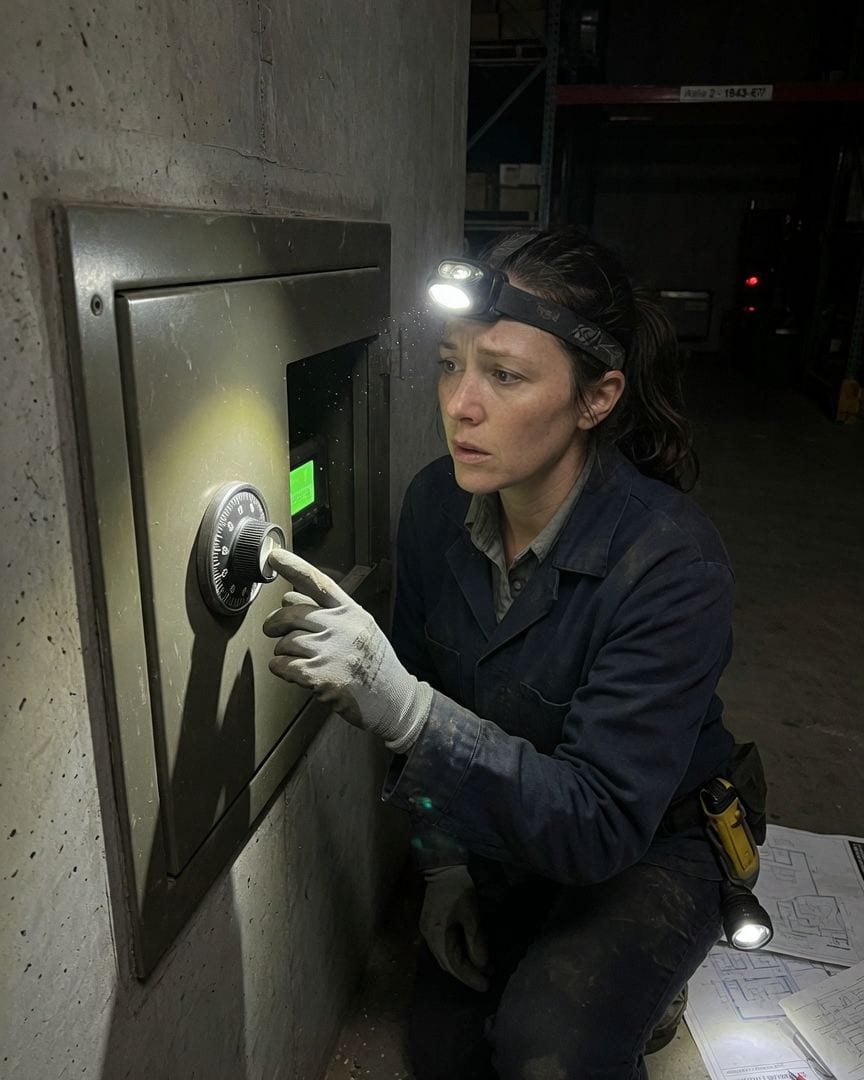
A meticulous records clerk finished her final inventory in a Cold War depot, then found a steel door not on any blueprint, worn smooth by decades of use, opening to an office with a log updated just hours ago.
Merit Lachance moved through the echoing darkness of Building 9, her headlamp cutting a lonely circle through dust motes. The depot’s oldest section was losing power, leaving her to finish her mandated shelf-read for the impending decommissioning. Every blueprint showed Building 9 as a single, vast room, so when her light fell on a waist-high, solid steel door set flush into the wall, her mind reeled. Its combination dial was worn smooth from decades of constant use, an impossible contradiction to the building’s known history. After meticulously working the dial, the heavy door shifted inward, revealing a dust-free, actively maintained office space with a terminal log updated just hours ago.
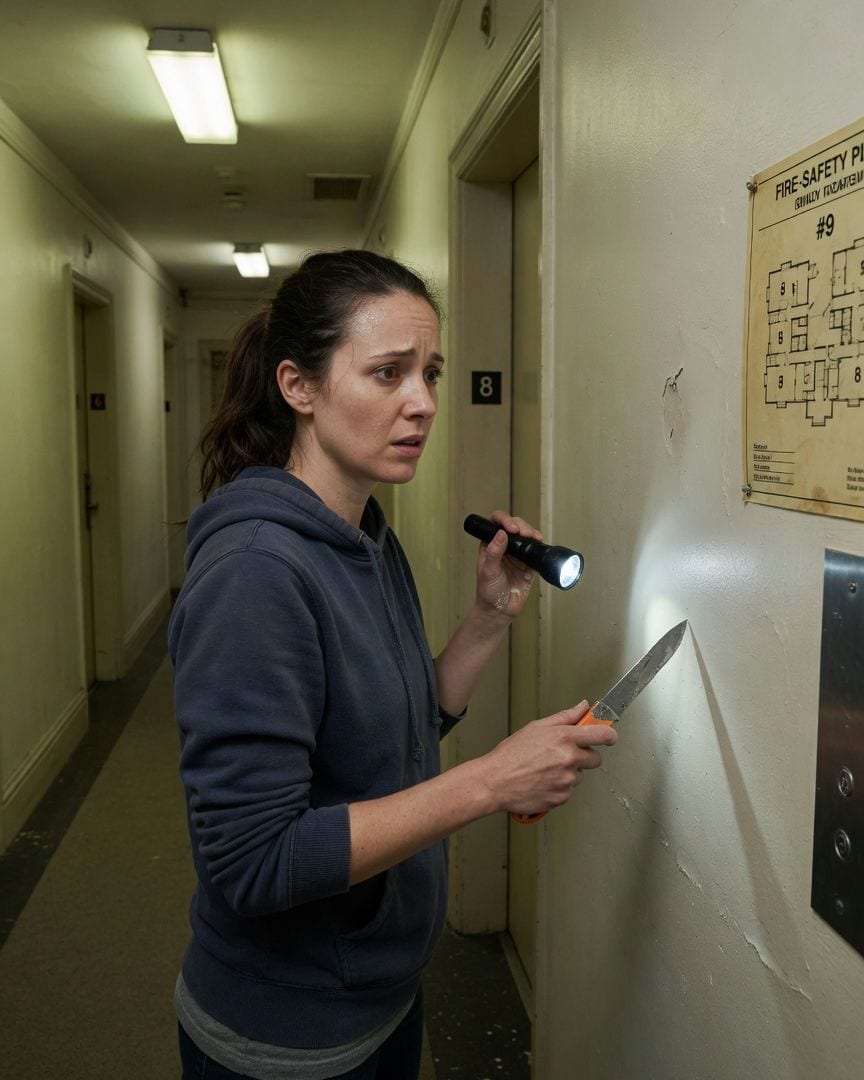
That blank wall in my hallway has a hidden metal plate. Tonight, after eleven years, it just clicked.
For eleven years, my apartment building's fire plan has shown nine apartments on my floor. But I've only ever counted eight doors, the space for the ninth a blank wall. Now, I've found a hidden metal plate behind the plaster, and from deep within, I just heard a soft *click*.
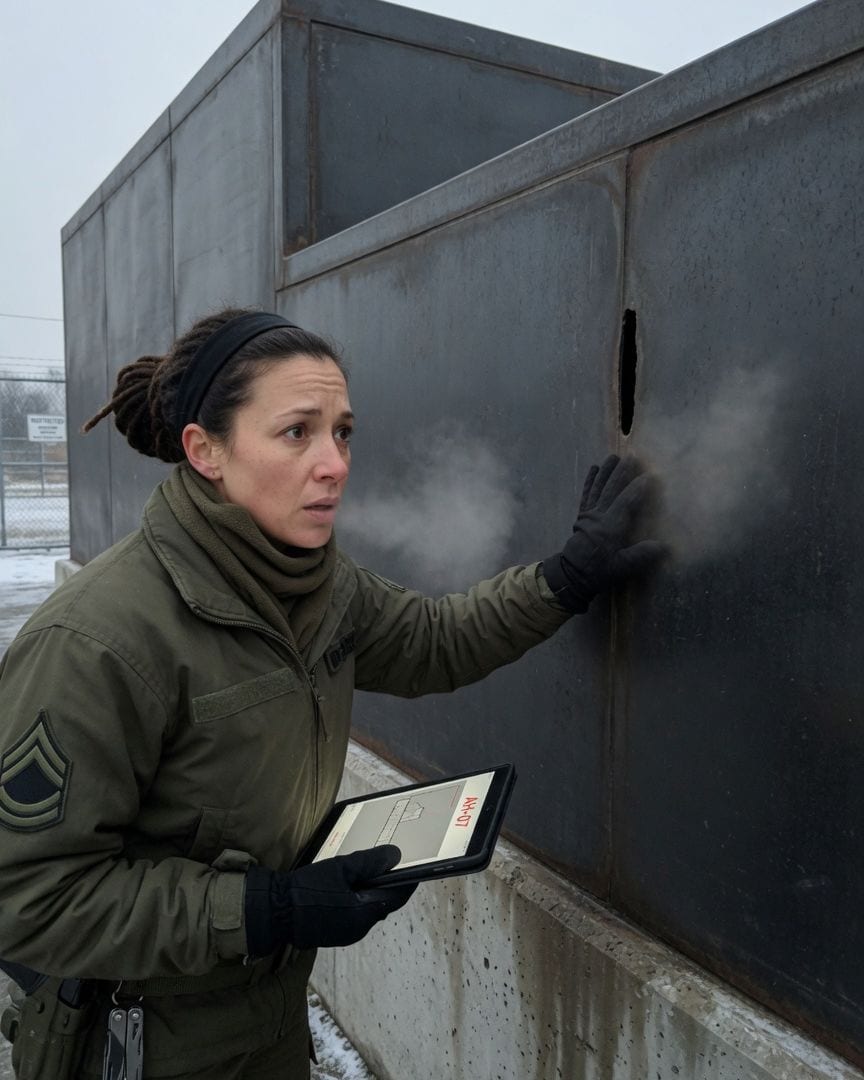
A Sergeant's audit uncovered an annex with no records. She pressed a hidden lever, and its steel wall hissed open to a sliver of impossible darkness.
Sergeant Iris Kowalczyk, a stickler for order, meticulously prepared for her transfer audit of the seventy-year-old installation. An annex behind the old post hospital defied all logic: no keyway, no maintenance record, no year built — it simply *was*. On a biting cold morning, she felt an undeniable warmth radiating from its thick, featureless steel, as if something active hummed beneath. Her fingers found a hairline seam, then a hidden, recessed pressure point that felt like a lever. When she pressed it, the steel hissed inward, revealing a sliver of impossible darkness from which a deep, electric hum and a heavy stillness pressed out. What secrets did this impossible structure conceal?
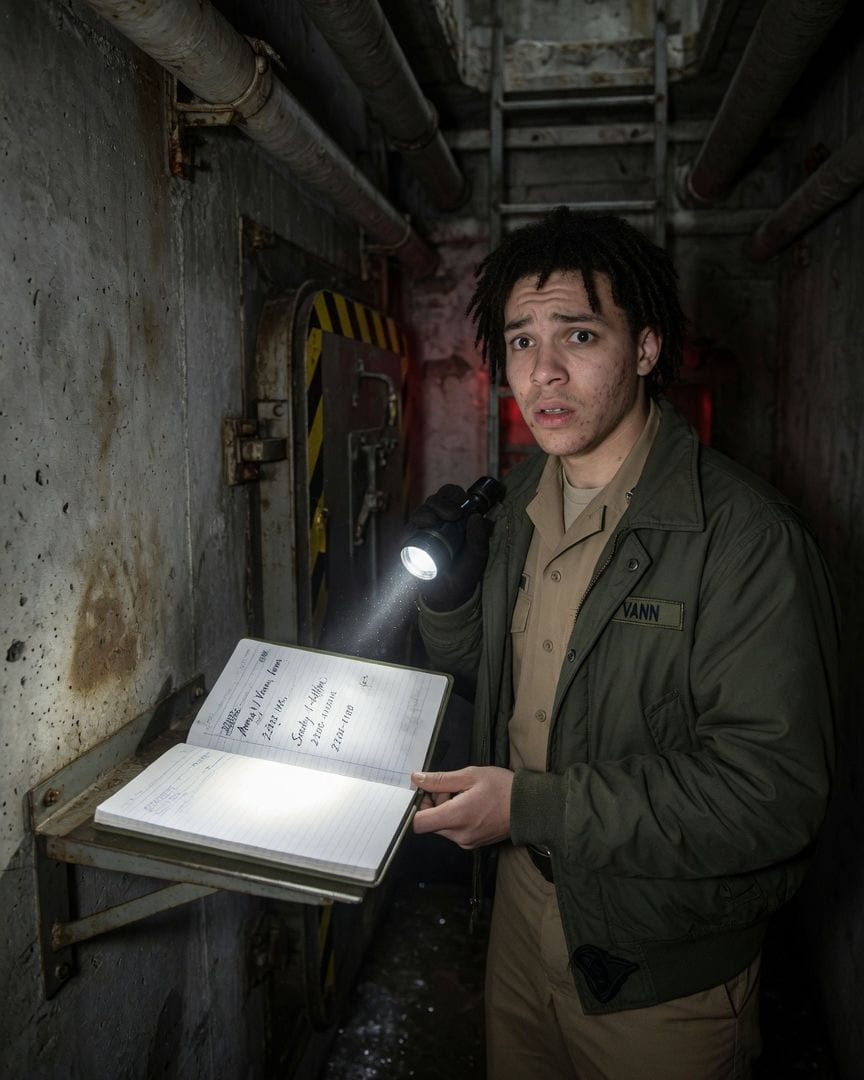
On his last patrol, Airman Vann sees a Cold War silo hatch light up from *inside*—it was welded shut a decade ago.
Airman Vincent Vann was on his last patrol across a vast, desolate Cold War missile field in the Dakotas, the cold, starless sky mirroring the emptiness of the landscape before his transfer. His routine check of eight hardened silo caps was shattered when a red fault light pulsed on Silo 4’s access panel, signaling an impossible breach from *inside* a hatch sealed for a decade. As more silos lit up, ignoring base orders, Vann found the hatch unlocked from within and descended into the dark shaft, where he discovered a pristine logbook bearing his own signature next to a chilling entry from a non-existent sentry, dated for *that very night*. Now, a steady *thump* echoed from deeper within the sealed concrete, leaving the Airman desperate for an explanation that simply wasn't there.
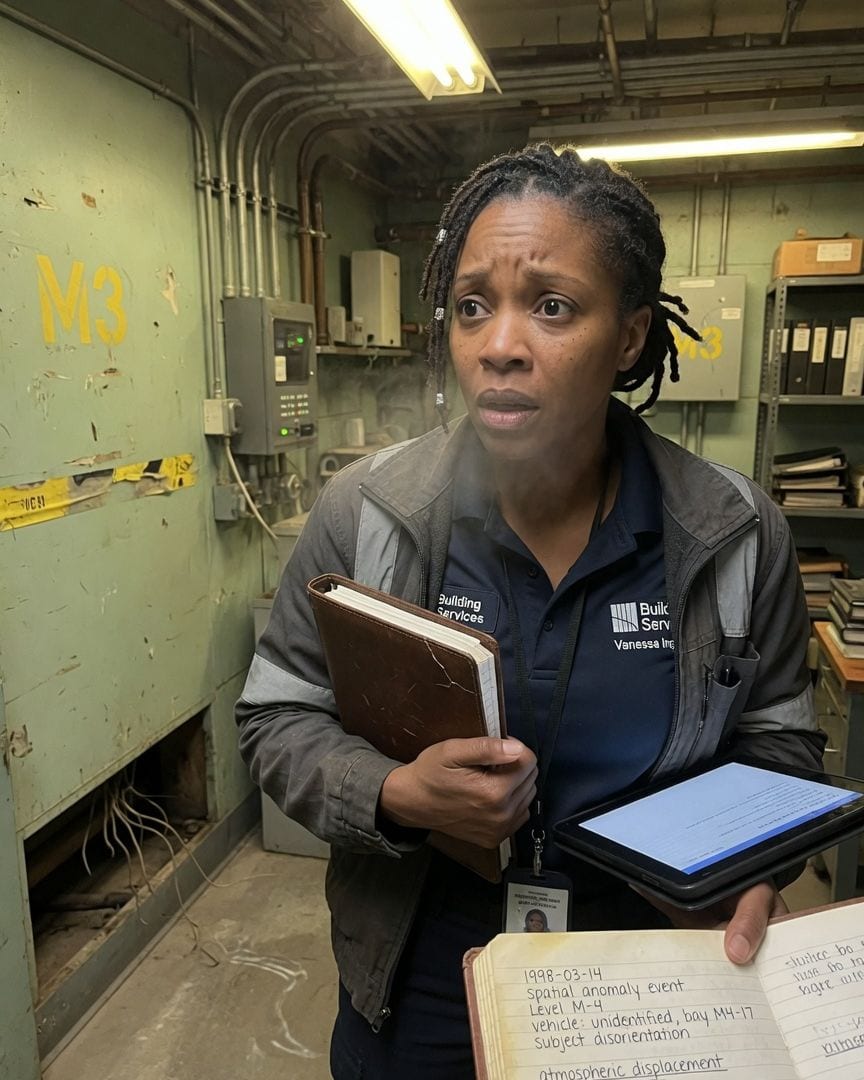
The lift offered a level below the lowest one, so I took the stairs down a flight that has never existed — into cold, empty bays where a single car sat, its engine still ticking like it had just been driven.
My routine as a Building Services Technician is usually solid, but today, the building offered a fourth basement level, M-4, that shouldn't exist. Descending into its frigid gloom, I found an old car tucked away in a bay, its engine ticking softly as if it had just arrived.