An archivist finds a Cold War file missing from its shelf, but the unnaturally cold box behind it holds a radar report of something impossible.
Airman First Class Hettie Braun scanned the green sweep of her radar scope, the only light in the cavernous, humming chamber at Thule Air Base. January 1978 in Greenland meant endless night outside and bone-deep cold within the concrete bunker.
She was twenty-two, with eight days left on her enlistment, and utterly bored. Then a blip appeared.
Not on the horizon, not approaching from the vast Arctic expanse, but inside the minimum range ring—a radius that indicated anything within it was already on top of them, or, impossibly, had manifested there.
Hettie’s training kicked in. Her fingers flew over the controls, isolating the target, confirming its speed and trajectory. Zero to impossible in less than a second. The blip held steady for a moment, an undeniable presence violating every known parameter.
She raised the alert crew, her voice calm despite the tremor of adrenaline that ran through her. A Navy P-2 pilot, Daniel Calloway, was airborne within minutes, responding to the scramble. His voice crackled over the comms, tense but steady.
“I’ve got it, Thule. Visual confirmation. Left window. It’s… it’s glowing. Like a goddamn welding arc.” The scope confirmed it. An object, impossible in its placement and light, hovered in the brutal cold above the ice.
Hettie tracked the impossible craft for nine minutes, the blip a constant, infuriating dot on her screen. It held its position, then, without warning, shot straight up.
The blip accelerated vertically, a thin, impossible line against the green until it vanished past the display’s top, a limit that shouldn’t have been reached. Hettie meticulously filed her report, detailing every impossible parameter, every time stamp, every disorienting fact.
Her superiors, though clearly skeptical, processed it. The official record of something inexplicable had been logged.
Decades later, in the humid climate-controlled chill of 2023, Greg Vaughn, a 52-year-old archivist, reviewed declassified Air Force files. The institution was undergoing a massive renovation, its old systems slowly yielding to digital.
He came across Hettie Braun’s report, flagged in the digital database with a peculiar, blank accession number slot. It was an entry with no entry, a placeholder for absence.
Greg assumed a system glitch, a lingering error from an incomplete transfer. He pulled up the metadata, noting the original physical location.
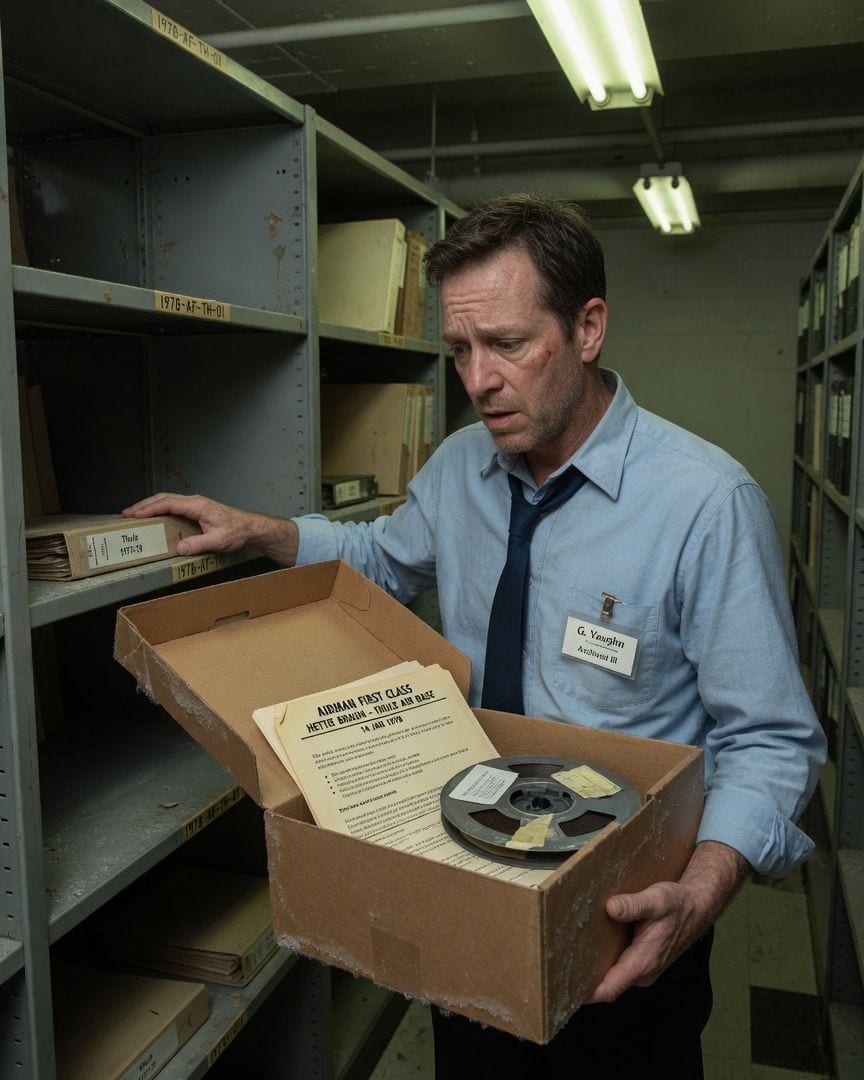
He walked the silent, echoing aisles of the archive basement, the fluorescent lights humming overhead, past row after row of steel shelving units. He found the corresponding shelf slot marked ‘1978-AF-TH-01,’ precisely where the digital record indicated it should be.
It was empty. The file was there in the digital ether, confirming the event, but the physical proof, the tangible report, was absent—a void in the system.
Frustrated, Greg ran his hand along the smooth, cool steel of the empty shelf slot. His fingers brushed against something hidden, pushed back hard against the rear wall of the shelf unit, behind the blank space.
He had to wedge his hand in, pulling at it, until it slid forward. It was a plain, unmarked brown box. No accession number, no label, no identifying marks of any kind. He lifted it.
It was unnaturally cold to the touch, as if it had been stored in a freezer, despite the room’s ambient sixty-eight degrees. He pulled open the lid.
Inside, tucked neatly into the box, sat Hettie Braun’s original incident report, dated January 1978, resting atop a single, unlabeled reel of scope tape.
Greg carefully examined the box and its contents under the bright task light on his desk. The reel was clearly an original, a magnetic tape from the era, matching the technical specifications for Hettie’s radar scope data.
The box itself was simple, sturdy cardboard, but its persistent, unnatural coldness was disturbing. He found an old, clunky tape reader in a storage closet, dusted it off, and threaded the reel onto its spindles.
The screen flickered to life, showing the familiar green sweep, then the impossible blip, tracking its nine minutes, then the vertical ascent, just as Hettie had described.
He meticulously cross-referenced Hettie’s typed report against the visual data on the tape, finding perfect, chilling agreement. Every data point, every time stamp, every impossible detail matched.
He tried to formally log the box and its contents into the archive’s system. He attempted to enter the blank accession number. The system rejected it, again and again, returning an error message: “INVALID ACCESSION NUMBER. ENTRY NON-EXISTENT.”
He tried to create a new entry, but the system insisted on a valid existing number to link the new item to. The box, with its impossible contents, simply could not exist within the archive’s official framework.
He consulted Maureen Ford, a spry 76-year-old retired archivist, still sharp as a tack, who occasionally volunteered to help with reorganization. He showed her the box, the report, the tape, explained the blank accession number.
Maureen’s eyes, usually twinkling with good humor, grew distant. She recalled whispers from her early days: 'unmarked boxes' that 'weren't on any list.' She’d never seen inside one, never touched one, but the stories were enough.
“Leave them be, Greg,” she advised, her voice unusually flat. “Some things… they don’t want to be found.”
She then mentioned a specific aisle in the basement, B-7, the one that always felt ‘off’ to her, subtly too long, by just a few feet, for the known dimensions of the building.
Ignoring Maureen’s warning, Greg plunged deeper. He started searching the restricted digital archive using the ‘blank accession number’ from Hettie’s report as a key. He cross-referenced it with other 'missing' or 'unaccounted for' files, records that officially simply vanished.
He uncovered faint, almost erased mentions of the exact same blank designation in dozens of cases, some dating back decades, spanning different military branches—Air Force, Navy, even a few obscure Coast Guard reports.
A pattern, clear and terrifying, began to emerge.
As he dug deeper, subtle anomalies began to occur around him. His access card, usually infallible, occasionally failed in specific areas of the building, notably around the basement access.
Files he was actively working on were subtly rearranged on his desk overnight, not stolen or altered, just shifted, a pen moved, a paperclip changed.
He tried to rationalize it – a system glitch, a new security measure, tired eyes – but the instances multiplied, becoming too frequent, too precise.
He started to feel an unsettling sense of being observed, a prickle on the back of his neck even when the archive was empty. One morning, a cryptic, unsigned note appeared on his keyboard, slipped beneath his monitor.
It was typed on an old, manual typewriter, not a laser printer, the letters slightly askew. ‘Some things are filed, not lost. Don’t look for the others.’
Greg confronted his supervisor, Walter Davenport, about the growing pattern and the anonymous warning. He laid out the evidence, the cross-referenced files, the recurring blank accession number. Davenport, 55, remained perfectly calm, almost unnervingly so.
He dismissed Greg’s findings as a 'known glitch' in the old system, a 'legacy error' that sometimes corrupted old entries. “The system isn’t perfect, Greg. You know that.”
Greg pressed, his voice tight. “This isn’t a glitch, Walter. It’s a pattern. The same blank number on dozens of cases, going back decades. USS Eldridge, Flight 19… there’s even a reference to Roswell. And now Hettie Braun.
These aren’t just blank. They’re missing with the same non-existent designation.” He pushed a printout of the cross-referenced spreadsheet across Davenport’s desk, highlighting the recurring blank string.
Davenport’s composure finally cracked, just slightly. A muscle in his jaw twitched. He picked up the printout, his eyes scanning the highlighted lines. He sighed, a slow, deliberate exhalation. “Alright, Greg. Look, some records… they are handled differently.
It’s an old designation. Very old.” He leaned forward, his voice dropping, though his eyes remained unsettlingly placid. “The blank accession number isn’t an error. It’s a… a designation of non-existence. For things that never officially were.
In the public record, at least.” He paused, letting the implication hang in the air. “It’s above our pay grade, Greg. Always has been. My advice? Drop it. Don’t look for the others. Some knowledge isn’t meant for us.”
The chilling lack of urgency in his tone was the worst part. Greg suddenly understood. The blank number wasn't an error. It was a category. The 'missing' events weren't mistakes; they were filed as part of a deliberate, hidden process.
Ignoring Davenport’s veiled threat, Greg returned to his terminal, the words ‘designation of non-existence’ echoing in his mind.
He used the blank accession number as a search term across a restricted internal database, one usually locked down for all but top-level security clearances.
He found dozens of entries, stretching back to the 1940s: ‘USS Eldridge,’ ‘Flight 19,’ ‘Roswell,’ and more recent, unpublicized incidents, all marked with the same non-existent number. It was a digital map of the disappeared.
The latest entry was from just last year, an 'unaccounted for' research vessel, latitude and longitude listed under 'last known coordinates.' Greg’s fingers trembled as he copied the coordinates and pasted them into his mapping software.
The program whirred, then the pin dropped. It landed on an isolated, recently acquired parcel of land, owned by a shell corporation, directly adjacent to the archive's own secure facility.
He zoomed in, the satellite image sharpening. He saw a faint, almost invisible structure on the satellite image – a single, windowless building, a dark rectangle against the scrubland.
Its dimensions were exact, identical to the 'longer-than-the-building' aisle in the archive's basement, the one Maureen had mentioned. There were no visible access roads, no entrances.
As he leaned closer, straining to make out details, the screen flickered once, twice, then a single, brief line of text appeared, unbidden, over the image, glowing a stark red: 'ACCESS DENIED. FILE OPEN. BRAUN, HETTIE.'
Chilled to the bone, Greg understood. The 'longer aisle' in the archive, the one Maureen Ford had found subtly disorienting, wasn't an architectural anomaly, or some structural oversight.
It was a physical link, a conduit, to that hidden facility next door. The archive itself wasn't just a dusty repository of old papers and forgotten truths; it was an active component of the secrecy machine.
The 'blank accession number' wasn't a classification for unexplained phenomena, or a code for things that had merely vanished without a trace. It was a designation for things that were processed by this machine.
Hettie Braun’s UFO, glowing like a welding arc, wasn’t an external craft invading airspace but a manifestation from this hidden mechanism, brought into physical existence to be ‘filed.’
The unnaturally cold box, the still-being-written file—it was all interconnected, a systemic operation.
The entities weren't invaders to be fought or mysteries to be solved; they were an intrinsic, managed part of this system, manifesting and receding through specific 'filing' processes.
The archive, with its strange aisle and its hidden counterpart, was not merely recording these events. It was a mechanism, and the 'filing' was how their presence was contained, controlled, perhaps even enabled.
The institution wasn't fighting them; it was operating them, a silent, patient horror.
Knowing he couldn't go to any external authority—who would believe him? And what proof would survive beyond the grasp of this pervasive system?—Greg made a decision. He had to expose it.
He worked through the night, a frantic urgency driving him. He copied all the files, the scope tape data, the evidence of the recurring pattern, onto an encrypted drive. Every line, every timestamp, every impossible coordinate.
The clock on his screen crawled towards dawn.
As the first gray light touched the high windows of the archive, he heard it: a faint, metallic groan that vibrated up from the floor below. The unmistakable sound of heavy machinery, a low, grinding hum.
It was coming from the basement, from the 'longer aisle,' directly beneath him. The hidden building next door, the one on the map, was active. They were filing something. Or someone.
He packed his bag, the encrypted drive clutched tightly in his hand, ready to leave, ready to leak everything. He made for the main exit, his heart pounding a frantic rhythm against his ribs.
As he reached the door, he swiped his access card. It failed. The lights in the hallway flickered, plunging the long corridor into near darkness.
The air grew unnaturally cold, heavy with a low, resonant thrum that vibrated through the floorboards and up into his teeth. He tried another door, then another, frantic now. All locked. He was trapped.
Then, from the direction of the basement entrance, he heard it: slow, deliberate footsteps approaching, growing louder with each beat of his heart.
The next morning, Greg Vaughn’s office was meticulously clean. His computer was wiped. The copied files, the cross-referenced spreadsheets, the research vessel coordinates – all gone.
The plain brown box and Hettie Braun’s original report, along with the unlabeled tape, were nowhere to be found. The peculiar, blank accession number slot in the digital database was now truly blank, indistinguishable from any other unassigned field.
The space on the physical shelf where he had found the box was empty, as if nothing had ever been there, nothing had ever been found.
Greg Vaughn was seen later that week, back at his desk, working diligently. He greeted his colleagues with a quiet, polite smile. He seemed… calmer. More focused. When Walter Davenport passed his desk, he paused. “Everything clear, Greg?”
he asked, his voice low. Greg looked up, his smile unwavering, his eyes holding a depth that wasn’t there before, an unsettling placidity. “Perfectly clear, Walter,” he replied. “The files are all in order.
And the new ones… they’re being signed.” The new accession numbers, of course, wouldn't exist on any official list.
If this one got to you
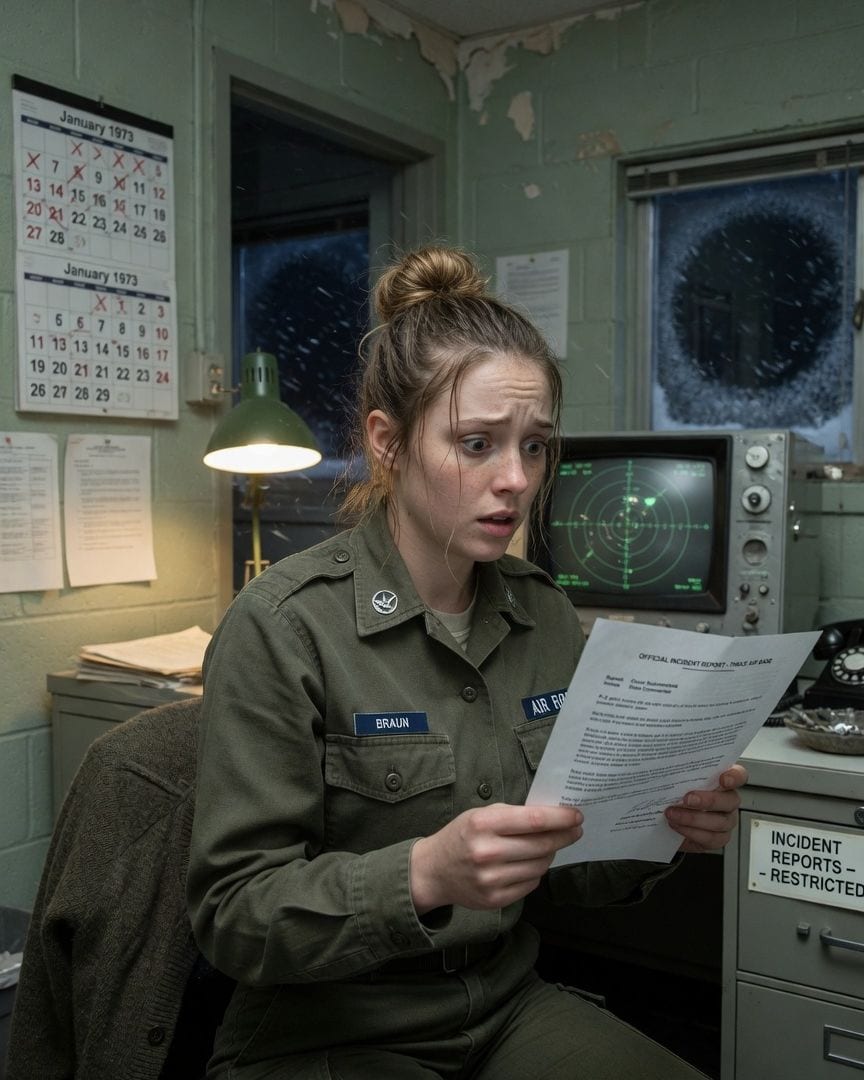
Cold War Airman Colette Braun's radar tracked a craft *inside* its own minimum range, then her official report changed the pilot's visual.
Airman First Class Colette Braun, 24, was counting down her final eight days at Thule Air Base in the monotonous Arctic winter of 1973. Her routine radar sweeps were broken by an impossible blip, a craft appearing *inside* the scope’s minimum range, confirmed visually by a Navy P-2 pilot. After its impossible vertical ascent, Colette overheard her Base Commander discussing "containment." On her last day, the official report arrived, stating the pilot saw "no visual contact." What did Colette truly witness, and why was her account altered?
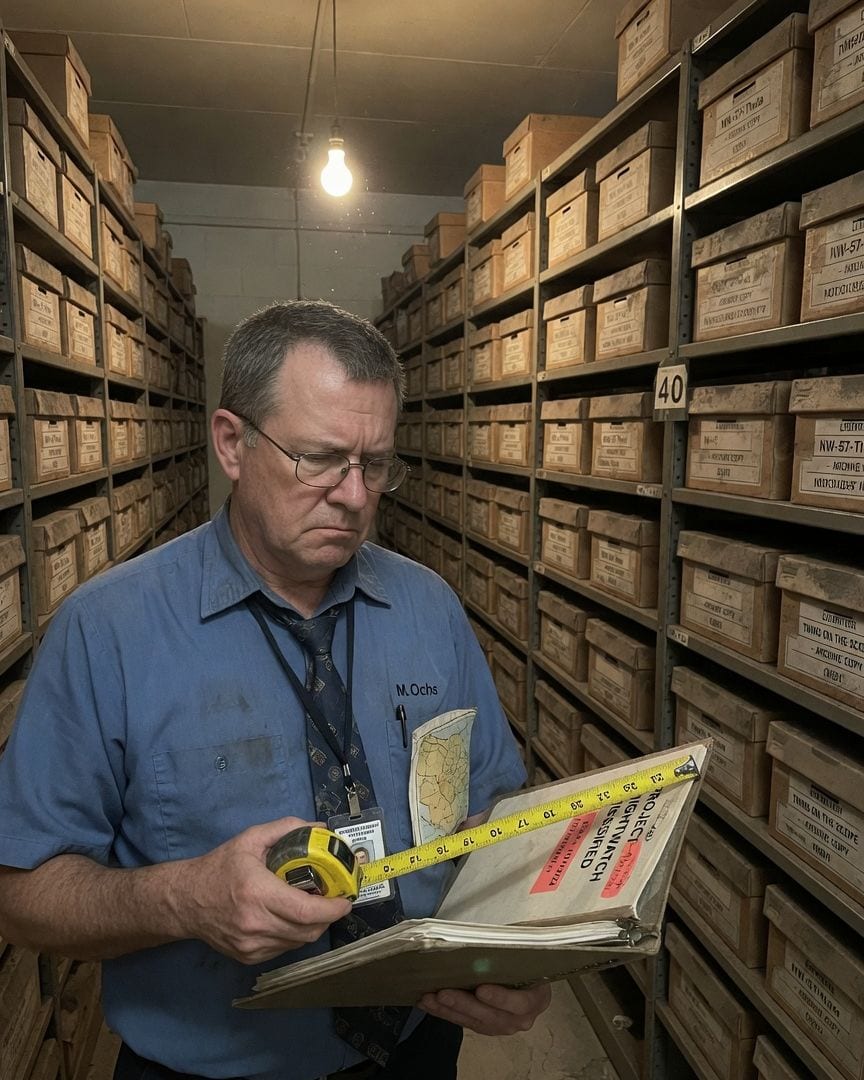
A Cold War records clerk on his final patrol found Aisle 40 stretched 61 feet longer, lined with unknown boxes. Inside one: 'PROJECT NIGHTWATCH - CLASSIFIED' with a fresh timestamp.
Marlin Ochs, a creature of habit after nineteen years at the St. Louis federal records depot, faced his final patrol through Aisle 40 before its scheduled pulping. His routine walk, usually 92 precise strides, suddenly stretched to an impossible 119, making the aisle 61 feet longer than its blueprint. The extra section felt colder, lined with dust-laden boxes bearing alien classification codes and no manifest. Inside one, he found a metal-bound file: 'PROJECT NIGHTWATCH - CLASSIFIED,' dated 1957, but with a timestamp just hours old.
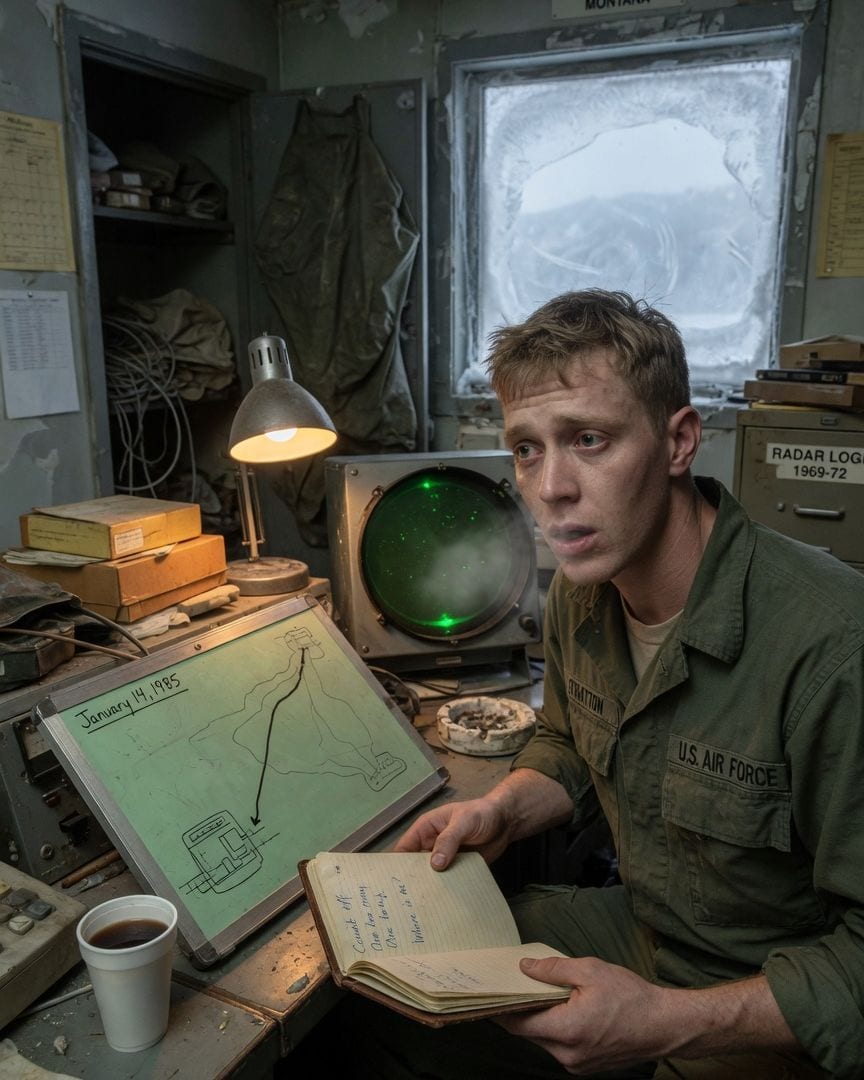
Airman Lars Stratton found an old Cold War manifest listing one name twice: 'Bernard Radcliffe' transferred and 'Bernard Radcliffe' still present.
Airman Second Class Lars Stratton was counting down his final weeks at Echo Station, a desolate Cold War outpost due for mothballing. He longed for home, far from the bitter Montana winds and the constant hum of static. Inside the dim radar shack, he logged the usual nightly ghost blip, a faint contact appearing at 2300, just as it had every winter since 1987. This night, a metallic tang like old blood lingered in the air, raising the hairs on his arms. Seeking distraction, Lars later discovered a leather-bound logbook from 1971, detailing the same 2300 contact, but with chilling notes and a manifest listing one airman's name, Bernard Radcliffe, twice—once transferred, once present. Was he truly alone in the silent, remote station?
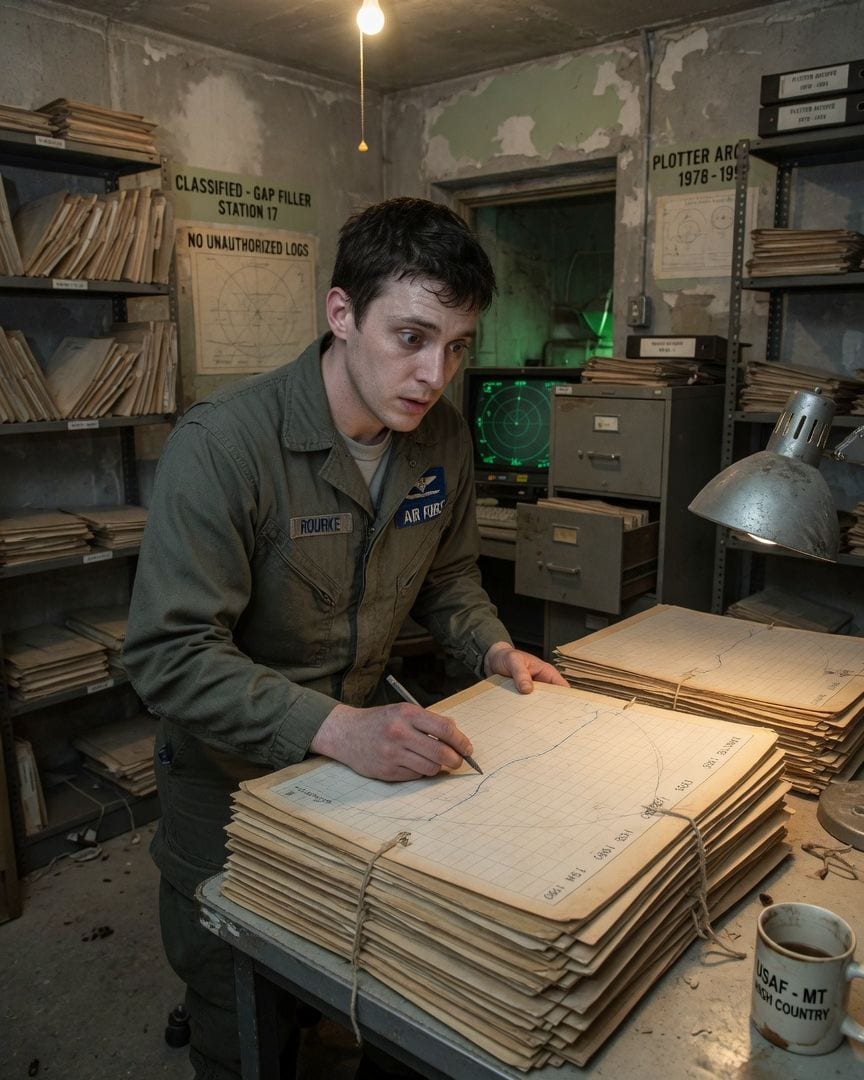
An Airman tracks a nightly radar contact. But in dusty archives, he finds old Cold War plotter boards, each showing that exact same line drawn by other airmen for three winters.
Airman Second Class Felix Rourke endured the cold, quiet nights at his isolated Cold War station, watching the perimeter radar. For three weeks, a single, slow contact appeared at 2300 hours, a precise violation of every protocol that chilled him deeply. He dismissed it as an anomaly, until a hunch led him to a forgotten closet in the dusty archives. There, he unearthed old plotter boards, each revealing the exact same impossible line drawn across the valley floor at the same hour, signed by different airmen from three consecutive winters decades ago. What impossible secret did the mountain station truly hold?
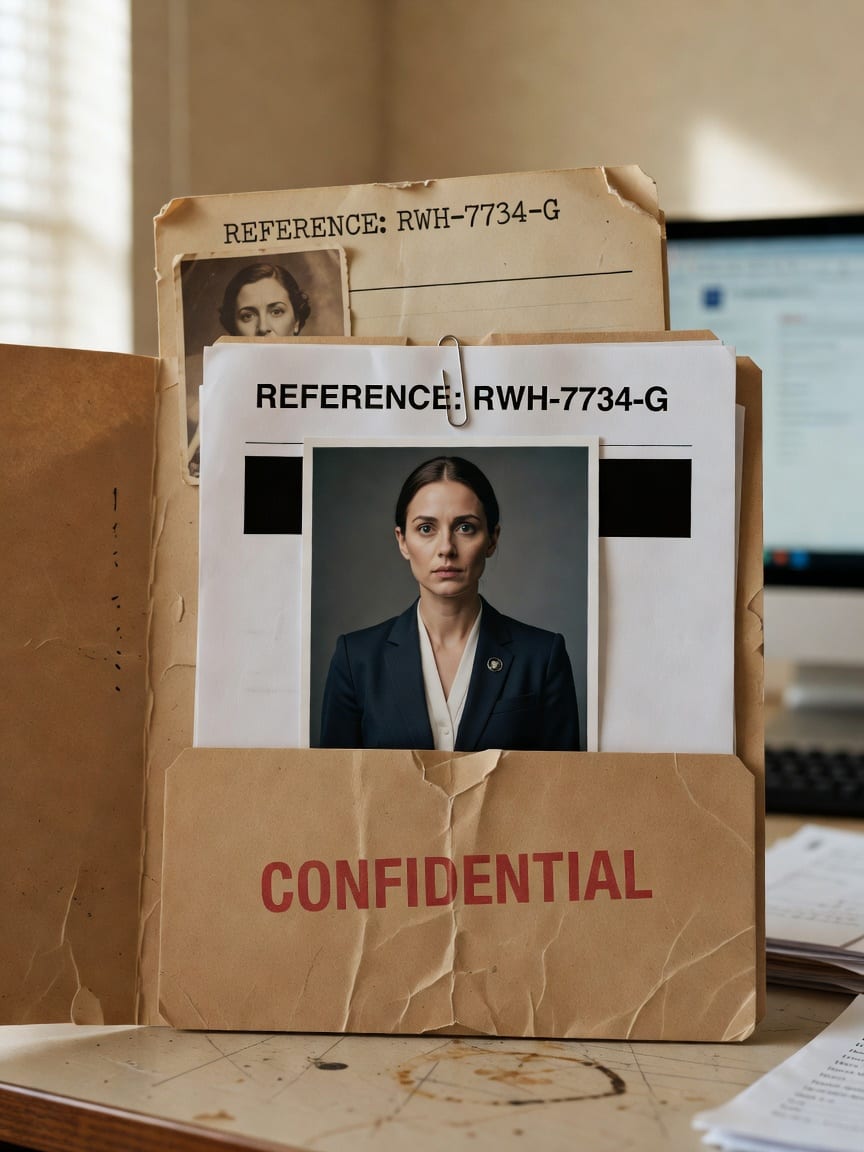
My security file was opened nine years before I was born. Its note said: 'subject not to be briefed'.
Auditing company digital records was routine until I pulled up my own personnel file. It clearly showed a 'Date Opened' nine years before I was born, yet bore my exact name and reference number. Below, an assessor's note from that impossible year mentioned a 'previous holder' and ordered the 'subject not to be briefed,' sparking a cold thrum in my chest.
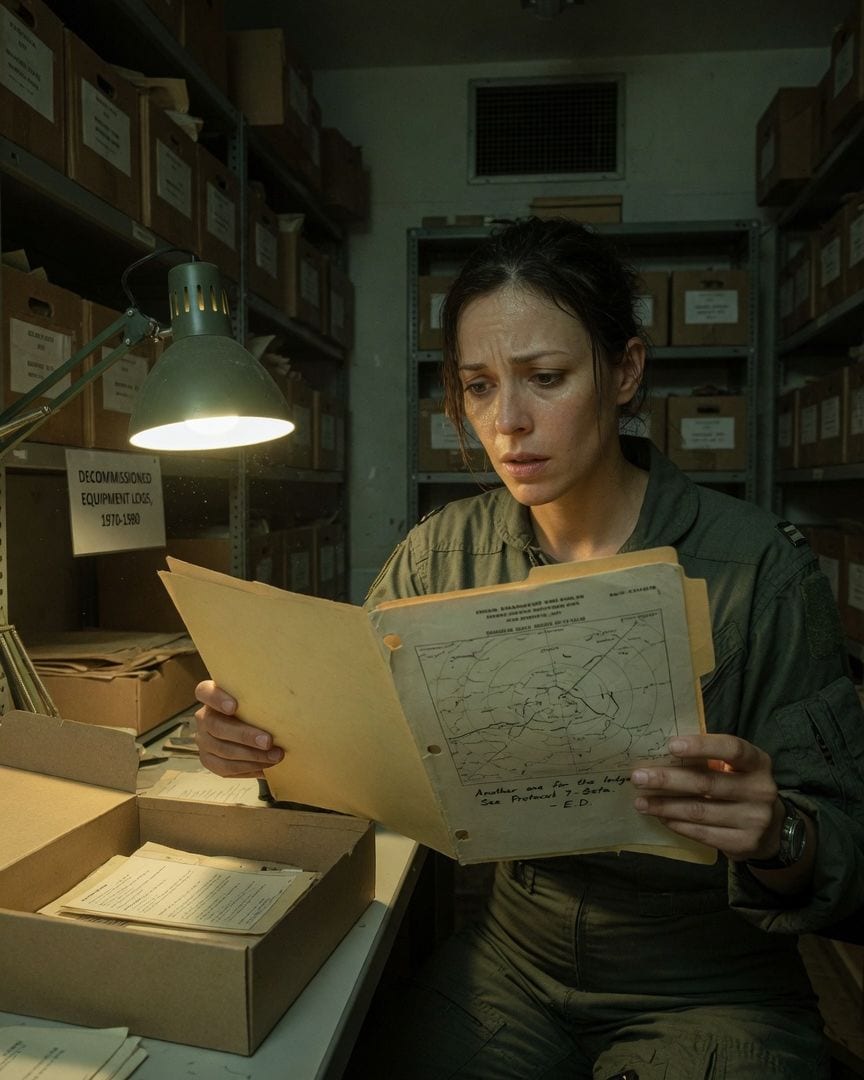
A radar captain's scope went clean, but the pilot swore a mile-wide UFO still filled his windscreen. Then she found a Cold War ledger of impossible sightings.
Captain Ines Bardolph, a 34-year-old radar operator in Bavaria, lived by the precise hum of her console. One quiet night, an impossible contact appeared over the Danube, then vanished from her scope just as a pilot swore it filled his windscreen. Replays showed the object had crossed the Alps in a single blink, defying all known physics. When bureaucracy sought to bury the incident, Captain Bardolph sought answers, leading her to a forgotten archive where a brittle folder revealed a chilling pattern: 'Another one for the ledger.'