Cold War Airman Colette Braun's radar tracked a craft *inside* its own minimum range, then her official report changed the pilot's visual.
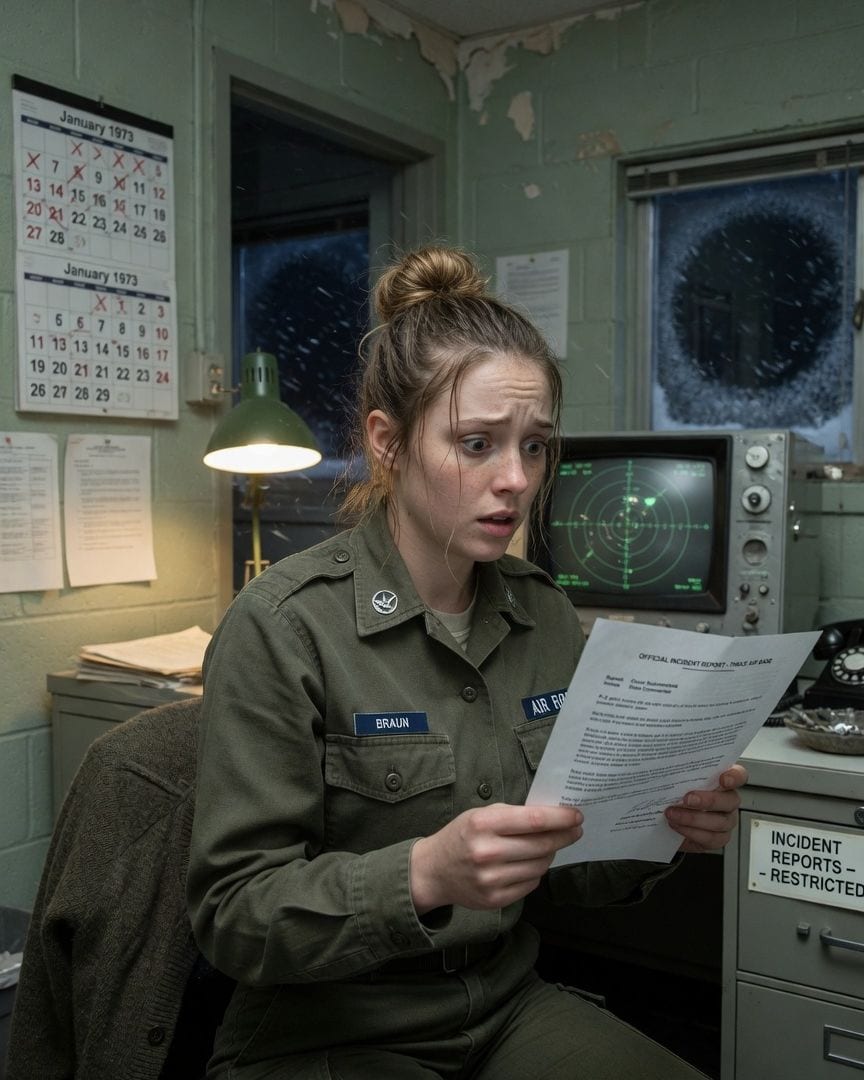
Airman First Class Colette Braun, 24, counted the eight days left until her Air Force discharge from Thule Air Base in January 1973.
The Arctic winter air hummed with the boredom of routine radar sweeps, a monotonous background thrum to her final stretch of service.
Her shift was a quiet rotation of green lines sweeping across a dark screen, interrupted only by the occasional chatter from other stations. She watched the distant, expected blips, marking known aircraft and weather patterns. Then, a new blip materialized.
It wasn't just another blip. This one appeared inside the minimum range ring, a physical impossibility, a violation of the scope's own logic.
Nothing could be there without having come from outside, and nothing could be inside without having been tracked on approach. Colette’s breath hitched, a small, involuntary gasp. Her hand instinctively reached for the comms.
She raised the alert crew, her voice tight with professional calm, masking the sudden tremor in her chest. She raised the second site, then the Navy P-2 that happened to be aloft, a patrol craft returning from a reconnaissance run.
The P-2 pilot, Desmond Granger, confirmed it out his left window, a welding-arc glow low over the ice, exactly where her scope insisted it wasn’t possible.
Colette tracked the craft for nine minutes, a ghost on her display, real yet impossible.
When it left, it shot straight up, a vertical line that climbed to the very top of her screen and vanished, not because it stopped, but because the display simply had a top, and the craft did not.
After the incident, Colette was debriefed by Base Commander Oscar Rutherford, 52. She detailed every minute with the precision of a trained airman: the impossible blip, Granger’s visual confirmation, the nine minutes of tracking, the impossible vertical ascent.
Rutherford listened, his expression unreadable, occasionally scribbling notes on a pad. The silence in his office was thick, broken only by the scratch of his pen.
Colette believed her account would be logged, filed, and perhaps, eventually, declassified into the annals of unexplained phenomena.
She tried to make sense of the experience herself, running through atmospheric conditions, equipment malfunctions, even the remote chance of an undiscovered experimental craft, but none of it fit the sheer impossibility of what she had seen.
Days later, while walking through a deserted corridor, the heavy arctic winds rattling the windows, she overheard Rutherford’s voice. It was a hushed conversation from behind a closed door, about 'containment' and 'managing the narrative.'
A chill snaked down her spine, colder than the outside air. The words felt too precise, too clinical for a simple radar anomaly, too deliberate. They hinted at something more than just processing an unusual report.
With only days left until her discharge, a disquieting urgency settled within Colette.
She felt an urgent need to see the preliminary incident report, to confirm her own sanity, to have a tangible record of what she’d witnessed, one that wasn't filtered through Rutherford's clinical words.
She told herself it was for peace of mind, a final closure before she returned to civilian life. She submitted a request through official channels, citing a need for 'personal record-keeping' before her departure.
It was a long shot, but she had to try.
On her last day at Thule, as the last of her gear was packed and the final papers processed, a sealed envelope arrived at her station. It felt heavy, substantial.
Inside was a copy of the official incident report, signed by Oscar Rutherford. The base around her seemed to hold its breath.
Colette’s hands trembled slightly as she unfolded the crisp paper, the faint smell of fresh ink hitting her nostrils. Her eyes scanned the dense blocks of text, searching for Desmond Granger’s name, for the line confirming his visual contact.
She found the section detailing the P-2’s involvement. Her gaze locked onto the words, and the air left her lungs in a silent gasp.
The line, which she distinctly remembered typing into the preliminary report herself, the words she had chosen to clearly convey Granger's account, now read: 'P-2 pilot reported no visual contact, attributing radar blip to atmospheric anomaly.'
Colette reread the altered line, her finger tracing the cold, impersonal print. A cold certainty settled in her gut, heavier than any arctic wind. It was a lie. A meticulously crafted lie, laid out in official typeface.
She knew it, and she knew Desmond Granger, 36, knew it too. Before her discharge, still reeling from the betrayal, Colette made a point of discreetly seeking out Granger.
She found him in the officer’s mess, nursing a coffee, his gaze fixed on the steam rising from his cup. His eyes darted nervously when she approached, a telltale sign of unease that he couldn't quite mask.
Colette asked him directly about the blip, about what he had seen. He denied seeing anything unusual, his voice strained, his posture rigid. 'Orders, Braun,' he muttered, not meeting her gaze.
His eyes skittered around the room, as if checking for unseen listeners. 'Got to protect my career.'
The words were an evasion, not a denial of the sighting itself, but a confirmation of a deeper truth: a threat, or perhaps a promise, had already been made.
Colette realized she wasn't fighting a clerical error; she was up against a system, a patient, unseen hand that could bend reality.
She remembered a specific detail from her raw radar log, scribbled in the margin: a unique, almost accidental identifier she’d penned next to the blip’s coordinates, a tiny, personal shorthand.
Weeks after her discharge, now a civilian, adrift in a world that felt suddenly alien without the uniform, Colette sent a formal, if vague, request to the Air Force archives, citing 'academic research' for a copy of her original raw radar logs from that January.
She knew it was a long shot, but she had to try to find the untainted truth, the record that held her truth.
Colette’s request for the raw radar logs was denied. A formal rejection letter arrived three weeks later, devoid of warmth or explanation. It cited 'security protocols' and 'classified information,' boilerplate language that offered no real answers.
The envelope felt too thin, too dismissive for the weight of her unanswered questions. A few days after that, a plain, unmarked envelope appeared in her mailbox.
It had no return address, no postmark, just her name and address typed precisely. Inside was a single, typed note, stark and unsettling: 'Some things are better left filed.'
The message sent a shiver down her spine, a prickle of cold skin. Someone knew she was still digging. The isolation of her civilian life, so different from the close-knit, if impersonal, military community, amplified the dread.
She wasn't just being denied; she was being watched. The note was a warning, proof that her attempts to verify the truth were being tracked, her civilian status offering no protection.
She began to wonder if her discharge hadn't been a release, but a strategic move by an entity that preferred its witnesses outside the fold, easier to dismiss, easier to silence.
The air in her small apartment suddenly felt thin, restrictive. She knew then that she couldn't give up. The truth, however buried, had to be found, not just for herself, but for whatever else had been 'filed' away.
Years turned into decades. Colette, now 65, found a new purpose working as a records clerk at a civilian archive in a quiet New England town.
The meticulous work of organizing historical documents was a strange comfort, a way to impose order on a chaotic past. Her access to various interconnected databases, often cross-referencing military and civilian records, was a quiet boon.
She still thought of the blip, the impossible ascent, the lie, a ghost that haunted the edges of her memory.
In 2014, driven by that decades-old obsession, she began to discreetly search for declassified military records related to 'atmospheric anomalies' or 'unexplained radar contacts' from her time at Thule.
It was a slow, painstaking process, searching through microfiche, dusty boxes, and digitized entries, many heavily redacted. The fluorescent lights of the archive hummed with a low, constant drone.
One afternoon, deep within a box of heavily redacted documents, seemingly unrelated to Thule, she found it. It was a single, loose page, clearly an unredacted fragment of her own raw radar log from January 1973.
The paper was brittle, yellowed with age, the ink faded to a pale gray, but the impossible 'inside minimum range' reading was starkly visible, a defiant mark against the faded background.
Next to it, in her own youthful hand, was the specific, unique identifier she’d scribbled all those years ago. Below it, in clear, typed text, was the confirmation, solid and unyielding: 'Visual confirmation by P-2 pilot DESMOND GRANGER.'
The words were a vindication, a cold, hard piece of the truth she’d chased for forty years. She wasn't crazy. Her memory hadn't failed.
The humming lights of the archive seemed to brighten, then dim, as if reacting to the revelation. But the relief was short-lived, immediately replaced by a growing horror at the sheer audacity of the cover-up.
The institution had not just buried her truth; it had actively rewritten it, making her a pariah, a deluded ex-airman. The fragment was real, untouched, a ghost from a past that refused to stay buried.
Colette compared the unredacted log fragment with the official, altered report she still possessed, pulling it from its secure hiding place in her desk. The discrepancies were stark, infuriating. The clean, typed denial against the faded, handwritten truth.
But as she laid them side-by-side on her desktop, a new, far more unsettling detail caught her eye.
The paper stock of the official report’s final page, the one with Rutherford’s signature, felt subtly different, smoother, newer than the preceding pages. The archive air, usually dry, felt suddenly heavy, humid.
And the ink on the date stamp and the signature itself was too dark, too vibrant for a document from 1973. It looked as fresh as if it had been signed yesterday.
She squinted, then pulled out a magnifying glass, the tiny lens a window into a chilling truth. The date stamp on the official report's final page wasn't from 1973 at all.
It was dated not from decades ago, but from the previous month.
Beneath it, a fresh, looping signature in dark blue ink, a signature that looked chillingly familiar from other, more recent documents she’d processed in the archive, documents from this year, this month.
The file wasn't just altered history; it was still being written.
The realization hit Colette with the force of a physical blow: the cover-up wasn't a historical event, locked in the past. It was an ongoing, active process.
The file on her own incident, and likely countless others, was a living document, constantly being reviewed and amended, a patient, tireless act of falsification. The quiet hum of the archive now sounded like a low, purposeful drone.
Using her archivist access, Colette expanded her search. She looked for any military reports from the Cold War era categorized as 'atmospheric anomalies' or 'unexplained losses' that also bore recent date stamps and signatures. She found them. Dozens of them.
Files for missing ships, aircraft, even entire units, all with meticulously altered reports.
The original logs, when she could find fragments tucked away in forgotten boxes, told a different story: impossible radar contacts, strange lights, sudden disappearances, trajectories that defied physics.
The 'causes of loss' in the official reports were vague, almost identical: 'storm,' 'mechanical failure,' 'lost at sea.'
But the common thread, the true pattern, was clear: the anachronistic date stamps, the fresh, dark ink of recent signatures, and the impossible trajectories mirroring her own experience.
She saw her incident not as an isolated event, but as one small, meticulously crafted thread in a vast, patient tapestry of erasure.
The secrecy machine didn't just bury records; it maintained them, ensuring they remained 'clean,' ready for any future scrutiny, an endless, quiet act of falsification.
One afternoon, Colette was deep in her research, the archive lights casting long shadows across her desk. She was comparing a newly amended file for a missing cargo ship from 1975 with its original, fragmented log.
The official report, freshly stamped and signed, now attributed the vessel's disappearance to 'unforeseen weather conditions.' She recognized the looping signature from her own file, the same dark blue ink, a signature she now knew belonged to Oscar Rutherford.
As she examined it, a subtle shift in the air caught her attention. The heavy archive door, usually propped open, creaked shut with a soft thud. Colette’s heart seized.
Standing in the doorway, framed by the dim light of the stacks, was Oscar Rutherford. He was 93 now, his frame stooped, his skin like parchment, but his eyes, though clouded with age, held a disturbing, almost predatory alertness.
He moved with a slow, deliberate shuffle, his footsteps barely audible on the worn carpet, approaching her desk. 'Still chasing ghosts, Airman Braun?'
His voice was a raspy whisper, yet it carried the weight of decades of knowing, a chilling calm that implied absolute control. He didn't threaten, didn't raise his voice.
His calm presence, his unbothered demeanor, and the chilling implication that he had been signing these files for forty years, for decades, was the horror. He embodied the institution's relentless, unfeeling patience.
Colette realized she wasn't safe, not even after all this time, not even in this quiet archive. The machine had a face, and it was watching her.
She made a quick decision, her hand closing on the newly amended cargo ship file and her own unredacted log.
She pushed back from the desk, her chair scraping loudly on the floor, grabbed her coat, and fled, the old man’s unnerving gaze following her until she disappeared around a stack of shelves, the silence in the archive settling back in like a shroud.
Colette, shaken to her core, returned to her small apartment, the files clutched tight. Her lungs burned from her dash, but the adrenaline still surged. She knew she could not expose this without risking everything, perhaps even her life.
The pattern was too vast, too entrenched, too patient. Rutherford's calm, his age, his continued involvement—they were not just proof of a cover-up, but of a living, breathing entity that spanned generations, an institution that simply endured.
She carefully secured her evidence, not with the authorities who were clearly compromised, but in a hidden location, a quiet act of defiance against a monolithic lie.
The world outside remained oblivious, the official records pristine, the lost still 'lost' to all but the few who knew the truth.
Colette sat alone in her apartment, the weight of decades of buried truths heavy on her. The chill of the Arctic winter from 1973 seemed to linger in the room.
She looked at the unredacted fragment of her log, the ink faded but the truth stark.
She knew the file on her own incident, the one with the fresh signature, was still out there, still being quietly maintained, waiting for a final entry that might involve her.
She carefully folded the fragment, placed it into a plain envelope, and tucked it into her secure location. The quiet hum of the building around her felt less like a comfort, more like a patient, waiting breath.
She had found the truth, but the truth had also found her.
The next morning, Pamela Carver, a young archivist, found a note taped to the locked door of the restricted records room: 'Some things are better left filed.' She thought nothing of it, just a strange message from a long-gone colleague.
If this one got to you
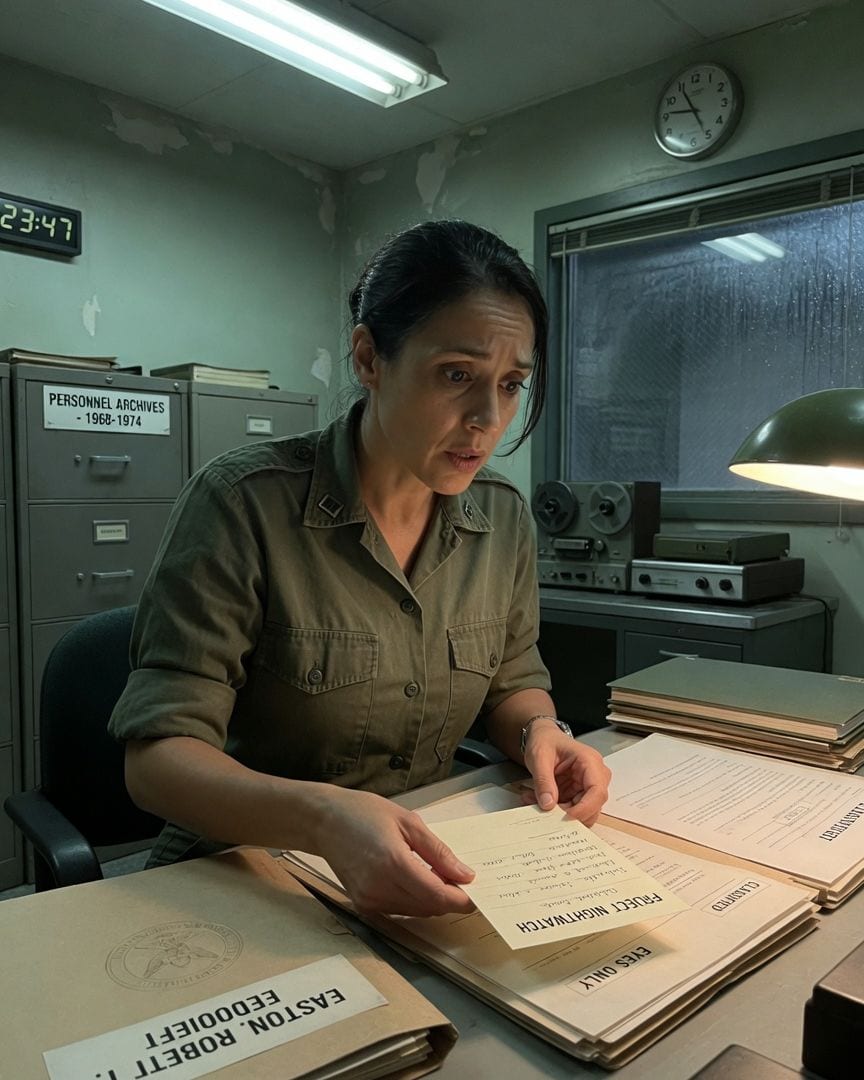
A Cold War tower controller logs an object vanish from radar, then hears the pilot scream it’s filling his windscreen. Her own name, 'Bardolph, Ines', now marked 'Observed' in a secret file.
Captain Ines Bardolph, a tower controller, was counting down the months until her transfer to Langley and the decommissioning of her base, hoping to leave behind the unsettling incidents of her final posting. But one night, her radar scope showed an impossible blip, solid and unwavering, 40 miles north of the Danube, only to vanish in less than a second, leaving a pilot screaming in terror. Despite the clear evidence, the official report blamed "atmospheric inversions," while the terrified pilot received a glowing review and promotion, his file meticulously scrubbed of any anomaly. As Captain Bardolph reviewed the pilot's pristine record, she found a hidden slip of paper, revealing a chilling truth: 'Subject: Bardolph, Ines. Status: Observed.' Was she merely an observer of the impossible, or was she now part of something far more sinister?
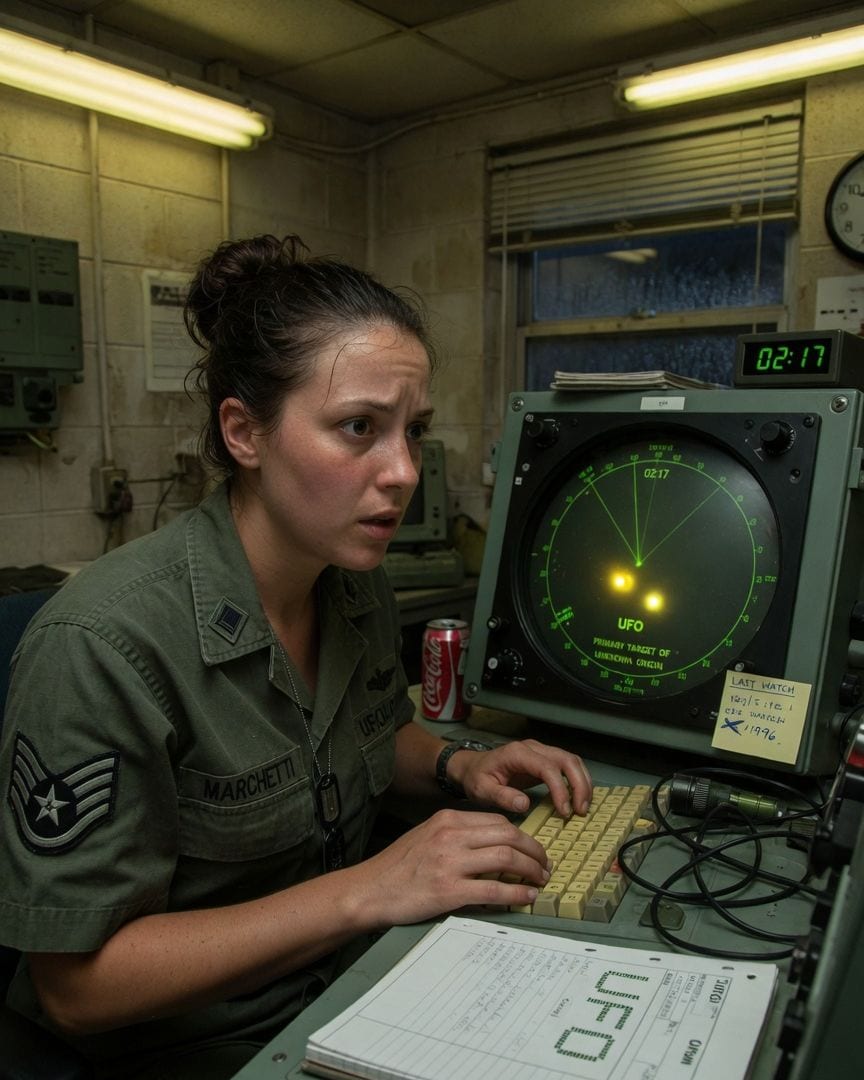
Technical Sergeant Marchetti's last watch saw an impossible radar blip merge with a plane. Later, its manifest showed a 'NO SHOW' passenger who *had* boarded, stamped 'FILE CLOSED'.
Technical Sergeant Odile Marchetti sat alone for her final watch at Gulf Coast ground control, anticipating a quiet transfer to a desk job. The dim console glow and rhythmic radar sweep were familiar, comforting sounds until 02:17, when an airliner captain reported impossible traffic flying in formation. Odile watched a second, larger blip appear on her screen, mirroring the plane's path with impossible precision. As the captain's voice, now tinged with a faint tremor, declared his plane was flying through where the object had been, the two radar returns merged into one, impossibly stable. Later, reviewing the official dismissal, Odile discovered an airline manifest listing a passenger as 'NO SHOW' who had, by handwritten note, definitely boarded—their name redacted, the file stamped 'CLOSED'.
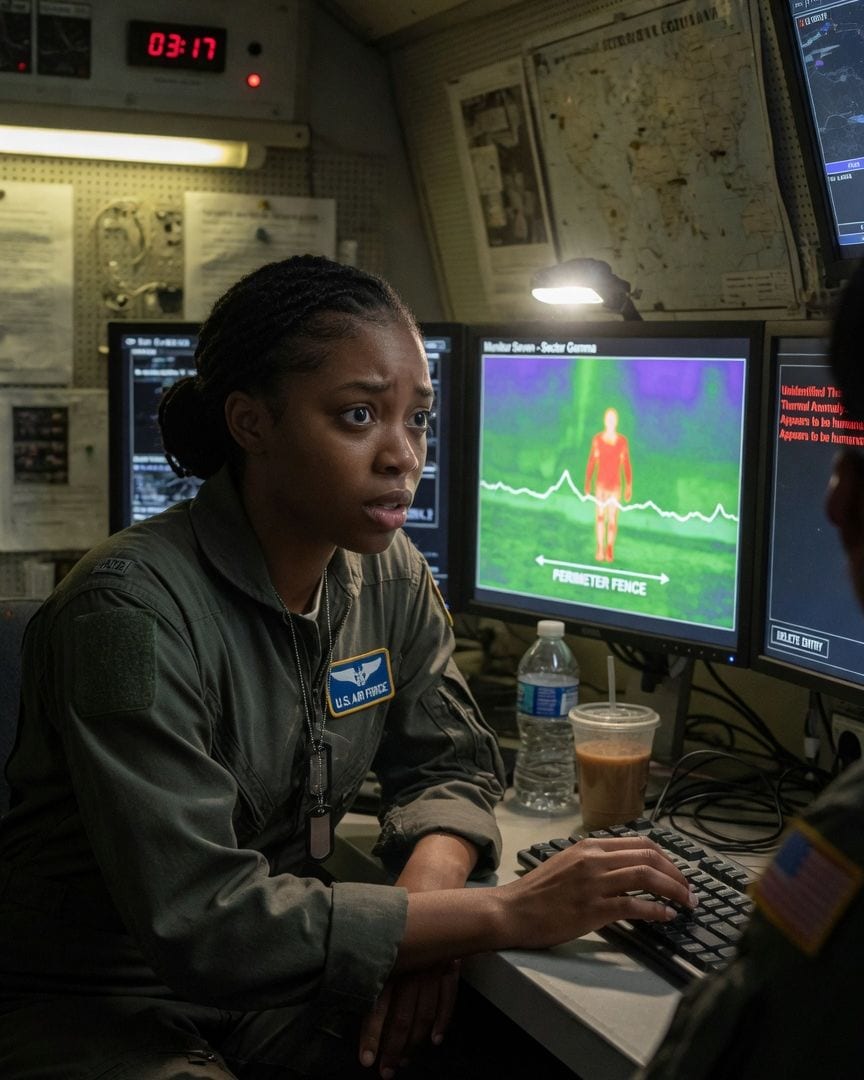
An airman’s thermal feed shows a figure moving in the restricted desert. Her captain orders it scrubbed, but the heat signature appears to tilt its head and look right at her.
Airman First Class Olivia Kade was new to her remote high-altitude outpost, fresh from advanced training, and the isolation pressed in, amplifying every hum. Her duty was to monitor the desert perimeter, but one shift, a faint thermal signature appeared on Monitor Seven: a solitary, upright figure moving with impossible precision beyond the barbed wire. No personnel were authorized in that sector. Her mission commander quickly ordered the anomaly scrubbed, but as it dissolved, the featureless outline seemed to tilt its head, looking directly into the camera. Now, the signature returns night after night, forcing the airman to wonder what impossible thing patrols the dark beyond the wire.
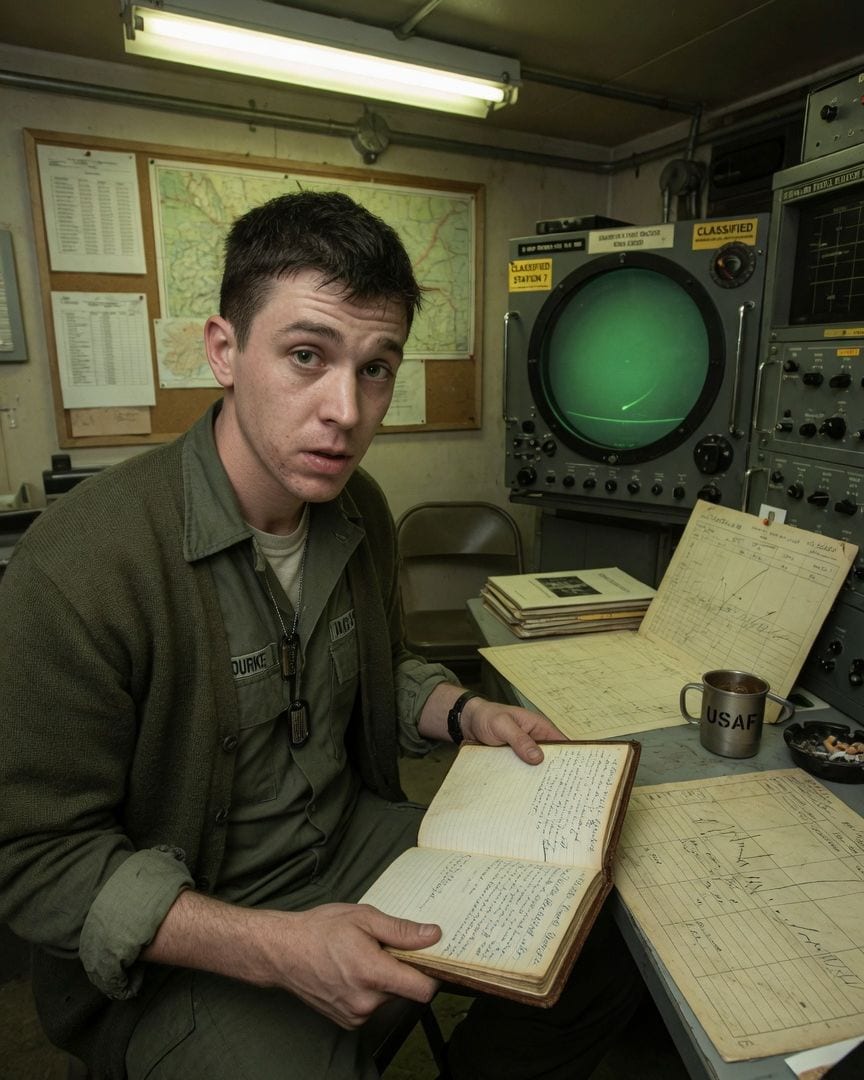
Nearing the end of his tour, Airman Rourke found an old Cold War logbook that named his nightly radar ghost: Airman Gerald Thornton.
Airman Second Class Preston Rourke was nearing the end of his two-year tour at Gap-Filler Station 7, a lonely outpost in the Montana high country. Every night, his radar screen painted a phantom contact, a slow line across the valley floor always dismissed as a temperature-inversion ghost. But while clearing a storage closet, Rourke found old plotting boards from prior winters, each showing the exact same impossible trace, drawn by different hands over successive seasons. His meticulous checks found no weather anomalies to explain the persistent radar ghost. Then, he uncovered a worn, unofficial logbook detailing more radar plots. One entry from 1968, next to an identical trace, contained a date and a name: Airman Gerald Thornton.
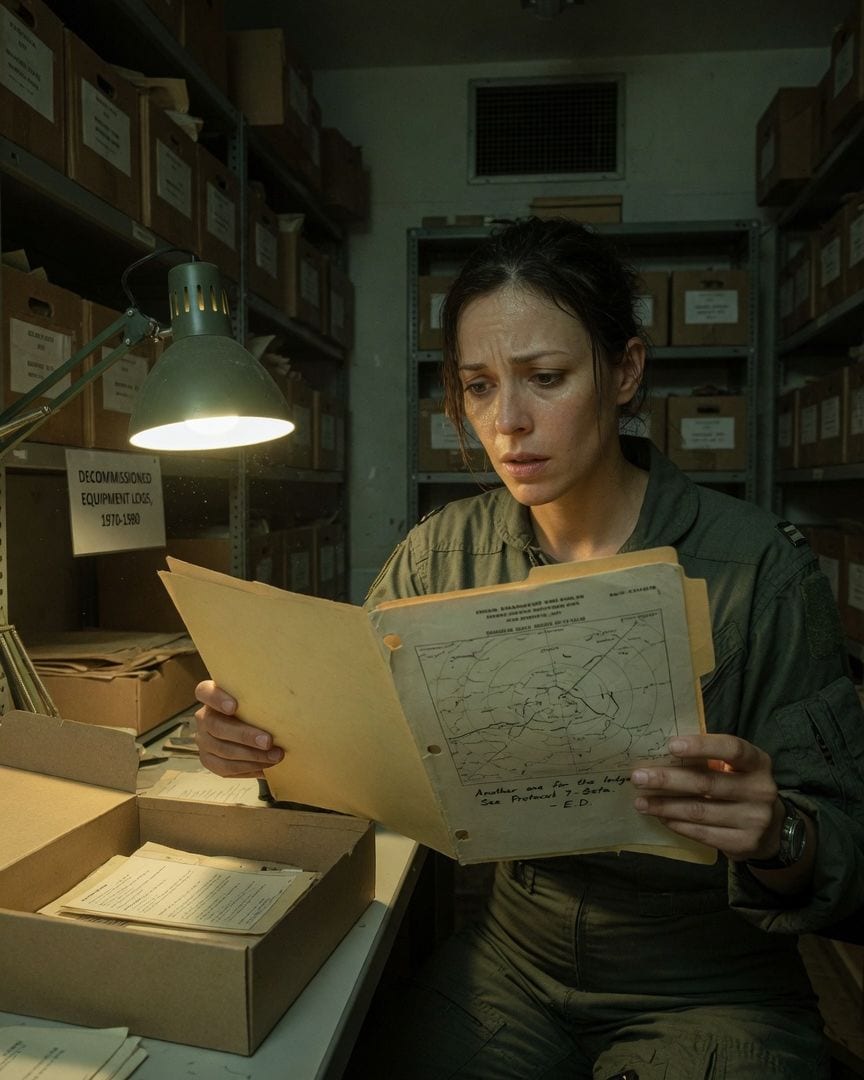
A radar captain's scope went clean, but the pilot swore a mile-wide UFO still filled his windscreen. Then she found a Cold War ledger of impossible sightings.
Captain Ines Bardolph, a 34-year-old radar operator in Bavaria, lived by the precise hum of her console. One quiet night, an impossible contact appeared over the Danube, then vanished from her scope just as a pilot swore it filled his windscreen. Replays showed the object had crossed the Alps in a single blink, defying all known physics. When bureaucracy sought to bury the incident, Captain Bardolph sought answers, leading her to a forgotten archive where a brittle folder revealed a chilling pattern: 'Another one for the ledger.'
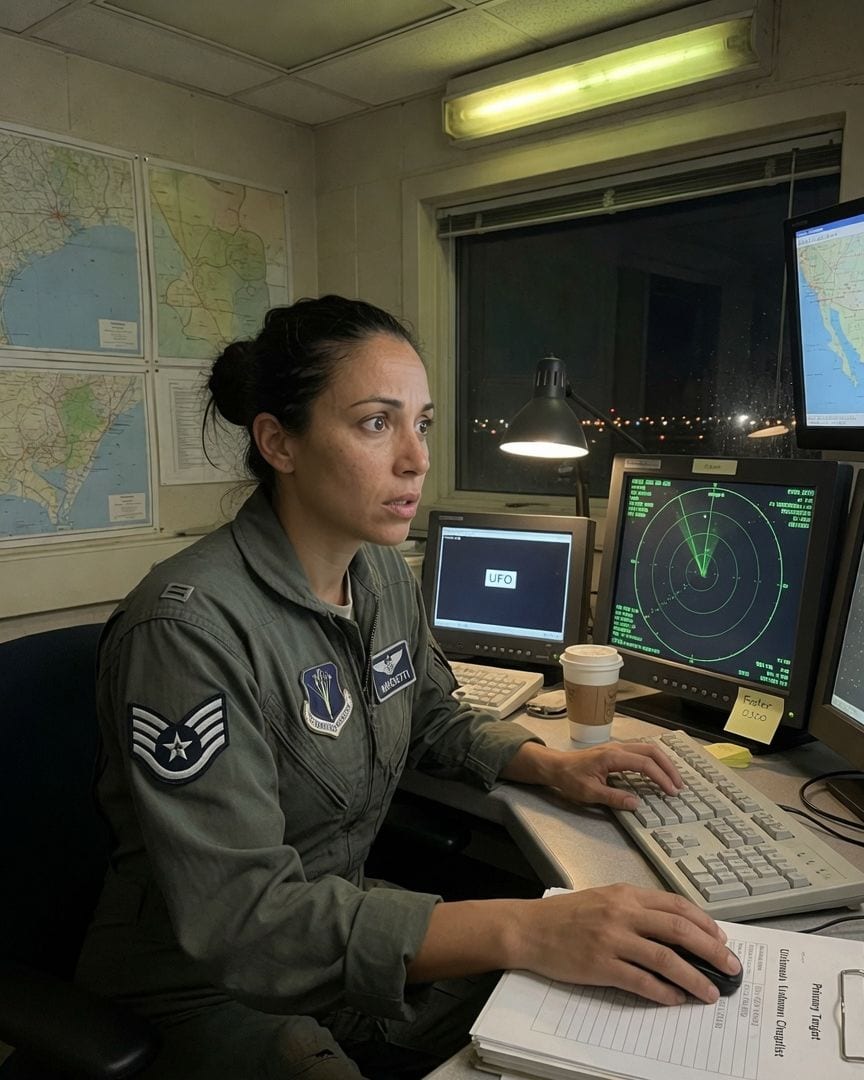
A radar operator watched a second blip, twice its size, merge into a plane on her screen. Her report was filed under a pre-existing, locked 'Special Handling' code.
Technical Sergeant Odile Marchetti sat alone in the dim radar room, her watch a final vigil for a base winding down along the silent Gulf Coast. At 02:17, a pilot reported a 'companion' on his wing, but her screen initially showed nothing. Then, a second blip bloomed, twice its size, before merging impossibly into the first and continuing its flight path without a ripple. She logged it as a UFO, only to discover the system already had a designated category for such anomalies – a pre-approved slot for the unexplained. A week later, her incident was re-categorized under a locked 'Special Handling' code, creating a new, inaccessible folder in her own personnel file.