Nearing the end of his tour, Airman Rourke found an old Cold War logbook that named his nightly radar ghost: Airman Gerald Thornton.
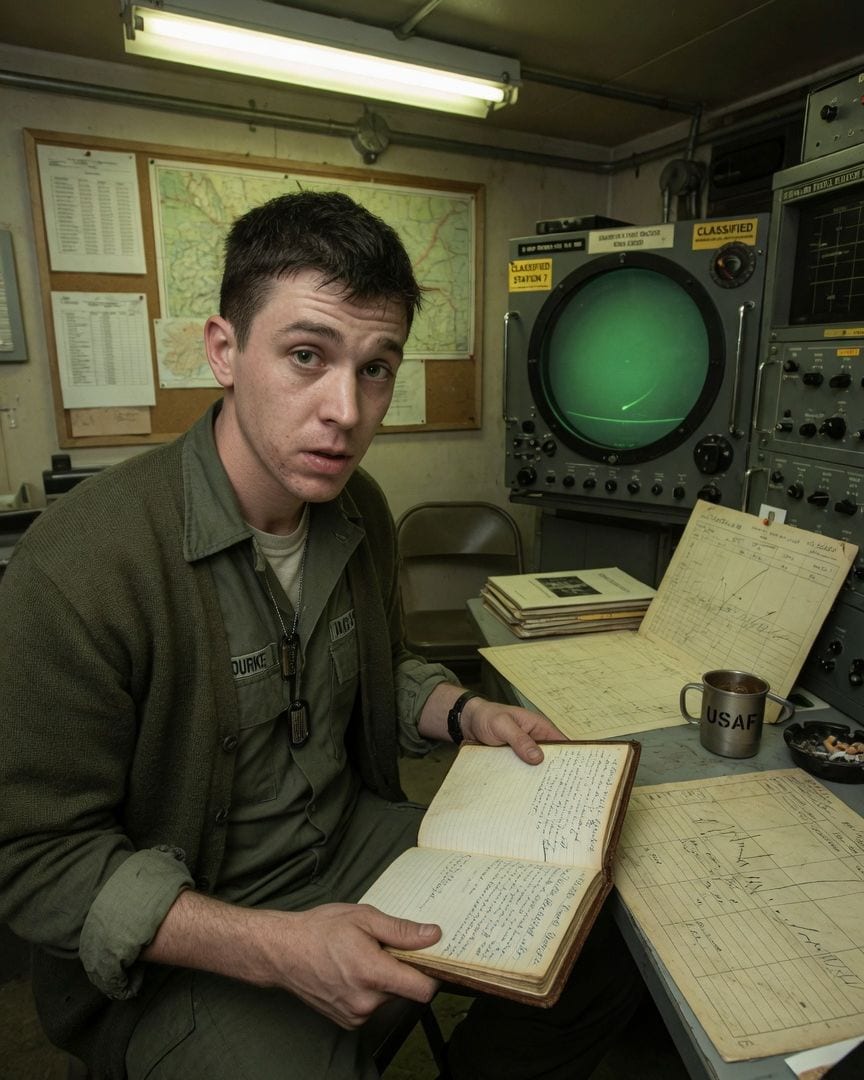
Airman Second Class Preston Rourke watched the green sweep of the perimeter radar at Gap-Filler Station 7, a lonely outpost in the Montana high country. It was 1983, and his two-year tour was nearing its end.
Every night at 2300, a single slow contact would paint itself across the valley floor, low and plodding, a phantom on the screen, gone before the interceptor cell could even consider scrambling.
Rourke, like every Airman before him, had logged it as a temperature-inversion ghost, a quirk of the cold air trapping radar signals. It was the official explanation, a line he had dutifully copied from previous logs.
Then, one afternoon, while clearing out a rarely used storage closet near the radar room, he found them. Tucked away on a high shelf, beneath a stack of dusty equipment manuals, was a pile of old grease-pencil plotting boards.
They were from prior winters, dating back three years. Curious, Rourke pulled them down. The faint marks of forgotten shifts covered their surfaces. He flicked through them, one after another, and a chill tightened in his chest.
On every single board, drawn by different hands over successive seasons, was that same slow line. Always at the same hour, always crossing the same stretch of valley. The official explanation, suddenly, felt very thin.
The discovery of the boards gnawed at Rourke. He spent his off-duty hours poring over them in the quiet operations room, comparing the faded marks with his own recent logs. The consistency was unnerving.
He cross-referenced the dates on the boards with the station’s old weather logs, meticulously checking for unusual atmospheric conditions, for anything that might explain such a regular ‘ghost.’ There was nothing. No record of sustained temperature inversions, no unique fronts.
This wasn't a ghost of the air; it was a ghost of the radar, appearing with clockwork precision, year after year.
The silence of the room seemed to press in on him, the hum of the equipment a constant, low thrum against his ears.
Hidden beneath the stack of official boards, tucked into a dusty corner of the shelf that Rourke had emptied, his fingers brushed against something else.
It was a small, leather-bound logbook, its cover worn smooth from decades of handling, clearly unofficial. The pages were filled with meticulous, handwritten notes, observations about the station, and more radar plots.
The script varied from page to page, as if many hands had contributed. Rourke flipped through, his heart picking up pace. Several entries detailed the nightly contact, some marked with question marks or cryptic annotations.
But one, from 1968, had a note appended that wasn't about atmospheric conditions or equipment malfunction. It was a name.
Rourke stared at the faded ink in the unofficial logbook. Next to a radar trace identical to the one he logged every night, under 'Local Anomaly,' was a date: October 17, 1968. And beneath it, a name: Airman Gerald Thornton.
Rourke’s breath caught. He remembered seeing Thornton's official transfer record, dated a week later, strangely devoid of a new assignment, no forwarding base listed.
He’d dismissed it as a clerical error then, a common enough occurrence in the sprawling Air Force bureaucracy.
Now, the name, linked to the impossible radar contact, felt like a cold hand on his shoulder, a silent accusation from the past.
Rourke’s next days were a blur of duty and clandestine investigation. The name Gerald Thornton became an obsession. He dug into the station’s limited archives, cross-referencing every name he found in the unofficial logbook with official personnel records.
Gerald Thornton's file remained maddeningly thin, a ghost in the system.
His transfer out of Gap-Filler 7 was noted, dated October 24, 1968, but there was no subsequent assignment, no forwarding address, just a blank space where his future duty station should have been.
This was unheard of for an active-duty Airman. Every Airman went somewhere.
Driven by a need for answers, Rourke eventually tracked down a retired Colonel, Walter Harrington, who had commanded Gap-Filler 7 in the late 70s.
Harrington, now living a quiet life in a small Montana town, seemed hesitant when Rourke mentioned the nightly radar contact.
He spoke in clipped, evasive sentences about 'operational peculiarities' and 'classified atmospheric phenomena,' but his eyes, despite his calm words, held a flicker of something deeper, something Rourke recognized as fear. Rourke pressed him, specifically asking about Airman Thornton.
Harrington’s face tightened, his jaw clenching. 'Some things, Airman Rourke,' he said, his voice dropping, 'are best left to the official record, however incomplete it may seem.' He warned Rourke that digging too deep could have 'unforeseen career implications.'
The air in Harrington's living room, warm moments before, suddenly felt several degrees colder.
Rourke felt a chill that had nothing to do with the Montana winter. Harrington’s warning was too specific, too personal. Back at the station, Rourke began to notice subtle shifts.
His own radar logs, usually filed without a second glance, were now consistently marked 'reviewed' by a superior officer he rarely interacted with, an officer whose shifts never overlapped with his own.
One night, while he was making coffee, he saw the new Airman, a fresh arrival just weeks ago, loitering near his console, pretending to adjust equipment. The new Airman quickly moved away when Rourke approached, offering a tight, unconvincing smile.
Later, Rourke found a small, almost imperceptible scratch on the lock of his personal footlocker, a scratch he knew wasn't there before. Someone was watching him; someone knew he was digging.
The feeling of isolation in the remote station intensified, the vast, empty valley outside suddenly feeling less empty, more like a waiting presence.
The hum of the radar equipment in the room seemed to acquire a new, malevolent pitch, a subtle shift that made the hairs on his arms stand up.
Driven by a growing sense of dread, Rourke found a way to access the deeper Air Force archives.
It took weeks of navigating bureaucracy, pulling strings through old contacts, but he eventually secured a meeting with Sylvia Barlow, a seemingly innocuous archivist in Denver.
He presented his findings: the contradictory records, the consistent pattern on the grease-pencil boards, the unofficial logbook, and the growing sense of unease.
Barlow, a woman whose demeanor was as dry as the dusty files she guarded, initially dismissed his concerns as 'conspiracy theories born of isolation.'
But Rourke pressed, detailing the exact inconsistencies in Thornton's file, the repeated radar anomaly, and Colonel Harrington’s cryptic warning. He showed her a grainy photograph he’d taken of the unofficial logbook entry.
Barlow’s composure finally cracked. She sighed, her eyes darting around the empty archive room, as if checking for listeners. 'Airman Rourke,' she began, her voice barely a whisper, 'there are... specific protocols for certain remote outposts. Gap-Filler Seven is... unique.
There have been instances, over the decades, of what the official reports call 'unexplained personnel re-designations.' She spun her chair, pulling open a locked drawer from an old filing cabinet.
From it, she produced a series of heavily redacted memos, each mentioning 'local anomalies' and 'personnel adjustments' at Station 7. The chilling phrase 'count that won't reconcile' appeared in one, circled in faded red ink.
She admitted that Gerald Thornton was indeed one of these 're-designated' individuals, his transfer a bureaucratic fiction designed to maintain the station's eight-person roster.
The institution, she revealed, had known about the nightly contact, and the disappearances, since the station was first commissioned in 1965. They just called it something else. The cold reality settled over Rourke like a shroud.
Barlow, her face pale, finally pushed a single, thin file across the table. It was bound in plain gray cardstock, with no markings. 'This is the classified addendum to Gap-Filler Seven’s original operational manual,' she explained, her voice trembling slightly.
'It’s not supposed to exist outside of a secure vault.' Rourke opened it with trembling hands. The document was titled 'Personnel Re-designation Protocols for Anomalous Local Contacts.'
His gaze raced through the dry, bureaucratic language, detailing procedures for handling 'unaccounted personnel' and 'integrating their data into cyclical anomaly monitoring.' It spoke of 'maintaining optimal observable conditions' and 'sustaining the local signature.'
His eyes fell upon a list, stark and terrifying: 'Re-designated Personnel.' It was a chronological tally, dating back to 1965, with names and coded designations. Gerald Thornton's name was there, with a code that meant 'continuous local registration.'
Rourke scanned further down, his breath catching in his throat as he reached the last entry.
A numbered blank space, then in an unfamiliar hand, the next sequential number was followed by a blank space, then his own name, neatly printed: Preston Rourke.
The blood drained from Rourke’s face. His name. Printed right there. Barlow watched him, her expression grim, a quiet despair in her eyes. 'They don't transfer them, Airman,' she said softly. 'They... account for them.
The station isn't just a radar outpost; it's a funnel. The 'slow contact' you've been logging isn't just one Airman. It's all of them.
A composite, or perhaps a cycle, of everyone who has ever been 're-designated' into the valley anomaly.'
She explained that the Air Force, unable to explain or stop the phenomenon, instead chose to contain and monitor it, maintaining the station as a perpetual observation post.
The 're-designation protocols' were their way of making the impossible count reconcile – by erasing the missing from the active roster and re-classifying them as 'local anomalies.'
The radar wasn't just tracking; it was, in a horrifying way, keeping tabs on its own victims, the ghostly signatures of men who had simply… become the valley.
Rourke realized that his own 'transfer' out of Gap-Filler 7 was never going to happen. He was already accounted for, just not in the way he thought.
Back at Gap-Filler 7, a cold fury settled over Rourke. He had to break the cycle.
He had to stop it, not just for himself, but for every name on that list, every ghost that painted itself across the radar screen. He knew the station’s systems intimately.
His plan was simple: erase the old logs, destroy the grease-pencil boards, burn the unofficial logbook, and disable the archaic radar system. If the anomaly couldn’t be tracked, perhaps it couldn’t be sustained.
If the 'count' couldn't be maintained, perhaps the funnel would stop. He waited for his next night shift.
At 22:50, with ten minutes to the nightly contact, he began. Working with frantic precision, he shredded the recent paper logs, feeding them into the station's heavy-duty incinerator.
He grabbed a heavy wrench from the maintenance locker and with a sickening crunch, smashed the radar’s primary tracking module, sparks flying, the screen flickering into static.
Then he gathered the stacks of grease-pencil boards, both the new ones and the ancient ones, and doused them with lighter fluid he’d found in the generator room.
Just as he lit the match, the door to the radar room hissed open, cutting through the sudden silence of the dying radar.
The new Airman, the one who had been watching him, stood there, a placid, unreadable expression on his face.
Behind him, silhouetted in the doorway, was the station commander, and behind him, Colonel Harrington, whose presence here, in full uniform, made Rourke’s blood run cold.
Harrington stepped forward, his eyes fixed on Rourke, devoid of pity, filled only with a weary certainty. 'Airman Rourke,' he said, his voice flat, 'you've discovered the protocols. But you can't break the count. It's always been full.
And it always will be.' The new Airman moved to flank Rourke, blocking his escape. The match in Rourke’s hand trembled, then dropped to the concrete floor, extinguished.
The official report stated that Airman Second Class Preston Rourke was honorably discharged due to 'psychological distress' and 'inability to adapt to remote duty conditions.' His personal effects were packed and shipped home, a standard procedure for medical discharges.
A new Airman was assigned to Gap-Filler Station 7 within the week, ensuring the eight-person roster remained full. Colonel Harrington oversaw the repair of the radar system, which was back online within 24 hours.
The grease-pencil boards, inexplicably, were replaced with fresh ones, ready for a new winter.
Rourke never returned home. His family received the official discharge papers, but he was never seen again. The valley had claimed another.
Decades later, a new Airman, fresh out of basic training, took his first solo night shift at Gap-Filler Station 7. At 2300, the perimeter radar painted a single slow contact crossing the valley floor.
He logged it as a temperature-inversion ghost, just like the manual said.
If this one got to you
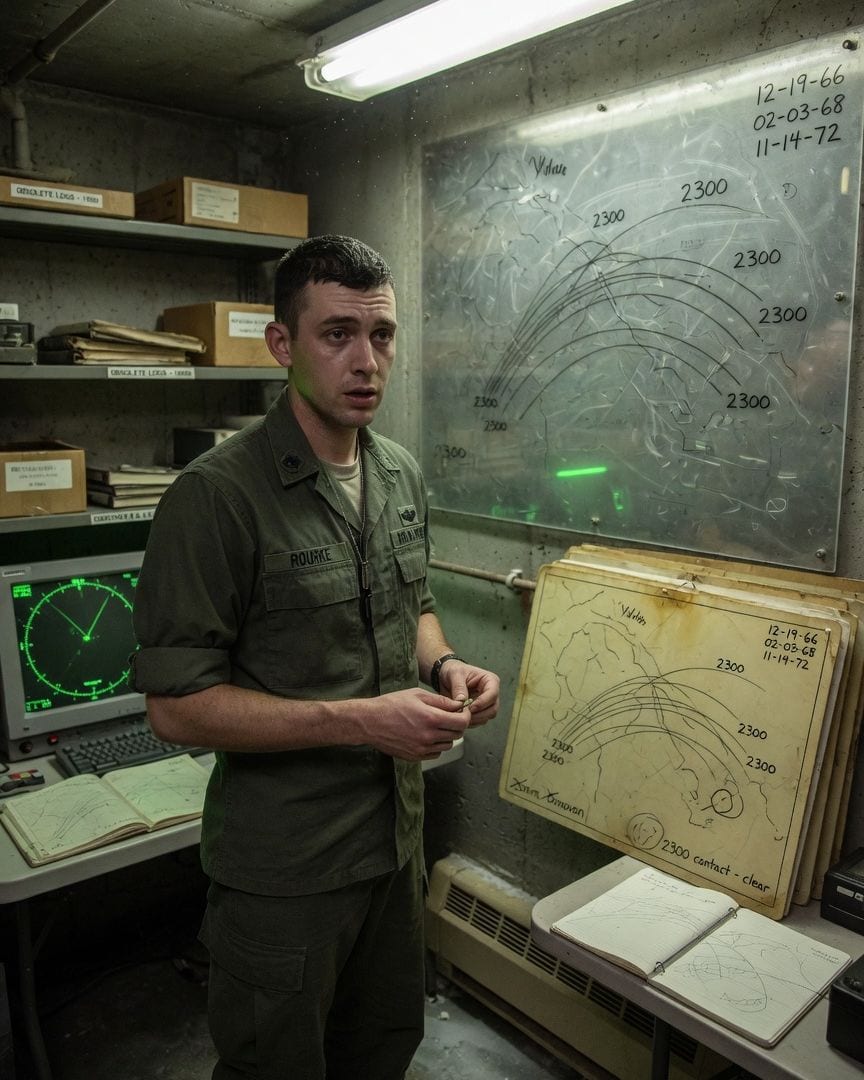
An airman found old radar logs repeating the same impossible ghost trace. One entry from '66 then made a shift's personnel count one off.
Airman Second Class Benjamin Rourke watched the familiar radar ghost glide across his screen at 2300 hours, just as it had every night for a month at the desolate Montana gap-filler station. He'd logged it as a temperature inversion, but its mechanical adherence to schedule felt deeply wrong. Driven by unease, Rourke searched the station's dusty storage closet, unearthing old plotting maps from years past. Every single board, recorded by different hands on different nights, showed the exact same impossible radar trace. But on one faded log from '66, a crude tally mark made that shift's personnel count seem one off.
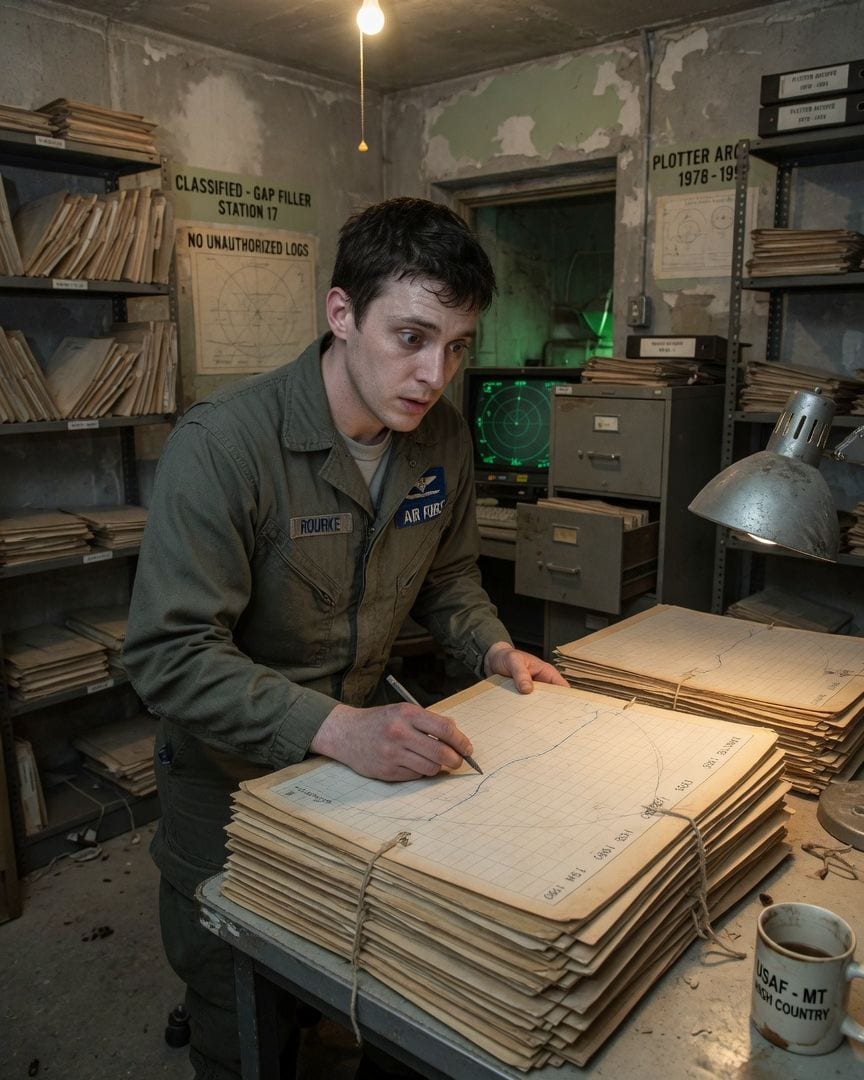
An Airman tracks a nightly radar contact. But in dusty archives, he finds old Cold War plotter boards, each showing that exact same line drawn by other airmen for three winters.
Airman Second Class Felix Rourke endured the cold, quiet nights at his isolated Cold War station, watching the perimeter radar. For three weeks, a single, slow contact appeared at 2300 hours, a precise violation of every protocol that chilled him deeply. He dismissed it as an anomaly, until a hunch led him to a forgotten closet in the dusty archives. There, he unearthed old plotter boards, each revealing the exact same impossible line drawn across the valley floor at the same hour, signed by different airmen from three consecutive winters decades ago. What impossible secret did the mountain station truly hold?
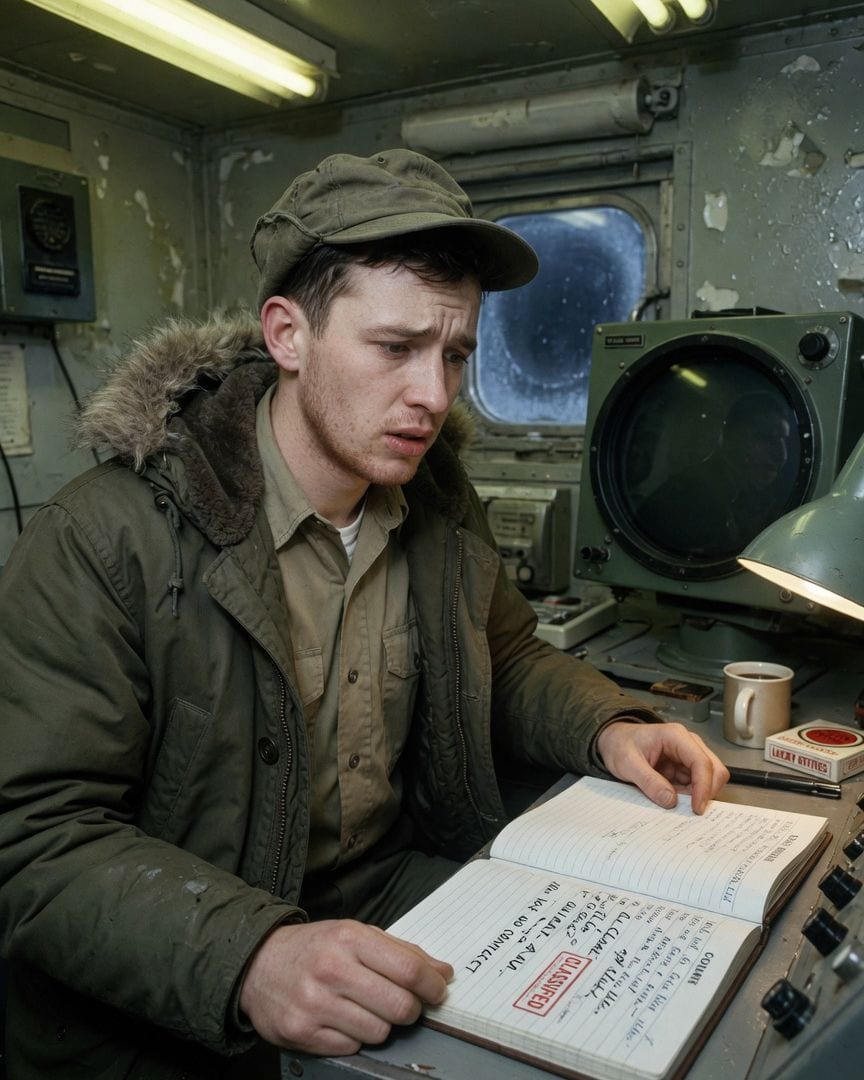
A Cold War airman logs an impossible radar contact on his last sweep. But his official logbook entry is stamped 'CLASSIFIED' and then contradicted by a hastily scrawled 'ALL CLEAR' dated moments before it.
Airman Ordway Vance, 22, manned the radar dome at Site Pellin in the biting North Atlantic dark of January 1962, running the last calibration sweep before its decommissioning. His scope picked up a faint, impossible return, growing closer with each pass, though the ocean remained empty to the eye. When Vance detailed the contact in his official logbook, a 'CLASSIFIED' stamp appeared, followed by a hastily scrawled 'ALL CLEAR' dated moments before his own entry, contradicting his every word. Commander Hartley dismissed it as equipment malfunction, but Vance sensed a chilling, official erasure behind the lie. He soon found a locked cabinet marked 'SITE PELLIN ANOMALIES,' hinting at a deeper truth buried within the base's final days.
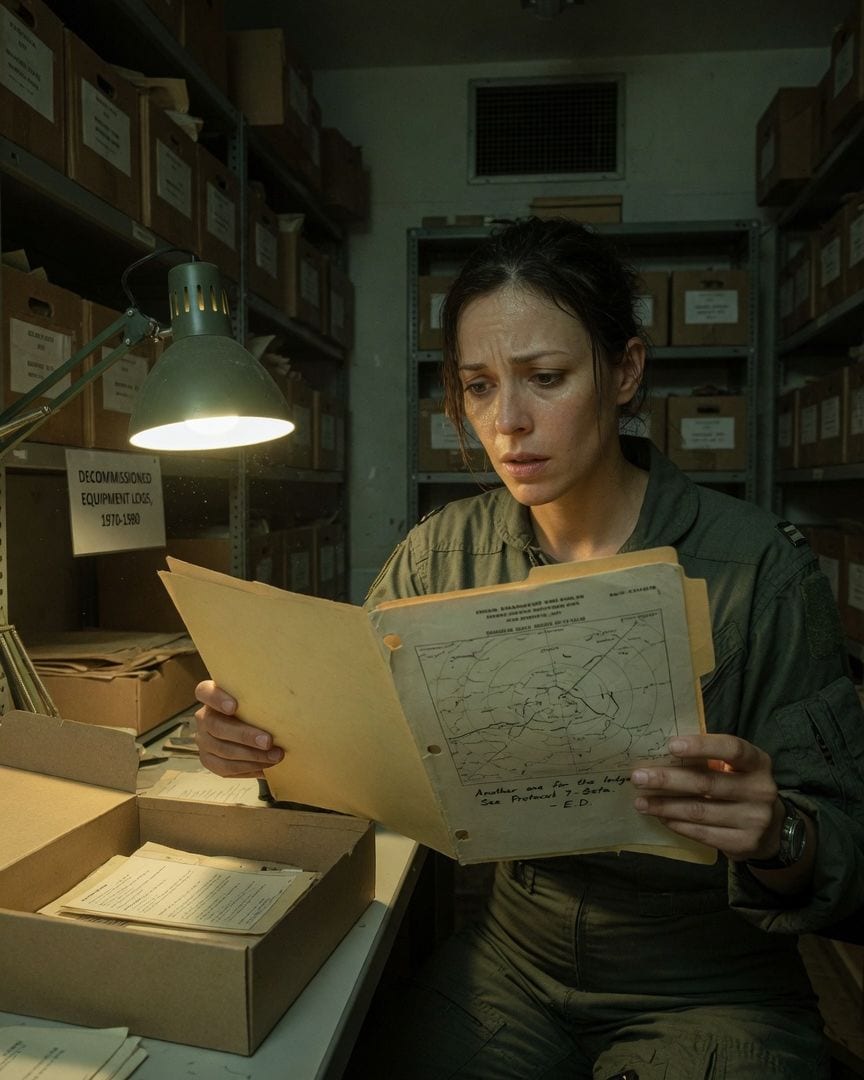
A radar captain's scope went clean, but the pilot swore a mile-wide UFO still filled his windscreen. Then she found a Cold War ledger of impossible sightings.
Captain Ines Bardolph, a 34-year-old radar operator in Bavaria, lived by the precise hum of her console. One quiet night, an impossible contact appeared over the Danube, then vanished from her scope just as a pilot swore it filled his windscreen. Replays showed the object had crossed the Alps in a single blink, defying all known physics. When bureaucracy sought to bury the incident, Captain Bardolph sought answers, leading her to a forgotten archive where a brittle folder revealed a chilling pattern: 'Another one for the ledger.'
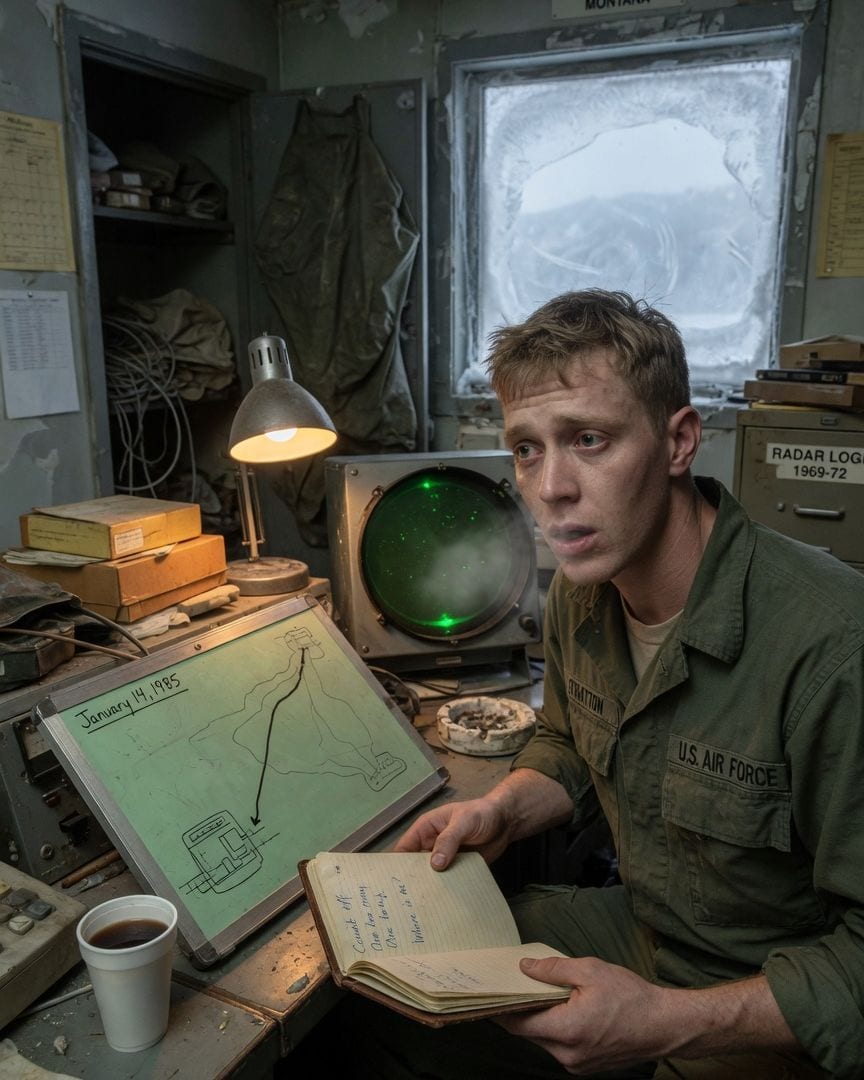
Airman Lars Stratton found an old Cold War manifest listing one name twice: 'Bernard Radcliffe' transferred and 'Bernard Radcliffe' still present.
Airman Second Class Lars Stratton was counting down his final weeks at Echo Station, a desolate Cold War outpost due for mothballing. He longed for home, far from the bitter Montana winds and the constant hum of static. Inside the dim radar shack, he logged the usual nightly ghost blip, a faint contact appearing at 2300, just as it had every winter since 1987. This night, a metallic tang like old blood lingered in the air, raising the hairs on his arms. Seeking distraction, Lars later discovered a leather-bound logbook from 1971, detailing the same 2300 contact, but with chilling notes and a manifest listing one airman's name, Bernard Radcliffe, twice—once transferred, once present. Was he truly alone in the silent, remote station?
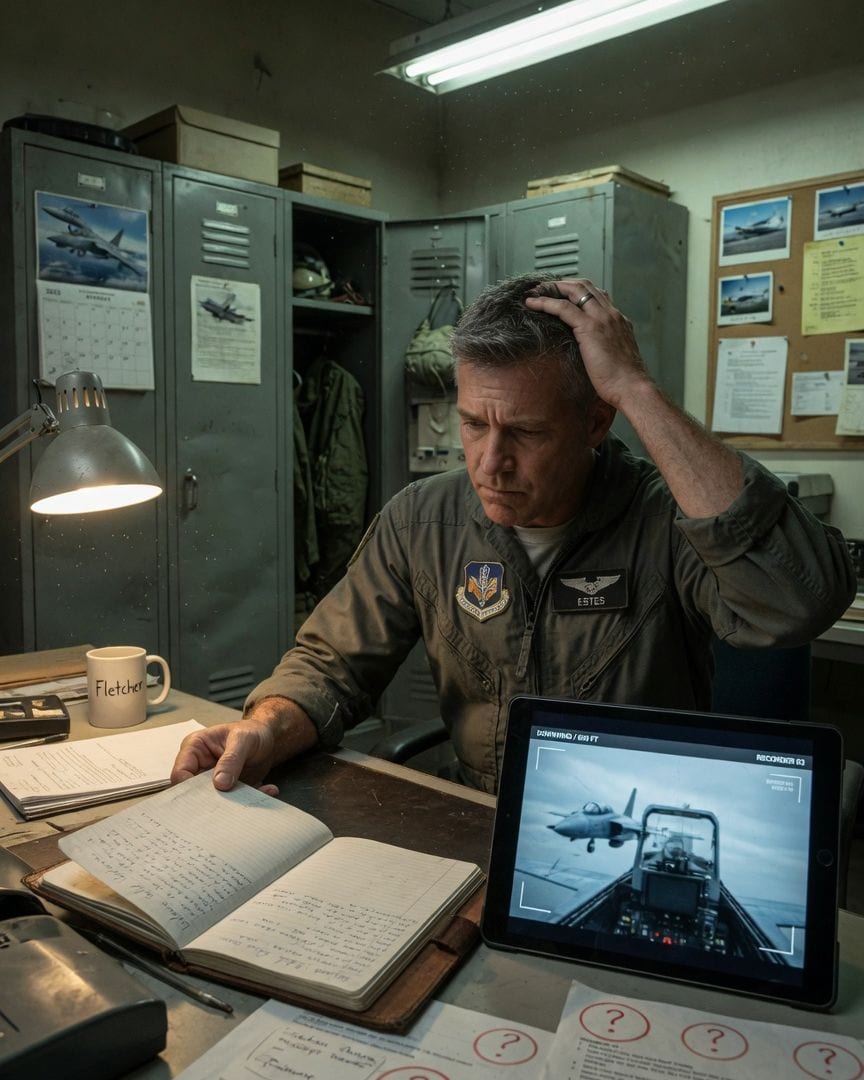
A Chief Warrant Officer's HUD tape shows a phantom jet, impossibly close, off his wing. Forty years ago, another Cold War pilot logged the same impossible sight.
Chief Warrant Officer Nathaniel Estes, a pilot whose career hinged on absolute precision, was under evaluation for a critical promotion. His nightly review of HUD tapes from routine Mojave test flights was a meticulous habit, but for a week, it revealed an impossible detail. At precisely 800 feet, one frame showed a sleek, experimental jet tucked impossibly close off his left wing—a craft ground radar never detected. When his maintenance chief found no equipment fault, Estes unearthed a dusty, decades-old logbook detailing identical phantom sightings from 1978. What unseen presence shadowed the desert skies?