A Chief Warrant Officer's HUD tape shows a phantom jet, impossibly close, off his wing. Forty years ago, another Cold War pilot logged the same impossible sight.
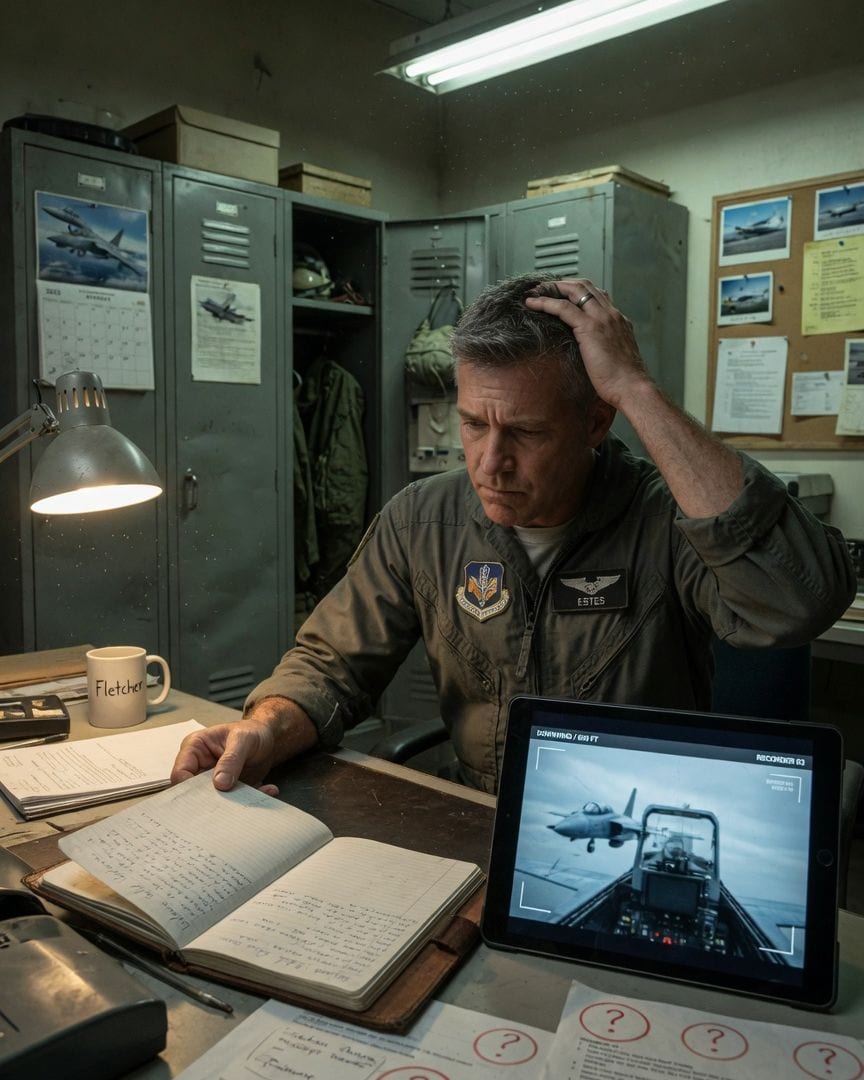
Chief Warrant Officer Nathaniel Estes, a man whose career was built on precision, found his training at odds with his eyes. Every evening, after his routine test flights out of the Mojave base, he reviewed the HUD tape.
It was standard procedure, a meticulous habit, essential for his evaluation for promotion to CW5. But for the past week, a single, impossible detail kept surfacing.
On the downwind leg, at exactly 800 feet, one frame held it: a second aircraft, tucked impossibly close off his left wing. It was an older model, a sleek, experimental jet he didn't recognize, its canopy subtly angled toward his.
Ground radar never saw it. His wingman, if he had one, certainly didn't.
Estes had dismissed it as a glitch, then a smudge, then a corrupted pixel in the recording. He’d tried every rational explanation.
Maintenance Chief Howard Fletcher, a man as meticulous as Estes himself, had swapped out the recorder twice, then a third time, running every diagnostic imaginable. Each time, the equipment tested clean. But the frame came back, every single flight.
Always at 800 feet. Always on the downwind leg. Always the same impossible ghost, a silent, unblinking presence where nothing should be.
Estes would rewind, play, freeze the tape, and there it was again, a stark contradiction to everything he knew about flight and physics.
Estes brought the recurring anomaly to Howard Fletcher again, not with accusation, but with a quiet, persistent dread. “Howard, look at this. Third recorder. Same exact spot. Same aircraft.”
Fletcher, a man who believed in diagnostics over ghosts, sighed, running a hand over his thinning hair. The harsh fluorescent lights of the hangar office made the lines on his face seem deeper. “Chief, I’ve run every test.
The system is clean. No ghost signals, no interference. It’s… it’s a phantom echo, maybe. Something in the older systems we haven’t purged.”
But the flicker in Fletcher’s eyes, the way he avoided looking at the screen for too long, suggested he knew more than he was letting on. Estes pressed, “Echo of what, Howard? This isn’t random noise. It’s too consistent.
It’s a definite shape.”
Fletcher finally leaned back in his creaking chair, defeated. The air in the small office, usually smelling of oil and cleaning solvents, felt suddenly stale. “Look, this base… it’s old. Classified projects, experimental craft. Stuff gets buried.
There was a tech, back in the late seventies, guy named Frank Coleman. Always talking about ‘ghosts in the machine.’ He kept his own log, unofficial. Said the official records were… incomplete.”
Fletcher rummaged through a dusty, dented locker in the corner, pulling out a brittle, leather-bound book that looked like it hadn't seen daylight in decades. Its spine was cracked, its pages warped.
“He swore up and down there were things the official logs didn’t account for. Said he saw things on the old radar screens that just… weren’t there.”
He blew a cloud of dust from the cover before handing the book to Estes. It smelled faintly of ozone and old, forgotten paper. “He transferred out suddenly. Never heard from him again.”
Estes took the logbook, its weight oddly heavy in his hands. He flipped through Coleman’s logbook, his fingers tracing the faded ink. Most entries were mundane, routine maintenance checks, lists of part numbers and torque specifications.
But then he found a section marked ‘Anomalies.’ Dates from 1978. A series of entries described 'unaccounted for returns' on long-range radar, 'visual confirmation of phantom aircraft' at specific altitudes.
He found one entry, scrawled furiously, dated August 14, 1978: 'Phantom return on downwind, 800 feet. Visual match to Project Chimera prototype. Canopy turned. Chief Montgomery ordered scrubbed. Transferring out.'
The words seemed to vibrate, a chilling confirmation that his ghost plane was not new, and that someone had actively tried to bury its existence.
The next morning, Estes bypassed official channels, taking Coleman’s logbook directly to Nina Sinclair, the base’s records specialist. Nina, usually unflappable amidst stacks of manifests and service records, grew quiet as Estes recounted his experience and showed her the logbook.
She ran a hand over the brittle cover, then peered at the faded entry. “Project Chimera,” she murmured, her finger tracing the words. “I’ve seen that name, but it’s always heavily redacted. Like it’s not supposed to exist.”
Together, they began to pull the thread. Nina searched the digital archives, her fingers flying across the keyboard, cross-referencing Coleman’s dates and the phrase ‘phantom return’ with any declassified flight plans or incident reports.
The official records were a brick wall of ‘No Data Found’ or heavily blacked-out documents that yielded nothing coherent. The old computer hummed loudly in the otherwise silent records office, its fan whirring like something trapped.
But Nina, with her knack for finding obscure footnotes, eventually found a vague reference to a “lost experimental prototype” from 1978, designated ‘Chimera-1.’ It mentioned a test pilot, Edward Montgomery, who vanished during a high-altitude test flight over the Mojave.
The coordinates of his last known telemetry, though obscured by redactions, hinted at the same general area as Estes’s own sightings.
They found no official record of Coleman’s transfer, only a blank space in the personnel files where his name should have been. The systemic erasure was almost as chilling as the entries themselves.
As they worked, Estes overlaid his own flight data with the approximate last known trajectory of Chimera-1. The downwind leg, the 800-foot mark, it all aligned with unnerving precision to Montgomery’s final reported path.
The ghost wasn't just a random echo; it was a replay, precise to the inch, of a flight that had ended decades ago.
As Estes and Sinclair delved deeper, the subtle pushback began. Files Nina had accessed the day before, now flagged as potentially relevant, were marked 'restricted' or inexplicably 'deleted from server.'
A request Estes made for older radar logs from 1978 was met with a polite but firm 'records unavailable' from a robotic voice on the phone. Then, an anonymous, untraceable email landed in Nina’s inbox, its subject line stark: 'Information.'
The single line in the body read: 'Some things are better left undisturbed. Let sleeping ghosts lie.' The message was unsettling, suggesting someone, or something, was aware of their investigation.
Estes, meanwhile, found his flights increasingly unnerving. Even when the HUD tape showed nothing, a prickling sensation crawled up his neck at exactly 800 feet on the downwind leg. The cockpit air felt suddenly colder, denser.
He’d glance sharply to his left, just past his wing, convinced he saw a fleeting shadow, a distortion in the desert air, gone before he could fully register it. Ground control always reported clear airspace.
The vast, empty sky seemed to watch him, waiting.
One evening, after landing and completing his post-flight checks, he found a small, almost imperceptible scratch on the fuselage, near his left wingtip, a mark that hadn't been there before his flight.
It was too precise to be random debris, too shallow to be serious damage, yet it raised the hairs on his arms.
It was as if something had tried to brush past him, a physical trace left by an unseen presence.
The dread was no longer abstract; it was personal, a cold breath on his neck, a phantom presence at his shoulder, watching him dig.
Estes knew he needed to go higher. He sought out retired General Charles Kingsley, a formidable figure who’d been the base commander in 1978.
Kingsley, now frail and stooped at 80, sat in his sun-drenched study, but his eyes still held a steely glint as he regarded Estes.
Initially, he dismissed Estes’s questions about Project Chimera as 'old rumors' and 'classified history you don’t need to worry about.'
Estes, however, laid out his evidence: the HUD tape with its impossible passenger, Coleman’s logbook, the redacted files, the scratch on his fuselage. He described the phantom aircraft, the specific altitude, the downwind leg, the canopy turned towards him.
Kingsley’s composure slowly cracked. He reached for a glass of water, his hand trembling slightly. “Project Chimera,” he began, his voice raspy, “was a marvel of its time. Experimental stealth. Edward Montgomery was our best.
He pushed the envelope like no one else.” He paused, looking out at the vast, unchanging Mojave through his window, as if seeing something beyond the horizon. “He vanished. No distress call. No debris. Just… gone.
The official story was equipment failure, pilot error. But that wasn’t the whole truth.”
Estes pressed, his own voice low, “What was the whole truth, General?”
Kingsley finally admitted, the words coming out in a slow, heavy stream. “Montgomery didn’t just vanish. His last telemetry showed him entering an unstable energy field, something we couldn’t explain. A localized temporal anomaly, the eggheads called it.
It wasn’t a crash. It was… a loop. He’s still flying it, Estes. Over and over. His last flight, perpetually replaying, bound to that specific airframe, that specific patch of sky.
That’s why your equipment can’t register it, and why the radar sees nothing. It’s an echo, but an echo that exists, physically, in a moment that never ends.” The general’s gaze sharpened, meeting Estes’s.
“The canopy turned towards you… He’s trying to complete it. He’s looking for his wingman.”
Estes felt a cold dread bloom in his chest, a sickening lurch in his gut. “Wingman? Montgomery flew solo. Project Chimera was a single-seater.”
Kingsley shook his head slowly. “Not always. For some of the higher-risk tests, the protocol designated a ‘shadow’ pilot, an observer who would theoretically be flying just off his wing, though not physically present. A contingency.
The records for those… they were scrubbed even cleaner than Montgomery’s.”
Armed with General Kingsley’s admission, Estes and Nina redoubled their efforts. They cross-referenced every scrap of information: Montgomery’s flight plans, the 'shadow' pilot protocol, and the heavily redacted personnel transfers from 1978.
The information came in fragments, but Nina, using her deep knowledge of base archives and her increasing certainty that they were onto something monumental, finally located a faded, declassified incident report from 1978 detailing Montgomery’s disappearance, marked 'Priority Alpha – Highly Classified.'
It was a fragmented document, riddled with blacked-out sections and cryptic codes, but it contained a list of all personnel remotely connected to Project Chimera, including ground crew, technicians, and even potential 'shadow' pilot designations.
Estes scanned the names, his heart hammering against his ribs, a cold sweat breaking on his brow. He saw familiar surnames of people he’d known on base, but nothing that made sense in the context of a 1978 operation.
Then, near the bottom, typed in a font that was subtly different from the rest, almost an afterthought, a single entry jumped out: 'Estes, N. – Auxiliary Observer.' His breath hitched. Nathaniel Estes. His own name.
Typed on a document from 1978, a full four years before he was even born. A profound, bone-chilling realization settled over him: he wasn't just investigating a ghost; he had always been part of its story.
The full, monstrous shape of the truth snapped into place. Estes revisited General Kingsley, the incident report clutched in his hand. “General, this name… 'Estes, N.' It’s mine. From before I was born.”
Kingsley looked at the document, his old eyes clouding, a deep weariness settling on his face. “The anomaly… it wasn’t just a loop. It was a draw. A designation. Montgomery was trapped, perpetually calling for his wingman.
The system, the anomaly itself, needed to complete the circuit. That name, 'Estes, N.', it wasn’t a person then. It was a placeholder. A role. For whoever would eventually answer the call.”
The general’s voice dropped to a whisper, barely audible over the distant hum of the desert wind. “It designates. It pulls. It brings the right man to the right place at the right time.
You, Chief Estes, are the right man.”
The canopy turned towards him, the consistent 800-foot altitude, the downwind leg – it wasn't a random manifestation.
It was Montgomery’s final, desperate attempt to complete his mission, to break free from his eternal loop, and he needed a wingman to do it.
Estes understood then: the ghost wasn’t just an echo of the past; it was a hungry presence, actively seeking to draw him into its cycle.
The system, designed to prevent anomalies, had inadvertently created a mechanism for one to perpetuate itself, and Estes was the designated, pre-ordained missing piece.
His entire career, his posting to this base, his specific flight path – it had all been leading to this, a horrifying, inescapable destiny written decades ago, before he even existed.
Nathaniel Estes sat in his cockpit, the engines thrumming, the Mojave sun beating down. Today was his final test flight before his promotion, a routine hop over the very quadrant where the anomaly lived.
He knew, with a certainty that chilled him to the bone, that he had to fly that downwind leg. He had to face it, and make a choice.
As he climbed, the desert stretching endlessly beneath him, his hands were steady on the cyclic and collectives, but his gut churned with a primal fear.
He reached the critical altitude, 800 feet. The air around him seemed to thicken, the sound of his rotors subtly changing, becoming muted, distant. Then, there it was.
Not a faint outline, not a flicker on the HUD, but solid, impossibly real, the experimental jet, Chimera-1, flying in perfect, silent formation off his left wing.
Its canopy was fully visible, and for the first time, Estes saw him: Edward Montgomery. His face was pale, drawn, his eyes wide with a desperate, ancient plea that spanned decades.
Montgomery’s gloved hand lifted, a clear, urgent motion, beckoning Estes to follow, to join him, to complete the loop, to take his place.
Every instinct screamed at Estes to break away, to flee, to dive for the deck and never look back. But his training, his discipline, the rational part of him that sought to understand and resolve, warred with his primal fear.
He was the designated wingman. He was the one who could complete the flight. He could feel an invisible tether, pulling him, drawing him closer to Montgomery's eternal prison, to the moment frozen in time.
With a guttural cry that tore from his throat, Estes yanked the cyclic, veering hard to the right, breaking formation with a violent, shuddering motion that threw his helicopter off course. The airframe groaned under the sudden stress.
He flew against his training, against the invisible pull, against the desperate plea in Montgomery’s eyes.
The ghost plane flickered, a sudden, violent distortion in the air, like a tear in reality itself, then vanished as if it had never been.
The air snapped back to normal, the roar of his rotors returning, but the silence that followed in Estes’s mind was deafening, heavy with the weight of what he had defied.
Estes landed, shaken but alive, his flight data inexplicably normal. No ghost plane, no anomaly registered on any of his systems, official or unofficial. He was cleared for promotion to CW5.
Howard Fletcher, reviewing the helicopter’s systems, noted a subtle, almost imperceptible tremor in the HUD recorder's optical drive after Estes's flight, a transient blip that passed diagnostics without a trace.
Nina Sinclair found that all digital traces of 'Project Chimera,' Edward Montgomery, and even the 'Estes, N.' entry had been completely purged from the base’s systems, as if the entire incident, the entire hidden history, had been scrubbed clean by an unseen hand.
The physical logbook, Coleman’s, remained in Estes’s locker, a silent, brittle testament. The official world had reset itself, dismissing the anomaly as it always had, leaving only the memory and the chilling knowledge.
Nathaniel Estes received his promotion to Chief Warrant Officer Five. He still flew, but never over that specific quadrant of the Mojave desert, never venturing near the coordinates of Montgomery’s eternal downwind leg.
Sometimes, a faint chill would prickle his skin at 800 feet, a phantom presence at his wingtip, a memory of the desperate face he had seen.
He knew he had broken the loop, defied the designation, and escaped the fate written for him decades ago. But he also knew he had left Edward Montgomery trapped, forever flying, forever calling for a wingman who would never come.
Estes would sometimes find himself staring at his flight plans, the meticulously plotted lines on the map.
And there, almost imperceptible, a single, tiny dot would occasionally appear, just off his planned trajectory, at 800 feet, on a downwind leg, a silent, persistent echo.
It was a reminder of the call he had refused, and the one that still waited. The dot remained, a faint echo of a desperate call that almost became his own, always waiting, just off his flight plan.
Estes moved on, his promotion a quiet confirmation of his return. Yet, a subtle shift in his demeanor went unnoticed by many, a distant look in his eyes when he thought no one observed.
His desk, always impeccable, now held a faint, almost invisible mark on its surface where his finger often traced an unknown trajectory.
The dot remained, a faint echo of a desperate call that almost became his own, always waiting, just off his flight plan.
If this one got to you
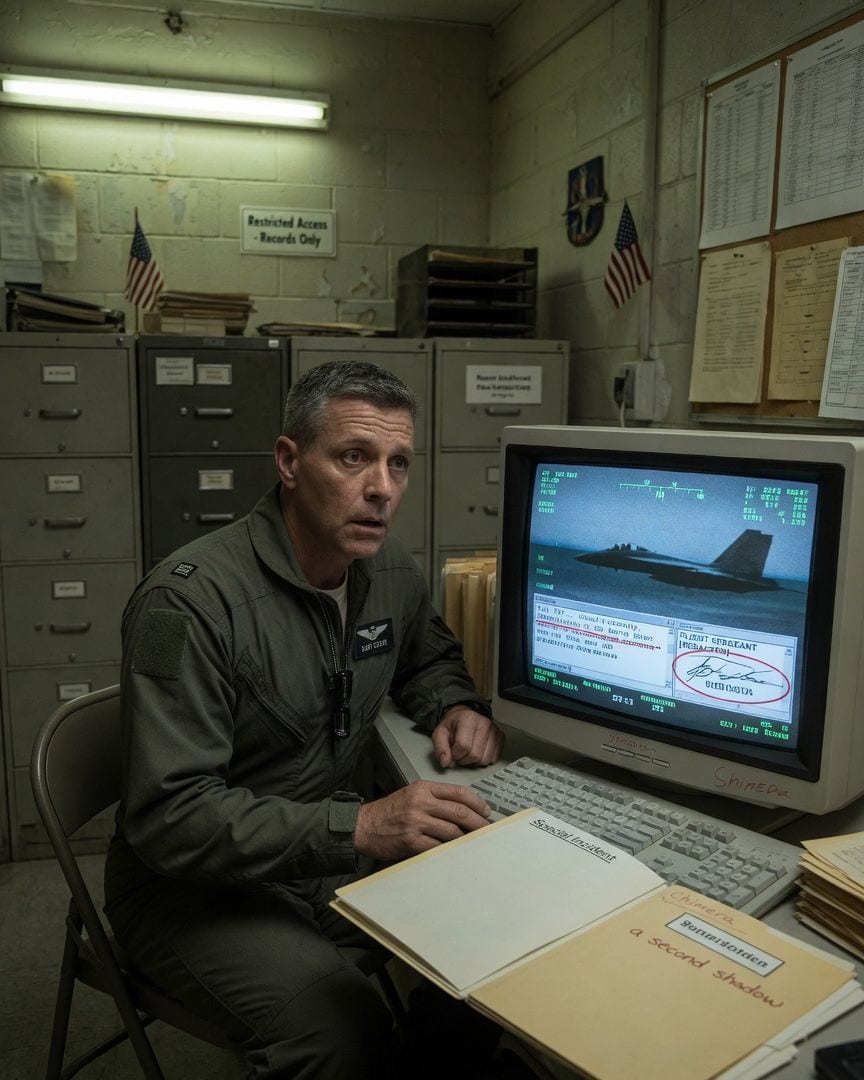
A Chief Warrant Officer's HUD showed a second aircraft watching his plane. He later found a log for *his* tail number reporting the same anomaly weeks ago, but he was grounded for medical leave.
Chief Warrant Officer Gary Estes, a man whose career was built on precision, found his impending Pentagon transfer shadowed by a baffling anomaly. On every flight, at exactly 800 feet, his aircraft's display would briefly show a sleek, dark second plane tucked off his right wing, its canopy subtly angled toward his, watching him. Ground radar never saw it, and his wingmen swore they flew alone. Desperate to maintain his clean record, Estes dug into maintenance logs and uncovered an entry for *his* tail number from weeks prior. It described the exact same 'visual anomaly' during a flight he knew, with chilling certainty, he had never flown.
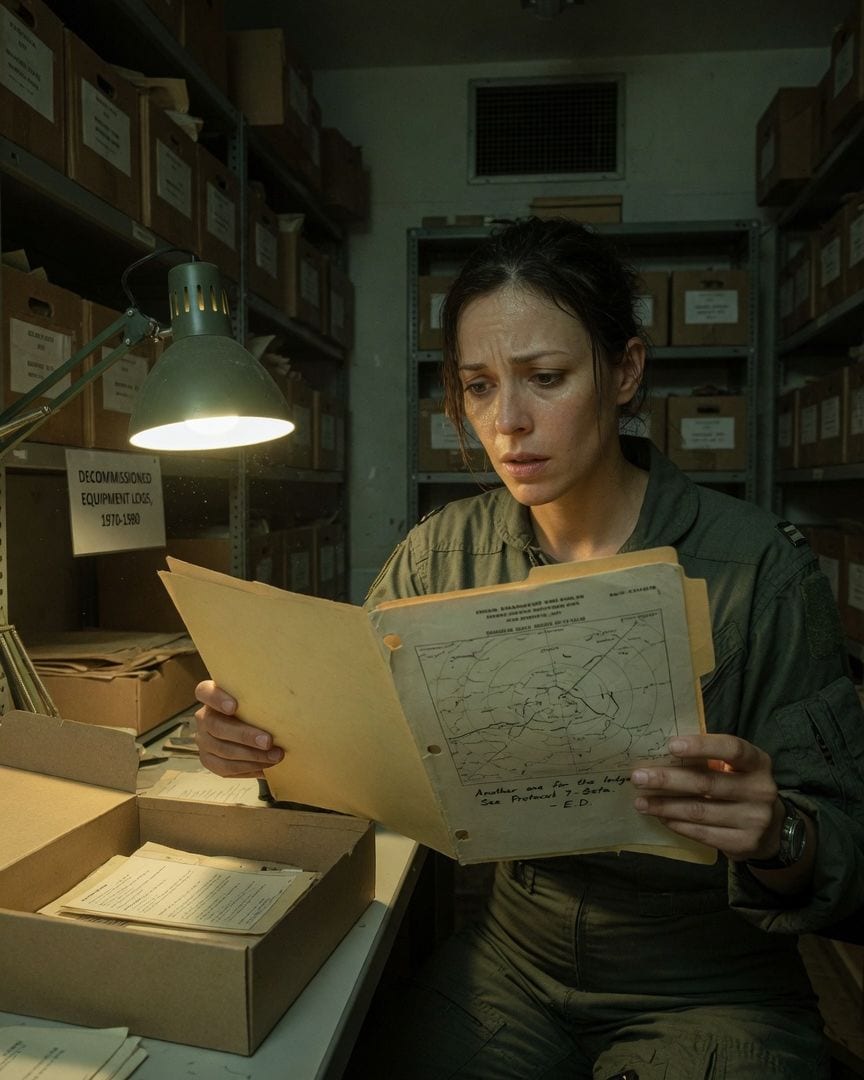
A radar captain's scope went clean, but the pilot swore a mile-wide UFO still filled his windscreen. Then she found a Cold War ledger of impossible sightings.
Captain Ines Bardolph, a 34-year-old radar operator in Bavaria, lived by the precise hum of her console. One quiet night, an impossible contact appeared over the Danube, then vanished from her scope just as a pilot swore it filled his windscreen. Replays showed the object had crossed the Alps in a single blink, defying all known physics. When bureaucracy sought to bury the incident, Captain Bardolph sought answers, leading her to a forgotten archive where a brittle folder revealed a chilling pattern: 'Another one for the ledger.'
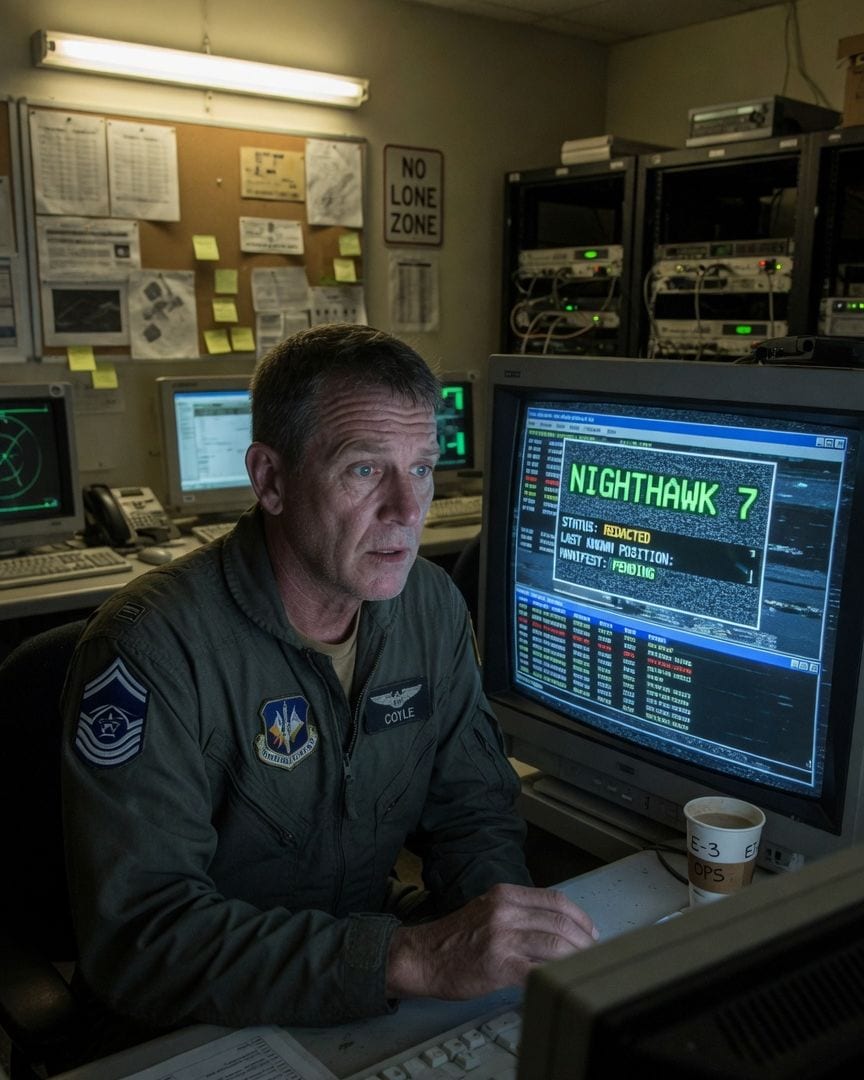
A ghost radar blip returned for Master Sergeant Coyle, three months from retirement. Its call sign: NIGHTHAWK 7, status REDACTED.
Master Sergeant George Coyle, nearly three decades in uniform, counted the last missions before his retirement. High above the black North Atlantic, his E-3 Sentry hummed with the familiar, impossible truth of a ghost radar blip. This single return squawked nothing, eluding every filter and fighter jet sent to investigate, yet the precise systems swore it was there, inbound, week after impossible week. Driven by obsession, Coyle later found a flicker of data: the call sign "NIGHTHAWK 7." Investigating further, an obscure database revealed its status as 'REDACTED,' with its last known position matching the ghost track. What forgotten project was haunting the skies, precisely where it had been scrubbed?
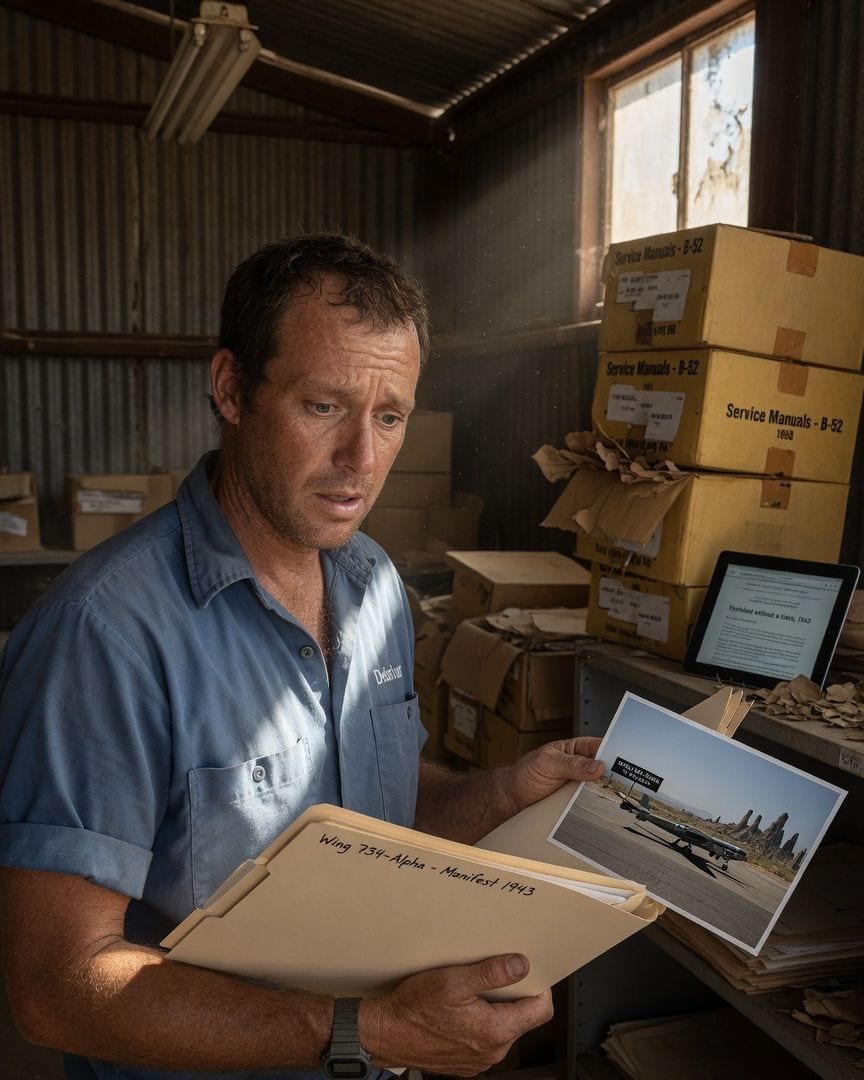
An inventory clerk finds 1943 files for a vanished wing. The paper is new, and photos show its 'lost' plane with impossible tech.
Inventory clerk Rafe Delahunt worked through the Kingman boneyard, his month-long task almost done, the Arizona sun baking through the roof. Amidst crumbling, forgotten records, his hand brushed eleven folders for a 'Wing 734-Alpha'—a designation that never officially existed. Unlike the brittle paper surrounding them, these felt supple and cool, smelling faintly new despite their 1943 dates. Then he found a pristine, modern-resolution photograph of a prototype aircraft officially vanished in 1943, now bearing impossible modifications on an unmapped runway. It was like seeing a ghost in high definition, hinting that these 'recoveries' might be happening closer than he imagined.
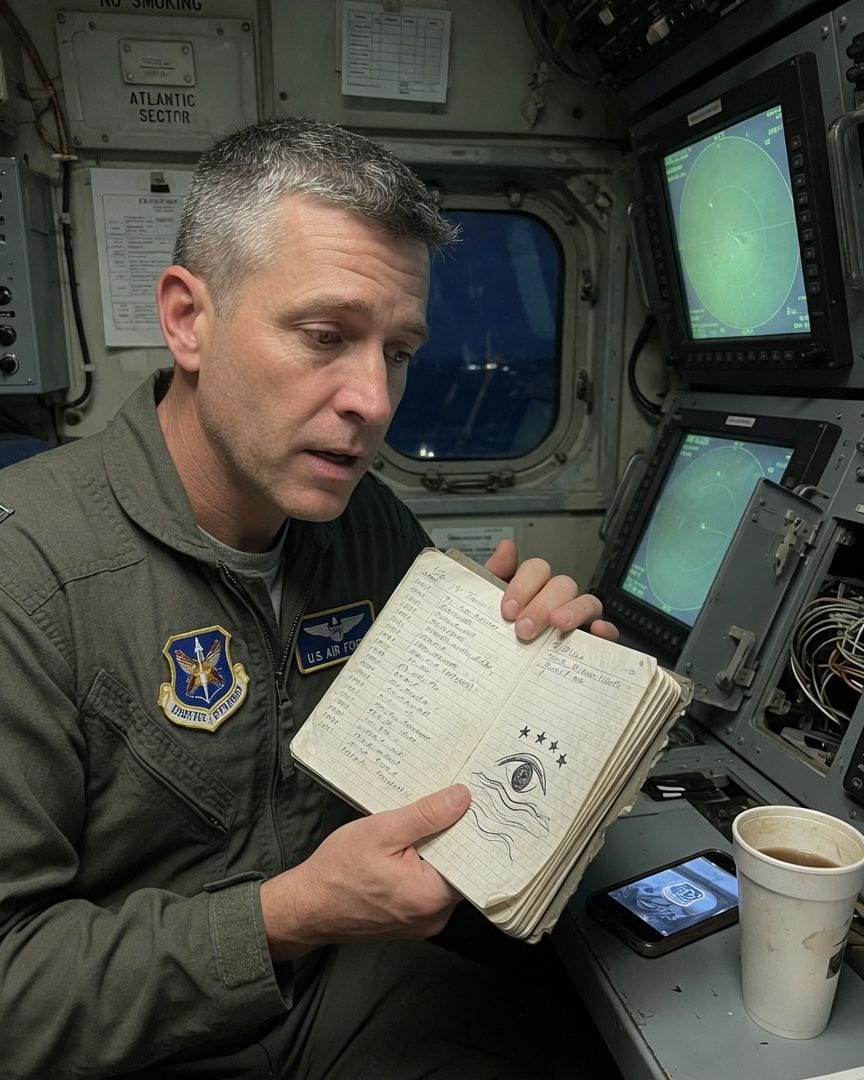
Weeks from his transfer, Master Sergeant Coyle found a Cold War logbook behind his console detailing the exact phantom blip he saw, documented since 1983.
Master Sergeant Everett Coyle yearned for his impending transfer, a clean break from the endless North Atlantic patrols. He had eighteen years of operational experience with the E-3's systems, but one anomaly, a silent blip he called 'The Traveler,' defied every explanation. Fighters found only empty sky, yet the track always returned, perfectly on schedule. During a routine console check, Coyle's fingers brushed against a hidden, spiral-bound notebook. Inside, meticulously handwritten entries detailed his exact phantom blip, recorded by other hands, spanning back to 1983, along with a chilling note: 'They say it's just a ghost. But it keeps trying to answer.'
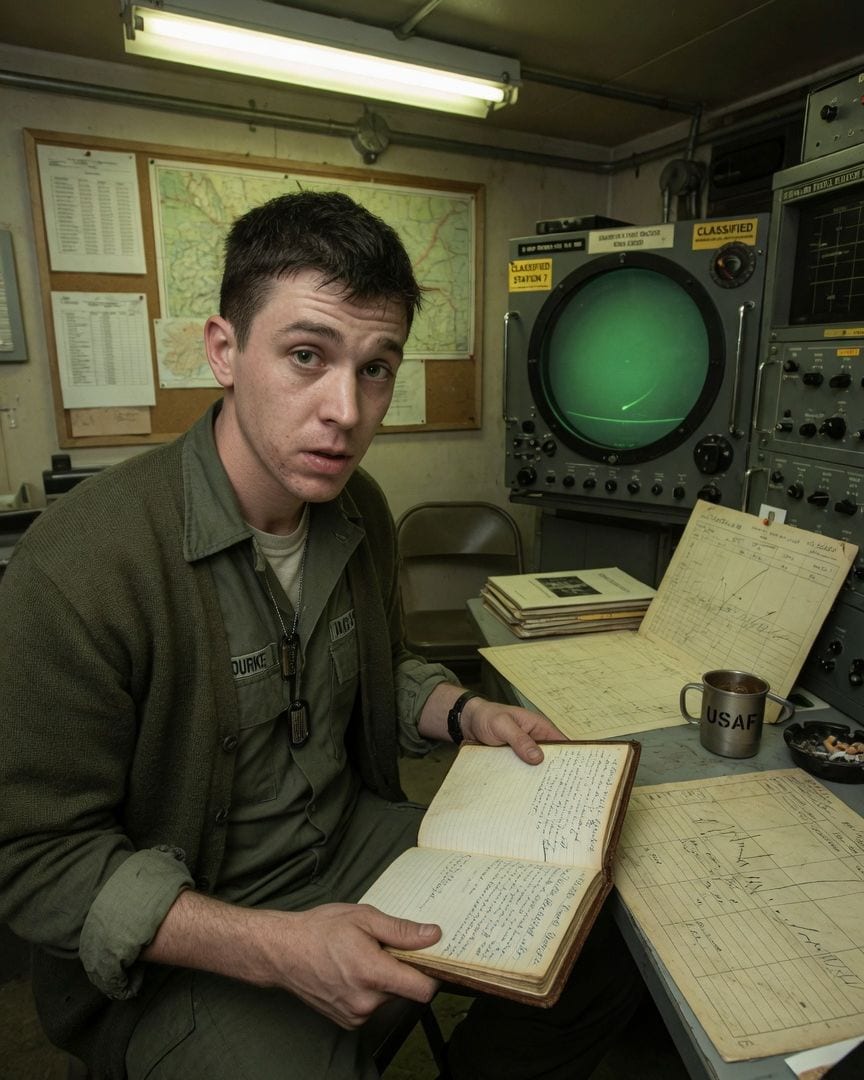
Nearing the end of his tour, Airman Rourke found an old Cold War logbook that named his nightly radar ghost: Airman Gerald Thornton.
Airman Second Class Preston Rourke was nearing the end of his two-year tour at Gap-Filler Station 7, a lonely outpost in the Montana high country. Every night, his radar screen painted a phantom contact, a slow line across the valley floor always dismissed as a temperature-inversion ghost. But while clearing a storage closet, Rourke found old plotting boards from prior winters, each showing the exact same impossible trace, drawn by different hands over successive seasons. His meticulous checks found no weather anomalies to explain the persistent radar ghost. Then, he uncovered a worn, unofficial logbook detailing more radar plots. One entry from 1968, next to an identical trace, contained a date and a name: Airman Gerald Thornton.