An airman found old radar logs repeating the same impossible ghost trace. One entry from '66 then made a shift's personnel count one off.
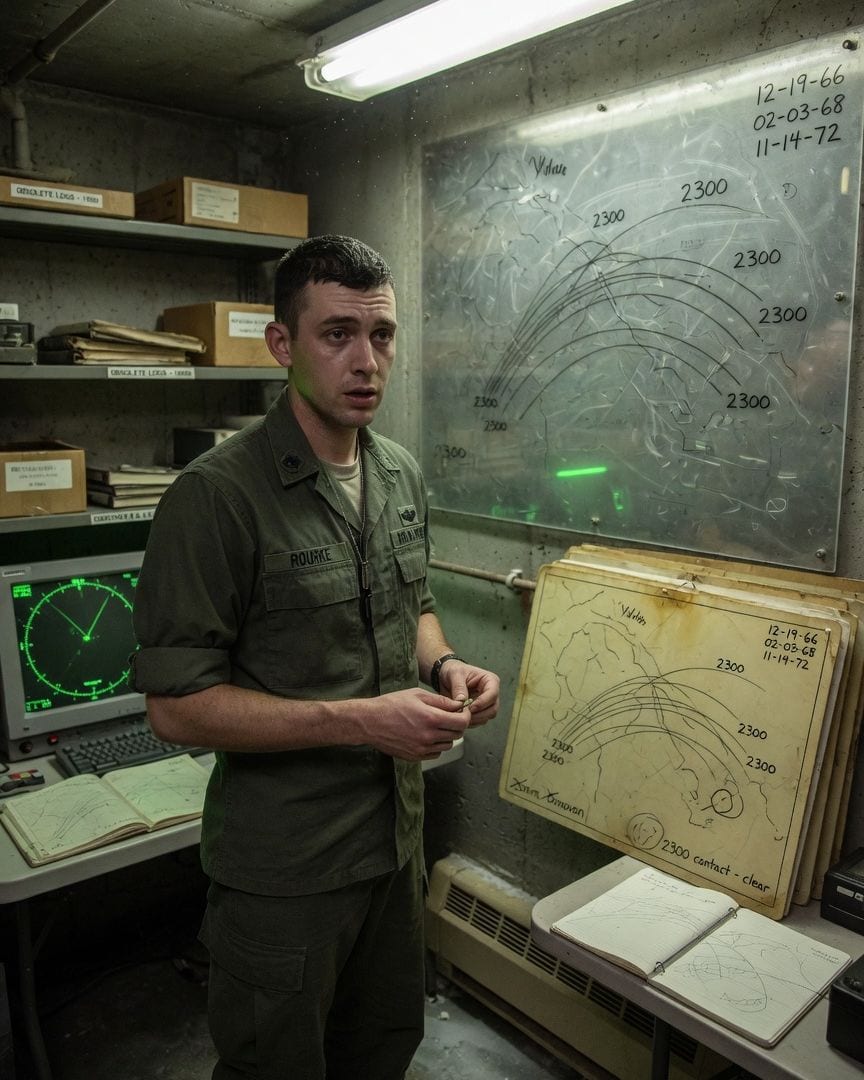
Benjamin Rourke, Airman Second Class, watched the green sweep of the radar screen. It was 2300 hours, and the air in the small, insulated room felt like a shallow grave.
Just as he knew it would, the slow, lumbering contact appeared at the edge of the display, tracing its familiar, unhurried path across the valley floor.
He’d logged it every night for the past month as a "temperature inversion ghost," exactly as Staff Sergeant Holloway had instructed him on his first day at this desolate Montana gap-filler station.
But the sheer predictability of it, the way it moved with impossible regularity, night after night, was what truly made it feel wrong. It wasn’t a glitch, not a transient atmospheric anomaly; it was a scheduled event.
He glanced at the wall where a rough, hand-drawn map of the valley hung, etched in grease-pencil on a clear plexiglass board. It was a plotting map, used by generations of radar operators.
He knew there were dozens more like it in the station's dusty storage closet. The base heater hummed, pushing warm air, but a persistent, marrow-deep cold seemed to seep into Rourke’s bones from the concrete floor.
He shivered, then scribbled the contact's course onto his own shift log, mimicking the precise, almost ritualistic marks he’d seen in older records.
The persistent ghost continued to bother Rourke. It wasn’t the contact itself, but its mechanical adherence to schedule. He waited until his shift ended, then headed for the storage closet, a dim, forgotten space smelling of stale paper and ozone.
He found a stack of old grease-pencil boards, each a duplicate of the one on the wall, tucked away behind boxes of outdated manuals. They dated back three winters, some yellowed, others cracked along the edges.
He pulled one from the stack, then another. Each board held the same hand-drawn valley map, crudely but precisely rendered.
And on every single one, at precisely the 2300 mark, was the exact same slow, plodding line, crossing the same stretch of valley. It wasn’t a series of similar blips, not atmospheric echoes that coincidentally mirrored each other.
It was the identical, unnerving trace. The same start point, the same arc, the same vanishing point, over and over, recorded by different hands, on different nights, years apart. He flipped through them, winter after winter, a perfect, impossible replication.
He tried to rationalize it. Maybe it was a unique geographical feature, a pocket of cold air that always condensed at the same spot, at the same time.
But the sheer consistency, across changing equipment, changing operators, and changing weather conditions, gnawed at him. The rational explanations withered under the weight of the repetition. No, this was not natural.
Rourke pulled one of the older boards closer, from the winter of '66. The plexiglass was scratched, the grease-pencil lines faded with age, but still legible.
Along the bottom edge, where the daily shift log would have been written, he saw faded, barely legible grease-pencil notations.
Next to the date of a particularly clear radar trace, one that showed the 2300 contact with unnerving clarity, someone had drawn a small, crude tally mark with a circle around it.
And then, faintly, a name — 'Donovan' — had been scrawled beside it, then crossed out with a single, thick line. The mark made the expected personnel count for that shift seem one off.
The crossed-out name and the tally mark sent a chill down Rourke’s spine, a deeper cold than the Montana winter.
He couldn't shake the image of 'Donovan,' erased from the log as if he'd never been there, yet marked by that strange tally.
He started comparing the old grease-pencil logs with the official station manifests stored in the administrative office, a task that quickly grew tedious. He cross-referenced dates, names, and shift rosters, spending late hours hunched over dusty ledgers.
A pattern began to emerge, faint at first, then stark: on roughly one in three nights when the 2300 contact was logged on the grease-pencil boards, the official manifest for that day showed a minor discrepancy.
Sometimes a name was briefly missing from a roster, as if someone had failed to clock in, or had been struck from the roll entirely.
More unsettlingly, sometimes a headcount, especially for the overnight shift, would appear to have an extra person for a few hours before correcting itself, the excess name vanishing without a trace.
These weren't major errors, easily dismissed as clerical oversights by a tired corporal, but they consistently aligned with the dates of the phantom radar contact.
He tried to ask Staff Sergeant Holloway about past "clerical errors" during a casual conversation over coffee. Holloway, a man whose face was etched with years of high-altitude solitude, simply grunted. "Old-timer sloppiness, Rourke.
Don't go digging up ghosts in the paperwork. Focus on your own duties." The dismissal was firm, leaving Rourke with the feeling that he’d touched a raw nerve.
Rourke's late-night digging didn't go unnoticed. He felt it in the subtle shifts of the station's routines, the way conversations stopped when he walked into a room.
One evening, after he’d spent hours meticulously poring over old files in the deserted admin office, he returned to his barracks to find his locker slightly ajar. He always locked it.
Nothing appeared to be missing, but the hinge creaked differently now, as if it had been forced.
A few nights later, while he was alone on the radar deck, the radio crackled with a burst of static, a common enough occurrence in the remote mountains.
But then, through the hiss, he heard it: a faint, distorted voice, almost like his own name being whispered, stretched and warped, just audible above the wind rattling the antenna array.
He gripped the edge of his console, dismissing it as interference, a trick of the exhausted mind, but the hairs on his neck stood up, prickling.
The room, usually a comfort of glowing screens and white noise, suddenly felt hostile, its silence too deep. Later that week, Janet Sterling, his shift buddy, found him staring into the coffee pot, lost in thought. She nudged him.
"Holloway's been watching you," she said, her voice low. "Like you're a new piece of equipment he's trying to figure out. Been asking about your hours." Rourke swallowed, the coffee in his mug suddenly tasting like ash.
The air in the station felt heavier, pregnant with unspoken questions, as if the very walls were holding their breath, waiting for something.
Driven by mounting unease, a cold dread that had taken root deep in his gut, Rourke used a rare opportunity during a supply run to the nearest town to track down Joel Vance.
He’d found Vance’s name in an old station yearbook, listed as NCOIC from the late 1960s. The town was little more than a dusty main street and a few scattered cabins.
He found Vance in one such cabin, tucked away among pines, the air around it thick with the smell of woodsmoke.
Vance, now a quiet, haunted man with eyes that seemed to have seen too much sky, initially dismissed Rourke's questions. "Just a ghost, kid. This whole valley’s full of them. Don't go looking for trouble you don't want to find."
His voice was raspy, slow, like gravel sliding down a hill. But Rourke pressed, pulling out the photocopies he’d made: the old grease-pencil marks, the tally, the crossed-out name 'Donovan', and the accompanying manifest discrepancies.
Vance’s eyes, dull moments before, narrowed as he recognized the familiar scrawl. He ran a trembling finger over the 'Donovan' entry. His composure, for a fleeting moment, cracked.
He finally admitted, his voice barely a whisper, "The thing in the valley… it comes for the count. Always at 2300. Always the same trace. It knows the transmissions. Draws it in. It takes one, or it adds one.
Sometimes you don't know which is worse. It messed with the numbers, sure. They called it 'the ghost in the machine' because it showed up on the radar, messed with the ledgers. But it wasn't just numbers. It was us."
He spoke of unexplained absences, of men who simply vanished from their shifts, leaving their posts vacant, only to reappear hours later with vacant stares, subtly altered, their memories hazy.
He recounted instances of headcounts that briefly swelled to an impossible number – six men in a four-man roster – before settling back, leaving everyone uneasy but unable to prove anything.
"The logs were how we tried to track it, before they made us stop. They said it was bad for morale." Vance lifted his gaze, meeting Rourke’s. "They made us burn most of them. Said it was classified."
Vance then showed Rourke an old, leather-bound personal journal, its cover worn smooth by decades of handling. "This one," he said, tapping it, "they didn't know about this one."
It was a forbidden record, kept in defiance of whatever orders had been given.
Inside, on a page yellowed with age and brittle to the touch, was a hand-drawn diagram of the station, crudely rendered but accurate, with various names and dates scrawled around it, connected by arrows.
It was a macabre map of past "incidents." Vance’s finger, gnarled and thick, traced a sequence of names. Each name was tied to a specific date, and each date was circled, marking the 2300 radar contact. "They came and went.
Like a tide. A name, a date, a quiet transfer, or just… gone." Rourke’s breath hitched. He followed the pattern, a slow, sickening realization blooming in his chest.
The sequence culminated in a name, scrawled in faded ink at the end of a long arrow, and a date that was only a week away. And that name, stark and utterly undeniable, was "Rourke."
Back at the station, the revelation from Vance’s journal detonated in Rourke’s mind, shattering any pretense of routine. The journal wasn’t just a warning; it was a prophecy.
He frantically re-examined every piece of data he possessed: the grease-pencil boards, the faded manifests, the cryptic tally marks, the crossed-out names. The pattern was undeniable and horrifyingly precise.
The radar contact at 2300 wasn't just an arrival; it was a signal, a fixed point in a terrifying cycle that repeated across decades.
The marginal notations and the manifest discrepancies weren't random errors or the sloppy work of tired airmen; they were markers for personnel changes, replacements, or brief, impossible additions to the crew.
The station itself, built on this high-country pass, wasn't just a radar installation; it acted like a beacon, a fixed point, or perhaps even a gate.
The "ghost in the machine" was a recurring presence that cycled through the station's crew, taking one, leaving another subtly altered, or simply adding an extra, unaccounted-for 'body' that slowly faded from memory and record alike.
The pattern, consistent across different rotations and dates, revealed a chilling schedule of infiltration, a roster for replacement. And Rourke's current assignment, his specific 2300 shift, and his impending leave date all aligned perfectly with the next 'event'.
He was not just an observer, not just a discoverer of a terrible secret; he was the next scheduled participant. The target was him.
The night of his scheduled "event" arrived, cold and clear. Rourke stood on the radar deck, rifle gripped tight in his shaking hands, a knot of pure terror tightening in his gut.
He’d tried to warn Holloway again, frantically explaining the pattern, showing him the photocopies of Vance’s journal.
But the NCO, his face impassive, had simply dismissed Rourke's claims as stress and fatigue, signs of an airman cracking under the pressure of remote deployment. "You're overtired, Rourke. Go get some rack time."
He spoke as if Rourke were a child, sending him away with a pat on the shoulder. Now, as the sweeping arm of the radar approached 2300, Rourke was alone. The hum of the machinery was the only sound.
At precisely 2300, the slow contact appeared on the screen, just as it always did, tracing its familiar, unhurried path across the valley.
But this time, Rourke saw something else in his peripheral vision – a faint distortion in the air near the perimeter door, a shimmering, like heat haze rising from asphalt on a summer day.
It wasn’t a shadow, not a trick of the light; it was an absence of light, a place where reality seemed to ripple. His heart hammered against his ribs, a frantic drum against the silence.
The distortion solidified, not into a clear figure, but a shifting, indistinct shape that seemed to absorb the ambient light, rendering itself a mobile void.
It moved with a slow, deliberate grace towards the main station area, bypassing the secured perimeter door as if it weren't there, simply flowing through it. Rourke raised his rifle, the cold steel a sudden comfort against his cheek.
He fired, the shots echoing deafeningly in the small, enclosed room, the sharp reports tearing through the unnatural silence. The shape faltered, a momentary flicker in its indistinct form, then dissolved, receding back through the phantom door it had created.
It left behind only the acrid smell of ozone and a faint, shimmering residue on the polished floor, like oil on water, quickly fading.
He had driven it back, for now, but he knew with a certainty that froze his blood: it was not gone. The cycle wasn't broken, only postponed.
Rourke's report was met with immediate, chilling skepticism. Holloway arrived moments after the shots, finding Rourke shaking, the rifle still smoking faintly.
The perimeter door showed no sign of forced entry, no bullet holes, and the shimmering residue quickly dissipated, leaving only the faint, fading smell of ozone. Rourke was given a swift, quiet transfer, then a medical discharge for "stress-related incidents."
His first leave, the one he had been counting down to for months, was canceled. The station itself was decommissioned ahead of schedule, its records sealed.
Holloway, his gaze colder now, made sure Rourke understood that talking about it, even hinting at it, would be a very bad idea. "Some things are better left buried, Airman. For your own good."
Benjamin Rourke now lives a quiet life, far from Montana, far from any mountains. He never joined another service, never settled in one place for long. He avoids remote areas, especially at night.
He checks the locks on his doors twice, every night, and sometimes, he thinks he sees a faint shimmer in the corner of his eye, like heat haze on a distant road, or the distortion of light on a radar screen.
He knows the cycle isn't truly broken, only postponed, waiting for its next scheduled time, its next name. He survived, but a part of him, an unseen tally, never truly left that station.
He carries it with him, a ghost in his own machine.
The station was gone, a phantom in the Montana snow, its decommissioning papers stamped and filed. But sometimes, when the wind was just right, a faint, almost inaudible whisper carried through the air, sounding suspiciously like a name.
Benjamin Rourke, wherever he went, found himself compulsively checking the numbers. He still checks the count.
If this one got to you
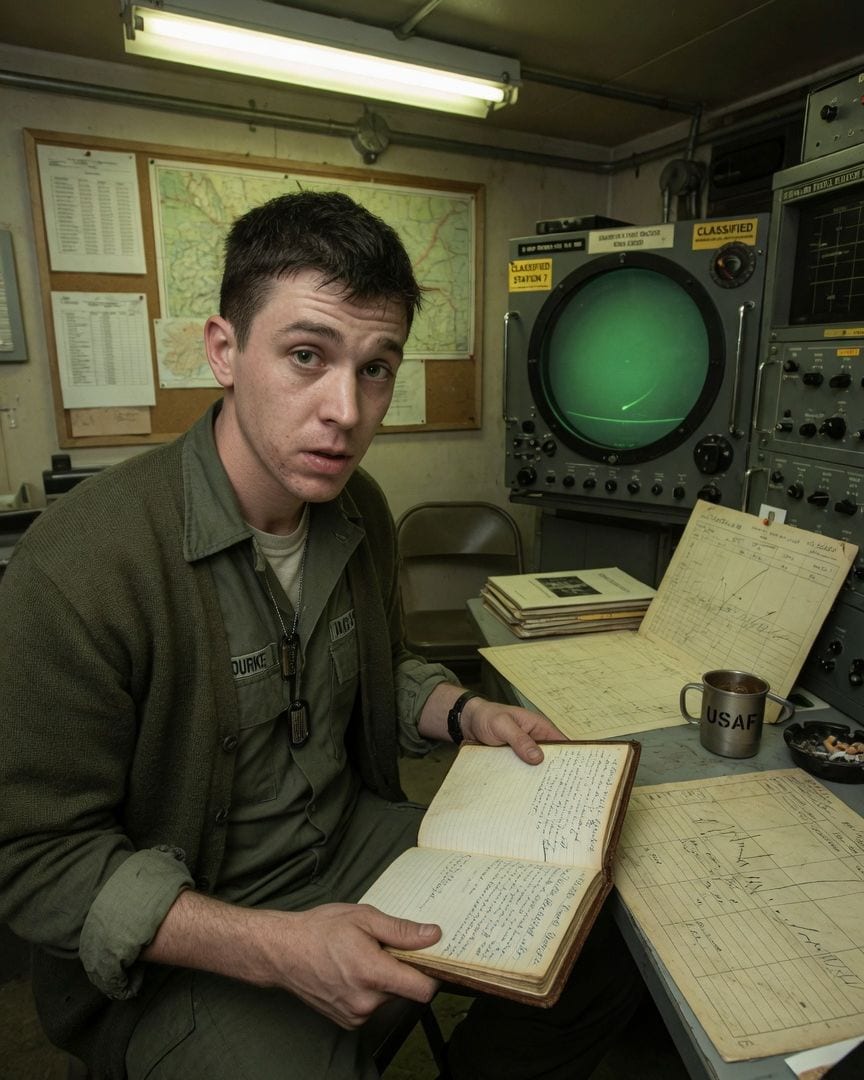
Nearing the end of his tour, Airman Rourke found an old Cold War logbook that named his nightly radar ghost: Airman Gerald Thornton.
Airman Second Class Preston Rourke was nearing the end of his two-year tour at Gap-Filler Station 7, a lonely outpost in the Montana high country. Every night, his radar screen painted a phantom contact, a slow line across the valley floor always dismissed as a temperature-inversion ghost. But while clearing a storage closet, Rourke found old plotting boards from prior winters, each showing the exact same impossible trace, drawn by different hands over successive seasons. His meticulous checks found no weather anomalies to explain the persistent radar ghost. Then, he uncovered a worn, unofficial logbook detailing more radar plots. One entry from 1968, next to an identical trace, contained a date and a name: Airman Gerald Thornton.
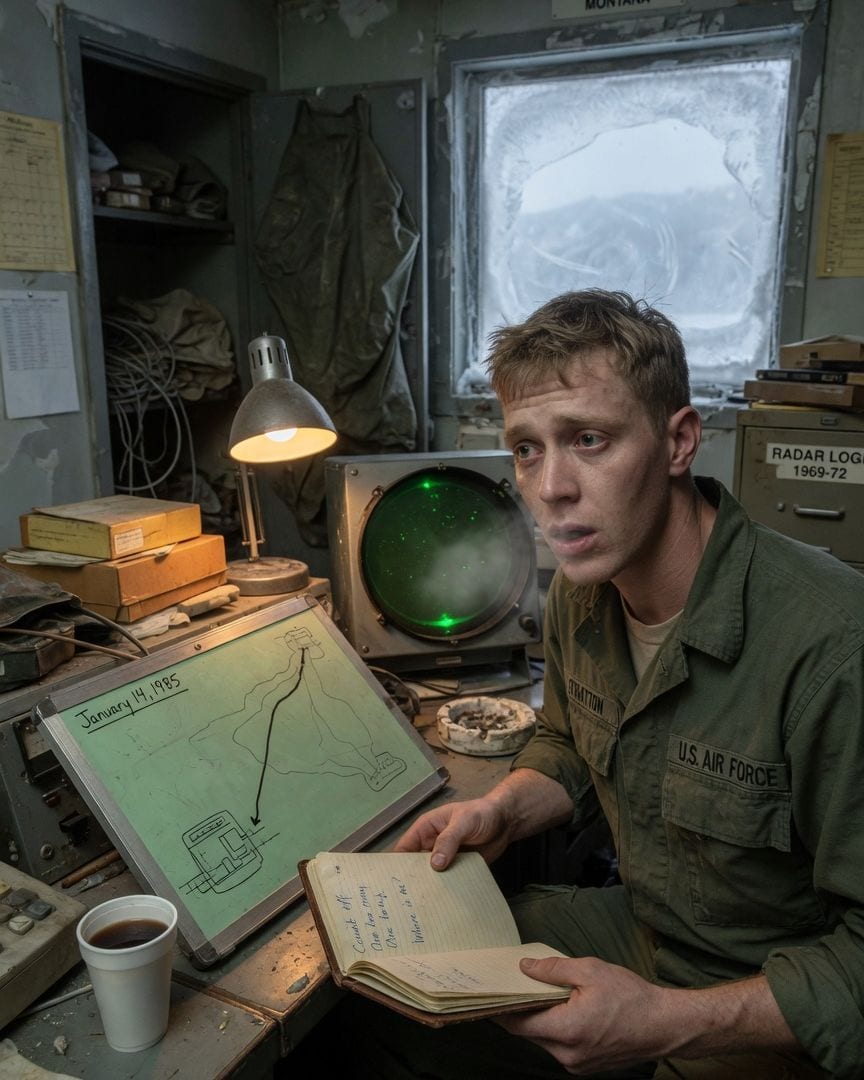
Airman Lars Stratton found an old Cold War manifest listing one name twice: 'Bernard Radcliffe' transferred and 'Bernard Radcliffe' still present.
Airman Second Class Lars Stratton was counting down his final weeks at Echo Station, a desolate Cold War outpost due for mothballing. He longed for home, far from the bitter Montana winds and the constant hum of static. Inside the dim radar shack, he logged the usual nightly ghost blip, a faint contact appearing at 2300, just as it had every winter since 1987. This night, a metallic tang like old blood lingered in the air, raising the hairs on his arms. Seeking distraction, Lars later discovered a leather-bound logbook from 1971, detailing the same 2300 contact, but with chilling notes and a manifest listing one airman's name, Bernard Radcliffe, twice—once transferred, once present. Was he truly alone in the silent, remote station?
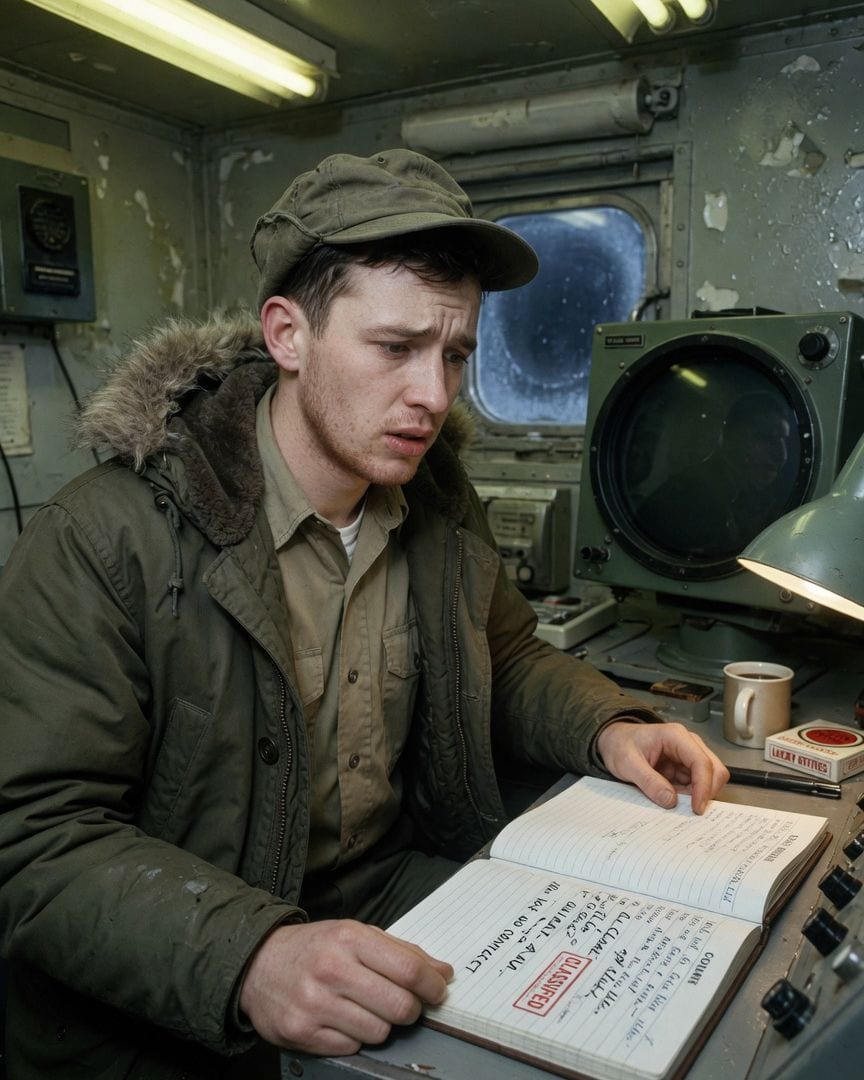
A Cold War airman logs an impossible radar contact on his last sweep. But his official logbook entry is stamped 'CLASSIFIED' and then contradicted by a hastily scrawled 'ALL CLEAR' dated moments before it.
Airman Ordway Vance, 22, manned the radar dome at Site Pellin in the biting North Atlantic dark of January 1962, running the last calibration sweep before its decommissioning. His scope picked up a faint, impossible return, growing closer with each pass, though the ocean remained empty to the eye. When Vance detailed the contact in his official logbook, a 'CLASSIFIED' stamp appeared, followed by a hastily scrawled 'ALL CLEAR' dated moments before his own entry, contradicting his every word. Commander Hartley dismissed it as equipment malfunction, but Vance sensed a chilling, official erasure behind the lie. He soon found a locked cabinet marked 'SITE PELLIN ANOMALIES,' hinting at a deeper truth buried within the base's final days.
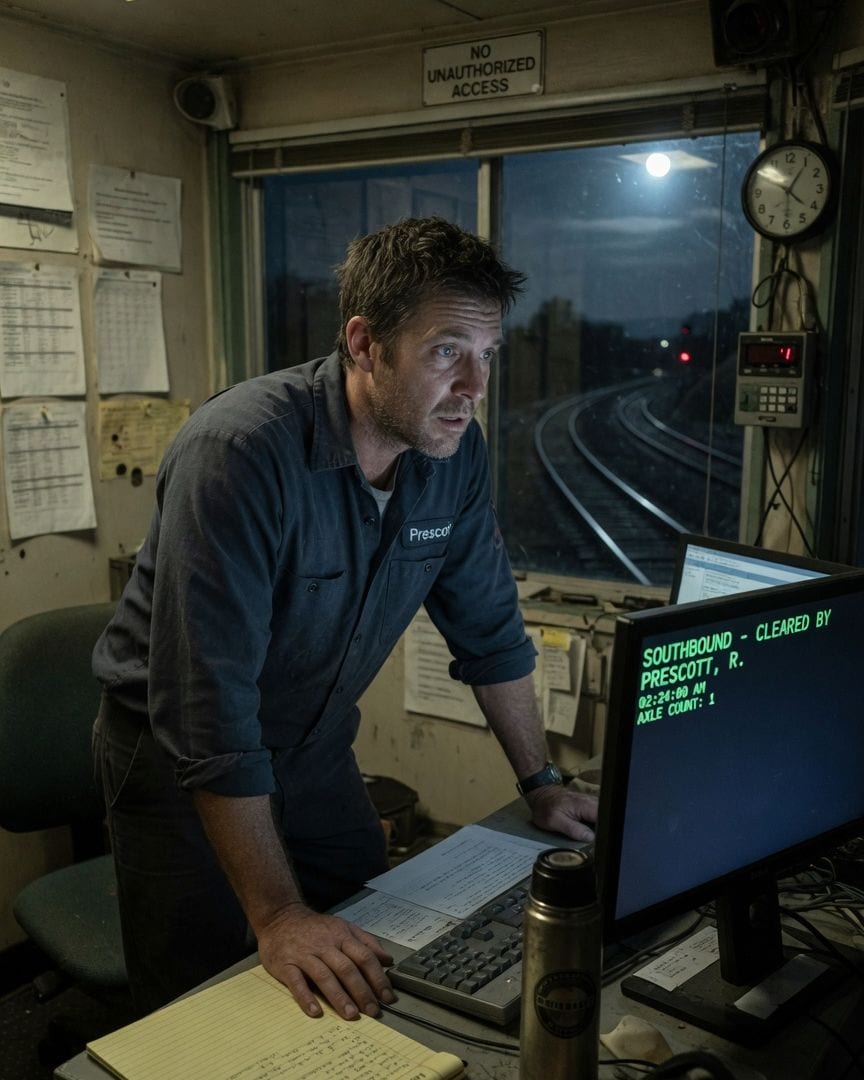
My signal box log shows I cleared a southbound train at 2:24 AM. No train was booked, but the wheel counter ticked over once.
My night shift in the signal box is usually quiet, just the hum of the panel and distant trains. But at 2:24 AM, a log entry for a southbound train appeared on screen, cleared by my name, even though I hadn't touched a thing. A cold prickle ran up my neck when the wheel counter ticked once, confirming an impossible passage on the empty tracks.
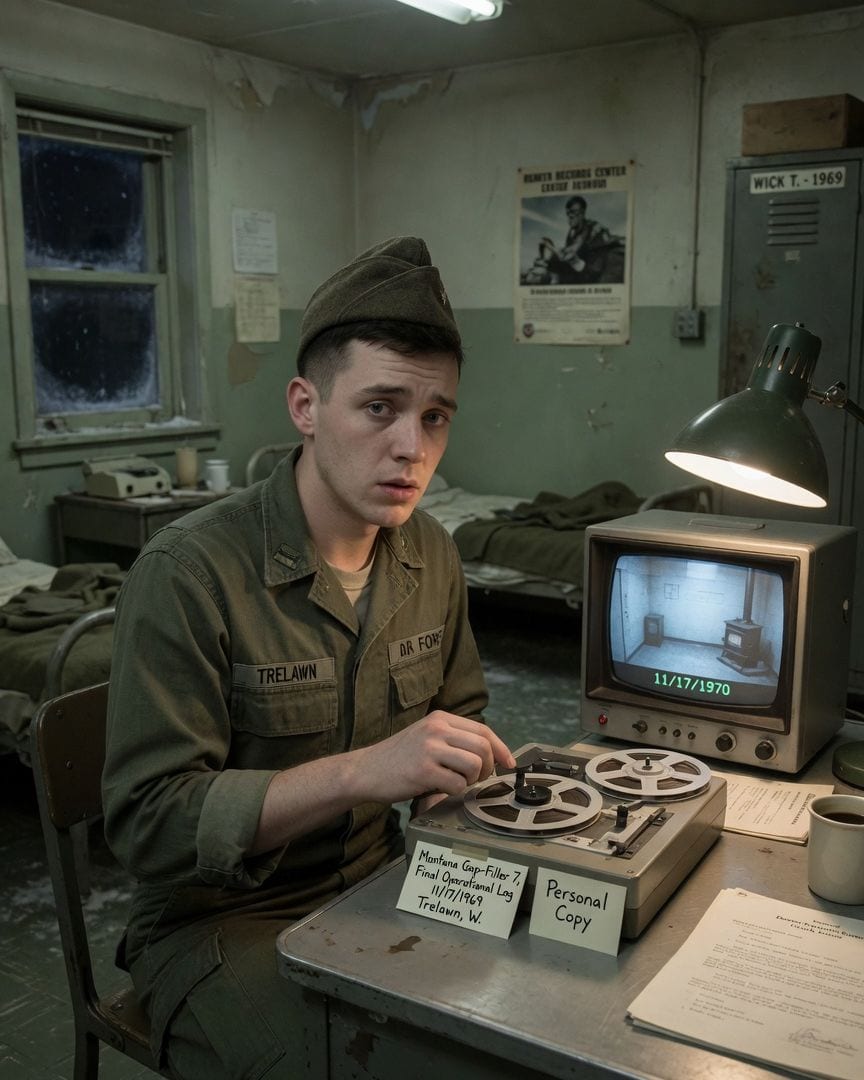
A Cold War gap-filler station was locked cold. Airman Wick Trelawn's final tape showed a man powering up the console a year later.
Airman Wick Trelawn shivered through his final hour at the remote Montana Gap-Filler 7, a Cold War radar station set to go cold forever. He meticulously logged its last operational moments, pulling the master tape as a final record. Later, reviewing a personal copy, Trelawn watched his empty control room play out as expected, but the tape kept running into a second hour. An indistinct man then appeared, methodically powering up equipment in the supposedly dead station. The site had been locked cold for a year by then, yet his official request for the original tape revealed a blinking timestamp of November 17, 1970. What impossible operations did the final log truly capture?
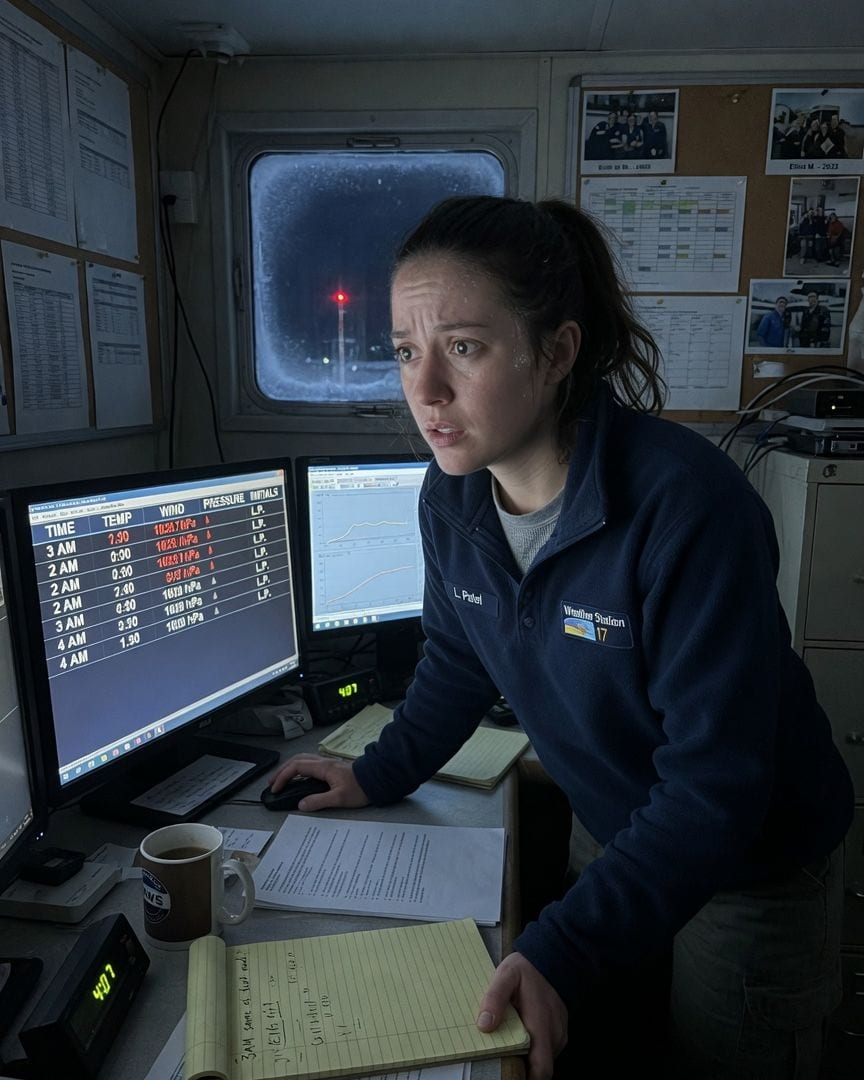
My weather station's 3 AM log shows a pressure reading I never made. My initials are on it, but the dials were dead still.
Working the overnight shift at the remote weather station, I routinely checked the digital logs. The 3 AM entry showed an impossible barometric pressure spike, a hurricane that simply hadn't happened. I distinctly remembered being outside at that time, calibrating a sensor, not making that entry. Yet, my initials, L.P., were clearly logged next to data I never made.