A Cold War tower controller logs an object vanish from radar, then hears the pilot scream it’s filling his windscreen. Her own name, 'Bardolph, Ines', now marked 'Observed' in a secret file.
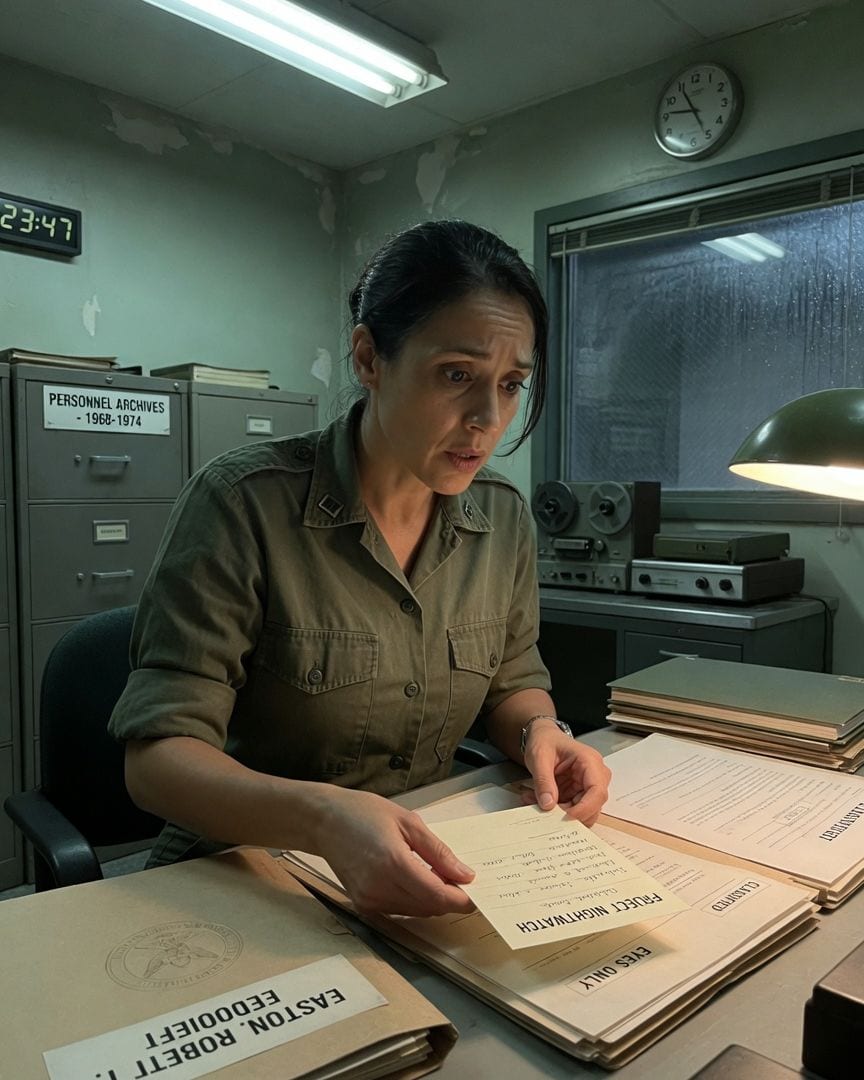
Captain Ines Bardolph gripped the headset, the synthetic leather clammy against her ear. Static crackled, a low hum beneath the rising pitch of Captain Robert Easton’s voice. "Tower, this is Phantom One-One. Target still present, bearing two-seven-zero, speed… impossible."
Her eyes remained fixed on the radar scope, a green, glowing circle that moments ago had shown an anomaly: a blip, solid and unwavering, 40 miles north of the Danube, holding position against the wind, against all logic.
Then, as her antenna swept across its coordinates again, the screen had gone clean. Nothing. But Easton, airborne in his F-4 Phantom over the Bavarian Alps, was screaming now. "It's right here! Filling the damn windscreen, Ines! What is it?"
Ines’s stomach tightened. She hit the recording button for the air traffic control tape, her movements precise, almost robotic. "Phantom One-One, confirm visual. My scope is clear."
The silence that followed was thin, stretched taut, punctuated by the ragged gasps she knew were Easton’s. He sounded like a man drowning. "It's… it's gone," he finally whispered, the panic replaced by a raw, hollow disbelief. "Just… gone."
Later, in the secure playback room, the fluorescent hum overhead felt cold. Ines cued up the radar tape. The blip appeared, a solid green square, then vanished. She slowed the playback, frame by frame, isolating the data.
The object had been there, stationary, then gone. Not faded, not dissolved.
It had simply ceased to be in one sweep, covering the 40 miles from its last tracked position to a point beyond the Alps in the fractional time it took her antenna to rotate. Less than a second.
It was an impossibility, a direct contradiction of physics, yet the tape was undeniable. The incident, Commander Coleman had informed her that morning, was classified, "Eyes Only." He'd shaken her hand, his gaze unusually steady. "Captain, your discretion is paramount.
Base decommissioning is scheduled in six months. Your transfer to Langley is already approved, effective immediately after." A quiet transfer, a fresh start.
It should have been a relief, a pathway to put this impossible truth behind her, yet the image of that blip, the sound of Easton’s voice, clung to her.
She wrote her report, methodical and rational, detailing every observable impossibility, knowing the paper would never hold the truth of what she had witnessed.
Weeks later, the official incident debriefing felt like a play she was watching from a strange distance.
Captain Robert Easton and his wingman, Kevin Vance, sat across from Commander Coleman, their faces unnervingly calm, their postures rigid with a quiet composure Ines hadn't expected. Easton spoke in clipped, professional tones, describing "anomalous atmospheric conditions" and "instrumentation glitches."
He omitted any mention of seeing an object, or the terror that had ripped through his voice on the comms. Vance nodded along, his eyes blank.
Their flight logs, cross-referenced with the radar room's official record, backed up their sanitized accounts, leaving out the crucial, impossible timeframe.
Ines kept her raw radar tape locked in her personal safe, a defiant secret against the growing tide of official amnesia.
The final official incident report, delivered for her signature weeks later, landed on her desk with the thud of finality. It was a meticulously constructed lie, blaming "equipment malfunctions and a rare atmospheric inversion event."
The narrative was neat, plausible, and utterly contradictory to her data. As Ines scanned the documents, her pen poised, she paused at Captain Easton’s performance review addendum.
Not only had he been cleared, his psychological evaluation was glowing, almost absurdly so, praising his "unflappable composure under duress."
More unsettling, he had received a swift, unexpected promotion, moving to a coveted flight lead position within a top-secret testing squadron.
It felt wrong, profoundly wrong, that a man who had screamed into his headset with genuine terror could be so quickly lauded for his "composure."
Unsettled, Ines used her access, still active for a few more days before her transfer, to review Easton's full personnel file. The folder was thick, heavy, filled with commendations, training records, and glowing reports.
She thumbed through it, page by page. It was pristine, unremarkable, a perfectly constructed edifice of a stellar military career.
She found no hint of the true nature of the incident, no lingering questions, no anomalies beyond the ones she already knew. The very perfection of it set her teeth on edge.
No mistakes, no doubts, just a smooth, upward trajectory. She ran her fingers across the embossed seal, feeling a deeper chill than the air conditioning justified.
Ines spent hours poring over Easton's perfectly scrubbed file, the fluorescent lights of the secure records room casting a sterile glow.
She searched for any hint of the incident's true nature, any anomaly, any misstep in his flawless career, but found none. Every page was meticulous, every commendation earned, every transfer a logical step up. His record was unnervingly pristine.
Her fingers, growing tired, brushed against something thin, almost imperceptible, tucked deep behind a sheaf of official commendations from his early career.
It wasn't a loose page, but a small slip of cream-colored paper, folded once, almost camouflaged against the aged parchment of the document it hid behind. Ines pulled it free.
Unfolding the slip, her gaze dropped to the stark, typewritten header: 'PROJECT NIGHTWATCH.' Below it, scrawled in an unfamiliar, tight hand, was a single line of text. Her breath hitched.
The words seemed to jump off the page, cold and sharp: 'Subject: Bardolph, Ines. Status: Observed.' Her own name. The quiet room, usually a comfort, now felt like a sealed vault, the air suddenly thin, freezing in her lungs.
The 'Project Nightwatch' slip, with her name scrawled on it, became a haunting presence in Ines's mind. She scanned classified databases, cross-referenced internal projects, even used back channels to inquire with contacts at other bases.
There was no official record of 'Project Nightwatch.' It was a ghost, a name without a body. The base's decommissioning accelerated, a palpable sense of closure settling over the concrete bunkers and empty hangars.
Boxes piled up, files were prepped for deep storage or incineration, and the clock ticked down on her access.
Ines, working with quiet desperation, began cross-referencing Easton's career trajectory with other pilots who had been involved in 'anomalous' incidents she could recall from her years in radar operations.
There were few, but a disturbing pattern emerged: rapid, quiet ascents to obscure, highly specialized postings. No one seemed to question their sudden reassignments, their careers insulated from the minor incidents that would normally mark a pilot's file.
It was as if a careful hand had smoothed their paths, redirecting them into less visible, more controlled channels.
She attempted to contact Easton for an interview, using a plausible cover story about a retrospective on Cold War-era radar system efficiency. The request went through, then got stuck in a bureaucratic loop.
Meanwhile, she delved into older, less-digitized archives, searching for any mention of the inverted delta symbol that had been roughly sketched in the margin of the 'Nightwatch' slip.
She found it, sparingly, in the margins of old internal memos, often marked 'rerouted.' These documents discussed "unexplained atmospheric phenomena" or "unidentified aerial contacts," but always with a detached, clinical tone.
The symbol was small, almost like a printer’s error, but it was there, an inverted triangle, a subtle signature. It never appeared on outward-facing documents, only on those meant for a select internal audience.
The symbol was a ghost, appearing just at the edge of official visibility, a whisper of something hidden within the bland language of military bureaucracy.
The deeper Ines dug into the inverted delta, the more she felt an unnerving sensation of being watched. It was a subtle shift in the background hum of her life, a feeling that her solitude was less solitary than before.
Returning to her quarters after a late night in the archives, her hand brushed the desk lamp. It was subtly shifted, angled an inch or two away from its usual position. A small thing, easily dismissed.
But then, on her pillow, lay an unmarked, cream-colored envelope. She opened it with a sudden, cold dread. Inside was a grainy, black-and-white photograph.
It was a blurry, distant shot of her own barracks window, taken from the tree line just beyond the fence. The implied warning chilled her to the bone, colder than any Bavarian winter.
The next day, her archive access was summarily revoked, citing "impending decommissioning protocols." Her scheduled interview with Easton was canceled, a curt email informing her of his "unforeseen health issues" requiring an indefinite leave of absence.
The timing was too precise, too immediate after her discovery and the photo. Ines realized she was no longer just an observer. She was part of the file, identified, her movements tracked.
Her quiet transfer to Langley felt less like a new beginning and more like a pre-arranged absorption. The base, scheduled to close in days, suddenly felt like a cage.
Her safety, she understood with a sharp, sickening lurch, was now very much at stake, her time running out.
Blocked at every turn, Ines abandoned her transfer plans. Instead, she drove through the night, a relentless eight-hour journey north, her raw radar tape, the 'Project Nightwatch' slip, and the grainy photo tucked into a secure bag beside her.
She found Robert Easton's house on a quiet, tree-lined street in coastal New England, a perfectly ordinary suburban home with a manicured lawn. He answered the door, looking older, softer, but still recognizable.
He didn't seem surprised to see her, merely nodded, acknowledging the canceled interview with a soft, "I figured you'd come eventually, Ines."
He led her inside, into a living room filled with framed family photos and the scent of lemon polish.
Ines didn't waste time. She pulled out a portable tape player she’d brought, setting it on his polished coffee table. "This is from that night," she said, her voice tight. She pressed play.
The familiar static filled the room, then the crisp, professional crackle of air traffic control. And then, his voice, climbing an octave, "It's right here! Filling the damn windscreen, Ines! What is it?" Easton went pale.
He closed his eyes, his hands clenching on his knees. The sound, the raw, undiluted terror in his own voice, was undeniable. He listened until his final, hollow whisper, then Ines clicked it off.
"They… they helped me," he finally said, his eyes still closed. "After that, after I came down. The disorientation, the nightmares… they made it stop." He opened his eyes, a strange, placid calm in their depths.
"It was a recalibration process. They called it a 'memory adjustment,' but it was more than that. They helped me understand that what I saw wasn't real, or at least, not real in a way that mattered.
My career, my family, this house… it's all perfect now. I’m… grateful."
He described the subtle reshaping of his memories, the reinforced disbelief that made the impossible seem mundane, even a grateful acceptance of his new, perfectly normal life and accelerated career.
He looked at Ines, a faint, unsettling smile on his lips. "They file away the impossible to keep the world safe." He paused, then pointed to an inverted delta carved into a wooden coaster on his table. "That's their mark."
The horror of his calm acceptance, his gratitude for having his mind altered, clarified everything for Ines. His perfectly normal life, his sudden composure, his fast-tracked career – these weren't simply the benefits of a cover-up.
They were the evidence of the 'Thing That Came Back Wrong.' All the earlier clues—the whitewashed report, his unnerving composure, his swift promotion—clicked into place as parts of this 'processing.'
He wasn't just a witness; he was a living testament to their power.
Easton, seeing the horror bloom across Ines's face, leaned forward, his voice dropping to a near whisper. "They know about you, Ines. They've always known." The placid calm in his eyes seemed to fracture, revealing a deeper, older fear.
"They don’t just react; they anticipate. 'Sensitives,' they call us. People who are… attuned. They're flagged for observation, years in advance."
He reached for a small, leather-bound notebook tucked into the side pocket of his armchair, its pages aged and brittle. "This was mine. Before the recalibration. My own notes, before they… adjusted them." He handed it to her.
"I managed to hide it. A piece of the old me."
Ines took the notebook, her hands trembling. It felt heavy, like a lead weight in her palm. The leather was worn smooth, the edges soft from years of handling.
She opened it, her gaze falling to the very first entry, dated 1976. Two years before her incident. It was a summary of a classified internal memo he’d accessed, detailing a "Pre-Incident Observation Program."
And there, among a list of names of 'potential subjects' for future 'engagement,' was her own. Clear, precise, undeniable.
"Bardolph, Ines. Age 28. Radar Operator. High cognitive recall, pattern recognition."
The dread that seized her was not just that she had been watched, or that her incident had been covered up. It was the crushing, suffocating realization that her entire life might have been a carefully orchestrated experiment.
The secrecy machine hadn't just reacted to the impossible; it had cultivated it.
It had had its eye on her, specifically, for years, long before she ever sat at that radar scope, long before she even knew what a blip could truly hide.
She hadn't accidentally stumbled upon a secret; she had been led to it, her role predetermined, the file on her opened and maintained long before she even became a witness.
Ines stared at her name in Easton’s notebook, the implications slamming into her with the force of a physical blow. Her 1978 incident wasn't an accident; it was an orchestration. Easton, his voice hushed, confirmed it all.
The 'Pre-Incident Observation Program' identified 'sensitives' like her, individuals with unique cognitive profiles. They were subtly guided, their career paths nudged, their lives steered, until they were precisely positioned to encounter an anomaly.
It wasn't about covering up what happened; it was about managing it, controlling the narrative from the very beginning.
The secrecy machine, Easton explained, viewed these encounters not as threats, but as controlled data points. They used 'sensitives' as unwitting early warning systems, or as subjects for 'recalibration' when the exposure was too direct.
The true horror, Ines realized, was not the alien object, but the institution itself. The 'Thing That Came Back Wrong' was the entire trajectory of lives, quietly steered, memories subtly nudged, belief systems reinforced.
The recurring inverted delta symbols, the whitewashed records, the 'unflappable composure'—it all fit. The institution didn't just suppress the truth; it controlled perception, maintaining a mundane reality for the masses, even at the cost of its own agents' minds.
Ines understood now: she wasn't just a part of the file; she was a living entry, her role predetermined from a memo dated years before she ever saw the blip.
Easton, his face ashen, warned Ines. "They will come for you. They’ll offer you a perfect life, just like mine. Don’t take it." He looked profoundly weary, the placid calm from moments before replaced by a fragile sadness.
Ines knew she had to escape, not just physically, but irrevocably. She gathered her proof: the raw radar tape, Easton’s pre-recalibration notebook, the 'Project Nightwatch' slip, and the grainy photograph.
She thanked Easton, a silent understanding passing between them, the shared weight of a truth too heavy for most to bear.
As she drove away, she saw it: a dark, unmarked sedan parked casually a few blocks down the street, its tinted windows reflecting the afternoon sun. She didn't look back, didn't hesitate. They were already there.
Ines pulled over miles later, using a payphone, making a series of anonymous, untraceable calls to journalists she’d known in her past life.
She fed them fragmented, carefully constructed breadcrumbs of a Cold War cover-up, blending enough truth with plausible fiction to make it sound like a rogue faction within military intelligence, not an overarching, omnipresent entity.
She knew her military career was over, her life irrevocably changed. She had traded her uniform for a shadow.
Ines drove towards her isolated cabin in the Bavarian Alps, accepting the cost: a life lived in vigilance, always looking over her shoulder. But she would be free, carrying the truth, and she would not be filed away or recalibrated.
Ines never returned to military service. Her records, quietly altered, simply read 'voluntarily separated due to personal circumstances.'
The NATO base closed six months later, its concrete bunkers eventually absorbed into the Bavarian landscape, its archives transferred to deep storage, then quietly forgotten. Robert Easton's perfectly normal life continued, a testament to the machine’s terrifying efficiency.
The journalists Ines had contacted published nothing, the story too incredible, too fragmented, too dangerous to pursue without verifiable sources. The world remained oblivious, turning on its axis, firmly believing in the mundane.
Ines understood she had escaped, but the cost was a quiet solitude, a perpetual vigilance that hummed beneath every moment of her life.
She lived with the knowledge that the secrecy machine, ever patient, had merely shifted its focus, her name now marked as 'uncooperative,' her file moved to a different, perhaps more secure, cabinet.
Years passed. Ines, older now, sat by her Alpine cabin window, the mountains a silent, unchanging backdrop to her contained life.
She still held the tape, the notebook, the slip of paper—tangible anchors to a truth no one would accept, a truth that she could never fully share.
She had escaped the grasp of the file, but lived a life indelibly marked by what she knew, a quiet solitude haunted by the machine's relentless patience. She was out, yes, but never truly free.
The file, she understood, was never truly closed. It merely awaited a new entry.
A faint, almost imperceptible blip appeared on the old, dusty radar scope in the abandoned control tower, a single, impossible track moving silently across the empty screen, as if still being signed.
If this one got to you
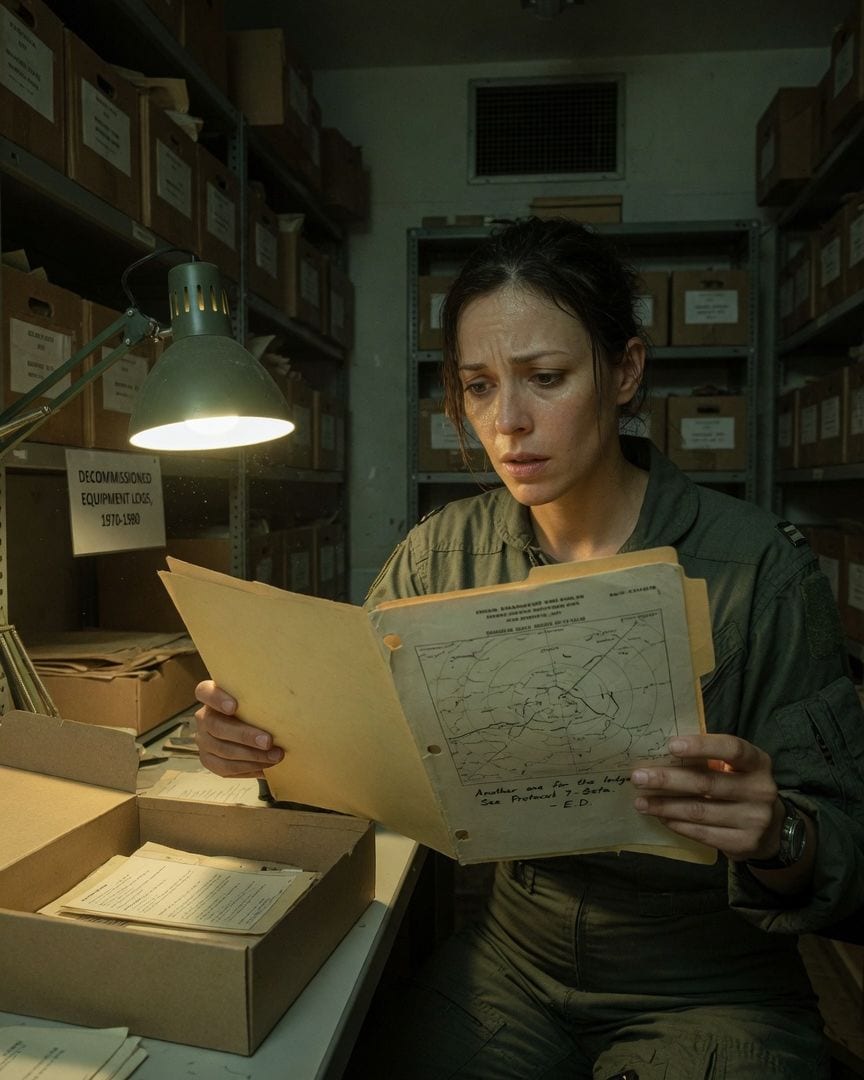
A radar captain's scope went clean, but the pilot swore a mile-wide UFO still filled his windscreen. Then she found a Cold War ledger of impossible sightings.
Captain Ines Bardolph, a 34-year-old radar operator in Bavaria, lived by the precise hum of her console. One quiet night, an impossible contact appeared over the Danube, then vanished from her scope just as a pilot swore it filled his windscreen. Replays showed the object had crossed the Alps in a single blink, defying all known physics. When bureaucracy sought to bury the incident, Captain Bardolph sought answers, leading her to a forgotten archive where a brittle folder revealed a chilling pattern: 'Another one for the ledger.'
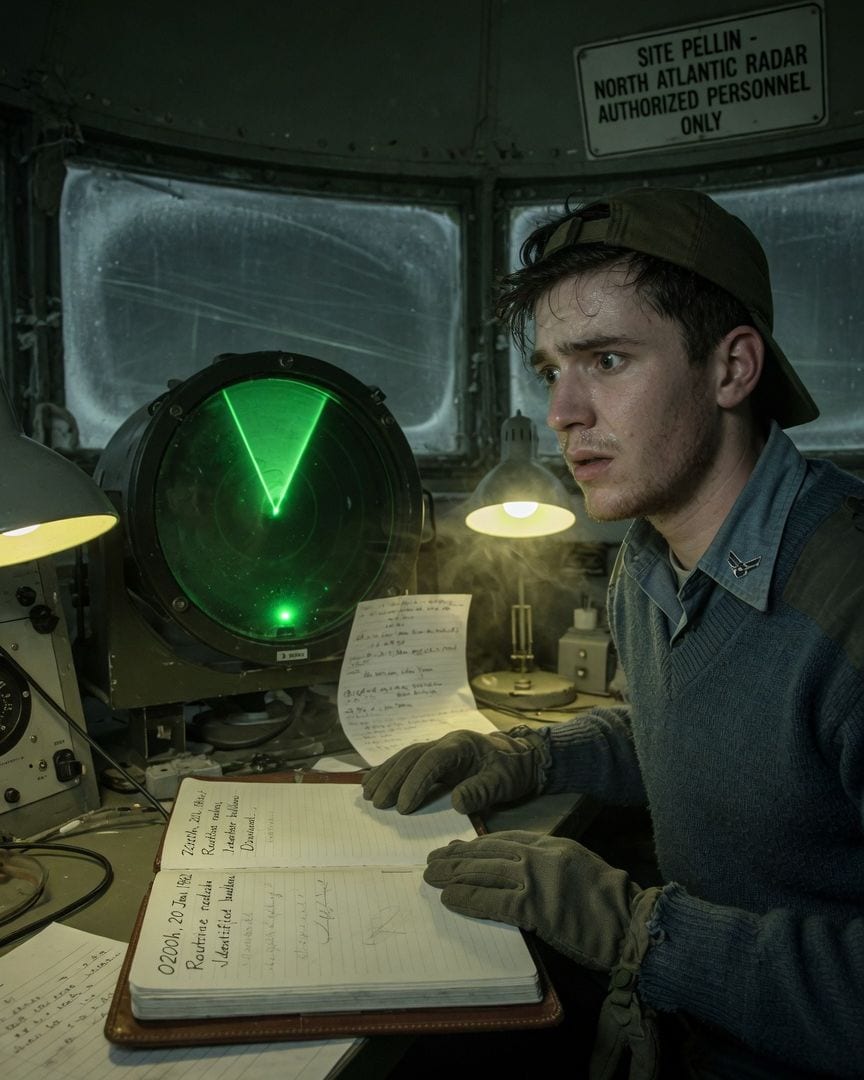
Nine days from closing, Cold War Site Pellin's Airman Vance watched his radar track a solid blip moving closer, dead in open sea where nothing could exist.
In the dimly lit dome of Site Pellin, Airman Ordway Vance, just days from discharge, ran his final radar sweeps before the base closed for good. Outside, the North Atlantic wind howled, but inside, only the hum of his console broke the silence. His last calibration had been clean, yet a single, unwavering green blip appeared on the scope, forty miles out, in open water where no vessel should be. The impossible return moved closer with each sweep, defying all logic and other sensors, until it sat static just beyond the coast fence line. What unseen presence did the radar truly hold in its unwavering green grip, contradicting the official record?
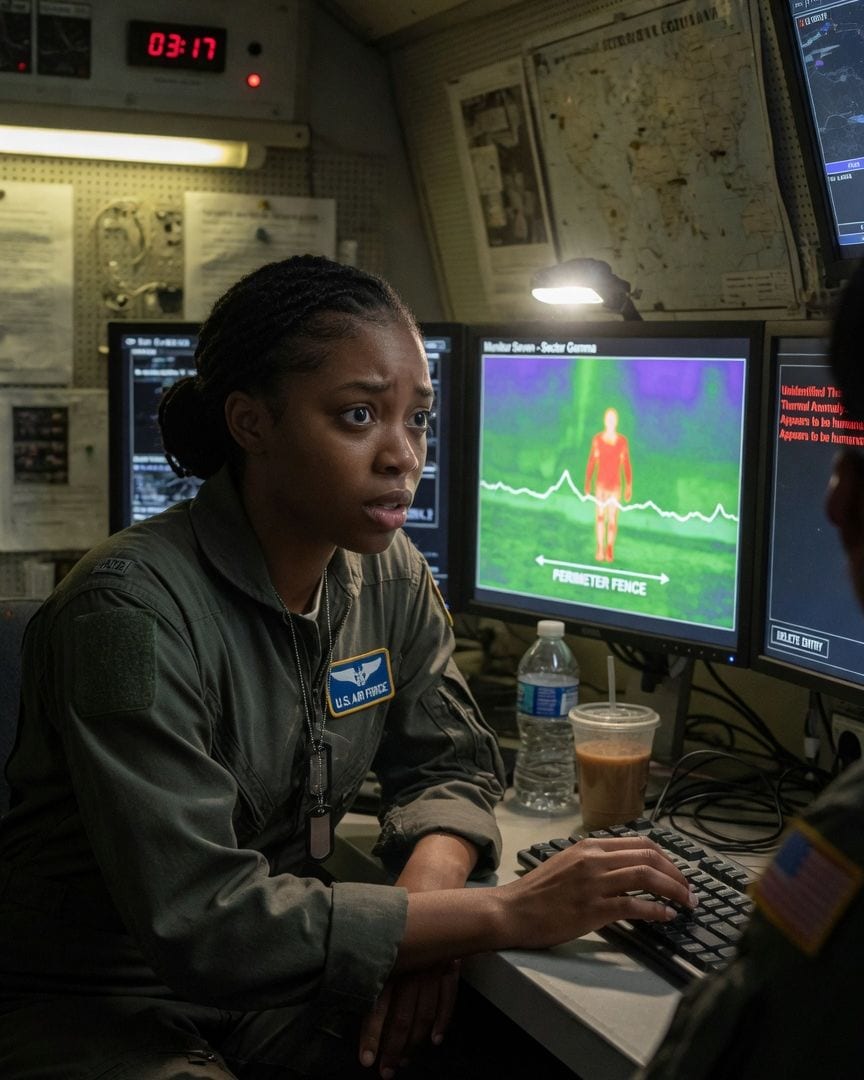
An airman’s thermal feed shows a figure moving in the restricted desert. Her captain orders it scrubbed, but the heat signature appears to tilt its head and look right at her.
Airman First Class Olivia Kade was new to her remote high-altitude outpost, fresh from advanced training, and the isolation pressed in, amplifying every hum. Her duty was to monitor the desert perimeter, but one shift, a faint thermal signature appeared on Monitor Seven: a solitary, upright figure moving with impossible precision beyond the barbed wire. No personnel were authorized in that sector. Her mission commander quickly ordered the anomaly scrubbed, but as it dissolved, the featureless outline seemed to tilt its head, looking directly into the camera. Now, the signature returns night after night, forcing the airman to wonder what impossible thing patrols the dark beyond the wire.
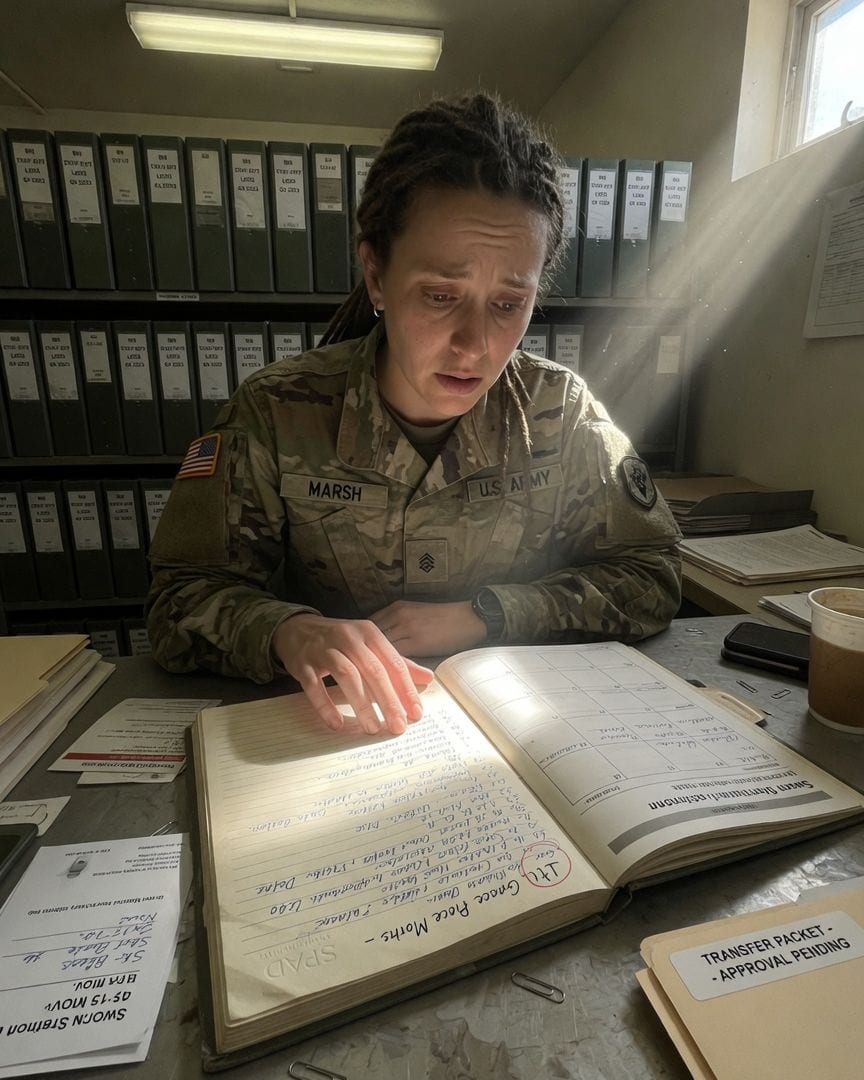
Preparing for a coveted post, a logistics officer found her own perfect signature on a duty log for a shift she swore she never worked. Then her coworker’s entry revealed his unique personal quirk.
Lieutenant Grace Marsh, a meticulous logistics officer, was deep in the archives, preparing her transfer packet for a coveted post. Her career depended on a spotless record, requiring absolute precision as she cross-referenced battalion staff-duty logs. Amidst the dusty binders and humming fluorescent lights, her gaze snagged on an entry for November 14th: her own perfect signature, logging a 24-hour shift she distinctly remembered spending hundreds of miles away in a court-martial. The impossible truth of a phantom doing her job was unsettling enough, but then she found another officer's entry, complete with his unique, personal quirk, for a day he was off-base. What was hidden in these official records?
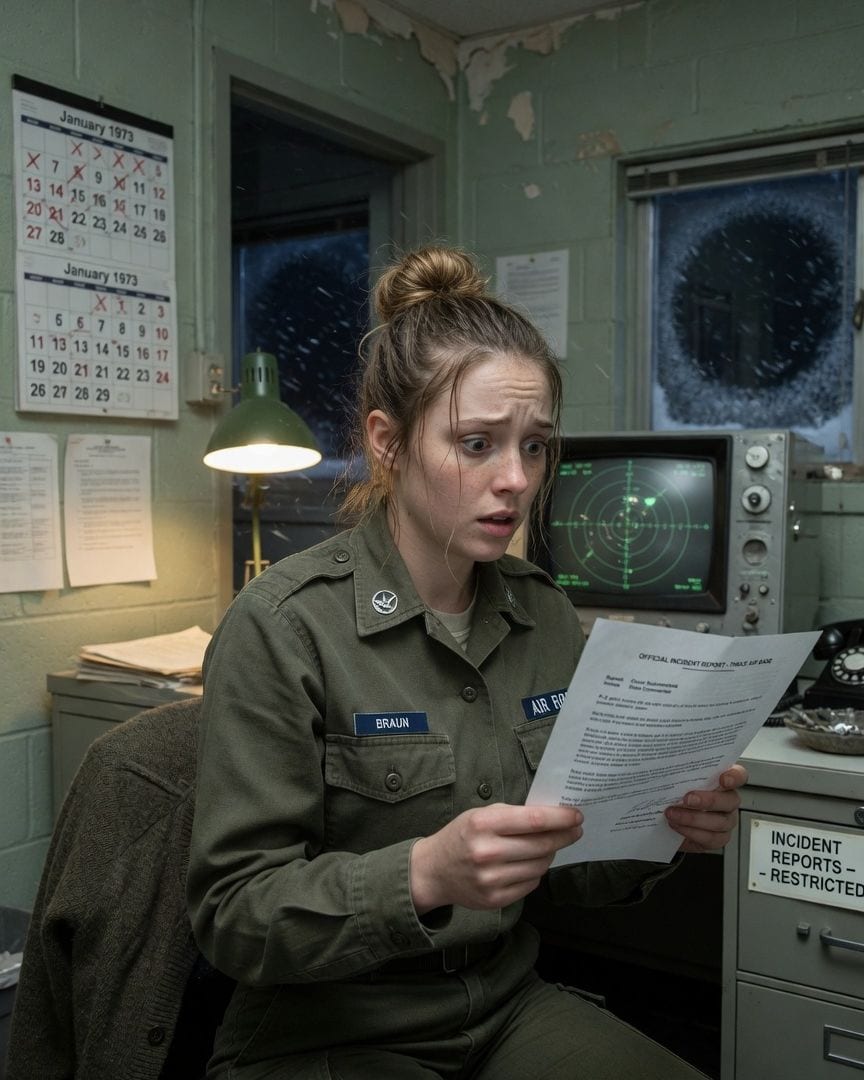
Cold War Airman Colette Braun's radar tracked a craft *inside* its own minimum range, then her official report changed the pilot's visual.
Airman First Class Colette Braun, 24, was counting down her final eight days at Thule Air Base in the monotonous Arctic winter of 1973. Her routine radar sweeps were broken by an impossible blip, a craft appearing *inside* the scope’s minimum range, confirmed visually by a Navy P-2 pilot. After its impossible vertical ascent, Colette overheard her Base Commander discussing "containment." On her last day, the official report arrived, stating the pilot saw "no visual contact." What did Colette truly witness, and why was her account altered?
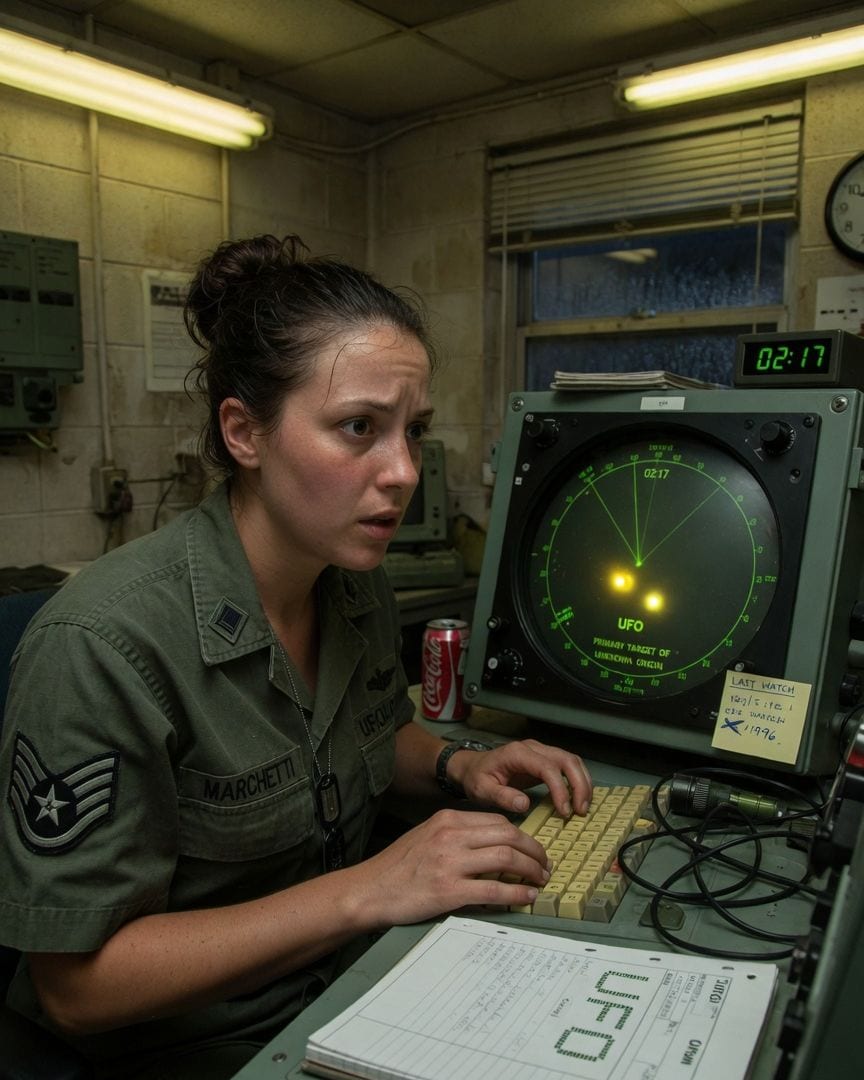
Technical Sergeant Marchetti's last watch saw an impossible radar blip merge with a plane. Later, its manifest showed a 'NO SHOW' passenger who *had* boarded, stamped 'FILE CLOSED'.
Technical Sergeant Odile Marchetti sat alone for her final watch at Gulf Coast ground control, anticipating a quiet transfer to a desk job. The dim console glow and rhythmic radar sweep were familiar, comforting sounds until 02:17, when an airliner captain reported impossible traffic flying in formation. Odile watched a second, larger blip appear on her screen, mirroring the plane's path with impossible precision. As the captain's voice, now tinged with a faint tremor, declared his plane was flying through where the object had been, the two radar returns merged into one, impossibly stable. Later, reviewing the official dismissal, Odile discovered an airline manifest listing a passenger as 'NO SHOW' who had, by handwritten note, definitely boarded—their name redacted, the file stamped 'CLOSED'.