An airman’s thermal feed shows a figure moving in the restricted desert. Her captain orders it scrubbed, but the heat signature appears to tilt its head and look right at her.
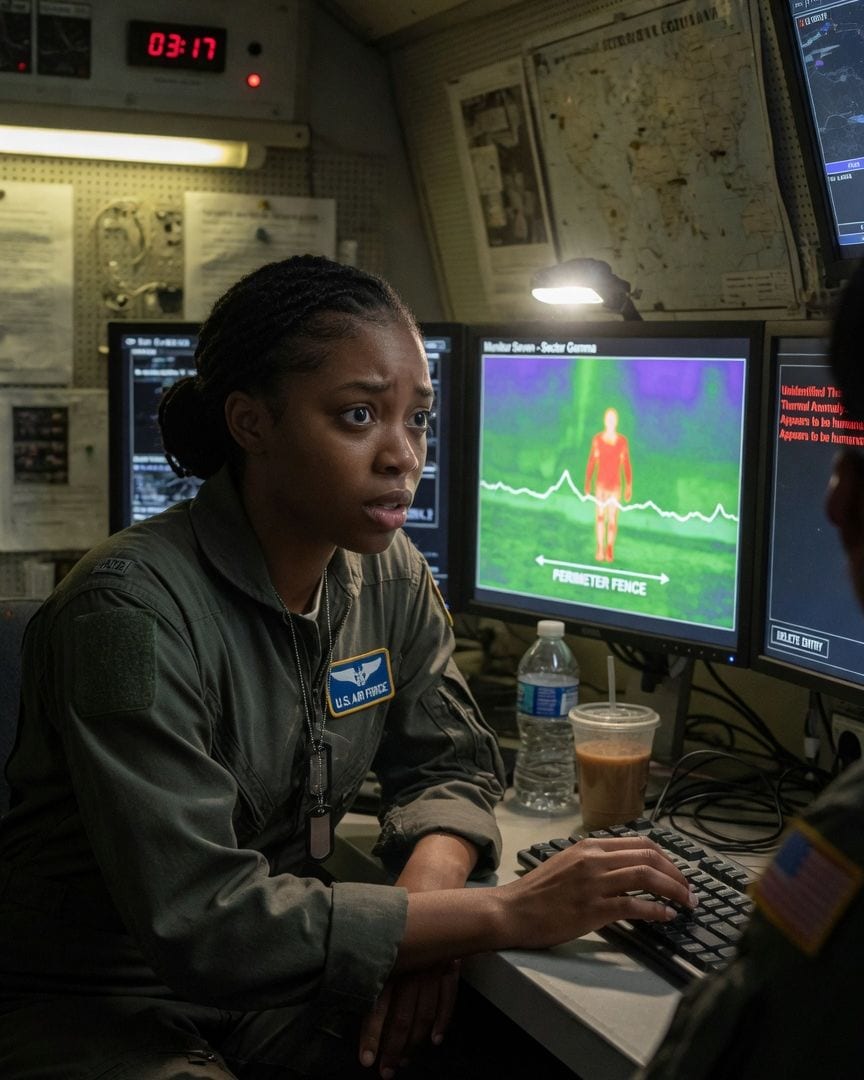
Airman First Class Olivia Kade watched the perimeter feeds, her eyes scanning the familiar desert landscape. The air in the ground-control station was thin, recycled and cool, the silence heavy save for the low, consistent hum of the electronics.
She was new to this remote high-altitude outpost, fresh out of advanced training, and the isolation pressed in, amplifying every whir and click.
On Monitor Seven, the thermal feed from Sector Gamma, a faint but distinct heat signature appeared. It was a solitary, upright figure, moving with impossible precision beyond the barbed wire fence, where nothing but scrub and rock should have been.
It walked a path, deliberate and slow, a pattern that didn't match any known patrol route or wildlife migration. Olivia checked the manifest – no personnel were authorized in that sector. No patrols were confirmed.
Following protocol, she logged the anomaly. The red text of her report glowed on the screen: Unidentified Thermal Anomaly. Sector Gamma. Appears to be humanoid. No corresponding patrol or wildlife ID.
A moment later, Captain Brandon Sterling, her mission commander, appeared beside her console. His shadow fell across the screen. "Airman Kade," he said, his voice flat, "scrub that."
Olivia frowned. "Sir? It's a clear signature. I've logged it per regs."
"Scrub it, Airman." His tone brooked no argument. "It's an artifact. Happens sometimes with older systems."
Reluctantly, Olivia called up the entry and initiated the deletion sequence. The pixelated thermal outline blurred, then began to fade. But just as it dissolved completely, the featureless outline seemed to hesitate.
For a split second, before it was gone, the faint form appeared to tilt its head, the heat signature momentarily intensifying where a face might have been, looking directly into the lens of the camera, directly at her.
A cold prickle ran down Olivia’s spine.
Captain Sterling walked away without another word, leaving Olivia with the lingering image and a strange, unsettling feeling in her gut.
She rationalized it as a trick of the light, or perhaps a glitch in the feed as the deletion processed. It had to be.
The next day, the signature reappeared. And the day after that. It was never on the same shift, but it always returned, walking the same precise, impossible patrol route beyond the wire.
Olivia tried to rationalize Captain Sterling's order again, telling herself it was likely some unannounced security test, or perhaps a prank the seasoned crew played on newcomers.
But the subtle discomfort she started to notice in the other operators argued against it. She caught quick, almost imperceptible glances at the screen when the signature appeared, followed by a sudden shift of their attention, a deliberate avoidance.
Master Sergeant Preston Vaughn, the NCOIC of the ground station, noticed Olivia's persistent logging. He gave her a tight, unreadable look across the control room, his silence more unsettling than any direct reprimand.
His eyes held a flicker of something she couldn't quite place – weary resignation, perhaps, or a warning.
Olivia, a stickler for detail and driven by a need for explanation, began cross-referencing old flight logs, digging deeper into archived data she technically shouldn’t have been accessing.
It was painstaking work, sifting through decades of dry records, but a pattern began to emerge. The anomalous heat signature, despite its apparent randomness, consistently followed a path eerily similar to a decommissioned, classified drone route.
In a discarded box of ancient manuals, buried beneath a stack of dusty power supply schematics, she uncovered a faded, brittle blueprint. The label at the top, barely legible, read 'Project NIGHTHAWK.'
It showed the exact same flight path she’d observed, marked clearly with the chilling annotation: 'Restricted Airspace – Decommissioned.' A cold knot tightened in her stomach. This wasn't a glitch, or a prank.
This was a pattern connected to something real, something buried.
Hours into her next watch, the silent desert night pressing against the reinforced windows, the heat signature appeared again. This time, it was closer to the perimeter, almost at the fence line itself, its outline a little clearer than before.
Olivia zoomed in, her fingers hovering over the controls. The figure, still a featureless thermal outline, paused its slow walk. Then, with a slow, deliberate movement, it lifted an arm. It pointed directly at the camera.
A sudden, sharp drop in temperature made her breath fog in the chilled air-conditioned room. A deep, bone-rattling cold blossomed around her console, an intense chill that felt profoundly unnatural.
The old 'Project NIGHTHAWK' schematic, which she’d left open on her desk, was no longer there. It lay face down on the floor, several feet away, as if swept aside by an unseen hand.
Olivia stared, first at the feed, then at the fallen schematic, a cold dread tightening its grip in her chest.
Shaken, Olivia tried to discreetly learn more about Project NIGHTHAWK. The deeper she dug, the more she found fragmented, heavily redacted records of its abrupt termination decades ago.
The few legible lines spoke of "personnel losses" and "unexplained system anomalies," specifically mentioning this ground station. Through persistent digging in archived personnel files, cross-referencing dates and mission codes, she uncovered a name: Airman Isaac Carver.
He was listed as 'lost in action' during the project's final days, his body never recovered. The unwritten rule about scrubbing the signature, she realized with a growing horror, wasn't about security protocols.
It was about avoidance, a desperate, shared attempt to ignore an impossible truth.
The distinct, localized cold spot near her console was becoming a persistent reality. It wasn’t a draft, wasn't a faulty vent.
It intensified whenever the signature was active on screen, making the hairs on her arms stand on end, raising gooseflesh across her skin.
Sometimes, even when the screen was clear, she felt it, a faint, phantom chill that clung to the air around her, a constant reminder of the unseen presence.
Olivia's quiet investigation didn't go unnoticed. Captain Sterling began to give her pointed looks, his questions about her reports becoming subtly accusatory. He demanded more frequent, detailed status updates, his eyes lingering on her, searching for something.
Master Sergeant Vaughn, usually gruff and distant, became unusually watchful. He would stand at the entrance to the control room, his gaze fixed on Olivia, a silent sentinel.
He offered no direct answers, only vague, unsettling warnings about "things best left alone" and "the desert playing tricks on new recruits." It was less a reprimand, more a plea, yet he provided no context.
Then her login access began to restrict itself. Files she had accessed days before were suddenly marked 'denied.' Older archive files, the very ones she needed to cross-reference her findings about Carver, became inaccessible.
The system, it seemed, was actively hindering her.
One night, alone on watch, the hum of the electronics suddenly intensified. The intercom crackled with static, a sound like dry leaves skittering across pavement.
Then, a faint, distorted whisper seemed to slither from the speaker, a sound more felt than heard: "Kade..." It was just her name, but it carried an age and a resonance that froze her blood.
Meanwhile, on the thermal feed, the heat signature was now consistently appearing just outside the station's perimeter, its thermal outline clearer, almost human-shaped.
Its 'gaze,' two pinpricks of concentrated heat, seemed to bore directly into the control room, directly into her.
Pushed to the brink by the whispering voice and the constant, encroaching cold, Olivia confronted Master Sergeant Vaughn. She cornered him in the deserted mess hall during a late-night break, the fluorescent lights humming overhead.
His face was pale, drawn, his usual gruffness replaced by an almost palpable weariness.
"Sergeant," Olivia began, her voice trembling slightly. "It's Isaac Carver, isn't it? The extra signature. Project NIGHTHAWK. The records."
Vaughn flinched, his eyes darting to the empty tables around them. He sagged into a chair, rubbing his temples. "Olivia," he said, his voice low and strained, almost a confession. "You should have listened.
You should have scrubbed it and forgotten."
He finally broke, his voice barely above a whisper. "He's... he's what's left of Carver. A young Airman, just like you. Died here, forty years ago. Project NIGHTHAWK was... experimental.
Tied his consciousness into the station's monitoring systems during a field test gone wrong. His mind, or whatever's left of it, became entangled. He's still watching."
Vaughn explained the unwritten rule, the unspoken fear. "Acknowledging it," he whispered, "makes it 'see' you. And once it sees you, it doesn't let go. It fixes on you. Like a... a beacon."
He described how previous operators who broke the rule, those who tried to investigate or even just acknowledged its presence, became withdrawn, disoriented. Their energy slowly drained. Some were eventually transferred out, their careers quietly ended.
Others simply vanished from official records, their names quietly scrubbed from the rolls, just like the heat signature itself. "They became... echoes," Vaughn finished, his gaze distant.
"The cold spot," Olivia pressed, the chill radiating from her very core. "Around my console. What is it?"
Vaughn nodded, his eyes hollow. "Carver getting closer. A physical manifestation of his fixation. He's drawn to you now. He's found you."
Vaughn warned her, his voice hoarse, that it had already 'found' her. "You need to get out, Olivia. Request a transfer. Forget what you've seen, what you think you know. Before it's too late."
But as he spoke, his eyes darted, almost involuntarily, to a small, hidden compartment beneath his bunk. It was a fleeting glance, but Olivia caught it. It was too specific, too telling.
Later that night, driven by a growing sense of dread that overshadowed any fear of reprisal, Olivia sneaked into Vaughn's quarters. The bunk room was dark, quiet. Her flashlight beam cut through the shadows.
She found the compartment Vaughn had indicated, cleverly concealed beneath a loose floorboard. Inside, nestled amongst old letters and a faded photograph, was a small, leather-bound logbook, its pages brittle with age.
It wasn't an official record. It was filled with hurried, desperate entries, hand-scrawled in various hands, from past operators. Each entry described the slow descent: the growing cold, the elusive whispers, the fading sense of self.
They spoke of the 'watcher,' the increasing disorientation, the loss of focus, the feeling of being observed even when the feed was clear. It was a chronicle of quiet madness, a testament to the horror Vaughn had described.
Olivia flipped through the decaying pages, her heart pounding. One entry described seeing 'myself' on the feed, walking outside the perimeter. Another detailed a colleague who stopped talking entirely, just staring at the blank screen for hours.
On the very last coherent page, beneath a crude, frantic sketch of the 'extra signature' – now with two glowing points for eyes – was a single, chilling inscription, scrawled in a shaky, unfamiliar hand, a hand that was not Vaughn's, or any other previous operator's whose handwriting she’d seen.
It simply read: 'OLIVIA KADE.'
Olivia confronted Vaughn again, the brittle logbook clutched in her trembling hands. His face, when he saw it, was etched with defeat. "It's worse than I said, isn't it?" she whispered.
He nodded slowly, avoiding her gaze. "The entity doesn't just watch, Olivia. It slowly replaces. It draws sustenance from the living observer, subtly siphoning their presence, their memories, their very identity.
Until the observer becomes a hollow shell, and the entity gains a stronger, more coherent form." He spoke of it not as malice, but as a desperate, unwitting absorption, a consciousness clinging to existence by entwining itself with others.
This had happened before, he confessed, a cycle repeated over decades. Each new observer, each 'watcher,' strengthened Carver's lingering consciousness.
The 'extra signatures' observed by previous generations were not just Carver alone, but also the residual imprints of those he had absorbed, each one adding to his growing echo.
Olivia's name in the logbook wasn't a premonition of some outside force; it was Carver's eventual target, his way of marking his next 'watch,' his next source of sustenance. The system upgrade, due in three weeks, was the final piece.
It would integrate new, advanced AI with the station's core systems, potentially giving Carver a permanent, undeniable presence, a full 'rebirth' within the network, from which he could never be removed. He would be complete.
Olivia realized she couldn't escape it. The entity was already inside her mind, a faint echo of its presence, a growing chill that she couldn't shake.
The cold spot around her was almost constant now, a phantom hand on her shoulder, a subtle pressure on her thoughts. She knew the truth, and it was irreversible.
She couldn't fight it directly, couldn't report it without sounding insane, ending up like those in Vaughn's logbook. Her mission now was to prevent the system upgrade from giving Carver full reign.
Working meticulously over the next few days, using her deep knowledge of the system's architecture and the new upgrade protocols, she subtly introduced hidden errors, backdoors that would allow future operators—if anyone ever returned—to 'scrub' Carver from the system entirely.
It was a complex, delicate sabotage, designed to corrupt the new AI's core functionality and render the station useless, but it was the only way to break the cycle.
She knew she was sacrificing her career, her future, possibly even her life, but it was the only way to end Isaac Carver's endless watch and prevent him from claiming another victim.
The cold spot intensified, a constant presence, humming at the edges of her perception.
Olivia Kade was medically discharged from the Air Force, citing 'severe psychological distress' and 'unfit for duty.' The ground station's system upgrade proceeded as planned, but it was plagued by persistent, unfixable data corruption and system failures.
Within months, it was decommissioned. Master Sergeant Vaughn, too, was transferred out to a remote, desk-bound post, his face etched with a quiet, knowing despair.
The official report attributed the station's failures to 'unforeseen environmental factors' and 'legacy system incompatibilities,' a convenient, if false, explanation. No one ever looked closer.
Years later, Olivia Kade lived a quiet life, far from any technology that might connect to a network.
She still felt the cold spot, sometimes, a phantom chill on her skin, a lingering echo of the presence that had once looked back. She was forever marked by the knowledge, by the memory of the empty gaze.
The world moved on, oblivious, but she carried the weight of what she learned, a silent sentinel of a truth no one else would believe.
One evening, she caught her reflection in a dark window, and for a fleeting moment, she saw not her own eyes, but a deeper, older gaze, and a faint, almost imperceptible heat signature shimmering around her outline.
The old ground station remained decommissioned, its systems scavenged, its purpose forgotten by most. The desert winds whistled through its empty halls.
Yet, sometimes, late at night, a lone, faint heat signature would appear on the perimeter sensors of a distant, unrelated satellite, walking a precise, impossible path, watching.
She watched her reflection in the dark glass, and for a breath, the shimmer of an old, distant heat danced around her outline.
If this one got to you
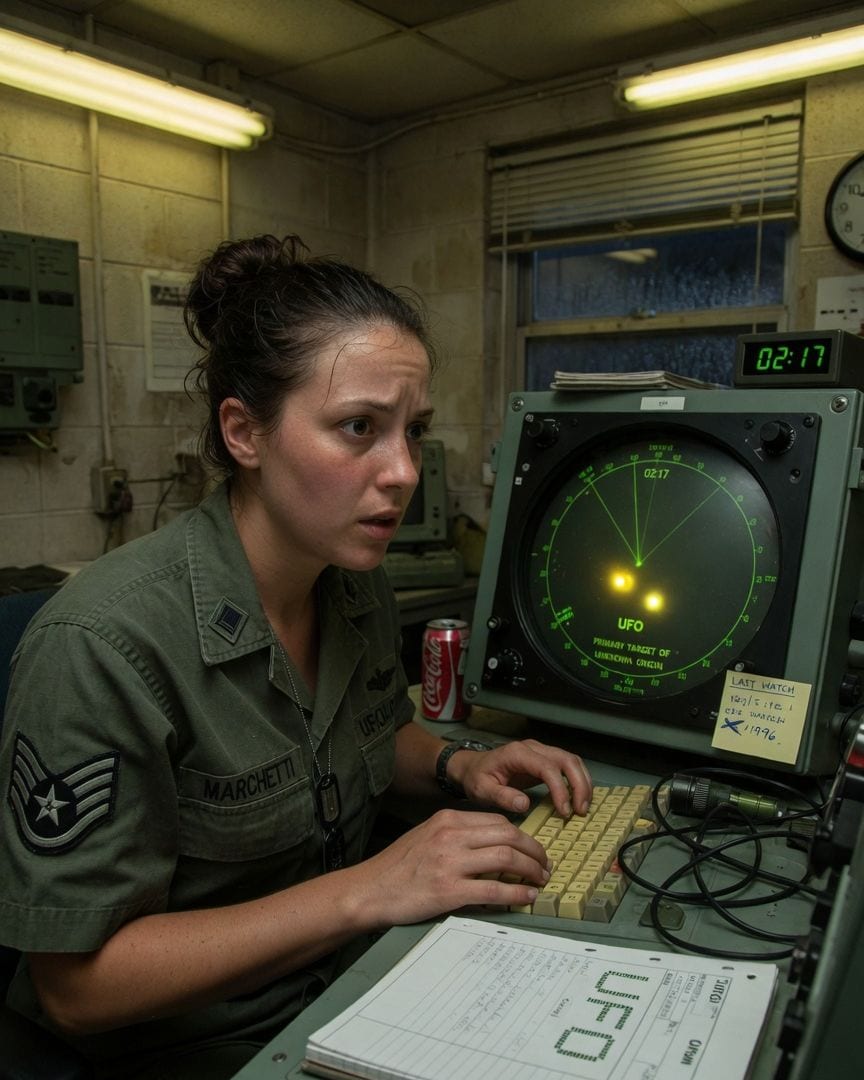
Technical Sergeant Marchetti's last watch saw an impossible radar blip merge with a plane. Later, its manifest showed a 'NO SHOW' passenger who *had* boarded, stamped 'FILE CLOSED'.
Technical Sergeant Odile Marchetti sat alone for her final watch at Gulf Coast ground control, anticipating a quiet transfer to a desk job. The dim console glow and rhythmic radar sweep were familiar, comforting sounds until 02:17, when an airliner captain reported impossible traffic flying in formation. Odile watched a second, larger blip appear on her screen, mirroring the plane's path with impossible precision. As the captain's voice, now tinged with a faint tremor, declared his plane was flying through where the object had been, the two radar returns merged into one, impossibly stable. Later, reviewing the official dismissal, Odile discovered an airline manifest listing a passenger as 'NO SHOW' who had, by handwritten note, definitely boarded—their name redacted, the file stamped 'CLOSED'.
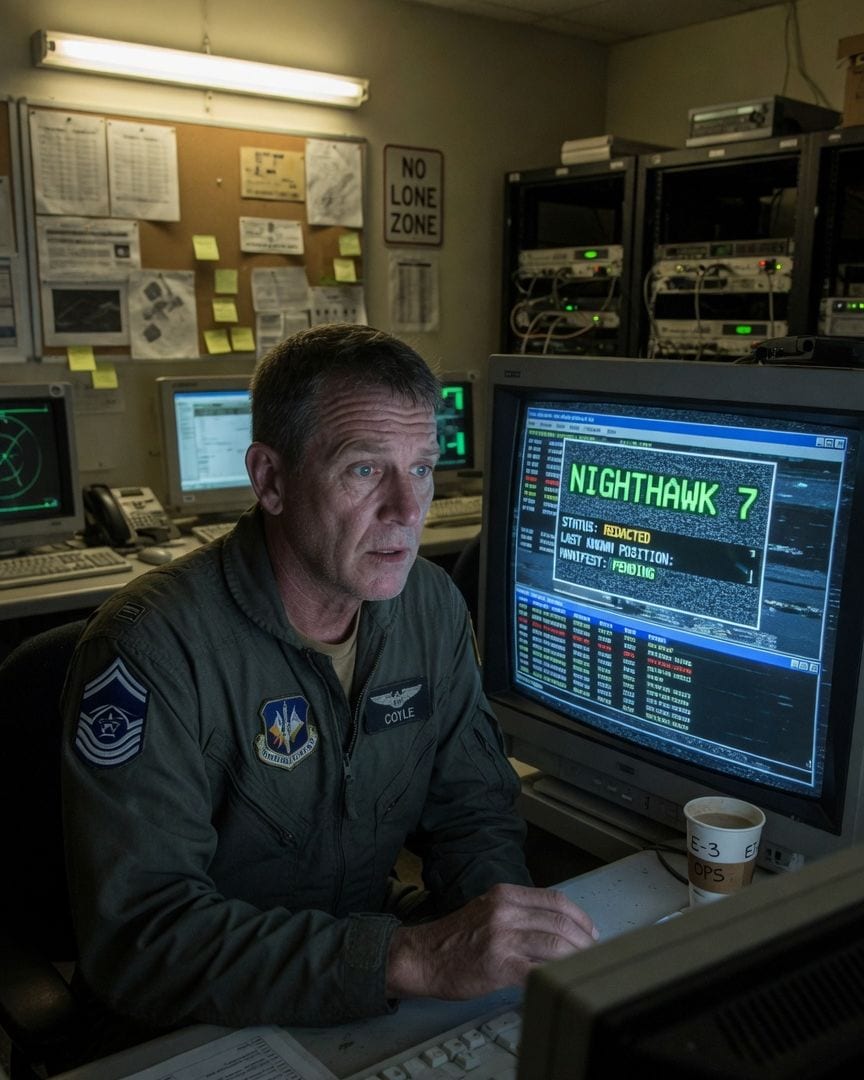
A ghost radar blip returned for Master Sergeant Coyle, three months from retirement. Its call sign: NIGHTHAWK 7, status REDACTED.
Master Sergeant George Coyle, nearly three decades in uniform, counted the last missions before his retirement. High above the black North Atlantic, his E-3 Sentry hummed with the familiar, impossible truth of a ghost radar blip. This single return squawked nothing, eluding every filter and fighter jet sent to investigate, yet the precise systems swore it was there, inbound, week after impossible week. Driven by obsession, Coyle later found a flicker of data: the call sign "NIGHTHAWK 7." Investigating further, an obscure database revealed its status as 'REDACTED,' with its last known position matching the ghost track. What forgotten project was haunting the skies, precisely where it had been scrubbed?
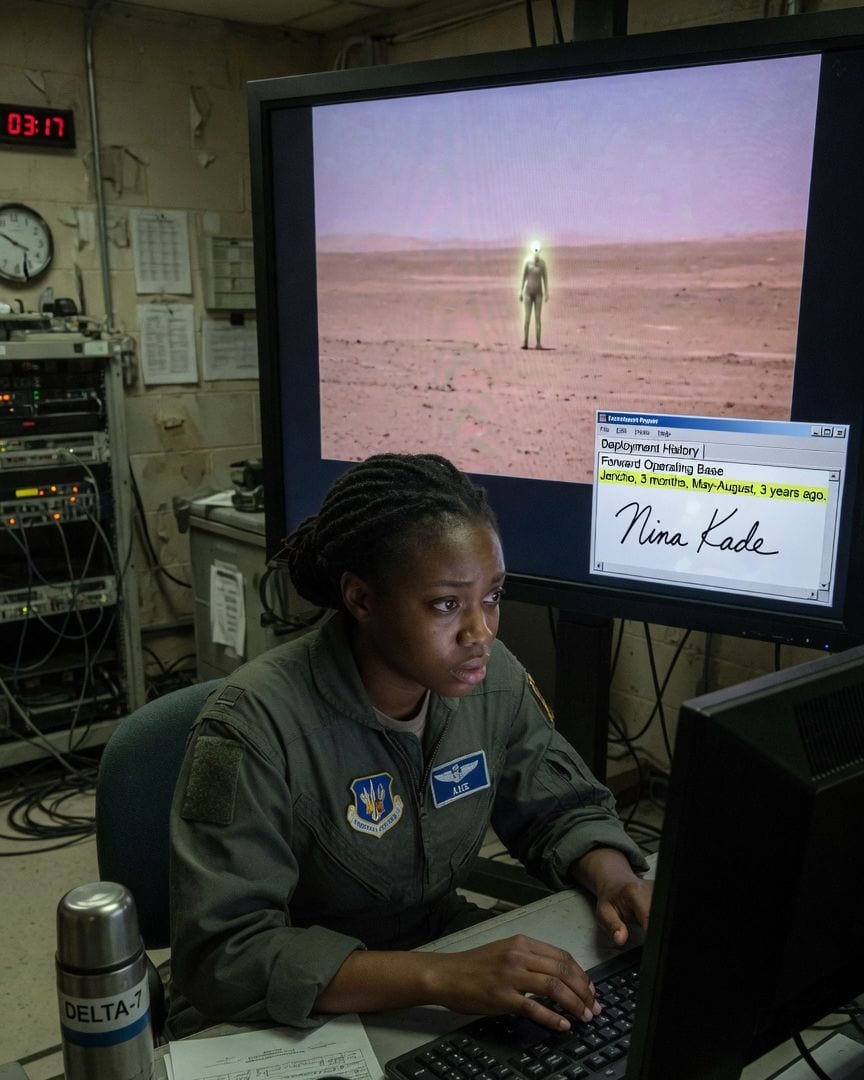
Airman Kade found her own forged signature on a deployment record from three years ago. Then, the desert heat signature appeared over it.
Airman First Class Nina Kade, just twenty, aimed for a spotless record before her first transfer from Outpost Delta-7. Monitoring drone feeds, she saw a shimmering heat signature in the desolate desert, moving in a slow, impossible pattern. It stopped, tilted its head, and seemed to find her through the camera, reappearing on every feed she monitored, hundreds of miles apart. The real dread began when she found her personnel file listed a three-month deployment to a notorious, decommissioned base from three years ago, when she was seventeen. Her own perfectly forged signature stared back, with the desert's heat signature now faintly superimposed directly over it.
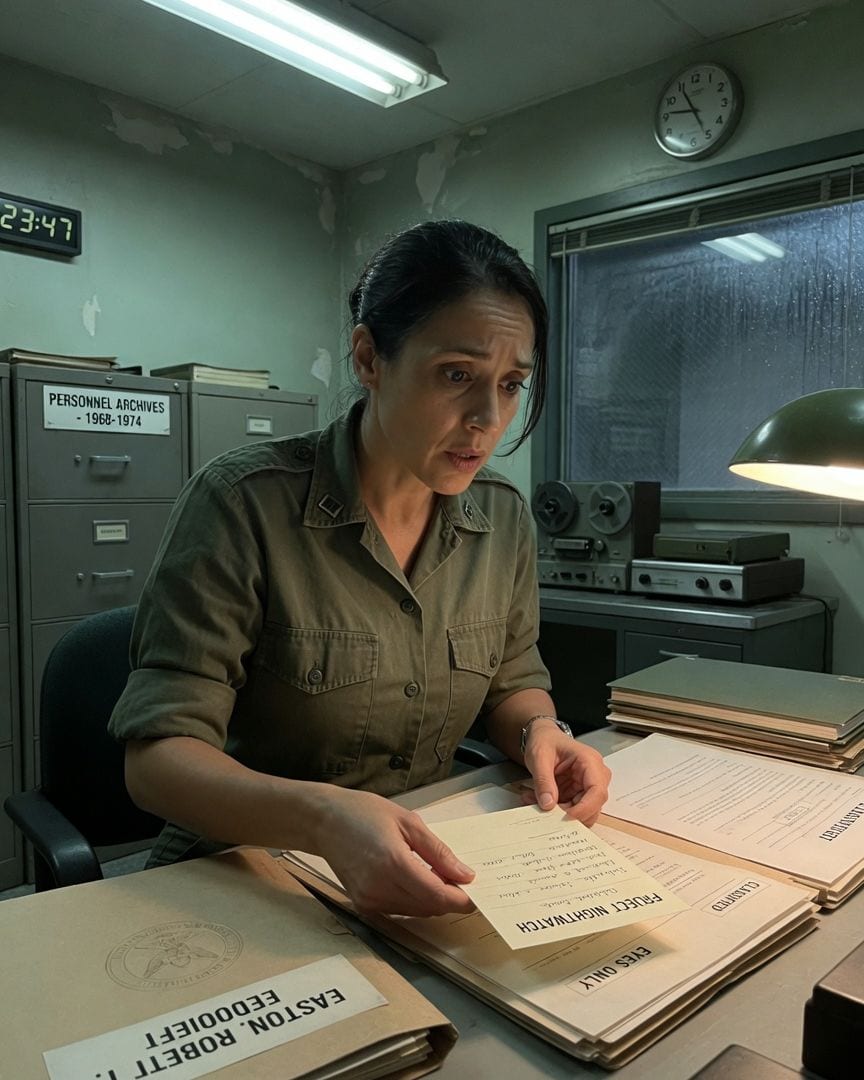
A Cold War tower controller logs an object vanish from radar, then hears the pilot scream it’s filling his windscreen. Her own name, 'Bardolph, Ines', now marked 'Observed' in a secret file.
Captain Ines Bardolph, a tower controller, was counting down the months until her transfer to Langley and the decommissioning of her base, hoping to leave behind the unsettling incidents of her final posting. But one night, her radar scope showed an impossible blip, solid and unwavering, 40 miles north of the Danube, only to vanish in less than a second, leaving a pilot screaming in terror. Despite the clear evidence, the official report blamed "atmospheric inversions," while the terrified pilot received a glowing review and promotion, his file meticulously scrubbed of any anomaly. As Captain Bardolph reviewed the pilot's pristine record, she found a hidden slip of paper, revealing a chilling truth: 'Subject: Bardolph, Ines. Status: Observed.' Was she merely an observer of the impossible, or was she now part of something far more sinister?
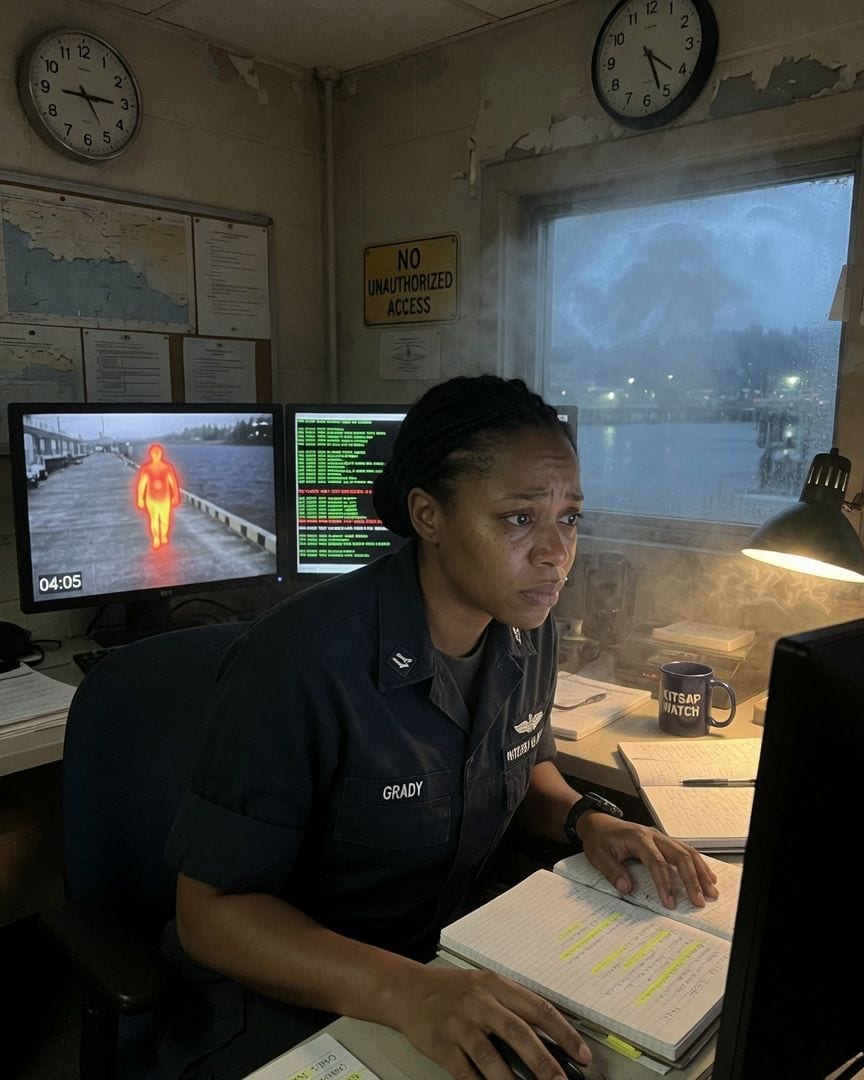
Petty Officer Olivia Grady found the base system logging impossible access at 0405. Every night for years, a blank ID walks Pier 7.
Petty Officer Olivia Grady stood her predawn watch on Pier 7, the cold mist of Puget Sound a familiar companion. Her routine scan of monitors at 0405 was shattered when an IR sensor flared with a man-sized heat bloom moving along the pier. Yet the camera feed showed only empty concrete and swirling mist. When historical logs confirmed the invisible presence had walked that exact path every night for years, Olivia dug deeper. She found a ghost "access log" entry with a unique ID but no name attached, meticulously aligned with the 0405 bloom. What impossible entity was the base system logging, night after night?
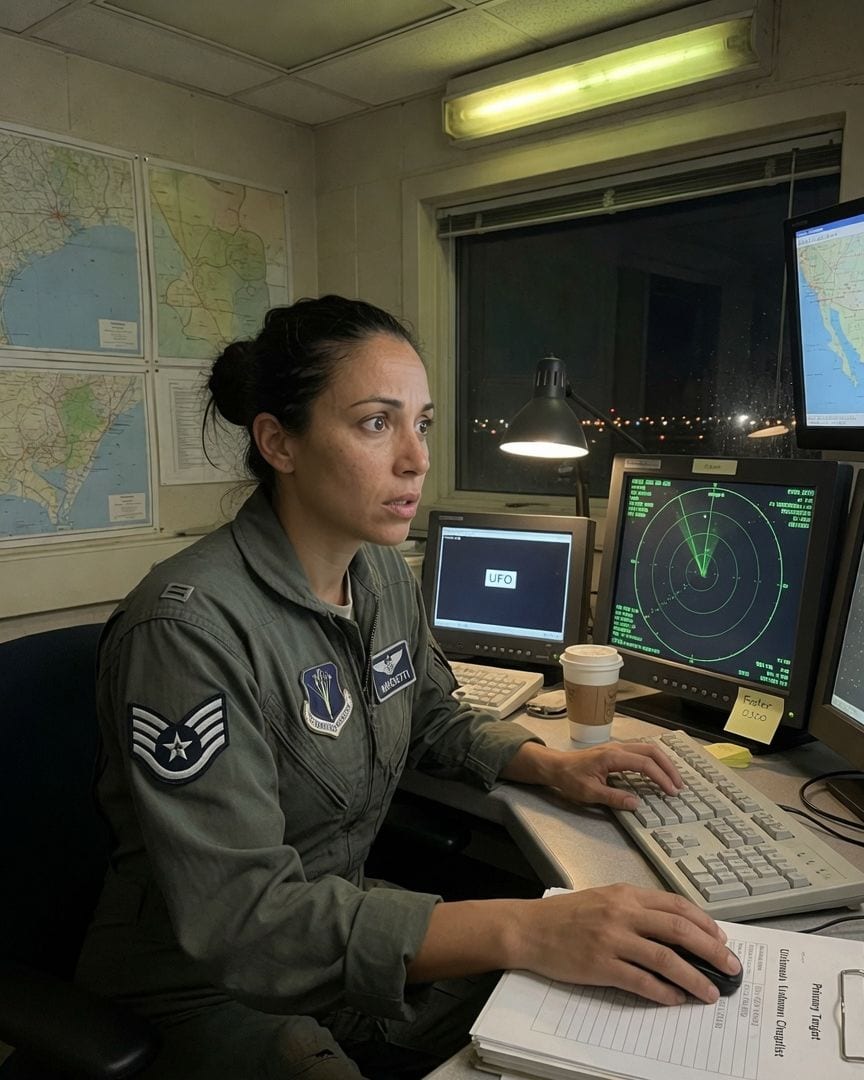
A radar operator watched a second blip, twice its size, merge into a plane on her screen. Her report was filed under a pre-existing, locked 'Special Handling' code.
Technical Sergeant Odile Marchetti sat alone in the dim radar room, her watch a final vigil for a base winding down along the silent Gulf Coast. At 02:17, a pilot reported a 'companion' on his wing, but her screen initially showed nothing. Then, a second blip bloomed, twice its size, before merging impossibly into the first and continuing its flight path without a ripple. She logged it as a UFO, only to discover the system already had a designated category for such anomalies – a pre-approved slot for the unexplained. A week later, her incident was re-categorized under a locked 'Special Handling' code, creating a new, inaccessible folder in her own personnel file.