A radar operator watched a second blip, twice its size, merge into a plane on her screen. Her report was filed under a pre-existing, locked 'Special Handling' code.
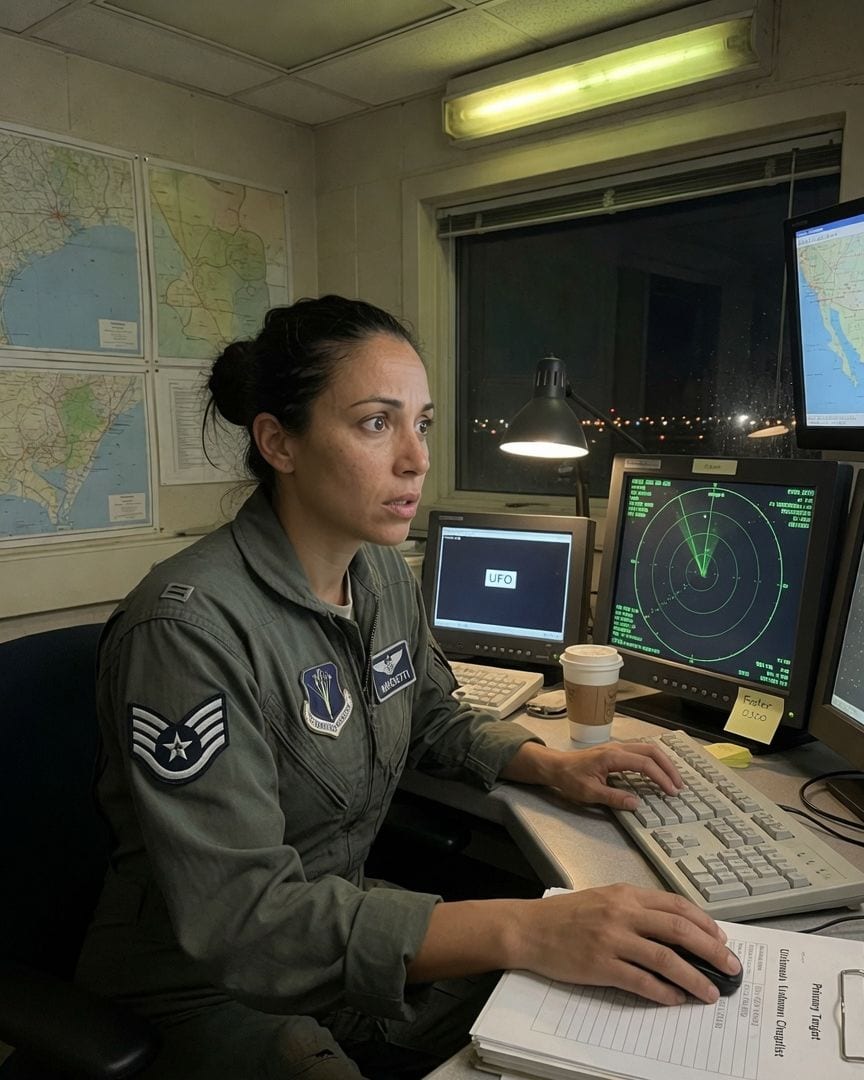
Technical Sergeant Odile Marchetti, 30, sat alone in the dim glow of the radar room, the Gulf Coast night stretching silent outside her window.
The base was winding down, slated for closure next year, and her watch felt like a last vigil. At 02:17, a voice crackled, calm and professional: Captain Ryan Ingram, Flight 709. “Ground, this is Seven-Zero-Nine.
Requesting clarification on traffic at my three o’clock, flight level three-five-zero. Looks like a companion.”
Odile’s scope showed nothing but Ingram’s transponder. “Seven-Zero-Nine, negative contact. Confirming clear airspace.”
A heartbeat later, a second return bloomed beside Ingram’s blip, twice its size, solid and unmistakable. She felt a cold prickle on her skin.
Odile ran the checklist, the one for a primary target of unknown origin, the one she’d trained on but never used. Her fingers, usually so sure, hesitated for a fraction of a second over the keyboard.
She typed ‘UFO’ into the log’s dedicated box.
Ingram’s voice returned, a slight tremor now, the calm fraying at the edges. “Ground, it’s pulled ahead. Just… stopped. I’m flying through where it was.”
On her screen, the two returns became one. One impossible blip, merging and coalescing as if the larger shape had simply folded itself into the smaller. And it stayed one, continuing its flight path without a ripple.
The air in the radar room seemed to thicken, pressing in on her, and the monitors hummed a little louder, a persistent, trapped sound.
Odile spent the next hour trying to rationalize it. A ghost return? Atmospheric anomaly? Equipment malfunction? She ran diagnostics, checked weather patterns, cross-referenced with nearby towers. Nothing. Every check came back green, every system nominal.
The merged blip continued its flight path as if nothing had happened, and Ingram’s voice remained steady for the rest of his sector, never mentioning it again. It was the silence, more than the event, that unsettled her.
It was as if the impossible had simply folded itself into the expected, and the world had moved on, unquestioning.
When her relief, Sergeant David Foster, arrived, Odile tried to explain. She pointed at the log, traced the flight path on the screen with a trembling finger, recounted Ingram’s stunned report.
Foster just nodded, eyes glazed with the fatigue of a graveyard shift. “Another one, huh? Just file it, Odile. They’ll sort it out upstairs.”
He pointed to the 'UFO' box on the digital log, a gesture so casual it made Odile’s stomach clench.
It wasn't a free-text field; it was a designated category, a pre-approved anomaly, like a checkbox for 'engine failure' or 'bird strike.' The sheer normalcy of it, the expectation, was a colder dread than the event itself.
This wasn't a fluke; it was a known quantity.
She filed the report, detailing the impossible radar signature, the captain’s report, the merging blips. A week later, a notification popped up on her internal comms. An audit request, specifically for her 02:17 entry.
Not a reprimand, not a query, but a routing slip. It had a code she’d never seen before: 'SC-709-ALPHA. Special Handling Required.' The words pulsed on the screen, a new kind of anomaly, one that belonged to the system itself.
Odile pulled up the audit report. It wasn't a review of her performance; it was a classification. Her incident, the one with Flight 709, had been re-categorized.
The new label glowed green on her screen, an alphanumeric string that meant nothing to her, yet felt deeply significant. SC-709-ALPHA. Special Handling Required. It wasn’t a mistake, not a glitch. It was a pre-existing designation.
She tried to access the details of that code, but her clearance was denied. Her terminal beeped sharply, a sound like a single, short sigh.
Then, an alert: a new sub-folder had been created within her own personnel file, locked behind the same SC-709-ALPHA code.
It was like a new drawer had opened in the filing cabinet of the universe, and her name had just been put inside.
The 'special handling' code gnawed at Odile. Her base was closing, her transfer pending, but she couldn't let it go. It clung to her, a cold, dry taste in her mouth. Using her systems access, she began cross-referencing SC-709-ALPHA.
It wasn't in any standard operating procedures. It wasn't a maintenance code. It was a classification, deeper than 'Top Secret', hinting at a protocol.
The radar room, usually a source of comforting routine, now felt like a cage, its walls closing in with every unanswered question.
She started searching the archives, not for 'UFOs' directly – the system was too smart for such a blunt approach, she realized – but for any incident flagged with similar non-standard codes, or for reports where a 'primary target of unknown origin' resolved into a 'merged contact.'
She found dozens, stretching back decades. The digital files shimmered with ancient data, some dating back to the earliest days of electronic record-keeping.
A cargo plane in the Pacific in '78, a Coast Guard cutter off Florida in '63, even a civilian pleasure craft in the Great Lakes in '91.
The details varied, the locations disparate, but the pattern was chillingly consistent: an initial unknown contact, a visual or radar report of it 'stopping' or 'hovering', and then a 'reconciliation' – the unknown merging with the known, two becoming one.
Always a single, impossible blip. The paper trails were meticulous, official, and utterly devoid of explanation. Each file ended with a 'Disposition: Reconciled' stamp and a new, unique SC-XXX-ALPHA code.
It wasn't a series of isolated glitches; it was a process. And somebody, somewhere, had been filing it all along. The hum of the servers in the empty room seemed to whisper a long, slow secret.
Odile’s late-night archive dives didn’t go unnoticed. One morning, she found a printout of her search history on her desk, tucked under her keyboard. No note, just the list of her queries, dating back to her first search for SC-709-ALPHA.
A shiver ran down her spine. The room, usually empty during the shift change, felt suddenly populated by unseen eyes.
Later that week, Bernard Stratton, the base security officer, a man known for his unflappable demeanor and unnervingly quiet movements, stopped by her station.
He moved like smoke, appearing without a sound, and Odile only registered his presence when a shadow fell across her console.
“Sergeant Marchetti,” he said, his voice a low hum, soft as rustling paper. “Taking a keen interest in historical anomalies, are we?” His eyes, gray and flat, held hers for a beat too long.
They were eyes that saw everything and revealed nothing.
Odile forced herself to meet his gaze. “Just making sure everything’s in order for the transfer, Sir. Archiving old incident reports.” The lie felt thin and transparent, but she held it.
Stratton nodded slowly, a ghost of a smile playing on his lips, a smile cold enough to freeze the air. “Of course. Due diligence. Just be careful, Sergeant. Some records are best left undisturbed.
They have a way of… unsettling the present.” He paused, then added, his voice dropping to a near whisper, “Especially those with a 'reconciliation protocol' designation. Wouldn't want you to get tangled up in something you can’t untangle.”
The warning was clear, delivered with a calm that was far more menacing than any threat. Odile felt a cold knot tighten in her stomach, an icy hand reaching into her insides. They knew.
And they had a name for it.
The next day, Odile received an encrypted internal memo. It was from Stratton, a single sentence: 'SC-709-ALPHA. Review 'Reconciliation Protocol 4.1' in Archive 7, Section Delta.'
It was a test, a deliberate breadcrumb, a game of cat and mouse where she was unsure if she was the hunter or the prey.
Accessing Archive 7 required higher clearance, but her 'special handling' tag, she discovered, now granted her provisional access. The system that had locked her out now welcomed her in, a silent invitation.
The files were ancient, digitized from microfiche, detailing 'Reconciliation Protocol 4.1' – a series of guidelines for managing 'anomalous contact events' that exhibited the merging signature.
It wasn't about understanding the phenomenon, but managing its 'integration points.' The protocol described 'observer/participant classification' and 'post-event disposition.' It referenced 'memory recalibration' and 'identity reconciliation.' The language was clinical, dispassionate, chilling in its precision.
The files didn't explain what the phenomenon was, but they coldly, methodically outlined how the institution processed it, and its human witnesses.
The room around her, once familiar, seemed to shimmer with a new, unwelcome light, the air crackling with unseen data.
Odile felt the pieces of her own experience snap into place with horrifying clarity. The dedicated 'UFO' box in the log wasn't for unknowns; it was the initial flag for a known protocol.
The captain flying through 'where it had been' wasn't a near-miss; it was the moment of integration, the point of reconciliation. The merged blip wasn't a glitch; it was a resolved 'reconciliation,' a completed event.
Her initial log entry wasn't just a record of an event; it was the first step in her own processing, her own classification. The institution didn't just file the lost; it filed the process of losing, and what came back.
This was not a secret history; it was a working manual, one she had unwittingly become a part of. The truth was not a revelation of what was unknown, but a confirmation of what was chillingly, horrifyingly known and managed.
Driven by a desperate need to understand her own 'special handling' classification, Odile dug deeper into Archive 7, past the general protocols, into specific case files.
She bypassed several layers of encryption, her fingers flying across the keyboard, a sense of mounting dread guiding her. The old data warmed the console beneath her hands. Eventually, she found a sub-directory labeled 'ACTIVE SUBJECTS – RECONCILIATION COHORTS.'
Inside, hundreds of entries, each with a name, a service number, and an 'event date.' She scrolled through them, a pattern emerging: names that reappeared, dates that seemed to cycle, a quiet, horrifying repetition.
Then, her breath hitched. Her own service number, 773-41-OM, was listed. She saw it, plain as day, glowing in the green text of the terminal. But the 'event date' wasn't 1996. It was 1989.
Odile was 23 then, a new airman, stationed in Germany. She had no memory of any 'event' in 1989. Below her entry, a single, chilling word: 'STATUS: REACTIVATED.'
The file hummed on the screen, a silent accusation, a current of static electricity running through her fingertips.
It proved she wasn't just an observer in 1996, but a subject already part of the machine, a piece of the record itself, waiting for its next entry.
The word 'REACTIVATED' burned into Odile’s vision. She scrolled further down her own file. The 1989 entry detailed a 'contact event' over the North Sea, an impossible radar signature, a 'reconciliation' involving a patrol aircraft.
The 'observer' was listed as 'Technical Sergeant Odile Marchetti.' Her name, her service number, but a past she didn't possess. The file implied a memory wipe, a reintegration. The 1996 incident wasn't her first encounter; it was a re-trigger.
The 'special handling' wasn't for a new case, but for a recurring one.
The secrecy machine wasn't just filing the lost; it was maintaining an archive of individuals who had been 'reconciled,' ensuring their continued function within the system, perhaps even facilitating their re-exposure.
The pattern across decades wasn't just similar events, but a cycle involving the same 'subjects.' The horror wasn't in what they didn't know, but in what they meticulously documented and managed. The lost were never lost. They were filed.
And Odile Marchetti was not just the person opening the file; she was the file itself, with a new entry just added. Her identity, her memories, were merely data points in an incomprehensibly vast and chillingly efficient system.
The cold in the room now felt like it came from within her, a chill that reached her very bones.
Odile knew she couldn't simply walk away. She tried to download her file, to copy the 'Reconciliation Protocol 4.1.' But every attempt was met with an invisible wall, a system-wide denial.
Her keystrokes produced only a flashing 'ACCESS DENIED' message, the monitor glaring back at her. She was trapped in the very archive she had uncovered, a fly caught in a web of her own making.
As she typed, the door to the server room hissed open, a soft, mechanical sigh. Bernard Stratton stood there, calm as ever, a small, knowing smile on his face. The fluorescent lights hummed above his head, casting long, still shadows.
“Sergeant Marchetti,” he said, his voice soft, almost sympathetic, yet utterly devoid of warmth. “I knew you’d find your way here eventually. It’s in your file, after all. Your curiosity is… a recurring trait.”
Odile felt a surge of cold fury, adrenaline spiking. “What is this? What have you done to me?” Her voice was thin, reedy, barely a whisper in the echoing room.
Stratton stepped closer, the low hum of the servers filling the silence between them. He stopped a few feet from her console, his hands clasped casually behind his back. “We do nothing, Sergeant. We merely observe, and we file.
The phenomenon… it selects. It reconciles. We simply ensure the system continues to function. You are a valuable asset, Odile. You always have been. And now, you understand your role.”
He gestured to the glowing screen, to her own service number, her 1989 'event date,' the 'REACTIVATED' status. “The record is real. Dated, checkable. It proves everything. And it proves you.” He didn’t threaten her, didn’t raise his voice.
He simply stated the facts, the chilling coherence of it all. The artifact, her own file, was right there, undeniable.
The ordinary explanation, that she was just a radar operator who saw something strange, died for good, suffocated by the cold, hard logic of the system.
Odile completed her rotation at the Gulf Coast site. Her transfer orders came through, clean and routine, exactly as scheduled.
She moved to a new base, a new radar room, a new coast, the scent of salt and ozone replaced by the dry, recycled air of a desert facility.
No one ever mentioned the 'special handling' code or the 'reconciliation protocol.' Stratton’s name never appeared in her records again, nor did she ever see his gray, flat eyes. She continued her work, diligent and methodical, just as before.
The file, her file, remained locked deep in Archive 7, its 'STATUS: REACTIVATED' entry a silent testament to her continuing role.
The system had absorbed her, not through force, but through coherence, through the relentless, undeniable logic of its own existence. She was a piece of the record, moving through the world, waiting for the next entry.
Sometimes, late at night, in the quiet hum of the new radar room, Odile would watch the blips on her scope. Each one a plane, a ship, a known entity. She knew what to look for now.
The subtle shimmer, the impossible stop, the way two distinct returns could, in an instant, become one. The low beeps of the radar, once merely functional, now seemed to pulse with a hidden language. She never spoke of it.
She never looked for it. But she knew. And she waited. The lost were never lost. They were filed. And the file was still being signed.
Years later, a colleague at her new posting would occasionally notice Odile Marchetti staring at her screen, a faint, almost imperceptible smile playing on her lips whenever a new, odd-shaped blip appeared, or two blips converged.
She’d just nod, a quiet, knowing look in her eyes, and log the details in the appropriate box. The file was still being signed.
If this one got to you
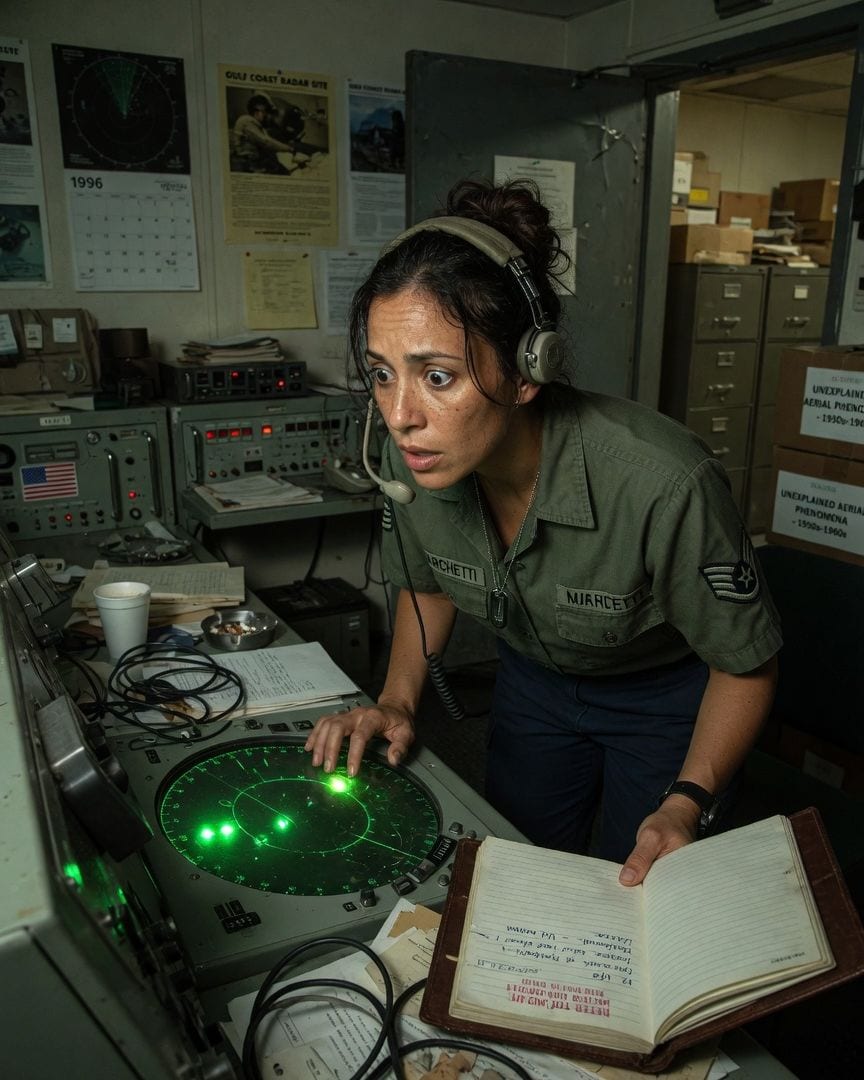
During her last weeks at the Cold War radar site, a technical sergeant logged a UFO. Her entry box was already stamped with a code from a missing 1958 jet.
Technical Sergeant Odile Marchetti was winding down her last few weeks as a radar operator at a remote Gulf Coast site in 1996. Alone in the cavernous room, she watched the green glow of her scope, the only light cutting through the pre-dawn gloom. At 2:30 AM, an airliner reported something flying in formation—a craft Odile couldn't see, until a massive, impossible blip bloomed beside it on her screen. After the pilot reported flying straight through empty air, Odile logged the UFO, only to find a faded, decades-old code already stamped on her logbook entry, identical to one on a missing jet report from 1958. Had this happened before, and was her own entry just a pre-written footnote in a much older, terrifying file?
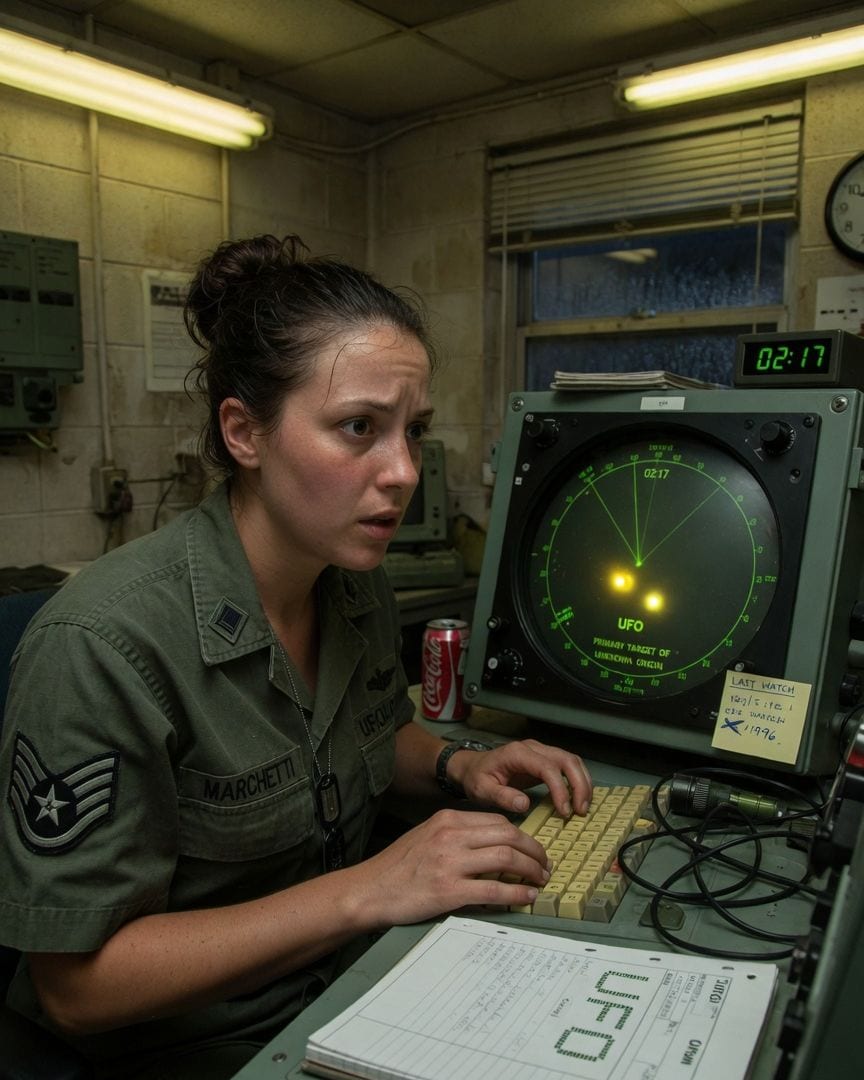
Technical Sergeant Marchetti's last watch saw an impossible radar blip merge with a plane. Later, its manifest showed a 'NO SHOW' passenger who *had* boarded, stamped 'FILE CLOSED'.
Technical Sergeant Odile Marchetti sat alone for her final watch at Gulf Coast ground control, anticipating a quiet transfer to a desk job. The dim console glow and rhythmic radar sweep were familiar, comforting sounds until 02:17, when an airliner captain reported impossible traffic flying in formation. Odile watched a second, larger blip appear on her screen, mirroring the plane's path with impossible precision. As the captain's voice, now tinged with a faint tremor, declared his plane was flying through where the object had been, the two radar returns merged into one, impossibly stable. Later, reviewing the official dismissal, Odile discovered an airline manifest listing a passenger as 'NO SHOW' who had, by handwritten note, definitely boarded—their name redacted, the file stamped 'CLOSED'.
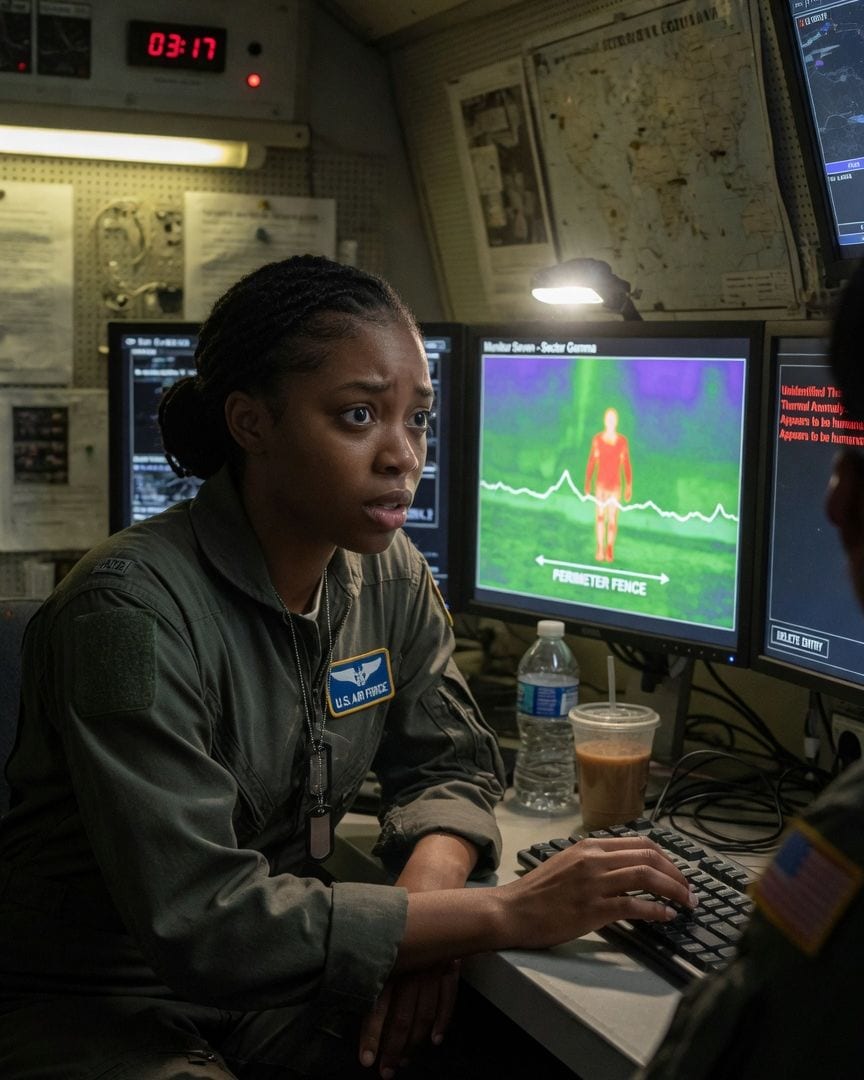
An airman’s thermal feed shows a figure moving in the restricted desert. Her captain orders it scrubbed, but the heat signature appears to tilt its head and look right at her.
Airman First Class Olivia Kade was new to her remote high-altitude outpost, fresh from advanced training, and the isolation pressed in, amplifying every hum. Her duty was to monitor the desert perimeter, but one shift, a faint thermal signature appeared on Monitor Seven: a solitary, upright figure moving with impossible precision beyond the barbed wire. No personnel were authorized in that sector. Her mission commander quickly ordered the anomaly scrubbed, but as it dissolved, the featureless outline seemed to tilt its head, looking directly into the camera. Now, the signature returns night after night, forcing the airman to wonder what impossible thing patrols the dark beyond the wire.
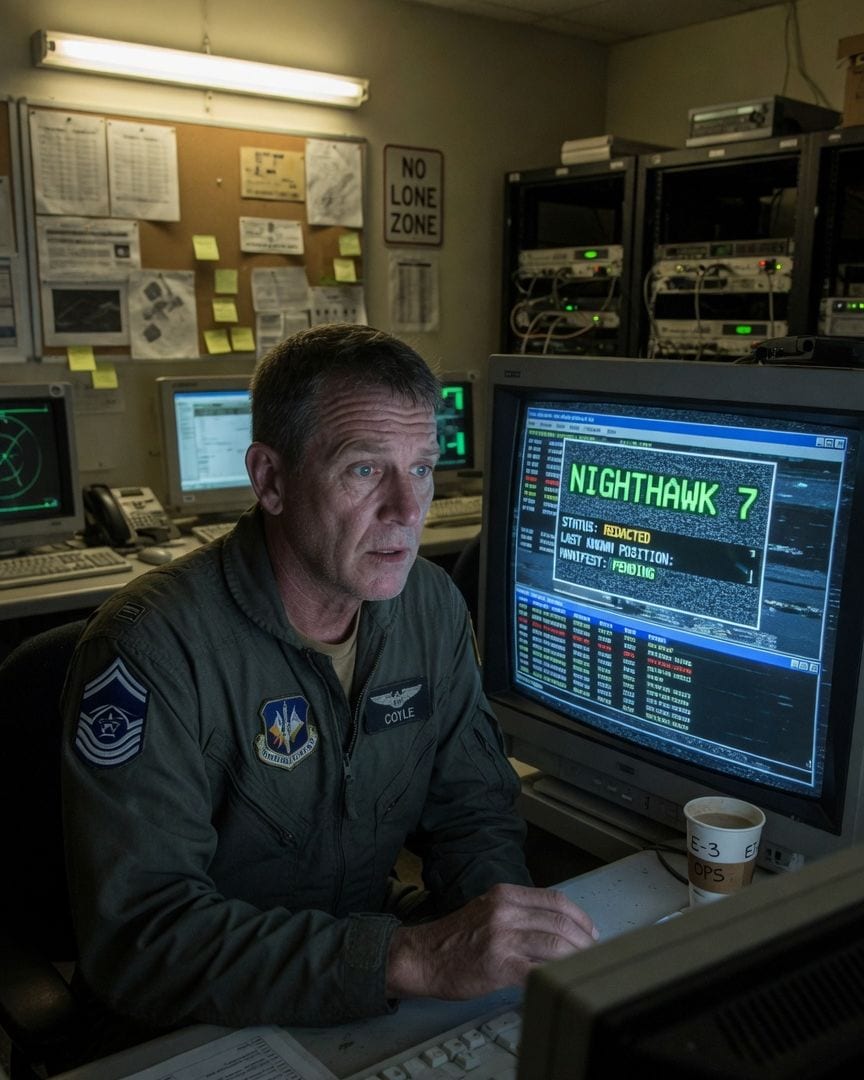
A ghost radar blip returned for Master Sergeant Coyle, three months from retirement. Its call sign: NIGHTHAWK 7, status REDACTED.
Master Sergeant George Coyle, nearly three decades in uniform, counted the last missions before his retirement. High above the black North Atlantic, his E-3 Sentry hummed with the familiar, impossible truth of a ghost radar blip. This single return squawked nothing, eluding every filter and fighter jet sent to investigate, yet the precise systems swore it was there, inbound, week after impossible week. Driven by obsession, Coyle later found a flicker of data: the call sign "NIGHTHAWK 7." Investigating further, an obscure database revealed its status as 'REDACTED,' with its last known position matching the ghost track. What forgotten project was haunting the skies, precisely where it had been scrubbed?
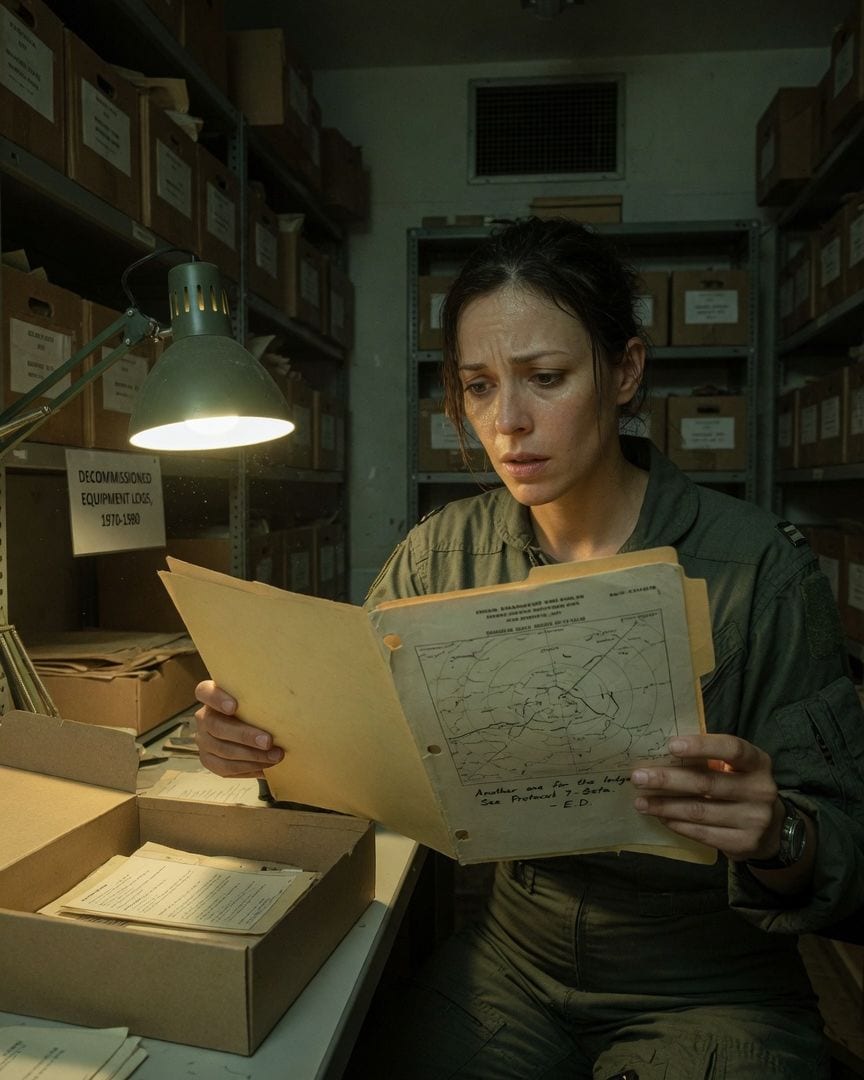
A radar captain's scope went clean, but the pilot swore a mile-wide UFO still filled his windscreen. Then she found a Cold War ledger of impossible sightings.
Captain Ines Bardolph, a 34-year-old radar operator in Bavaria, lived by the precise hum of her console. One quiet night, an impossible contact appeared over the Danube, then vanished from her scope just as a pilot swore it filled his windscreen. Replays showed the object had crossed the Alps in a single blink, defying all known physics. When bureaucracy sought to bury the incident, Captain Bardolph sought answers, leading her to a forgotten archive where a brittle folder revealed a chilling pattern: 'Another one for the ledger.'
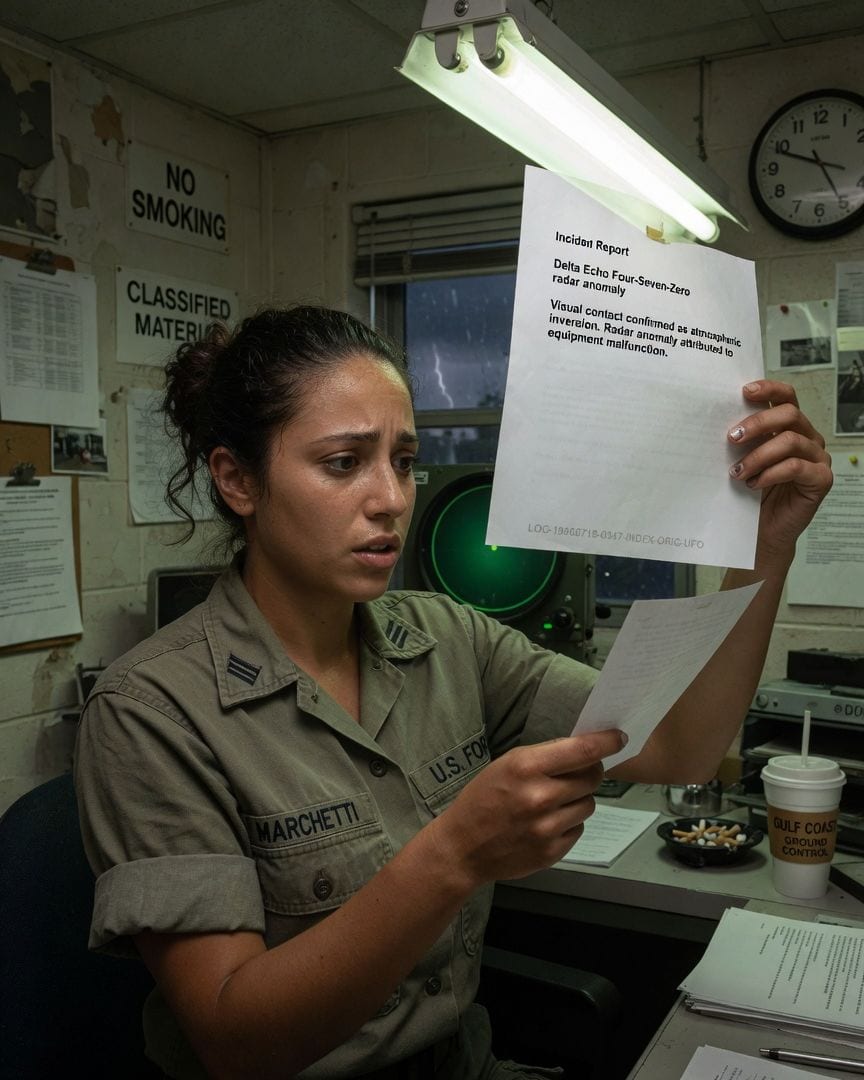
A radar operator's official report changed her UFO sighting to a malfunction, signed by her own system.
Technical Sergeant Odile Marchetti, a 22-year-old radar operator, was deep into a routine midnight shift at a dimly lit Gulf Coast ground control site in 1996, the air thick with an approaching summer storm. Her quiet night shattered when a pilot reported an impossible second return on her scope, a blip twice the size of an airliner that then vanished into the original. But the true dread settled in the morning when the official incident report, meant to log her 'UFO' sighting, returned with a mundane explanation she hadn't written. Scrutinizing the paper, she found a faint digital watermark: a sequence of numbers from her own system, silently falsifying her record. Who had overridden her log, and why?