During her last weeks at the Cold War radar site, a technical sergeant logged a UFO. Her entry box was already stamped with a code from a missing 1958 jet.
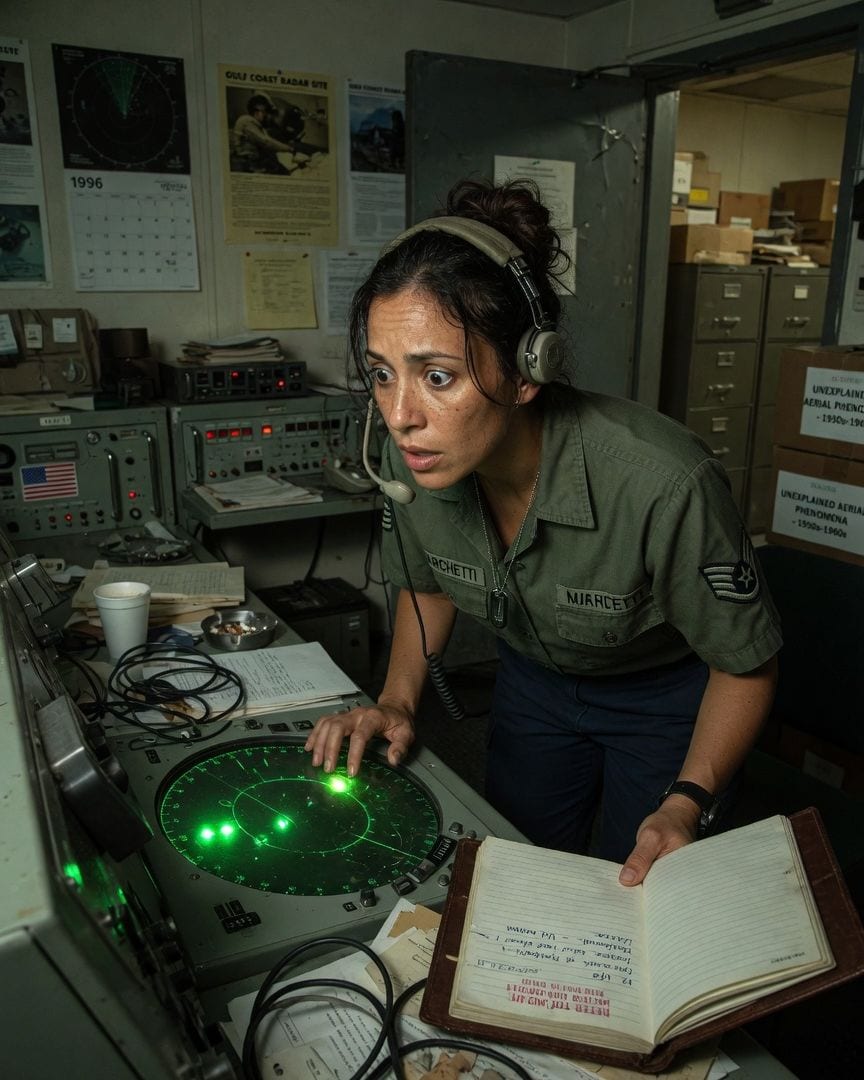
Technical Sergeant Odile Marchetti hunched over her radar scope, the only light in the cavernous room the green glow of her display and the muted hum of the equipment.
It was 2:30 AM, 1996, on a remote Gulf Coast site, and the air carried the faint, metallic scent of ozone and the distant, briny tang of the ocean.
Her last few weeks here were winding down, a fact she often found herself replaying in her mind. Tonight, the screen was almost empty, a single blip representing Delta 711, an airliner at flight level three-five-zero, heading east.
Captain David Brooks’s voice crackled through her headset, polite but strained. “Gulf Coast Radar, this is Delta 711. Confirming my airspace clear?”
Odile checked her scope again. “Delta 711, your airspace is clear. No traffic inbound or outbound.”
A pause, longer this time. “Roger that, Gulf Coast. Just… curious what was flying formation with us, then.”
Odile felt a flicker of unease. She scanned the screen, ran a quick sweep. Nothing. Only Delta 711’s primary return, a steady, familiar track. “Delta 711, I show no other contacts at your altitude or proximity.
Are you experiencing visual anomaly?”
As if in answer, a second bloom of light appeared on her scope, right beside Delta 711. It pulsed, twice the size of the airliner’s return, impossibly close. It wasn’t a ghost, not a double-echo; it was solid, definite.
Odile’s breath hitched. She ran the checklist for a primary target of unknown origin, her fingers flying over the keyboard. Her training screamed 'protocol', even as her gut screamed 'impossible'.
She typed 'UFO' into the designated log box, the letters stark against the digital entry.
“Gulf Coast, the craft just… it pulled ahead,” Captain Brooks’s voice said, now edged with genuine alarm. “It stopped. Directly in front of me.”
Odile watched, rigid. The two blips on her scope held their impossible positions. Then, in the space of a heartbeat, the larger, unknown return seemed to shimmer, to compress.
“Gulf Coast, we just… flew right through it,” Brooks reported, his voice flat with disbelief. “Through nothing. Just empty air.”
On Odile’s scope, the two returns merged, became one, and stayed one. The second target had simply folded into the first, leaving no trace of its impossible presence.
The familiar hum of the equipment seemed to deepen, a low, unnerving growl.
Odile’s heart pounded against her ribs, but the cold discipline of her training snapped her back to function. She launched into a battery of checks. She recalibrated the entire system, ran comprehensive diagnostics, cross-referenced with the backup radar array.
Every readout, every sensor, every redundant system confirmed her initial observation. No equipment malfunction. No atmospheric anomaly. The radar system was operating at peak performance.
She requested the raw radar tape from the control room’s central recorder. When it played back, it offered no comfort.
The tape clearly showed two distinct returns, then one, with no transitional blip, no fade, no distortion indicative of a technical error. It was as clean and precise as the flight path of Delta 711 itself.
“Delta 711, this is Gulf Coast. Can you confirm visual?” Odile asked, her voice tight, formal.
Captain Brooks’s voice came back, now undeniably shaken. “Negative visual contact now, Gulf Coast. But I swear, it was there. Directly ahead. Massive. Then it just… vanished. We passed through something.
Felt like a cold spot, a brief vibration, but no impact. Nothing.” He sounded like a man trying to convince himself as much as her. “No damage. No turbulence. Just… nothing.”
Back at her console, Odile pulled the physical logbook for her shift, the heavy, leather-bound volume where every significant event was meticulously recorded.
Her entry was there, under the 02:30 AM timestamp, detailing the encounter with clinical precision: 'Unknown primary target, twice size of Delta 711, observed formation, then merged with primary. Captain reports visual contact, then passed through empty space. UFO.'
She scanned the page again, double-checking her own notes. And then she saw it. Beneath her entry, in a small, pre-printed box she’d never noticed before, was a faded, barely legible stamp.
It wasn’t a standard code, not one she recognized from any official military directive. It read: 'REFER TO PROJECT CHRONOS, FILE 7-ALPHA-96-OM'.
The letters were crisp, but the ink looked old, as if applied decades ago to a blank page that had just been waiting for her entry.
Odile’s fingers flew across her secure terminal’s keyboard, trying to access 'PROJECT CHRONOS'. The screen flashed green for a moment, then went dark, replaced by stark white text: 'ACCESS DENIED: CLASSIFICATION LEVEL OMEGA-7.' Her stomach dropped.
She wasn’t cleared for anything beyond Top Secret. Omega-7 wasn't even in the standard nomenclature.
Frustrated, a cold knot forming in her stomach, she remembered the dusty archive room in the back of the facility.
It was a forgotten space, filled with old, forgotten reports from decades past, some dating back to the site’s original construction in the 1950s.
She pushed open the heavy steel door, the hinges groaning, and the smell of aged paper and dry dust filled her nostrils. The room itself seemed to shrink around her, drawing in the sparse light from the hallway.
Rows of metal cabinets, each crammed with manila folders, loomed in the gloom. She found a box labeled 'UNEXPLAINED AERIAL PHENOMENA - 1950s-1960s.' Her flashlight beam cut through the dust motes dancing in the air.
Digging through yellowed documents, she pulled out a thick report from 1958. Its cover read: 'U.S. Navy F-8 Crusader, Missing Over Gulf of Mexico.'
The details were chillingly similar to Delta 711: a pilot reporting an unknown 'formation,' a sudden, inexplicable disappearance from radar. The last transmission mentioned 'a wall of light' just before silence.
And there, in the top right corner, stamped in faded, blood-red ink, was the identical, impossible code: 'PROJECT CHRONOS, FILE 7-ALPHA-58-GH'.
Odile stared at the faded, typewritten page of the 'missing aircraft' report, the same classified CHRONOS code stamped across its top corner that she saw on the reference for her own UFO log entry.
Her finger traced the identical, impossible classification mark.
Over the next few days, Odile dedicated every spare moment to the archive. The formal paperwork of her transfer, slowly processing, offered a convenient cover for her long hours in the back room.
She started cross-referencing every report that mentioned an unknown aerial phenomenon, a sudden disappearance, or any unusual radar signature. The 'PROJECT CHRONOS' code, once an inscrutable anomaly, became her guide, a cryptic thread weaving through the decades of forgotten incidents.
She found it again on a 1967 merchant vessel’s log, detailing the eerie report of a 'ghost ship' that appeared on the horizon, sailed directly toward them, then simply vanished before it could be hailed, leaving nothing but an empty stretch of ocean.
The accompanying report, filed under 'Anomalous Maritime Occurrence,' bore the unmistakable 'PROJECT CHRONOS' stamp, followed by a different file designation.
Then there was a 1973 air traffic control incident. A small private plane, flying VFR over the plains, its transponder return solid and clear, simply ceased to exist mid-flight.
Not a crash, not a fade, just a sudden, abrupt blankness where it had been. The pilot’s last, confused transmission spoke of 'a distortion in the air.' Again, a 'CHRONOS' file.
A 1982 report detailed a cargo plane that landed at an Air Force base with an impossible extra crate in its hold. No manifest, no entry point, no record of it ever being loaded.
The crate, reportedly humming with a low, strange vibration, then disappeared from the secured hangar before it could be opened, leaving only an empty space on the concrete floor and a bewildered security team. Another 'PROJECT CHRONOS' entry.
The pattern was chillingly consistent, a cold, precise echo across time: an observation, a record, and then a complete erasure of the anomaly, leaving only the paperwork as proof it had ever existed.
She noted the specific phrasing used by witnesses— 'flew through it,' 'simply ceased,' 'folded into itself,' 'vanished,' 'disappeared.'
Every incident described a physical 'unhappening,' a void where something just was, a momentary rip in the fabric of reality that then seamlessly stitched itself closed.
The files were meticulous, precise, and utterly devoid of explanation. They were records of impossible events, filed away as if a natural, albeit rare, part of the bureaucratic process.
The air in the archive room grew colder the more she uncovered, a pervasive chill that seemed to emanate from the papers themselves.
Odile’s inquiries did not go unnoticed. Her terminal access to certain historical databases suddenly became 'intermittent,' displaying error messages she’d never encountered before.
Files she’d been examining in the physical archive were subtly shifted, sometimes replaced with blank covers, the original documents nowhere to be found. It was too precise to be random, too deliberate to be accidental.
The hair on her arms would stand up, not from a draft, but from the sudden, profound silence in the room when she reached for a folder that was no longer there.
One evening, after her shift, a senior NCO, a man named Theodore Underwood, stopped her in the deserted hallway outside the radar room.
He was a lanky man, his face a roadmap of wrinkles, with eyes that seemed to have seen too much. He had worked in records for decades, a fixture in the lower bowels of the facility.
He didn't directly address her research, his voice low, even.
“Technical Sergeant Marchetti,” he said, his gaze fixed somewhere beyond her shoulder. “Heard you were digging around in the old files.”
Odile’s heart hammered. “Just… cross-referencing some operational anomalies, Sergeant Underwood. Standard procedure.”
He offered a thin, humorless smile. “Standard procedure is to follow established protocols, Sergeant. Not digging too deep into old, confusing paperwork.” His eyes, though, held a depth of knowing that chilled Odile to the bone.
They were old eyes, tired, but sharp. He mentioned, almost casually, that “some things are best left filed where they belong.”
The words hung in the air, heavy with unspoken weight, before he turned and shuffled away, his footsteps echoing in the silence.
Later that week, Odile found a small, unmarked envelope tucked into her locker. It was ordinary, brown kraft paper, unsealed. Inside was a single index card, the kind used for library cataloging.
On it, typed in an old-fashioned serif font, were the callsign 'Delta 711' and the exact timestamp of her incident: '02:30 AM, 1996'. Below it, in neat, blue handwriting, was a single, stark word: 'Watched.'
The message was clear: someone knew exactly what she'd found. And they were closer, far closer, than she had ever imagined.
Odile confronted Theodore Underwood in the deserted archive room. The air was thick with dust and the scent of forgotten histories. The overhead fluorescent lights hummed with a low, insistent drone, making the shadows seem to writhe.
She slapped the index card down on a stack of files. "You sent this," she accused, her voice barely a whisper, afraid of the silence swallowing her words. "You know about this, don't you? All of it. Project Chronos."
He didn't flinch. He just sighed, a sound heavy with years of unspoken knowledge, as if the weight of every filed secret pressed down on him. He picked up the index card, ran a thumb over the typed words.
"Not a project, Marchetti," he said, his voice barely audible above the hum. "A classification. It means it happened, then it didn't."
Odile stared, the words echoing in her mind. "What are you talking about? 'Didn't'? I saw it. Captain Brooks saw it. The radar tape shows it."
"The record is the only thing left," Theodore explained, his gaze distant, fixed on a point beyond the peeling paint of the archive room wall. "The anomaly is observed, logged, and then removed from reality.
The files are how we keep track of what's been… unhappened." He gestured vaguely at the rows of cabinets around them. "This isn't an investigative unit, Technical Sergeant. It's an accounting department.
We aren't trying to understand the 'what' or the 'why.' Only to contain the 'that.'"
He explained that the 'unhappenings' were localized temporal or dimensional shifts. Not a disappearance, but an erasure.
The object or event was made to effectively 'un-exist' in the immediate present, while leaving behind the observational data – the radar blip, the eyewitness report, the logbook entry. "Your captain flying through it?
That's the moment it was filed," he said, his gaze distant. "The anomaly was removed. Folded back into whatever non-existence it came from."
Odile thought back to the radar tape, the two blips becoming one. It wasn't a merge; it was an erasure. Not two things becoming one, but one thing vanishing into the other, leaving only the original.
The dread tightened its grip, a cold, precise understanding blooming in her mind. The objects, the planes, the ships, they weren't lost. They were simply… archived.
The horror wasn't in the unknown, but in the clinical, bureaucratic nature of its management.
This vast, silent institution wasn't a search and rescue operation; it was a librarian of the impossible, ensuring the world remained unaware of its own fluctuating reality.
Underwood, seeing the terror blooming in Odile's eyes, leaned forward, his voice dropping to a conspiratorial whisper. "The true horror, Marchetti, isn't just the 'unhappenings.' It's the system's foresight."
He rose stiffly, shuffled to a particular filing cabinet, older than the others, its steel scarred and grimy. He pulled a heavy, brass key from his pocket and unlocked a deep, steel drawer.
The latch clicked like a bone snapping in the silence.
"Most of these," he said, waving a hand at the rows of cabinets, "are records of what has happened. They're historical. But some files are different."
He retrieved a single, thin file from the drawer, its cover marked with a faded, rectangular stamp in red: 'PRIORITY CHRONOS - PRE-EMERGENT.'
Odile felt the blood drain from her face. Pre-emergent. Before it happened.
He opened the file, revealing a single, yellowed internal memorandum, dated from 1985. The paper was brittle, crinkling softly as he held it. Its title, typed in a precise, almost elegant font, read: 'Procedures for Observer Integration into CHRONOS Events.'
Beneath the bureaucratic jargon, in the memo's body, was a list. Odile's eyes scanned the names, each one a jumble of letters, until a cold knot formed in her stomach. Then she saw it.
Clear as day, typed with an undeniable certainty: her full name, Technical Sergeant Odile Marchetti, followed by her service number.
Theodore Underwood's hand hovered over a yellowed, internal memo from 1985. He slides it across the table, his eyes fixed on Odile's.
Her name, Technical Sergeant Odile Marchetti, and her service number, are clearly visible on a list under the heading 'Future CHRONOS Contact Personnel'.
The full truth detonated, not with a bang, but with a quiet, sickening click.
Theodore explained, his voice flat, devoid of emotion, that the institution not only documented these 'unhappenings,' but actively identified and monitored individuals who were 'sensitive' or 'positioned' to observe them.
Odile’s 1996 incident, her encounter with Delta 711 and the impossible target, was not random. She was on a list, a potential witness, years before she even joined the service, her name already filed, her experience anticipated.
The 1985 memo outlined meticulous protocols for ensuring such individuals were in the right place at the right time.
Not by direct manipulation, Underwood clarified, but by subtle guidance, by creating a path of least resistance towards a predetermined observational point. The 'secrecy machine,' as he called it, wasn’t just reactive; it was anticipatory.
It didn’t just clean up anomalies; it curated them.
The pattern Odile had seen across decades and classifications wasn't merely a record of events, but a blueprint for how reality was managed. The UFOs, the missing ships, the impossible objects—they were all part of a controlled, recurring phenomenon.
The 'filing' was a continuous process, not just of events, but of the observers themselves. They were not merely witnesses; they were anticipated data points, human sensors in a vast, silent network.
"You weren't just a witness, Marchetti," Theodore said, his voice heavy, devoid of judgment. "You were an anticipated data point. And now you're an active file."
He said it as if she were a piece of paper, already cataloged and awaiting her next entry.
The realization was colder than any fear of the unknown: her entire life, perhaps even her choices, had been subtly nudged towards that radar screen on that particular night.
Odile tried to act. The knowledge was a burning coal in her chest, too heavy to carry alone.
She attempted to copy some of the 'CHRONOS' files, to download the scanned documents, to leak the information, to expose the pattern she had uncovered. Her keyboard clicked furiously, her fingers numb.
But the system was too vast, too ingrained, too anticipatory. Her terminal access, already 'intermittent,' was systematically revoked for sensitive historical databases. Her computer logs were flagged.
Emails she drafted to outside journalists or internal oversight committees vanished into the ether, never sent, never received.
There was no dramatic confrontation, no armed guards, no violent escape. Just a slow, bureaucratic tightening of the noose. Within weeks, the processing of her transfer, which had been lagging, suddenly accelerated.
She was quietly moved from the Gulf Coast site, not to the less active post she was promised, but to a remote, isolated radar station in the high desert of Nevada, hundreds of miles from any major air traffic, far from any significant population center.
The desert landscape was vast and empty, mirroring the void in her stomach.
Her new posting was a dead end, with limited network access and no physical archives. She was effectively 'filed' away, not physically erased, but rendered powerless and isolated.
The institution didn't need to silence her violently; it just needed to contain her knowledge, to make her a witness to nothing important, in a place where no one would listen.
The dread wasn't in a sudden, violent end, but in the quiet efficiency of it all, the terrifying realization that her 'escape' was just another, more subtle form of containment by the very system she had sought to expose.
She was still a part of Project Chronos, simply in a different capacity now.
Months later, Odile was in the desert, at her new post, staring at a blank radar screen. The silence of the vast, empty sky outside the small, prefabricated building was a constant, mocking reminder of what she knew.
Her transfer had been officially explained as a 'restructuring' of personnel, a routine reassignment.
Her former colleagues, if they thought of her at all, assumed she was enjoying a quiet life, perhaps even a promotion, in some obscure corner of the military.
The Gulf Coast site continued its operations, its archives still holding the impossible records, its radar scopes scanning for anomalies that would inevitably be 'unhappened.'
The 'PROJECT CHRONOS' files remained sealed, untouched by the world, but actively maintained by unseen hands. The system hummed on, patient and invisible, a constant presence in the background of reality.
Odile was just another cog, a discarded sensor now filed away.
Odile sits at her console, the desert night stretching out beyond the windows, utterly silent. The only sound is the low hum of the equipment, a familiar, sterile drone that fills the empty space.
She thinks of the files, the patterns, the names, her own name, predicted years before, a line on a pre-written ledger.
She survived, she knows, but the knowing is a new kind of confinement, a cage built of understanding rather than steel.
The world moves on, oblivious to the gaps in its reality, to the things that happen, and then unhappen, leaving no trace but a timestamp and a classification.
She looks at her empty radar screen, then down at her hands, resting on the console. The file is still being signed.
If this one got to you
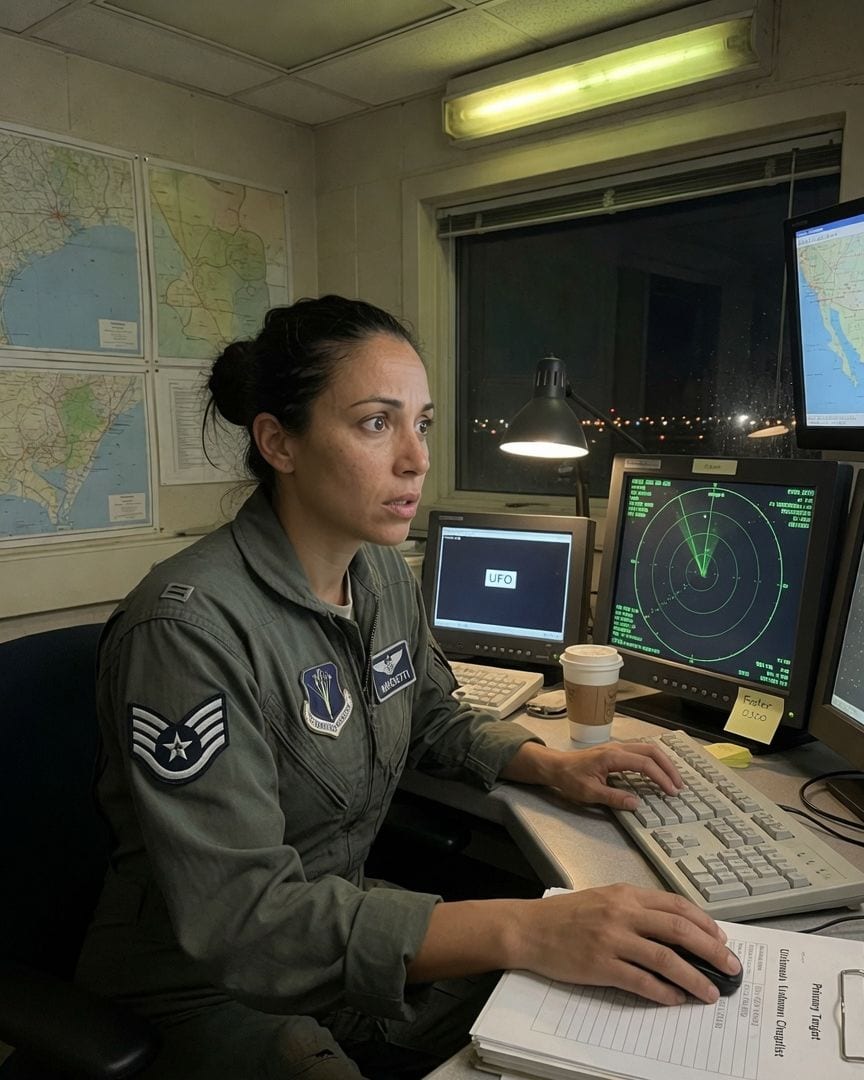
A radar operator watched a second blip, twice its size, merge into a plane on her screen. Her report was filed under a pre-existing, locked 'Special Handling' code.
Technical Sergeant Odile Marchetti sat alone in the dim radar room, her watch a final vigil for a base winding down along the silent Gulf Coast. At 02:17, a pilot reported a 'companion' on his wing, but her screen initially showed nothing. Then, a second blip bloomed, twice its size, before merging impossibly into the first and continuing its flight path without a ripple. She logged it as a UFO, only to discover the system already had a designated category for such anomalies – a pre-approved slot for the unexplained. A week later, her incident was re-categorized under a locked 'Special Handling' code, creating a new, inaccessible folder in her own personnel file.
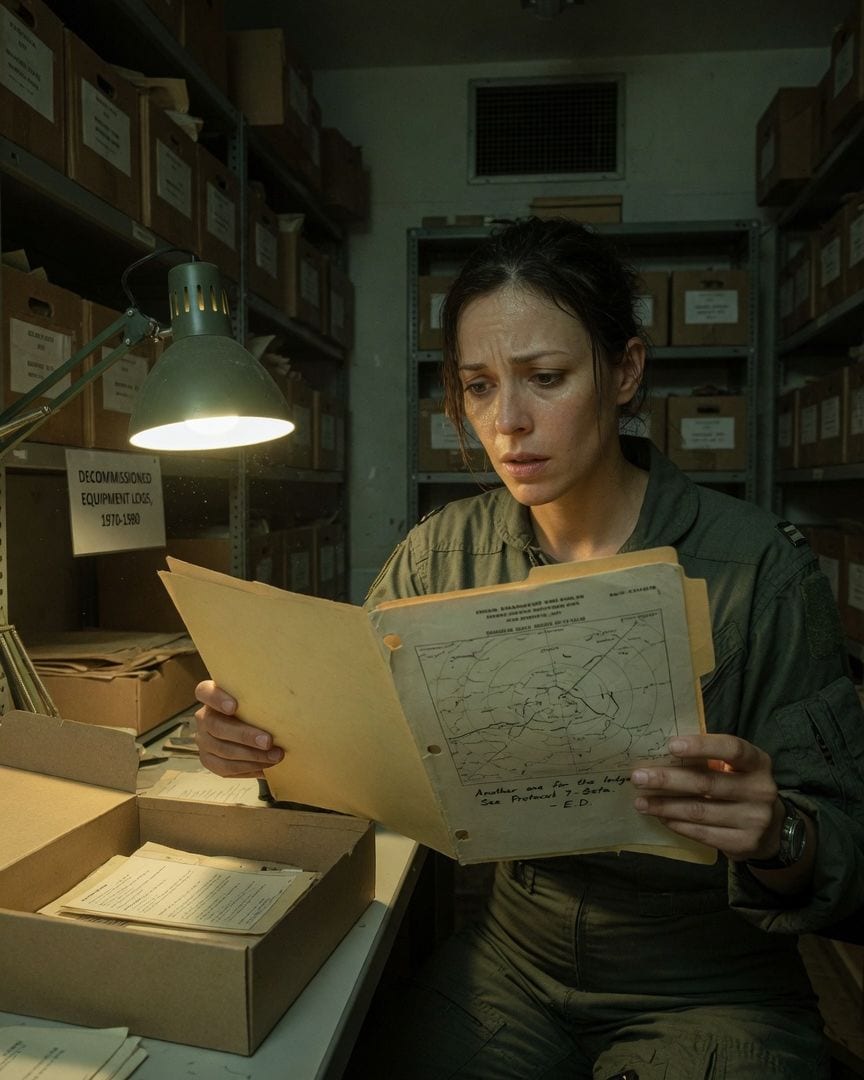
A radar captain's scope went clean, but the pilot swore a mile-wide UFO still filled his windscreen. Then she found a Cold War ledger of impossible sightings.
Captain Ines Bardolph, a 34-year-old radar operator in Bavaria, lived by the precise hum of her console. One quiet night, an impossible contact appeared over the Danube, then vanished from her scope just as a pilot swore it filled his windscreen. Replays showed the object had crossed the Alps in a single blink, defying all known physics. When bureaucracy sought to bury the incident, Captain Bardolph sought answers, leading her to a forgotten archive where a brittle folder revealed a chilling pattern: 'Another one for the ledger.'
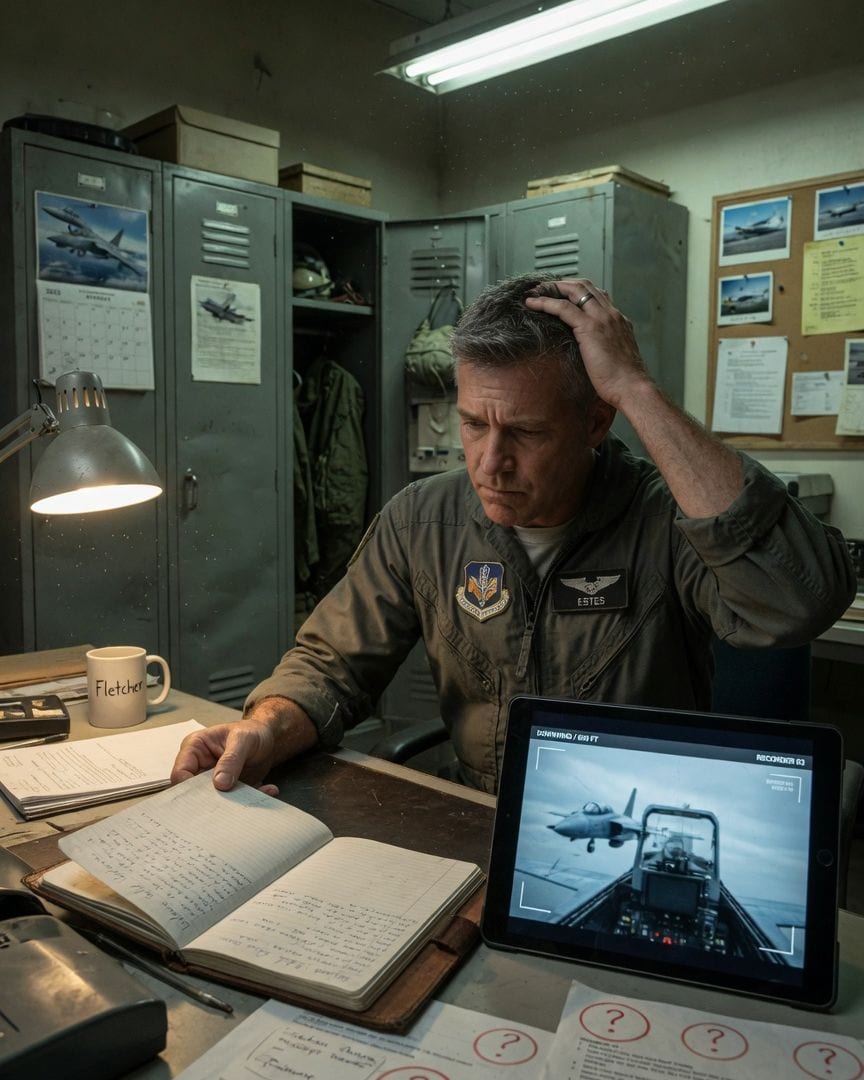
A Chief Warrant Officer's HUD tape shows a phantom jet, impossibly close, off his wing. Forty years ago, another Cold War pilot logged the same impossible sight.
Chief Warrant Officer Nathaniel Estes, a pilot whose career hinged on absolute precision, was under evaluation for a critical promotion. His nightly review of HUD tapes from routine Mojave test flights was a meticulous habit, but for a week, it revealed an impossible detail. At precisely 800 feet, one frame showed a sleek, experimental jet tucked impossibly close off his left wing—a craft ground radar never detected. When his maintenance chief found no equipment fault, Estes unearthed a dusty, decades-old logbook detailing identical phantom sightings from 1978. What unseen presence shadowed the desert skies?
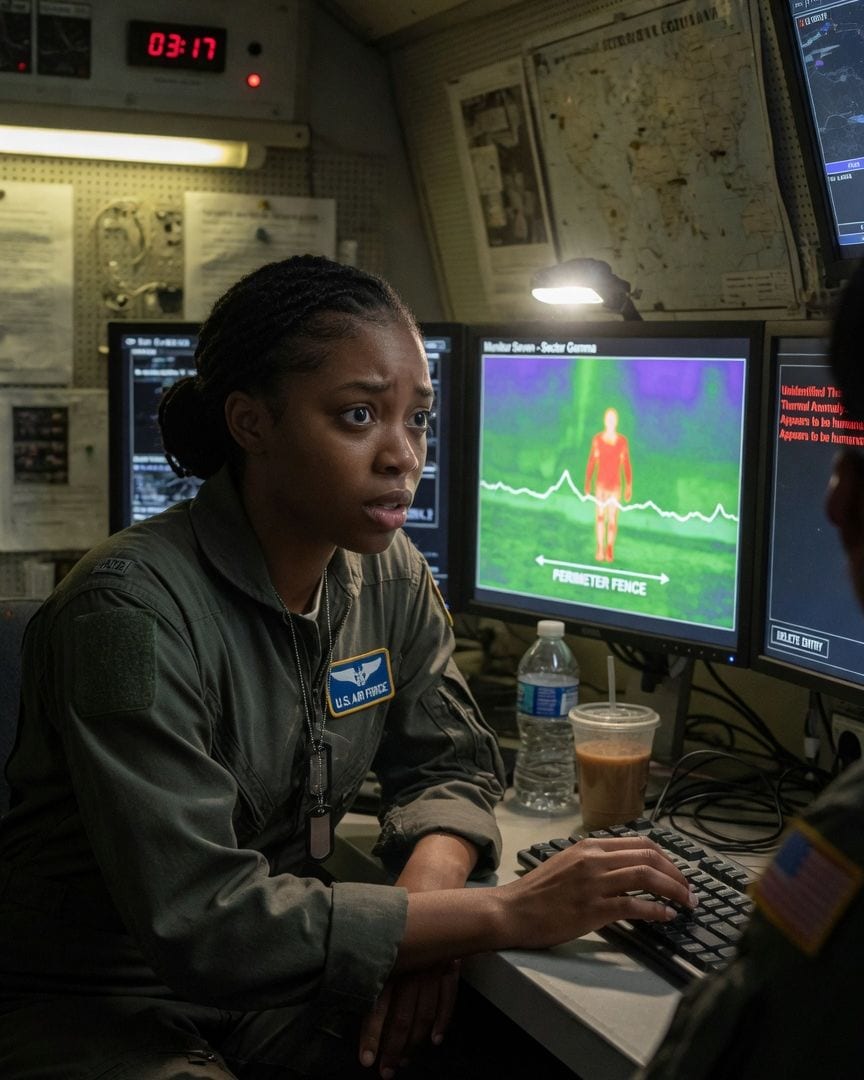
An airman’s thermal feed shows a figure moving in the restricted desert. Her captain orders it scrubbed, but the heat signature appears to tilt its head and look right at her.
Airman First Class Olivia Kade was new to her remote high-altitude outpost, fresh from advanced training, and the isolation pressed in, amplifying every hum. Her duty was to monitor the desert perimeter, but one shift, a faint thermal signature appeared on Monitor Seven: a solitary, upright figure moving with impossible precision beyond the barbed wire. No personnel were authorized in that sector. Her mission commander quickly ordered the anomaly scrubbed, but as it dissolved, the featureless outline seemed to tilt its head, looking directly into the camera. Now, the signature returns night after night, forcing the airman to wonder what impossible thing patrols the dark beyond the wire.
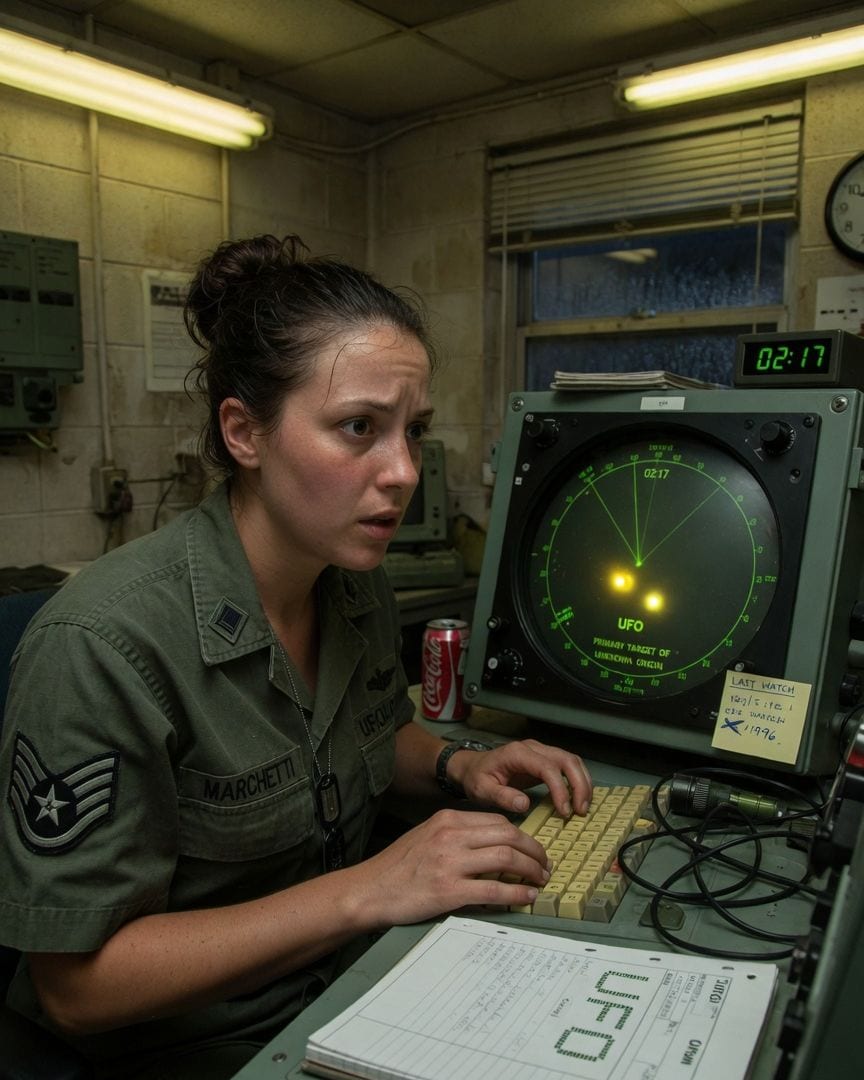
Technical Sergeant Marchetti's last watch saw an impossible radar blip merge with a plane. Later, its manifest showed a 'NO SHOW' passenger who *had* boarded, stamped 'FILE CLOSED'.
Technical Sergeant Odile Marchetti sat alone for her final watch at Gulf Coast ground control, anticipating a quiet transfer to a desk job. The dim console glow and rhythmic radar sweep were familiar, comforting sounds until 02:17, when an airliner captain reported impossible traffic flying in formation. Odile watched a second, larger blip appear on her screen, mirroring the plane's path with impossible precision. As the captain's voice, now tinged with a faint tremor, declared his plane was flying through where the object had been, the two radar returns merged into one, impossibly stable. Later, reviewing the official dismissal, Odile discovered an airline manifest listing a passenger as 'NO SHOW' who had, by handwritten note, definitely boarded—their name redacted, the file stamped 'CLOSED'.
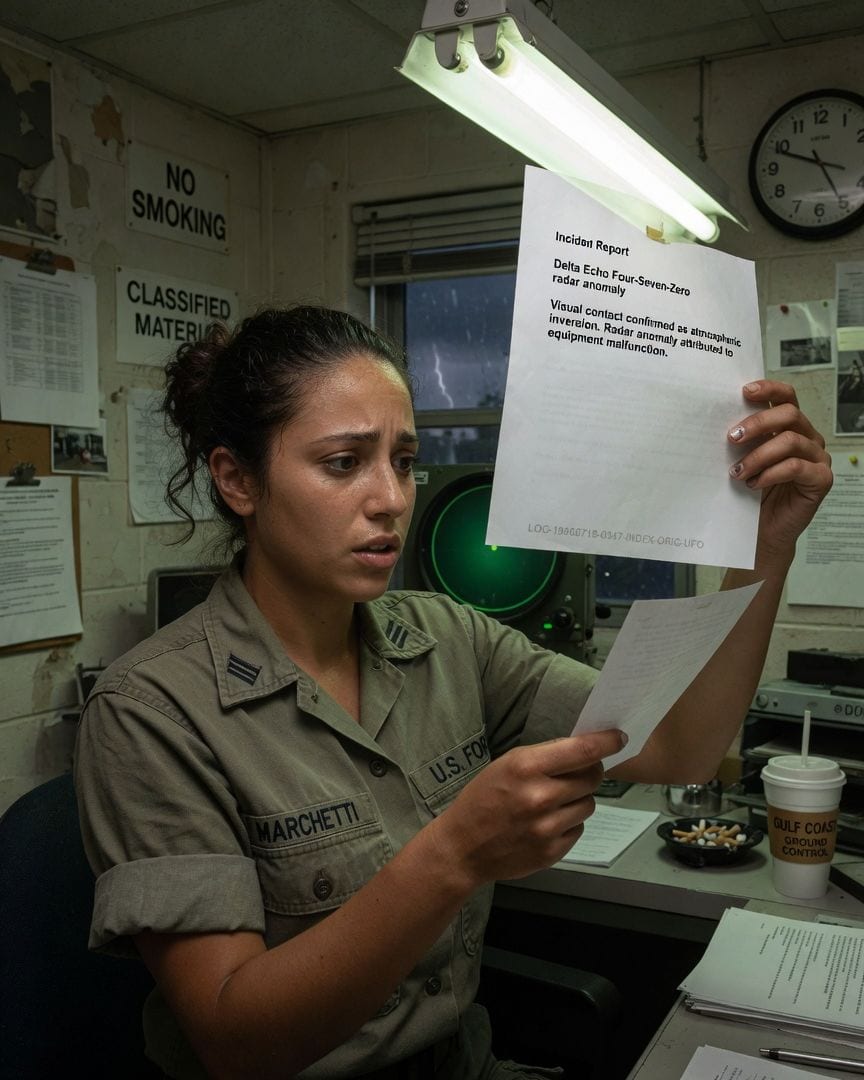
A radar operator's official report changed her UFO sighting to a malfunction, signed by her own system.
Technical Sergeant Odile Marchetti, a 22-year-old radar operator, was deep into a routine midnight shift at a dimly lit Gulf Coast ground control site in 1996, the air thick with an approaching summer storm. Her quiet night shattered when a pilot reported an impossible second return on her scope, a blip twice the size of an airliner that then vanished into the original. But the true dread settled in the morning when the official incident report, meant to log her 'UFO' sighting, returned with a mundane explanation she hadn't written. Scrutinizing the paper, she found a faint digital watermark: a sequence of numbers from her own system, silently falsifying her record. Who had overridden her log, and why?