Nine days from closing, Cold War Site Pellin's Airman Vance watched his radar track a solid blip moving closer, dead in open sea where nothing could exist.
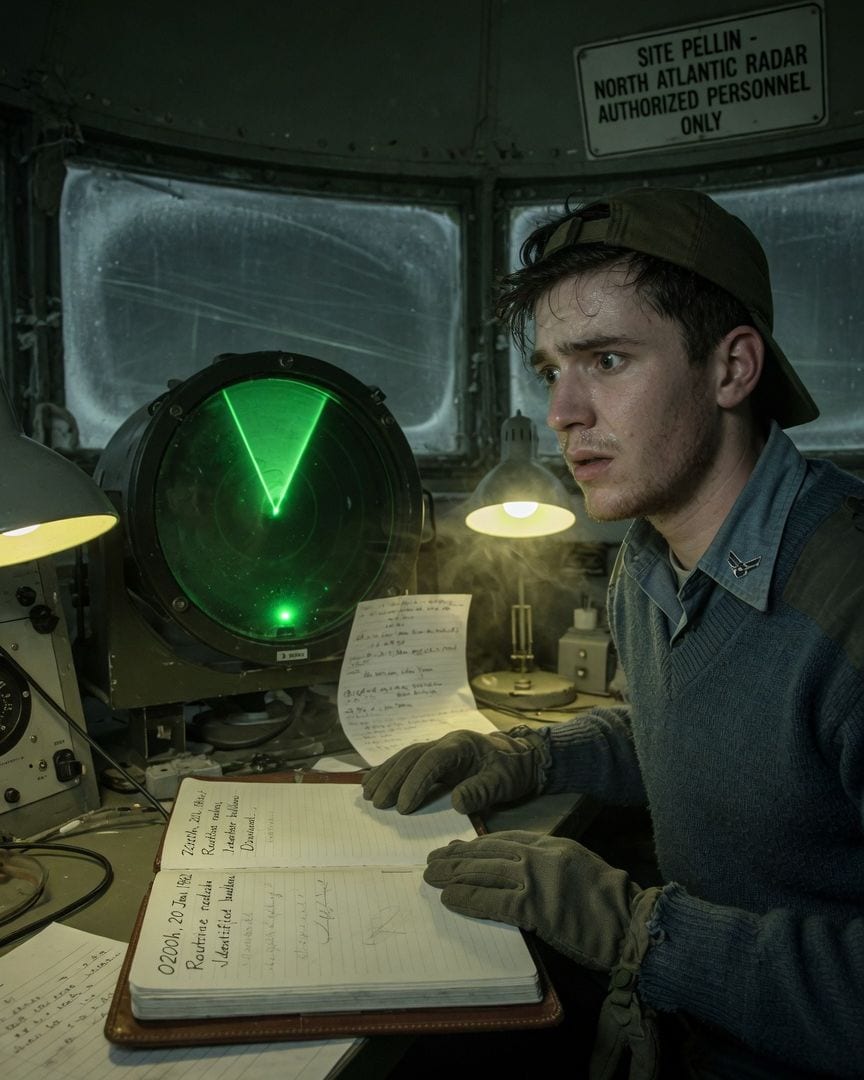
Airman Ordway Vance, at twenty-two years old, ran his hand across the cool, curved metal of the radar console. The air in the dimly lit dome of Site Pellin tasted faintly of ozone and old electronics.
Outside, a bitter January wind whipped off the North Atlantic, driving sleet against the hardened glass of the observation slits. Nine days until the base closed for good, its equipment to be pushed into the churning sea.
His last posting before discharge. Ordway wanted to leave with a clean record, nothing unexplained.
He watched the sweep arm rotate, a rhythmic green line washing over the scope. His last calibration sweep had come back clean, as expected. Nothing but the usual swells, distant shipping lanes, and atmospheric noise.
Then, a single, unwavering return blipped on the screen at forty miles. It was a solid green mark, small but distinct, standing dead in the swell.
The coordinates placed it precisely where the charts and tide tables and every surface picture he had ever seen indicated nothing but open water, miles from any known shipping lane or island outcrop.
“Site Commander Kingsley, this is Vance,” Ordway said, his voice steady into the intercom. “Possible ghost return, bearing zero-four-zero, forty miles out. No correlating visual, sonar, or passive listening data.”
Commander Benjamin Kingsley, forty-five, a man whose voice always carried the dry rustle of official papers, crackled back over the intercom. “Acknowledged, Vance. Run a second sweep. Double-check all parameters. Standard protocols.”
Ordway complied, his gloved fingers moving with practiced efficiency over the controls. The sweep arm began its slow, deliberate rotation again, its soft hum the only sound in the dome save for the distant howl of the wind.
He watched, eyes narrowed, as the green line chased its own tail, waiting for the blip to reappear, or, more likely, to vanish.
It didn't vanish.
The blip appeared again, exactly where it should, but closer now. Twenty miles. Still solid. Still unwavering. Ordway felt a prickle of unease at the back of his neck. This was no glitch, no transient atmospheric effect.
The scope was telling him something impossible. He called it in, his report precise, detached. Kingsley’s response was clipped. “Understood, Vance. Another sweep. And initiate close-range protocols.”
Ordway ran the third sweep. The blip was inside the fence line now, a static, impossible presence, a green pinprick of wrongness.
It sat three miles off the coast, just beyond the breaking waves, where no vessel could possibly sit, where nothing should exist at all.
The scope was the only thing that could see it, a silent accusation against the known world, against the charts and the tide tables and the very concept of empty ocean.
He stared at it, the green point humming softly on the glass, waiting for the explanation that wouldn't come.
He tried to rationalize it. A sub-surface inversion, perhaps, bending the radar waves? A rogue weather balloon caught in an impossible current? He checked the atmospheric conditions again, pulled up the latest weather reports. Clear. Stable.
He cross-referenced with the passive listening arrays, ran a quick sonar burst. Nothing. The deeper sensors picked up only the groaning of the sea ice and the distant, rhythmic thump of his own blood in his ears.
The scope, however, was unwavering, holding the impossible return in its green grip. It just sat there.
Ordway logged the anomaly precisely. He detailed its steady, impossible trajectory, the lack of any correlating data from other sensors. He wrote down the exact coordinates, the time, the atmospheric pressure.
His hand moved without a tremor, documenting the undeniable, even as his mind struggled to contain it. He felt a profound, cold certainty: this was not a mistake.
Then, he opened the official Site Pellin logbook, a heavy leather-bound ledger kept in a secure compartment beneath the console. Its pages, thick and cream-colored, held the history of every significant event, every radar contact, every patrol.
He found the page for January 20th, 1962. Commander Kingsley's neat, authoritative hand had already filled the page.
Ordway read the entry: "0200h, 20 Jan 1962: Routine radar anomaly. Identified as weather balloon. Dismissed."
Ordway’s stomach tightened. He looked from the clean, official script in the logbook to his own raw data printout, a curling sheet of paper taped to the console, showing the impossible, static blip. There was no balloon. No way.
He felt a slow, cold anger building. Kingsley hadn't just dismissed his report; he had overwritten reality.
He leaned closer to the logbook, his eyes tracing the elegant curves of Kingsley’s signature. Then he noticed something beneath it. Almost erased, faint, uneven pencil strokes. Not Kingsley’s neat hand.
Ordway ran a gloved finger over the smudged graphite, brushing away a minuscule flake of dried wax. The words became just barely legible: ‘…Project Pelican… no visual… containment…’.
A cold knot formed in his gut, tighter than any fear he had known. Project Pelican. No visual. Containment. The words whispered of something far more deliberate, far more chilling than a simple cover-up. Kingsley had known.
And whatever he had known, he had filed it away, not as a glitch, but as something requiring a protocol.
Ordway glanced at the intercom, then back at the logbook. The official record, signed and stamped, stated a lie. His own data, undeniable, told a different story.
The dome, usually a space of comforting quiet, seemed to press in on him, cold and heavy. The chill he felt had nothing to do with the January dark outside.
The impossible return was still there on his scope, a silent accusation, holding its position, unwavering. Ordway traced the faint pencil marks again, the words ‘containment’ echoing in the silence.
He knew, with a certainty that iced his veins, that Commander Kingsley hadn’t just made a mistake or covered up a glitch. He had filed something.
And that something was still out there, just beyond the fence line, unseen by human eyes, but undeniably present, waiting.
Decades later, in 2018, Ordway Vance, now seventy-eight and a retired veteran, still couldn't shake the memory of Site Pellin.
The site had been dismantled, its dome pushed into the sea as planned, a final, unceremonious end to his last posting. But the 'weather balloon' had never quite left his mind.
It festered, a tiny, unresolved point of wrongness in an otherwise ordered life. He’d spent years, quietly, methodically, following any lead on 'Project Pelican', a name that had clung to his memory like brine to stone.
His search led him to the National Archives in Washington D.C., a labyrinth of hushed halls and towering shelves. After countless requests and endless bureaucracy, a dusty, recently declassified box arrived, marked simply: 'Operation PELICAN'.
He worked with archivist Dorothy Bennett, a kind woman in her sixties with a soft voice and a sharp mind who initially humored his 'historical curiosity' with a bemused smile.
The initial files were innocuous: procurement requests for obsolete radar equipment, personnel transfers for Site Pellin, base blueprints. Mundane records of a forgotten outpost.
But then Ordway found a series of documents detailing a 'marine recovery operation' in 1962, precisely in the North Atlantic sector where Site Pellin had been.
The recovered 'vessel' was described only by a serial number and a vague 'anomalous energy signature'. There were no photographs, no schematics, just dry, technical language that described something without ever truly naming it.
The recovery report was signed by none other than B. Kingsley.
Ordway felt the familiar cold dread coil in his stomach. The same signature. The same location. The same year. This wasn't a clerical error.
He found a manifest for the 'recovered vessel' listing a crew complement, then payroll records for the same crew. The dates on the payroll sheets, however, stretched not just for months, but for years beyond 1962.
Each entry was signed, again, by B. Kingsley.
The dates progressed, steadily, into the 1970s, then the 80s, all for a 'vessel' that was officially declared lost and recovered in '62, a crew that should have long since moved on, or vanished. Dorothy, reading over his shoulder, frowned.
“This is… unusual,” she murmured, her voice tight with professional curiosity. “Perhaps a legacy payroll system?” Ordway shook his head, a grim certainty hardening his features. This wasn't just unusual. It was impossible.
Ordway and Dorothy, now deeply engrossed, spent days sifting through the file. The impossible paperwork continued to surface. Maintenance schedules for the 'vessel', dated 1990, detailing routine systems checks and hull integrity reports.
Requisition forms for 'containment materials' in 2005, requesting esoteric compounds and specialized damping fields. All of them, every single one, signed by B. Kingsley. Dorothy, initially skeptical, grew visibly unnerved. Her usual calm demeanor began to fray around the edges.
“This… this isn’t possible, Ordway,” she whispered one afternoon, her gaze fixed on a maintenance report from 2008. “Kingsley died in ’88. I checked his service record last night. Confirmed.”
The hushed quiet of the archives seemed to amplify her words, making them feel like a pronouncement.
As they worked, Ordway began to notice things. A man in a dark suit, always at the periphery, subtly watching their table from the reading room entrance, then from behind a distant row of microfiche readers.
He never approached, never spoke, but his presence was a constant, unsettling pressure.
One specific file folder, which they had carefully placed aside, was later found returned to its box, its contents subtly rearranged, though Ordway couldn't identify precisely what had been moved. The room itself seemed to hold its breath around them.
One evening, after the archives closed for the day and Ordway was back in his sparse hotel room, his phone rang. The caller ID was blocked. He answered, a strange premonition settling over him.
A distorted, synthesized voice, flat and inhuman, simply said, “Some files are meant to stay closed, Mr. Vance. For everyone’s safety.” The line went dead with a soft click. Ordway stared at the phone, his hand trembling slightly.
The next morning, Dorothy arrived at their table, her face pale. She placed a single, blank maintenance sign-off sheet on the table. It had been tucked into her personal belongings, inside her handbag.
The signature line at the bottom was pre-printed with a crisp, official-looking 'B. Kingsley'. The dread was no longer abstract; it was personal, breathing down their necks. They were being watched, warned. The file, it seemed, had its own guardians.
Shaken, Ordway and Dorothy decided they couldn't continue alone. They confronted their findings with a senior archivist, Daniel Prescott, a man in his fifties known for his rigorous adherence to protocol.
Prescott listened, initially dismissive, attributing the anomaly to an elaborate historical hoax, a clerical error compounded over decades, or a 'legacy project' where a name was kept for continuity to honor a foundational figure.
He tapped a finger impatiently on the table as Ordway laid out the impossible dates, the identical signatures spanning decades, and the specific details matching his 1962 experience.
But as Ordway pressed, his voice steady despite the tremor in his hands, describing the 'vessel's' impossible movement, the 'containment' annotation in the logbook, Prescott’s composure began to fracture.
His jaw tightened, his gaze flickered from Ordway to Dorothy, then to the stack of impossible documents. He closed his eyes for a moment, a muscle twitching in his cheek.
“The Pellin Project was a codename,” Prescott finally admitted, his voice low, almost a whisper, as if speaking it aloud might shatter the fragile reality of the room.
He picked up one of the payroll sheets, its impossible dates mocking him. “Not for a recovery, not exactly. But for… management. Containment.”
He explained that the 'vessel' Ordway saw in 1962 was not a ship, not even a conventional anomaly. It was an anomalous entity, discovered to be dormant, but capable of 'reactivation' under specific conditions.
Commander Kingsley, Prescott revealed, wasn't just a commander; he was the architect of the containment protocol.
“The file,” Prescott said, tapping the impossible payroll sheet with a finger that now subtly trembled, “it’s not a record of what happened. It’s a record of what is happening. The administrative framework. The signatures… they’re part of the system.
A continuous authorization. Kingsley didn't just sign off on events; he authorized the ongoing containment through this paperwork. Even after his death.”
Ordway felt the world tilt, the floor beneath him seeming to shift. The 'weather balloon' he reported, the blip on his radar screen, that was the initial 'filing'.
The 'Project Pelican' annotation, almost erased from the old logbook, that was the beginning of the containment protocol.
The scope being the 'only thing that could see it' was because it was being actively managed out of human sight, beyond the reach of conventional perception.
The horror wasn't a monstrous creature or a secret weapon; it was the sheer, meticulous bureaucracy of the impossible. A system so vast, so patient, that it could administrative-record-keep a thing into existence, or rather, into endless, quiet, bureaucratic containment.
Prescott then pulled out a faded, heavily redacted document from his own secure vault, a heavy, unmarked binder that seemed to hum with contained secrets.
It was a 'Project Pelican' mission directive, dated 1961, outlining the exact purpose of Site Pellin. It wasn't just a radar station; it was designed as a 'passive observation and initial containment facility' for 'Type-7 Anomalous Marine Entities'.
The document detailed a network of similar 'Pellin-class' sites across global maritime choke points, each designated for a specific 'Unit'. Ordway's Site Pellin had been 'Unit 7'.
He scanned the list of other sites: Site Kingsley, Site Radcliffe, Site Forsythe.
Each entry had a corresponding 'Unit' designation, and each listed a 'primary operational commander' — all names he now recognized from the 'Operation PELICAN' file as signatories on impossible, decades-spanning documents. The file they had found wasn't unique.
It was just one thread in an immense, invisible tapestry.
Just then, Dorothy, who had gone utterly pale, reached across the table and pointed. Not at the document, but at the archival box itself, the one that had held the 'Operation PELICAN' file.
A faint, dark stain was seeping through the bottom, spreading slowly across the polished wood of the table. It was not just a dark liquid; it was a viscous, almost organic-looking residue, thick and strangely iridescent.
It smelled faintly of brine and something else, something metallic and cold, like stagnant machinery and deep ocean pressure.
Ordway Vance, his breath catching, held up a maintenance report from the 'Operation PELICAN' file. Dated '12.04.2018', it detailed 'routine systems check, Unit 7, North Atlantic Sector'. The signature at the bottom, in a steady, familiar hand, read 'B. Kingsley'.
He looked at the archivist, Dorothy Bennett, who had gone pale, her gaze fixed not on the document, but on the faint, dark stain seeping through the bottom of the archival box, spreading slowly across the table.
Prescott explained that the stain was a 'trace residue' from the containment protocols, a byproduct of the entities' ongoing 'management'.
The entities, he clarified, were not biological in the traditional sense, but complex, self-sustaining energy forms that interacted with the physical world, often manifesting as 'ghost returns' on radar or sonar.
The 'dead in the swell' description from 1962 was accurate – they became inert without active 'management'. They simply existed, dormant, waiting.
The 'Pellin Project', he continued, was a global, multi-generational effort to keep these entities in that dormant, 'filed' state.
The paperwork, the endless signatures, the payroll for non-existent crews – it was all a complex, bureaucratic ritual, a continuous act of administrative will, designed to maintain the 'containment field'.
If the paperwork stopped, if the 'filing' was interrupted, the entity would 'reactivate'. Kingsley and others like him weren't just signing documents; they were effectively maintaining the prison walls through the sheer force of official record-keeping.
They were the system, and the system was the containment.
The 'vessel' Ordway saw in 1962 had been 'reactivating', its energy signature flaring. Kingsley's quick 'weather balloon' entry was a desperate, immediate re-filing, a reassertion of its contained status, an administrative act to push it back into dormancy.
The erased 'Project Pelican' annotation was a panicked acknowledgment of the system's near-failure, a moment where the administrative spell had almost broken. The pattern across decades and classifications, the impossible dates, the unwavering signatures, now made a horrifying, perfect sense.
The horror was not that something was out there; it was that something was in here, carefully maintained, patiently administrated, forever.
Ordway understood. The file wasn't just paper; it was an active spell, a perpetual motion machine of bureaucracy designed to keep impossible things from existing in plain sight.
To expose it, to declassify it fully, would be to unravel the containment, to potentially unleash these dormant entities.
But to let it continue was to participate in a lie, a horrifying, patient horror stretching across the globe, silently warping reality.
He and Dorothy, with Prescott's reluctant, terrified help, devised a plan. They wouldn't expose the entities directly. They would expose the impossible paperwork.
They would release Kingsley's 'active' signature, dated decades after his death, the payroll for ghost crews, the maintenance logs for a vessel lost decades ago.
They would make the absurdity undeniable, forcing the institution to address the 'clerical errors', the 'anomalies' in their own record-keeping.
Their goal was not to destroy the system, but to force a re-evaluation, to make the 'filing' visible, to shift the burden of this endless, patient horror from the hidden few to the public consciousness.
As they prepared the documents for public release, copying and encrypting them for multiple recipients, the man in the dark suit appeared again.
He stood in the archive doorway, framed by the pale light of the corridor, his face obscured by shadow. He didn't speak, just watched them, his expression unreadable, his presence an oppressive weight.
Ordway felt a profound chill, a sense of immense, patient power radiating from the silent figure. He knew this wasn't an agent of the government.
This was an agent of the file itself, the embodiment of the system that kept things hidden, that kept things filed.
Ordway, defying the silent threat, clicked 'send' on the secure email, releasing their findings to a handful of trusted journalists. The man in the suit remained motionless, a still, dark silhouette.
Then, a slow, faint smile touched his lips, a smile that seemed to stretch too wide, too long, a hairline crack in his composed facade.
He simply turned and walked away, leaving Ordway with the chilling certainty that the 'file' had just gained new signatories.
The initial reports caused a stir, quickly dismissed as 'unsubstantiated claims' and 'archival anomalies' by official channels. The public, presented with evidence of dead men signing payrolls for ghost crews, largely shrugged it off as sensationalism or a sophisticated prank.
But the seed was planted. Dorothy Bennett found herself quietly transferred to a different department, her access to certain archives revoked. Daniel Prescott took an early retirement, disappearing from public life, his secure vault resealed and forgotten.
Ordway Vance, however, found himself unexpectedly contacted by a small, dedicated group of researchers, all with their own impossible 'files' and 'anomalies'. They understood. The world hadn't ended.
The entities hadn't reappeared en masse, screaming their silent horror across the oceans. But the secrecy machine had been forced to acknowledge a crack in its facade, a single, undeniable contradiction in its meticulously maintained reality.
The burden of knowledge had shifted, from a lone airman trying to make sense of a green blip, to a quiet network of the aware.
Ordway Vance sits by his window, looking out at the North Atlantic, the same dark water he watched from Site Pellin so many years ago. The wind still howls, the waves still break.
He keeps a small, locked box on his desk, filled with copies of the impossible documents, the payrolls, the maintenance logs. He knows the 'file' is still active, still being signed, somewhere.
He sometimes imagines the faint, green blip of an impossible return, moving silently beneath the waves, managed by unseen hands, its existence validated by endless, meticulous paperwork. He knows he didn't stop it, couldn't stop it.
He just made it visible, at least to a few. The dread is that it all makes perfect, chilling sense. He picks up a pen, a fresh, blank sheet of paper before him.
He has a new entry to make, a new document to file. Not for the Project, but for himself, for the record of what he now knows. The file was still being signed, and the ink was still wet.
If this one got to you
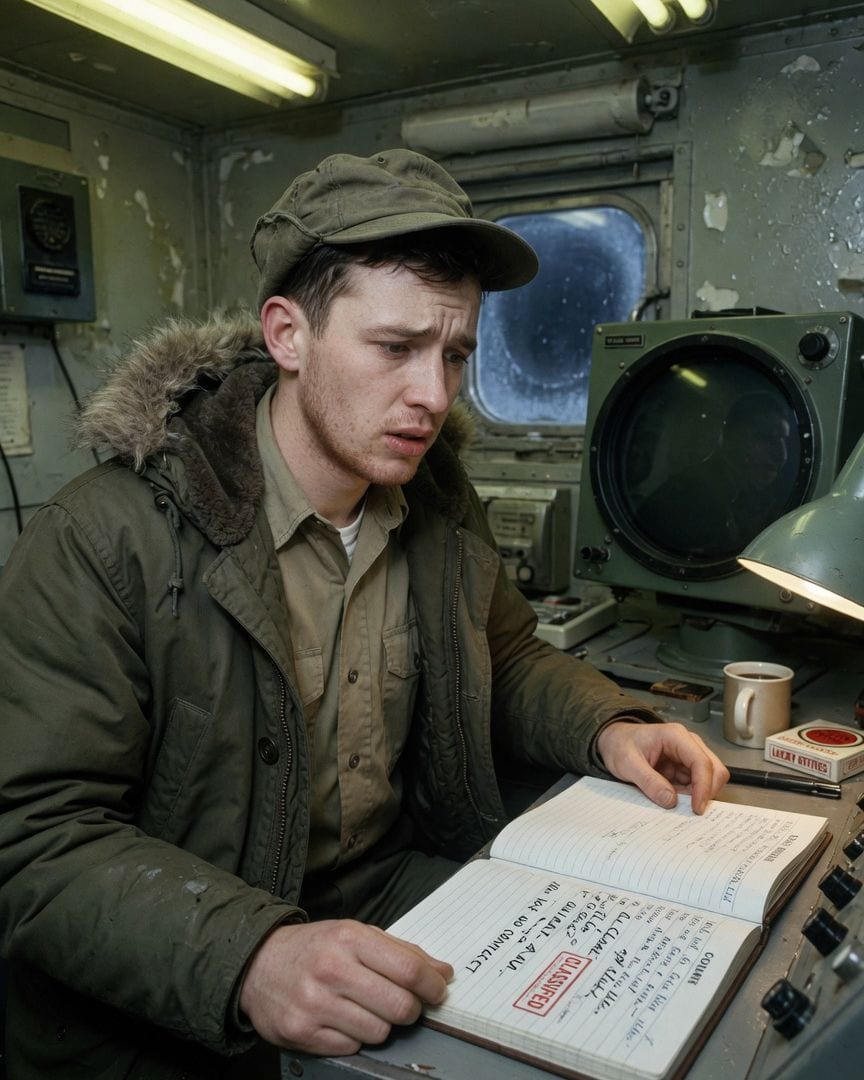
A Cold War airman logs an impossible radar contact on his last sweep. But his official logbook entry is stamped 'CLASSIFIED' and then contradicted by a hastily scrawled 'ALL CLEAR' dated moments before it.
Airman Ordway Vance, 22, manned the radar dome at Site Pellin in the biting North Atlantic dark of January 1962, running the last calibration sweep before its decommissioning. His scope picked up a faint, impossible return, growing closer with each pass, though the ocean remained empty to the eye. When Vance detailed the contact in his official logbook, a 'CLASSIFIED' stamp appeared, followed by a hastily scrawled 'ALL CLEAR' dated moments before his own entry, contradicting his every word. Commander Hartley dismissed it as equipment malfunction, but Vance sensed a chilling, official erasure behind the lie. He soon found a locked cabinet marked 'SITE PELLIN ANOMALIES,' hinting at a deeper truth buried within the base's final days.
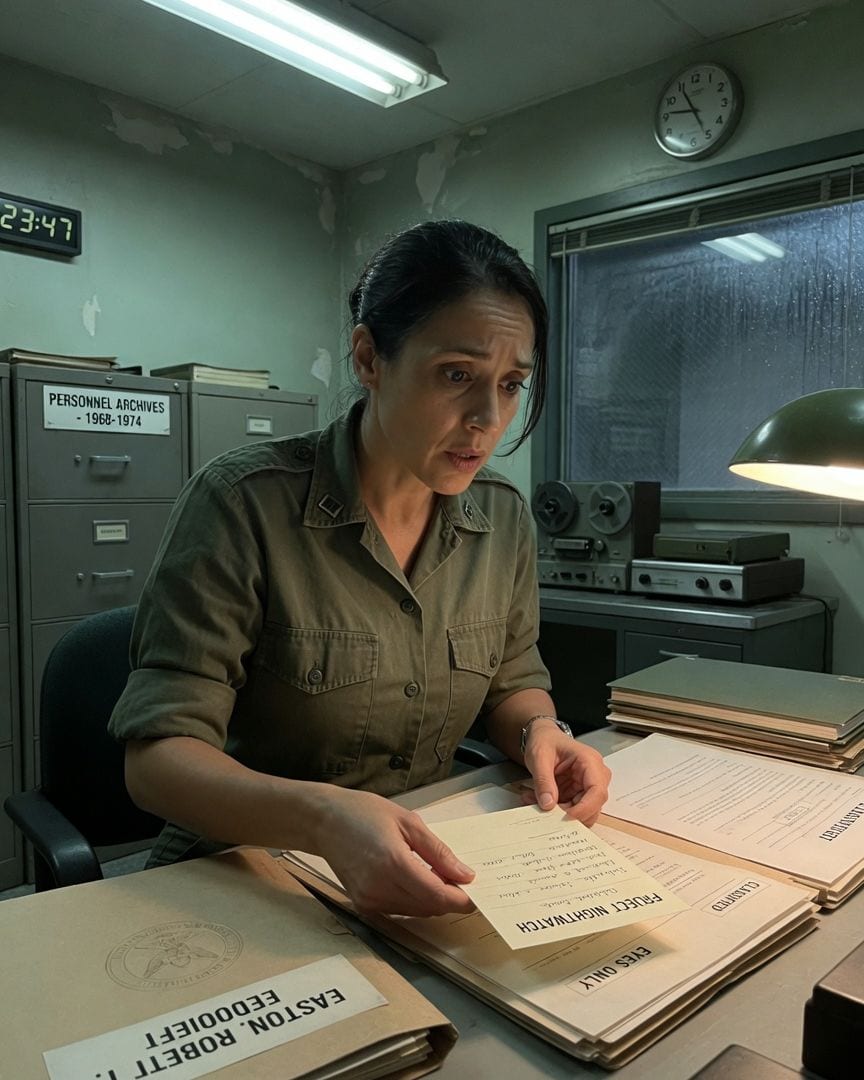
A Cold War tower controller logs an object vanish from radar, then hears the pilot scream it’s filling his windscreen. Her own name, 'Bardolph, Ines', now marked 'Observed' in a secret file.
Captain Ines Bardolph, a tower controller, was counting down the months until her transfer to Langley and the decommissioning of her base, hoping to leave behind the unsettling incidents of her final posting. But one night, her radar scope showed an impossible blip, solid and unwavering, 40 miles north of the Danube, only to vanish in less than a second, leaving a pilot screaming in terror. Despite the clear evidence, the official report blamed "atmospheric inversions," while the terrified pilot received a glowing review and promotion, his file meticulously scrubbed of any anomaly. As Captain Bardolph reviewed the pilot's pristine record, she found a hidden slip of paper, revealing a chilling truth: 'Subject: Bardolph, Ines. Status: Observed.' Was she merely an observer of the impossible, or was she now part of something far more sinister?
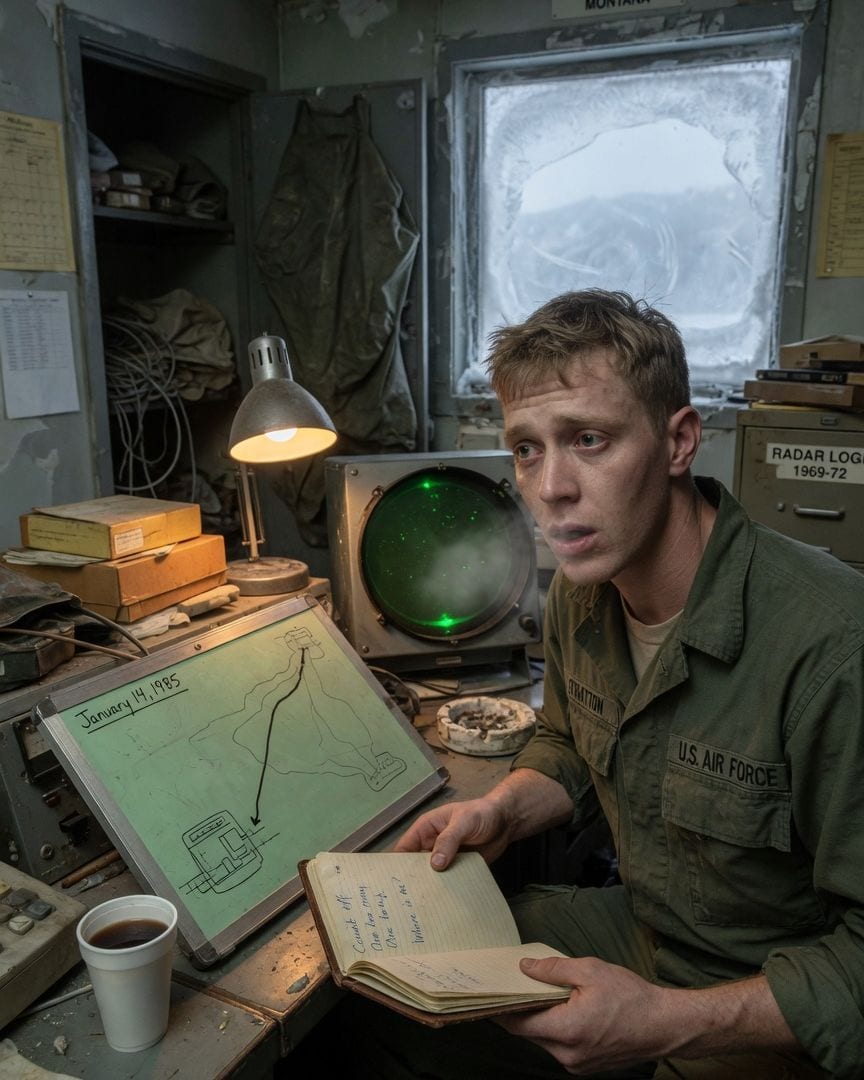
Airman Lars Stratton found an old Cold War manifest listing one name twice: 'Bernard Radcliffe' transferred and 'Bernard Radcliffe' still present.
Airman Second Class Lars Stratton was counting down his final weeks at Echo Station, a desolate Cold War outpost due for mothballing. He longed for home, far from the bitter Montana winds and the constant hum of static. Inside the dim radar shack, he logged the usual nightly ghost blip, a faint contact appearing at 2300, just as it had every winter since 1987. This night, a metallic tang like old blood lingered in the air, raising the hairs on his arms. Seeking distraction, Lars later discovered a leather-bound logbook from 1971, detailing the same 2300 contact, but with chilling notes and a manifest listing one airman's name, Bernard Radcliffe, twice—once transferred, once present. Was he truly alone in the silent, remote station?
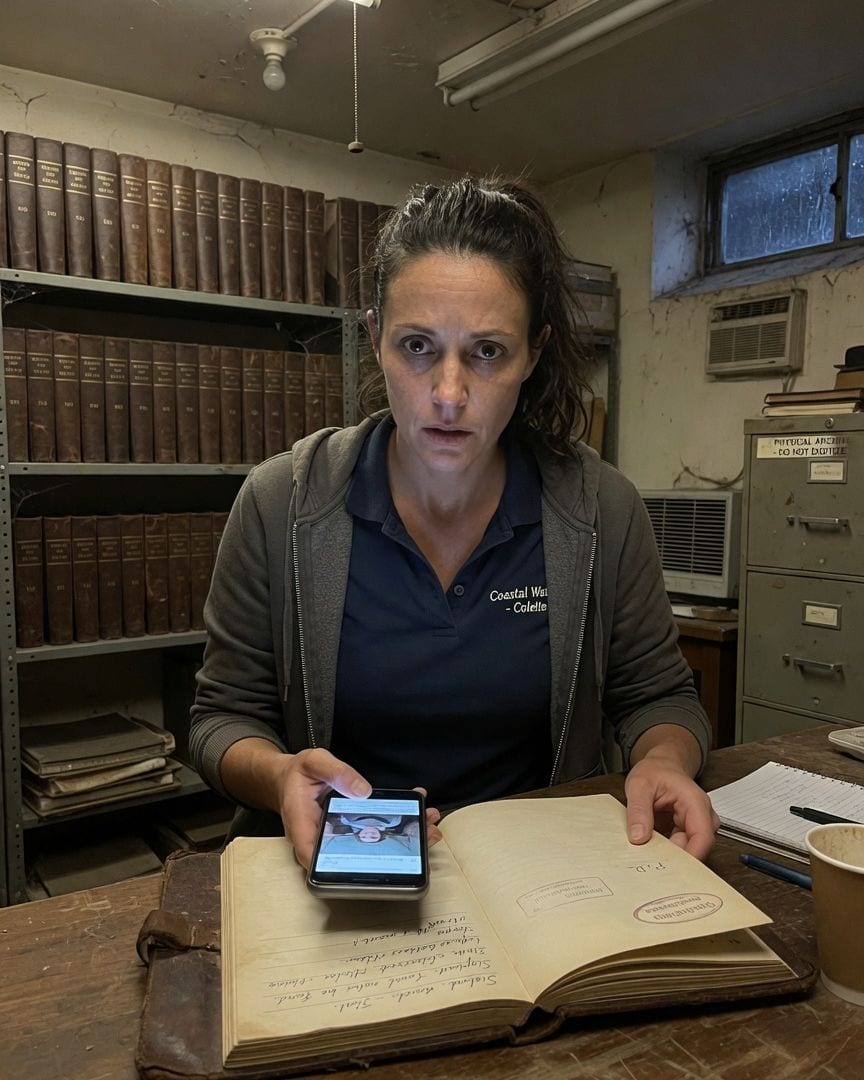
My coastguard log noted Sighting 9 again tonight, a light where no vessel showed. The old logs carry Sighting 9 off Skerry Point at 3:14am every tenth year since 1954, always 'nothing found,' always 'send no boat.'
On my watchtower night shift, the radar screen glowed green and the ocean was quiet. Then, a familiar light appeared off Skerry Point, exactly on cue, just as it had every tenth year for decades. But digging deeper, I found a hidden stamp in an old logbook: 'Operation Skerry. Status: Complete.' It left me with a chilling sense of finality.
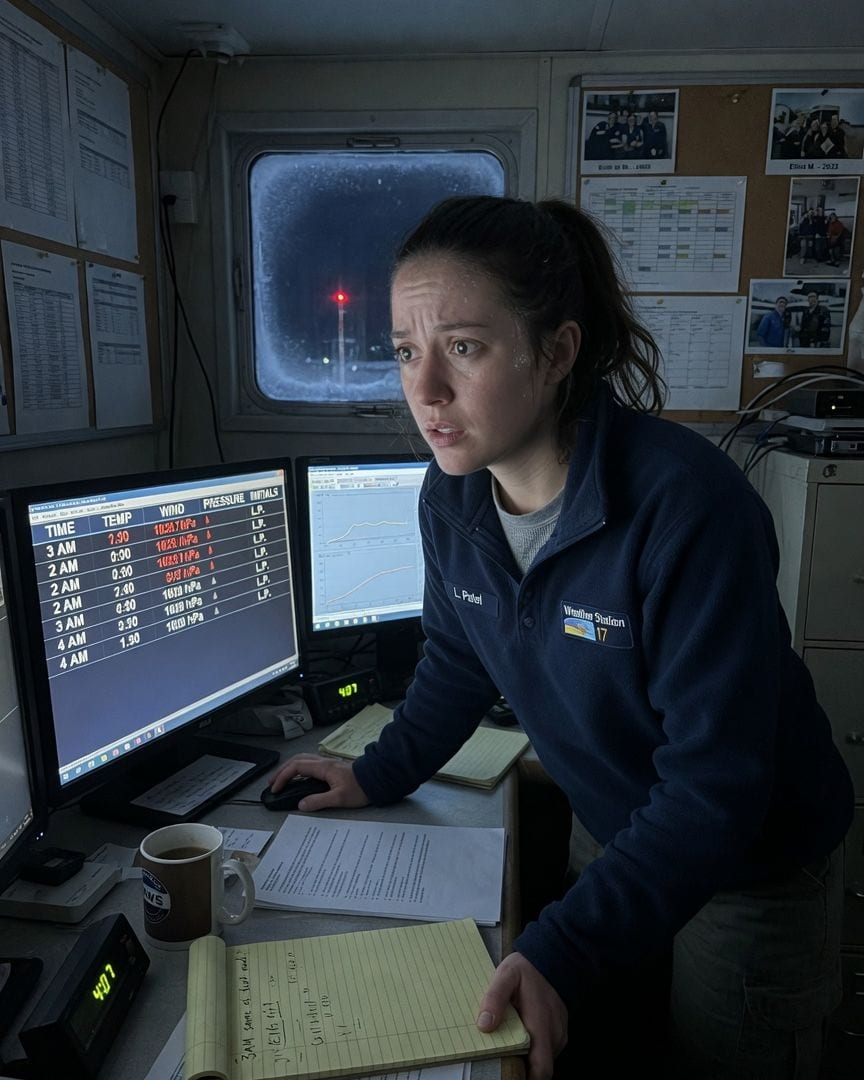
My weather station's 3 AM log shows a pressure reading I never made. My initials are on it, but the dials were dead still.
Working the overnight shift at the remote weather station, I routinely checked the digital logs. The 3 AM entry showed an impossible barometric pressure spike, a hurricane that simply hadn't happened. I distinctly remembered being outside at that time, calibrating a sensor, not making that entry. Yet, my initials, L.P., were clearly logged next to data I never made.
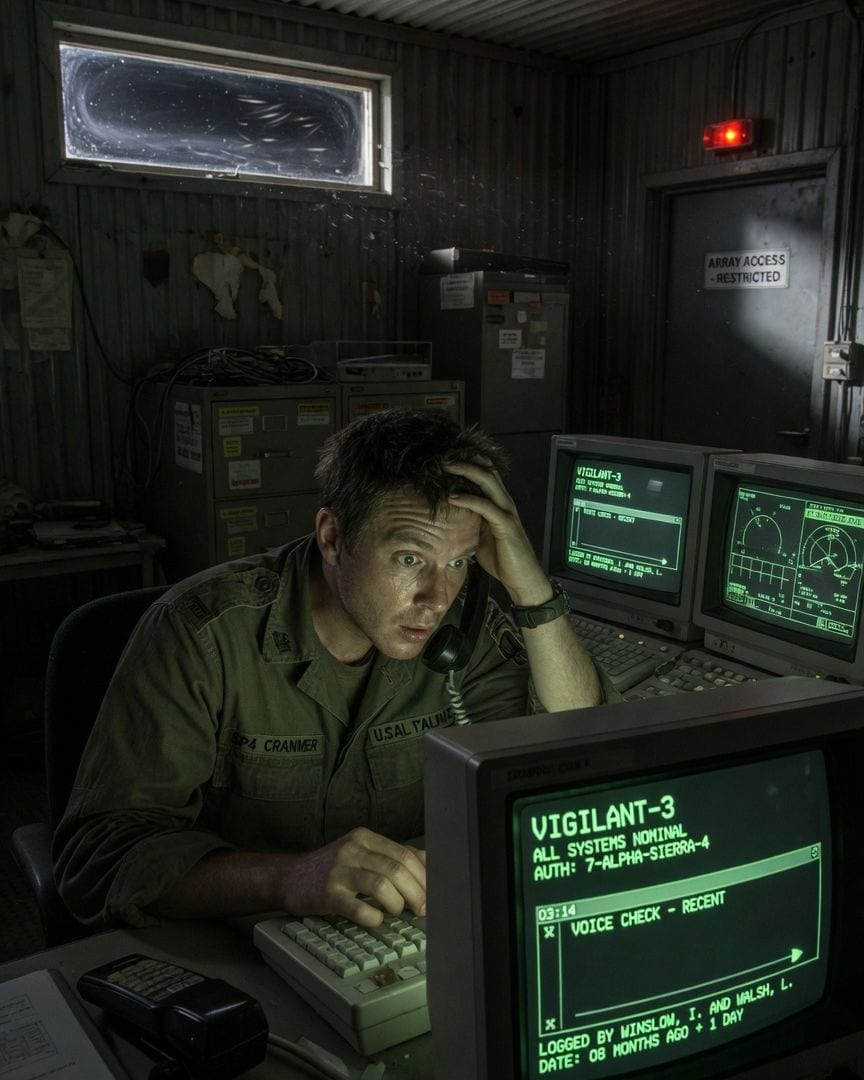
Specialist Cranmer’s console logs a voice from a station destroyed eight months ago. Its dead operators ask, 'Did anyone ever find out what happened to us?'
Specialist Arthur Cranmer endured another lonely overnight watch at Radar Site 4, the wind howling outside his isolated Anatolian post. At 0314, a routine comms check brought a chilling response from Vigilant-3, a station that had burned down, killing its two operators eight months prior. Cranmer's commanding officer dismissed it as a glitch, but the radar specialist knew better. He accessed classified logs, uncovering eight months of regular 'all systems nominal' check-ins from the destroyed station, authenticated by the dead operators. He then found his own recent call, logged by the same two k*lled personnel, followed by their haunting question: 'Did anyone ever find out what happened to us?'