A Cold War Berlin corporal heard her own chair shift on a reel sealed in 1949, five years before her listening room was built.
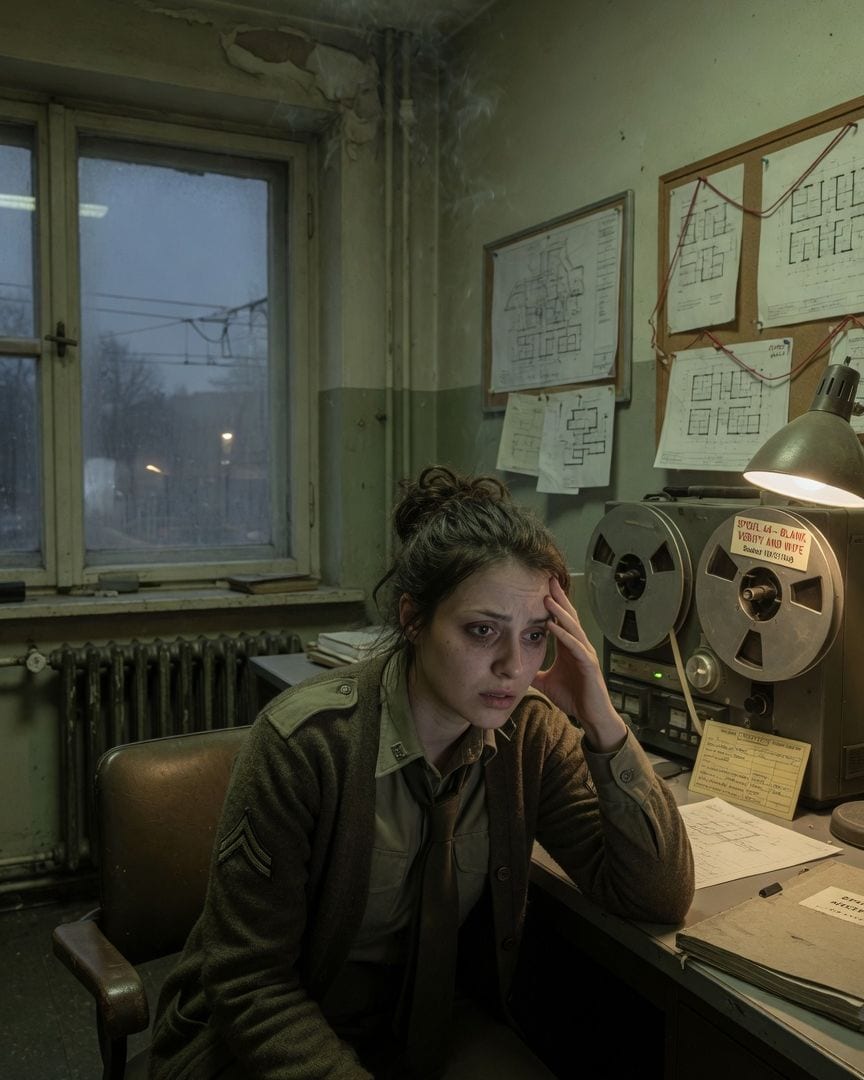
Corporal Deyna Vosk, 22, had eleven months in the Berlin listening room by February 1954, and a habit of playing back reels nobody had signed for.
This was how she found SPOOL 44 – BLANK, VERIFY AND WIPE in the smallest hour of a cold February morning.
The reel had been sealed and stamped in 1949, when the room she was sitting in had not yet been built.
A dull ache started behind her eyes as she took it to her console, the heavy, clunky reel-to-reel machine humming softly in the chill, quiet room. The green indicator light flickered as she threaded the tape.
It was not blank. Forty minutes of static, a faint, almost imperceptible hum, and then the unmistakable knock of her own radiator. A shiver ran down her spine, though the room held its steady, low temperature.
A moment later, the far-off clatter of the tram on Klingelhöferstraße drifted through the speakers, followed by the particular, tell-tale hiss of her own chair as she shifted her weight, a subtle leather-on-fabric sound she knew intimately.
The recording was of her room, right now, five years before it existed, and an hour before dawn.
Deyna replayed the segment, certain it was a trick of the mind. The sounds were too specific, too personal.
She checked the reel’s log entry again, pulling the card closer to the weak lamp: 'SPOOL 44 – BLANK, VERIFY AND WIPE. Sealed: 10/12/1949. Verified: 10/12/1949. Unit: Allied Berlin Listening Post.'
She knew for a fact the current facility, built on the rubble of the old Gestapo headquarters, had only been operational since late 1951. Before that, the entire block had been a cleared-out bomb site, a cratered wasteland.
There was no 'Listening Post' here in 1949 to generate such a recording, let alone seal it.
Deyna pulled up the architectural schematics for the building, her fingers flying across the keyed panels, cross-referencing construction dates.
The blueprints confirmed it: the specific layout of her listening room, its distinctive cast-iron radiator, its window facing Klingelhöferstraße – all post-1951.
She tried to rationalize it – a mislabeled reel, a transferred file from another post, a clerical error in the sealing date.
But the meticulous, official stamp and signature on the physical reel, the uniform, steady hand that signed the verification, spoke of absolute certainty. The reel was unequivocally dated 1949, and the recording was unequivocally of 1954, here.
Deyna felt a growing coldness that had nothing to do with the drafty room. This wasn't a misfile. It was a contradiction of reality itself.
Driven by a desperate need to understand the source of the impossible recording, she sought out the original sealed file jacket for SPOOL 44, archived in the post's deep storage.
It was a thick, heavy folder, smelling of dust and old paper, its contents meticulously cataloged. Inside, among the blank verification forms and technical specifications, she found a single, unexpected document: a personnel transfer order.
It was dated for late 1955, and listed 'Cpl. D. Vosk,' service number 713-44-90, status: 'reassigned to deep cover.' Deyna’s own service number was 713-44-90.
The transfer order, with her name and number, dated for a year in the future within a 1949 file, hit Deyna with a physical shock. Her tour was scheduled to end in a normal discharge within the next ten months.
'Deep cover' was not a standard option for a signals corporal.
She secured the file and, feigning a need for historical data, requested access to similar 'blank' or 'verify and wipe' classified recordings from the Allied HQ records office in Frankfurt.
Major Leonard Montgomery, the post commander, a man in his fifties with a perpetually tired face, signed off without much thought, dismissing her concerns about the reel as 'night shift jitters.'
A week later, a thick binder arrived, filled with dozens of similar entries: reels marked 'BLANK,' 'NULL,' or 'DECOMMISSIONED,' all sealed years before their alleged contents could have been recorded.
Some listed specific aircraft that hadn't been built yet, others, call signs for units that wouldn't exist for another decade.
The pattern was horrifyingly consistent: a pre-written record of something that was supposed to be lost or never exist, sealed in the past, waiting.
Deyna spent her off-hours in the silent records room, comparing the official stamps, the precise typography, the steady, anonymous hand that signed each verification. It was always the same.
The impossible records were not isolated incidents; they were a systemic, deliberate operation, a machine that filed things away long before they were gone.
Deyna’s persistent inquiries did not go unnoticed. One afternoon, while reviewing her findings in the post’s small, unheated library, a woman in a crisp, dark suit approached her.
Vivian Foster, 46, a records officer from HQ, her smile too wide, her gaze too steady. "Corporal Vosk, Major Montgomery mentioned your... interest in historical recordings." Foster’s voice was smooth, devoid of inflection, like a polished stone.
"A fascinating hobby, but these files are delicate. Best left undisturbed."
Deyna felt a prickle of unease. Foster had no reason to be here, in Berlin, much less in the post library. "Just trying to understand a discrepancy, ma'am. A reel from '49 with a '54 recording."
Foster's smile didn't waver. "Such things happen. Clerical errors, mislabeling. The system is vast." But her eyes held a deeper, unreadable knowledge, a chill that seemed to settle on Deyna's skin.
That night, Deyna found her personal locker slightly ajar, though nothing was missing. Later, while walking back to her barracks, she noticed a dark sedan idling down the street, its headlights off.
It slowly pulled away as she turned to look. The message was clear: someone was watching, and they knew exactly what she was looking for.
The next morning, Deyna confronted Major Montgomery. She laid out the stack of files, the impossible dates, the identical official hand, and finally, her own transfer order from the SPOOL 44 file.
Montgomery, initially annoyed, grew pale as he examined the documents. "This isn't just a misfile, Major. This is a pattern. A record of things that haven't happened yet, filed away as if they already have."
He picked up her transfer order, his hand trembling slightly. "'Reassigned to deep cover'… Vosk, I've seen these before. Always for people who… vanished. No trace. No explanation." He looked up, his eyes wide with a dawning horror.
"I always assumed they were legitimate, just highly classified. But if they're dated before the event…"
Deyna pushed. "The system isn't just recording history, Major. It's making it. It pre-files the lost, the disappeared. And it's doing it to me."
Montgomery, a man who had seen combat and survived the bureaucracy, looked genuinely afraid. "There was a rumor… among the old hands. The 'Archivist.' Not a person, but… a process. That some records weren't just kept, but generated in advance.
To ensure consistency. To ensure… things went as planned." He pointed to the specific official stamp, the uniform ink on every impossible file. "That's the 'Archivist's Seal.' Used on all records deemed 'pre-verified.'" The pieces clicked into place for Deyna.
The blank reel, the pre-dated events, her own pre-filed transfer. It wasn't about finding what was lost; it was about understanding what was going to be lost, because it had already been recorded.
Montgomery, shaken, agreed to help Deyna access the primary archival system for SPOOL 44's file jacket. He used his authority to grant her temporary, top-tier access, citing a 'security audit.' He warned her to be careful, to trust no one.
Late that night, alone in the main records office, Deyna accessed the digital index for SPOOL 44. The system was ancient, clunky, but functional, its green text glowing faintly on the black screen.
She pulled up the full, comprehensive file jacket data. The initial entries were as she expected: 1949 sealing, verification, initial contents. But as she scrolled, her breath caught. Below the original 1949 entries, there were newer ones.
Typed, dated, and meticulously entered. Entries detailing her own requests for access to 'blank' reels, her inquiries about SPOOL 44, her discussions with Major Montgomery. Each entry was dated after February 1954, some as recently as this week.
And each one was signed by 'V. Foster.'
Deyna stared at the screen, a cold, hard knot forming in her stomach. Vivian Foster wasn't just observing her; she was actively writing her into the file.
The secrecy machine wasn't just a predictive system; it was a self-fulfilling one, using its own records to guide events, and its agents to ensure compliance.
The 'blank' reel was never meant to be blank; it was a placeholder for her own recorded disappearance, a future event filed in the past.
The sounds of her room, the specific radiator knock, the tram on Klingelhöferstraße, the hiss of her chair – they weren't just a recording; they were the signature of her 'filing,' a timestamp for her eventual removal.
Her pre-dated transfer order wasn't a suggestion; it was an instruction.
And Vivian Foster, the bland, smiling records officer, was the 'Archivist's' hand, ensuring the ledger was balanced, that every individual marked for 'filing' had their story meticulously documented, even as it was unfolding.
Deyna realized the files weren't just proof; they were the mechanism of the horror. She had been drawn into a bureaucratic nightmare where her future was already classified, stamped, and signed.
Deyna knew she couldn't outrun a system that had already written her future. Her only chance was to expose it, or at least, to leave a trace outside its purview.
She printed every entry in SPOOL 44's file jacket, especially the recent ones detailing her own actions and Foster's signatures. The printer whirred, spitting out page after page, each one a chilling testament to her predetermined fate.
She then accessed the post's secure external communications, drafting a coded message to a trusted contact in Washington, detailing everything: the impossible reel, the pre-dated transfer, Foster's active role, and the self-writing nature of the files.
As she typed, the door to the records office creaked open.
Vivian Foster stood there, silhouetted against the dim hallway light, her expression unreadable. "Corporal Vosk. Still 'auditing' our records?"
Foster stepped into the room, the faint scent of ozone accompanying her, her hand resting on the holster of a small sidearm. "You were always meant to find SPOOL 44. Your curiosity, your diligence... it's all part of the process.
We needed you to verify the entries, to make them real, in a way." Deyna finished typing, her finger hovering over the 'send' key, her gaze locked on Foster's. She hit 'send' just as Foster raised the weapon.
"The file is still being signed, Corporal. And you are the next entry." The shot was muffled by the thick walls, and the communication console's green light flickered once, then went dark.
Major Montgomery found the records office empty the next morning, the secure console dark. The printouts Deyna had made were gone. He filed a report: 'Corporal D. Vosk, status: unaccounted for.' No body was found, no sign of a struggle.
The official explanation was desertion, quietly amended to 'reassigned to deep cover' in a classified addendum. Vivian Foster was transferred back to HQ, a commendation for 'exceptional service' noted in her file.
The Berlin listening post continued its operations, the chill in the air and the hum of the machines unchanged. SPOOL 44 was re-sealed, marked 'VERIFIED AND CLOSED.' Its file jacket, however, had one final, new entry: 'Cpl. D. Vosk.
Status: Filed. Date: 02/18/1954. Signed: V. Foster.'
Deyna Vosk’s name never appeared on another duty roster. Her barracks bunk was cleared, her personal effects packed and shipped to an address that no longer existed. Major Montgomery, unable to shake the dread, retired early, citing 'health reasons.'
He would often sit by his radio late at night, listening to static, convinced he could hear the faint, distant knock of a radiator, a sound that was somehow always just beyond reach.
A year later, a small, heavily encrypted data packet was received by a contact in Washington, originating from a secure, now-decommissioned Allied comms channel in Berlin. It contained a fragmented message, a digital ghost, barely coherent. Its last line read:
They don't just record the lost. They create them. And the file is still open.
If this one got to you
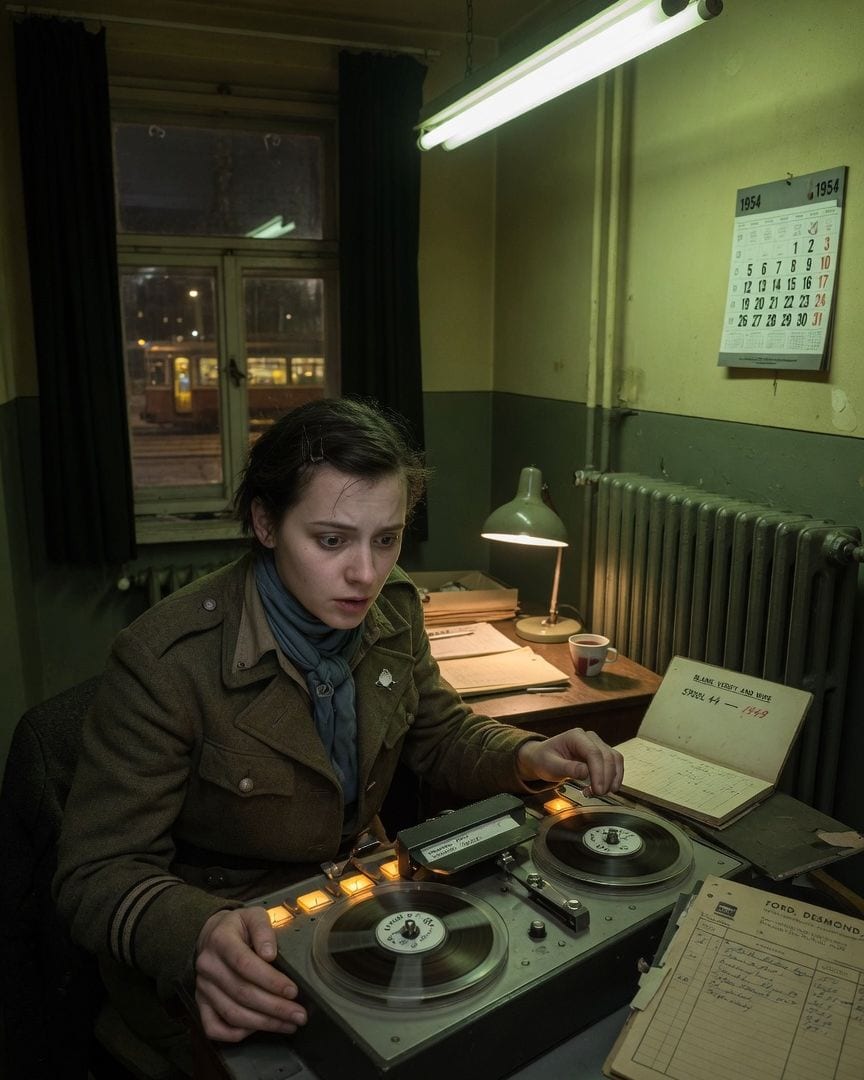
On her last watch, a corporal heard her Berlin listening room on a Cold War tape sealed two years before the building was even built.
Corporal Deyna Vosk began her last watch before dawn in a Berlin listening room, the familiar radiator knock echoing as she played unsanctioned reels. She loaded a tape marked 'BLANK,' sealed in 1949. Instead of silence, it played the impossible sounds of her current room – the radiator, her chair, the distant tram – a space not built until 1951. Then, a reel from 1947 spoke her current service number, and a missing soldier's file showed active supply orders at her post years after his disappearance. What impossible truths were trapped on these tapes?
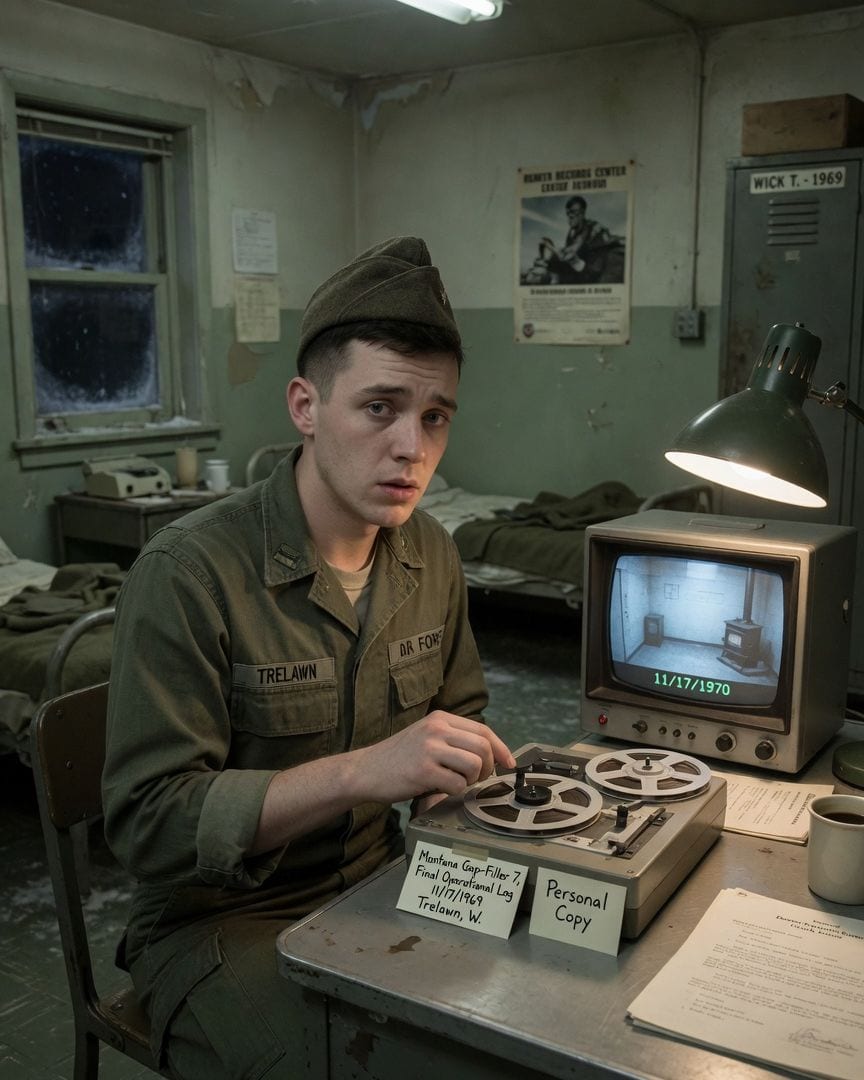
A Cold War gap-filler station was locked cold. Airman Wick Trelawn's final tape showed a man powering up the console a year later.
Airman Wick Trelawn shivered through his final hour at the remote Montana Gap-Filler 7, a Cold War radar station set to go cold forever. He meticulously logged its last operational moments, pulling the master tape as a final record. Later, reviewing a personal copy, Trelawn watched his empty control room play out as expected, but the tape kept running into a second hour. An indistinct man then appeared, methodically powering up equipment in the supposedly dead station. The site had been locked cold for a year by then, yet his official request for the original tape revealed a blinking timestamp of November 17, 1970. What impossible operations did the final log truly capture?
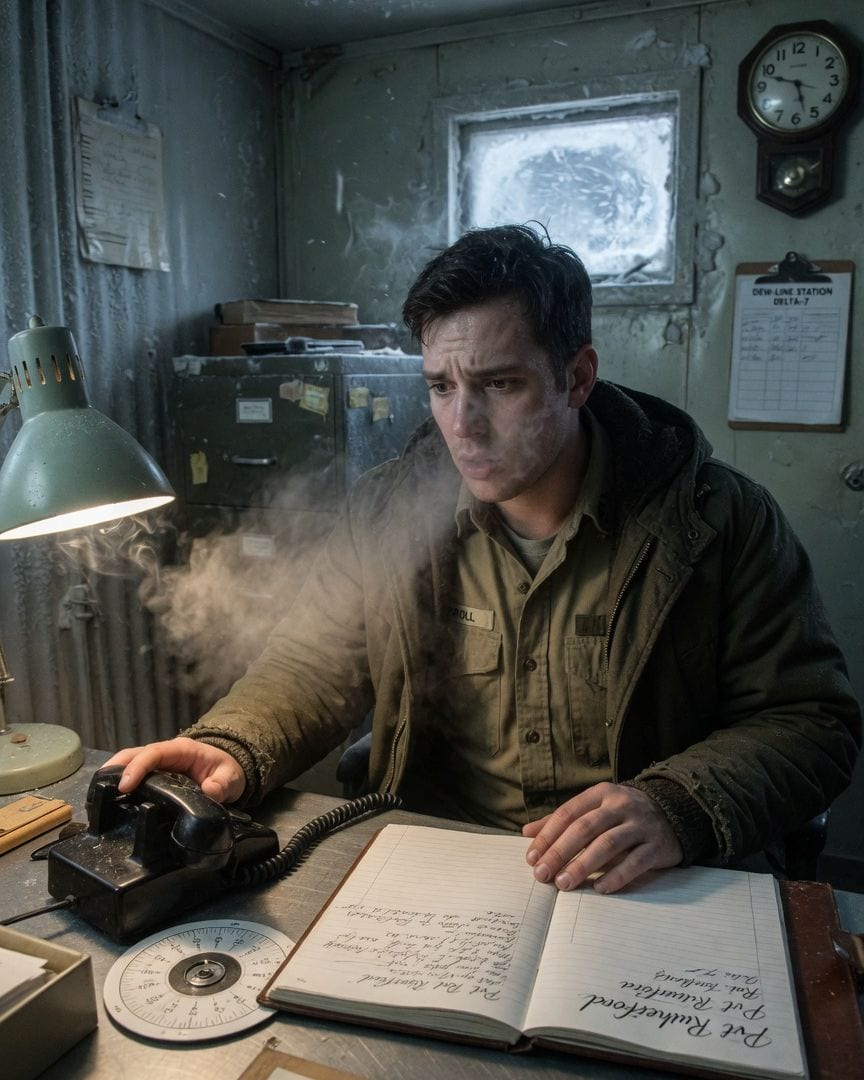
A communications specialist saw his last line go dead. Then the old Cold War field phone rang with a voice from 1966, naming a man freshly signed into his current shift log.
Specialist Walter Kroll shivered in the frigid communications room of DEW-line Station Delta-7, completely cut off by a historic Arctic blizzard. He had personally watched the last hard-wired connection to the outside world snap earlier that day. Now, past midnight, the old field phone at his position began to buzz, impossible from a line he knew was dead. A calm, unfamiliar voice spoke, reading a crew roster Kroll didn't recognize, including Private Rutherford. His search through decades of dusty logbooks revealed Rutherford was assigned to this exact watch in 1966, but then Kroll found the same name freshly inked into his *current* shift's sign-in sheet.
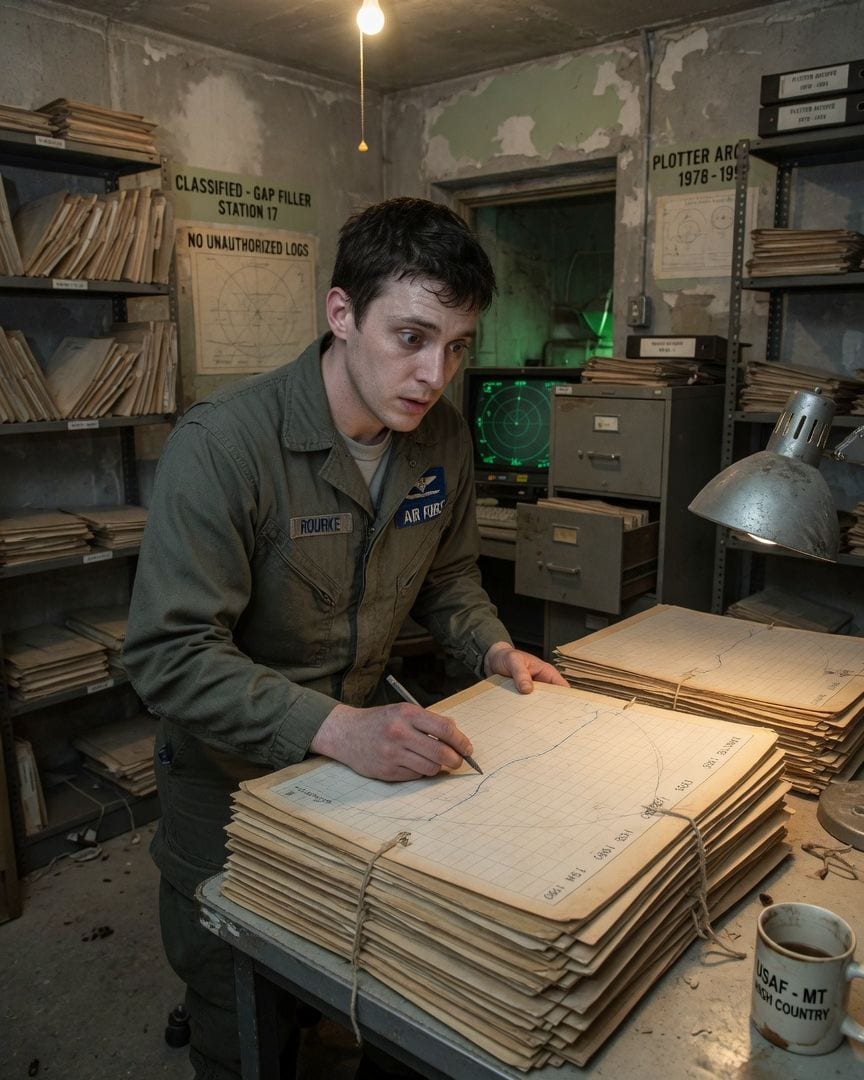
An Airman tracks a nightly radar contact. But in dusty archives, he finds old Cold War plotter boards, each showing that exact same line drawn by other airmen for three winters.
Airman Second Class Felix Rourke endured the cold, quiet nights at his isolated Cold War station, watching the perimeter radar. For three weeks, a single, slow contact appeared at 2300 hours, a precise violation of every protocol that chilled him deeply. He dismissed it as an anomaly, until a hunch led him to a forgotten closet in the dusty archives. There, he unearthed old plotter boards, each revealing the exact same impossible line drawn across the valley floor at the same hour, signed by different airmen from three consecutive winters decades ago. What impossible secret did the mountain station truly hold?
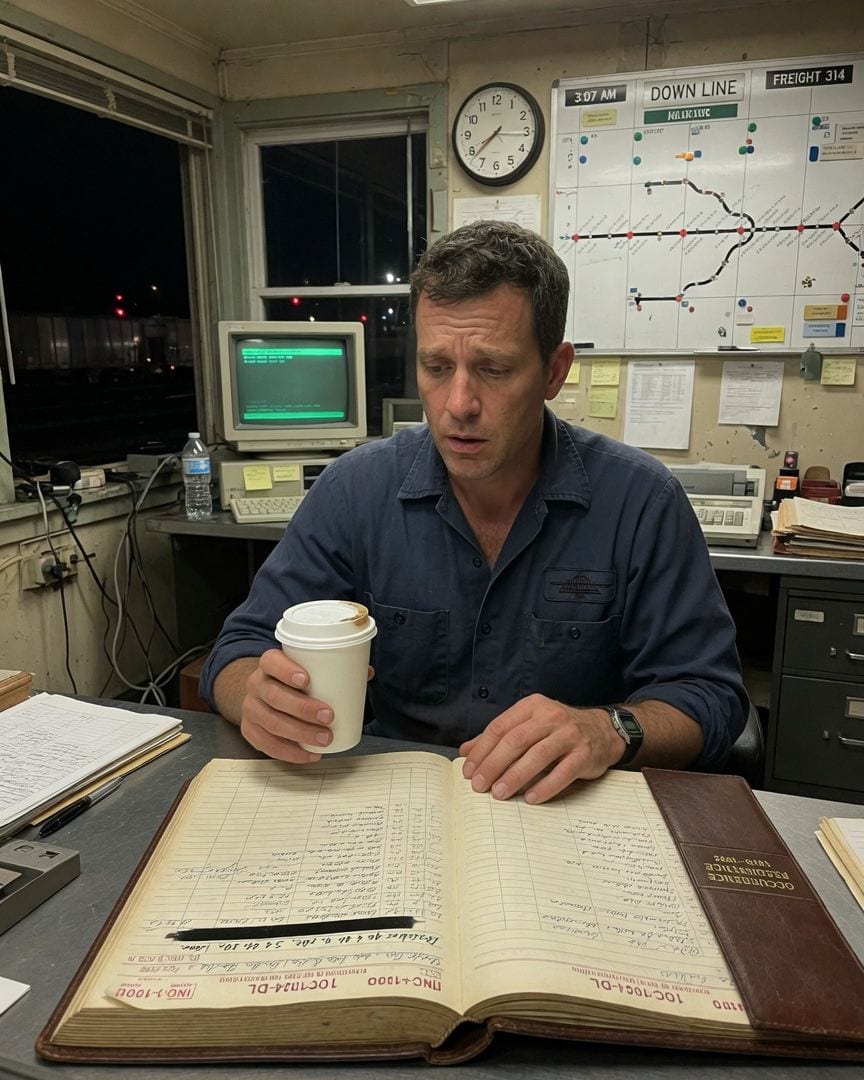
My new colleague's face is identical to a woman in a 1958 archive photo. She was declared 'the woman on the down line' for decades.
Working my solitary shift in the signal box, I found a blacked-out entry in the old occurrence register. It noted 'the woman on the down line' and the instruction 'do not stop.' This same strange entry, word-for-word, recurred every October 4th, back through the years from 1988. It felt like a chill in the routine, a silent dread in a book of transient events.
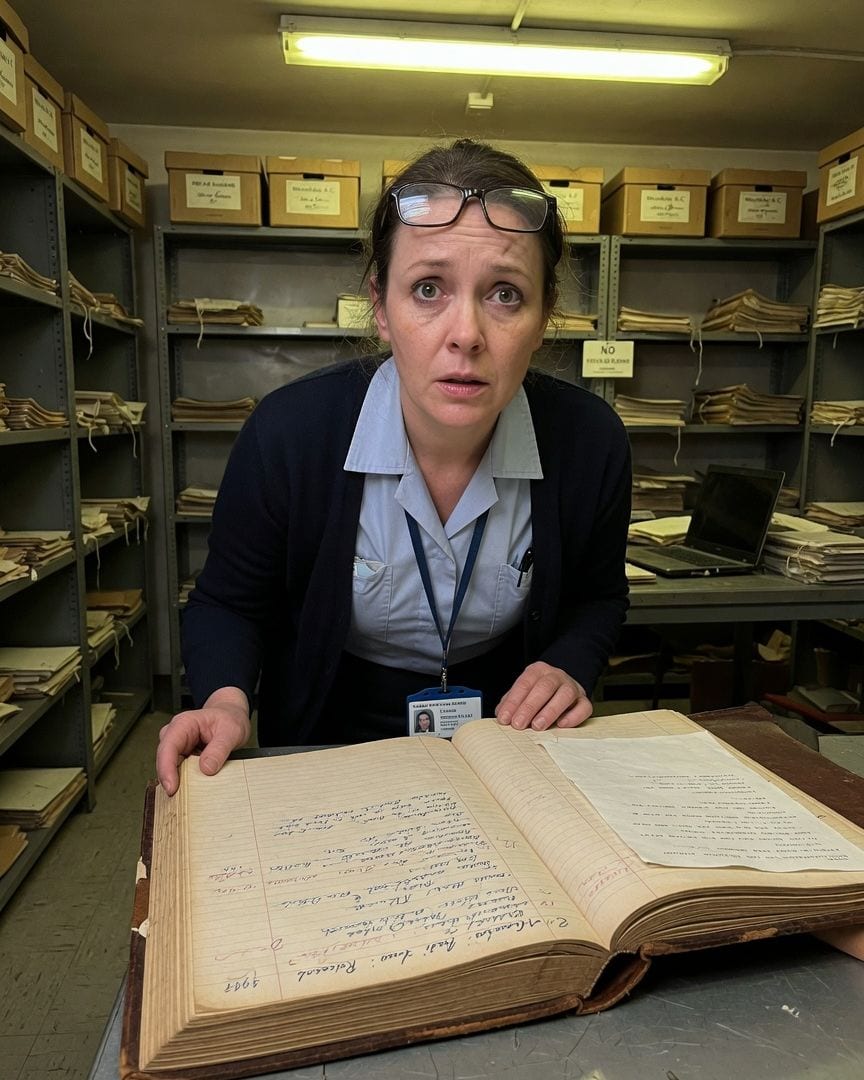
My ambulance trust's incident log shows callout 22-014 to 6 Cathcart Row at 2:40 AM. Every four years, the same call, same address. Always 'patient not found'.
My job involves tedious data entry for ambulance calls, but Incident 22-014 was different. It appeared every four years, always at 2:40 AM, always closed as 'patient not found.' Digging into the dusty physical archives, I found an entry from 1961 for the exact same incident, but its resolution read: 'Subject Secured. Relocated to "Holding".'