A Cold War Navy officer's daughter finds a photograph of herself as a child, dated nine years before she was born.
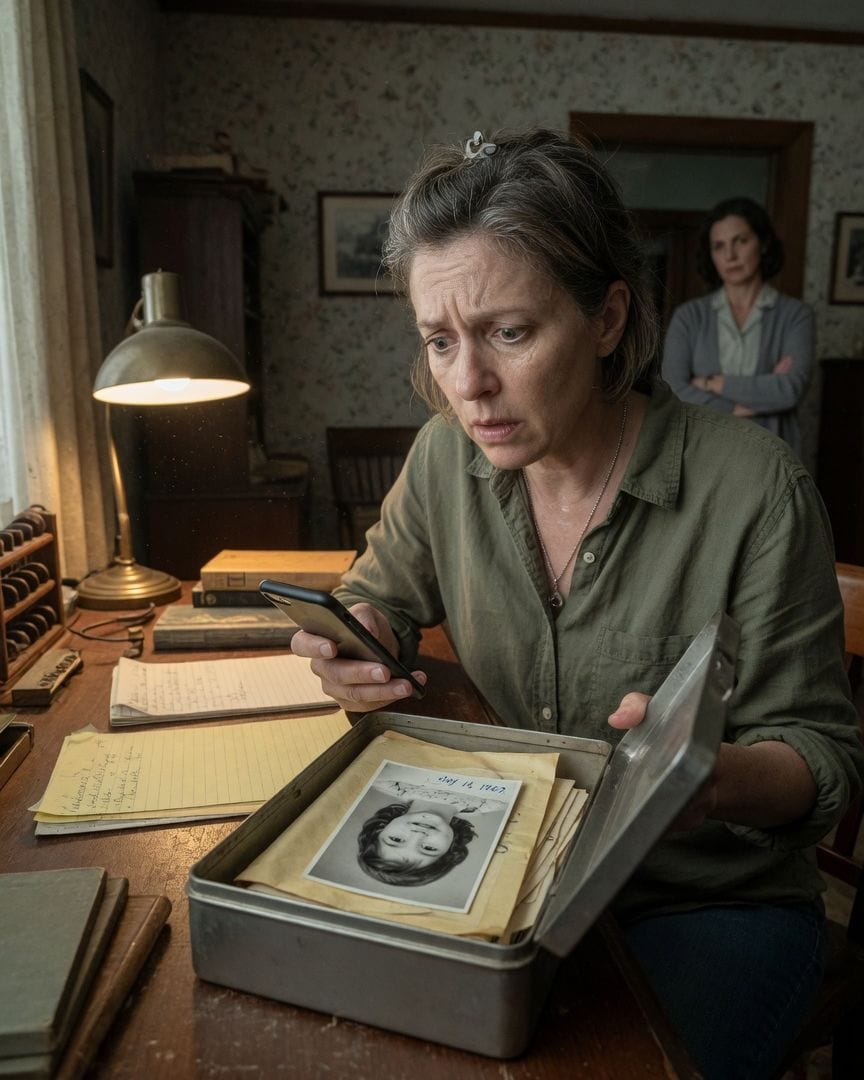
Corinne Truscott, 47, hunched over her phone in the dim, echoing concrete of a Norfolk parking garage, felt a cold knot tighten in her gut.
Her father, Bernard Truscott, a Navy officer lost at sea in 1969, rarely wrote anything personal.
But here, on seventeen declassified pages of his private log, released by clerical error on a Thursday, were meticulous notes about weather patterns, the morale of his men, and a peculiar, metallic-ozone smell coming off the water near Point Argos.
Mundane, until the final page. There, in his familiar, precise hand, was a message addressed to her by name—'To Corinne, my beloved daughter'—with an instruction about a locked drawer.
The log was dated the week before he was declared lost in 1969. Corinne was born in 1976. She reread the date, then her father's words, then her own birth year, an impossible loop of dread.
The log's impossible message propelled Corinne to her childhood home, now owned by her cousin, Margaret Pierce, 50. Margaret, a practical woman, barely tolerated Corinne’s 'morbid fascination' with her father’s past.
Bernard’s old study remained largely as he’d left it: dusty, filled with forgotten books and the faint scent of pipe tobacco. Corinne found the heavy mahogany desk, its surface scarred with decades of use.
She ran her hand over the polished wood, locating the small, reinforced drawer her father had mentioned. It was locked.
Margaret, observing from the doorway with a sigh, offered a spare key from a jar of old hardware, adding, 'Your father was always filing things away, Corinne. Probably just old tax receipts.'
Corinne tried the key; it turned with a stiff click. Inside, beneath a stack of yellowed correspondence, sat a small, heavy metal box, completely unmarked, the wood around it faintly stained as if it had sat there for decades.
Corinne lifted the unmarked box. It was cold to the touch, heavier than it looked, with no visible seams or hinges, just a faint click-latch on one side. Her fingers trembled as she pressed it.
The lid opened with a soft hiss, revealing a bed of faded, yellowed silk. Nestled within was a single, perfectly preserved black-and-white photograph.
It showed a young girl, no older than four or five, with a bright, open smile, looking directly into the lens.
The wide, curious eyes, the faint freckle above her lip—it was unmistakably Corinne herself, a ghost from her own forgotten childhood. On the back, in her father's precise hand, was a date: July 14, 1967.
Two years before he was lost. Nine years before she was born.
The photograph, a physical impossibility, burned a hole in Corinne’s reality. She couldn't dismiss it as a clerical error or a misremembered dream. It was tangible proof of a profound wrongness.
She began to research Point Argos with renewed urgency, not just for her father, but for herself.
Leveraging her declassification reviewer access, she delved into restricted Navy archives, searching for any other anomalies linked to the area in the late 1960s and early 1970s.
She found a series of 'missing persons' reports—sailors, scientists, even a few civilian fishermen—all from the Point Argos vicinity.
Each file, otherwise unremarkable, bore a faint, almost invisible stamp: a stylized 'A' with a partial circle, unlike any official Navy or intelligence marking she’d ever seen.
The disappearances were often correlated with unusual weather events and fleeting, unexplained radar contacts. The official explanations were always vague: 'equipment malfunction,' 'severe squall,' 'lost at sea.' Corinne cross-referenced the names, the dates, the locations.
A pattern, faint but undeniable, began to emerge, pointing to a specific, unmapped geological feature near the coast. She tried to find any official record of the 'A' stamp, but it was as if it didn't exist.
Corinne's relentless digging did not go unnoticed. One evening, an anonymous, untraceable email landed in her inbox. The subject line read, 'He knew.' The attachment was a single, grainy black-and-white aerial photograph of Point Argos, clearly an old reconnaissance image.
A small, almost imperceptible 'X' was marked over a remote, rocky section of coastline, precisely where her research suggested the anomalies converged. The implication was chilling: someone was watching her, knew what she was looking for.
She started noticing small, unsettling displacements in her apartment—a book moved from its usual spot on the shelf, a window she distinctly remembered locking now slightly ajar. The unease was a constant, cold pressure.
She knew she needed to speak to someone, but who? After much deliberation, she made a discrete call to Elliot Delaney, 60, a retired Navy archivist who had worked with her father decades ago.
Elliot, his voice strained and wary, listened to her questions about Point Argos and the 'A' stamp. 'Corinne,' he said, his tone low and urgent, 'some things are meant to stay sealed. For your own good, drop it.
There are forces at play you don't understand.' His warning felt less like advice and more like a threat.
Corinne ignored Elliot's warning. The photograph of her younger self, dated 1967, was too personal, too impossible to abandon. She drove to Elliot's quiet suburban home, the photo clutched in her hand.
He opened the door, his face pale when he saw her. 'I told you to let it go,' he hissed, ushering her inside. Corinne laid the photograph on his coffee table. 'Elliot, this is me.
My father took it two years before he disappeared, nine years before I was born. What did he know?' Elliot stared at the photo, his composure finally cracking. He sank into an armchair, running a hand over his balding head.
'Bernard wasn't just lost, Corinne. He was investigating Project Argos.' He explained that it was a highly classified, off-the-books operation, initiated by a small, rogue faction within Navy Intelligence.
They believed the disappearances and strange phenomena at Point Argos were linked to a unique geological feature—a kind of temporal anomaly. 'The 'A' stamp you saw,' Elliot continued, 'that was their unofficial marker.
They suspected the official explanations were cover-ups, or worse, a deliberate misdirection by whatever was behind the anomaly itself.' Bernard, he revealed, believed the anomaly wasn't random. It followed a pattern.
It could 'reach out,' sometimes across time, to certain individuals. 'Your father was obsessed with a 'list' of names,' Elliot whispered, his eyes wide with a fear Corinne had never seen. 'He believed some people were… marked. From birth.
Or even before.' Corinne felt a cold dread spread through her as the pieces clicked into place, the impossible photograph now making a horrifying kind of sense.
The word 'marked' echoed in Corinne's mind as she drove home, the photograph now a terrifying confirmation of her father's chilling theory. She pulled out Bernard's private log again, her hands shaking slightly.
She reread the last page, searching for any mention of this 'list,' any other hidden clue. Her fingers brushed against something brittle, tucked deep into the binding—a loose, yellowed piece of paper.
It was a carbon copy, clearly very old, of a personnel manifest. The header was stamped 'TOP SECRET - PROJECT ARGOS - CLASSIFIED.'
Her eyes scanned the names, a mix of military personnel and some civilians, all with dates of birth and service numbers.
At the bottom, under a section ominously titled 'Project Argos - Personnel of Interest (Pre-emptive Classification),' a new wave of icy dread washed over her. There, clearly typed, was her own name: 'Truscott, Corinne.'
And below it, a handwritten note in her father's familiar, precise script: 'Subject observed. Birth date: 1976.' Her own name, on a classified list, dated before her birth, an observed subject in a project she had only just discovered.
She wasn't just investigating a mystery; she was the mystery.
The manifest confirmed it. Corinne wasn't merely a daughter seeking answers; she was part of the very pattern her father had died investigating.
The 'secrecy machine,' as Elliot described it, wasn't just a cover-up; it was a reactive system, an institution trying to contain something that defied all known laws of physics and time.
Her father hadn't just been lost; he'd been trying to understand how she was connected, how her name could appear on a classified list before her birth, how the anomaly could 'reach out.'
She spread out the log, the photograph, the manifest on her kitchen table. The 'smell off the water,' the 'weather anomalies,' the disappearances—they weren't just unrelated events.
They were traces of an entity, a phenomenon, that was actively 'filing' certain individuals, observing them, perhaps even influencing their existence, marking them for an unknown purpose.
Her father's final instruction about the locked drawer wasn't just to leave her a clue; it was to warn her that she was already inside the system, a subject rather than an observer.
He had tried to use the machine's own methods against it, to protect her, to give her the means to understand, perhaps even to escape. But the manifest, with her own name on it, proved his attempt had failed.
She had always been 'filed.'
Driven by a terrifying clarity, Corinne drove to Point Argos. The aerial photograph, with its stark 'X,' guided her to a desolate stretch of coast, shrouded in a thick, cold fog that swallowed the sound of the ocean.
Crumbling concrete foundations marked the remains of an abandoned military outpost, long forgotten. The air was heavy, thick with the metallic-ozone smell her father had described decades ago. It was a smell of deep water and something ancient.
Following the coordinates from her father's log, she found the precise spot marked by the 'X'—a narrow, almost invisible fissure in the jagged rocks, leading down into absolute darkness.
A faint, rhythmic sound began to emanate from the depths below, a deep, resonant bell answering out of the black water, a sound that resonated not in her ears, but in her bones.
It was the same bell Elliot had spoken of, the one that defied all surveys. She felt an irresistible pull, a profound sense of recognition, as if this place, this fissure, had been waiting for her, calling her home.
She knew, with chilling certainty, that her father hadn't simply disappeared; he had gone into this place, following the pattern, perhaps hoping to break it.
She stood at the edge, the cold mist clinging to her face, the bell's rhythm growing stronger, compelling. As she leaned forward, drawn by an unseen force, a hand, cold and firm, closed on her shoulder. She didn't scream.
It wasn't human. It was the culmination of the pattern, finally claiming its subject.
Corinne Truscott's car was found abandoned near Point Argos a week later, her phone on the passenger seat, open to a half-written post about her father's log. Her apartment was empty, undisturbed, all her research materials gone.
The locked drawer in her father's desk was found ajar, the small metal box gone. No other trace of Corinne was ever found.
The Truscott private log, along with the 'Project Argos' manifest, was quietly reclassified within the deepest vaults of Navy Intelligence, its seal date now marked 'Indefinite.'
The last entry on Corinne Truscott's phone, still in draft form, described the cold smell from the fissure, the deep, resonant sound of the bell answering out of the black water, and the sense of something waiting. It ended abruptly.
Seven years later, a declassification reviewer, Marcus Ford, 35, working on a separate, unrelated file, found a single, anomalous entry in a forgotten annex database. It was a personnel record, updated just last week, for 'Truscott, Corinne.'
Her status: 'Active – Filed.'
'Active – Filed.'
If this one got to you
An Army records clerk's dead father just received a medical bill from a Cold War sanatorium closed since 1968, asking for his daughter.
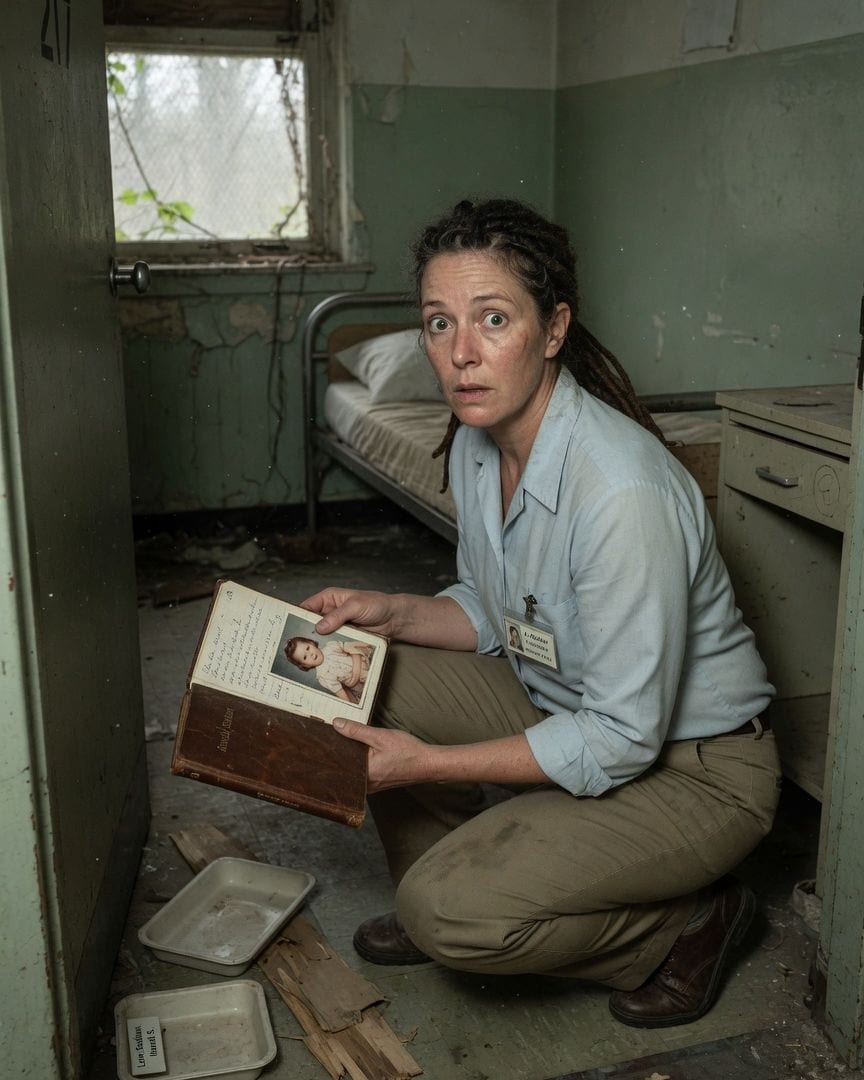
An Army records clerk named Odette Cardew found routine comfort in the archives' dusty quiet, a place that also held the official record of her father, Harold Sutton, who died in the Korean War when she was two. One morning, a declassified medical release with his name appeared, but the bill was dated last month, from a sanatorium in the Ozarks. The facility had closed in 1968, yet the account was active. A chilling handwritten note asked, "Patient asked, again, whether his daughter had come." Driven by dread, Odette visited the crumbling, overgrown sanatorium, where in Room 217, she found a recent meal tray and her father's journal, holding a photo of her as a child and a question dated just last week: "Did she come?"
The christening gown in my museum names my own family on a blacked-out donor card. It's the fourth to carry that number since 1919 — and the date it comes back is already typed in.
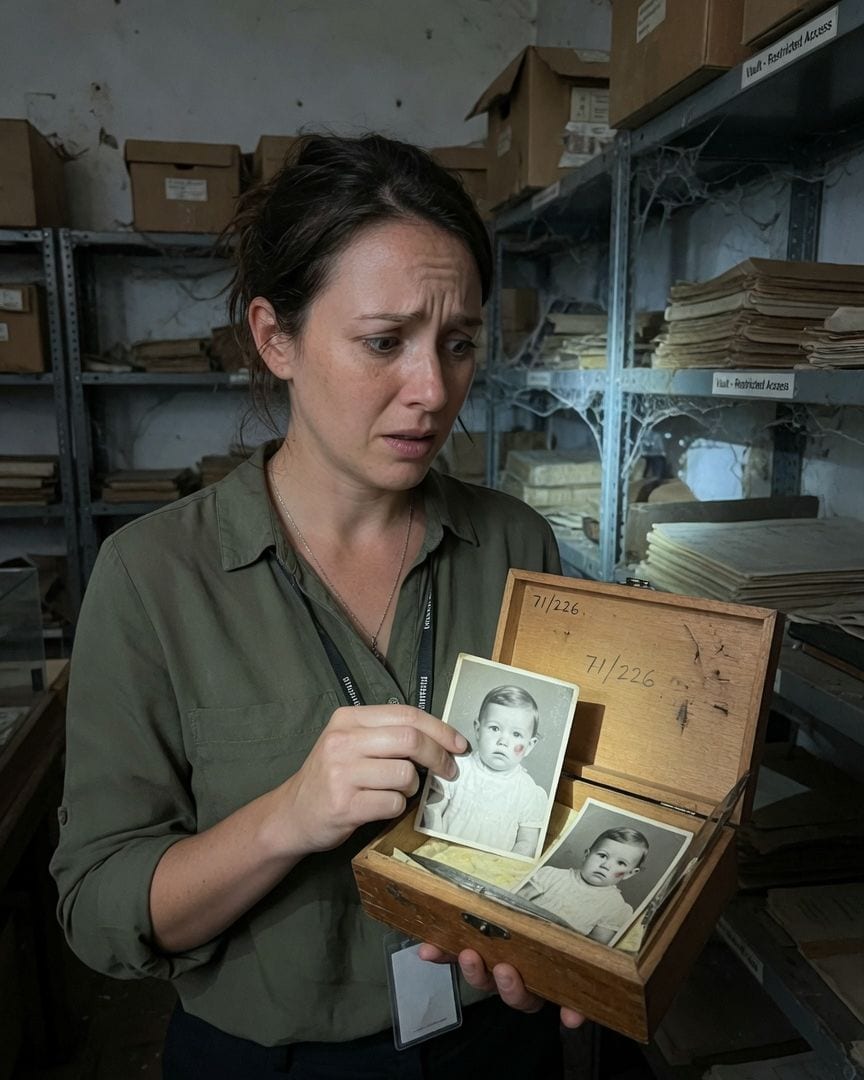
Cataloguing an antique christening gown, I found its museum card listed a future "return" date, and then uncovered an old box in the vault. Inside, a 1961 photograph of a child bore a birthmark identical to my own, taken at my street address, and chillingly marked "Returned."
My grandmother’s name reappears in the old book of remembrance — on the same date, same street, every few decades since 1929. A verger’s note reads: 'ask no family.'
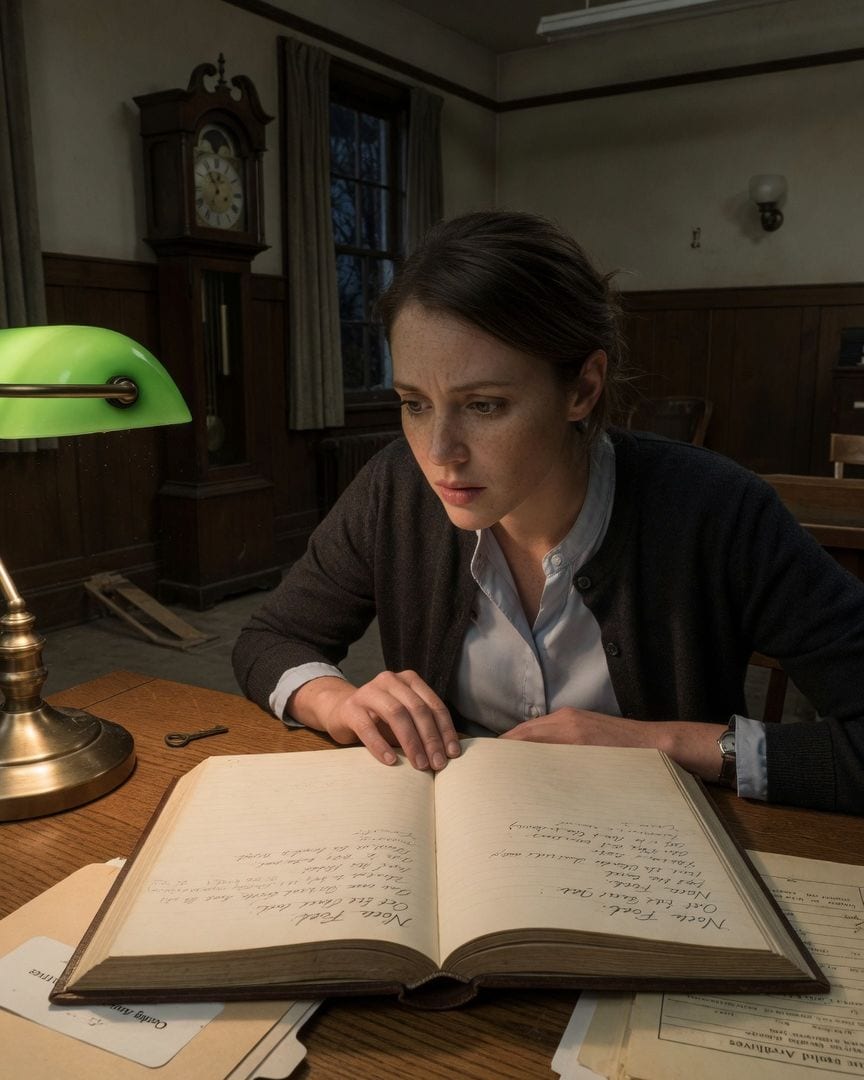
As Keeper of the crematorium's Book of Remembrance, my job is quiet and meticulous. But while updating my own grandmother's entry, I found two more Nora Fords listed above hers. Each died on October 3rd, decades apart, with the same address and a strange instruction: 'ask no family.'
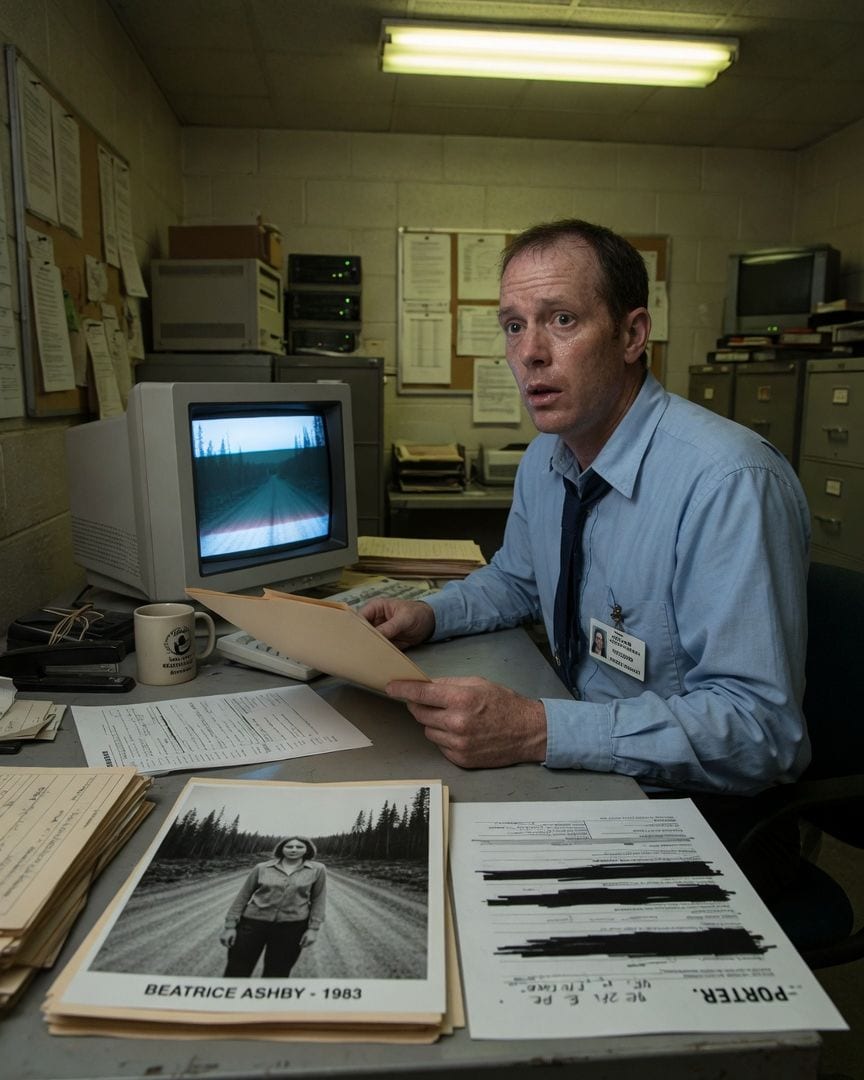
A federal clerk found his dead mother’s photo in a 1983 Cold War file, listed as a witness.
Devon Ashby, a federal records clerk in Missoula, Montana, spent years dismissing a repeated request for a 1983 file. He finally pulled the thin folder, expecting a clerical anomaly, but found a stark black-and-white photograph. It showed his mother, Beatrice Ashby, looking directly into the lens, calm and familiar, yet stamped with the year 1983. Devon remembered her funeral in 1981 and the quiet scrape of earth against her coffin, making her appearance in the official file two years later a chilling impossibility. Further investigation revealed conflicting records and a handwritten addendum with geographic coordinates, hinting at a truth far darker than a simple misfile.
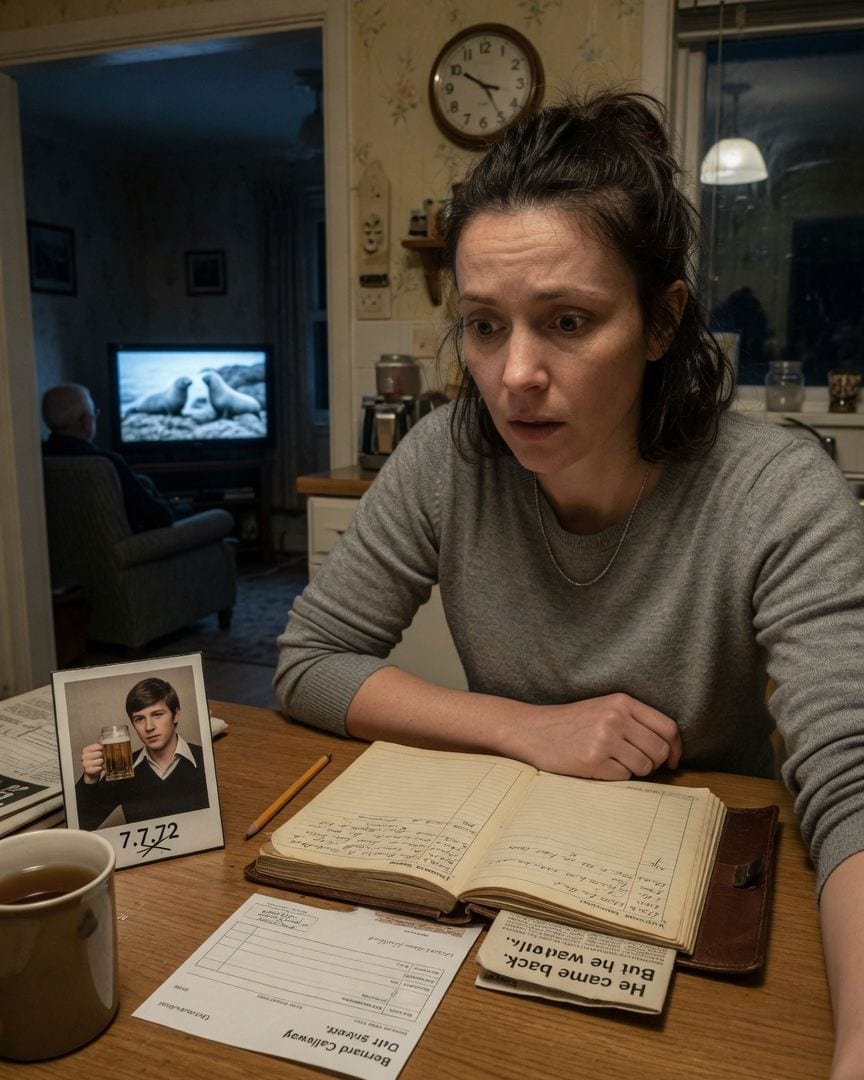
My father's bank slip had uncrossed '7's. He swore he never had that habit.
My father, Bernard, returned three months ago, a miracle after being presumed lost at sea. But a bank statement revealed a disturbing detail: the '7's in his signature were uncrossed. For decades, he'd meticulously crossed every '7', yet now he denied ever having the habit.
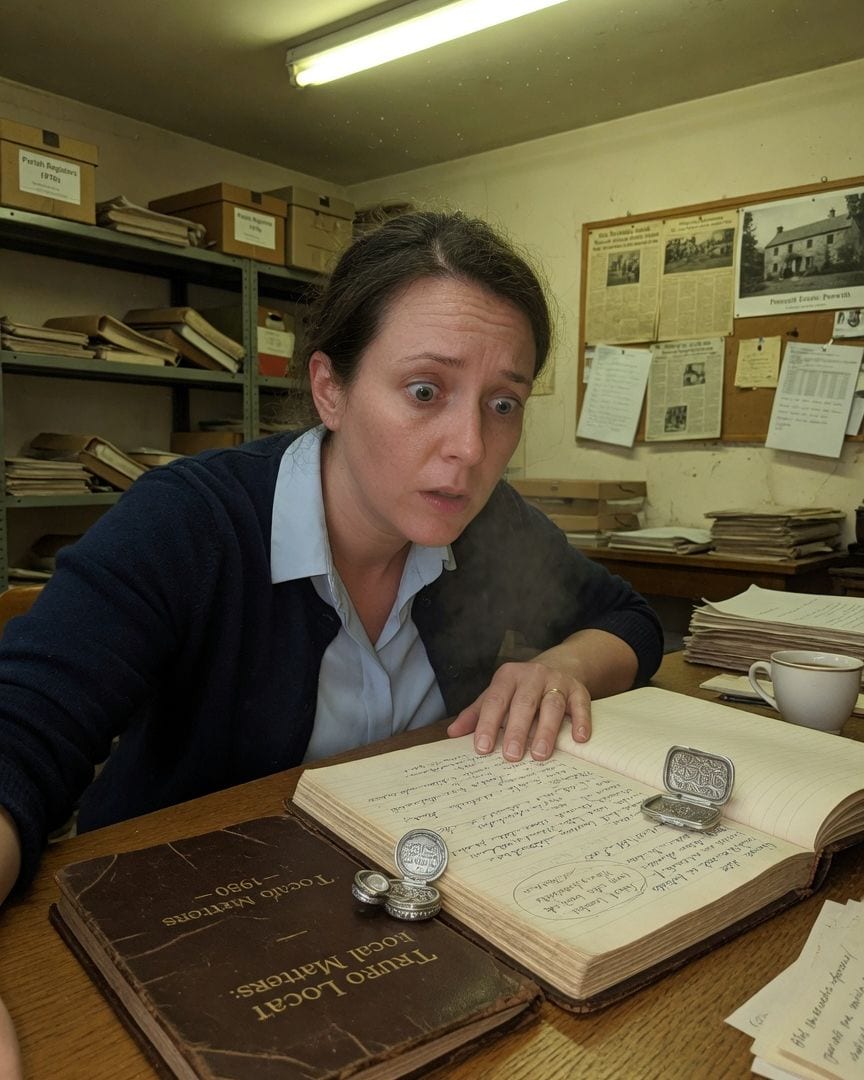
My antique locket held my maiden name, unused in eleven years, engraved 'until the ninth.' The dealer said it was 'for her, when she comes.'
After a tough week, Maxwell gifted me a beautiful antique locket from Truro market. Later, examining it with a jeweler’s loupe, I found my maiden name, 'Sheppard,' etched inside, along with the words 'until the ninth.' I haven't used that name in eleven years, and the impossible precision of the engraving sent a chill through me.