My cruise cabin's evacuation plan shows nineteen doors. I just walked past twenty, with a wet handprint on the twentieth.
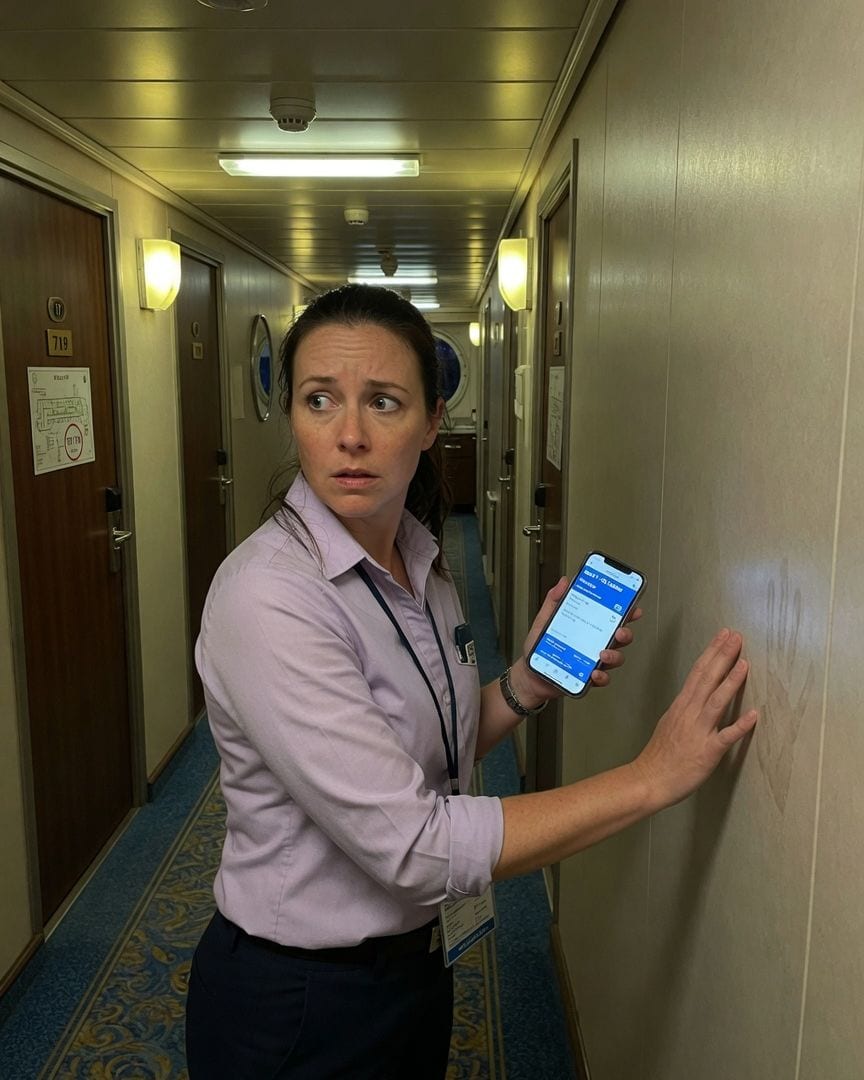
The cruise ship 'The Oceanic Wanderer' was only a few hours out from port when the mandatory muster drill was announced. My colleague, Evelyn, and I had just finished unpacking in Cabin 718 on Deck 7.
Systems analysts by trade, we’re both pretty detail-oriented, which I suppose is why I noticed it.
The evacuation plan posted on the back of our cabin door was standard: a map of our section of Deck 7, showing the route to the muster station. It depicted nineteen cabins, numbered 701 through 719.
As I walked the corridor, methodically counting each door to memorize the route, I verified it: 701, 702, and so on, all the way to 719. But then, there it was. After 719, there was another door. Cabin 720.
It looked exactly like all the others – the same dark wood, the same brass handle, even the little holder for a name card, though this one was empty.
A standard life-jacket diagram was affixed to its surface, just like on every other cabin door. What struck me, though, was the frame. A fresh, wet handprint, a little smeared at the palm, clung to the dark wood.
It looked recent, still slick. The air around it felt noticeably cooler, with a strange, damp chill that made the hairs on my arms prickle.
At the muster station, while Evelyn chatted with another passenger, I cornered Purser George Montgomery. He was a man in his late fifties, with a tidy grey uniform and eyes that seemed to have seen too many storms.
“Excuse me, Purser,” I said, trying to keep my voice casual. “I just noticed an extra cabin on Deck 7. Cabin 720. The evacuation plan shows only nineteen.”
He stopped adjusting a life jacket, turning to me slowly. His gaze was unnervingly direct, unblinking. For a second, he just stared, then he spoke, his voice flat. “Deck 7 has nineteen cabins, Ms. Galloway. Always has. Always will.”
He turned back to his task, dismissing me.
I tried to argue, to mention the wet handprint, the cold air, but he just shook his head slightly, a gesture that conveyed finality.
I walked away, the image of that twentieth door, and the cold dampness that seemed to linger in the air around where it had been, stubbornly refusing to leave my mind.
It was a small detail, easily dismissed, but it felt… wrong.
After the drill concluded, I made a beeline back to Deck 7, a knot of unease tightening in my stomach. I had to see it again, to confirm I hadn’t imagined it.
But when I reached the spot where Cabin 720 should have been, there was nothing. Just a seamless stretch of wall, identical in every way to the rest of the corridor. No door. No frame. No life-jacket diagram.
The wet handprint was gone, too, leaving no trace. The wall was dry and warm, indistinguishable from the sections on either side.
I pulled out my phone, comparing the ship’s official digital deck plan, accessible through the Harrington Lines app, to the physical one posted near the elevators. Both showed nineteen cabins.
I walked the corridor again, slowly, counting aloud under my breath. One. Two. Three… all the way to nineteen. It ended at 719. The numbers added up perfectly.
The space where I was certain I’d seen Cabin 720 was now just a blank wall.
Evelyn caught up to me as I stood there, rubbing my temples. “Everything alright, Monica? You look like you’ve just seen a ghost.”
“I… I thought there was an extra cabin here earlier. Cabin 720.” I waved vaguely at the blank wall.
She squinted. “Monica, honey, there’s no 720. You’re probably just having a pre-vacation brain glitch. You’ve been staring at system architecture diagrams for weeks.” She laughed, putting an arm around my shoulder. “Come on, let’s go get some lunch.”
I tried to accept it. Evelyn was right, probably. My mind was playing tricks on me. Jet lag, the novelty of the ship, whatever. I had simply miscounted, or misinterpreted a reflection, or something. The rational explanation always won.
Back in Cabin 718, I kicked off my shoes, ready to forget the whole strange episode. That’s when I saw it. Tucked under my cabin door frame, almost completely hidden, was a small, damp piece of paper.
It looked like it had been there for a while, perhaps pushed in by a draft.
I knelt, pulling it out. It wasn’t a memo or a flyer. It was a crude, hand-drawn floor plan of Deck 7, sketched roughly in smudged pencil. The layout was instantly recognizable as the 'Oceanic Wanderer', eerily accurate.
Except for one detail. Where the official plans showed a blank wall, this drawing clearly marked and circled a space labeled 'Cabin 20'.
The paper was yellowed and brittle, feeling ancient in my hands, as if it had been stored in a forgotten drawer for decades. Yet, the dampness on it was fresh, chillingly so, making my fingers feel clammy and cold.
I smoothed out the damp drawing on my small cabin desk, my gaze fixed on the circled '20'.
The pencil lines were faint, smudged in places, as if the drawing had been handled by wet hands many times over the years. In the lower right corner, barely legible, a date was scrawled: '1993'. Thirty years ago.
My mind reeled. This wasn't some recent prank, certainly not a product of my tired mind.
The Oceanic Wanderer had been built long before then, but this drawing pre-dated any digital records I’d seen, yet it perfectly matched the modern layout, save for that impossible cabin.
The detail was too specific, too accurate to be random, a mirror image of the ship’s actual deck plan, contradicted only by its impossible content.
The fresh dampness on this ancient paper, still chilling my fingertips, made my skin crawl with an instinctive revulsion.
As I held the fragile document, a faint, rhythmic scratching sound began from the wall shared with where Cabin 720 had been, like something dragging against the inside of the bulkhead.
The scratching stopped as abruptly as it had begun, leaving only the dull thrum of the ship’s engines in its wake, and a frantic pulse pounding in my ears.
The next day, I couldn't shake the image of that drawing, the date, and the unsettling sound. I spent the morning doing what I always do when confronted with an anomaly: I observed. Discreetly, of course.
I walked Deck 7 multiple times, trying to spot anything out of place.
I noticed subtle inconsistencies: a ventilation grate that seemed slightly off-center where the phantom cabin had been, a join in the bulkhead that didn’t quite align with the opposite wall in the adjacent corridor.
It was the kind of minute detail only someone trained in systems and design might pick up, but it gnawed at me. The ship was trying to hide something, but it wasn't perfect.
Later, I retreated to the ship’s public Wi-Fi lounge. Instead of browsing social media like most passengers, I researched ‘The Oceanic Wanderer’. Harrington Lines was a reputable company, with a long history.
I found archived brochures and scanned old travel forums.
The older deck plans from the ship’s early years were sparse and conflicting, some hinting at slightly different layouts for Deck 7, almost as if the designers couldn’t quite make up their minds.
I even found a forgotten thread from a decade ago discussing 'ghost cabins' on older cruise ships, quickly dismissed as urban legend and drunken ramblings.
But the seed of certainty was germinating. The ship itself was changing. It wasn’t just a trick of my mind or a structural quirk; something fundamental was wrong with this vessel.
I broadened my search, looking for any mention of structural anomalies or unusual incidents connected to the ‘Oceanic Wanderer’. What I found next chilled me more than the damp paper.
I discovered a series of missing persons reports, scattered across decades of voyages on this very ship. They were always neatly categorized as ‘fell overboard’ or ‘disappeared at port’, but their sheer number seemed disproportionately high for this specific vessel.
And, almost invariably, each missing person was last seen on or near Deck 7. It wasn't just one or two isolated incidents; it was a recurring pattern, too consistent to be ignored.
My persistent questions and searches didn't go unnoticed. One afternoon, I returned to my cabin to find the door ajar. I distinctly remembered locking it, checking the deadbolt twice, as is my habit.
Nothing appeared to be missing—my laptop was still on the desk, my clothes neatly folded—but my neatly stacked papers, including some notes I'd made about the missing persons, were slightly askew. A subtle disarray that screamed 'someone was here'.
Later, I was huddled in a quiet corner of the ship’s library, my laptop screen glowing. I was scrolling through historical passenger manifests, cross-referencing names with the dates of reported disappearances.
Purser Montgomery walked by, his polished shoes silent on the carpet. He paused, his gaze lingering first on my screen, then settling on me. His eyes were cold, knowing, betraying none of the professional indifference he usually displayed.
“Still chasing ghosts, Ms. Galloway?” he asked, his voice barely a whisper, yet it cut through the hushed library air. “Some things are better left alone on the open sea.”
He didn’t wait for a response, moving on with that same unsettling silence. The warning was clear, undeniable. He knew what I was looking for, and he wasn't happy about it.
A prickle of genuine fear traced its way down my spine.
That evening, I was showered and getting ready for dinner when I heard a soft rustle at my door. Another envelope. This one was sealed, thicker than the last. Inside, a single sheet of paper.
On it, one word, crudely cut from various magazine letters and pasted together: 'STOP'.
The 'STOP' note, far from deterring me, only solidified my resolve. It confirmed that I was on to something real, something someone wanted hidden. The next morning, I went straight to Purser Montgomery’s office. The door was slightly ajar.
I pushed it open without knocking.
He looked up from a stack of manifests, his expression hardening when he saw me. “Ms. Galloway. This is a restricted area.”
“What is Structural Anomaly 7-B?” I demanded, ignoring his words. I laid the damp, yellowed drawing of Deck 7, with its circled 'Cabin 20', on his desk.
Next to it, I placed my printed list of missing persons reports, each one tied to Deck 7 on 'The Oceanic Wanderer'.
He picked up the old drawing, scoffing. “This is a child’s scribble, Ms. Galloway. And I have no idea what you’re talking about regarding ‘Structural Anomaly’ anything. You’re overwrought. Perhaps a good massage at the spa would help you relax.”
He tried to hand the drawing back to me.
I pushed it back. “Don’t insult my intelligence, Purser. I saw Cabin 720. I counted it. Then it vanished. I’ve seen the inconsistent deck plans, the misaligned bulkheads. This ship changes. And people disappear from Deck 7, disproportionately often.
You know what I’m talking about. You gave me that look in the library. And you sent me that note.”
His composure, which had seemed so impenetrable, finally cracked. He sighed, running a hand over his face, looking suddenly much older. He picked up the drawing again, his fingers tracing the faint '1993' date.
“It’s… a quirk of the ship,” he admitted, his voice barely audible, as if the words themselves were a heavy burden. “The older vessels sometimes have… peculiar structural properties. Certain sections can… shift.”
“Shift how?” I pressed, my heart hammering against my ribs. “Like Cabin 720? Is that what it is?”
George nodded slowly, a ghost of a resignation in his eyes. “Yes. It’s a localized spatial distortion. Happens every few years. Harrington Lines… we have protocols.”
My mind raced, every confusing detail snapping into horrifying focus. The cold, the dampness, the disappearing door, the drawing from decades ago, the missing passengers. “Protocols for what?” I almost shouted, the words tight in my throat.
“For covering it up? For the people who disappear?”
He flinched, then looked away, his gaze settling on a framed photo of the ship on his desk. “Harrington Lines has procedures for ‘containment’ and ‘re-calibration’. It’s all in the internal logs. Standard operating procedure for this class of vessel.”
He emphasized 'internal' with a pointed, warning look, clearly implying that I would never, could never, see them. The dread solidified, cold and hard in my stomach.
He wasn’t just aware of it; he was a knowing, complicit part of the system that maintained the secret. And he had been for a very long time.
After George’s admission, my fear turned into a cold, grim determination. The ‘internal logs’ were the key. He’d practically given me the search terms: ‘Structural Anomaly 7-B’, ‘Containment Protocol Gamma’, ‘Harrington Lines’.
I spent hours, then days, trying to find an access point, a forgotten terminal, any crack in Harrington Lines' meticulously maintained digital facade.
I knew enough about corporate systems to guess at weak points, obsolete protocols, and the kind of legacy hardware that often got overlooked.
Late one night, well past midnight, while most passengers and many crew members were asleep, I ventured into a rarely used crew lounge on a lower deck. It was dark, dusty, and smelled faintly of old coffee and ozone.
Tucked away in a corner, half-hidden by a stack of forgotten cleaning supplies, was an old, clunky terminal. It hummed faintly, its screen dark. ‘Ship Operations Archive’, a faded label read. Unsecured.
With a combination of my systems analyst skills and a desperate guess at a common default password – ‘HARB0URMSTR’ – I gained access. The interface was archaic, green text on a black screen, but functional.
I navigated through layers of directories, past supply manifests and engine maintenance reports, until I found a section marked ‘Structural Maintenance’. My heart hammered against my ribs, a frantic drum against my bones.
There, buried deep in decades of entries for ‘The Oceanic Wanderer’, I found it. 'Structural Anomaly 7-B'. Entry after entry, spanning fifty years, detailing ‘Containment Protocol Gamma’ on Deck 7. I scrolled frantically, each line confirming my terrifying suspicions.
Dates, coordinates, brief, sterile descriptions of ‘spatial recalibration’.
One entry, dated just last year, jumped out at me, glowing green against the black: ‘Re-emergence of Cabin 720. Passenger manifest adjusted. Cycle continues.’ A cold, metallic taste filled my mouth. The ship hadn't just shifted once.
It had been doing this for generations. It wasn't an anomaly, it was a system.
Just as I was about to reach for my phone to snap a photo, to capture this undeniable proof, the lounge door creaked open behind me, sending a draft of cold air across my shoulders.
A heavy hand clamped down on my shoulder from behind, and Purser Montgomery’s voice, low and strained, said, “You shouldn’t have seen that, Monica.”
I flinched, but didn't scream. George's grip on my shoulder tightened for a split second, then slackened, his hand falling away. He walked around the terminal, his posture stooped, looking utterly defeated, not menacing.
"They'll know," he whispered, staring at the glowing green text on the screen, his face pale in its eerie light. "They always know when someone accesses that. Harrington Lines has sensors, protocols for everything."
He pulled up a dusty plastic chair and settled heavily into it, sighing. "They've known about these anomalies since the ship was built, Monica. Not just this one, either. Other vessels in the fleet have them too.
They call them 'pinch points'. Places where the geometry… thins. And sometimes, it opens."
He explained it all, his voice flat, devoid of emotion, like a man recounting a long-accepted nightmare. Cabin 720 wasn’t just a shifting wall, not just a simple structural glitch.
It was a temporary pocket of impossible space, a void that could manifest, sometimes for hours, sometimes for days. When it appeared, it sometimes 'took' passengers. People who happened to be nearby, or trapped inside if it materialized around them.
The company’s protocols, he said, involved isolating the area, adjusting all official records, and quietly moving on. "The wet handprint you saw? That's… residual. From the other side. From the last time it opened."
Every single clue I’d found – the conflicting deck plans, the crude, old drawing with its impossible cabin, the disproportionate number of missing persons reports, the chilling phrase 'passenger manifest adjusted' – snapped into horrifying, undeniable focus.
It wasn't a random glitch. It was a controlled, recurring event, a horrifying pattern woven into the very fabric of the ship, managed and concealed for decades.
Harrington Lines wasn't trying to fix it; they were managing its fallout, protecting their reputation over human lives, over and over again.
I tried to download the log, frantically searching for a 'save' or 'export' option. But George stopped my hand, his grip firm. "It's useless. They'll just purge it remotely the second they detect this access.
You need to get off this ship, Monica. Forget what you saw. They’ll just make you another 'adjusted manifest'."
But I refused. My fingers flew across the keyboard, desperately trying to connect to an external server, to send the evidence, anything to expose Harrington Lines, to rip back the veil of secrecy.
George, caught between decades of loyalty and a sudden, desperate conscience, tried to physically restrain me, pulling my hands away from the keyboard. He was desperate, fearing the repercussions not just for himself, but for me.
"You don't understand what you're up against!" he hissed, his face contorted.
As we struggled, the ship groaned deeply around us, a sound unlike any engine noise. A low hum vibrated through the deck beneath our feet.
The old fluorescent lights in the lounge flickered wildly, then dimmed to a sickly yellow glow. The air grew suddenly cold and damp, a familiar, sickening chill.
A section of the wall near the terminal, a plain, painted bulkhead, began to ripple, distorting like water. Slowly, silently, a faint outline of a door began to form – Cabin 720.
The numbers shimmered into existence, becoming solid, glowing faintly.
I felt a dreadful, irresistible pull, a physical sense of being drawn towards the newly forming space, a cold emptiness emanating from within. George, seeing the re-emergence, pushed me away from it with surprising, panicked force. "Go! Get out! Now!"
he shouted, his face pale with raw terror. He lunged back for the terminal, his fingers flying across the keys, trying to wipe the logs, to erase my access, to cover our tracks.
Disoriented by the terrifying shift in reality, I stumbled back towards the door of the lounge, my mind screaming. The hum grew louder, the cold more intense, pressing in on me.
The door to Cabin 720 was now fully visible, slightly ajar, a deeper, impenetrable darkness within.
I saw George, hunched over the terminal, his form blurring at the edges as the air around Cabin 720 seemed to thicken, pulling at him, at everything. I had a split second to run, or to try and help him.
The choice was made for me by sheer, primal terror. I ran.
I made it off the ship. I don't remember how, only a blur of cold air rushing past me on the gangplank and the frantic, echoing shouts of George Montgomery from somewhere deep inside the vessel.
My attempts to report Harrington Lines were met with polite skepticism. There was no 'Structural Anomaly 7-B' in any official record, no evidence of Cabin 720, no proof of 'adjusted manifests'.
The purser, George Montgomery, was listed as having 'retired unexpectedly' mid-voyage. Harrington Lines issued a bland statement citing 'minor electrical issues' on 'The Oceanic Wanderer' and, in a gesture of corporate goodwill, offered all passengers a complimentary future cruise.
I had no physical proof, nothing but my own fractured memories and the lingering, inexplicable chill deep in my bones.
Back home, I found myself compulsively counting things. Doors in my apartment. Steps from my bedroom to the kitchen.
I'd count, and then I'd count again, needing the numbers to add up, needing the geometry to be stable, needing the world to make sense.
It was a compulsion I couldn't break, a desperate attempt to impose order on a reality that had shown me its true, terrifying malleability.
One evening, my partner, Joel Vaughn, pointed to a plain, cream-colored wall in our living room, near the hallway. "Hey, did you finally get around to fixing that damp patch? I swear it wasn't there this morning."
I looked. On the unblemished paint, a faint, almost transparent damp patch had appeared. It was shaped unmistakably like a handprint, small and slightly elongated, as if pressed there by someone reaching out from within the wall itself.
I reached out, my fingers hovering inches from the mark, a familiar, creeping dread prickling my skin.
Joel traced the outline, wondering if Monica had finally gotten around to that repair he'd asked about, but the wall felt cold, and the paint was unbroken.
If this one got to you
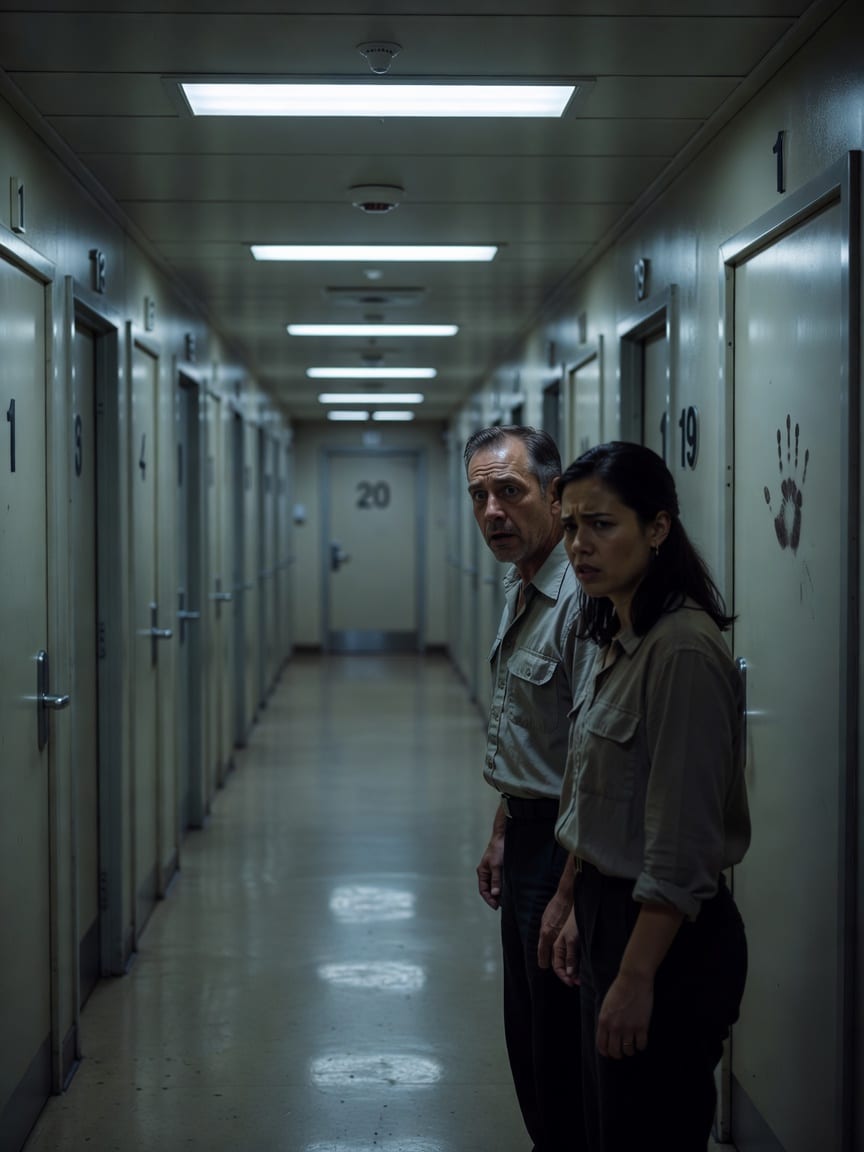
My ship's evacuation plan shows nineteen cabins. I just walked past twenty. Cabin 20 had a name-card and a wet handprint, on a deck the purser swears doesn't exist.
As an accountant, I rely on details and systems, so the mandatory safety drill on the Ocean's Embrace III was a routine check. My cabin's evacuation plan clearly states Deck 4 has nineteen cabins, but then we walked past Cabin 19 and found Cabin 20, its door bearing a distinct, glistening, wet handprint.
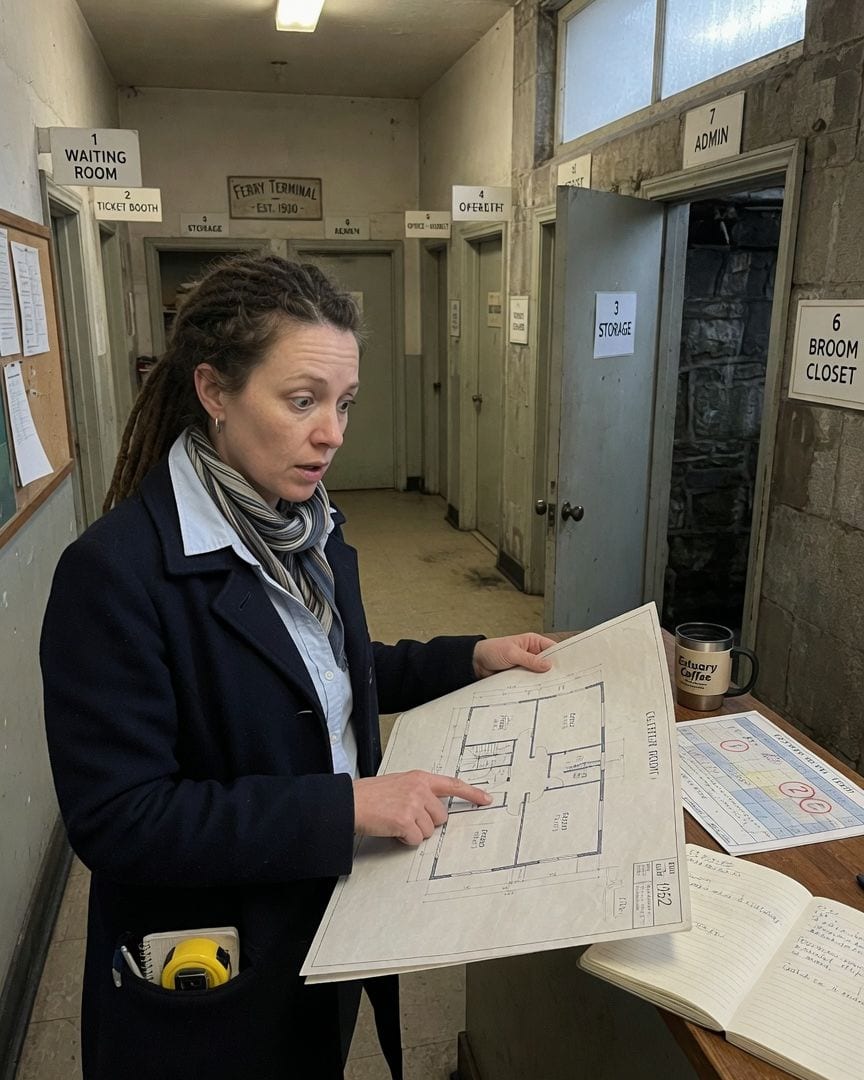
Our ferry returned to the same slipway three times yesterday, the town quay dissolving to our village shore. The crossing was never made.
After our ferry inexplicably kept returning to shore, I investigated the old office building. Its architectural plans clearly showed six rooms, but when I walked the hallway, I found a seventh door. That extra room was undeniably there, an impossible presence.
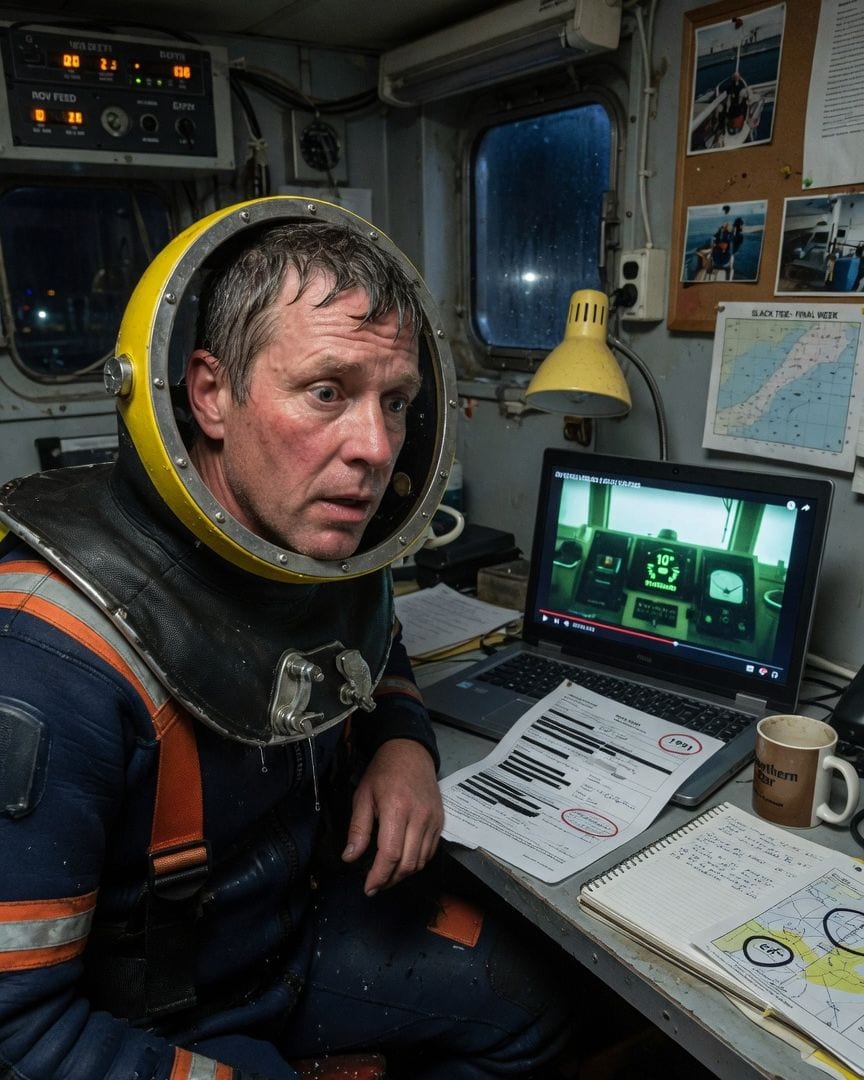
A deep-sea surveyor's final dive into a 1991 wreck found a logbook dated 2023, and a figure watching him.
Deep-sea surveyor Hugo Amsel faced the final week of his Bering Sea survey, under immense pressure to find conclusive evidence before the short season closed. In the abyssal gloom, he located the *Wynn Portal*, a sealer lost with fourteen crew in 1991, surprisingly intact. Through its clear wheelhouse window, he saw a rudder indicator glowing green, an impossible light on a dead ship. Later, on a second dive, he found a leather logbook tucked beneath the helm, open to a page clearly dated 2023. As he stared, a shadow inside the window shifted, coalescing into a figure watching him from the depths.
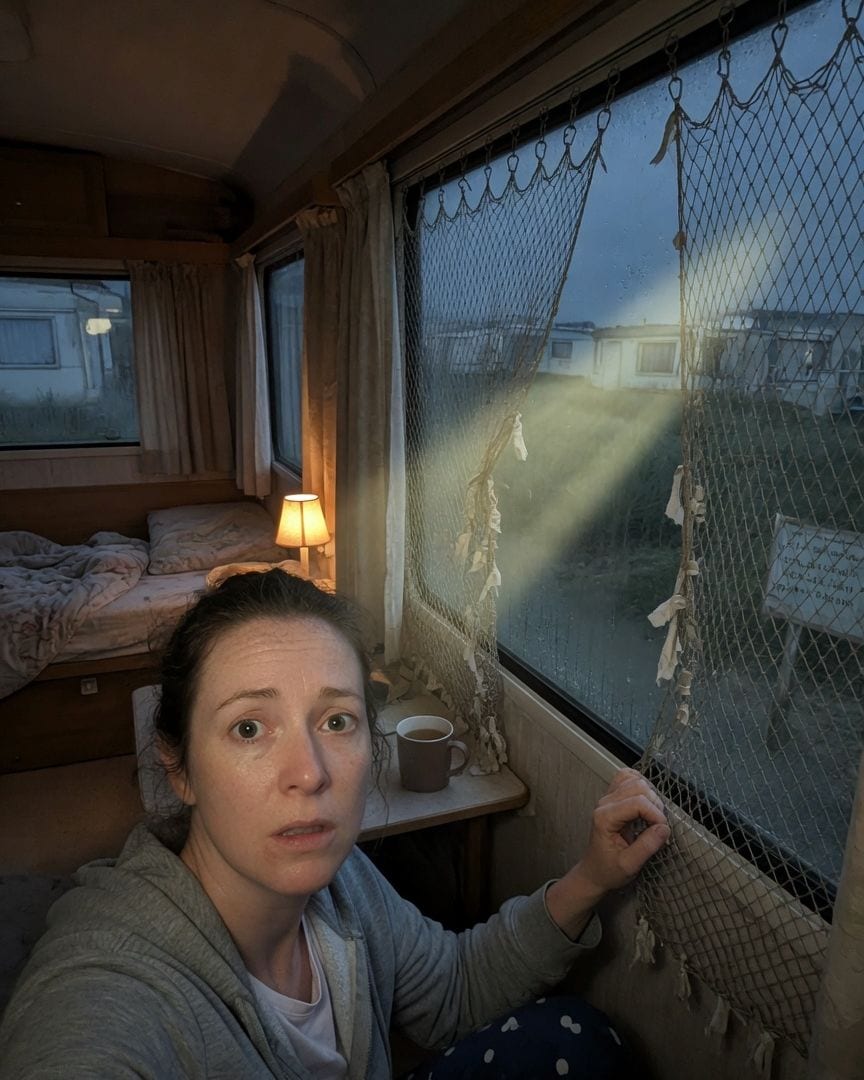
My caravan's seaward curtain was wide open. Fifteen minutes later, it was drawn tight, the hooks ripped outwards from the sea.
I arrived at Seawall Sands Caravan Park, looking forward to quiet nights by the sea in my caravan, number 14. An old sign mentioned a rule to draw seaward curtains by nine, but I forgot. I woke to find my curtain, left open, now tightly closed, its metal hooks ripped outwards from the sea side.
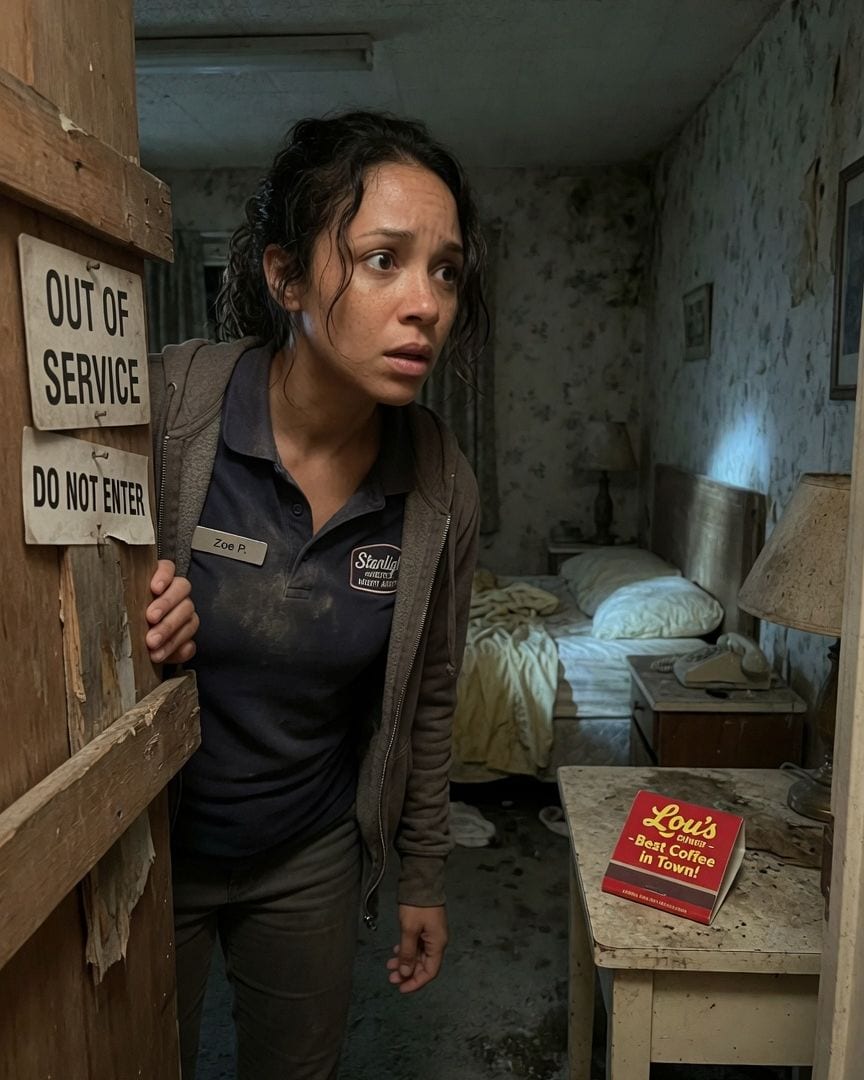
My motel register shows a check-in for Room 9 at 3:33 AM, in my own handwriting. Room 9 has been out of service since the flood.
Working the quiet night shift at the Starlight Motel, I found a chilling new entry in the guest register. My own initials had checked someone into Room 9 at 3:33 AM. The problem? Room 9 has been officially boarded shut and out of service for six months, its key still hanging untouched on the wall.
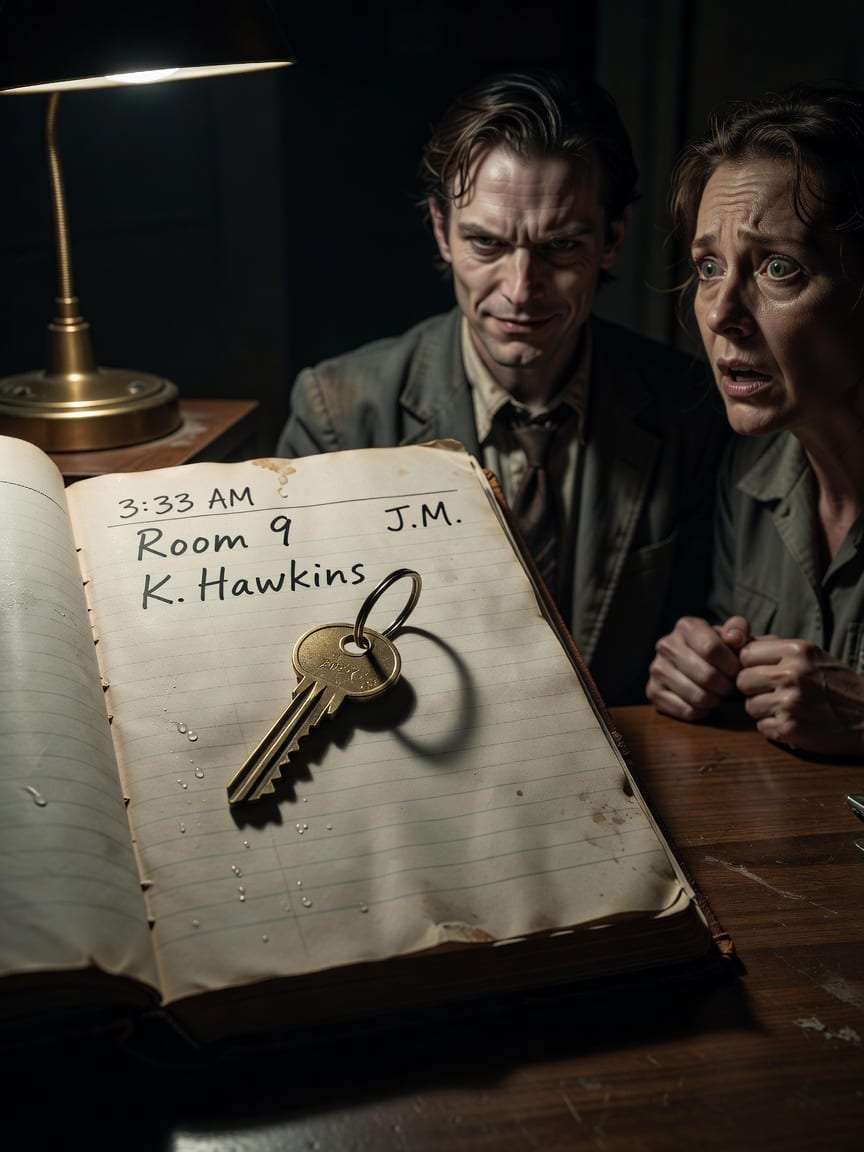
My hand wrote the Room 9 check-in at 3:33 AM. My initials were there. But Room 9 has been sealed since the spring flood, and its key still hangs on the peg.
Working the quiet night shift at the Marsh View Motel, I found a fresh entry in the register with my own initials, for Room 9. But Room 9 has been sealed since the spring flood, its key hanging untouched on the wall. Inside, a half-empty glass of water and a second, mud-encrusted key lay on the bed.