My digital log shows a dog in an empty kennel, medicated at 3:35 AM. That kennel has been empty for days, and I was the only tech on shift.
I’m writing this because I need someone, anyone, to know. I’m Iris Granger, 28, and I used to be an overnight emergency vet tech. This happened a week ago, starting on a Tuesday night.
I was halfway through my shift, the usual quiet hum of the clinic around me, just the faint snores of recovery patients and the occasional sigh of the ventilation system. Routine. That’s what I told myself, anyway.
I was reviewing the digital treatment log, something I’d done a thousand times. My login, my initials, my timestamp: 3:35 AM. The entry was clear: a dose of sedative administered to ‘Buster,’ a Labrador in Kennel 6.
Except Kennel 6 has been empty since last Thursday. Not just unoccupied, but thoroughly cleaned, disinfected, and tagged ‘awaiting repair’ because the latch was sticky. No overnight patients had been admitted, certainly not a Labrador named Buster.
I checked the intake sheet again, pulled up the manifests from the last week. Nothing. No Buster.
My first thought was a system glitch. The clinic’s network could be finicky. I went to the drug inventory. That’s where the cold started to set in.
One dose of that specific sedative – the exact amount logged for 'Buster' – was missing. Physically gone from the locked cabinet. I stared at the blank space where the vial should have been, then back at the glowing screen.
My login. My initials. 3:35 AM. A phantom entry, a ghost dog, a missing drug. It didn’t make sense. It refused to make sense.
I told myself it was just a bizarre error, a series of unfortunate coincidences. Maybe a day-shift tech forgot to log it properly, or logged it under the wrong kennel.
I grabbed my heavy-duty flashlight from the charge station, its beam cutting a solid path through the dimly lit corridor. Kennel 6 gleamed, a sterile, empty box of stainless steel.
I ran my hand over the cool metal, checking every inch. Spotless. No stray hairs, no lingering animal scent of any kind. Definitely no dog.
I even checked the old, rarely used physical logbook, a dusty, leather-bound ledger kept in the supply closet. Just in case there was some ancient manual override, some analog record that defied the digital.
Page after page, neat handwriting documented intakes, treatments, discharges. Nothing for Kennel 6 since last Thursday’s deep clean. No 'Buster.' Nothing at all. The silence of the clinic felt heavier than usual, pressing in.
As I turned to leave, a faint, unsettling odor caught my attention. It wasn't the usual clinic smell – not disinfectant, not wet fur, not even the faint tang of anxiety. This was... different.
Sweet, metallic, almost coppery, but definitely not blood. It was alien, like something you’d never encounter in a vet clinic. I swept my light again, slowly, trying to pinpoint the source. It was strongest near Kennel 6.
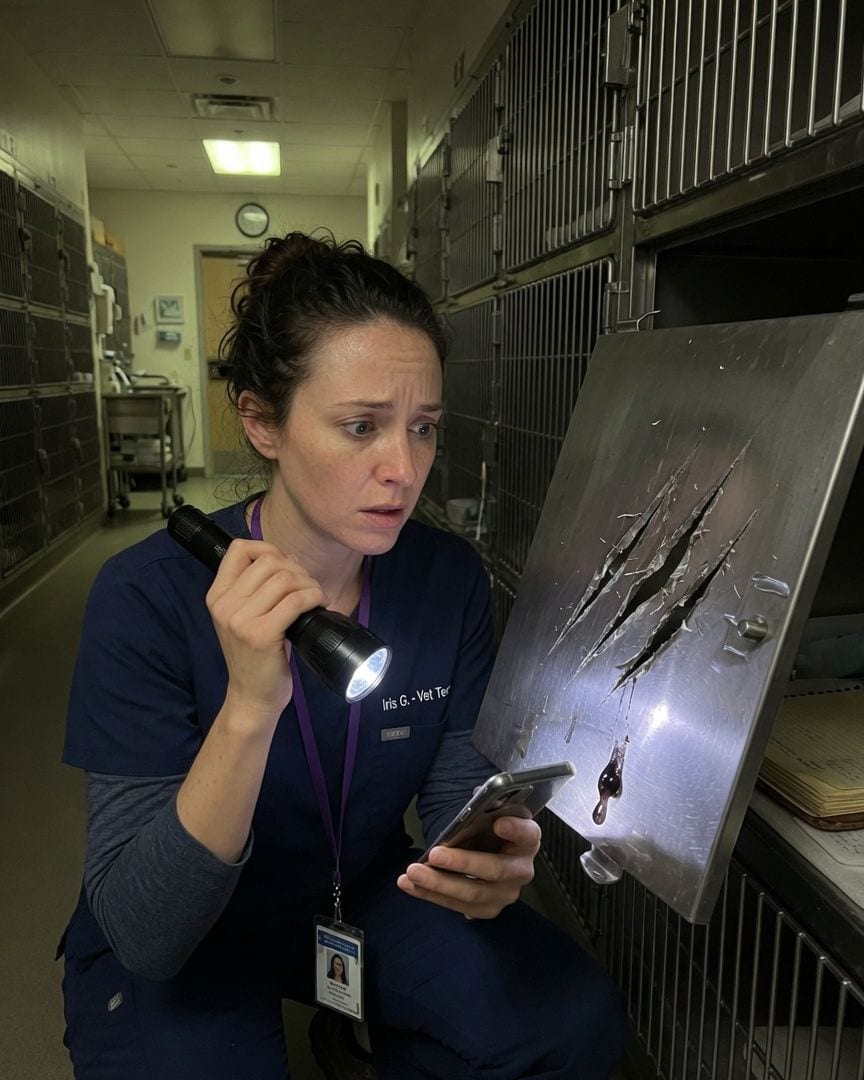
Then I saw it. A deep, fresh scratch mark on the inside of the kennel door. Not a faint scuff, but a gouge, about halfway up the door.
It was too high for any normal dog, even a large Labrador, to make with its paws.
And the gouge itself was too wide, too blunt, almost like something with thick, rounded claws had dragged across the metal, leaving a rough, torn edge. I reached out, my fingers tracing the sharp, unyielding metal.
A shiver, cold and sharp, ran down my spine. The air in the kennel area felt heavy, wrong.
I pulled out my phone, the cold metal a small, familiar comfort in my hand. My heart was thumping a rhythm against my ribs I hadn’t felt since I was a kid, hearing things in the dark.
I angled the phone, snapped a photo of the impossible scratch, the undeniable evidence I knew I shouldn’t be finding.
As my flashlight beam swept across the kennel door one last time, a tremor in my hand, it caught something else. Something tiny, almost invisible, clinging to the very bottom of the door latch. A dark droplet.
It wasn't blood; it was too thick, too viscous. And in the direct, stark beam of my light, it subtly shimmered with an internal, faint luminescence, like dark starlight trapped inside.
I reached out a hesitant finger, my breath catching in my throat, inches away from the impossible thing.
I forced myself to be steady, to be a scientist, to be the tech I was trained to be. I didn't touch it.
Instead, I carefully collected a minuscule sample of the shimmering droplet onto a clean slide, using a sterile swab. Back in the lab, under the clinic's basic microscope, it was organic, complex, swirling with intricate patterns, but utterly unidentifiable.
No cellular structure matched any known animal blood or fluid. Nothing in the clinic’s reference materials even came close. It just was.
The next morning, the clinic felt normal again, bathed in natural light. That made it harder to believe what I’d seen. Still, I cornered Michael Brooks, our day supervisor, by the breakroom coffee machine.
I tried to frame it as a 'weird system glitch' and a 'possible prank,' showing him the log entry on my phone and the photo of the scratch. I watched his face. Michael, usually so straightforward, was unusually dismissive.
His eyes darted away from the photo, then back to his lukewarm coffee. He shrugged it off as 'night shift jitters' and 'system hiccups.' "The network's been funny lately, Iris," he mumbled, not quite meeting my gaze. "Probably nothing.
Go get some sleep." The way he avoided looking at the scratch, the way he dismissed the missing sedative, left me with a sour taste. It wasn’t convincing.
Later that day, back home, sleep wouldn't come. My mind kept replaying the glowing droplet, the impossible scratch. I found myself at my laptop, still digging into the clinic’s archived digital logs, using the remote access I had.
Filtering by my login and the exact 3:35 AM timestamp, I found a disturbing pattern. Similar phantom entries for empty kennels, always for 'medication,' always under my login, stretching back not just days, but weeks.
The 'animal names' were often strange, archaic, almost like placeholders: 'Grim,' 'Cinder,' 'Shadow,' 'Sunder.' They were never real patient names. The consistency was too precise for a glitch, too specific for a random error.
Someone, or something, was using my credentials.
I started staying late after my night shift, sometimes even coming in on my days off, feigning paperwork or organizing supply closets. What I was really doing was watching.
The clinic had a sub-basement, an old part of the building rarely used, mostly for ancient storage and the occasional broken piece of equipment.
Clinic policy stated it should be accessible to all staff, but the heavy steel door at the end of the access corridor was always locked, usually with a thick chain.
I started noticing subtle anomalies. A faint, irregular light flickering from under the sub-basement access door, even when the clinic was otherwise dark and empty. A metallic clang from below, muffled but distinct, sometimes followed by a low scraping sound.
And then, at precisely 3:30 AM, just before the phantom log entries would appear, I started to hear it: a low, rhythmic thrumming sound.
It wasn't loud, but it vibrated faintly through the floor, a deep, resonant pulse that made the small, framed photos on Michael’s desk subtly rattle.
I pressed my hand to the linoleum, feeling it thrum beneath my palm, a living thing within the dead building.
One night, while I was meticulously cross-referencing even older digital logs from a dusty external hard drive I found tucked away, the clinic owner, Joan Carter, 62, quietly entered the office.
She usually only came in during day hours, often leaving before the night shift even began. She stood in the doorway, a calm, almost serene smile on her face.
The fluorescent lights overhead buzzed, making her look almost angelic, but something in her eyes was cold. "Everything running smoothly on the night shift, Iris?"
she asked, her voice soft, but with an unnerving undertone, like a velvet glove over a steel fist. A prickle of pure, cold unease spread through me. It wasn't a question. It was a statement.
A cold certainty settled in my gut: my digging had been noticed.
The next morning, I confronted Michael again, this time with the full weight of my findings. I laid it all out: the patterned log entries, the photo of the scratch, the unidentifiable droplet analysis, the 3:30 AM thrumming.
I pushed him, hard, demanding a real explanation. He looked haggard, his face pale beneath the harsh clinic lights. His usual composure crumbled.
He admitted it. He’d heard the sounds too, more than once, late at night. Seen shadows flicker in the sub-basement access corridor.
He’d always rationalized it away, he said, convincing himself it was the old building settling, or his imagination, or just a trick of the light. "You get tired on these shifts," he muttered, running a hand through his thinning hair.
"Your mind plays tricks." But his eyes, hollow and haunted, told a different story.
He confessed that Joan Carter had always been ‘peculiar’ about the sub-basement, sometimes supervising 'special projects' down there herself, late at night, sometimes even taking animal carcasses down there after euthanasia, saying it was 'discreet disposal for a private client.'
He recounted an old rumor, whispered by long-gone staff who didn’t last long: the clinic wasn't just old; it was built over something much, much older.
He said Joan’s family had owned the land for generations, with a ‘stewardship’ that went back further than anyone knew.
“My grandmother used to talk about the Carter family,” he said, his voice barely a whisper, “said they kept to themselves, had their ‘ways.’ Said they watched over something the town forgot.”
His voice dropped lower, urgent. "Some things, Iris," he warned, his eyes finally meeting mine, full of genuine fear, "are best left undisturbed if you want to keep your job… or worse.
Joan doesn’t take kindly to questions about her ‘family business.’ She's... protective." The clinic around us seemed to hold its breath, the cheerful animal posters on the walls mocking the grim conversation.
Ignoring Michael's terrified warning, and armed with a strange resolve, I stayed late that night. I found an old, forgotten keycard in a dusty drawer in the back office, tucked under a stack of ancient tax returns.
It was plain, magnetic stripe, probably decades old. I pressed it to the card reader on the sub-basement door. The lock clicked, a loud, metallic thud that echoed in the silent hall.
The air down there was cold, damp, and carried that same unsettling sweet, metallic scent I’d found in Kennel 6, only stronger, thicker. It wasn't a storage area.
It was surprisingly modern, gleaming sterile surfaces juxtaposed against ancient, rough-hewn stone walls that felt primal, deep. My flashlight beam cut through the oppressive darkness.
I moved deeper, past rows of what looked like empty, reinforced containment units, each with thick, opaque glass.
I found a small, reinforced server room, tucked into an alcove. The door, heavy steel, had a rudimentary keypad lock. My tech skills, honed over years of troubleshooting finicky vet software, made short work of it.
Inside, an old, disconnected terminal sat on a metal desk. I powered it up. The screen flickered to life, showing an archived directory. My blood ran cold.
These weren't 'patients,' they were 'Subjects.' I clicked. The record_that_cannot_be unfolded before me: a series of detailed, clinical entries for 'Subject Alpha-7,' 'Beta-9,' 'Gamma-3,' and others.
The anatomical descriptions were chilling, clearly not animal: 'multi-limbed,' 'dermal plates,' 'bioluminescent sac,' 'chitinous exoskeleton.' The 'treatment protocols' were for 'growth acceleration' and 'containment sedation.' The earliest entry was dated 1968, decades before the current clinic was even built.
The room itself felt like it was humming, the monitor beeping like something trapped behind the glass.
One entry, timestamped 3:35 AM from last night, matched my own log. It was for 'Subject Delta-12.' The associated image was a blurred, low-resolution photograph.
A multi-limbed creature, its form barely discernible, seemed to pulse with a faint light, contained within a sterile chamber. Undeniably real. My breath hitched.
I stared, transfixed, at the screen, the impossible creature's blurred image burning itself into my mind. My fingers, numb with a horror that was rapidly solidifying into sickening coherence, clicked through more files.
The 'medication' I'd logged, the sedative that disappeared from inventory, wasn't just a sedative. It was a specific chemical compound – a potent growth accelerant for these entities, disguised as a common animal tranquilizer in the clinic's main inventory.
The 3:35 AM log entries weren't errors or glitches. They were a precise, daily feeding and sedation cycle for whatever was being cultivated down here.
The 'animal names' – Buster, Grim, Shadow – they were codes, specific identifiers for different species or stages of development.
The clinic wasn't just a front; it was a resource, a cover for an ancient, ongoing operation, its innocent facade hiding a truth that warped everything I thought I knew.
A soft voice broke the silence, making me jump. "You found the family business, Iris."
Joan Carter stood in the doorway, exactly where I had been just moments ago. Her expression was calm, utterly unbothered, a faint, sad smile on her lips, as if she were a kindly professor explaining a complex but mundane subject.
The cold from the sub-basement seemed to radiate from her.
She walked further into the room, her footsteps unnervingly quiet. "These entities," she began, her voice a low, even murmur, "are ancient. Older than any records we have. They're tied to this land, deep beneath us.
My family's duty, for generations, has been to 'manage' them. To ensure they don't grow too large, don't escape, don't disturb the surface world." She gestured around the sterile room, at the containment units, at the data on the screen.
"The clinic, as you've discovered, provides a convenient cover. A supply of 'food' – animal carcasses from euthanasia, discreetly processed as waste disposal. And, of course, a constant stream of unwitting overnight staff to log the 'treatments.'
Your diligence, Iris, has been quite helpful."
The casualness with which she spoke, the lack of any malice, was more terrifying than any scream. She was simply stating facts, the way I might discuss a difficult case with a colleague.
Joan attempted to persuade me, her voice hypnotic, almost reasoning. She spoke of 'balance,' the necessity of their 'stewardship,' the terrible consequences if they failed.
She painted a picture of a world ravaged by these things, if her family didn’t contain them.
"Those who resist, Iris," she said, her eyes fixed on mine, "those who fail to comprehend the delicate balance we maintain, they often… become part of the balance." The implication hung in the cold, damp air, heavy and undeniable.
My mind raced, every cell in my body screaming for me to run. I wasn’t listening to her words; I was just registering the sound, the rhythm, while my eyes darted around.
I saw the flash drive I'd prudently brought with me, sitting in the terminal's port, already containing a full copy of the sub-basement files. With a surge of adrenaline so potent it made my vision tunnel, I snatched it.
I didn't even bother pulling it out properly; I yanked it, the terminal sparking. Then I bolted.
Joan didn't pursue immediately. She merely watched, a patient, knowing look on her face, the faint smile still playing on her lips.
But there was a subtle shift in her gaze, a hardening, a chilling promise of something far worse than anger. I raced through the sub-basement, past the now-grotesque familiar equipment, the empty containment units that weren't empty at all.
Up the stairs, my heart hammering against my ribs, each beat a frantic drum against the silence.
I burst into the main clinic, past the rows of kennels that suddenly looked like a mockery, the x-ray machine a dark, silent sentinel.
My hands fumbled with the lock on the back employee exit, the only way out I knew. It clicked open with an agonizing slowness.
I burst into the pre-dawn chill, jumping into my car and speeding away, not daring to look back.
In my rearview mirror, a final glimpse: Joan Carter, standing calmly at the clinic entrance, a faint, patient smile on her face, silhouetted against the first gray light of dawn.
I drove until dawn, then kept driving, putting hundreds of miles between myself and the clinic. The images of the files, the blurred creature, Joan’s calm voice, replayed in my head.
I called the police, then the health department, then even a local journalist, recounting my impossible story, offering the flash drive as undeniable proof.
Each call ended the same way: polite skepticism, outright dismissal, veiled threats of libel if I persisted. They said I was overwrought, that it sounded like a bad dream.
They said the clinic had an impeccable record, that Joan Carter was a pillar of the community.
I lost my job, of course. The official reason cited as 'abandonment of post' and 'unprofessional conduct.'
My former colleagues, including Michael, either avoided my calls or hinted that I was 'unwell,' that the night shifts had 'gotten to her,' that I needed 'help.'
The clinic, I learned from a quick, anonymous search, continued its operations, undisturbed, a normal facade over an unspeakable truth.
I moved to a new city, started a new job far from anything medical, something that involved plants and quiet greenhouses.
I see a therapist, try to build a new life, try to forget the thrumming that vibrated through the clinic floor, the sweet, metallic scent, the impossible image on the screen.
But the night still holds a quiet terror for me. I sometimes wake at exactly 3:35 AM, heart racing, convinced I hear a faint, rhythmic vibration from deep underground, even in my new, quiet apartment building, hundreds of miles away.
The flash drive remains in my fireproof safe, the only proof of a truth no one wants to hear, a truth that cost me everything but my life.
I still check the locks on my doors and windows, sometimes twice, sometimes three times, before I dare to try and sleep.
I still keep the flash drive in a fireproof safe, knowing no one will ever believe what it holds.
If this one got to you
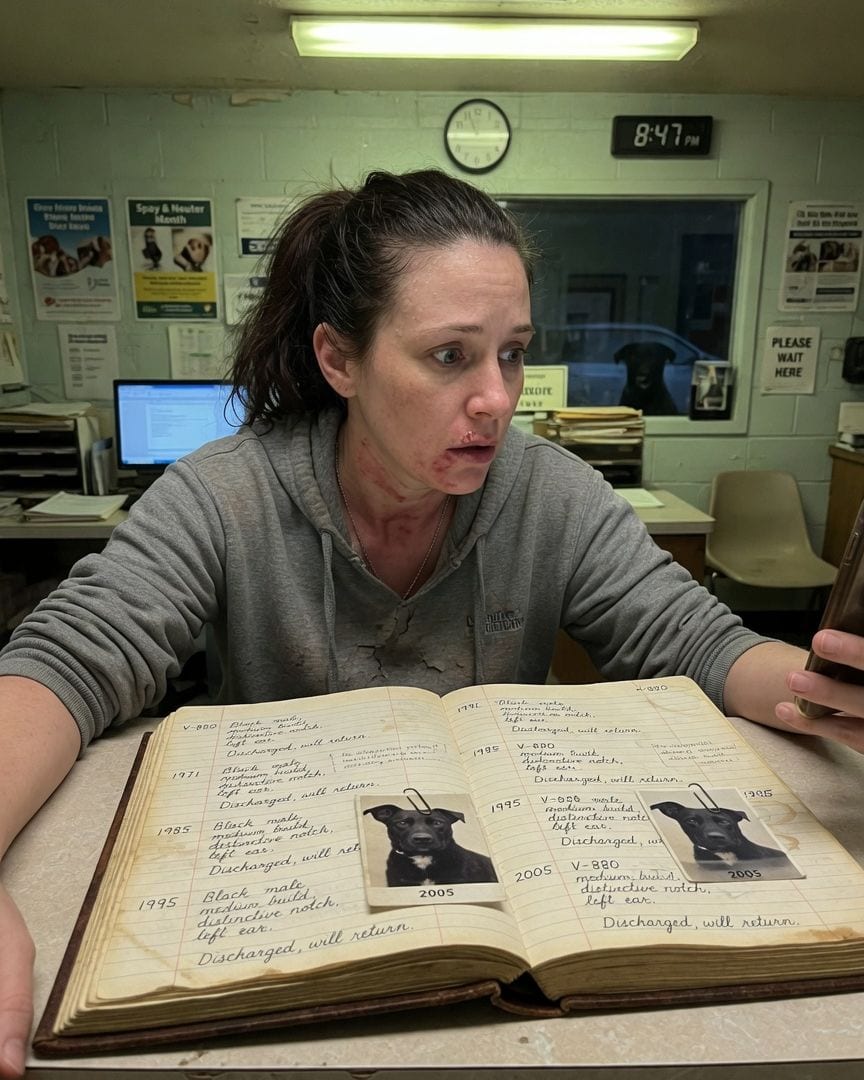
My dog's case number, V-880, traces the same black dog with a notched ear back to 1971, through four different owners, all discharged 'will return'.
As an IT professional, I expect logic. But when I took my new stray, Midnight, to the vet, his old ledger held a chilling, repeated note. Across entries from different decades, it simply read: 'Discharged, will return.'
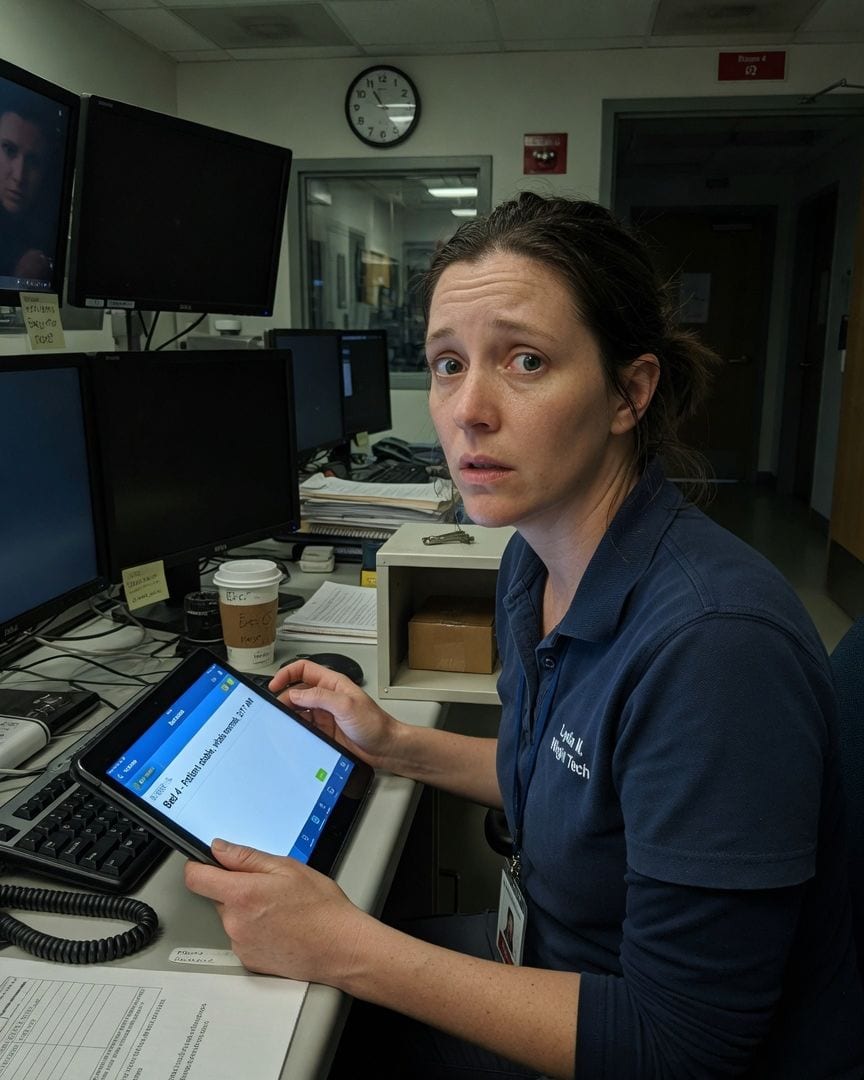
My sleep clinic's Bed 4 patient waves and asks about the humming — but the bed's empty, and its intercom was disconnected.
It was 3 AM, and the sleep clinic should have been empty, especially Bed 4, which was officially offline for repair. But for the third night in a row, a patient in Bed 4 was waving at me, their voice asking about a humming sound through a disconnected intercom.
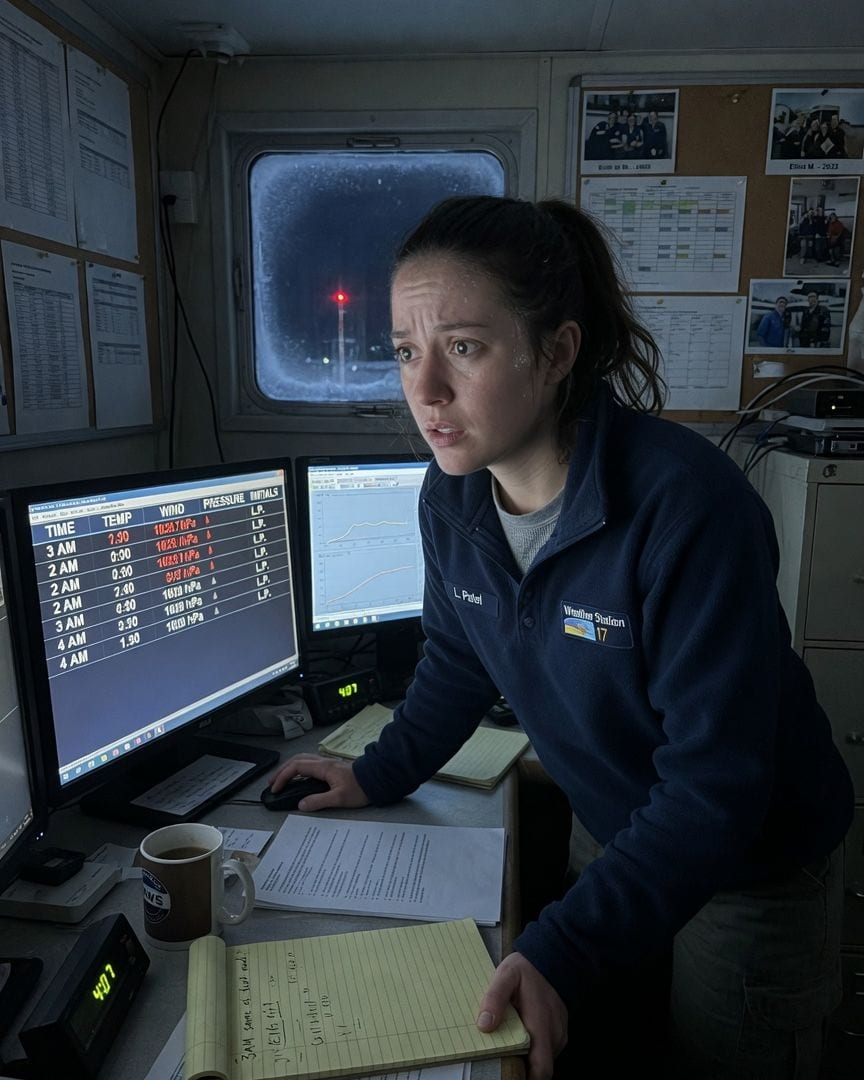
My weather station's 3 AM log shows a pressure reading I never made. My initials are on it, but the dials were dead still.
Working the overnight shift at the remote weather station, I routinely checked the digital logs. The 3 AM entry showed an impossible barometric pressure spike, a hurricane that simply hadn't happened. I distinctly remembered being outside at that time, calibrating a sensor, not making that entry. Yet, my initials, L.P., were clearly logged next to data I never made.
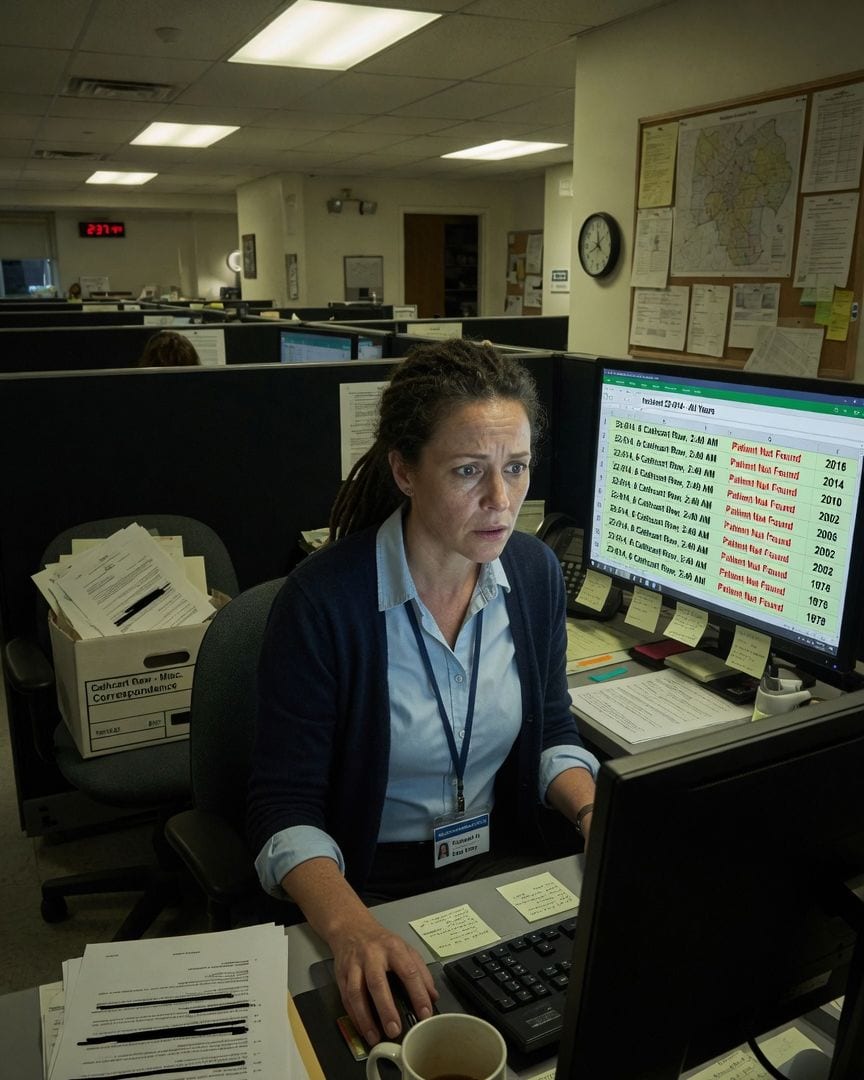
My computer log shows the same 2:40 AM call to Cathcart Row, every four years since 1978, always closed 'patient not found'.
Working data entry for the County Ambulance Trust, I found a routine incident logged as 'Patient Not Found.' But digging deeper, I discovered the exact same phantom call had repeated every four years for over forty years, always at the same address, always at 2:40 AM. Then I found a heavily redacted memo linking it to my own street.
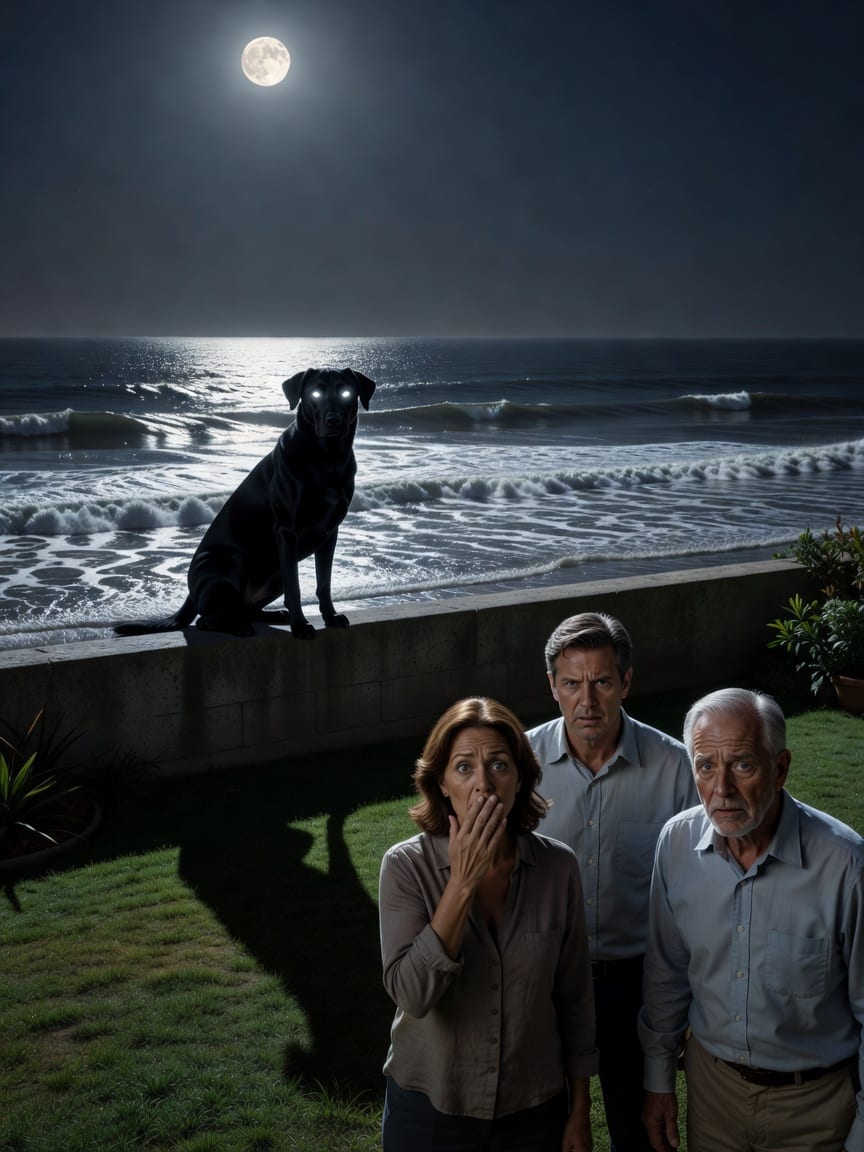
My black dog on the sea wall isn't mine. Its eyes held something ancient and cold, and my neighbours laughed when they warned me not to feed it. The lifeboat log shows its name beside every drowning for ninety years.
My new cottage by the sea offered peaceful sunsets and a solitary black dog patrolling the wall. I left it some stew, thinking it was just a stray. But its eyes met mine, and they weren’t dog eyes at all—they were obsidian, ancient and cold, devoid of all warmth.
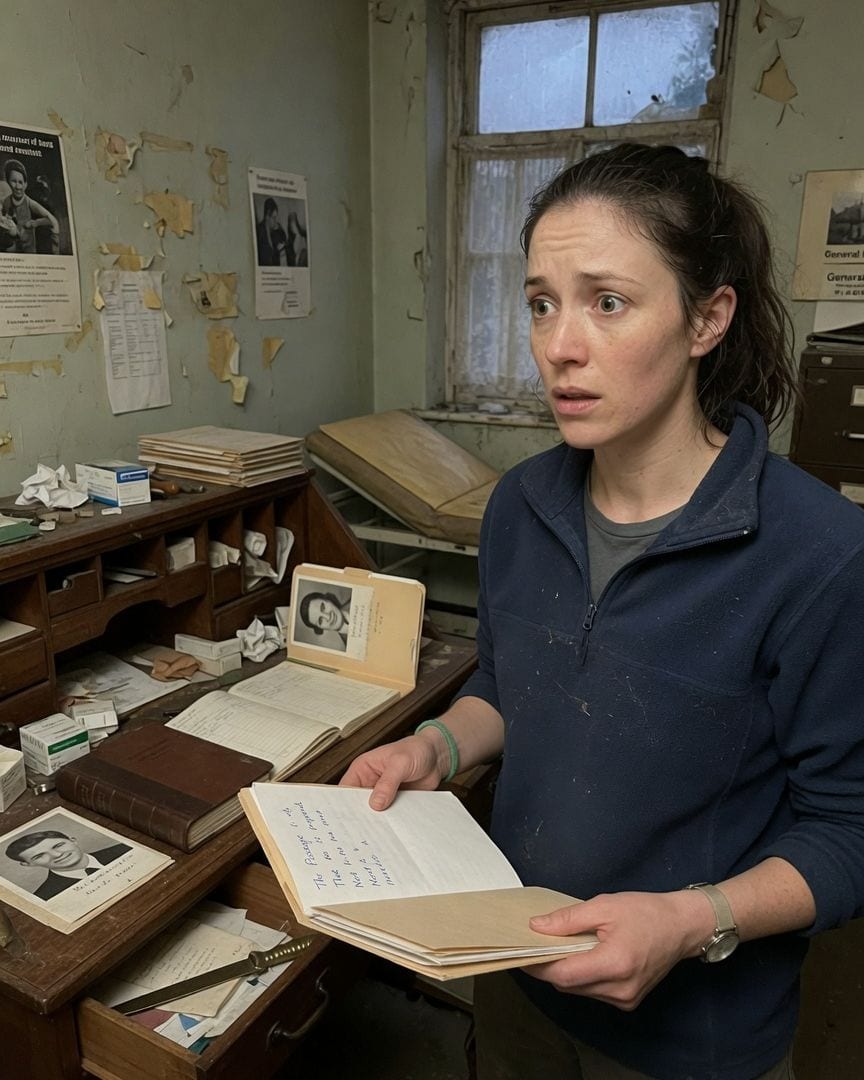
My new clinic's appointment book shows entries for this coming Monday, decades after the doctor retired and died.
Chloe Lawson bought an old, abandoned surgery in Nettlebed, ready to open her new vet clinic. Locals insisted Dr. Almott retired in '79 and the practice shut down for good. But then Chloe found his dusty appointment book filled with meticulous entries, continuing unbroken from 1979 through the decades, right up to this coming Monday.