My employer's security file holds a vetting report on me dated nine years before I ever applied. It has my full name and my parents' address — with only one line, the source who referred me, blacked out.
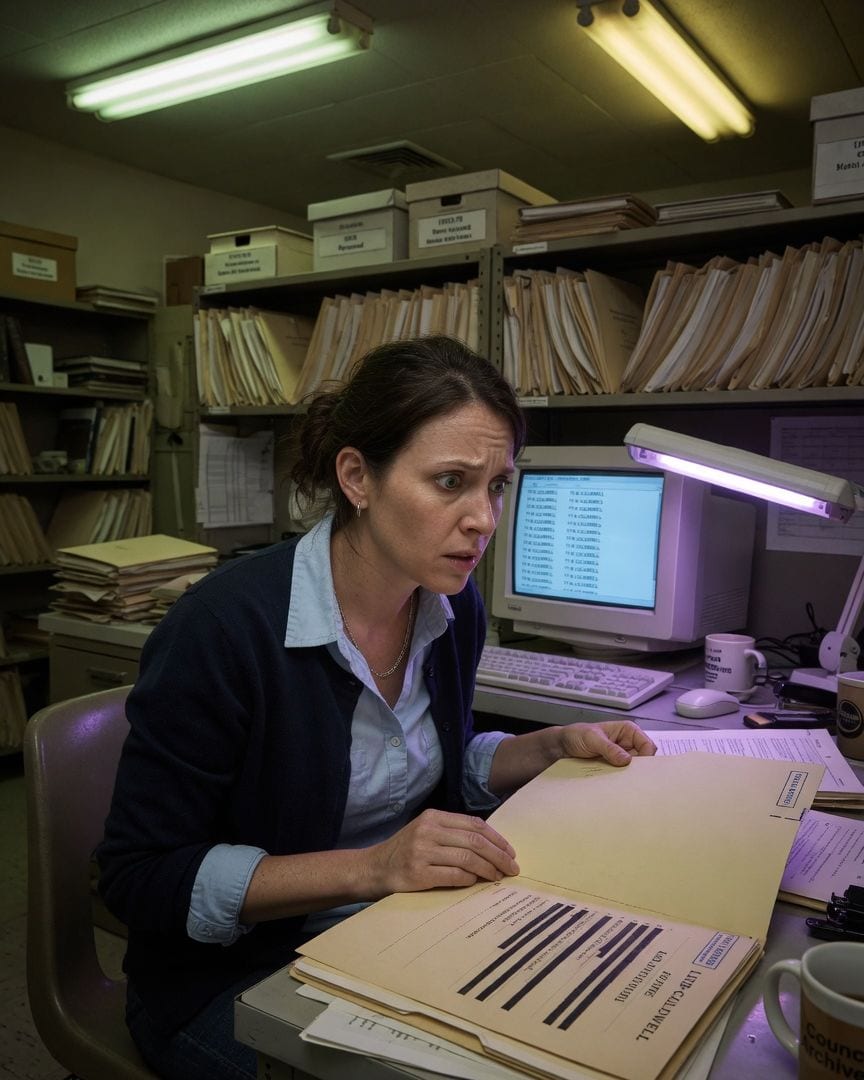
The fluorescent hum of the archive was usually a comfort, a steady drone against the rustle of paper and the soft click of hard drives. Today, it felt like a low-frequency thrum against my skull.
I was conducting a routine data integrity audit, a task usually as thrilling as watching paint dry, when I pulled my own security vetting file. Vanessa Caldwell. Me. Age 35.
Everything else on the hard copy was perfectly aligned with my life. Full name, date of birth, even my parents' current address in the suburbs.
But the issue date, stamped boldly in blue ink at the top right corner, stopped me cold: '03-07-2009'. I stared at it. Nine years. Nine years before I'd even applied for this archivist position at the local council in 2018.
My first interview hadn't even been a thought in my head back then.
I flipped past the standard forms. Background check clearances, a generic medical questionnaire I didn’t remember filling out.
Then, halfway down the third page, a line labeled 'Referral Source' was starkly blacked out, a thick, inky bar obscuring whatever lay beneath.
Below it, in a neat, old-fashioned script, an assessor’s note read: 'As with the previous holder of this reference, clear and place, subject not to be briefed.'
I leaned back, the plastic of my chair squeaking. The file was unmistakably mine. My name, my details. But 2009? I tried to rationalize it, to force it into a mundane box.
A re-issued number, perhaps, from some general pre-employment check for a different, long-forgotten role I might have vaguely considered? But the specific note, 'as with the previous holder,' echoed in the quiet archive, refusing to settle into any ordinary explanation.
It sounded like an instruction, a protocol, and it was attached to my name, years before I became me, the council employee.
A cold knot tightened in my stomach. I pushed the thought away, telling myself it was a clerical error, a misplaced sheet, anything but what the date clearly stated. This was an archive, after all. Mistakes happened.
But my eyes kept dragging back to that blacked-out line, then to the precise, almost elegant script of the assessor's note. It wasn't a mistake. It was too deliberate.
Determined to find a rational explanation, to prove this was just a system glitch, I logged into the archive's digital cross-referencing system. My file, I noted, was tagged with a unique identifier: 'Reference ID: 77-B-CALDWELL.'
It stood out, a series of numbers and letters that felt more like a classification than a mere administrative tag.
I typed the ID into the search bar, expecting a single result, or perhaps a handful of unrelated, long-defunct administrative entries for some forgotten council project. The screen flickered for a moment, the database whirring, then burst to life.
Instead of one or two, a long list scrolled down, files spanning back decades, to the early 1960s.
Every single entry was marked '77-B-CALDWELL.' But the names attached to them were different. 'Linda Ellison,' dated 1985. 'Daphne Caldwell,' 1970s. 'Joan Caldwell,' 1960s. The dates jumped, but the ID was constant.
Each file summary indicated an association with the same local council institution, often in administrative or support roles, just like mine.
My fingers trembled as I clicked through a few of the older entries. Linda Ellison. The digital copy showed the same internal forms, the same basic structure. And, chillingly, the same blacked-out 'Referral Source' line.
Below it, in that identical, old-fashioned script, was the chillingly familiar assessor’s note: 'As with the previous holder of this reference, clear and place, subject not to be briefed.'
The sheer volume and consistency of the entries, all under the exact same 'Reference ID' but for different people, defied any simple explanation of clerical error or re-issuance. This wasn't a glitch.
This looked less like a reference number and more like a designation, quietly passed down through decades, attached to a series of individuals, all ending up in the same local council. The implication was a cold hand on my neck.
These people, myself included, weren't just employees. We were... something else.
I requested the physical file for 'Linda Ellison,' dated 1985. The paper was yellowed, fragile at the edges, the ink faded to sepia, but the format was identical to my own.
The same generic cover sheet, the same odd sequence of forms. The 'Referral Source' line was, predictably, a heavy black bar.
My hands were shaking slightly. This wasn't some mistake I could explain away. This was a pattern.
I carried the aged file to a specialized workstation, one equipped with an archive’s UV lamp, typically used for authenticating documents or revealing faded inscriptions.
I held the page up to the light, hoping for a watermark, a signature, anything that might cut through the manufactured obscurity. Nothing. The black remained opaque.
But as I lowered it, pulling it away from the direct beam, the angle of the light caught something else. A faint, almost imperceptible indentation on the page, just beneath the heavy black redaction.
It wasn’t ink, but the ghost of pressed letters, visible only for a fleeting second, like a shadow of a word etched into the paper itself. I squatted, adjusting the lamp, my breath catching in my throat.
My heart hammered against my ribs. The faint impression spelled out a familiar sequence of characters, impossible to mistake: the exact street name of my own current address.
Armed with the chilling discovery of the imprinted street name, I methodically traced the lineage of the '77-B' designees. I pulled the physical files for 'Daphne Caldwell' from the 1970s and 'Joan Caldwell' from the 1960s.
Each displayed the same pattern: the heavy black redacted 'Referral Source,' and beneath it, when I angled them just so under the UV lamp, the unmistakable faint impression of that same street name. My street name.
Each individual, I noted, eventually entered the council's employ, fulfilling roles that, while mundane – accounts, logistics, records – seemed to position them subtly within the local bureaucracy. Not power positions, but critical nodes. Conduits.
I cross-referenced the files with public records, pushing past the typical scope of an audit. I searched for connections, living relatives, any hint of a shared history beyond the council. The trail was frustratingly cold.
Relatives were listed as 'moved away suddenly' or 'no forwarding address' in official documents. Childhood doctors' offices were long closed, schools demolished.
It was as if these individuals, after their 'placement,' were carefully integrated, their pasts obscured, their origins wiped clean.
The pattern solidified into something monstrously coherent. A specific reference ID, recurring for decades. A specific street name, imprinted beneath a deliberate redaction. A specific institution, the local council itself.
A specific note, 'clear and place, subject not to be briefed.' All repeating across generations of seemingly unrelated people who shared a quiet, bureaucratic path that led them, inevitably, to this building.
It was too precise to be coincidence, too widespread to be oversight. It felt like a clockwork mechanism, operating silently, invisibly, around me. And I was in it.
My unusual string of requests for obscure, decades-old 'legacy files,' particularly those within the 77-B series, did not go unnoticed. The archive, usually a quiet, solitary realm, suddenly felt like a place under subtle surveillance.
The hushed air seemed to vibrate with an unspoken awareness.
One afternoon, as I was cross-referencing a new data point for Joan Caldwell, a shadow fell over my desk. I looked up to see Isaac Whitfield, a senior archivist.
He was in his sixties, with a reputation for quiet efficiency and an almost preternatural memory for the archive's vast holdings. He rarely spoke, preferring to communicate through precise notes or knowing glances.
He didn’t accuse me, didn’t warn. Instead, he simply remarked, his voice calm and even, a soft murmur that somehow filled the quiet space. "Quite the deep dive you’re taking into the old records, Vanessa. Particularly the 77-B series.
Finding anything... illuminating?"
His eyes, though mild, held a knowing glint, a spark that told me he wasn't asking a casual question. He was testing me. A chill ran down my spine.
I felt like a creature caught in the beam of a flashlight.
I tried to deflect, mumbling something about "historical data integrity" and "spot-checking anomalies." Isaac just nodded slowly, a faint, almost imperceptible smile playing on his lips. It wasn't a warm smile.
It was the kind of smile you might give to a child who's just broken a fragile heirloom, knowing it was inevitable.
"Some things are best left filed, wouldn’t you agree?" he said, his gaze sweeping over the rows of cabinets around us. "The system, after all, works best when it's undisturbed.
And some people," he added, his gaze lingering on me for a fraction too long, a cold pressure in the air, "are just... built for certain roles. It’s a matter of ensuring continuity."
He turned and walked away, his footsteps soft on the carpeted floor, disappearing around a towering shelf of ancient ledgers. He left me with the distinct, unsettling impression that I was no longer the hunter, piecing together a mystery.
I had been observed all along. And the system he spoke of wasn't some abstract concept. It was here, in this building, in this archive, and it knew my name.
The next morning, the archive felt heavier. Every creak of the shelves, every distant thrum of the building's ventilation system, seemed to hold a meaning I was only now beginning to grasp.
I cornered Isaac in a deserted corner of the archive, near the restricted government documents vault, where the air was noticeably cooler. The fluorescent lights overhead buzzed, casting a sterile glow.
"Isaac," I started, my voice lower than I intended, a tremor I couldn't quite control. "I need to know what this is." I laid out the evidence, not dramatically, but precisely.
The recurring '77-B-CALDWELL' designation, the multiple names attached to it, stretching back to the 60s. The identical assessor's notes, word for word. And the faint, chilling indentation of my own street name beneath every single blacked-out 'Referral Source' line.
Isaac listened, unperturbed, his hands clasped behind his back, his posture perfectly calm. His composure was infuriating, unsettling. It made the air in the deserted aisle feel impossibly thick.
"It’s a designation, Vanessa," he finally admitted, his voice a hushed but clear murmur, devoid of malice or triumph. He spoke as if explaining a technical process, not a profound, generations-long deception. "Not a file number.
It marks individuals who are... placed."
He explained that the '77-B' individuals are part of a 'continuity program' managed by a specific, unnamed department within the council.
Their purpose, he said, was to ensure 'stability' and 'subtle correction' within the community, through their positions in local administration. Not spies, not agents in the dramatic sense. Just quiet influencers. Gears in a vast, self-correcting machine.
The blacked-out 'referral source,' he revealed, was the 'point of placement'—often a local orphanage, a specific foster home, or even a designated family chosen for the program. My discovery of the street name clicked into place with horrifying precision.
He confirmed that my own family, the Caldwells, were part of the 'placement' for the current '77-B.' Me.
He spoke of it with the detached calm of a historian recounting established fact, not a conspirator admitting a secret.
The earlier clues clicked into place with devastating clarity: my vetting file, dated years before my interview, wasn't vetting; it was tracking. The 'previous holder' wasn't a mistake; it was a succession.
The blacked-out line wasn't a secret; it was a mechanism.
The horror wasn't a monster lurking in the dark. It was a perfectly functioning, quiet bureaucracy. A system so ingrained, so normal, that it simply was. And I, Vanessa Caldwell, had always been inside it.
I felt the world tilt, the floor beneath my feet swaying. My entire life, every choice, every path, had been a managed trajectory. My family, a conduit, a part of this quiet, pervasive control.
The scale of it, the cold, intricate web, made my head spin. I tried to process it, to grasp the invisible strings that had guided me, even before I was aware enough to walk.
Isaac, watching me, took a deep, calm breath, a slight movement in the otherwise still air. The quiet hum of the archive seemed to deepen, pressing in on me.
"And of course," he added, his voice softer now, almost paternal, "the program extends to family. We ensure the lineage is... maintained."
He reached into his satchel, a worn leather bag he always carried, and produced a printed, pristine file. It was new, crisp, identical in format to my own, but somehow more chilling for its untouched perfection.
He slid it across the cold metal table between us.
The label, in stark, precise lettering, read: '77-B-Prime-CALDWELL, Sarah.'
My breath caught in my throat. Sarah. My daughter. It was dated for a future entry into the system, detailing her own preliminary designation. Sarah. My 8-year-old daughter. Already marked.
Already 'placed' in a system I had only just discovered, a system she had no idea existed.
I stared at her name, printed so neatly, so officially, on that blank page. Isaac smiled faintly, a chillingly gentle expression that offered no comfort, only certainty. "A good candidate, Sarah. Very adaptable.
She'll be ready for placement in a few years."
The revelation of Sarah's file detonated in my mind, a silent, internal explosion that shattered any lingering hope I had of a normal life. Isaac watched me, his expression still and unreadable, as if observing a chemical reaction.
He continued, detailing the 'function' of the program with chilling clarity, his voice a low, steady drone against the frantic beat of my heart.
The '77-B' designees, he explained, are not spies or saboteurs. They are 'stabilizers.' They act as quiet conduits, subtly influencing decisions, guiding policy, and correcting 'deviations' within the community's natural development.
They are the background hum of order, the unseen hand that keeps things just so. My parents, he implied, were either chosen for the placement or were themselves unwitting participants, their lives arranged to ensure my integration.
The 'subject not to be briefed' note, he insisted, was crucial. Awareness of the program, he said, contaminates the natural, organic integration of the individual into their role.
It creates resistance, a friction that goes against the very principle of 'subtle correction.' He spoke of it as if it were a scientific principle, an undeniable truth.
The 'Caldwell' surname recurrence, he confirmed, wasn't a coincidence, but a deliberate cultivation of a family line. A lineage consistently 'seeded' with 77-B designees for generations, ensuring a continuous, reliable presence within the council's operations.
Every planted clue, every repeating detail, every blacked-out line, every quiet word from Isaac, snapped into a coherent, monstrous shape. My life, my family, my future, Sarah's future—all part of a quiet, relentless, self-perpetuating system.
It was a tapestry woven from lives, and I was just one thread.
A cold, determined fury settled over me. I couldn't just stand by. I attempted to expose the program. I started with Fiona Reynolds, my immediate supervisor, trying to explain the documents, the patterns, the terrifying implications.
Fiona listened patiently, her expression kind but uncomprehending. She gently suggested I might be 'overworking,' or seeing 'patterns where there were none' due to stress.
I escalated. I spoke to other department heads, then even a sympathetic councilor I knew, a woman I'd always trusted.
But each conversation followed the same chilling pattern: polite dismissal, a mild suggestion that my 'interpretations' were mistaken, or a calm, knowing glance that echoed Isaac's. No one was alarmed. No one was surprised. There was no outrage, no investigation.
The institution itself was not malicious, not in the way I understood it. It was vast, silent, and utterly unshakeable. There was no grand villain to confront, no single person to stop.
The program was embedded, woven into the very fabric of the council, managed by a network of calm, ordinary people who saw it as essential, a quiet, necessary function of governance.
They didn't see it as sinister; they saw it as stewardship.
I considered running, taking Sarah and disappearing, but Isaac's earlier words echoed in my mind: 'the program ensures their well-being, Vanessa, it always has.' I understood. If I were to disappear, another '77-B' would simply be 'placed.'
My departure wouldn't disrupt the system; it would confirm its necessity. The horror was the utter normalcy of it all, the quiet, unyielding power of a system that saw me, and my daughter, as mere designations.
I saw my only recourse as a quiet, internal resistance. To plant seeds of doubt in Sarah, to give her daughter a chance at awareness I myself never had, knowing it’s a battle I cannot truly win.
A whisper of rebellion against a quiet, implacable machine.
I continued my work at the archive, the hum of the computers and the rustle of paper now infused with a pervasive dread. I looked at other 'legacy files,' seeing patterns I'd once dismissed as coincidence, now horrifyingly clear.
The quiet hum of the council building, once a symbol of civic order, now felt like the drone of a vast, indifferent machine, processing lives.
I watched Sarah, my bright, innocent daughter, with a love now laced with an unbearable sorrow. I saw the quiet clock ticking on her life, already pre-ordained, already marked.
The institution, undisturbed, continued its work, its 'continuity program' ensuring the 'stability' of the community, one generation at a time. I was a part of it, and so was she.
I tried to live a normal life, to find moments of genuine joy with Sarah, but the knowledge was a constant, cold companion. It sat in my chest, a shard of ice.
I planted little questions for Sarah, subtle nudges about choices, about listening to her own instincts, hoping to cultivate a flicker of resistance for the future.
I knew I couldn't stop the program, not truly, but perhaps, just perhaps, I could give Sarah the gift of awareness. The quiet dread was that I might already be too late. The threads were already laid.
A year later, Sarah Caldwell is applying for a summer internship at the local council, a natural progression for a bright student. Her application is processed efficiently.
Later that evening, her mother, Vanessa, asks her about it, a tremor in her voice. Sarah just smiles, a faint, knowing little smile. 'It just felt... right,' she says. 'Like I was always meant to be there.'
If this one got to you
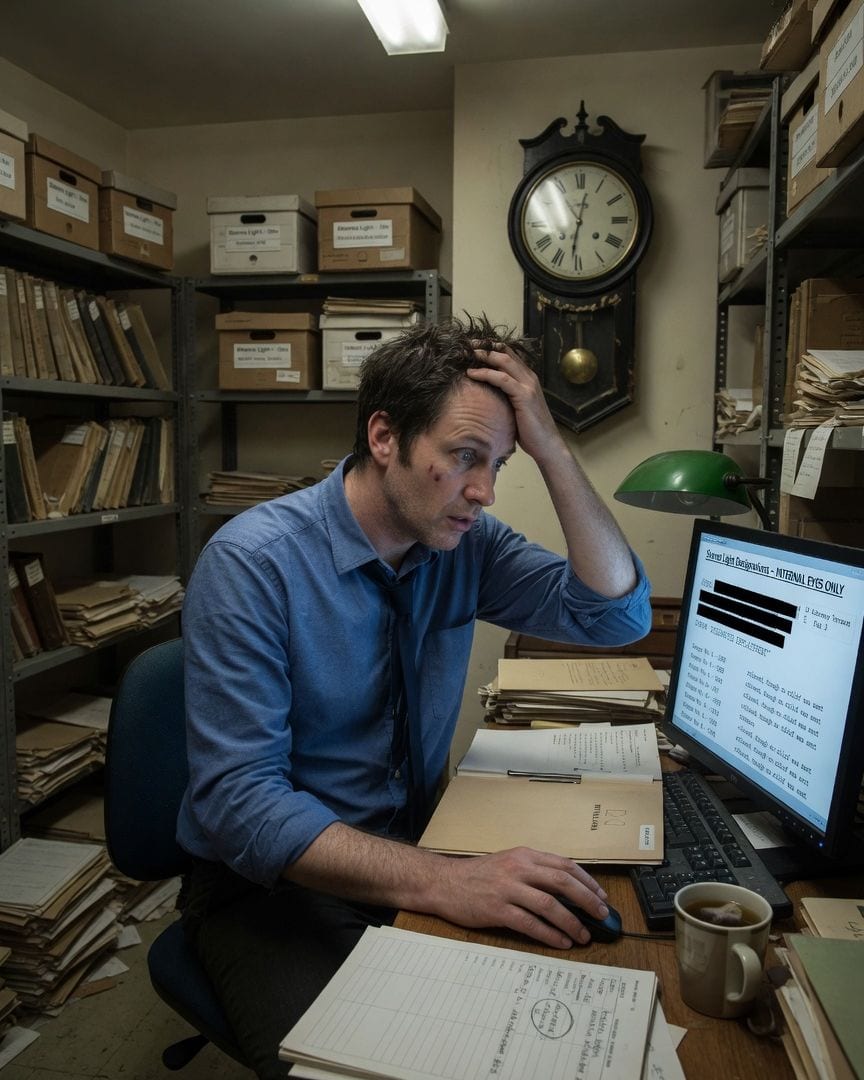
I found my street address in a century-old lighthouse file, printed decades before I lived there.
As a maritime archivist, my world revolves around forgotten lives and dusty ledgers. But the Skerne Light files broke that quiet rhythm, revealing a chilling pattern: 'Keeper number 6' relieved, though no relief was sent, repeating for decades. Now, an internal document with a strange code has led me to a redacted entry, revealing my own street address, decades before I ever lived there.
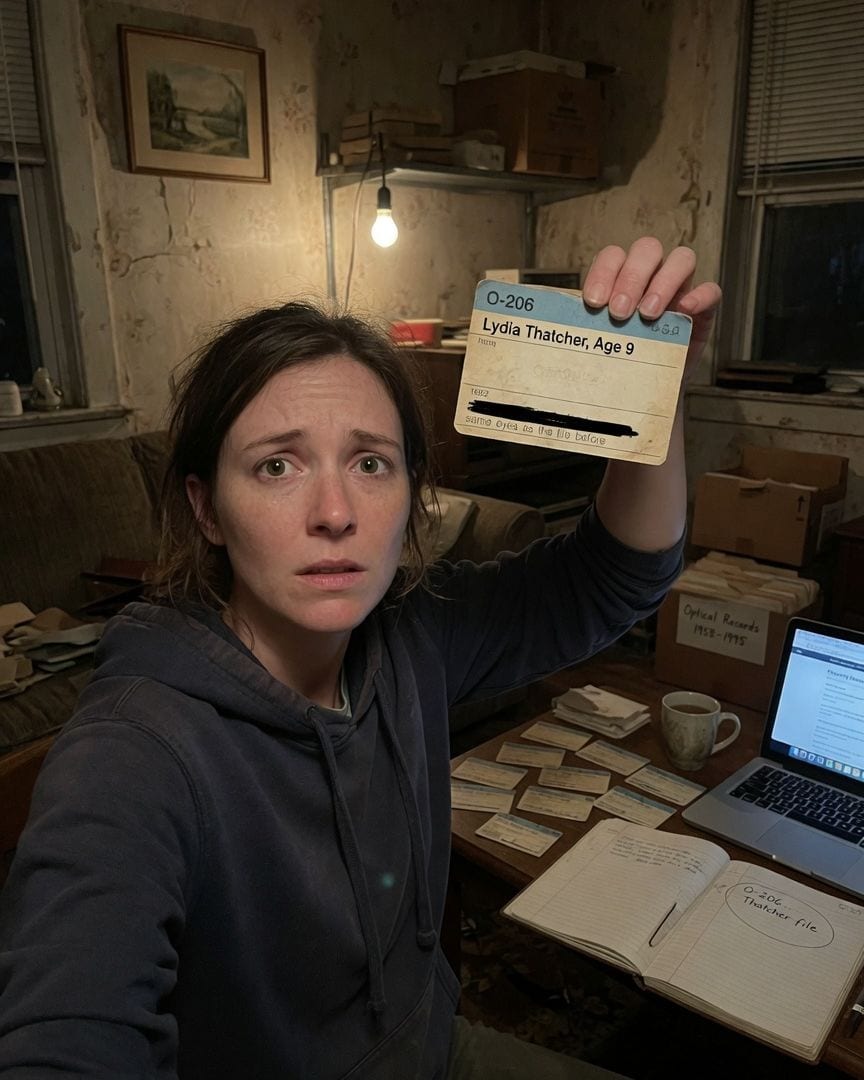
My own optical card is dated 1962, with my name on it. I wasn't born until 1993.
Sifting through old patient files from my former optical practice, I found my own O-206 card. It had my name, Lydia Thatcher, and my current home address printed on it. But the card was dated 1962, decades before I was even born, and a redacted note mentioned 'same eyes.'
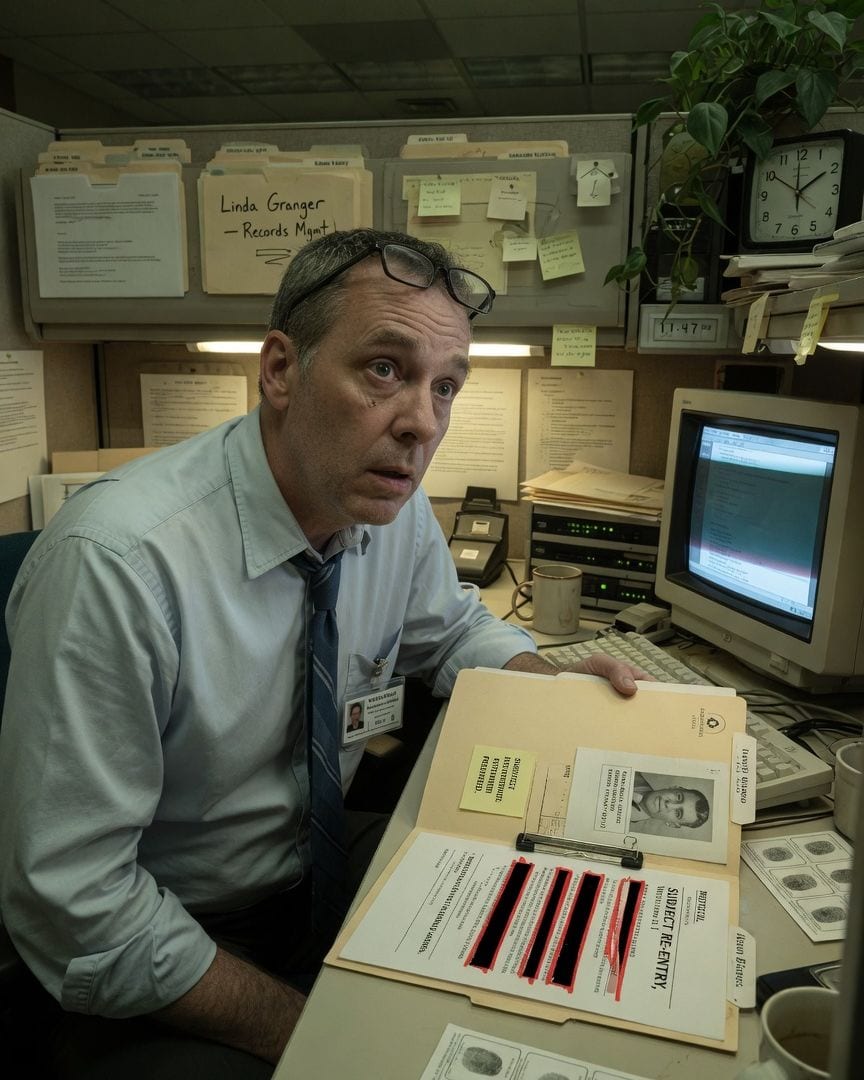
A declassification agent processed old Cold War files. A man reported dead in 1951 had 1958 fingerprints matching an employee badged into the building that morning.
Anton Skeel, a declassification agent nearing two decades of service, meticulously processed the endless backlog of Cold War secrets. His cubicle hummed with the ghosts of forgotten files, but one 'Hollow Bell' folder held a particularly glaring anomaly. It contained a 1958 fingerprint card for Henry Bishop, a man officially reported dead in 1951. When Anton fed the print into the active database, it matched Carl Romano, an employee badged into the building that very morning. A cold certainty settled over him: this wasn't an error, but a system designed for such impossible discrepancies.
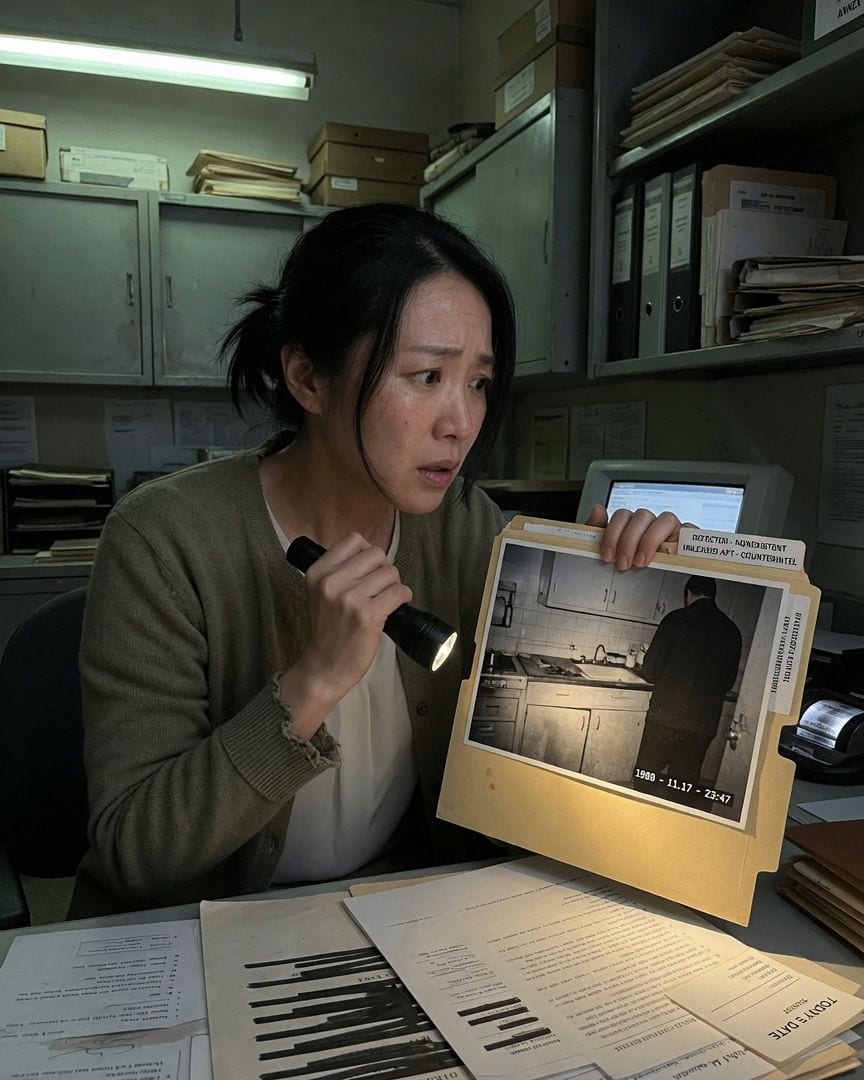
Against a midnight deadline, archivist Junie Kwan finds a Cold War dossier with a photo of her grandmother's kitchen, empty the night of the funeral, with an unknown figure standing inside.
Archivist Junie Kwan huddled in the hushed, cool Alexandria archives, working against a midnight court order to reseal a strange counterintelligence dossier. The file, dense with blanked sections, concerned a 'defector who never existed' and an 'unleased apartment.' As she scanned a grainy surveillance photo, a prickle of unease turned to dread: it was her grandmother's kitchen, dated 1988, the night of the funeral. A tall, rigid figure stood at the sink, yet Junie knew with certainty the apartment had been empty and locked that night. How could an impossible presence appear in a locked, empty room, tied to a phantom Cold War case?
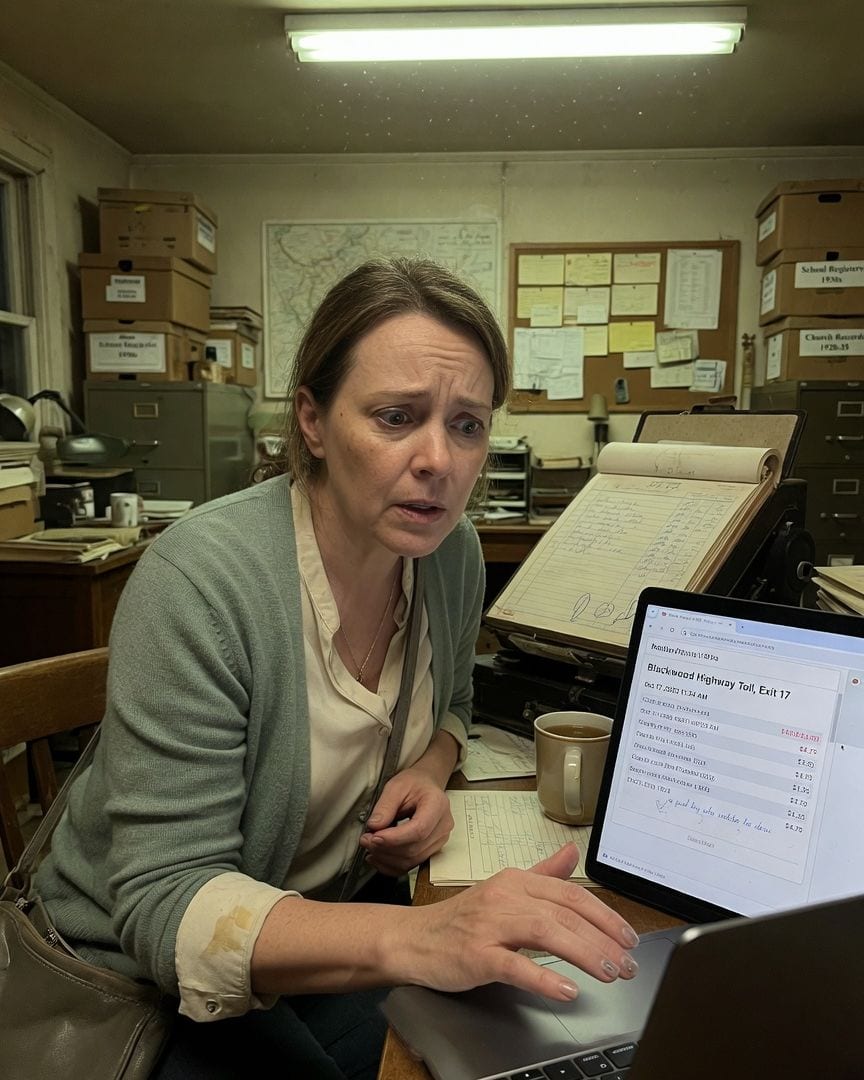
A 1931 school register marks me present every single day of that spring term — but I was born in 1969. And the teacher's note beside my name calls me 'a quiet boy who watches the door.'
As the village archivist, Lydia Kowalski uncovered her own name in a 1931 school register, decades before she was born. Then she found her unmistakable signature in the book, followed by the teacher's chilling note describing 'a quiet boy who watches the door'. Later, her bank statement showed a highway toll charge from a place she'd never been, on a day she was home with the flu.
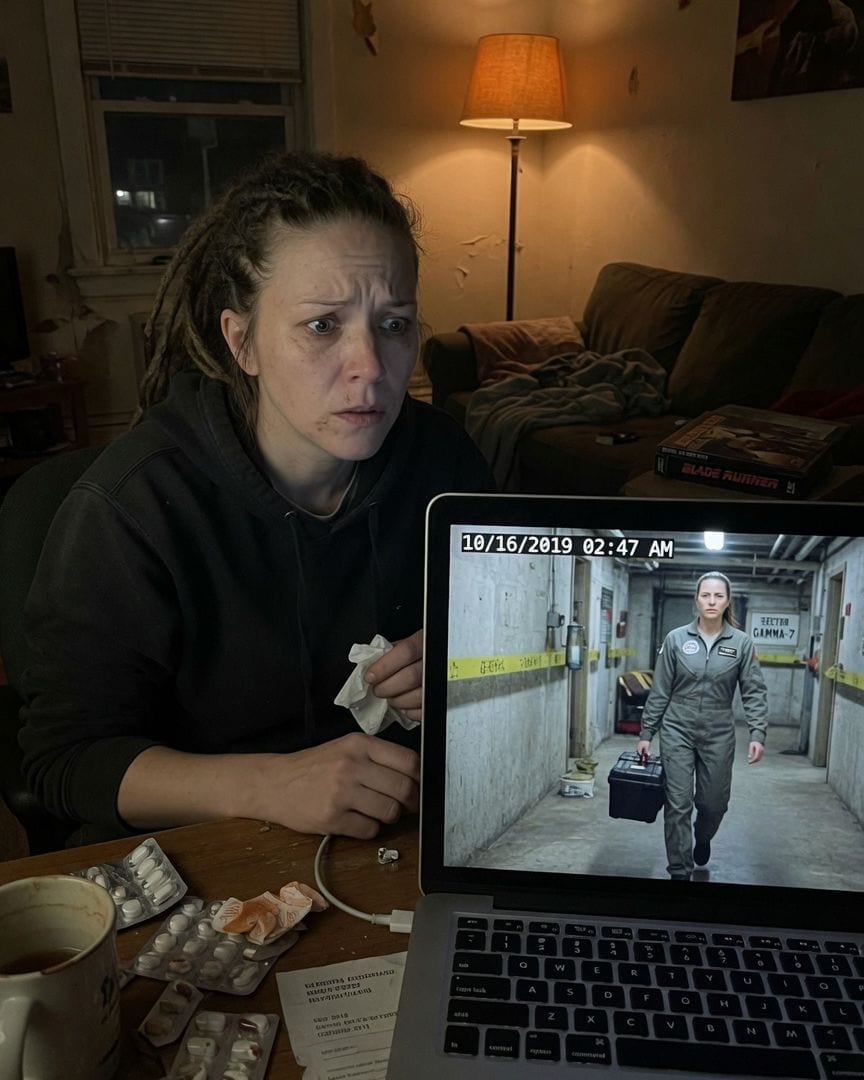
My timesheets show me working night shifts in a town I never lived in. The signatures are mine. The pay went to an account that isn't.
An old employer sent me timesheets from five years ago, detailing night shifts I supposedly worked at a depot 80 miles away. But I knew I was home recovering from surgery that entire week, nowhere near the industrial town. Then a security photo arrived, showing my face in an unfamiliar uniform, working a shift that wasn't quite me.