On his final crossing, Corporal Kowalski found a WWI soldier's name: 'Vestergaard, Corporal, 1918,' on his 1943 manifest.
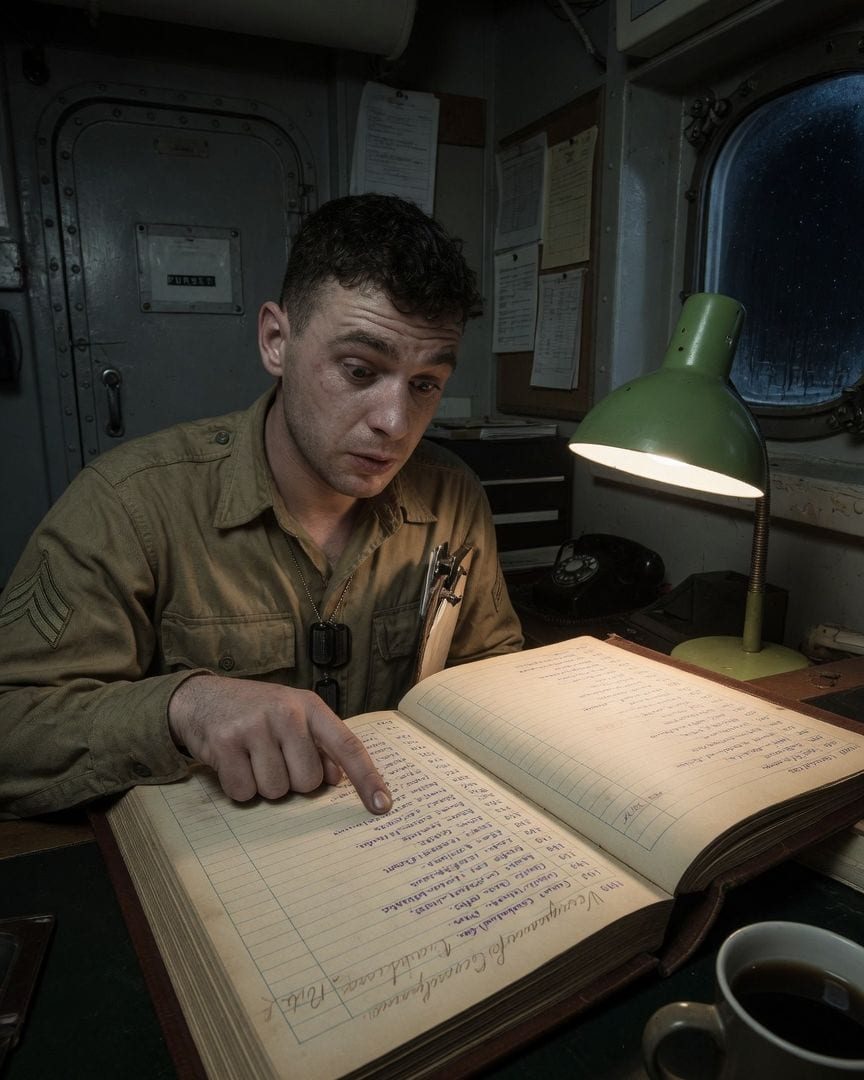
The blacked-out troopship USS Harrington cut through the heavy Atlantic swell, the cold, damp air of the troop deck clinging to Corporal Arthur Kowalski.
At 24, he was on his final Atlantic crossing, a promised reprieve before reassignment to the Pacific. He meticulously checked his clipboard, the names on the official embarkation roll a litany he knew by heart.
Four hundred and two men, compartment by compartment. Every name had a corresponding bunk, a gear locker, a face he recognized. Each man accounted for.
But when the boat drill bell rang and the men lined up at their assigned boat stations, a chill that had nothing to do with the ocean seeped into Kowalski’s bones.
He ran the count again, his eyes scanning the lines of khaki-clad figures, calling names off the roll, watching each man answer. He moved from front to back, then back to front.
Four hundred and three soldiers stood to the boats. Four hundred and three. The manifest swore there were four hundred and two.
He double-checked the adjacent companies, asked Sergeant Carl Norwood if anyone had borrowed a man, if anyone was covering for a sick bunkmate. No one was missing a buddy. No one was out of place.
Yet the numbers refused to reconcile, stuck in an impossible loop, a cold, hard fact that defied every official record.
Kowalski spent the next two days running his own private investigation, discreetly re-checking bunks, cross-referencing duty rosters, even trying to catch a glimpse of the 'extra' man. He found nothing. Every official record, every physical inspection, confirmed the 402 count.
He felt the ship itself push back against his efforts, the creaking timbers and groaning metal refusing to yield answers. Captain Deborah Patterson, 38, the ship’s no-nonsense Executive Officer, dismissed his concerns as fatigue.
“Kowalski,” she’d said, her voice clipped, “the rolls are gospel. You’re shipping out soon. Get some rest.” But Kowalski couldn't rest. The discrepancy gnawed at him, a splinter under the skin of his meticulous mind.
During a quiet night watch, with the ship's engines thrumming a low, constant note through the hull, he sought out the master embarkation roll, a thick, leather-bound ledger kept locked in the purser's office.
He obtained permission from the duty officer, citing a need to double-check a supply manifest that didn't actually exist.
Under the dim, hooded lamp, its light barely breaking the surrounding gloom, he flipped through the crisp pages, the names of thousands of men, living and dead, flowing past.
He checked the current list, then the reserve, then the medical, searching for any possible misfiled entry. All 402. But something snagged his eye, a faint discoloration near the bottom of a page, almost like a smudge or a bleed-through.
He leaned closer, holding the page steady. Beneath the last entry for the current crossing, barely visible, as if someone had tried to erase it, was a single, handwritten name: 'Vestergaard, Corporal.' And beside it, a year: '1918.'
A cold dread, colder than the Atlantic night, settled over him. The ink was faded, archaic, its texture different from the machine-stamped entries around it, yet undeniably present on a page meant only for 1943.
He stared, his mind racing, trying to find a rational explanation for a WWI soldier’s name appearing on a WWII manifest. Perhaps it was a misprint, a factory error in the ledger itself?
He ran his finger over the date, the number 8 distinct beneath the pad of his finger. It wasn’t a factory error. It was written.
Kowalski stared at the faint, handwritten name 'Vestergaard, Corporal' on the 1943 embarkation roll. The date, '1918,' stood out, stark and impossible, a quiet scream on the page.
His finger traced the impossible entry, the old ink cool beneath his touch, woven into the very fabric of the official record he himself had just used to count 403 men.
He looked up, his eyes sweeping the empty purser's office, then out through the reinforced porthole to the black, churning Atlantic.
The impossible name on the page felt like a physical presence in the room, a silent witness to a count that could not be.
The ship groaned around him, a deep, metallic sigh in the endless dark, a sound that seemed to carry the weight of decades.
The next morning, Kowalski, fueled by stale coffee and a growing sense of unease, sought out Lieutenant Joel Mercer, the ship’s doctor, 30. Mercer, a pragmatic man with an almost clinical detachment, initially scoffed. “A clerical error, Kowalski.
Old ledger, fading ink, probably just a bleed-through from a prior page.” He gestured dismissively. But Kowalski produced a careful tracing of the name and date, drawn with painstaking accuracy.
Mercer, intrigued by the precision of Kowalski’s work, admitted it looked like a legitimate, if misplaced, entry. “Someone was very thorough,” he murmured, examining the tracing under a lamp.
Kowalski then confided in Sergeant Carl Norwood, 28, a seasoned NCO who respected Kowalski's meticulous nature, even if he didn't quite understand it. Norwood, though skeptical, agreed to help him discreetly search the ship’s older, less-accessed archives.
Deep in the ship’s bowels, past the rattling steam pipes and the thick smell of oil and brine, they found a small, dusty room filled with forgotten logs and manifests.
The USS Harrington was old, pressed into service, and its history was long. Among the brittle pages, they found a partial manifest from a 1918 transatlantic crossing.
It was incomplete, damaged by water, its edges flaking, but there, under a section for 'Unaccounted For,' was the name: 'Vestergaard, P. Corporal.' The initial was different, but the surname and rank matched, undeniably.
A faint, sepia-toned photograph, tucked into the same ledger, showed a young, earnest soldier in a WWI uniform, his eyes wide and distant, caught in a moment of time. Kowalski felt a cold chill bloom in his chest.
This wasn't a clerical error. This was a man, lost, now demanding to be counted.
The ship's records, designed for precision, were now revealing a terrifying pattern of unacknowledged absences, and the 'extra man' was no longer an abstract problem but a specific, named individual.
Kowalski and Norwood spent the following nights sifting through more of the decaying archives, finding other faint, impossible entries, other names from decades past subtly appearing in the margins of later manifests.
The 'extra man' wasn't unique; it was a recurring phenomenon, a relentless re-inscription.
One evening, as Kowalski was returning from the archives, his flashlight beam cutting a path through the dim corridor, a shadow detached itself from the gloom of a bulkhead.
Captain Patterson stood there, her face unreadable in the weak emergency lighting.
“Corporal Kowalski,” she said, her voice low, a flat tone that carried a distinct weight, “I understand you’ve been spending a considerable amount of time in the ship’s historical records.
Is there a specific supply issue that requires such… extensive research?” Her tone was devoid of anger, but carried a distinct warning. Kowalski felt a prickle of unease, a cold knot forming in his stomach.
He mumbled something about inventory discrepancies he was trying to track through older ledgers. Patterson’s gaze was sharp, unwavering. “This ship, Corporal, has a long memory. Some things are best left undisturbed. Focus on your current duties.
Your reassignment orders are being processed.” The implication was clear: stop digging, or risk your future.
Later, as he made his rounds, Kowalski noticed small, almost imperceptible shifts. A heavy steel door he’d left ajar in the archives was now firmly shut, its latch engaged with a quiet thunk.
A page in a ledger he’d been examining, marked with a slip of paper, was subtly turned, the paper gone. He wasn't just investigating; he was being observed.
The ship itself seemed to be watching, its ancient timbers groaning in the swells, a silent, knowing presence. The 'extra man' wasn't just a number; it was a force, and it didn't appreciate its secrets being disturbed.
The next day, Kowalski confronted Captain Patterson, not with accusations, but with the specific, impossible entries he’d found.
He laid out the careful tracings of 'Vestergaard, Corporal, 1918' and several others he and Norwood had unearthed, along with the faded photograph.
Patterson listened, her expression slowly shifting from professional skepticism to a weary resignation, the sharp lines of her face softening into something approaching sorrow. Finally, she sighed, running a hand through her short, graying hair.
The silence in her cramped office was heavy, broken only by the distant thrum of the engines.
“The Harrington,” she began, her voice barely a whisper, a contrast to her usual clipped tone, “has always been… a difficult ship. She’s old. Saw service in the Great War, too. There were stories, even then.
Men lost, never quite accounted for. The official records, always a man short, or a man too many. They called it ‘Harrington’s Ghost,’ but it was never a ghost. It was the ship itself, correcting the ledger.”
She explained that for decades, certain names, men who died at sea and were never properly logged, would subtly reappear in the ship’s manifests. Not as living men, she clarified, but as silent, unacknowledged entries, physical facts that defied logic.
“They just want to be counted, Arthur,” she said, using his first name for the first time, a gesture of unexpected intimacy. “The military demands accountability. And this ship… she enforces it, even beyond the grave.
Every tally, every roll call, every muster… it’s a living document. And if a name is missing, it finds a way to be added. If a count is wrong, it makes it right.”
The ship’s extra man wasn't a random anomaly, a glitch in the system; it was the ultimate expression of the military's own sacred bureaucracy, a system so absolute it could manifest the uncounted.
The cold dread deepened in Kowalski as he realized the 'extra man' wasn't a flaw in the system, but the system itself, brutally correcting its own forgotten errors, a terrifying, sentient ledger keeper.
Captain Patterson had given him access to the deepest, most restricted archives: the ship’s original commissioning logs, its full, unbroken chain of manifests dating back to its launch. She told him to find all the uncounted.
It was a solemn duty, a final act of reconciliation before the Harrington went into drydock.
Kowalski spent hours in the musty, airless room, the flashlight beam cutting through the dust motes dancing in the stale air, illuminating brittle pages and faded ink.
He found dozens of names, men lost in forgotten skirmishes, in storms, in accidents, their official records incomplete or nonexistent. Each name added a weight to the air, a silent pressure.
The room grew colder around him, a chill that seemed to emanate from the stacks of paper itself.
Then, in a brittle, water-stained manifest from 1918 – the same year as Corporal Vestergaard – under a section starkly titled 'Lost at Sea - Unaccounted For,' his beam caught a familiar surname.
It was faded, almost illegible, but undeniably present, the curling script unmistakable. 'Kowalski, Private A.' His own family name, etched into the ship’s ledger from decades before his birth, a ghost from his own lineage staring back from the page.
He felt a profound chill, the blood draining from his face. His hand trembled, sending the flashlight beam dancing across the ancient script.
He wasn't just an observer; he was part of the ship's dreadful accounting, named in its ledger of the lost.
The revelation of his own name in the ancient manifest shattered Kowalski’s composure. He returned to Captain Patterson, the brittle page clutched in his trembling hand.
“My family,” he choked out, the words catching in his throat, “my great-uncle, Anthony Kowalski. Lost at sea, WWI. Records were always vague, said he just… disappeared.” Patterson nodded gravely, her gaze steady. “The ship remembers, Arthur.
Some families have a deeper connection to these vessels than they know. The Harrington doesn’t just count the living; it accounts for its own. Your great-uncle was one of the uncounted.
And sometimes, when the ledger is out of balance, it calls for a new hand to set it right. Someone with a stake in the count.”
The true horror wasn't just an extra man, but a living, breathing system of cosmic accountability. The 'extra man' was a placeholder, a symptom of a deeper, more profound imbalance.
The ship, a silent, ancient arbiter, sought to balance its books, and sometimes, it reached across generations to do so.
The names on the manifests weren't just entries; they were souls seeking recognition, and the ship, in its own terrible way, was ensuring they received it.
The 403rd man, the silent figure at the boat drill, was not just Vestergaard, but a representation of all the lost, a physical echo of the ship's forgotten dead, given form by the very system that denied them official closure.
Every inexplicable detail, every impossible count, now clicked into a terrifying, coherent whole. The ship wasn't haunted; it was simply accounting.
With Captain Patterson’s grim approval, Kowalski and Norwood began the harrowing task of compiling a complete, accurate list of every 'unaccounted for' name they could find in the ship’s archives, a counter-manifest of the forgotten.
It was a race against the clock. The USS Harrington was just days from port, days from drydock and decommissioning, a final, irreversible act that would seal the fate of its uncounted dead, forever denying them the acknowledgment they sought.
They worked tirelessly, their hands stained with dust and the faint smell of decay, sifting through decades of logs.
Kowalski felt a strange, detached calm as he added name after name to their new, unofficial roll, the pencil scratching softly on the clean white paper.
He felt a peculiar connection to the task, as if his great-uncle, Private A. Kowalski, was guiding his hand, urging him onward. The names, once silent entries, now whispered in his mind.
On the final night before docking, with the ship's engines slowing to a gentle thrum as they approached the harbor, Kowalski stood on the troop deck, the new, meticulously compiled manifest in his hand.
He called out each name, slowly, clearly, acknowledging every 'unaccounted for' soul. Norwood stood beside him, a silent witness, his face etched with a mix of apprehension and awe.
As the last name was spoken, a profound quiet descended upon the ship, deeper than the usual night silence. The air grew still, the groaning timbers seemed to hold their breath, a collective pause.
Then, a faint, almost imperceptible tremor ran through the deck, a sigh of release that resonated deep within Kowalski’s own bones. The ship had balanced its books. The count was finally, truly, reconciled. But the cost was Kowalski himself.
The weight of all those names, all those forgotten lives, settled deep within him, taking root. He had completed the count, but he had also become a part of it, a living ledger of the ship's terrible past.
The USS Harrington docked the next morning, its final active duty voyage complete. Arthur Kowalski, thin and pale, but with a strange, resolute light in his eyes, submitted his compiled counter-manifest to Captain Patterson.
It was filed away, unofficial but acknowledged, a testament to a truth only a few now knew. His reassignment orders came through, to a quiet supply depot in the Pacific.
He boarded the next transport, leaving the old troopship behind for good, its silhouette fading into the morning mist. Norwood watched him go, a concerned frown on his face. Kowalski had done his duty, but something had changed in him.
He walked with a new, quiet solemnity, his gaze often distant, as if still counting unseen men, his internal landscape forever altered.
Years later, Arthur Kowalski, now a civilian, lived a quiet life in a small town, far from the sea. He rarely spoke of the war, or of the USS Harrington.
But sometimes, late at night, a faint, almost imperceptible tremor would run through his old house, a distant echo of a ship's engines, a memory in the floorboards.
And when he meticulously organized his pantry, or balanced his checkbook, he would often find himself performing a silent, internal headcount, a roll call of names only he could hear, a phantom muster.
It was a habit he couldn't break, a quiet, internal accounting for all the uncounted. He always came out one too many.
His wife, Rachel, would sometimes find him staring blankly at a wall, a faint, almost imperceptible smile on his lips. “Arthur,” she’d ask softly, “what are you thinking about?”
He’d turn, his eyes clear but distant, and simply say, “Just making sure everyone’s accounted for.”
If this one got to you
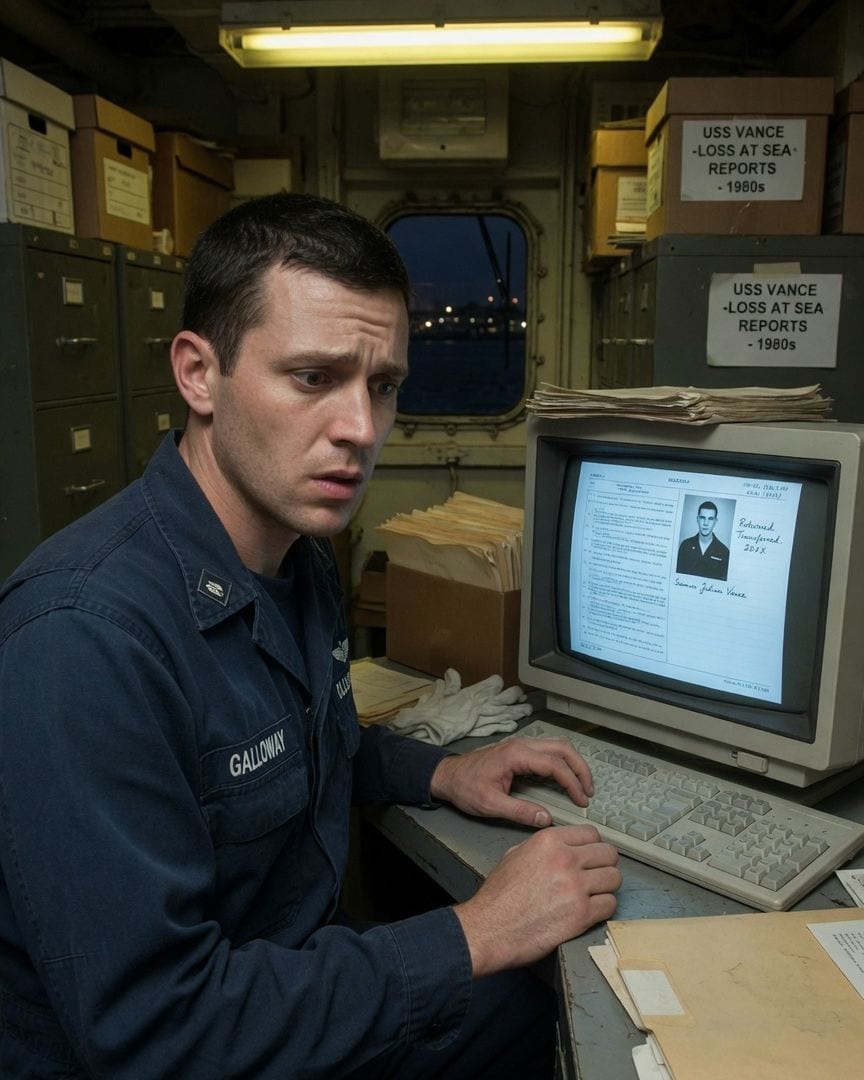
Petty Officer Galloway logged a sailor onto his ship. The man died at sea 40 years ago.
Petty Officer Joel Galloway scanned a sailor's ID on the USS Vance quarterdeck. The man's name, 'Seaman Julian Vance,' and his out-of-date uniform pricked at Galloway's memory. Later, the ship's berthing count came back one over, with an extra entry in the system but no physical body.
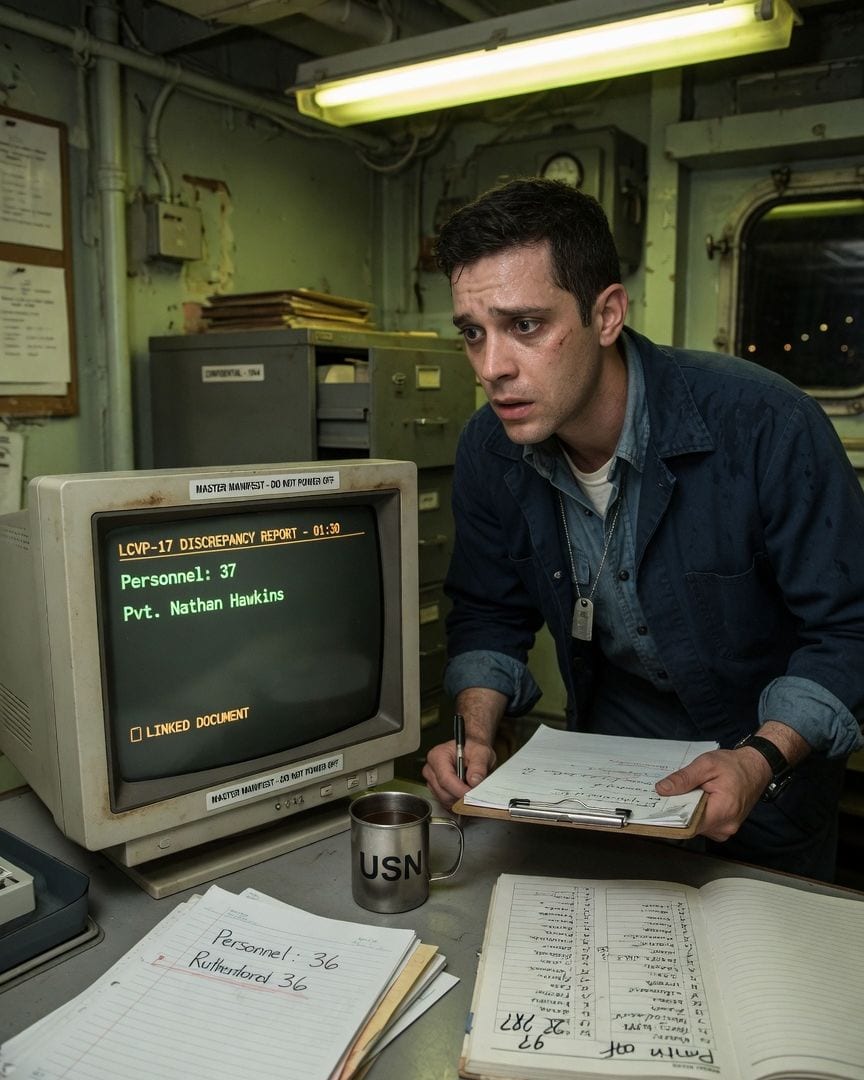
Coxswain's Mate Rutherford counted thirty-seven men in his landing craft, but the manifest logged only thirty-six. A hidden report, filed hours before, named Private Nathan Hawkins.
Coxswain's Mate Donald Rutherford, 28, began his final count for a standard load of thirty-six men in LCVP-17, the salty spray stinging his eyes. Halfway to the beach, a violent wave slammed the craft, throwing the men against each other. When the vessel settled, Rutherford instinctively recounted, his heart knocking against his ribs. This time, his count came back thirty-seven bodies crowded into the small boat. Official logs confirmed only thirty-six men, yet a hidden report, dated hours before his deployment, listed an extra man by name: Private Nathan Hawkins.
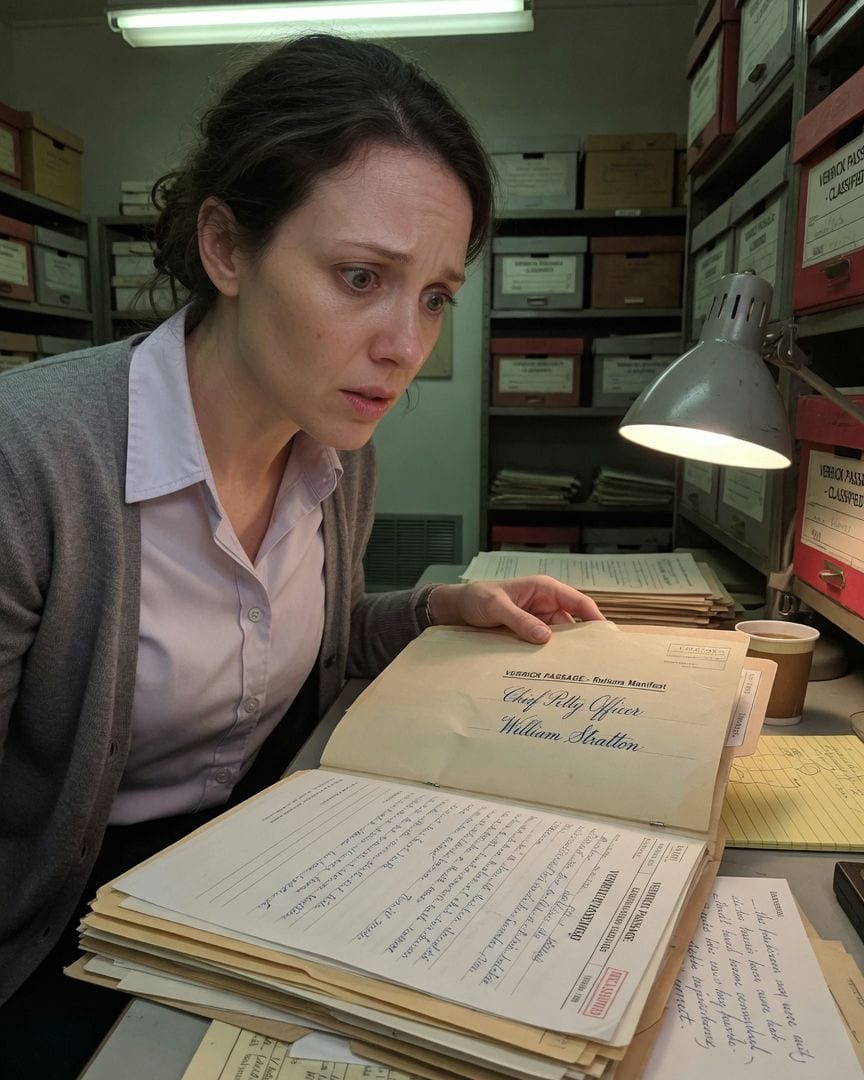
A records reviewer found personnel files for men lost 80 years ago, still being signed in an identical, perfect hand.
In the sterile hush of the declassified archives, meticulous reviewer Ione Fash had a routine task: cross-referencing witness statements from the Verrick Passage file. But as she reviewed files eighty years thick with official silence, she found nine separate interviews containing the exact same chilling sentence, all in an identical, precise hand. Her rational mind sought explanation, yet then she discovered something worse: personnel files for men lost in 1943, still being updated with modern requisitions and payroll runs. Each impossible entry, including a manifest signed just two weeks ago by a casualty from eighty years prior, bore the same unnervingly perfect signature. The file wasn't just a record of the lost; it was still being signed.
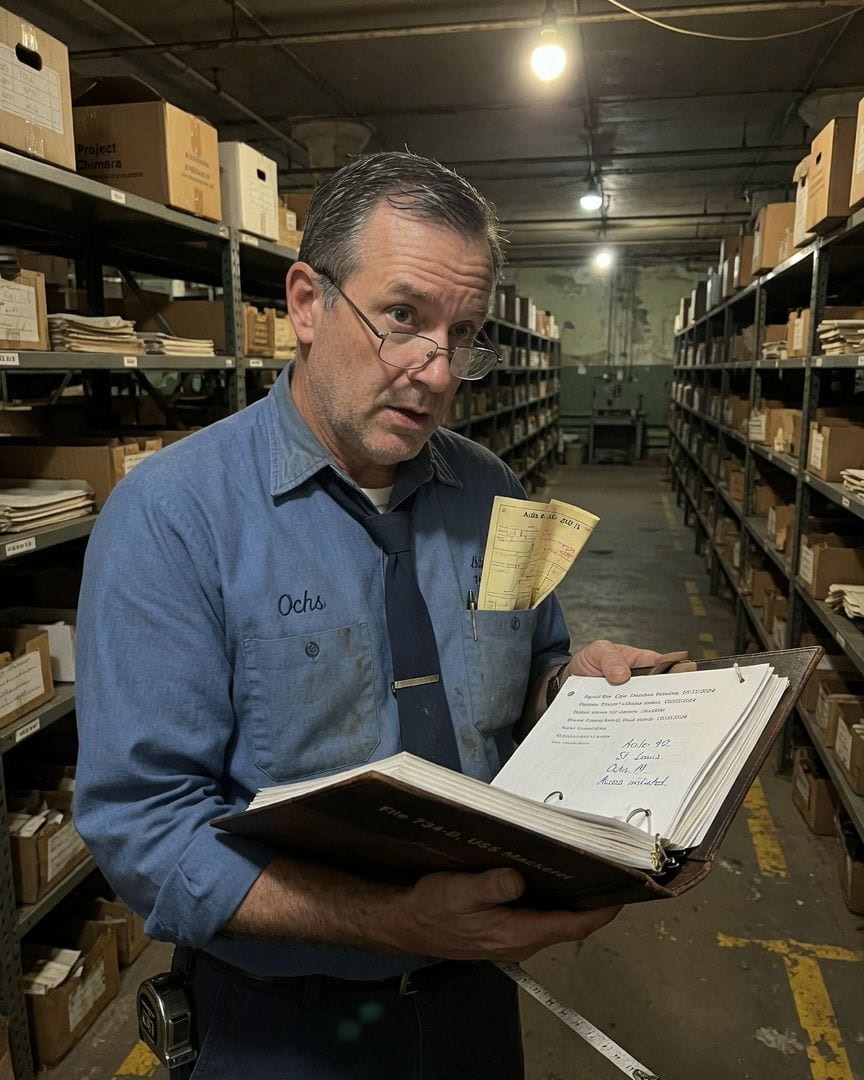
On his final inspection, a depot worker found Aisle 40 had grown 61 feet longer, and a Cold War submarine file hummed warm in his hand.
Marlin Ochs, a man of precise rhythms at the St. Louis depot, approached Aisle 40 for its final inspection before the entire structure was pulped tomorrow. For nearly two decades, the aisle had been a consistent ninety-two paces long. But on this night, his boot heels clicked past the expected mark, stretching to one hundred and nineteen paces, revealing an impossible, colder extension. Deep inside, Marlin found a heavy, leather-bound binder titled 'File 734-B, USS Mackerel,' a Cold War submarine lost with all hands in 1958. It felt oddly warm, almost humming against his palm, filled with maintenance logs and payrolls dated decades after the sub was sunk.
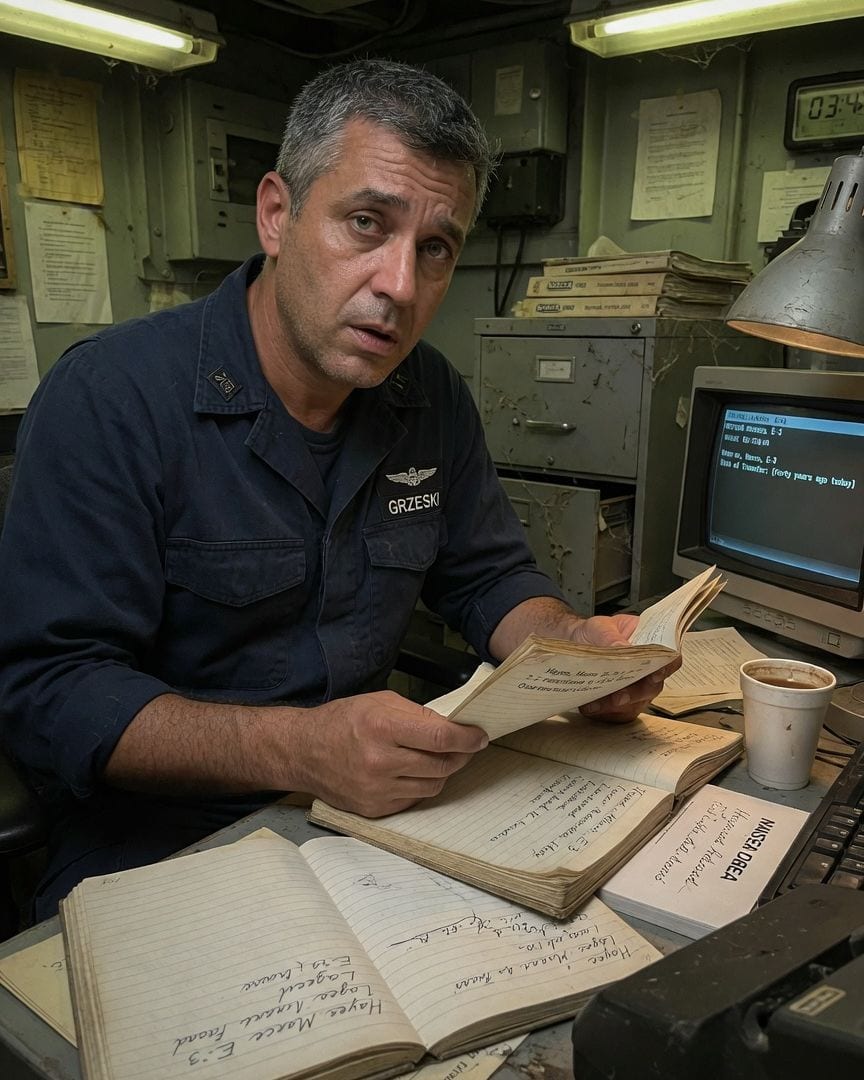
A Petty Officer logged a sailor on his final watch. Then he found the same exact entry in a logbook from forty years ago.
Petty Officer Anton Grzeski stood his final quarterdeck watch on the USS Vance, just six hours from transfer. The humid Gulf night was thick around him as a sailor climbed the gangway at 0130, giving his name as Marco Hayes. Grzeski logged him aboard, but a nagging memory surfaced: Hayes had been listed as transferred off forty years ago. The next morning, a berthing count came back one over, and Grzeski's own logbook entry for Hayes chillingly mirrored one from four decades prior, found in the ship’s dusty archives. What impossible record had he just confirmed?
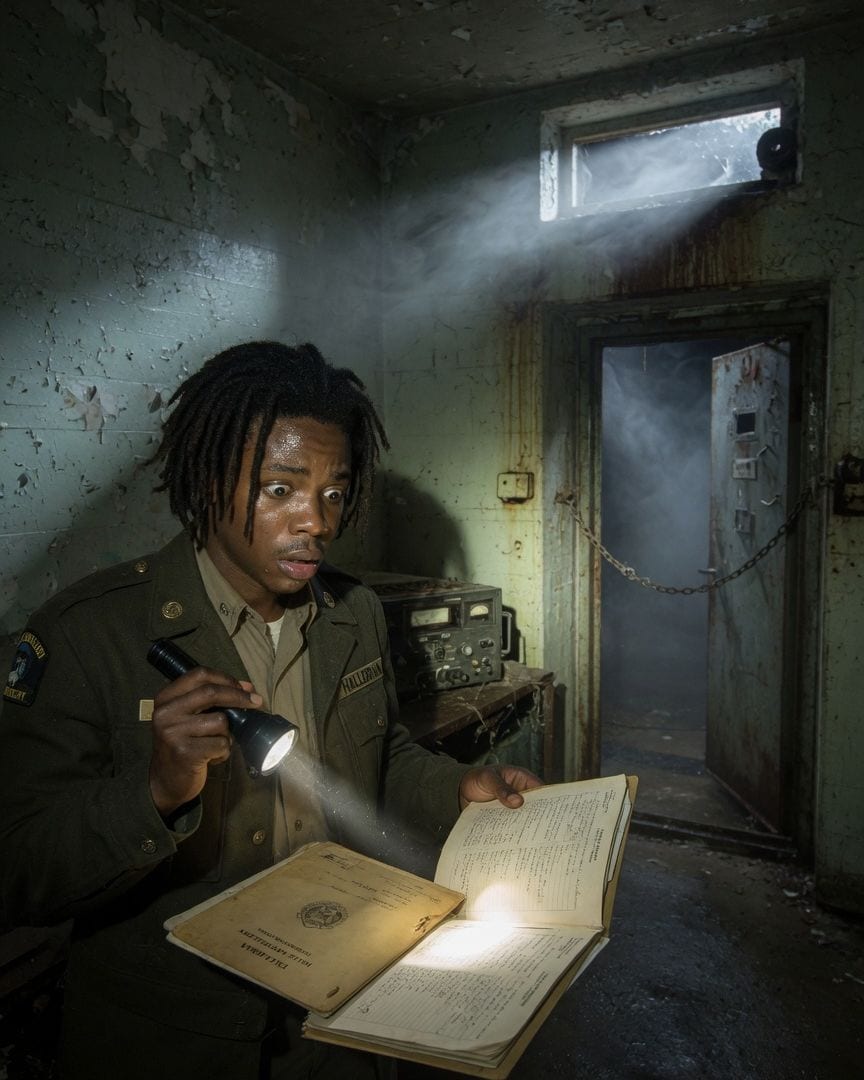
On his last shift, a coast sentry finds his own name signed in fresh ink on a 1943 army record, dated exactly one year ago.
Private Roy Halloran counted the final hours of his last watch behind the searchlight of an old, rust-tinged artillery bunker on the northern California coast. His monotonous graveyard shift was nearly done, and his transfer close, but at 0100, the swirling coastal fog revealed a silent landing party of men on the beach, their gear anachronistic and alien. When dawn burned off the mist, the beach was empty, yet faint drag marks led directly to the bunker’s long-sealed rear hatch, now mysteriously ajar. Inside, amidst the cold, acrid air, he discovered a pristine 1943 army service record bearing his own name. A freshly signed entry dated exactly one year ago to the day left him wondering: had the past somehow reached out to claim him?