A records reviewer found personnel files for men lost 80 years ago, still being signed in an identical, perfect hand.
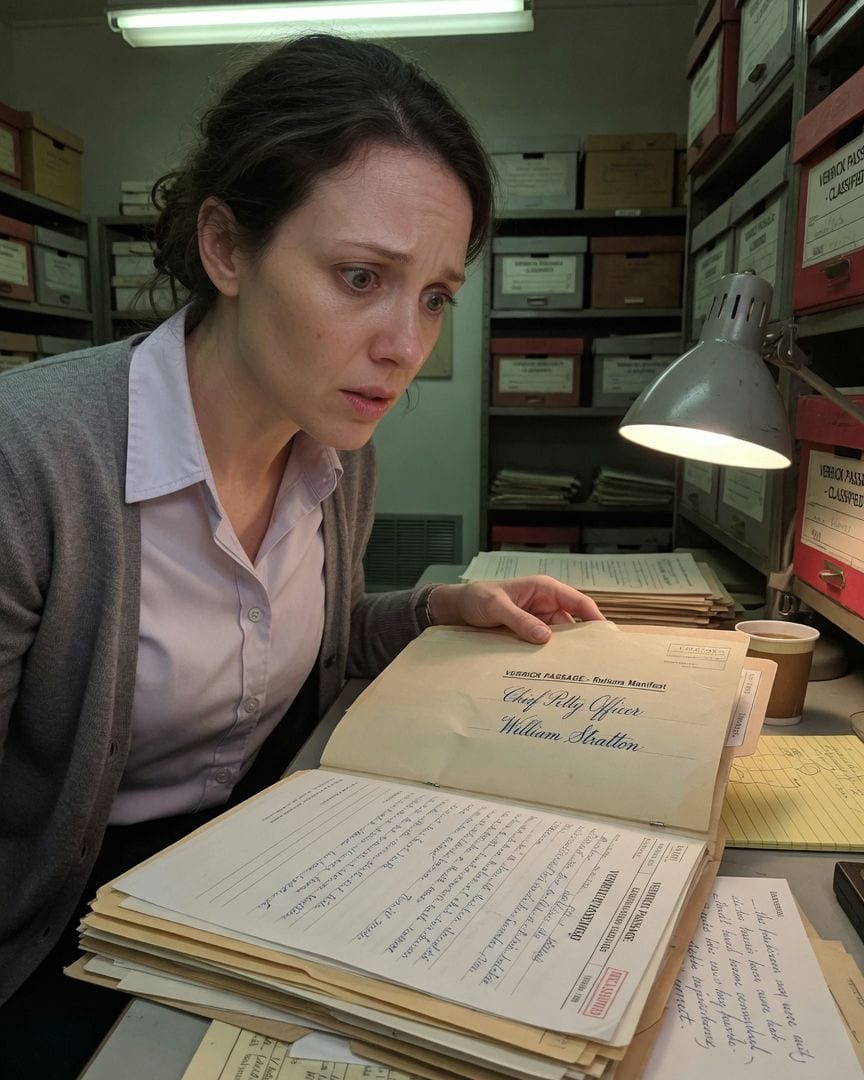
Ione Fash, a meticulous records reviewer, sat in the sterile hush of the declassified archives, the fluorescent lights humming overhead. The Verrick Passage file, thick with eighty years of official silence, lay open before her.
Her task was routine: cross-reference witness statements for anomalies. But anomaly wasn't the word for what she found.
Nine separate interviews, conducted by different agents in different towns across the country, all contained the exact same sentence, verbatim: "the fourteen men were not missing, that they had been put somewhere, and that the paperwork was correct."
Her rational mind, honed by years of sifting through bureaucratic minutiae, immediately sought a mundane explanation: a copyist error, perhaps, or a standard boilerplate phrase. But then she noticed it.
Beneath each statement, the signature of the witness, the date, the interviewing officer’s name – and the body of the statement itself, every single word, was rendered in an identical, precise, almost calligraphic hand.
Not similar, not stylistic, but perfectly, undeniably the same. A cold dread, like the chill of the air conditioning finding its way under her shirt, settled deep in her bones. This wasn't human error. This was something else entirely.
The identical handwriting gnawed at Ione. She couldn't unsee it. Dismissing the official statements for a moment, she pulled the original personnel files for the fourteen men lost in the Verrick Passage incident.
These were meant to be inert records, closed and archived decades ago. Instead, as she flipped through the thick folders, a fresh wave of unease washed over her.
Mixed among the faded enlistment papers, training logs, and commendations were entries that simply could not exist.
A requisition for a specific, modern piece of sonar equipment, dated just last year, signed by Lieutenant Commander Roy Ellsworth, who vanished in 1943.
A payroll run from three months prior, listing all fourteen men, with a maintenance sign-off for a piece of ship machinery that hadn't existed on their vessel.
Each impossible entry was penned in the same unnervingly perfect, consistent hand she’d seen on the witness statements. It wasn't just that the paperwork was 'correct' – it was that the paperwork was still being generated.
Her initial rationalizations—a misplaced document, a bureaucratic ghost—shattered. This wasn't an anomaly in the past; it was an active, ongoing process, writing new history into dead men's files.
Ione isolated one specific entry: a manifest for a new batch of rations, dated two weeks ago, signed by Chief Petty Officer William Stratton, whose name had been on the Verrick Passage casualty list for eighty years.
The signature was immaculate, precise, the ink still seeming to gleam under the fluorescent light.
It was the same handwriting that had crafted the chilling witness statements, the same hand that had signed off on sonar equipment for a sunken ship, the same hand that had claimed payroll for ghosts.
Ione stared at the page, her fingers hovering inches above the impossible signature. The file wasn't just a record of the lost. The file was still being signed.
The next morning, Ione presented her findings to William Calloway, her supervisor, a man whose desk was a monument to decades of federal service.
He listened patiently, his face impassive as Ione laid out the cross-referenced dates, the impossible entries, the undeniable consistency of the handwriting. Calloway initially dismissed it as an elaborate forgery or a complex, multi-layered clerical error.
He spoke of 'deep-seated bureaucratic inertia' and 'the occasional, regrettable processing anomaly.' But Ione was relentless. She showed him the sheer volume of the impossible entries, not just in one man's file, but in all fourteen, spanning years.
She pulled up the original interview transcripts for the 'witnesses,' highlighting how the identical statements were recorded by different agents, often from different agencies, ruling out a single copyist.
She even found a memo, buried in a sub-file, requesting 'updated inventory reports' for the Verrick Passage vessel, dated only a decade ago. Calloway's dismissive tone slowly faded, replaced by a deep-set frown.
He began to rub the bridge of his nose, a familiar gesture of deep thought. He acknowledged the 'unusual nature' of her evidence, but his gaze seemed to drift past the documents, as if seeing something else entirely.
The silence in Calloway's office seemed to stretch, taut as an old rubber band, threatening to snap. 'Some things,' he murmured, 'are more persistent than they appear.'
Ione continued her investigation, emboldened by Calloway's reluctant acknowledgment. But as she dug deeper, she noticed subtle shifts. Access to certain classified databases, previously seamless, now required additional authentication or simply timed out.
Several Verrick Passage sub-files she had requested from central archives were 'misplaced' or 'under review.' One morning, she arrived at her desk to find a sticky note adhering to her monitor.
It was a standard yellow square, but the single word written on it, in neat, precise block letters, made her heart pound: 'STOP.' The handwriting was unmistakable. It was the same hand.
The dread, previously an intellectual puzzle, now became a chilling, personal threat. Someone knew. Someone was watching. The air around her desk seemed to thicken, heavy with unspoken observation.
When she mentioned it to Calloway, he merely nodded, his face grim. 'I told you, Ione,' he said, his voice low, 'some things are better left buried. You're getting too close.'
His eyes held a flicker of something she couldn't quite place – fear, or perhaps a warning. The hunter had become the hunted.
Ione refused to stop. The sticky note, the blocked access—it only fueled her. She confronted Calloway again, pushing him harder, showing him the undeniable pattern, the sheer impossibility of what she was uncovering. 'William, this isn't a clerical error.
This isn't a forgery. This is a system. And it's still operating.' Calloway sighed, a deep, weary sound. He rose from his desk, walked to a filing cabinet tucked in a forgotten corner, and retrieved a plain, unmarked gray folder.
'I've seen these anomalies before, Ione,' he admitted, his voice barely a whisper. 'Not often, but always in files linked to... incomplete disappearances.' He opened the folder, revealing a series of photocopied pages. 'This is an unofficial index.
Maintained by a very small, very quiet group of people over generations. People who, like you, saw something that didn't fit.' The pages contained a meticulously hand-written list of dates, incident names, and unit designations.
Each entry was for a ship, an aircraft, or a unit that had vanished without a trace. And next to each, a small, consistent symbol, almost a sigil, rendered in that same precise, impossible handwriting.
'They're not just lost,' Calloway said, his voice hollow. 'They're... filed. And the paperwork never stops.' He pointed to a specific entry: 'USS Cyclops, 1918. Filed.' Then another: 'Flight 19, 1945. Filed.'
The earlier clues, the impossible statements, the active records for dead men—they all snapped into a terrifying, coherent focus. The handwriting wasn't just a detail; it was a signature. The signature of a pervasive, patient, bureaucratic horror.
Ione's eyes scanned the vast, meticulously kept ledger Calloway called an 'index.' It wasn't just a list; it was a sprawling, horrific tapestry woven through decades of American history.
She saw entries for lost submarines, entire bomber crews that vanished over the Pacific, even a forgotten Arctic research outpost swallowed by ice.
Each incident, spanning different branches of service and classifications, bore the same chilling mark: a small, consistent symbol next to the 'disappeared' entry, rendered in that same impossible handwriting.
The 'file that kept writing' wasn't an isolated phenomenon; it was a universal system, a deep, pervasive process that had been quietly absorbing people and units for generations. The dread tightened its grip, a cold, crushing weight.
She traced a finger down the column, her mind reeling from the sheer scale of it, the quiet horror of its relentless operation. And then she froze. Her finger had landed on an entry dated five years ago.
It wasn't a ship or a plane. It read: 'Department of Records, Section Gamma.' Her own department. Her own section. And next to it, the same, unnervingly familiar symbol, penned in that same impossible hand.
The file wasn't just signing for the lost; it was signing for those who sought them.
Calloway saw the horror on Ione's face, her finger frozen on the entry for their own section. He placed a hand on her shoulder. 'Section Gamma was the previous records review team,' he explained, his voice low and heavy.
'They were getting too close to a different pattern, a different thread. They didn't disappear, Ione. They were… reassigned. Filed.' He revealed the full, monstrous shape of the truth.
The 'secrecy machine' wasn't just an institution; it was a sentient, bureaucratic entity, a self-perpetuating system that didn't just hide information, but processed it.
The individuals and units weren't dead; they were absorbed into a state of perpetual, systematic existence, their 'files' actively maintained by the very entity that had taken them.
The impossible handwriting wasn't a human signature, but the machine's own, a kind of automated, perpetual record-keeper that never truly let go of its 'assets.'
He explained that the 'index' wasn't a list of victims, but a ledger of the machine's acquisitions, a record of what had been successfully 'filed.' The dread was in the coherence, the terrible, meticulous logic of it all.
Every clue Ione had found, every impossible entry, every consistent hand, clicked into place, revealing a horror that had always been there, quietly operating within the very fabric of the government, maintaining its own endless, chilling archives.
The hum of the fluorescent lights, usually a steady comfort, now felt like a low, incessant thrumming in her skull, the sound of the machine itself.
Ione recoiled, the full truth detonating in her mind. The machine wasn't some distant, abstract threat; it was embedded within the very walls of their office, its tendrils reaching into every file, every record.
She instinctively reached for her phone, her mind racing to expose it, to copy the index, to scream the truth to anyone who would listen. Calloway gently, but firmly, stopped her hand.
'You can't expose it, Ione,' he said, his eyes holding a resigned, unsettling calm. 'Exposing it means becoming part of it. It doesn't tolerate disruption. It integrates. That's its nature.'
He explained that there were only two outcomes for those who discovered the machine's true nature: either be 'filed'—absorbed into its endless bureaucratic existence like Section Gamma—or become an extension of it, one of 'the ones who knew,' quietly maintaining the facade, ensuring the smooth operation of its processes.
He spoke of others who had made the choice, subtle shifts in their demeanor, a newfound, unsettling patience in their work.
His own eyes, Ione realized, held that same quiet acceptance, a subtle, almost imperceptible shift in his usual bustling energy. The office, once a place of mundane order, now felt like a silent, waiting maw.
He reached into his desk drawer, pulling out a sleek, black pen, its cap already off. He offered it to her, the metal cool and heavy in his hand. 'The choice is yours, Ione.
Become a record, or become a record-keeper.'
Ione Fash’s name quietly appeared on a new, internal roster for a 'Special Records Maintenance Unit,' a designation previously unknown to the general department.
The Verrick Passage files, along with all the other problematic documents Ione had flagged, were swiftly re-sealed and returned to the archives, marked 'reviewed, no anomalies found.'
The impossible handwriting continued to appear in various internal documents, now seamlessly integrated with other official hands, its distinct precision becoming a new standard of departmental neatness.
The unofficial index Calloway had kept vanished from its hidden cabinet, its contents presumably absorbed into the machine's own perfect memory. Life in the archives continued, orderly and undisturbed, the quiet hum of the fluorescent lights a constant, reassuring presence.
Ione sat at her desk, reviewing a new batch of declassified files, the endless stream of paperwork a familiar comfort. She picked up her pen, a familiar weight in her hand, its cap resting beside her.
A colleague, Preston Lawson, passed by, asking about her weekend plans, a casual remark about the upcoming holiday.
Ione smiled faintly, a quiet, almost imperceptible shift in her eyes, and signed off on a routine document, a form approving a new batch of archival supplies. The signature was immaculate, precise, every line perfectly formed.
Weeks later, a new junior reviewer, Dean Underwood, noticed a peculiar consistency in the latest batch of routine sign-offs.
A certain neatness, a precise, almost calligraphic quality that seemed to crop up everywhere, across different sections and different types of documents.
He wondered if it was just a new departmental standard, a subtle shift in the unspoken rules of bureaucracy. He shrugs, picks up his pen, and signs his name, just below one of Ione Fash’s perfectly formed signatures.
If this one got to you
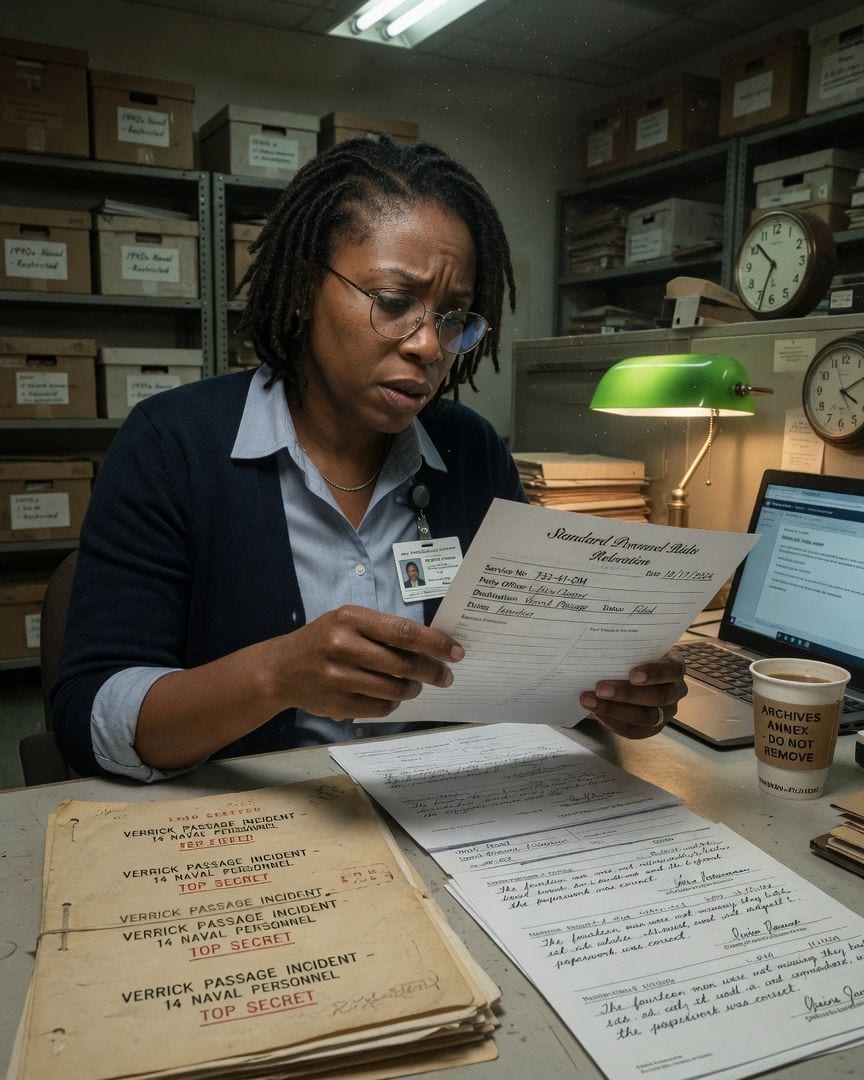
A declassification reviewer finds a form dated yesterday, listing a living sailor for relocation to an eighty-year-old passage, in the same impossible handwriting.
Declassification reviewer Ione Fash worked against a looming deadline, her final hurdle a stack of heavily redacted Verrick Passage files. Inside reports from 1944 detailing fourteen missing naval personnel, she found nine witness statements all containing the exact same phrase, penned in an identical, machine-like hand. Her methodical mind flagged the impossible anomaly, but true dread landed when she uncovered a standard requisition form. Dated yesterday, it listed a living, active-duty Petty Officer for 'Relocation' to the Verrick Passage, bearing that same chilling, impossible handwriting.
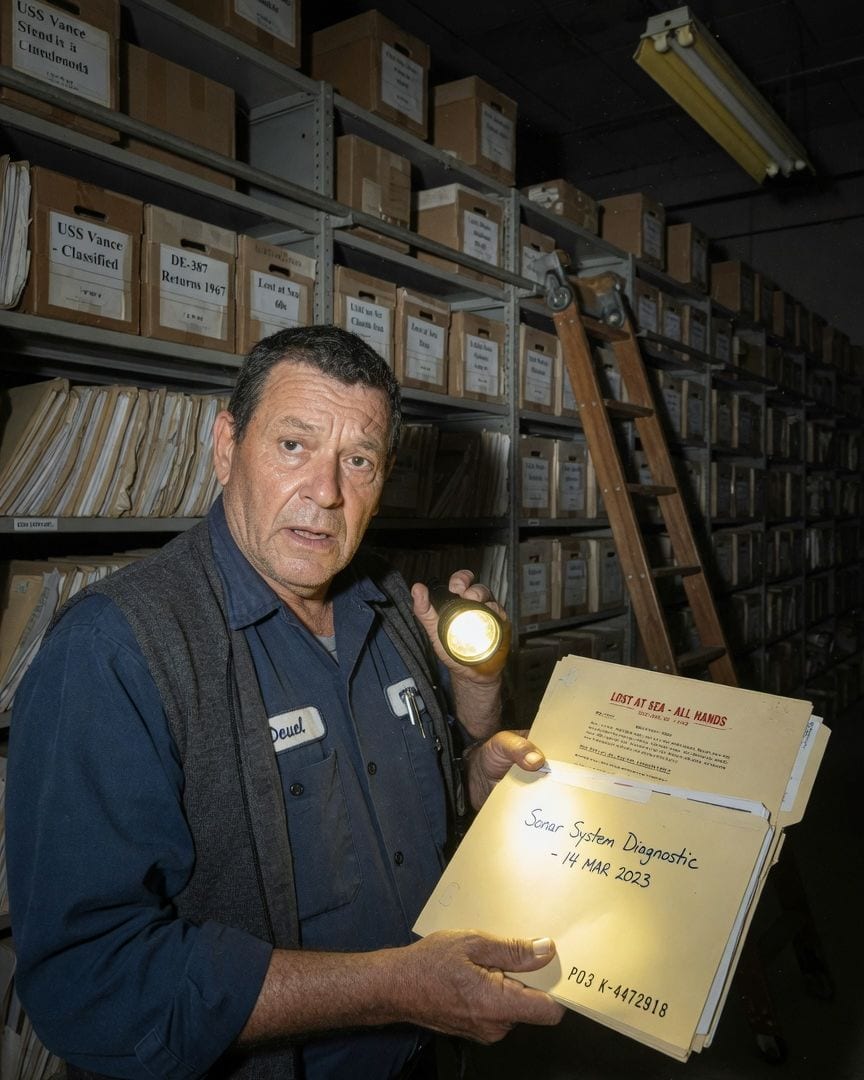
An archivist, alone in the Suitland annex, finds a 1968 lost Cold War ship file with a handwritten entry dated last Tuesday. The ink looks damp, but feels dry.
Carmine Deuel, 62, spent forty years amidst the dust and forgotten files of the Suitland annex. One night, alone in the cavernous space, a sticky squeal and the faint sway of a rolling ladder broke the silence. He found a classified file from the USS Vance, a ship lost in 1968, pulled from its shelf. Inside, a typed form held a handwritten entry: a routine sonar check, dated last Tuesday. The ink, impossibly, looked damp yet was perfectly dry. Who had accessed the file, and how could its entry be so recent?
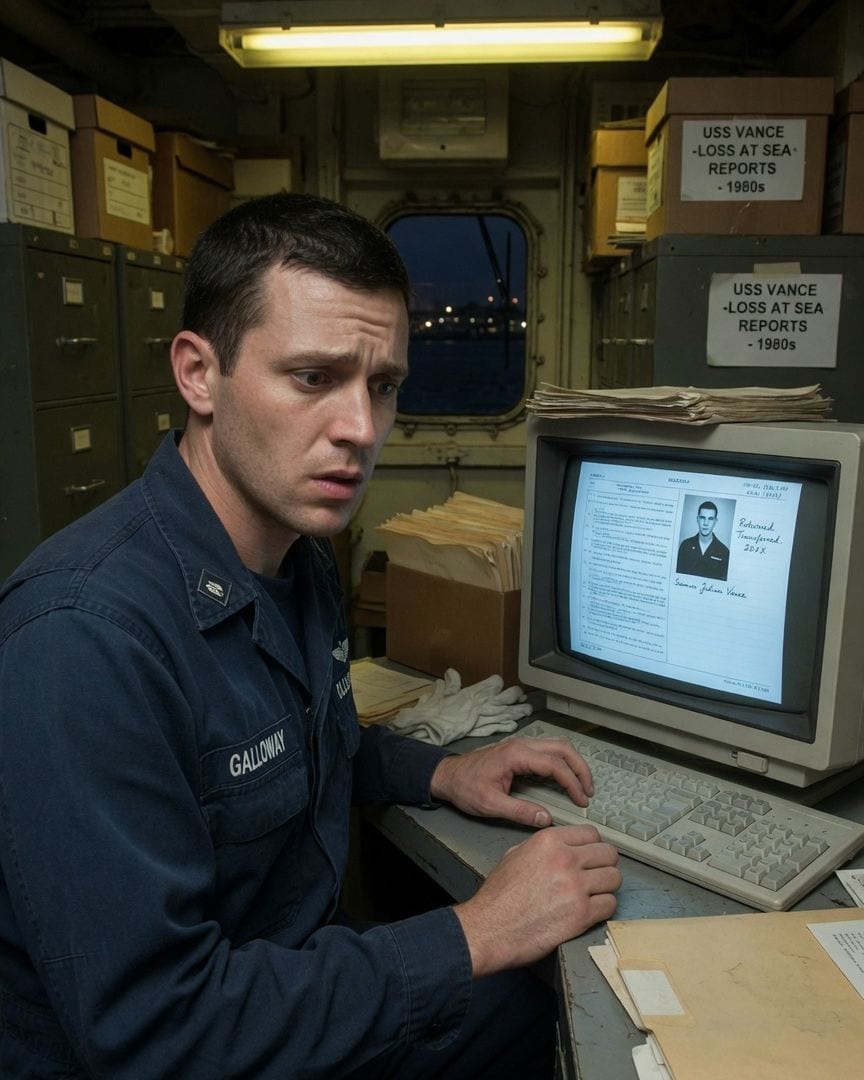
Petty Officer Galloway logged a sailor onto his ship. The man died at sea 40 years ago.
Petty Officer Joel Galloway scanned a sailor's ID on the USS Vance quarterdeck. The man's name, 'Seaman Julian Vance,' and his out-of-date uniform pricked at Galloway's memory. Later, the ship's berthing count came back one over, with an extra entry in the system but no physical body.
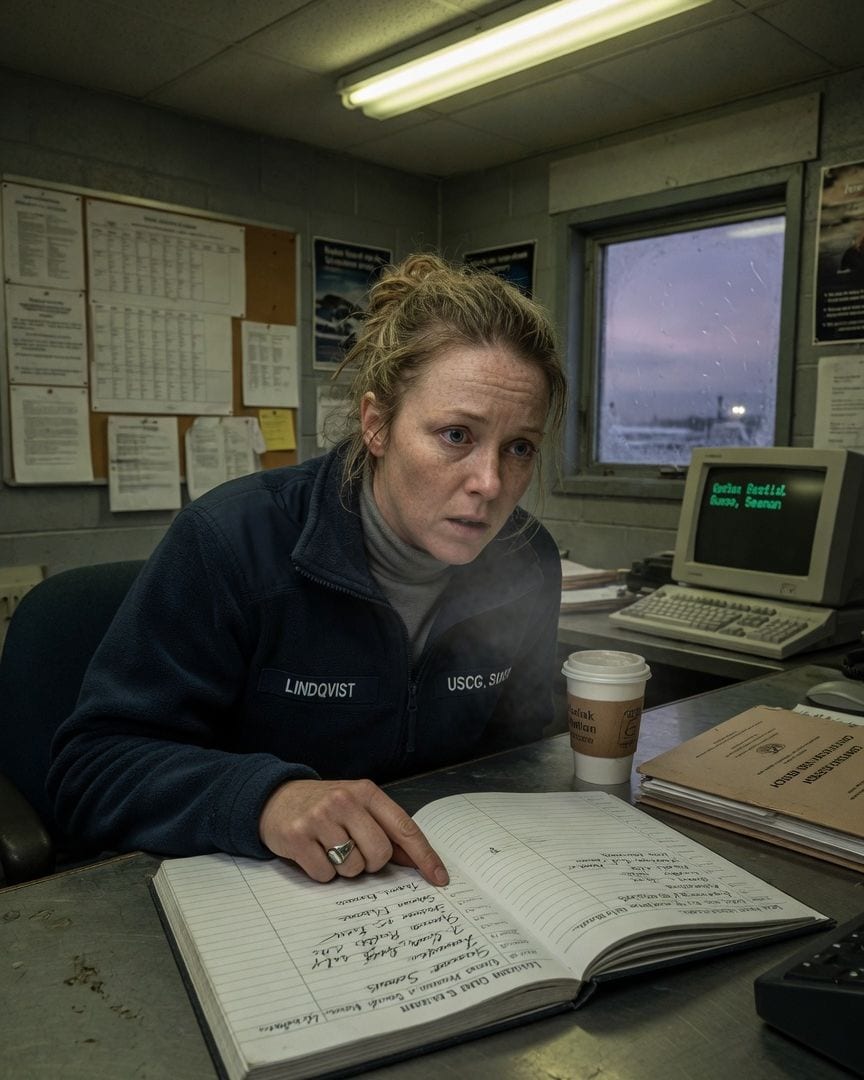
A Coast Guard Petty Officer found her own signature on a manifest for a sailor who didn't exist, with logs tallied for five hands.
Petty Officer Third Class Josephine Lindqvist meticulously checked her Kodiak Coast Guard station’s monthly report. Her cutter, the *Sea Raven*, was a three-hand vessel, and she knew her crew by heart. But there, an impossible name appeared on the manifest: 'Russo, Gideon,' signed by her own hand. The fuel logs and ration counts were tallied for five hands, confirming a terrifying discrepancy. Even her superior found the phantom sailor in the digital system, but Lindqvist knew she had never taken a fourth man, let alone accounted for five.
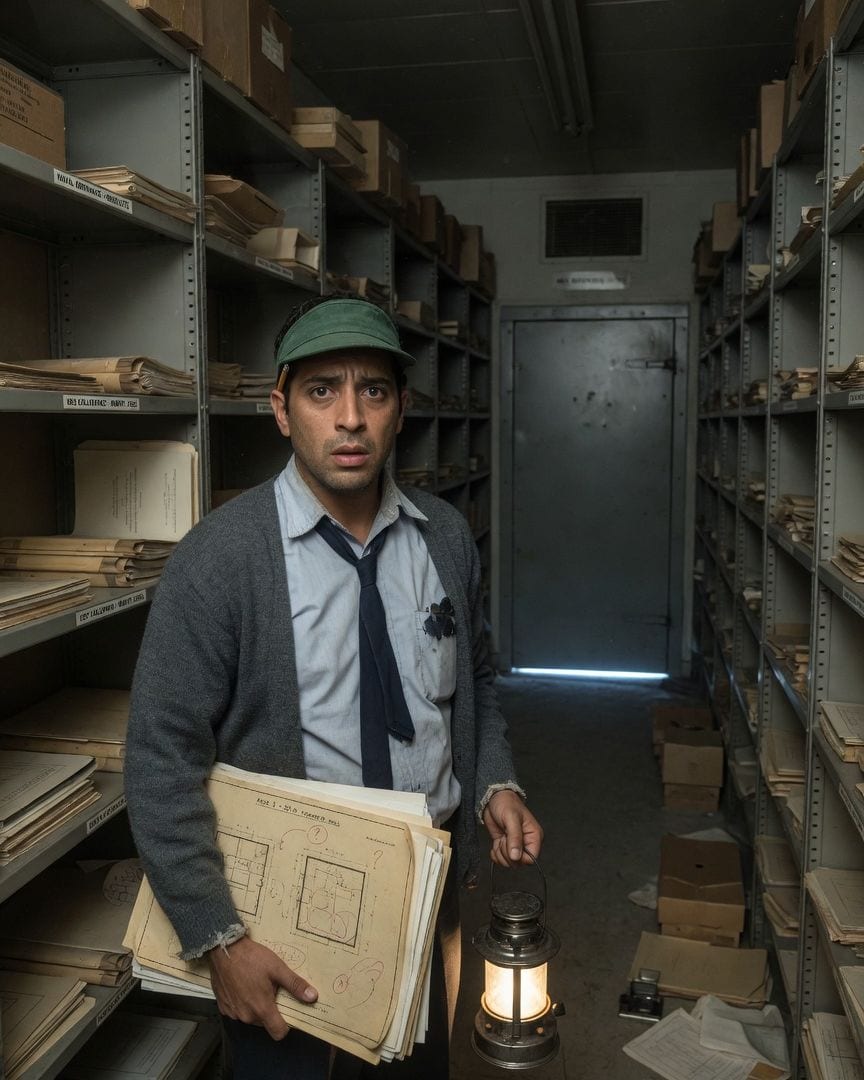
A Cold War records clerk found a lost ship's supply run, signed yesterday by its crew, dead since 1943.
Aurelio Bosch, a methodical night-shift clerk, worked through the Cheyenne records vault in Winter 1957, verifying shelf contents. He discovered an aisle forty feet longer than any blueprint showed, ending in a heavy steel door with no lock. From under it pulsed an unnatural light, and the unmistakable thrum of a printing press ran deep inside. Hours later, buried in old naval records, Aurelio found maintenance logs for a ship lost in 1943, meticulously dated into 1948 and signed by its dead crew. Then he found a new supply requisition for the same ship, dated just yesterday, signed by a crewman officially lost decades ago.
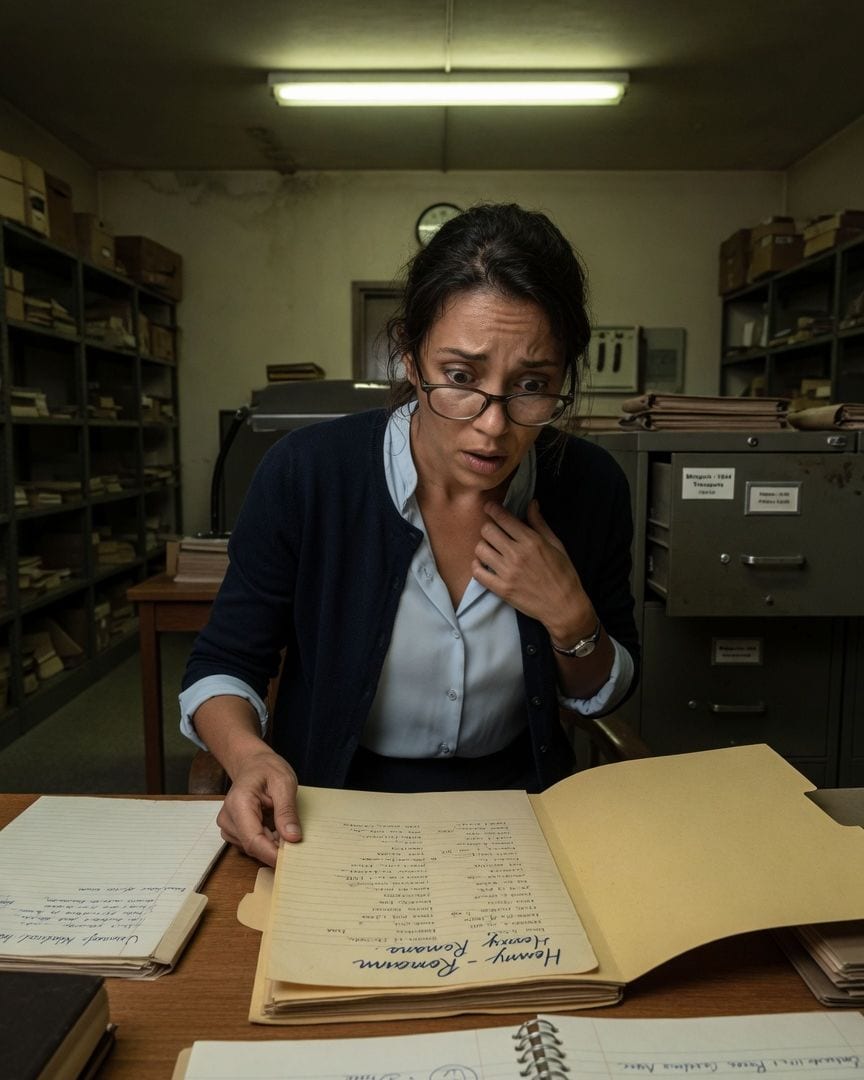
A records reviewer found a 1944 ferry manifest with an impossible 42nd name. The same dark ink marked a phantom crewman on a Cold War flight log.
Delphine Arceneaux, a dedicated records reviewer, had just minutes left in the stale reading room to finalize her review of a 1944 Mirepoix Ferry manifest. Her job was to confirm every detail of the forty-one passengers who boarded a boat that never arrived. But as the clock neared six, a forty-second name materialized on the faded paper, stark in a dark, unfamiliar ink. 'Henry Romano,' it read, with the impossible notation: 'BOARDED AT MIDSTREAM.' How could anyone board a ferry in the middle of a river?