An archivist, alone in the Suitland annex, finds a 1968 lost Cold War ship file with a handwritten entry dated last Tuesday. The ink looks damp, but feels dry.
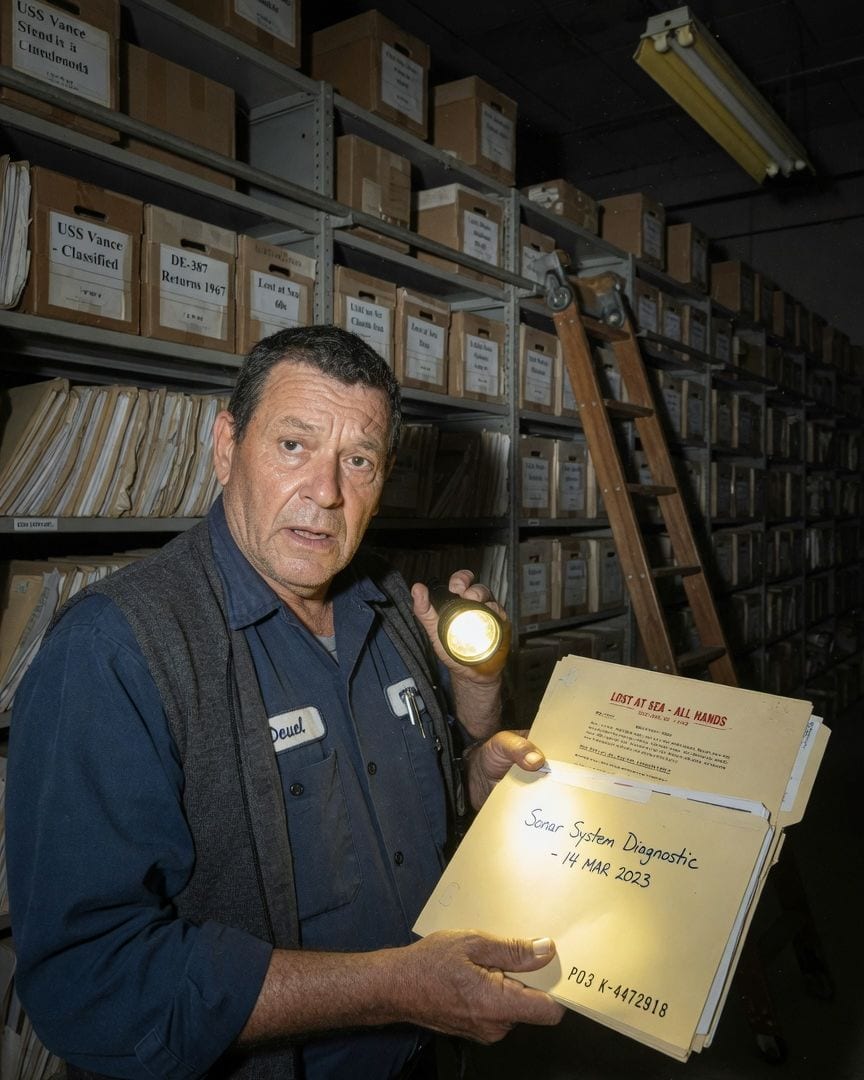
Carmine Deuel, 62, navigated the cavernous Suitland annex by the beam of his flashlight, the single working bulb across a hundred and sixty yards of shelving long since dead.
The air hung thick with the scent of old paper and dust, a smell that had been his constant companion for forty years.
He was shelving a stack of declassified returns when the sound reached him – the distinct, sticky squeal of a rolling ladder wheel, followed by the soft, rhythmic thud of someone climbing. He froze, listening. He was alone.
He always was, this late. He moved four aisles over, his flashlight beam cutting through the gloom. The heavy wooden ladder stood against a shelf, still swaying faintly on its rail.
Eleven feet up, a heavy cardboard carton, labeled 'USS Vance - Classified,' had been pulled out three inches and left crooked, its corner askew, the way someone leaves a file when they’re coming right back.
Carmine waited, flashlight steady, but no one appeared. He called out, his voice swallowed by the vast space. Nothing. He reached the ladder, its wheels still warm to the touch. He climbed, slowly, the rungs groaning beneath his weight.
The carton, heavy and brittle with age, yielded easily. He pulled it down, setting it carefully on a lower shelf.
Inside, nestled amongst other 'lost at sea' files from the late 60s, was the main incident report for the USS Vance, a destroyer escort declared lost with all hands in 1968.
Carmine had seen this file countless times over his career. He opened it, flipping through the faded reports, the casualty lists, the final declarations. Then he stopped.
On a typed, official form, typically for routine maintenance checks, there was a handwritten entry. It detailed a sonar system diagnostic. The date was last Tuesday.
The ink, a dark, precise blue, appeared subtly damp, catching the light as if freshly applied. He ran a thumb over it, expecting a smudge, but it was perfectly dry, yet somehow looked wet.
A clerical error, he thought, a misfile, someone's morbid prank. But the access log for the annex showed no one had requested this file, let alone retrieved it, in over a decade.
And the handwriting was a perfect, almost machine-like official script, not the hurried scrawl of a prankster.
Carmine held the thick, official file of the USS Vance, his flashlight beam illuminating the typed form.
Below the faded declaration of 'LOST AT SEA - ALL HANDS,' a new entry, handwritten in neat block letters, recorded a routine sonar maintenance check, dated last Tuesday. He checked the signature block.
It was a standard, illegible flourish, the kind that denoted a mid-level petty officer. But below it, stenciled in perfectly aligned black ink, was a service number.
It was a number Carmine recognized, not from the crew list of the Vance, but from a different, far more recent file.
He didn't know why he knew it, but it sat there, stark and impossible, staring back at him from the page. He traced the number with a trembling finger, his heart hammering against his ribs.
The ink felt cool, solid, but still, impossibly, looked damp.
The next morning, Carmine returned to the annex, the impossible entry burning in his mind. He spent hours cross-referencing, pulling every auxiliary file related to the USS Vance. He found more entries.
Not just maintenance, but requisitions for spare parts, payroll transfers for crew members long dead, even muster entries, all dated within the last five years.
Each was in the same precise, official hand, complete with stamped approvals and service numbers that didn't match the original crew.
He took a stack of these newer documents to Judith Radcliffe, his section chief, a woman who valued order above all else. “Judith,” he began, laying the files on her desk, “I think we have a serious problem.
These are all recent entries for the USS Vance.” Judith, without looking up from her screen, waved a dismissive hand. “Carmine, please. That’s a known clerical anomaly. Sometimes old files get picked up by automated systems, or new clerks misfile.
It’s a mess, but harmless.” She chuckled. “Probably some ghost in the machine, still trying to sail the old girl.” Carmine insisted, pointing out the specific dates, the damp-looking ink, the service numbers.
Judith finally glanced at them, her expression tightening. “Carmine, I'm telling you, it’s a glitch. We have thousands of files, things get… confused. Just refile them as 'closed' and forget it.” But Carmine couldn't forget.
He remembered an old mentor, Isaac Mercer, who had worked in the annex for even longer than him. Isaac always had a story for every oddity, a different kind of explanation.
Carmine knew Isaac was his only chance for a real answer.
Carmine found Isaac Mercer living in a small, cluttered apartment filled with books and the faint smell of mothballs. Isaac, frail but still sharp, listened to Carmine’s story with a quiet intensity. When Carmine finished, Isaac just nodded slowly.
“Ah, the Vance. She’s a persistent one.” He leaned forward, his voice dropping to a whisper. “The archives, Carmine, they’re not just paper. They’re… a kind of organism. Things settle in.
Things that were never meant to be lost, but were filed anyway. They find a way to keep their records current.”
Isaac spoke of old colleagues who had 'gone deep into the records' of certain persistent anomalies, only to disappear themselves. “Their files,” Isaac said, his eyes distant, “were quietly closed. Transferred. Permanently.”
Driving back to the annex, Carmine felt a prickle of unease. The vast building seemed different, the shadows deeper, the silence heavier. He heard faint whispers echoing from empty aisles, the rustle of paper where no breeze stirred.
Back at his desk, a single piece of paper lay on his keyboard. It was a blank index card, but scrawled in the same precise, official hand from the Vance file was one word: 'Filed.'
Carmine looked around, his heart pounding. He was alone, but he was no longer unwatched.
Carmine called Isaac again, his voice tight with fear. “What did you mean, ‘permanently transferred’? And the note – I found a note on my desk, Isaac. Just one word: ‘Filed.’” Isaac sighed, a sound like rustling parchment.
“They don’t like being disturbed, Carmine. The ones who run the filing. It’s an old system. Older than the archives themselves. It… keeps track. Of everything that goes missing. And everyone who goes looking for it.”
He explained that certain 'lost' files, like the Vance, were never truly lost to the system. They were simply re-categorized, moved to a different kind of 'active' status. “There was a fellow, Paul Mitchell,” Isaac continued, his voice heavy.
“Worked here in the 70s. Obsessed with a missing B-52 crew. Found anomalies, just like you. Then one day, his desk was empty. His records showed a transfer to a 'Special Projects Annex.' Nobody ever saw him again.
His file was still being updated, though. Performance reviews, commendations, even a retirement party invitation… years after he vanished.” Isaac paused. “They don’t want to be found, Carmine. The ones who are filed. And the ones who do the filing.
They just want to continue their work.” He then gave Carmine a specific instruction. “There’s an old sub-annex, deep below the main stacks. Used to be for classified waste disposal. I kept a key.”
He gave Carmine a combination, a series of numbers he swore he hadn't thought of in decades. “They keep their own records down there. The real ones.” Isaac's voice was barely a whisper. “Go. But be careful, Carmine.
You're already in their system now.”
That night, Carmine used the combination Isaac had given him. He found the heavy steel door in the deepest basement level, behind a stack of condemned filing cabinets. The key, an old brass skeleton key, turned with a solid click.
Inside, the sub-annex was smaller, colder, and utterly silent. Rows of steel filing cabinets, older than any he’d seen upstairs, lined the walls. They were filled with inactive personnel files, hundreds of thousands of lives neatly cataloged.
Carmine walked slowly, his flashlight beam sweeping across names he faintly recognized from history books, names that should have been dust. He reached a drawer marked, simply, 'Active Transfers.' His breath hitched. He hesitated, then pulled it open.
The drawer was half-full. He flipped through the files, each one containing a transfer order to some obscure, non-existent annex or department. And then, near the back, he saw it. His own name. Carmine Deuel.
The file, thin but present, contained his service record. He pulled it out, his hands shaking, and opened it. Inside was a single, crisp document: a transfer order to 'Annex Section 7, Permanent Assignment.' The date: tomorrow.
Carmine stared at the transfer order in his own inactive service record. The destination: 'Annex Section 7, Permanent Assignment.' The date: tomorrow.
The signature was unmistakably his own, Carmine Deuel, but the careful, precise loops and lines were alien, a hand he has never written in his life. His blood ran cold.
Carmine confronted Judith in her office the next morning, the transfer order clutched in his hand. “This is my file, Judith. Dated for tomorrow. With my signature. What is Annex Section 7?”
Judith looked up, her face devoid of surprise, or even concern. She simply nodded. “It’s happening, then. They’ve processed your transfer.” She leaned back, a chilling calm in her voice. “Annex Section 7 isn’t a place, Carmine. It’s a status.
It’s where those who truly go missing are filed. The secrecy machine isn’t just an institution, it’s… an entity. It feeds on the paperwork of the lost, the unclosed cases. The archives aren’t just a repository; they’re its digestive system.
It absorbs, processes, and maintains the illusion of bureaucracy. The ladder you heard? That was another 'transfer' being finalized. Someone else was being filed.”
She explained that for decades, certain individuals within the archive system, like herself and Isaac, had learned to recognize the pattern, to navigate around it, to simply process the impossible paperwork without questioning, hoping to avoid drawing its attention.
“The ones who knew, like Isaac, they just keep the machine running. It’s easier than fighting it. And safer. You started pulling threads, Carmine. You started looking for what wasn’t meant to be found.
And now, you’re part of the record.” Every impossible entry, every damp signature, every phantom ladder sound clicked into place with horrifying coherence. The dread wasn't in the unknown, but in the terrible, systematic logic of it all.
Carmine, horrified, backed away from Judith’s desk. “No. I won’t be filed.” He rushed to his computer, pulling up his personnel file, trying to delete the transfer order. The screen flickered violently.
Lights in the annex began to strobe, plunging the vast space into alternating darkness and blinding flashes. Shelves rattled, files tumbled, papers flew through the air like a blizzard.
On his screen, a new ledger sheet appeared, his name at the top, and beneath it, the precise, official hand from the Vance file began to write, charting his 'arrival' at Annex Section 7.
He heard the faint, sticky squeal of a rolling ladder. He knew he couldn't fight it from here. His phone. He had to expose it.
He fumbled for his phone, snapping a quick, shaky photo of the transfer order on his screen and another of the impossible entries in the Vance file, the damp ink stark against the aged paper.
The screen on his computer went black. The lights died completely, plunging the annex into total darkness. He could hear the rolling ladder now, closer, the sticky squeal growing louder, moving down his aisle.
He turned, his flashlight beam cutting through the inky blackness. The ladder was directly behind him, silent now, its top rung level with his head, waiting.
The next morning, Carmine Deuel’s desk was empty. Judith Radcliffe, with a practiced, unreadable expression, signed off on his 'retirement' paperwork, noting his 'transfer to Annex Section 7.'
She ensured his pension and benefits were processed without a hitch, a final, meticulous act of bureaucratic closure.
The files Carmine had pulled, the Vance entries, his own transfer order—all were neatly returned to their correct places, the impossible dates and signatures now just part of the vast, unchanging record.
The annex returned to its usual, cavernous silence, the hum of the old fluorescent ballasts the only sound.
A month later, a new, younger records clerk, Vera Hughes, started in the Suitland annex. She complained about the single working bulb across a hundred and sixty yards of shelving, but she quickly settled into the rhythm of the place.
One afternoon, she opened a newly arrived crate of 'returns' from a government office that had recently downsized.
On the bottom of the crate, beneath the faint impression of a phone number, a single word was scrawled in an unfamiliar, precise hand. She frowned, wondering who had written it. It was just one word: 'Filed.'
If this one got to you
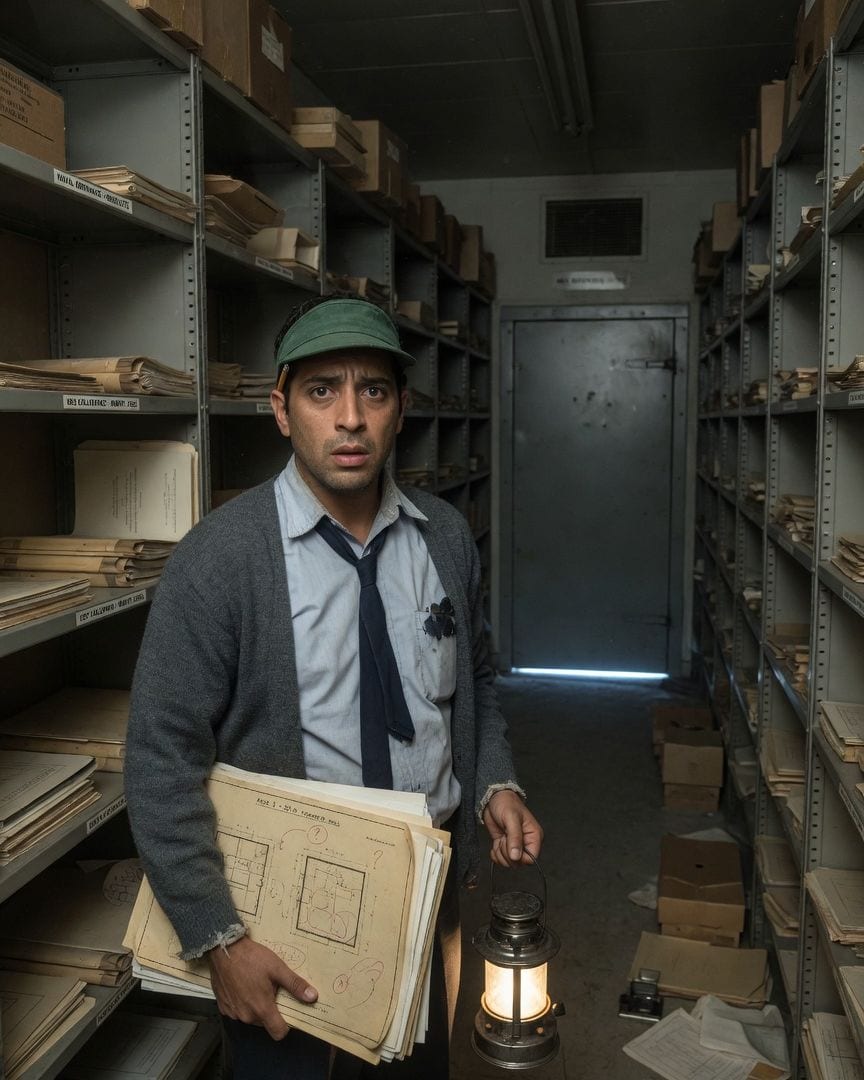
A Cold War records clerk found a lost ship's supply run, signed yesterday by its crew, dead since 1943.
Aurelio Bosch, a methodical night-shift clerk, worked through the Cheyenne records vault in Winter 1957, verifying shelf contents. He discovered an aisle forty feet longer than any blueprint showed, ending in a heavy steel door with no lock. From under it pulsed an unnatural light, and the unmistakable thrum of a printing press ran deep inside. Hours later, buried in old naval records, Aurelio found maintenance logs for a ship lost in 1943, meticulously dated into 1948 and signed by its dead crew. Then he found a new supply requisition for the same ship, dated just yesterday, signed by a crewman officially lost decades ago.
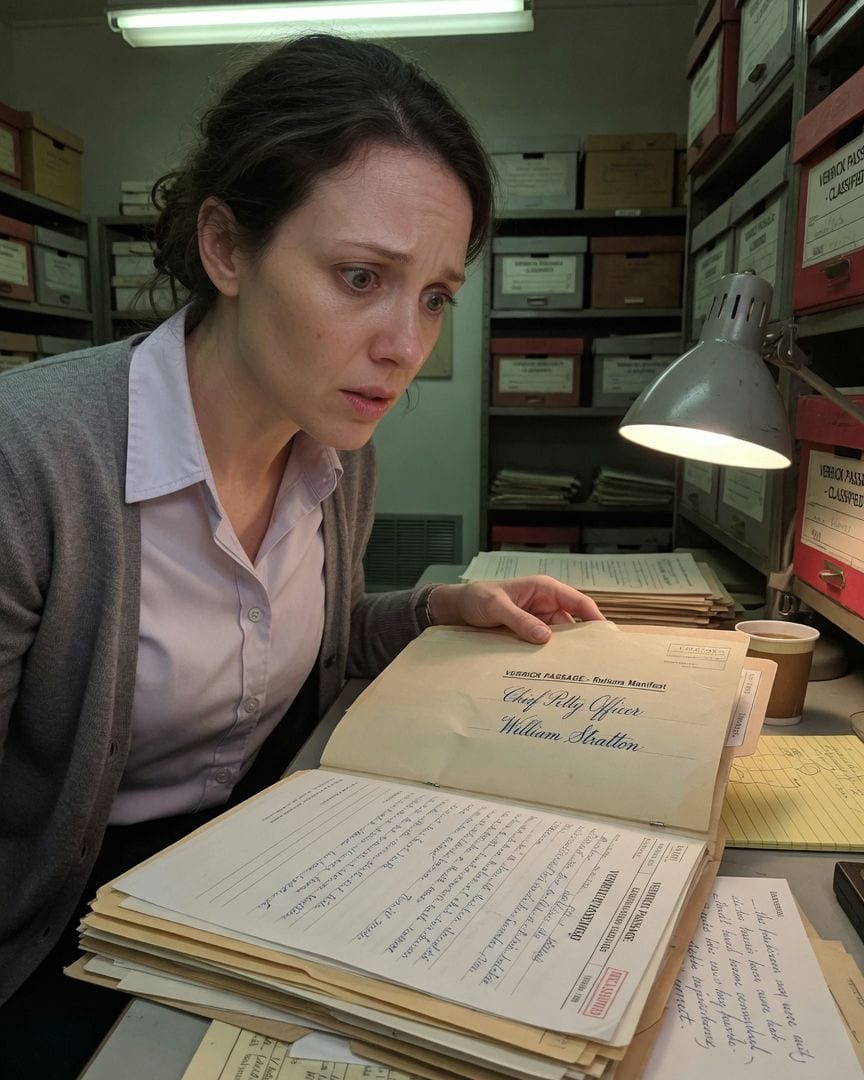
A records reviewer found personnel files for men lost 80 years ago, still being signed in an identical, perfect hand.
In the sterile hush of the declassified archives, meticulous reviewer Ione Fash had a routine task: cross-referencing witness statements from the Verrick Passage file. But as she reviewed files eighty years thick with official silence, she found nine separate interviews containing the exact same chilling sentence, all in an identical, precise hand. Her rational mind sought explanation, yet then she discovered something worse: personnel files for men lost in 1943, still being updated with modern requisitions and payroll runs. Each impossible entry, including a manifest signed just two weeks ago by a casualty from eighty years prior, bore the same unnervingly perfect signature. The file wasn't just a record of the lost; it was still being signed.
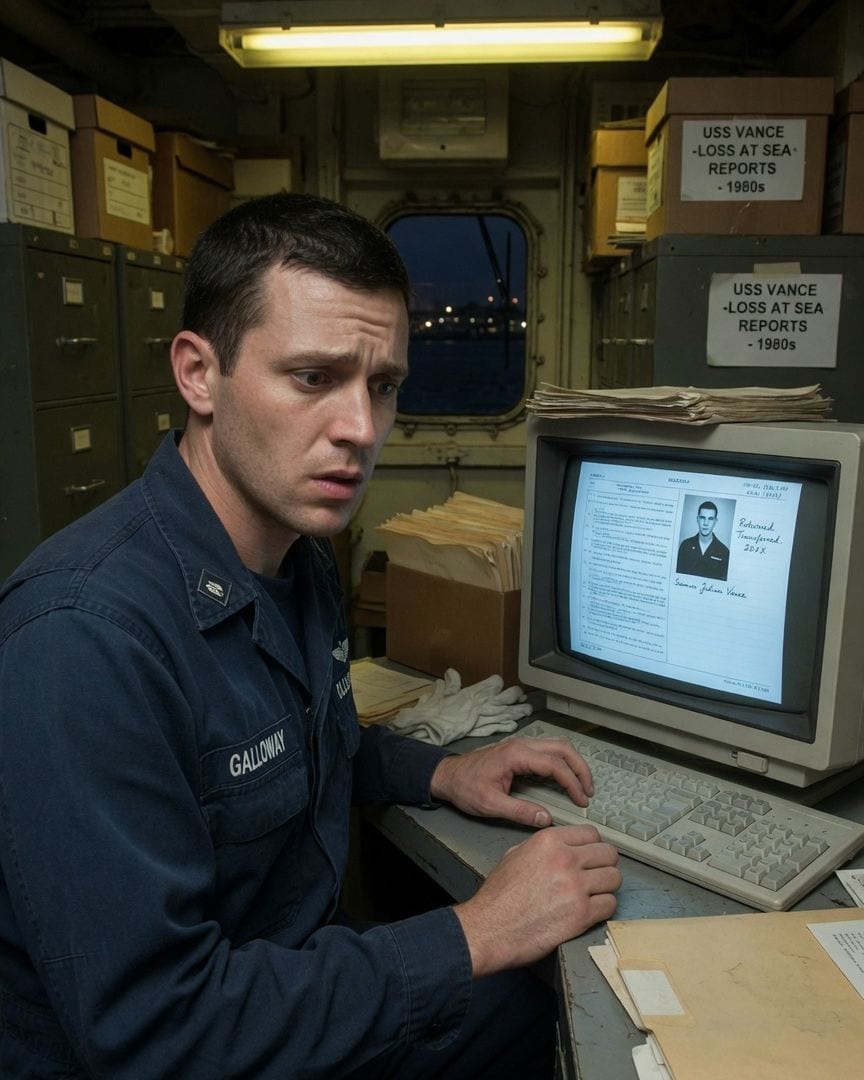
Petty Officer Galloway logged a sailor onto his ship. The man died at sea 40 years ago.
Petty Officer Joel Galloway scanned a sailor's ID on the USS Vance quarterdeck. The man's name, 'Seaman Julian Vance,' and his out-of-date uniform pricked at Galloway's memory. Later, the ship's berthing count came back one over, with an extra entry in the system but no physical body.
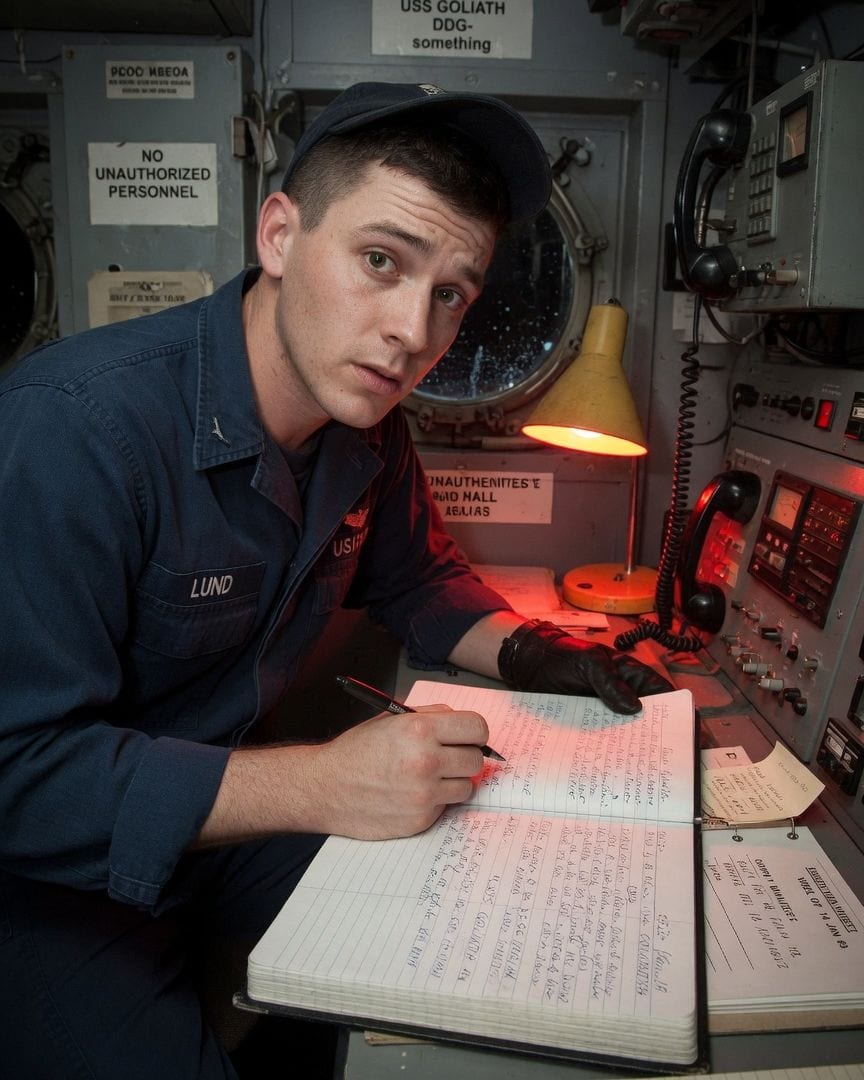
Petty Officer Lund heard his own captain's mayday: the Cold War USS Goliath was sinking, two hundred miles astern.
Petty Officer Marco Lund kept a lonely vigil in the USS Goliath's radio room, the destroyer battling the North Atlantic in deep winter 1983. Suddenly, a garbled mayday broke through: his own ship, his own captain, reporting they were going down two hundred miles astern. Though the bridge confirmed the Goliath was fine, the same chilling call came again an hour later, stronger and from the exact waters they had just crossed. Deeply unsettled, Marco began searching ship logs, eventually discovering a phantom entry: an identical mayday, logged a week prior, pressed into the very paper beneath his own.
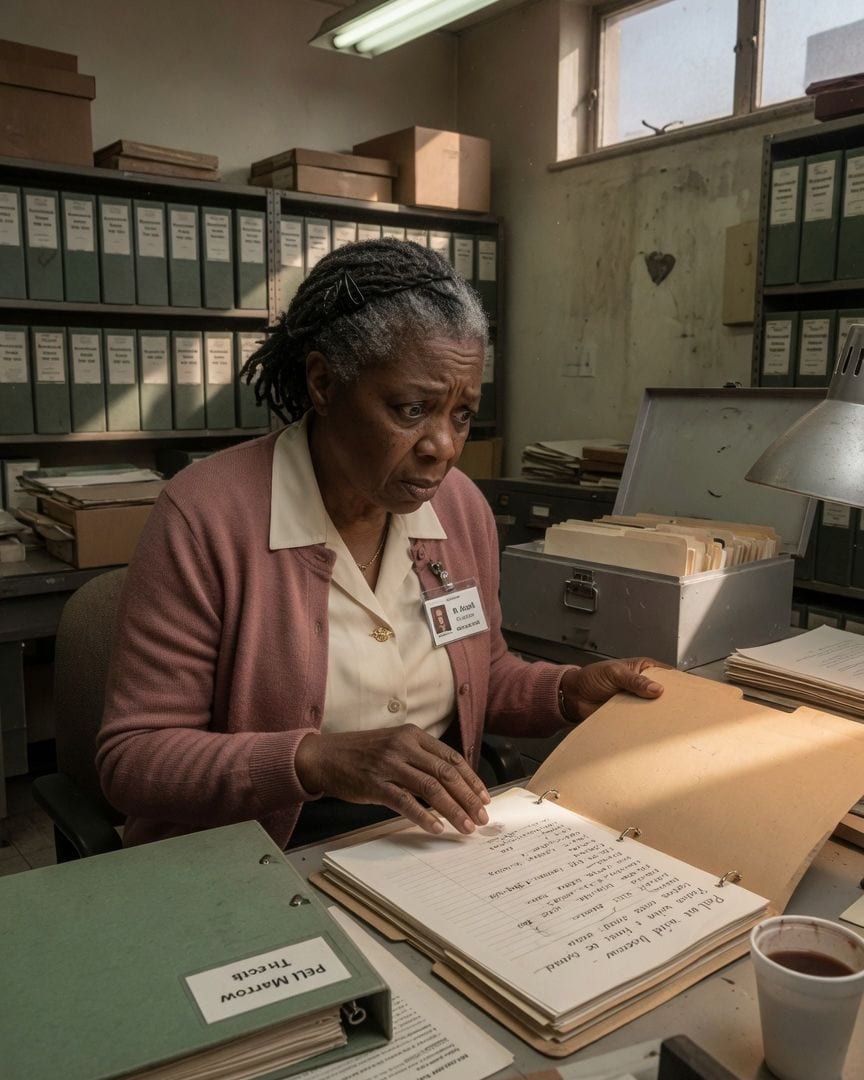
A records clerk's archive file for a Cold War reconnaissance plane lost in 1968 showed it flew yesterday to her own building.
Marguerite Ansell, a records clerk nearing her final week before retirement, meticulously audited Cold War-era files. In the cool, dusty archive, she pulled a file for an oiler declared missing in 1951. Inside, she found a fueling schedule with entries stretching into the present, the last dated just eleven days ago. Then, a second lost ship revealed a similar impossible log, and a cold certainty began to bloom in her chest. Deep in the shadows, Marguerite found an unmarked steel box containing a file for a reconnaissance plane lost in 1968. Its flight log showed a final flight yesterday, to the precise coordinates of her own archive building.
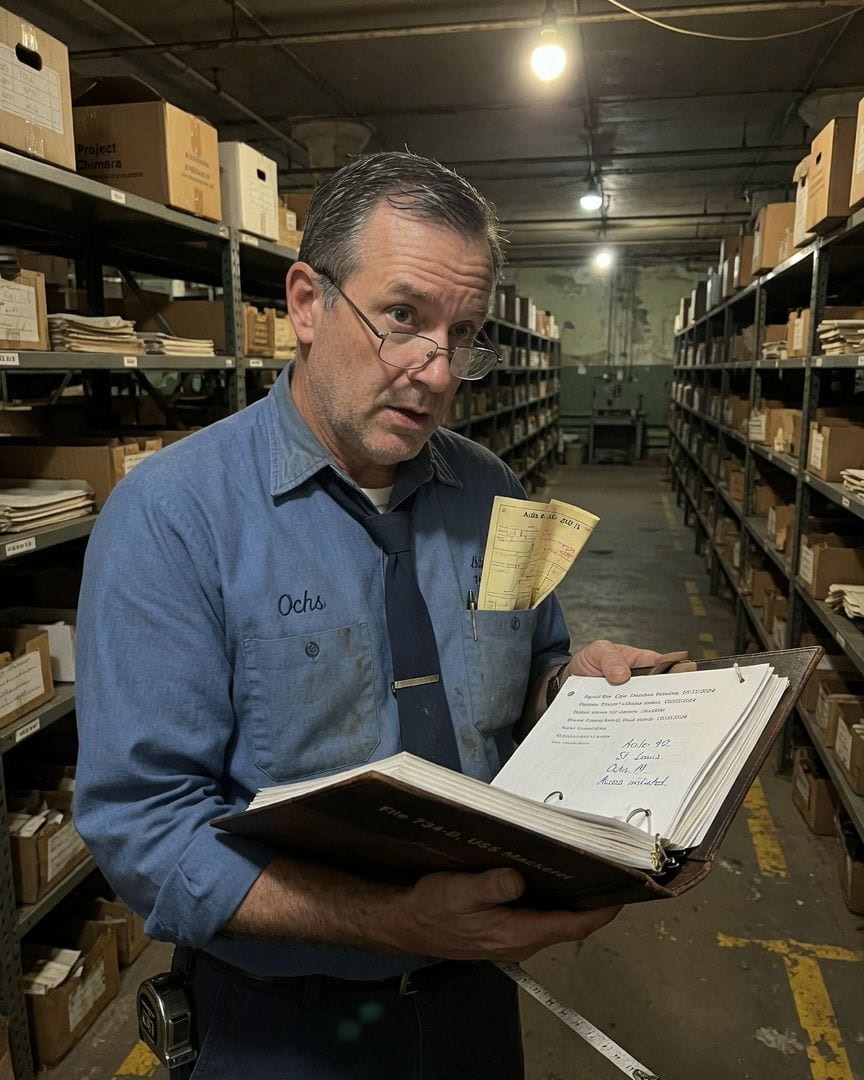
On his final inspection, a depot worker found Aisle 40 had grown 61 feet longer, and a Cold War submarine file hummed warm in his hand.
Marlin Ochs, a man of precise rhythms at the St. Louis depot, approached Aisle 40 for its final inspection before the entire structure was pulped tomorrow. For nearly two decades, the aisle had been a consistent ninety-two paces long. But on this night, his boot heels clicked past the expected mark, stretching to one hundred and nineteen paces, revealing an impossible, colder extension. Deep inside, Marlin found a heavy, leather-bound binder titled 'File 734-B, USS Mackerel,' a Cold War submarine lost with all hands in 1958. It felt oddly warm, almost humming against his palm, filled with maintenance logs and payrolls dated decades after the sub was sunk.