A records clerk's archive file for a Cold War reconnaissance plane lost in 1968 showed it flew yesterday to her own building.
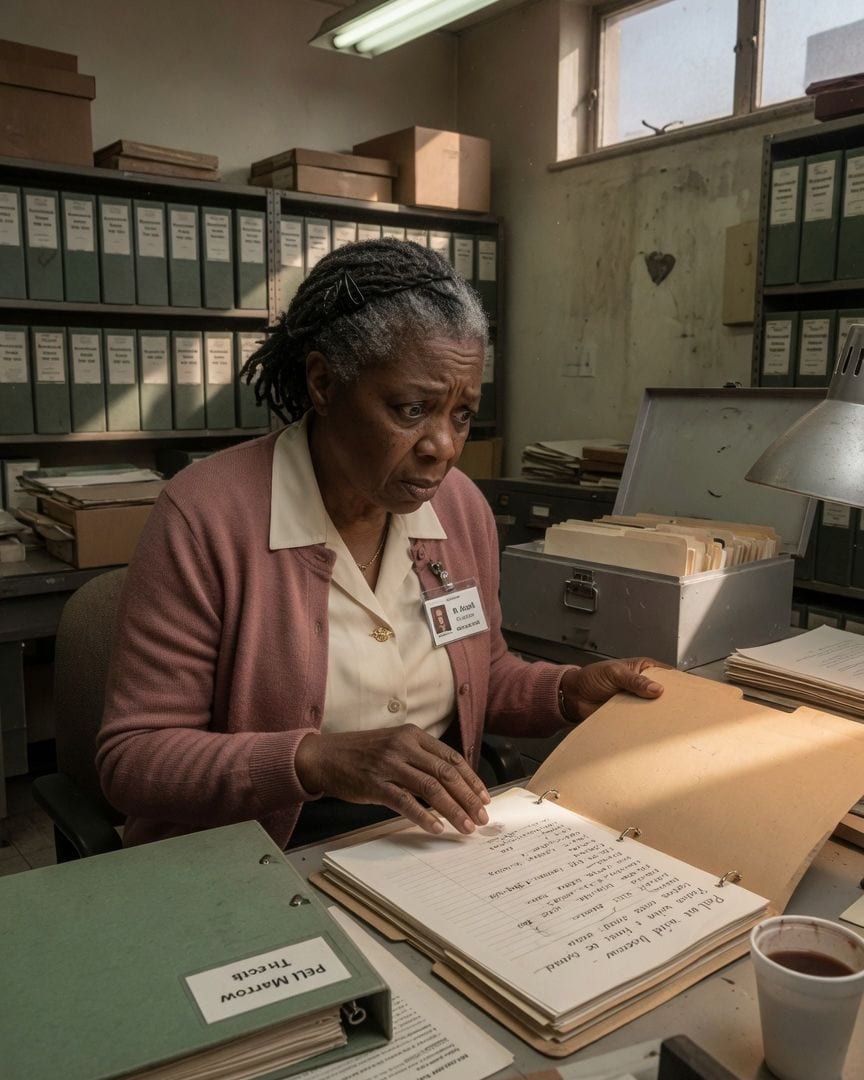
Marguerite Ansell, a records clerk closing in on her sixty-second birthday and her final week before retirement, sat at her familiar desk.
The air in the archive was always cool, smelling of old paper and dust motes dancing in the sunbeams that pierced the high windows. Her current task involved a final audit of Cold War-era declassified files, a meticulous, satisfying process.
She pulled the file for the oiler Pell Marrow, a vessel declared missing in the Mediterranean in 1951. It was a standard 'lost at sea' report, crisp with the official stamps of half a century ago.
Nothing out of the ordinary, at first glance.
But tucked inside, beneath the casualty report and a faded crew manifest, she found it: a fueling schedule. It was a simple, printed form, but the entries were handwritten.
Her practiced eye scanned the columns: dates, fuel type, tonnage, and a signature. The early dates were expected – 1950, 1951. Then, the numbers marched on: 1955, 1962, 1978.
Each entry was signed with a precise, official hand, the graphite dark and firm. Marguerite traced the line of entries, her brow furrowing.
Past her birth year, past the height of the Cold War, into decades she had lived through, worked through, retired through.
The script changed several times over the years, from a tight, almost spidery hand to a more modern, looping style, but the meticulous care remained constant.
Then she saw the last entry. It was dated a mere eleven days ago. Marguerite’s fingers brushed the fresh graphite, a cold, impossible sensation. The ship had been lost seventy years ago. A ghost ship couldn't take on fuel.
Yet, here it was, a record of a recent transaction, a precise tonnage, a firm signature. Somebody was still filling its tanks.
Marguerite tried to rationalize it away. A placeholder document, perhaps, accidentally slipped into the wrong file. Or a misfiled record from a completely different vessel, a common enough clerical error from a bygone era when everything wasn't digitized.
She told herself it had to be a mistake, a relic of a less organized past. The archive had its quirks.
She consulted the official multi-volume finding aid, a hulking set of green binders that had been her constant companion for decades. She thumbed through the index for the 'Decommissioned Vessels, Mediterranean Theater, 1940-1960' section.
The Pell Marrow was clearly listed as 'Decommissioned, Lost at Sea.' There was no mention, not a single line, of an ongoing fueling schedule. The impossible document existed outside the official record, yet it lay nestled within the official file.
Marguerite then examined the other files in the same unassuming brown box she had pulled the Pell Marrow's folder from. Most were routine. She checked three, then four. All perfectly normal.
She began to relax, ready to dismiss the Pell Marrow log as a singular, baffling oddity.
But then, a second anomaly. She pulled the file for a destroyer, the USS Halcyon, also declared lost in the Mediterranean in 1953.
Inside its folder, just like the Pell Marrow, was a similar, impossible maintenance log, with entries stretching into the late 1990s. The hand was different from any on the Pell Marrow log, but equally precise, equally official.
A prickle of unease, cold and sharp, started to bloom in Marguerite's chest. Two 'lost' ships, two sets of impossible, active records. This wasn't a mistake. This was a pattern.
The archive room, once a comforting haven of order, felt suddenly vast and cold around her. The silence seemed to press in, listening.
Driven by a cold certainty, a feeling that had nothing to do with rationality and everything to do with a creeping sense of wrongness, Marguerite searched the back of the shelf.
Her fingers trailed over the spines of the heavy official finding aids. Tucked behind the last, numbered volume, half-obscured by shadow and years of undisturbed dust, she found it.
It was a small, unmarked gray box, roughly the size of a shoebox, made of heavy-gauge steel. It had no accession number, no label, no handwritten title.
It was not on any list, she knew, not anywhere in the sprawling, meticulously cataloged archive system. The metal was cool beneath her fingertips. She pulled it out, a faint scraping sound disturbing the archive's profound quiet.
She opened it. Inside, neatly filed, were more folders, their manila tabs blank. She selected one at random, her heart thudding a slow, heavy beat against her ribs. The label, handwritten in a spidery, faded ink, read: 'Raven-3.'
A reconnaissance aircraft, lost over the Baltic in 1968. She opened the file. Inside was a flight log. Her eyes darted to the last entry. It was dated 'yesterday.'
The coordinates for the last recorded destination were precise, chillingly so: 38.8977° N, 77.0365° W. The exact latitude and longitude of her own archive building.
The gray box, 'The Box That Is Not on Any List,' became Marguerite's obsession. The shock of the Raven-3 log had solidified something in her mind: this was not a quirk of the archive, nor a series of isolated errors.
This was deliberate. Under the guise of her final audit, she systematically examined its contents. The metal box became her secret world, hidden in plain sight.
Dozens of files, each for a different 'lost' asset, lay within. Cargo ships, patrol boats, even a forgotten tactical missile unit designated 'Cerberus-4.' All of them, declared missing decades ago in official records, now held impossible, ongoing logs.
The dates in these logs were always recent, almost unnervingly so – within a month or two of the current day, some even within the last week.
She noted the progression of handwritings in each file, a silent testament to time passing. A series of distinct, official hands, some neat and precise, others more hurried, yet all maintaining the meticulous documentation over decades.
It was a precise, unbroken chain of clerks, each picking up where the last left off, for entities that supposedly no longer existed.
Marguerite spent hours cross-referencing the names and designations of these 'lost' assets with public records, using every database she had access to, every finding aid. She searched microfiche, scanned digitized newspapers, even pulled old naval registries.
But she found only official 'lost at sea,' 'decommissioned,' or 'destroyed' designations. There was no public trace, not a whisper, of their continued existence. The silence of the public record was deafening.
The coherence of the impossible documentation, its sheer volume, and the fact that it all fit within its own hidden system, was more terrifying than any random error.
She realized the archive wasn’t just a place where things were filed; it was where things were kept alive, in secret.
The rows of silent shelving seemed to hum with an unheard energy, the very walls of the building now feeling like the skin of some vast, sleeping entity.
Marguerite’s unusual focus on the obscure 'Decommissioned Vessels' section didn't go unnoticed. She felt it, a subtle shift in the currents of the office, like a change in air pressure before a storm.
Her supervisor, George Bishop, a man whose life seemed to be an extension of the archive's own rigid rules, began to observe her. He had the placid, unruffled demeanor of a man who saw everything but revealed nothing.
He made casual inquiries about her progress, about the specific files she was requesting. "Getting a jump on your retirement reading, Marguerite?"
he joked one afternoon, leaning against her cubicle wall, his gaze lingering on the stack of folders from the gray box on her desk. His voice was light, but his eyes, usually placid and distant, were sharp, assessing.
Marguerite offered a bland smile, a noncommittal answer about checking a cross-reference.
She felt a subtle shift in the office's atmosphere, a new tension that had nothing to do with her impending departure.
The other clerks, usually bustling with their own quiet tasks, seemed to move with a strange awareness, their conversations hushed when she passed.
One evening, after she had carefully left the gray box open on her desk, half-hidden by a stack of manifests, she returned the next morning to find her workstation subtly disturbed.
A stack of folders that she had meticulously aligned an inch to the right of her monitor was now an inch to the left.
Her chair, which she always pushed in perfectly straight, was at an odd angle, askew from the desk. No one else ever touched her desk. A cold dread settled in her gut, heavy and sickening.
They weren’t just watching; they were confirming.
That afternoon, she discreetly attached a small, pen-sized camera to the underside of her desk, just beneath the front lip. Its tiny lens promised a silent, unbiased witness. The next morning, the camera was gone.
The blank space where it had been felt like a missing tooth. A new, unsettling certainty took root: her digging had been noticed. She was no longer just an observer; she was observed.
The archive, once her quiet haven, had become a cage.
Marguerite decided on a direct approach, fueled by a mixture of desperation and a clerk’s inherent need for order. She walked into George Bishop’s office, the heavy door clicking shut behind her with a definitive thud. She didn’t sit.
Instead, she placed the Pell Marrow's impossible fueling schedule and the Raven-3's recent flight log – the one listing the archive's coordinates – squarely on his meticulously tidy desk.
"This isn't a clerical error, George," she stated, her voice steady despite the tremor she felt in her hands. "This is a system."
George leaned back in his chair, his expression unreadable, a faint smile playing on his lips. "Marguerite, with all due respect, these are declassification anomalies. Outdated forms, placeholder documents.
Or perhaps," he suggested, picking up the Raven-3 log and turning it over with a dismissive flick of his wrist, "some old joke gone too far. It's your last week. Don't go looking for more work."
His words were smooth, practiced, a well-worn script.
But Marguerite persisted. She pulled out more files from her bag – photocopies she’d made in the dead of night.
She systematically presented the pattern across multiple 'lost' assets from the gray box, the recent dates, the progression of different handwritings, the exact archive coordinates in the flight log.
She laid out the impossible coherence of it all, the sheer volume of documentation.
As she spoke, she watched George’s face. The dismissive facade began to crack, slowly, almost imperceptibly. The faint smile vanished. His eyes, usually placid, hardened, becoming cold and knowing.
He leaned forward, resting his forearms on the desk, pushing the documents back towards her. His voice dropped to a low, cold tone, a sound Marguerite had never heard from him.
"Some things are best left... filed, Marguerite," he said, the words hanging in the air like dust motes. He paused, his gaze boring into hers. "This place… it holds more than just paper. You understand?"
It wasn't a question. It was a statement of fact, an implicit threat delivered with unsettling calm. The air in the room grew heavy with unspoken knowledge, thick enough to taste. He knew. And he was part of it.
The official denial was a performance, the files a deliberate lie maintained by a succession of quiet men and women. The records weren't errors; they were evidence of an ongoing, hidden operation, and George was one of its quiet custodians.
The dread wasn't just in the impossible files, but in the knowing silence of the man across from her, the way he looked at her now – not as a colleague, but as someone who had seen too much.
The faint hum of the fluorescent lights suddenly seemed to grow louder, insistent, like a warning.
Shaken by George's veiled threat, by the terrifying composure of his admission, Marguerite returned to her desk. The archive, once a sanctuary of order and quiet predictability, now felt like a labyrinth of secrets, its walls pressing in on her.
George wasn't just dismissing her; he was warning her, perhaps even claiming her as part of the system he served. The air felt thick with unseen eyes.
She pulled the 'Raven-3' file from the gray box again, her fingers trembling slightly. She stared at the flight log, the precise coordinates of the archive building.
It clicked into place with sickening clarity: the aircraft wasn't just flying to the archive; it was flying from it, confirming the building itself as an active operational hub, a disguised base.
This wasn’t just a filing system; it was a command center.
As she turned a page, a small, stapled memo, folded once, fell out from between two sheets. It was stark white against the faded yellowing paper of the log. Her heart hammered.
The header read: 'Access Protocol 7G-Delta for unauthorized personnel who have initiated deep-level inquiry into Project BLACKWATER assets.'
Her blood ran cold, a sudden, icy jolt. 'Project BLACKWATER.' This was the name of the machine. The name of the shadow entity operating within the official archives.
Her eyes scanned down the document, to a neatly typed list labeled 'Identified Individuals.' She held her breath.
Her own name.
'Ansell, Marguerite, R-344-09-517.'
And beneath it, a single, chilling line, stark and absolute: 'Reassignment: [Date one day after her scheduled retirement].'
Her retirement wasn't an escape; it was a transition into a new 'file,' a new 'assignment.' She was already in the system, logged and identified, and it was waiting for her, patiently, inevitably.
The humming of the archives seemed to intensify, a low, resonant thrum that filled the room, swallowing the silence.
The 'Project BLACKWATER' memo detonated in Marguerite's mind, a cold, silent explosion that rearranged every impossible detail she had encountered.
The 'lost' vessels and assets were never truly lost; they were officially 'filed' as such, casualties of history, to mask their true purpose.
The archive wasn't merely a repository of history; it was the nerve center of Project BLACKWATER, a clandestine operation maintaining these assets for unknown purposes.
The very building she had worked in for decades, filled with the comforting scent of old paper, was a front.
The fueling schedules, the flight logs, the maintenance records—they were a living, parallel system of documentation, a bureaucratic shadow world operating seamlessly within the official one.
George Bishop, and others like him, were not just archivists; they were the 'clerks,' the 'filers,' maintaining the illusion, ensuring the 'lost' remained 'lost' in public while secretly remaining operational.
The progression of handwritings in the logs was a generational succession of these silent custodians.
The 'reassignment' date wasn't a transfer; it was her induction. She was to become one of them, to take over a file, to become another cog in the machine that perpetually documented the impossible.
She would maintain the lie, ensuring the Pell Marrow or the Raven-3 continued their phantom existence on paper, fueling the illusion.
The Raven-3's flight path to the archive wasn't an anomaly; it confirmed the building itself as an operational base, a place where these 'lost' assets were managed, perhaps even housed or serviced in hidden facilities beneath the very ground she stood on.
The foundations of the building now felt like the shell of something alive, something vast and indifferent.
The horror wasn't a monster with teeth and claws; it was the cold, patient, coherent logic of a bureaucracy dedicated to maintaining a lie for decades, absorbing anyone who got too close.
It was the complete eradication of her individual future, replaced by an endless, secret task, her retirement erased with a single typed line.
Marguerite knew confrontation was futile. George was part of the system, a quiet, unyielding cog, and the system had already claimed her. Its patience was infinite, its grasp inescapable.
Her only option was to escape, and to carry proof, a tiny seed of truth she could plant outside this labyrinth.
Working methodically, with the ticking clock of her 'reassignment' date looming, she began to copy. She spent her last two days moving with a strange, internal urgency. She used the archive's old microfiche machine, loading films from various 'lost' files.
She then, with trembling hands, transferred the key 'Project BLACKWATER' memo, the Pell Marrow fueling schedule, and the Raven-3 flight log onto a discreet USB drive, purchased weeks ago for her retirement photos.
Each click of the camera, each whir of the microfiche reader, echoed in the unnaturally quiet archive, sounding impossibly loud to her ears.
She folded the microfiche carefully into her wallet, nestled deep inside, a tiny, brittle film of impossible truth. The USB drive she kept in her palm, its cool plastic a tangible anchor to reality.
Throughout her final day, she maintained a facade of normalcy, packing her personal effects into a worn cardboard box. She made small talk with other clerks, smiling faintly, answering questions about her retirement plans with vague, reassuring platitudes.
George watched her from his office door for much of the afternoon, his gaze unnervingly steady, unwavering. She felt the weight of his expectation, the system's vast, impersonal patience. He knew she knew. And he knew she was leaving.
For now.
As the clock on the wall neared five, she lifted her cardboard box. She walked out of the archive's main doors for the last time, her retirement official. The cool evening air felt sharp and real against her face.
She clutched the USB drive, the microfiche burning, a phantom heat, against her skin, proof of an impossible truth.
The cost was immediate: the crushing weight of knowledge, the certainty that she was now a marked individual, a 'file' in a system that never closed.
Marguerite left the archive, but the files followed her. The knowledge was a relentless hum in her mind, a constant static she couldn't switch off.
She tried to present her evidence – the USB drive, the microfiche, her meticulously compiled notes – to anyone who would listen. A local journalist, initially intrigued, became visibly uncomfortable.
A retired Navy officer she knew through a friend listened politely, his expression shifting from curiosity to pity. An old friend in government offered sympathetic clucking.
They attributed her claims to retirement stress, an elaborate hoax, or simply a misinterpretation of declassified documents, a natural consequence of a lifetime spent sifting through bureaucratic minutiae.
The proof, so chillingly coherent to her, was dismissed as the ravings of a tired old woman. The USB drive remained unexamined, the microfiche unread. No one wanted to believe in ghost ships and secret aircraft.
No one wanted to believe in Project BLACKWATER. She lived with the constant, quiet hum of the knowledge, the certainty that she was now on a different kind of 'schedule,' an invisible, lifelong monitoring by the system she had exposed.
She was a loose end, not yet reeled in, but always accounted for.
She moved to a small, quiet town in the Midwest, far from any coast or major archive, hoping to outrun the echoes of Project BLACKWATER.
The flat plains, the endless sky, offered a sense of openness she desperately craved, a contrast to the oppressive, secret-filled architecture she had left behind.
Every morning, she scanned the news, searching for any mention of old, decommissioned vessels, for anything that might hint at the impossible truth she carried. She never finds anything. The public record remained pristine, undisturbed.
But sometimes, late at night, in the profound silence of her new home, she thinks she hears the faint, rhythmic thrum of a distant engine.
It is too deep for any commercial vehicle, too constant for anything local, a sound that seems to carry across impossible distances, a reminder that some things are never truly lost, only filed.
She knows the file is still being signed.
Weeks later, George Bishop sits at Marguerite's old desk, now his own. The worn desktop, recently cleared of Marguerite's personal effects, gleams faintly under the fluorescent lights. He opens a new file, pristine and white.
The label, typed neatly, reads: 'Ansell, Marguerite, R-344-09-517.' He initials the first blank line under 'Status: Monitored.' He then picks up a pencil, and in a neat, official hand, begins to log her daily activities, starting with '07:00, coffee.'
The file is still being signed.
If this one got to you
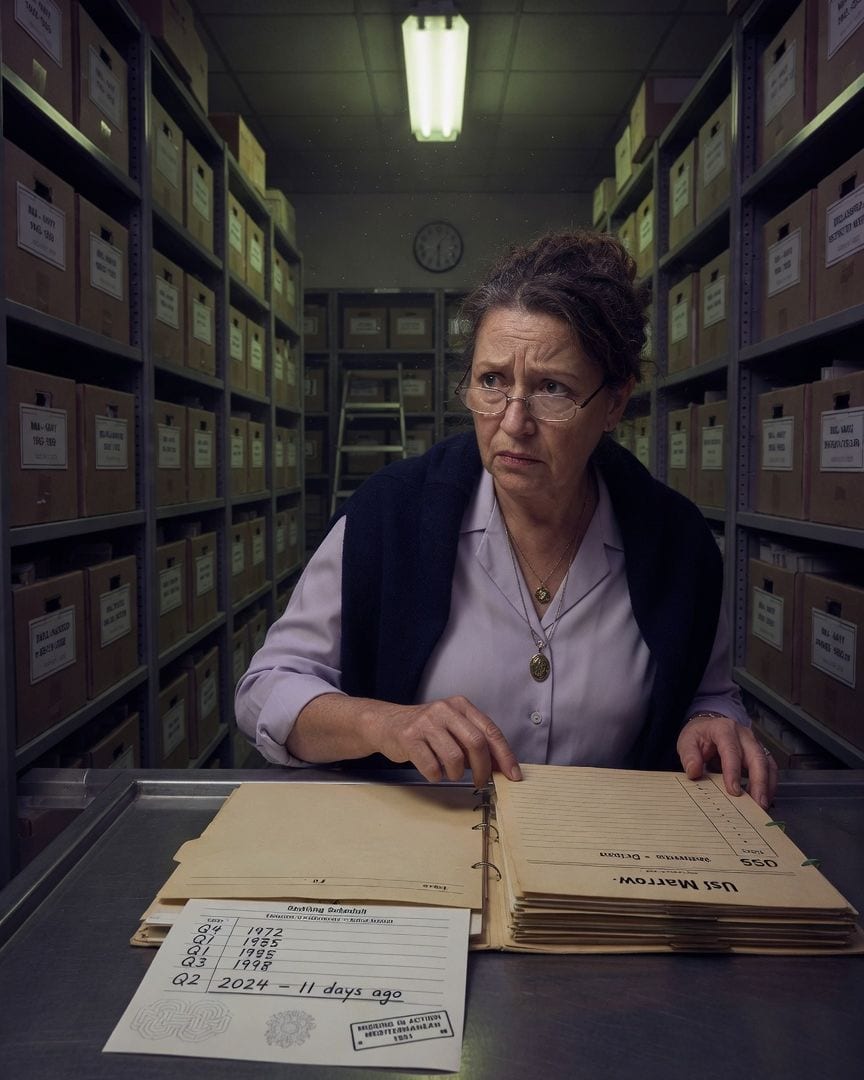
In her last week before retirement, an archivist discovers a Cold War oiler, lost in 1951, still has fuel logs updated just 11 days ago.
Marguerite Ansell, an archivist, faced her final week before retirement in the National Archives. Dust motes danced in the anemic fluorescent light as she navigated endless rows of forgotten history, counting down to quiet days. Her last routine task, auditing 'missing in action' files, led her to the oiler Pell Marrow, officially lost in the Mediterranean in 1951. Inside its yellowed folder, a crisp, newer fueling schedule revealed quarterly updates, running relentlessly forward to an entry just 11 days old: someone was still filling the Pell Marrow’s tanks. As she found similar active schedules for other 'lost' assets, each bearing a peculiar, unknown fractal stamp, a cold dread settled: what agency kept these ghosts of the Cold War afloat?
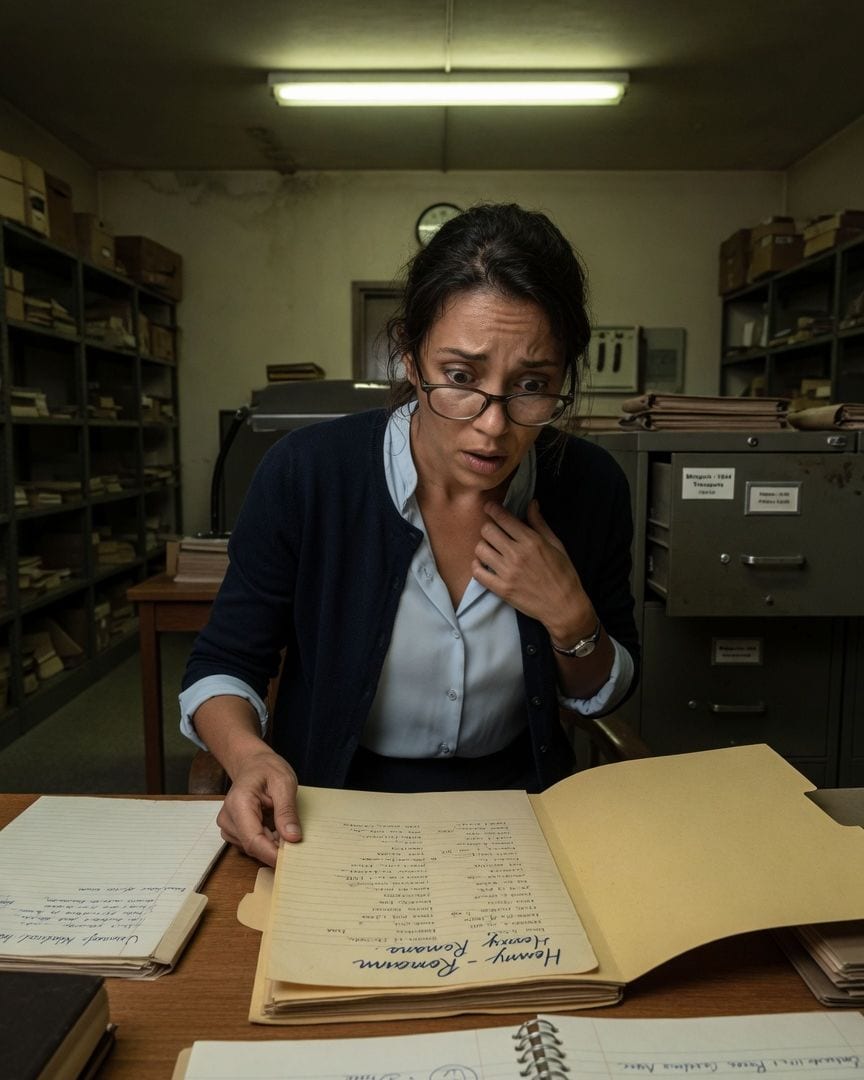
A records reviewer found a 1944 ferry manifest with an impossible 42nd name. The same dark ink marked a phantom crewman on a Cold War flight log.
Delphine Arceneaux, a dedicated records reviewer, had just minutes left in the stale reading room to finalize her review of a 1944 Mirepoix Ferry manifest. Her job was to confirm every detail of the forty-one passengers who boarded a boat that never arrived. But as the clock neared six, a forty-second name materialized on the faded paper, stark in a dark, unfamiliar ink. 'Henry Romano,' it read, with the impossible notation: 'BOARDED AT MIDSTREAM.' How could anyone board a ferry in the middle of a river?
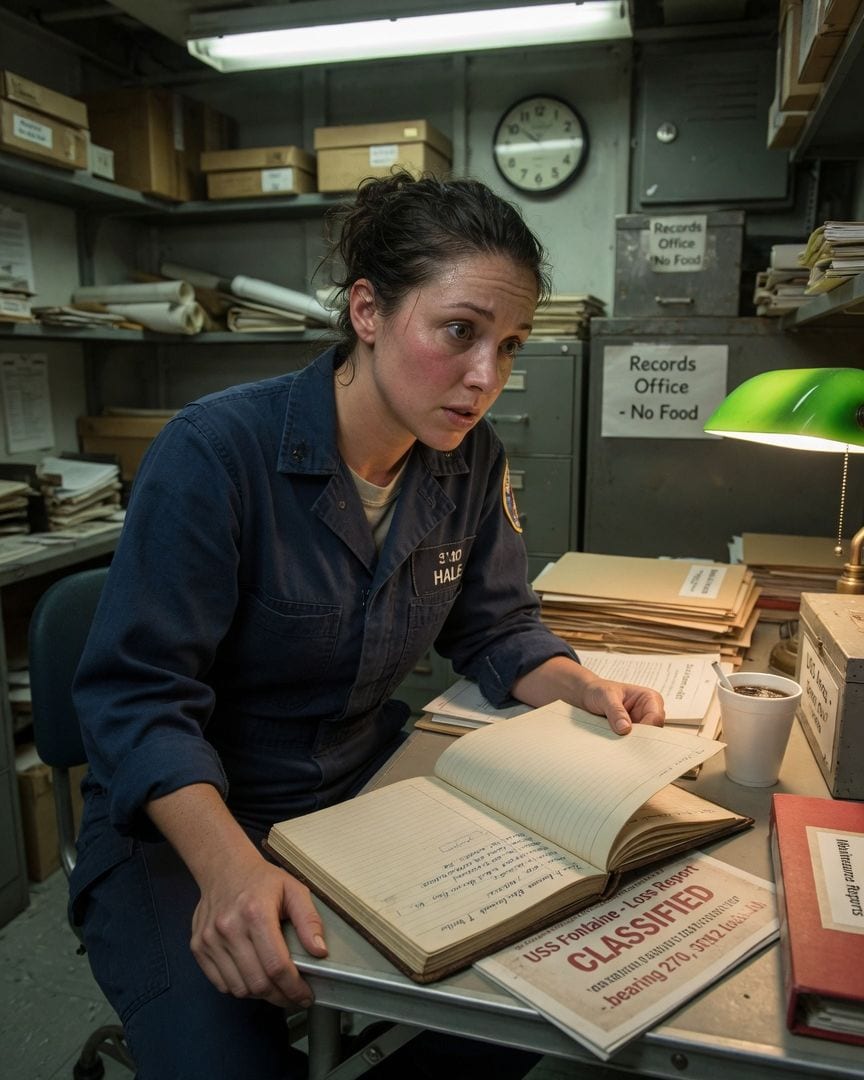
Petty Officer Hale needs a spotless record for her transfer. But the USS Ares sonar logs show an identical, impossible contact, logged to the minute, years apart, and tied to a classified loss report.
Petty Officer Sarah Hale needed a spotless record for her coveted shore duty transfer, a posting she'd worked five years to secure. Alone in the USS Ares sonar shack, three days out from San Diego, her midwatch was broken by an impossible contact: a close, slow echo holding perfect pace, invisible to radar, then vanishing. Her heart hammered, not from fear, but from the data's impossibility. When she found an identical entry in her own log from just one week prior, the cold dread tightened its grip. But the true chill settled when she unearthed decades of similar records, signed by other sonar officers, all showing the same impossible contact at 0212, off the port beam, for nineteen minutes, on the same ship, stretching back years—a persistent echo tied to a classified loss report.
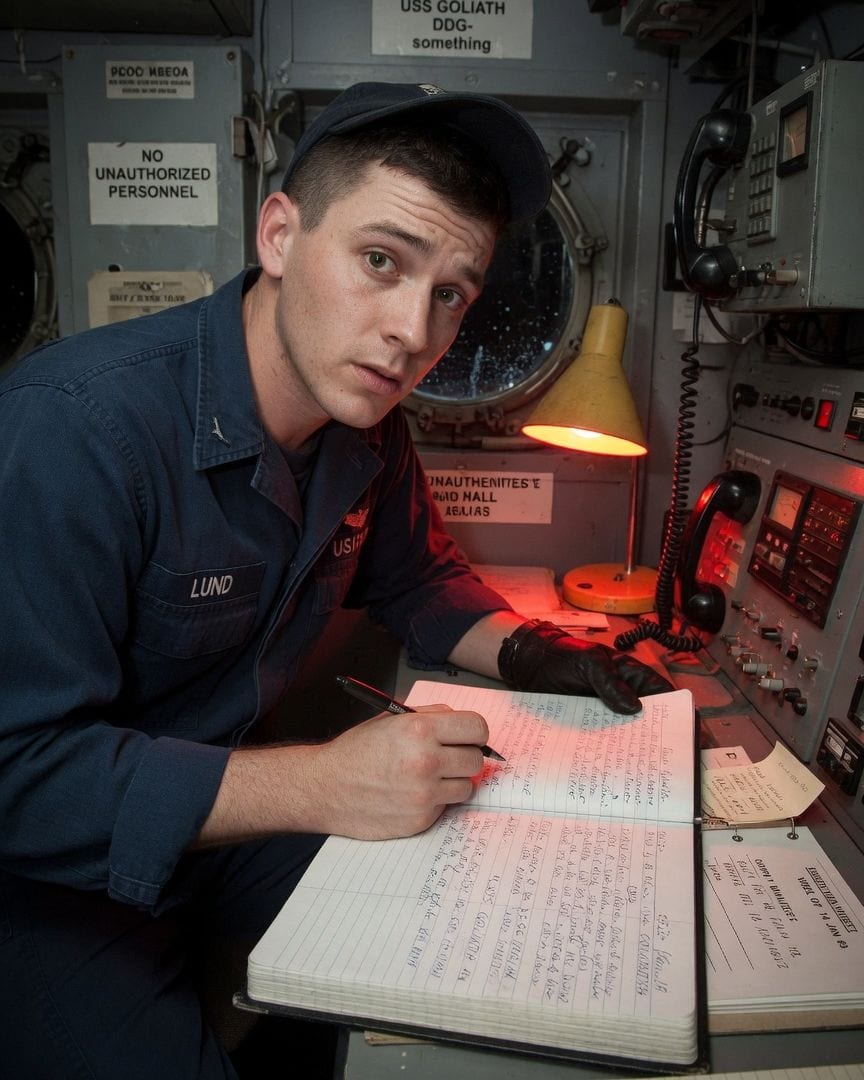
Petty Officer Lund heard his own captain's mayday: the Cold War USS Goliath was sinking, two hundred miles astern.
Petty Officer Marco Lund kept a lonely vigil in the USS Goliath's radio room, the destroyer battling the North Atlantic in deep winter 1983. Suddenly, a garbled mayday broke through: his own ship, his own captain, reporting they were going down two hundred miles astern. Though the bridge confirmed the Goliath was fine, the same chilling call came again an hour later, stronger and from the exact waters they had just crossed. Deeply unsettled, Marco began searching ship logs, eventually discovering a phantom entry: an identical mayday, logged a week prior, pressed into the very paper beneath his own.
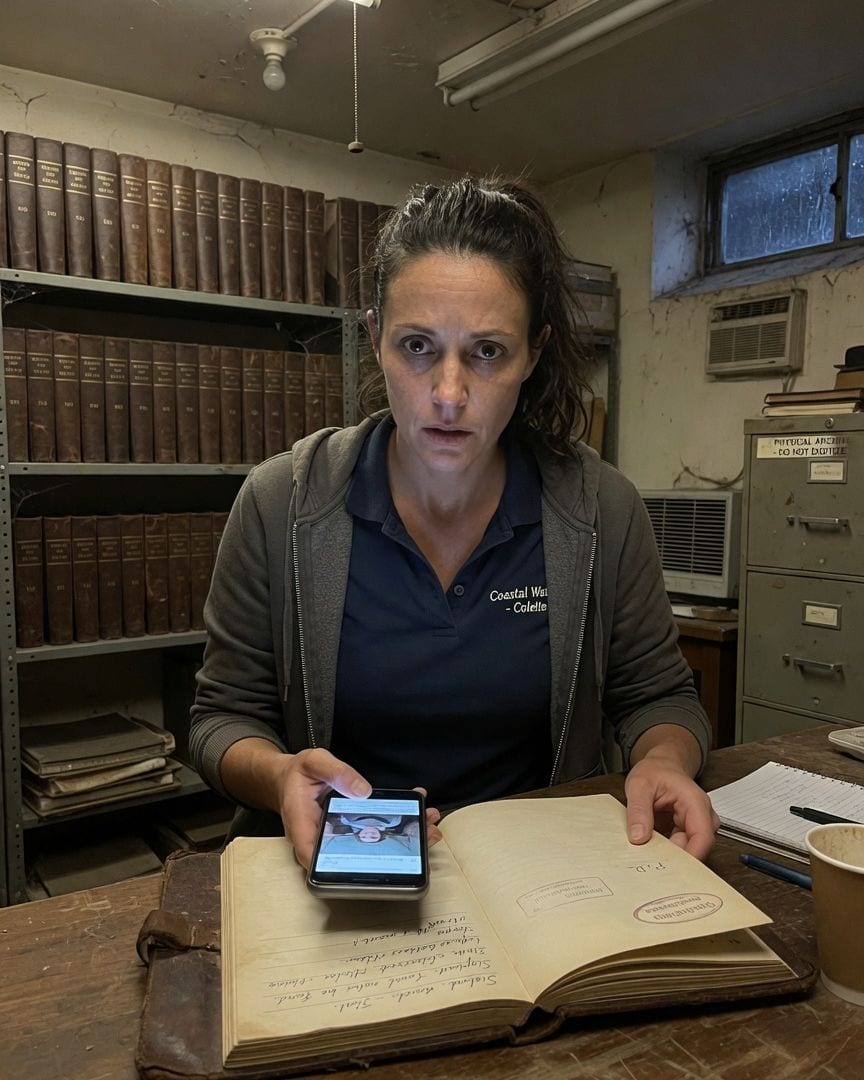
My coastguard log noted Sighting 9 again tonight, a light where no vessel showed. The old logs carry Sighting 9 off Skerry Point at 3:14am every tenth year since 1954, always 'nothing found,' always 'send no boat.'
On my watchtower night shift, the radar screen glowed green and the ocean was quiet. Then, a familiar light appeared off Skerry Point, exactly on cue, just as it had every tenth year for decades. But digging deeper, I found a hidden stamp in an old logbook: 'Operation Skerry. Status: Complete.' It left me with a chilling sense of finality.
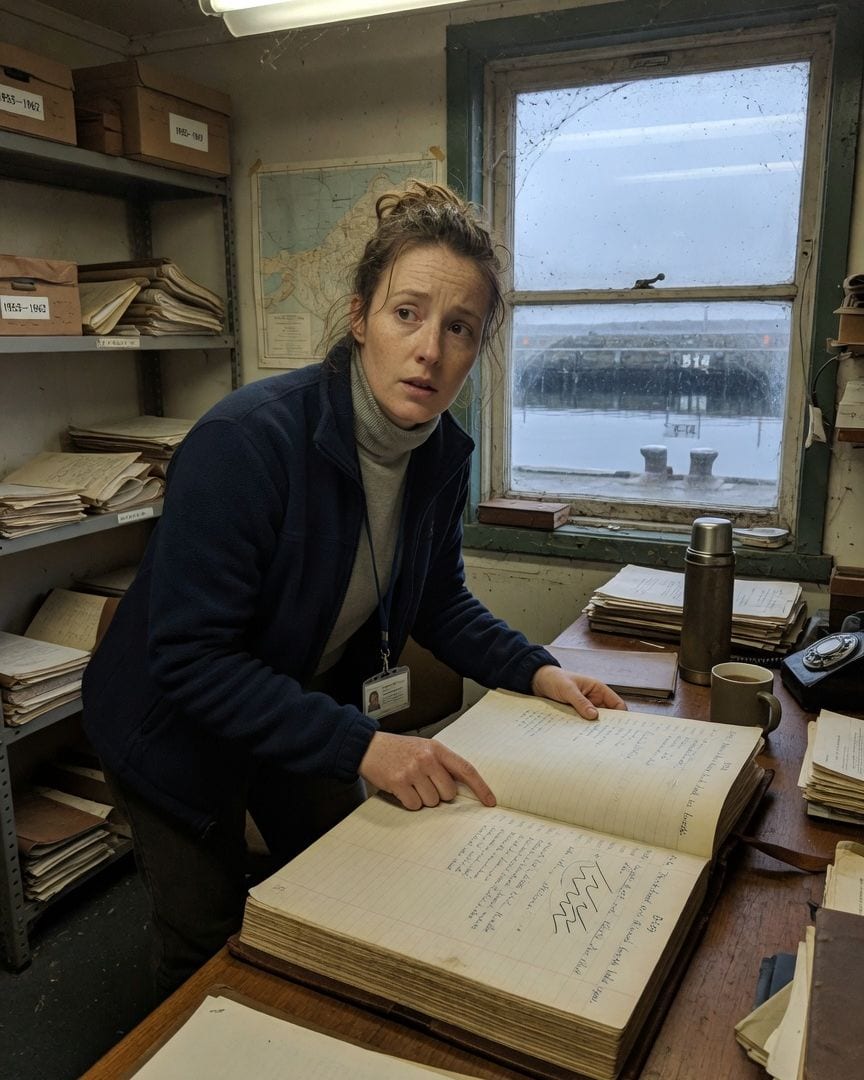
My harbour ledger shows Berth 14 let to a trawler every few years, but it's always empty. Each entry reads 'not returned to sea, berth held open'.
My job as Harbour Master's Assistant is managing the berth ledger, tracking every vessel. But Berth 14 holds a strange paradox: my book says it's let, yet it's always empty. Each entry for that berth closes with the same cryptic note – 'not returned to sea, berth held open' – a pattern stretching back to 1955.