Petty Officer Lund heard his own captain's mayday: the Cold War USS Goliath was sinking, two hundred miles astern.
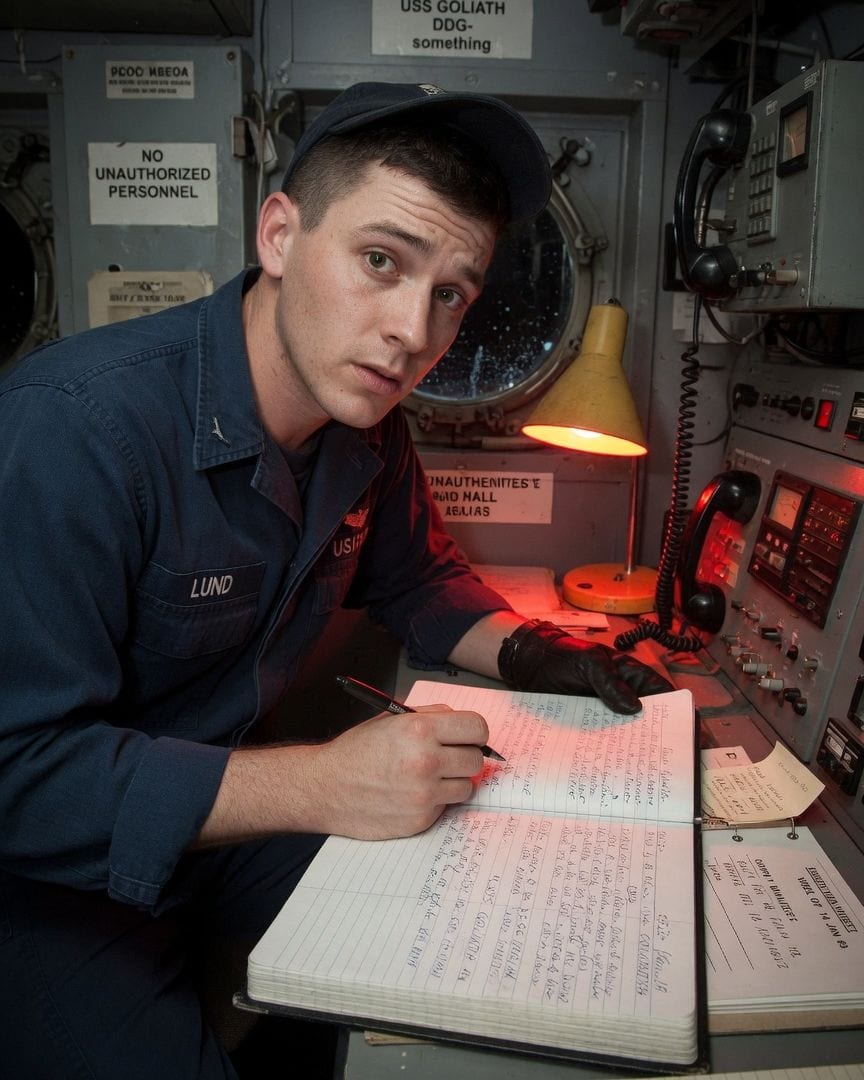
Petty Officer Marco Lund sat hunched over the console in the USS Goliath's radio room, the destroyer bucking through the North Atlantic in the deep winter of 1983.
The mid-watch was a lonely vigil, punctuated only by the crackle of static and the hum of the ship's systems. The dim red lights of the console cast long shadows across his face.
Suddenly, a weak, garbled mayday broke through on the guard channel.
The voice was distorted, choked with static, but the hull number and captain's name were unmistakable: his own ship, his own skipper, reporting they were going down, two hundred miles astern. Marco’s blood ran cold.
He logged the impossible call, his hands moving automatically, the familiar weight of the pen strange in his fingers. He noted the time, the garbled coordinates, the chilling content.
Then he grabbed the internal phone, his voice tight as he confirmed with the bridge that Captain Sterling and the Goliath were perfectly fine, steaming steadily. Ensign Trevor Vaughn, the Bridge Watch Officer, sounded annoyed. "Disregard it, Lund.
Probably a phantom signal from atmospheric interference. Happens." Marco was told to disregard it, a phantom signal, a glitch in the icy air.
But an hour later, as the Goliath cut through the black, churning water, the same mayday came again, stronger, clearer, and closer. The voice was no longer distorted.
It gave a position that Marco knew, with a sickening lurch, was the exact stretch of black ocean they had just steamed across.
The hum of the ship's systems seemed to thrum a little lower, a little colder, in the quiet room.
The second phantom mayday left Marco deeply unsettled. He couldn't shake the coordinates, the captain's voice, the sheer impossibility of it echoing in the small radio room. Ensign Vaughn's dismissal felt hollow.
He began to pore over the ship's internal records during his off-duty hours, starting with maintenance logs for the past week, trying to find any explanation, any anomaly, however mundane. He scanned every entry, from engine diagnostics to galley repairs.
His eyes snagged on a peculiar entry in the supply manifest: a requisition for a specialized hull patch kit, part number 77-Alpha-9, dated for 'this week' and marked 'urgent'.
Yet, there had been no hull damage reported, no repair work order issued. Marco tried to rationalize it, running through possibilities – a clerical error, a misplaced order, perhaps an item for future stock.
He approached Chief Petty Officer Penelope Hale, the Chief Yeoman, a no-nonsense woman with an encyclopedic knowledge of ship's paperwork. Her office was a fortress of impeccably organized binders and flashing computer screens.
He subtly inquired about the odd part number, framing it as a curiosity from his own perusal of the logs. Hale, after a moment's search on her terminal, located the requisition. Her brow, usually smooth, furrowed slightly.
'That's a rare one,' she mused, her finger tapping the screen. 'And no corresponding work order. A ghost order, I guess. Happens sometimes. Probably just sitting in storage, taking up space.'
Marco felt a cold prickle at the back of his neck. 'Ghost order.' The phrase resonated with the phantom distress call, a chilling echo.
Unable to dismiss the 'ghost order' or the phantom mayday, Marco returned to the radio room later that night.
The ship was quiet, the mid-watch again, the only sounds the shudder of the hull and the distant groan of the engines. He pulled out the heavy, official radio logbook, its stiff cover cool under his gloved fingers.
This was the very one he had made his entry in just hours before. He traced his finger over his own neat handwriting, the impossible coordinates for the sinking Goliath, the chilling details.
Then, just beneath his entry, almost perfectly aligned with the one he had made, he noticed it: a faint, almost invisible impression in the thick paper. He leaned closer, angling the desk lamp.
It was another entry, for the exact same phantom mayday, the same hull number, the same coordinates, the identical chilling message of a ship going down. But this one was dated a week prior.
The handwriting was different, older, almost faded into the paper itself, as if pressed there, or slowly rising to the surface from beneath the fibers.
He ran a gloved finger over the impression, feeling the slight indentation in the paper, a physical trace of a record that cannot exist.
The phantom log entry was a physical impossibility, a ghost on paper, yet undeniable beneath Marco’s touch. He knew he couldn't bring it to official channels without risking his career, perhaps even his sanity.
He sought out Chief Hale again, this time asking more broadly about historical record-keeping practices on older vessels like the Goliath, mentioning 'auxiliary' or 'unofficial' logs.
Hale, sensing his genuine curiosity despite his vague explanations, directed him to the ship’s archives, a cramped, rarely used room deep in the engineering section.
The air there was thick with the smell of dust and old paper, the shelves crammed with forgotten files and rusting equipment.
Marco spent his off-duty hours there, meticulously sifting through decades of forgotten paperwork. The chill in the room seemed to deepen with each passing hour, the metal shelves groaning faintly as the ship pitched.
After days of fruitless searching, tucked away behind a stack of decommissioned sonar tapes that felt brittle and cold to the touch, he found it: a worn, leather-bound book titled 'USS Goliath - Special Incidents,' with no official Navy markings, no hull number, just that cryptic title.
Its pages were brittle, the ink faded in places. Inside, dated 1978, was an entry for a 'phantom distress call' from the Goliath itself, reporting its own sinking, with details eerily identical to his own experience.
It was signed by a Petty Officer 'R. Holloway.' The pattern was undeniable, stretching back years, across different rotations and different crews, a silent, impossible history hidden in plain sight.
Marco's frequent disappearances into the archives did not go unnoticed. One afternoon, Ensign Trevor Vaughn, Marco's direct supervisor, called him aside in the narrow corridor outside the radio room.
Vaughn was a sharp, ambitious officer, usually focused solely on operational efficiency. He leaned against the bulkhead, arms crossed, his posture radiating casual authority.
'Petty Officer Lund,' Vaughn began, his voice calm but his eyes unnervingly direct, 'I've noticed you've been spending a good deal of your off-duty time in the archives. Anything you care to share about this newfound interest?'
Marco stammered, offering a vague explanation about researching historical communications equipment, hoping it sounded convincing. He felt the cold pressure of Vaughn's gaze, like a spotlight on his sudden secret. Vaughn nodded slowly, a slight, humorless curve to his lips.
'Right. Well, I'm sure you understand the importance of focus, especially with your upcoming performance review. Unnecessary distractions, unauthorized research... these things can reflect poorly on a sailor’s record, wouldn't you agree?'
The implied threat was clear, heavy in the confined space. The air in the corridor felt suddenly colder. Vaughn knew. Or someone above him knew, and was watching Marco's every move, his every deviation from the expected path.
Marco felt a sudden, chilling vulnerability, the hunter now feeling hunted.
The warning from Ensign Vaughn only solidified Marco's resolve. He found Chief Hale again, this time in a quiet corner of the mess deck after hours.
Her usual composure seemed to crack under the strain of his persistent questions, her eyes scanning the nearly empty room. He laid the 'Special Incidents' logbook on her desk, open to the 1978 entry.
Hale's face paled, the color draining from her cheeks. 'Where did you get this?' she whispered, her gaze darting nervously to the door, as if expecting someone to walk through it.
Marco pressed her, explaining his own experience, the phantom mayday, the impossible log entry beneath his own. He spoke quickly, urgently, the words tumbling out.
She finally broke, admitting that the 'Goliath's ghosts' were more than just legend, more than just a sailor's superstition.
She revealed that the 'Special Incidents' log was an unofficial, classified protocol, a system to document events that could not be officially acknowledged.
'It's how we keep the books straight, outside the Navy's eyes,' she explained, her voice barely a whisper, a contrast to the clatter of silverware from the distant galley.
'Orders come down through channels for these entries to be cross-referenced, but no one ever says why.'
Then, with a deep sigh, she pulled up Marco's own service record on her console, her fingers trembling slightly on the keyboard. 'There’s something else, Lund. Something I never understood.'
She pointed to an entry: a commendation for 'exemplary conduct during a simulated emergency' dated March 15th, 1983 – the exact date of Marco's phantom mayday.
Marco stared at it, a commendation he had absolutely no memory of earning, a piece of official recognition for an event that, to his knowledge, had never happened.
'It's real,' Hale said, her voice tight, 'signed off by Captain Sterling himself. But there was no simulated emergency that day. Nothing on official record that would justify it.'
The phantom commendation, a record of an event that never occurred, shook Marco to his core. If his own service record could lie, what else did it contain?
What other fabricated truths lurked in the bureaucratic labyrinth of his naval career? He demanded to see his full, complete service history, every assignment, every transfer. The hum of the ship around them seemed to intensify, a low, unsettling vibration.
Chief Hale hesitated, her fingers hovering over the keyboard, her eyes wide with a mixture of fear and reluctant understanding. 'Lund, this is highly unusual. Some of these records are... restricted. For a reason.'
Marco insisted, his voice low and firm, overriding her hesitation. 'Show me.' With a sigh of resignation, Hale accessed the deeper files. The screen flickered, then refreshed, displaying a detailed timeline of Marco's naval career.
His eyes scanned down, past his enlistment, his training, his deployments, each entry a familiar anchor to his past. Then he stopped.
An entry glowed on the screen, stark and impossible, a dark stain on the clean white text: 'Temporary Assignment: USS Goliath (DDG-83) - Special Operations Support,' for a six-month period stretching from April to October of 1981.
This was a time he vividly remembered spending on shore duty in San Diego, working in a naval supply depot, nowhere near a destroyer.
His own name was on the manifest, his own signature on the transfer order, accounting for a deployment he never made.
The cold, hard fact of the official paperwork contradicted his own lived memory, implicating him directly in the ship's impossible history.
Marco, clutching the printout of his impossible service record, confronted Captain Sterling in his quarters.
The Captain, a man usually radiating authority, was seated calmly at his polished wooden desk, a mug of coffee in his hand, the steam rising in the cool air.
Marco laid the documents – the phantom log entry, the 'Special Incidents' book, the impossible commendation, and his fabricated transfer order – on the desk.
Sterling merely glanced at them, his eyes lingering on Marco's signature, then back at Marco, his expression unperturbed.
'Petty Officer Lund,' he said, his voice quiet, almost conversational, 'you've been digging.' He then calmly explained the Goliath's 'condition.' The ship, he revealed, was a temporal anomaly.
It occasionally 'drifted,' or more accurately, 'echoed' through its own timeline, manifesting past or even future events.
The phantom maydays, the impossible repairs for hull patch kit 77-Alpha-9 that were indeed used on a 'different version' of the ship, the 'ghost orders' – they were all real, just not strictly 'present.'
The USS Goliath had a history of these 'incidents,' stretching back decades, a pattern acknowledged and managed by successive commands.
He explained that individuals like Marco, who became too acutely aware or entangled in these echoes, were sometimes subject to 'Special Operations Support' assignments.
These were fabricated deployments, designed to account for periods when a sailor's experience with the anomaly became too disruptive, or to 'reset' their perspective away from the ship.
He confirmed that Marco had indeed been 'assigned' to the Goliath two years prior, though he hadn't physically been on board, a period when his perception of reality had briefly 'aligned' with a different temporal iteration of the ship.
The commendation for a 'simulated emergency' on March 15th, 1983, was merely a cover, a piece of paperwork to explain his proximity to that specific anomaly.
Sterling's words were delivered with the calm certainty of a man discussing the weather, and that was the most terrifying part.
Captain Sterling's calm explanation was far more terrifying than any shouted denial. He detailed how previous commands, and now he, maintained the coherence of the Goliath's operations for the outside world.
The 'Special Incidents' log, the phantom commendations, the fabricated assignments – they were all part of an elaborate system to manage the anomaly, to account for the impossible.
'The Navy can't acknowledge a ship that occasionally sails through its own past or future,' Sterling stated, his eyes holding Marco's across the desk.
'A destroyer that reports itself sinking two hundred miles astern, only to be found perfectly fine, is a national security nightmare. But we can ensure the paperwork always adds up, that the accountability that cannot be, appears to be.'
The ship's internal mechanisms whirred softly, a sound that now seemed less like machinery and more like the grinding of gears on something vast and unseen.
He then offered Marco a choice, not an escape. Marco could accept the Goliath's unique reality, learn to filter the echoes, to log the impossible with a straight face, and continue his promising career.
He would become part of the system, one of the few who knew. He would learn the protocols, the cross-referencing of these 'unusual log entries' that Chief Hale had mentioned as a 'standing order.'
Or, he could request a transfer, a quiet medical discharge citing 'stress-related issues,' his service record marked in such a way that he would never serve on a ship again.
He would be out, but his career, his identity as a sailor, would be over, dissolved by the very truth he had uncovered.
The choice was not about fighting the anomaly, but about how he would live with it, or be broken by it.
The captain’s calm acceptance of the Goliath’s 'condition' was the worst part; there was no solution, only accommodation to the impossible.
Marco made his choice. He stayed. He learned to recognize the subtle shifts in the radio static, the faint bleed-through from other timelines, and to ignore them.
He logged the occasional 'special incident' reports with a practiced, detached hand, his signature now neatly mimicking the precise, almost identical script of the previous officers in the unofficial log, a testament to his assimilation.
The USS Goliath completed its patrol, its impossible journey continuing, its secrets held tight by a crew who now understood what they were truly serving aboard, a select few navigating the impossible.
Marco sat on mid-watch, the familiar hum of the radio room around him, the dim red glow washing over his console. A faint, almost imperceptible voice whispered on an unused channel, calling out a hull number.
It was distorted, barely audible, but Marco recognized the cadence, the impossible urgency. He didn't react. He simply logged the routine weather report for the North Atlantic, his pen moving smoothly.
Then, with a slow, deliberate movement, he reached for a small, leather-bound journal he now kept hidden in his locker, its cover cool and worn under his fingers. He opened it to a blank page.
He made a new entry, in his own hand, carefully recording the details of the phantom voice, the coordinates, the date. He signed it with his rank and name, a new, almost perfectly formed signature.
Years later, a veteran records archivist, reviewing the decommissioned USS Goliath's logs, found a pattern of identical, impossible entries across decades, all signed by officers who officially served elsewhere at the time.
The last entry in the 'Special Incidents' logbook, dated the day the Goliath was finally scrapped, bore a single, clear signature beneath it: 'Petty Officer Marco Lund.'
If this one got to you
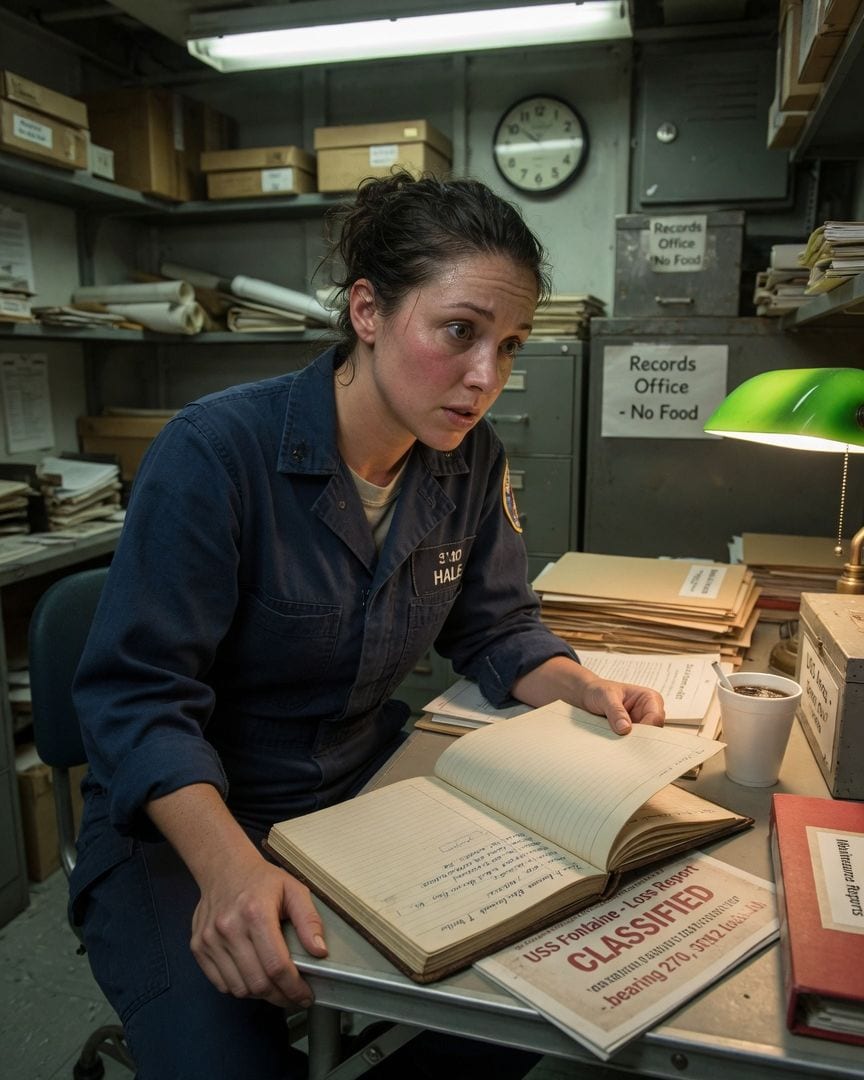
Petty Officer Hale needs a spotless record for her transfer. But the USS Ares sonar logs show an identical, impossible contact, logged to the minute, years apart, and tied to a classified loss report.
Petty Officer Sarah Hale needed a spotless record for her coveted shore duty transfer, a posting she'd worked five years to secure. Alone in the USS Ares sonar shack, three days out from San Diego, her midwatch was broken by an impossible contact: a close, slow echo holding perfect pace, invisible to radar, then vanishing. Her heart hammered, not from fear, but from the data's impossibility. When she found an identical entry in her own log from just one week prior, the cold dread tightened its grip. But the true chill settled when she unearthed decades of similar records, signed by other sonar officers, all showing the same impossible contact at 0212, off the port beam, for nineteen minutes, on the same ship, stretching back years—a persistent echo tied to a classified loss report.
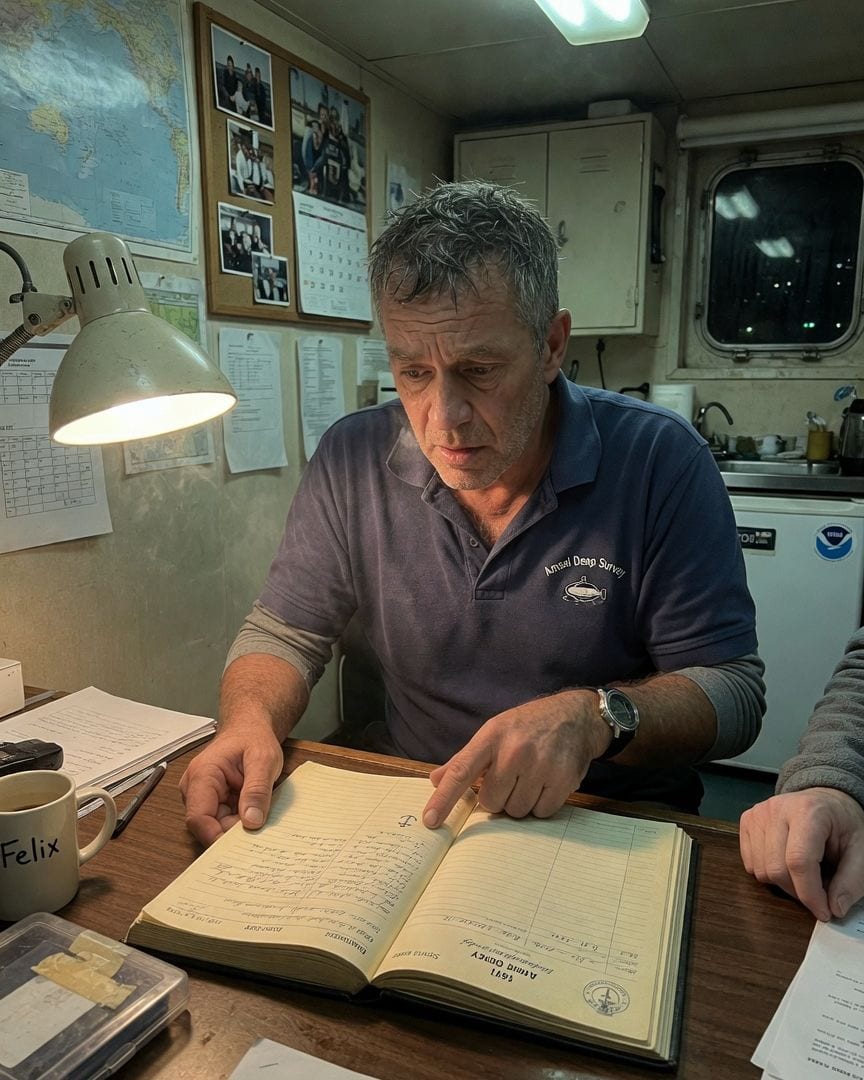
On his final deep-sea survey, a submersible pilot watches a 32-year-old Cold War wreck's rudder shift two degrees.
Deep-sea surveyor Hugo Amsel embarked on his final major dive, anticipating a quiet retirement after decades exploring the crushing pressures of the deep. His submersible's lights cut through the murky green, revealing the *Wynn Portal*, a sealer vanished in 1991, eerily preserved with unnervingly clear windows, free of any marine growth. Then, the inexplicable: the wreck's rudder angle indicator, softly lit, twitched two degrees further to starboard. Later, inside the wheelhouse, Hugo found the ship's official logbook, its final entry dated three days *after* the vessel's recorded disappearance, hundreds of miles north. How could a ship vanish, only to log a journey days later, from a place it never reached?
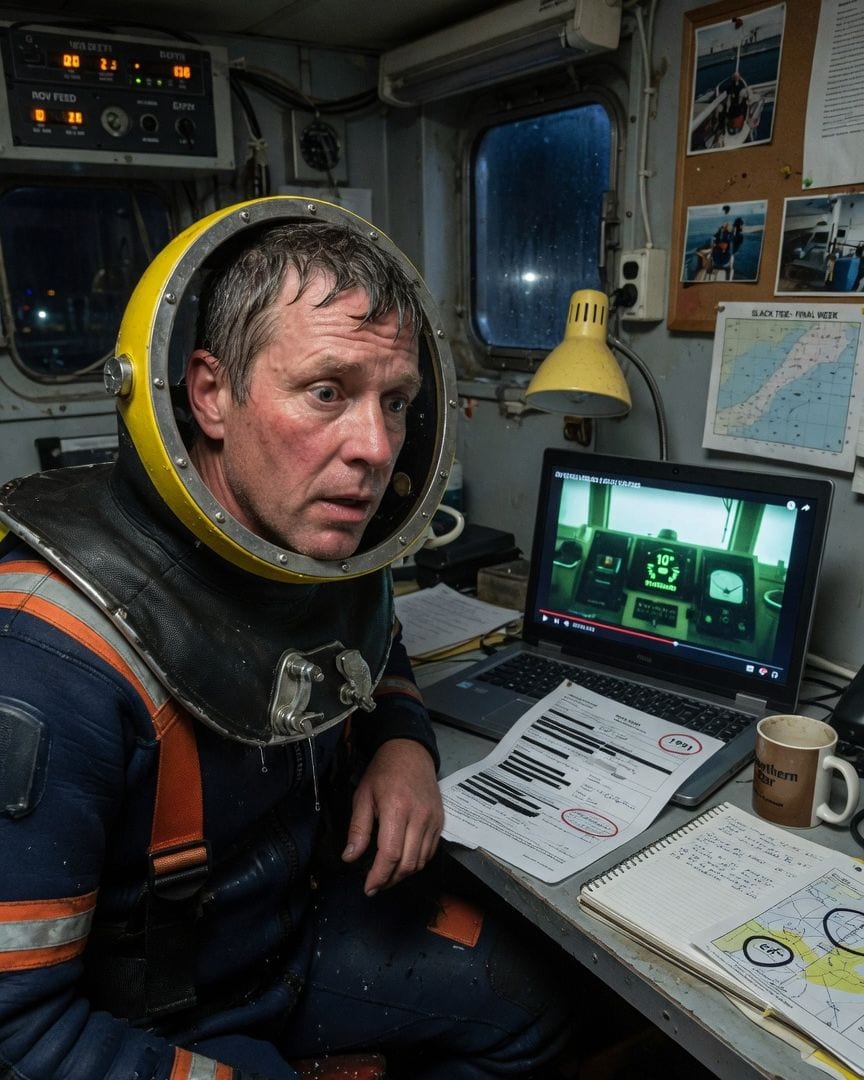
A deep-sea surveyor's final dive into a 1991 wreck found a logbook dated 2023, and a figure watching him.
Deep-sea surveyor Hugo Amsel faced the final week of his Bering Sea survey, under immense pressure to find conclusive evidence before the short season closed. In the abyssal gloom, he located the *Wynn Portal*, a sealer lost with fourteen crew in 1991, surprisingly intact. Through its clear wheelhouse window, he saw a rudder indicator glowing green, an impossible light on a dead ship. Later, on a second dive, he found a leather logbook tucked beneath the helm, open to a page clearly dated 2023. As he stared, a shadow inside the window shifted, coalescing into a figure watching him from the depths.
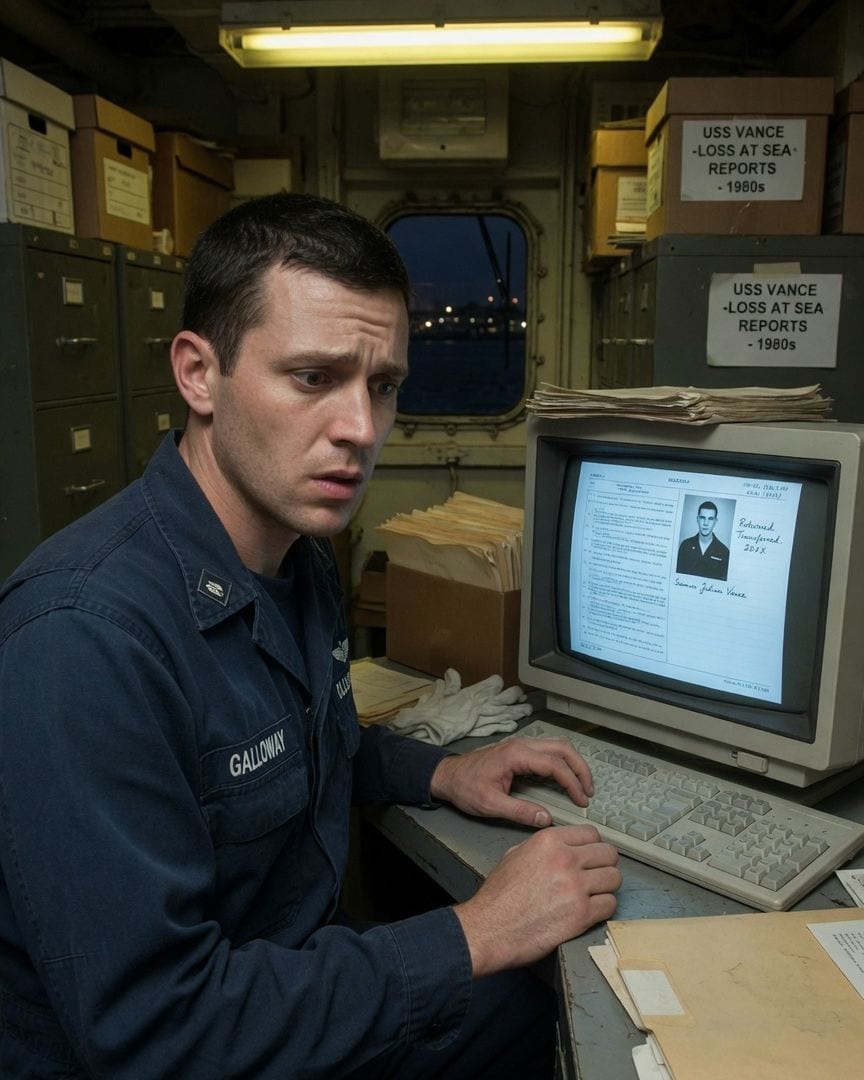
Petty Officer Galloway logged a sailor onto his ship. The man died at sea 40 years ago.
Petty Officer Joel Galloway scanned a sailor's ID on the USS Vance quarterdeck. The man's name, 'Seaman Julian Vance,' and his out-of-date uniform pricked at Galloway's memory. Later, the ship's berthing count came back one over, with an extra entry in the system but no physical body.
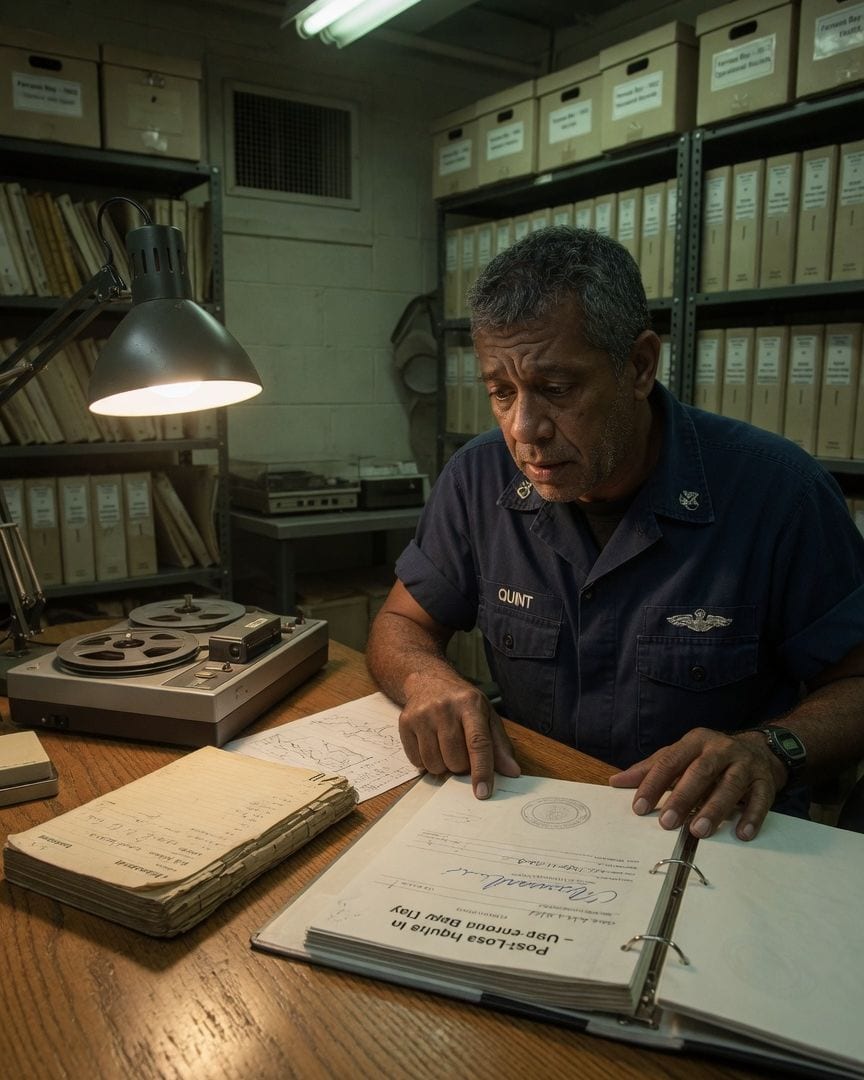
A Cold War sonarman heard his dead father’s voice on a tape, charting the ship’s wreck thirty years after it sank.
Chief Sonarman Abel Quint spent six weeks in the Naval Records vault, listening to the final transmission of the USS Ferrous Bay. His father, Desmond Quint, was on that ship when it vanished in 1962, and Abel sought some final comfort in his voice. But on this morning, a faint, second set of sonar soundings emerged from the recording—soundings in his father's precise cadence that charted the ship’s wreck site thirty years in the future. As Abel cross-referenced records, he then found a maintenance log for the Ferrous Bay's sonar system, dated six months after the ship and his father were officially lost, signed by Desmond Quint himself. What impossible truth was hidden in these official naval records?
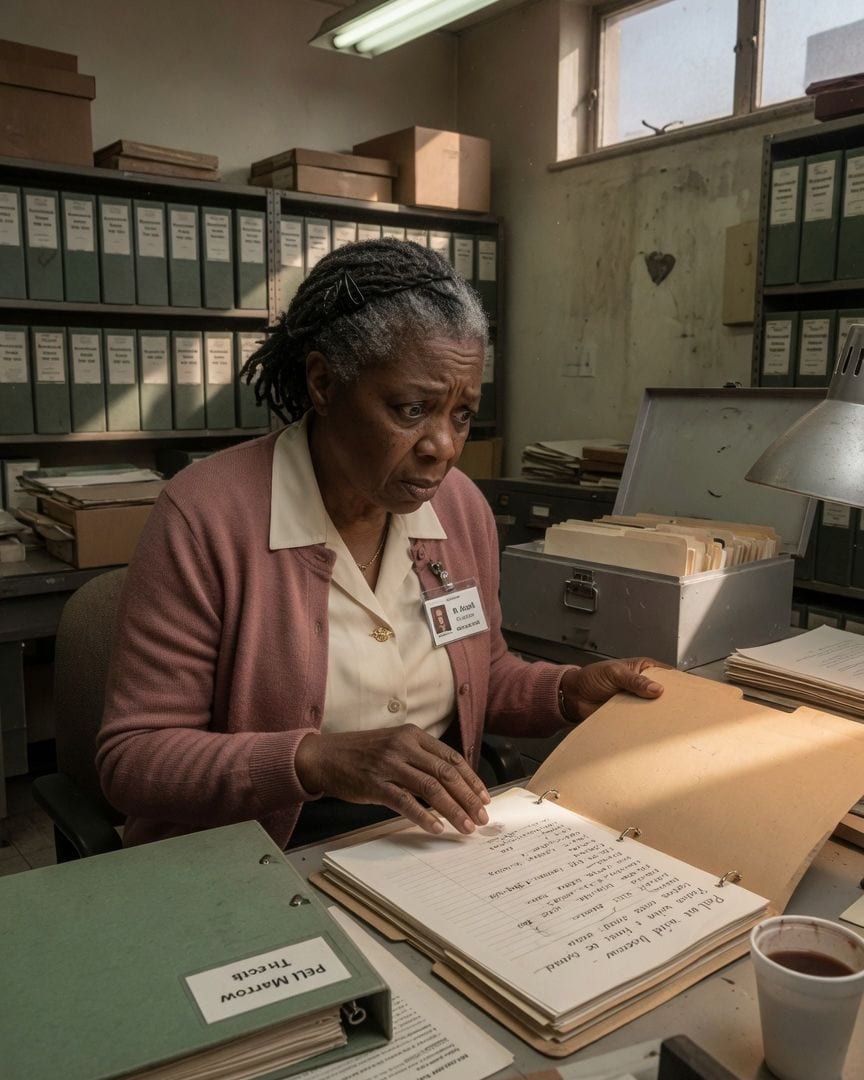
A records clerk's archive file for a Cold War reconnaissance plane lost in 1968 showed it flew yesterday to her own building.
Marguerite Ansell, a records clerk nearing her final week before retirement, meticulously audited Cold War-era files. In the cool, dusty archive, she pulled a file for an oiler declared missing in 1951. Inside, she found a fueling schedule with entries stretching into the present, the last dated just eleven days ago. Then, a second lost ship revealed a similar impossible log, and a cold certainty began to bloom in her chest. Deep in the shadows, Marguerite found an unmarked steel box containing a file for a reconnaissance plane lost in 1968. Its flight log showed a final flight yesterday, to the precise coordinates of her own archive building.