A Cold War records clerk found a lost ship's supply run, signed yesterday by its crew, dead since 1943.
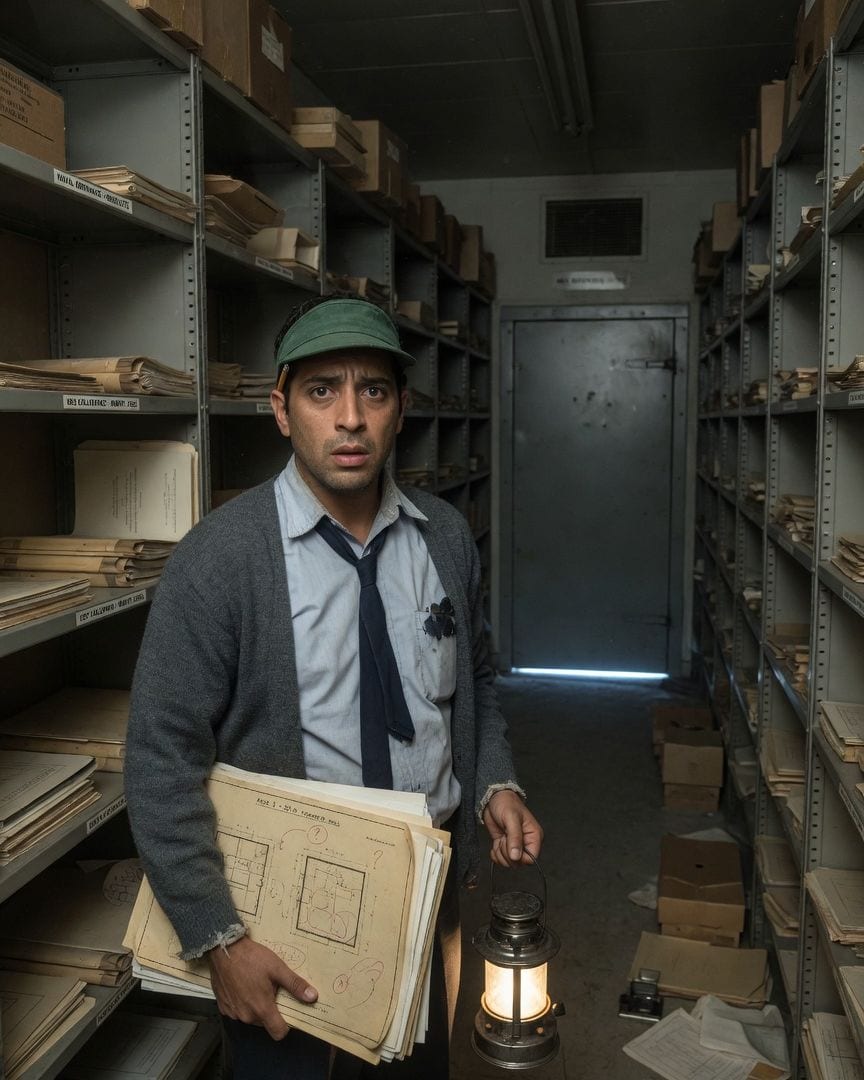
Aurelio Bosch, 35, a methodical night-shift clerk, worked in the Cheyenne records vault, a labyrinth of steel shelves and forgotten paper. It was Winter 1957, and he’d taken the shift nobody wanted.
His job was simple: verify shelf contents against the master list, aisle by aisle. He reached the end of the list in Aisle 3, a section usually dedicated to obsolete naval ordnance manifests.
The official blueprints stated the aisle was thirty feet deep, ending in a solid concrete wall, clearly marked.
But as Aurelio pushed his cart forward, the shelving kept going, another forty feet of it, loaded and dusted, stretching into a space that, by all accounts, should not exist.
At the far end, where the wall should have been, was a heavy steel door, a solid, unyielding slab with no visible handle or lock.
From under it, a thin line of light pulsed, a cool, unnatural glow that shimmered against the dust motes dancing in the stale air. Aurelio knew no fixture in the vault that could produce such a light.
Then, he caught it: the faint, rhythmic thrum and the metallic tang of ink, the unmistakable smell of a printing press running, deep within the hidden space.
He checked the blueprints again, then the vault’s maintenance logs, tracing the grid of the facility by lantern light. No annex, no utility room, nothing accounted for the extra forty feet of functional shelving or the space beyond the door.
The door itself was an enigma, solid, unmarred, with no seams or hinges visible. The thrumming from behind it was subtle, a vibration more felt than heard through the thick concrete floor.
Aurelio tried to rationalize it—a mislabeled section, a forgotten storage closet from an earlier renovation, perhaps just a ventilation hum echoing strangely—but the persistent, unnatural light and the undeniable smell of ink defied every ordinary explanation.
He decided to search for clerical anomalies in the surrounding sections, hoping a misplaced record might hint at the room’s purpose or history.
Hours later, buried in microfilm for old naval records, he found it: File 77-Delta-9, for the USS Calloway, a Navy destroyer lost with all hands in the Pacific in 1943.
Beside the official loss report, Aurelio found maintenance logs and supply requisitions, meticulously detailed and dated into 1948, five years after the ship’s confirmed disappearance. They were signed, repeatedly, by its original crew.
He initially dismissed it as a bizarre misfile, a clerical error from the chaos of wartime record-keeping, a common enough occurrence in such old archives.
Aurelio continued his search, the earlier rationalization beginning to feel thin, a cold dread settling in his stomach. He found another anomaly: File 11-Bravo-Six, for a B-29 bomber lost over the Pacific in 1950.
Its flight logs, handwritten and meticulously detailed, continued into 1955. The signatures on the later logs were identical to the pre-loss ones, down to the subtle flourish on the 'R' in the pilot's name. This wasn't a misfile.
This was a pattern. He felt his hands begin to tremble. Then, he found it: a new entry, tucked into the Calloway file, a carbon copy dated just yesterday, Winter 1957.
It was a requisition for a 'routine supply run,' specific and detailed, signed by a crewman officially listed as lost with the ship in 1943.
The next night, Aurelio returned to the vault, the Calloway file clutched in his hand. He cross-referenced the 'yesterday' entry with every official dispatch and supply chain record he could access through the vault's aging terminals. Nothing.
No corresponding requisition number in the logistical manifests, no linked payroll entries, no trace in the general naval supply system. These 'active' files, he realized, were entirely isolated, existing only within the vault's own peculiar reality.
He began compiling a list of similar anomalies, working systematically through the dusty shelves.
He discovered dozens of files for ships, aircraft, and even entire military units declared lost decades ago, yet accruing new, official-looking entries, often with dates extending into the current year.
A chilling pattern emerged: many of these post-loss requisitions included a specific, highly specialized item – either a unique lubricant, "Cryo-Lube 7," or a "Spectral-Band Sensor Component, Mark IV."
These weren't standard issue for any of the listed units, and Aurelio found no procurement records for them anywhere outside these anomalous files.
The dread deepened; this wasn't just bureaucracy gone rogue, but a system with its own strange, internal logic, functioning in the dark beneath the official records.
Aurelio's long hours and unusual inquiries didn't go unnoticed. One morning, as he prepared to leave, he found his desk subtly rearranged.
A stack of empty file boxes he’d left neatly on the right side of his desk was now on the left.
A specific, obscure historical document he’d been reviewing was replaced with a different volume from the same collection, as if someone had tidied up, but with an unsettling precision. Nothing overtly stolen or damaged, just... shifted.
He felt a prickle on the back of his neck, the distinct sensation of being observed.
The rhythmic thrumming from behind the impossible door in Aisle 3 seemed louder now, a low, resonant heartbeat echoing through the quiet vault, a sound that previously he’d only felt in the floor.
Then, on his desk, tucked neatly under his coffee mug, he found an anonymous memo. It was printed on official letterhead, heavy cream paper, but no sender was listed, no date was present.
It contained only a terse warning, typed in a crisp, sans-serif font: 'Unauthorized access to sensitive materials will result in immediate termination and severe disciplinary action. Strict adherence to classification protocols is mandatory.'
The language was cold, precise, and utterly devoid of personal touch. Someone knew what he was doing.
The next morning, Aurelio confronted his supervisor, Walter Hughes. Walter, a man in his late fifties with a placid, unreadable face, listened to Aurelio’s agitated account of the memo and the strange files, his expression unchanging.
Walter’s initial response was a dismissive wave of his hand, citing 'security protocols' and 'classified annexes' that Aurelio, as a junior clerk, wouldn't be privy to.
But Aurelio pressed, detailing the impossible length of Aisle 3, the faint thrum and chemical tang of the printing press, the specific dates on the Calloway and B-29 files.
He laid out his meticulous notes on the repeated crew signatures and the mysterious Cryo-Lube and sensor component requisitions. Walter’s placid expression didn't change, but Aurelio noticed a subtle tension enter his shoulders, a slight clench of his jaw.
He leaned forward, his voice dropping to a near whisper, almost a confiding tone. 'Aurelio, some things are never truly lost. They are… re-purposed.'
He explained that certain 'assets' were considered 'active but off-ledger,' individuals and units whose official status ended, but whose service continued.
Their records, he stated, were maintained in a secure, internal system – the very one behind the door in Aisle 3.
He explained that the 'lost' weren't dead; they were simply integrated into a different kind of service, a silent, unseen continuation. Walter’s calm, almost serene demeanor as he spoke of this unspeakable truth sent a shiver down Aurelio’s spine.
'The secrecy machine itself,' Walter murmured, his eyes unblinking, 'it requires maintenance. And it requires… operators.' He warned Aurelio, with a paternalistic tone that felt more like a threat, to drop his investigation, for his own good.
Aurelio’s earlier clues snapped into focus with a sickening click: the specific lubricant, the sensor components – they weren't for ships or planes, but for the machine itself. The continuous files weren't errors, but proof of an ongoing, horrific process.
Shaken to his core, Aurelio retreated from Walter’s office. The vault, once a place of quiet order and predictable routine, now felt like a mausoleum for the living, a silent factory of dread humming beneath the earth.
He returned to his desk, his mind reeling. He needed to process Walter’s words, to understand the full implication of 're-purposed,' to grasp the enormity of the hidden system.
As he sat down, he noticed a new file box on his chair. It was unlabeled, pristine, its corners sharp, and it had not been there when he left for Walter's office just minutes before.
His heart hammered against his ribs, a frantic drum in his chest. He reached out a trembling hand and opened it. Inside, perfectly organized, crisp and new, was his own personnel file.
His service number, his birthdate, his current assignment, all meticulously documented. He flipped through the familiar pages, his breath catching in his throat, a cold sweat breaking out on his brow.
At the very back, a new section, its heading crisp and bold: 'Current Operational Status.' Under it, a single, horrifying entry, dated tomorrow: 'Activation Protocol: Records Vault Personnel, Shift Beta.'
It was signed, in a steady, official hand, by Walter Hughes.
Aurelio confronted Walter again, his own file clutched like a shield, the crisp paper crinkling under his shaking fingers. Walter remained calm, his expression unruffled, almost expectant.
'So, you understand now,' Walter said, a faint smile playing on his lips, a smile that didn't reach his eyes. He explained that the 'lost' were indeed not lost, but had been quietly integrated into the 'secrecy machine.'
The printing press in Aisle 3 wasn't just printing records; it was generating new identities, new roles, new instructions for these re-purposed assets.
The ships and planes were merely the initial points of acquisition, the conduits through which personnel were fed into the system.
The unique lubricant and sensor components Aurelio had found were for maintaining the very mechanism of this integration, for keeping the machine running smoothly, perpetually processing.
The vault wasn't just a storage facility; it was a processing center, a quiet, efficient factory for converting the missing into the 'active but off-ledger,' filing them into a continued, off-ledger existence.
Walter then delivered the final, crushing blow: Aurelio, by discovering the system, by displaying such methodical curiosity and thoroughness, had proven himself an ideal candidate. He had been 'activated.'
His new role was to become one of the machine's permanent operators, to ensure the files—and the process—kept writing.
The door in Aisle 3 wasn't to a room, Walter clarified, but to the core of the machine itself, a perpetual engine of quiet dread, and a new life.
Horror twisted in Aurelio’s gut. He backed away, stumbling over a loose file cart that clattered loudly in the sudden silence of the vault. 'No,' he whispered, his voice hoarse, 'I won't.'
He spun, desperate to escape, to call for help, to expose this impossible truth to a world that would never believe him. But Walter, moving with a slow, deliberate purpose, blocked his path to the main exit.
His movements were too precise, too unhurried, almost as if pre-programmed, devoid of human hesitation. Aurelio fumbled for his phone in his pocket; it was dead, the vault’s thick walls and hidden systems rendering it useless, a mere toy.
Walter spoke, his voice calm, almost sympathetic, yet chillingly devoid of genuine emotion. 'The system needs new operators, Aurelio. Methodical minds. You are perfect.'
He extended a hand, an open, inviting gesture that felt less like an offer of help and more like the opening of a trap.
Aurelio realized Walter wasn't just guarding the system; he was part of it, an earlier 'activation' who had long since accepted his role, absorbed into its placid logic.
The thrumming from behind the door in Aisle 3 grew louder, a deep, resonant hum that vibrated through the floorboards, a siren song for the newly 'activated,' calling him into its embrace.
Aurelio found himself trapped between the silent, impassive supervisor and the hidden door, its line of light pulsing with a terrifying invitation. Walter took another step, his hand still extended, a placid smile on his face.
Aurelio had nowhere left to go.
Aurelio Bosch never returned home from his night shift. His absence was noted, a missing person report quietly filed by his landlord and quickly closed by the local precinct, citing 'personal leave' after Walter Hughes provided a signed, official-looking document.
The Cheyenne records vault continued its operations, undisturbed by the shift in personnel, its quiet hum unchanging. Walter Hughes remained on staff, performing his duties with quiet efficiency, his placid demeanor unchanged.
The official records of Aurelio Bosch were eventually transferred to a new, sealed annex, filed under 'Active Operational Status, Type Beta.' Life outside the vault continued, oblivious to the quiet hum beneath the earth, the perpetual engine of secrets.
A few weeks later, a new, younger clerk was assigned to the night shift in the Cheyenne records vault.
He found a small, unlabeled box on his desk, already containing a single sheet of paper: a requisition for a unique type of lubricant, 'Cryo-Lube 7,' signed 'A. Bosch.'
The new clerk, methodical and quiet, filed it away without a second thought.
Later that month, Walter Hughes walked past Aisle 3. From under the door, a faint, rhythmic thrumming echoed. He paused, a faint, almost imperceptible smile touching his lips. 'Good work, Aurelio,' he murmured, and continued on his way.
If this one got to you
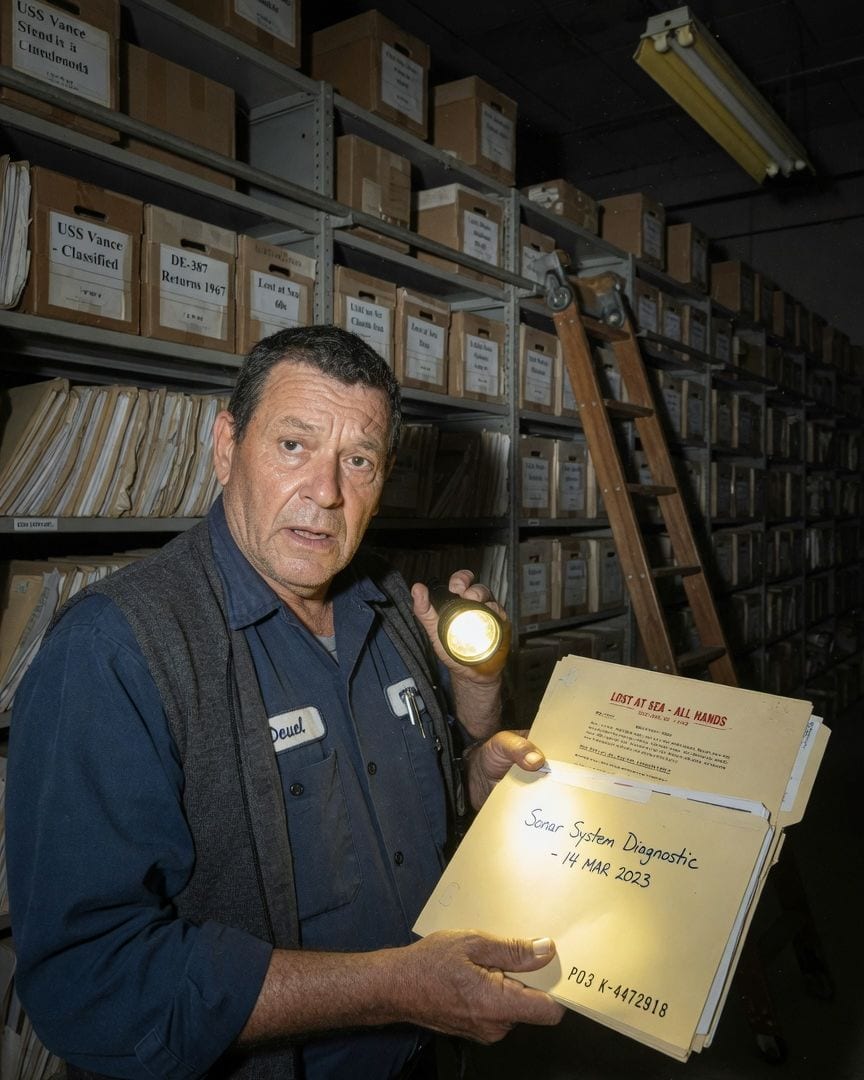
An archivist, alone in the Suitland annex, finds a 1968 lost Cold War ship file with a handwritten entry dated last Tuesday. The ink looks damp, but feels dry.
Carmine Deuel, 62, spent forty years amidst the dust and forgotten files of the Suitland annex. One night, alone in the cavernous space, a sticky squeal and the faint sway of a rolling ladder broke the silence. He found a classified file from the USS Vance, a ship lost in 1968, pulled from its shelf. Inside, a typed form held a handwritten entry: a routine sonar check, dated last Tuesday. The ink, impossibly, looked damp yet was perfectly dry. Who had accessed the file, and how could its entry be so recent?
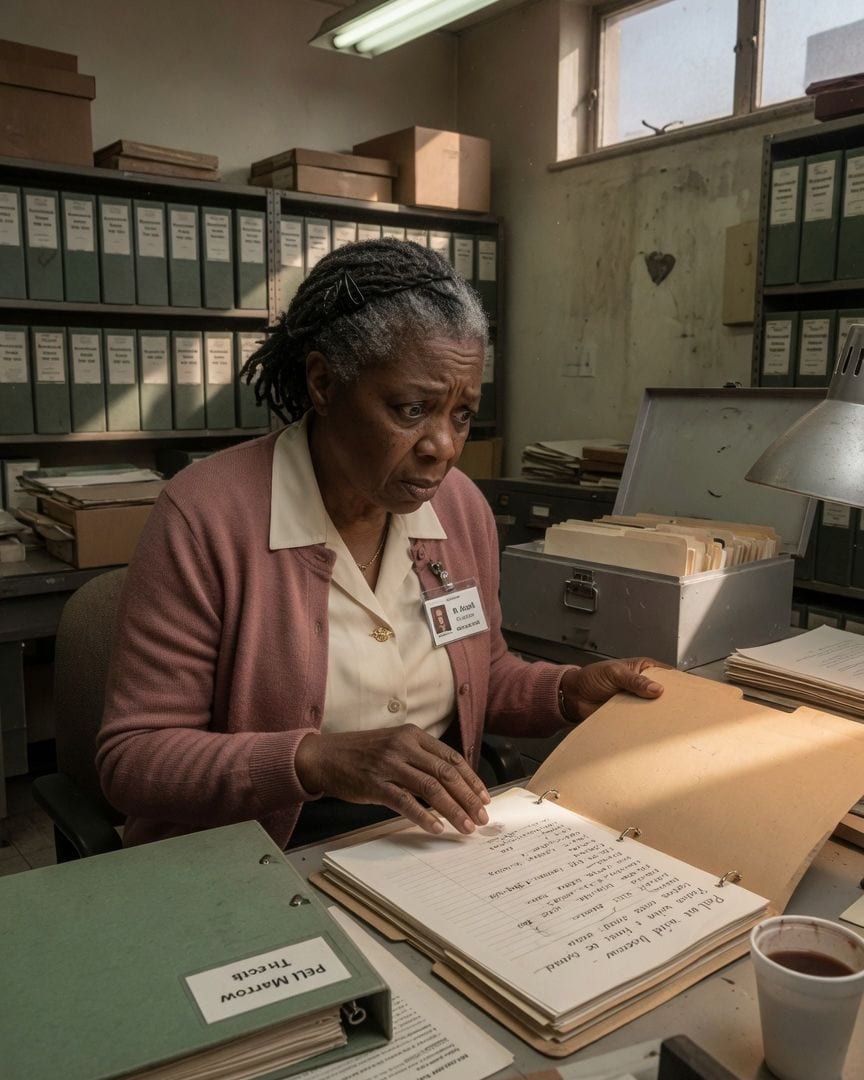
A records clerk's archive file for a Cold War reconnaissance plane lost in 1968 showed it flew yesterday to her own building.
Marguerite Ansell, a records clerk nearing her final week before retirement, meticulously audited Cold War-era files. In the cool, dusty archive, she pulled a file for an oiler declared missing in 1951. Inside, she found a fueling schedule with entries stretching into the present, the last dated just eleven days ago. Then, a second lost ship revealed a similar impossible log, and a cold certainty began to bloom in her chest. Deep in the shadows, Marguerite found an unmarked steel box containing a file for a reconnaissance plane lost in 1968. Its flight log showed a final flight yesterday, to the precise coordinates of her own archive building.
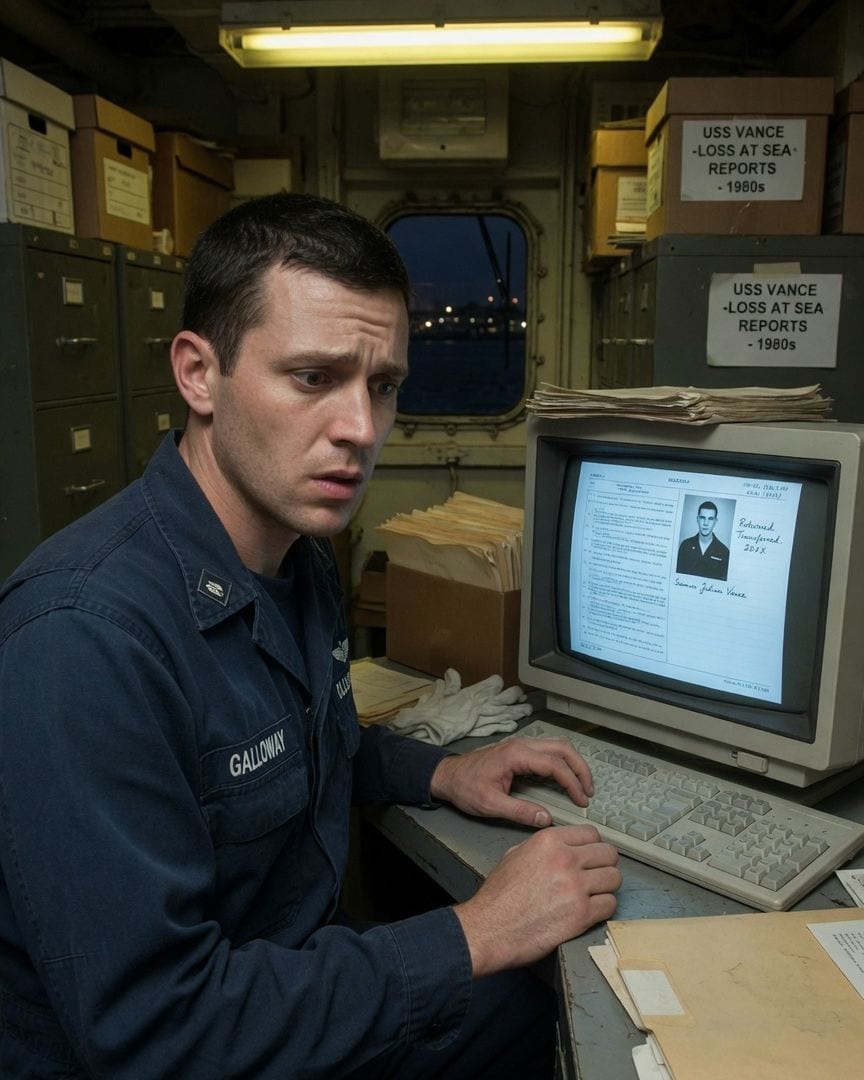
Petty Officer Galloway logged a sailor onto his ship. The man died at sea 40 years ago.
Petty Officer Joel Galloway scanned a sailor's ID on the USS Vance quarterdeck. The man's name, 'Seaman Julian Vance,' and his out-of-date uniform pricked at Galloway's memory. Later, the ship's berthing count came back one over, with an extra entry in the system but no physical body.
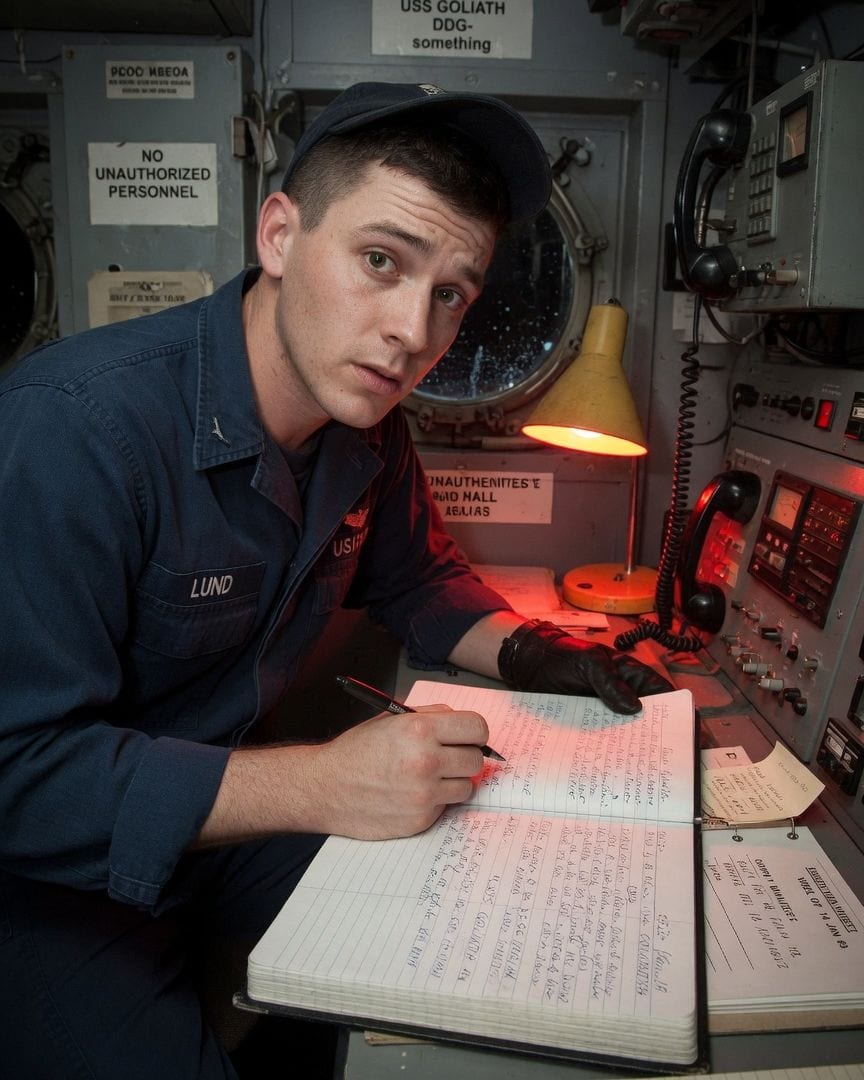
Petty Officer Lund heard his own captain's mayday: the Cold War USS Goliath was sinking, two hundred miles astern.
Petty Officer Marco Lund kept a lonely vigil in the USS Goliath's radio room, the destroyer battling the North Atlantic in deep winter 1983. Suddenly, a garbled mayday broke through: his own ship, his own captain, reporting they were going down two hundred miles astern. Though the bridge confirmed the Goliath was fine, the same chilling call came again an hour later, stronger and from the exact waters they had just crossed. Deeply unsettled, Marco began searching ship logs, eventually discovering a phantom entry: an identical mayday, logged a week prior, pressed into the very paper beneath his own.
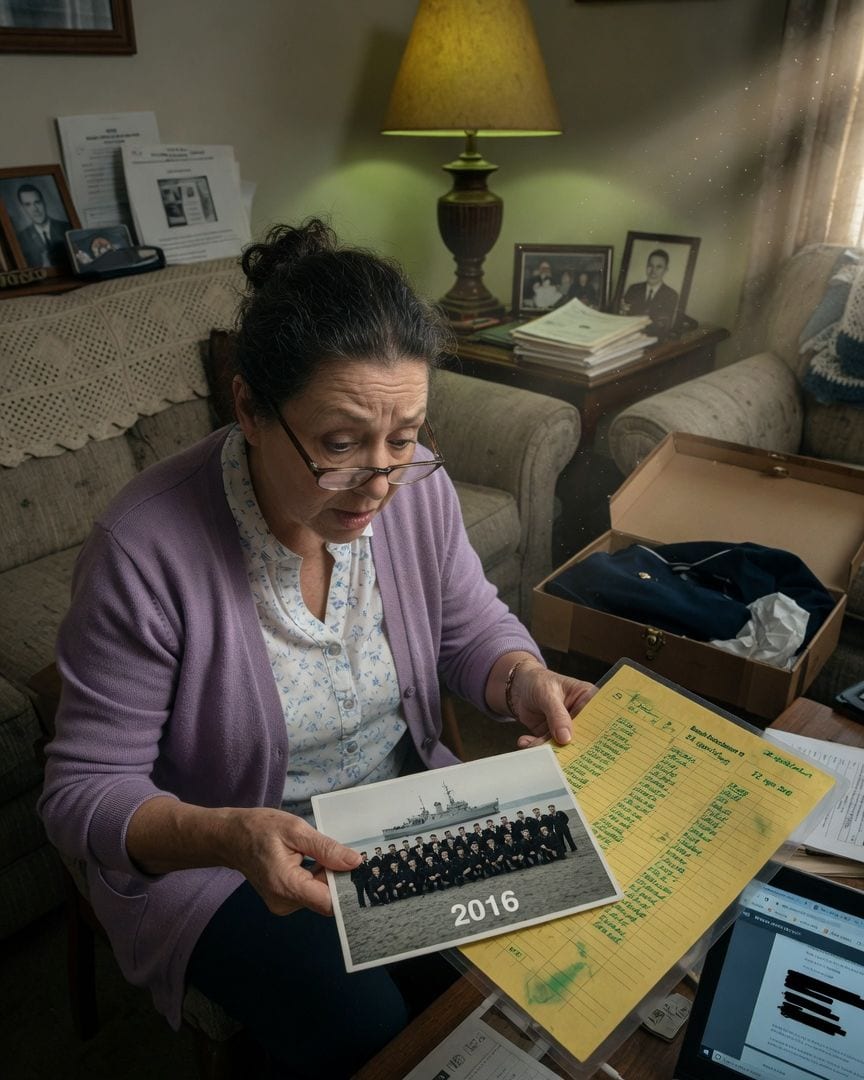
Marisol Frayne unlatched her husband's old footlocker. A photo inside showed his ship, pristine in 2016, three years after the Navy declared it lost.
Marisol Frayne, 62, finally unlatched her husband’s old footlocker in 2024, eleven years after the Navy declared his ship, the Kaskillan, lost at sea. Dust motes danced in the afternoon light as she lifted the lid, releasing the scent of old canvas and cedar. Inside, beneath his perfectly folded dress blues, she found a photograph of David and his crew standing before a pristine Kaskillan. Her breath caught: the photo was dated 2016, three years after the official reports claimed the ship vanished with all hands. Marisol's methodical search then revealed official logs showing a K-class vessel designation active in 2016, leaving a chilling void where her husband's fate should have been.
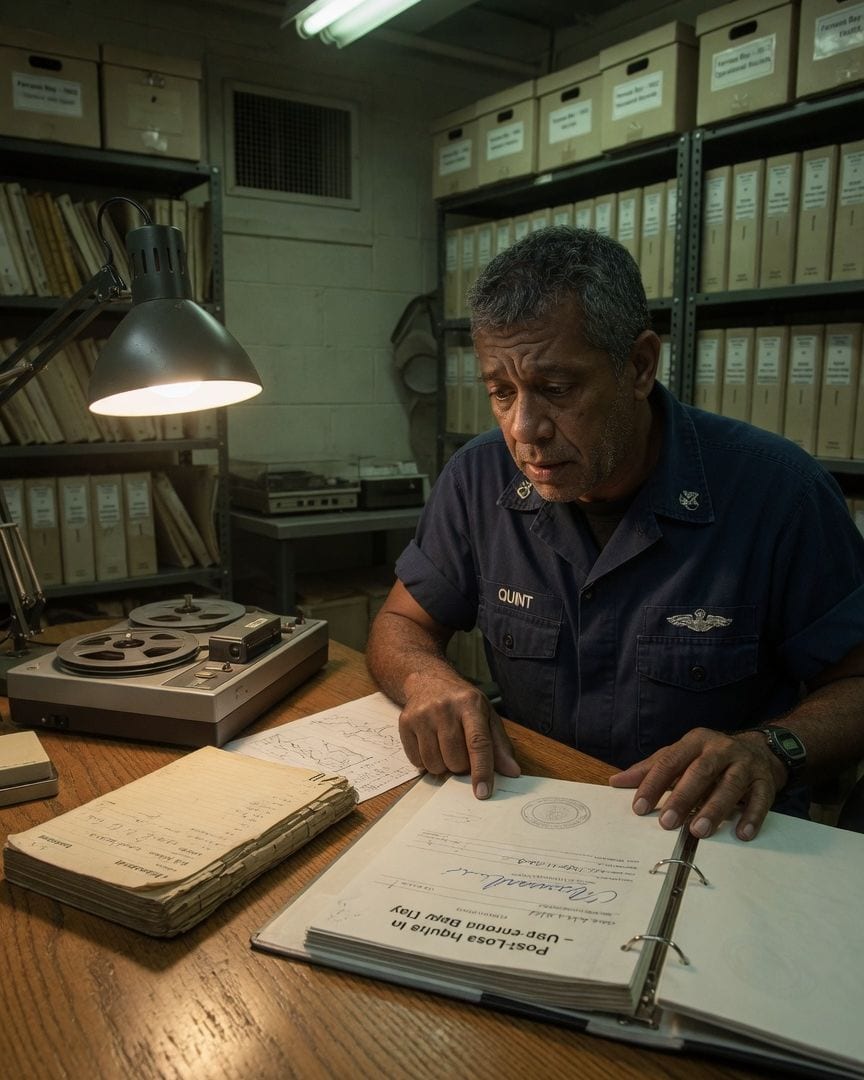
A Cold War sonarman heard his dead father’s voice on a tape, charting the ship’s wreck thirty years after it sank.
Chief Sonarman Abel Quint spent six weeks in the Naval Records vault, listening to the final transmission of the USS Ferrous Bay. His father, Desmond Quint, was on that ship when it vanished in 1962, and Abel sought some final comfort in his voice. But on this morning, a faint, second set of sonar soundings emerged from the recording—soundings in his father's precise cadence that charted the ship’s wreck site thirty years in the future. As Abel cross-referenced records, he then found a maintenance log for the Ferrous Bay's sonar system, dated six months after the ship and his father were officially lost, signed by Desmond Quint himself. What impossible truth was hidden in these official naval records?