My finger caught on a symbol pressed into the old fire log. It was the same mark I'd seen etched on the building's concrete floor.
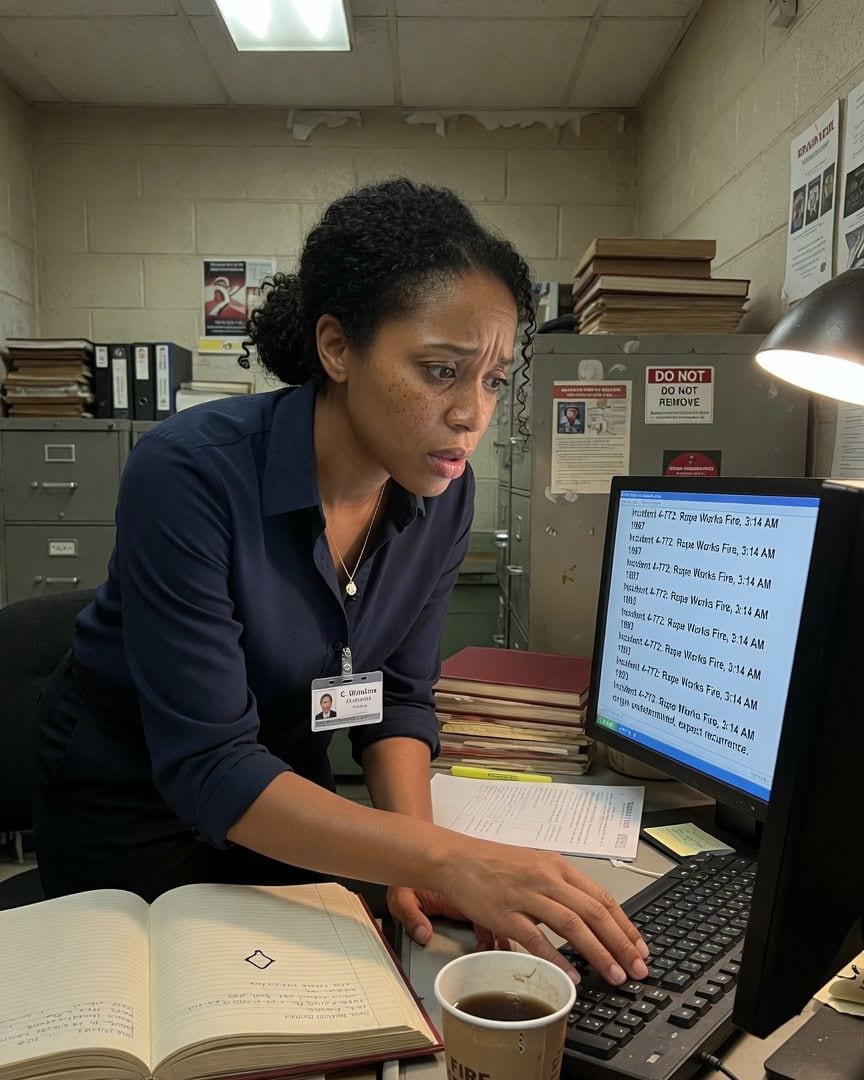
The digital records system was supposed to be cleaner, faster. No more faded ink or coffee rings on brittle paper.
But as I, Camille Winslow, a new archivist for the city fire service, proofed the recently digitized incident logs, something snagged. My screen displayed ‘Incident 4-772: Rope Works Fire, 3:14 AM, 1967.’
I clicked to the next entry, expecting a new incident, a different address. Instead, it was the same incident number: 4-772. Same building: the old rope works. Same precise time: 3:14 AM. But the date was 1980.
My first thought was a database error. A copy-paste gone wrong during the migration from the old mainframe. I cross-referenced the digital checksums, verified the database entries. No glitch. Each record was distinct, unique in its digital fingerprint.
Another entry, 1993, identical: 4-772, same building, same 3:14 AM. It defied logic. What kind of fire repeats itself precisely, down to the minute, across decades?
Each report, regardless of the year, ended with the terse, unsettling phrase: ‘origin undetermined, expect recurrence.’ I tried to find a corresponding ‘original incident’ tag or a ‘re-opened case’ flag. There wasn’t one.
The system treated each as a distinct, new occurrence, yet bafflingly used the identical reference number, as if the fire itself was merely a placeholder for something else, something that simply happened on a peculiar, decades-long schedule.
I pulled up the property file for the old rope works building, a hulking, derelict brick structure on the industrial edge of town. According to the land deeds, it had been city property, under Fire Service jurisdiction, since 1961.
I expected demolition orders or redevelopment plans, something mundane for a property held for over sixty years. Instead, I found only a single, faded internal memo from 1962, tucked away deep in the digital folder.
It simply stated: ‘Site acquired for long-term strategic containment. Access restricted to authorized personnel only.’ The words felt heavy, official, and profoundly out of place for a crumbling, abandoned factory.
My colleague, Nina Mercer, 28, a quiet but observant junior archivist, noticed my intense focus on the screen. 'Problem with the old logs?' she asked, her voice soft, almost a whisper.
I gestured to the cluster of 4-772 entries. 'This incident. It's... repeating. Same number, same place, same time, decades apart. It defies logic.'
Nina leaned closer, her long fingers hovering over the screen, but never quite touching. 'Hmm. Must be a data entry error, a placeholder that got duplicated across generations of system migrations. Happens with legacy systems, especially the really old ones.'
I shook my head, a stubborn certainty growing within me. 'I checked the metadata, Nina. Each is a distinct record. Different incident commanders, different fire marshals' signatures, even different report formats for each era.
Look at this phrase: 'origin undetermined, expect recurrence.' It's verbatim in every single one, across thirty years.'
Nina shrugged, a faint, almost imperceptible flicker of something unreadable in her eyes. 'Maybe it's a known problem site. Old buildings, spontaneous combustion, faulty wiring, derelict structures attracting arsonists. Some places just catch fire repeatedly.'
I tried to rationalize it, to force the mundane explanation to fit, but the identical incident numbers gnawed at me. 'No, the number. Why reuse it? That goes against every protocol.
Even if it was the same building, they'd assign a new incident number each time. This is... deliberate.'
I decided I needed to see the originals. The digitized logs were scans, true, but some subtle detail, some anomaly, might have been missed by the scanning process. I requested the physical logbooks for 1967, 1980, and 1993.
The records clerk, a gruff man named Roy Maddox, 55, grumbled about 'old paper dust' and 'newfangled digital nonsense,' but eventually retrieved three hefty, red-bound volumes from the climate-controlled vault.
Back at my desk, the fluorescent lights humming above me, I opened the 1967 log. The paper was brittle, the ink faded, just as I’d expected. I found Incident 4-772, exactly as digitized.
But as I ran my finger along the margin, my fingertip caught on a slight, almost imperceptible raised texture on the page.
I carefully angled the 1967 logbook under my desk lamp, the light catching the subtle indentation. There, pressed into the paper next to the 'origin undetermined' line, was a tiny, crudely drawn symbol.
It looked like a stylized knot or an intertwined figure-eight, no larger than my thumbnail. It wasn't part of the printed form, clearly a deliberate, if subtle, addition. I checked the 1980 log.
The same symbol, drawn with a different hand, but unmistakably identical in design, next to the same phrase. And the 1993 log: again, the symbol, etched with a slightly heavier hand. Three different reports, three different hands, same impossible symbol.
A chilling realization washed over me. This wasn't a glitch, not a fire. This was a pattern, a message, a secret communication. I remembered a recent site visit to the old rope works, a mandatory inventory check I performed alone.
Walking through the cavernous, empty shell, my boot scuffed against something on the concrete floor near where the central furnace used to be. I’d dismissed it as random graffiti, a meaningless scratch.
But now, a vivid memory flashed back: the faint, almost entirely worn-away etching on the floor, the exact same symbol.
The etched symbol at the rope works confirmed my growing unease; it grounded the anomaly in a physical place, suggesting something deliberately marked.
I spent my lunch breaks and evenings researching the symbol, cross-referencing ancient texts on local folklore, obscure protective charms, and even local historical societies' archives.
Nothing concrete emerged, but I found similar patterns in esoteric texts on geomancy and warding sigils. The idea was ridiculous, the stuff of fiction, yet it fit the 'expect recurrence' line in a chillingly plausible way.
The archives, usually a place of quiet order, felt charged now, the rows of paper a silent testament to secrets I was only just beginning to uncover.
I returned to the digitized records, now with a new focus, searching for any other incident numbers with similar recurring patterns or the exact 'expect recurrence' phrase. There were none; 4-772 was truly unique.
I also looked up the names of the incident commanders and report signees for each 4-772 event. Most were long retired or deceased.
One name, however, stood out: Gordon Carter, 67, listed as a junior officer on the 1980 report, later becoming a deputy chief. I remembered seeing his name on an internal memo about George Lawson's retirement in 2006.
George Lawson, 68, the former Records Manager, would have overseen the archiving of these very files. He’s still alive, listed in the Fire Service's alumni directory. I decided to visit him.
I made an appointment under the guise of an 'alumni project' for the archives, hoping to glean information about old record-keeping practices and perhaps, subtly, about 'unusual' files.
Nina watched me make the call, a faint, almost imperceptible smile playing on her lips. 'Researching the old guard?' Nina asked, her voice light, 'They love to tell stories, especially the ones who've seen it all.'
I forced a smile, a knot tightening in my stomach, wondering if Nina's comment held a deeper meaning, or if I was just imagining things, a symptom of my growing obsession.
I drove to George Lawson's quiet suburban home, feeling a growing sense of apprehension. The house was neat, unassuming, a picture of tranquil retirement. Yellow roses climbed a trellis by the front door, and the lawn was perfectly manicured.
He answered the door promptly, a trim man with sharp, intelligent eyes that seemed to take in everything at once. He led me into a living room filled with framed photos and the scent of old books.
I recounted my discovery of the repeating incident number and the cryptic symbol. George listened patiently, offering me a mug of chamomile tea, its warmth doing little to soothe my nerves.
He didn't dismiss me, didn't try to explain it away with talk of glitches or faulty wiring. Instead, he simply nodded, his expression unreadable, almost serene. '4-772,' he murmured, as if speaking to an old, familiar friend.
'Yes, that one was... a peculiar file. Required special handling, even back then.'
He didn't elaborate, instead steering the conversation to the general challenges of digitizing old paper records, the fading ink, the brittle pages. I pressed, taking out my printouts of the symbols. 'What is this, Mr. Lawson?
It's in every report, yet it's not official. And I saw it etched at the rope works.'
George took a slow sip of his tea, his gaze distant, fixed on a spot beyond my shoulder. 'Some things, Ms. Winslow, are best left filed away. For the public good, you understand.
Not everything fits neatly into a standard incident report, or a rational explanation.' His calm, almost detached demeanor was profoundly unsettling. He didn't deny the symbol, or the recurrence. He just...
acknowledged it, as a fact of life, an accepted part of the institutional memory. It was as if he was talking about the weather.
As I prepared to leave, a sense of unease intensifying, George placed a hand on my arm. 'You're a bright young woman, Camille. But some threads, once pulled, unravel more than you expect.
Be careful where you look, and who you ask.' His gaze was direct, unwavering, a quiet warning that resonated deep within me, echoing through the quiet street as I drove away.
Later that week, back at the office, I noticed Nina had subtly rearranged the shelf where the 4-772 logbooks were stored, placing them behind a stack of more recent, innocuous files.
'Just tidying up,' Nina said, without looking up from her screen, 'those old books were getting dusty and taking up prime space.' I felt a prickle of alarm. Had Nina been watching her? Had she reported my visit to George?
The feeling of being observed, of being managed, became almost palpable, as if the very air in the archives was thickening around me.
I couldn't shake the feeling of surveillance, or George's cryptic warning. The quiet hum of the archives, usually a comfort, now felt like a low, continuous whisper, a sound that watched.
I found Nina at her desk, meticulously sorting through a box of old microfiches.
'Why did you move the 4-772 logs?' I asked, my voice sharper than I intended. 'And why did you give me that look when I mentioned George Lawson?'
Nina finally looked up, her usual soft expression hardening into something uncharacteristically serious. Her eyes, usually so deferential, now held a knowing depth that sent a shiver down my spine.
'My family has worked for the Fire Service for a long time, Camille. Generations. Not always in archives, but always... with certain files. The ones that don't fit the standard narrative.'
I felt a cold dread spread through me, a sickening understanding dawning. 'What files? What are you talking about?'
Nina paused, then sighed, a sound laced with a tired resignation that seemed too old for her twenty-eight years. 'The ones that 'expect recurrence.' The old rope works isn't just a derelict building. It's... a pressure valve.
Or a vent for something deep beneath the city.' She explained, not with fear, but with a calm, almost academic tone, that the building sat over a geological anomaly, a place where 'things' sometimes bled through.
Not monsters, not ghosts, she clarified, but a kind of temporal or energetic bleed that manifested as a localized, contained 'fire' event.
'The Fire Service didn't buy it for development. They bought it to contain it. To file it. To make sure no one else tried to develop it, to make sure the public never knew what was really happening there.'
The 'fires' were a natural, cyclical event, a periodic release of this subterranean energy. The incident number 4-772 wasn't a mistake; it was a specific designation for this phenomenon, a unique identifier in a secret, internal protocol.
The symbols were not wards, not exactly, but markers. They denoted the active zone of the manifestation, a way for the 'keepers' to track its exact location and ensure the building remained secure and undisturbed.
'My great-grandfather, a Mercer, was the one who added the first symbol in '67,' Nina said, her voice quiet, almost a confession. 'His job was to document, to manage the 'recurrence protocol.'
Just like it will be mine, and eventually, yours, if you stay.'
I stumbled back a step, the weight of the revelation pressing down on me, making the air feel thin. The casualness of Nina's admission, the lack of any dramatic flourish, made the truth all the more horrifying.
The bureaucratic management of the impossible. The pieces of the puzzle, once scattered and nonsensical, now clicked into place with terrifying precision, reframing every strange detail I had observed.
The 'origin undetermined, expect recurrence' was no longer a puzzle, but a declaration.
'Mine?' I whispered, my voice barely audible, laced with a dawning horror. 'You mean... they knew I'd find it? That I was being tested?'
Nina offered a small, sad smile, a flicker of something almost sympathetic in her eyes. 'The family has a way of knowing who might be... suitable. Who has the right kind of curiosity, the right kind of mind for patterns.
You fit the profile.'
She explained that George Lawson was the last of the previous generation of 'keepers,' and that he'd been observing me since I started, subtly guiding me toward the 4-772 file, making sure I saw what needed to be seen.
It was all a quiet, bureaucratic handover, a torch passing in the shadows of the archives.
The 'origin undetermined, expect recurrence' wasn't a warning for the public, but an internal memo to the next generation of keepers, a reminder of their solemn, unspoken task.
The Fire Service, as an institution, wasn't just filing it away; it was actively managing it, in secret, for decades, ensuring the anomaly remained contained and the public remained ignorant.
I felt a terrifying coherence click into place. Every oddity, every quiet observation, every almost-explanation, now made horrifying sense. I wasn't an accidental discoverer; I'd been groomed, selected. The realization was a cold, heavy weight.
As if on cue, a quiet, almost imperceptible knock sounded at the door of the old records room. George Lawson stood there, his calm, knowing eyes falling first on Nina, then on me.
He held a small, leather-bound book in his hands, pristine and new, its spine blank, waiting. He stepped into the room, closing the door softly behind him, and gestured toward the empty chair across from Nina, a silent invitation.
George Lawson sat, placing the new logbook gently on the table between us. Its unblemished leather seemed to absorb the dim light of the room.
'Welcome, Camille,' he said, his voice devoid of malice or triumph, simply a calm statement of fact. 'Nina has explained some of it, I trust.'
He proceeded to calmly detail the full, horrifying history.
The city acquired the rope works in 1961 after a series of unexplained localized tremors and strange thermal spikes were detected by early warning systems installed near a newly laid gas line.
The Fire Service, under the guise of urban planning and property acquisition for 'future development,' was covertly tasked with containing the 'anomaly.'
The 'fires' weren't combustion; they were energy discharges, a physical manifestation of the bleed-through from a deep geological fault line, a rare phenomenon that cycles roughly every 13-17 years.
The 'warding sigil' wasn't magic, not in the supernatural sense, but a subtle marker, a way to triangulate the exact epicenter of the discharge for monitoring and to visually denote the containment zone.
It must be refreshed after each recurrence, he added. 'Origin undetermined' became the official cover because explaining a localized spacetime distortion or an energetic anomaly was simply not within the Fire Service's remit, or the public's comprehension.
'Expect recurrence' was an internal directive to the designated 'keepers' to prepare for the next cycle, to ensure the site was secure, and to meticulously document the event.
'We don't fight it, Camille,' George said, his gaze steady, 'we manage it. We file it. We keep it quiet.'
He explained that the Fire Service, as an institution, provides the perfect bureaucratic cover: a public service with access to property, infrastructure, and the authority to cordon off areas without question.
Nina's family, the Mercers, have been the primary 'keepers' for generations, passing down the knowledge and the duty through quiet instruction, identifying and grooming suitable successors from within their ranks, or from those who, like me, showed the 'right kind of mind.'
The cold, rational acceptance of the impossible. That was the core of it.
'And what about me?' I asked, my voice trembling slightly, but still steady, a new resolve hardening my features. 'What happens now?'
George smiled, a gentle, paternal expression that held no comfort. 'You have the mind for it, Camille. The eye for detail, the need for coherence. You saw the pattern where others would see only errors.
You are the institution's next choice, a new bloodline, if you will, to ensure continuity. The anomaly is perpetual, and so must its management be.'
Nina nodded, her expression now entirely composed, holding out the new logbook. 'We need a new entry soon. The cycle is due within the next few months. We'll need to prepare the site, refresh the markers.'
I stared at the blank pages, the weight of decades of quiet, mundane horror pressing down on me. The calm, bureaucratic management of an inexplicable, terrifying phenomenon. I could walk away, expose them, but who would believe me?
And what would it achieve? The entity at the rope works would still exist, still cycle. The city would still need its quiet protectors.
The dread wasn't in a monster, but in the cold, rational acceptance of the impossible, the realization that this quiet horror has always been here, woven into the fabric of the city's infrastructure, managed by ordinary people.
I looked from George's knowing eyes to Nina's resigned ones. I understood now. The institution, the pattern, the quiet management – it was worse than any monster because it was human, deliberate, and entirely rational.
The world was not safe, but it was being managed. I reached out, my fingers brushing the smooth, unblemished leather of the new logbook. I picked it up, the weight of it suddenly immense.
'What's the first thing I need to know about the next recurrence?' I asked, my voice steadier now, the question an acceptance of my new, terrifying role.
George Lawson's smile widened, a look of profound satisfaction on his face. 'We start with the precise date of the last one, Camille. And the exact coordinates for the new sigil. Every detail matters.'
I continued my work at the Fire Service archives. I still digitized old records, but now, a new, unofficial duty had been added to my portfolio.
The new leather-bound logbook, marked 'Incident 4-772: Recurrence Protocol,' sat hidden in a locked drawer beneath my desk, its first few pages now meticulously filled out in my own precise hand.
I began to learn the subtle art of monitoring obscure geological reports, thermal imaging data from old industrial zones, and filtering public inquiries about the old rope works.
Nina Mercer became my quiet mentor, guiding me through the nuances of the 'containment protocol,' the quiet maintenance of a necessary, terrifying secret.
The city remained oblivious, safe in its ignorance, while two archivists, one young and one still learning, quietly managed the unmanageable. Life, for everyone else, continued as normal.
For me, 'normal' had become a carefully constructed facade, a bureaucratic layer over an unsettling truth.
The next scheduled recurrence of Incident 4-772 passed without public notice. I, following Nina's instructions, had ensured the perimeter was secure, the monitoring equipment in place, and the new sigil etched precisely where it needed to be.
The official report, filed under the familiar 4-772, read: 'origin undetermined, expect recurrence.' I proofread it myself, my hand steady, my signature now added to the long line of 'keepers.' It was just another day at the office.
A week later, I was alone in the archives, meticulously cross-referencing a new set of seismic readings against the old 4-772 logs. The fluorescent lights hummed, casting a sterile glow over the rows of files.
Nina walked in, holding a small, framed sepia-toned photograph. 'Found this cleaning out my grandmother's old desk,' she said, handing it to me.
It was a faded black-and-white photo of a group of Fire Service personnel from the 1960s, standing rigidly in front of the old rope works. Among them, a young, serious George Lawson, barely recognizable.
And, in the background, almost obscured by shadow, a woman who bore an unsettling resemblance to Nina, her eyes fixed not on the camera, but on the looming, derelict building itself.
'She was the first Mercer keeper in that generation,' Nina explained, taking the photo back. 'She understood the importance of the file.' I looked back at my screen, at the repeating number. The file they kept.
'Is that so?' Camille replied, with a faint, wrong little smile.
If this one got to you
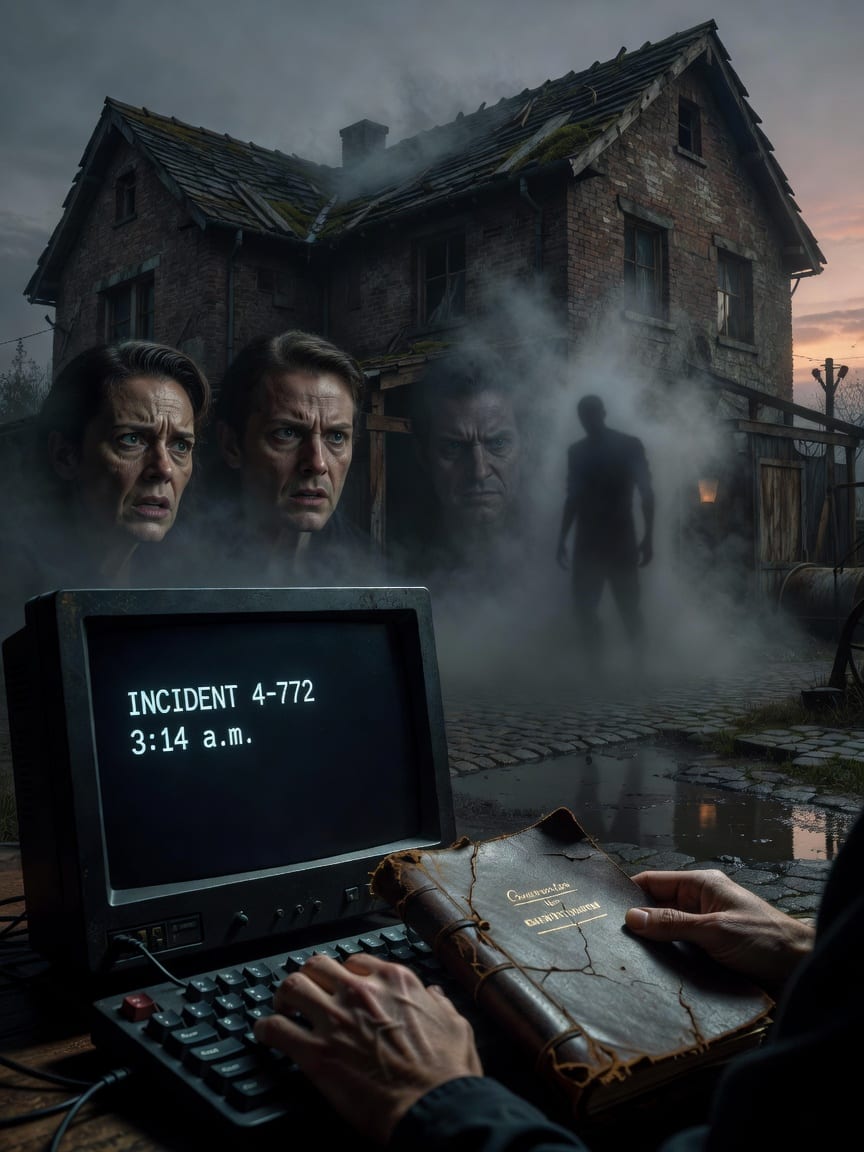
My screen showed Incident 4-772: a fire at the old rope works, 3:14 a.m. It was logged again for 1980. Then 1967. And 1993. Same incident, same time, same building. Each report ended with the same three words: 'expect recurrence.'
As a new archivist, I usually found my work digitizing old fire service records monotonous, until I found a heavily redacted line in a 1961 site assessment. Faint letters beneath the black bar slowly revealed my own family name, DRUMMOND, dated years before I was even born.
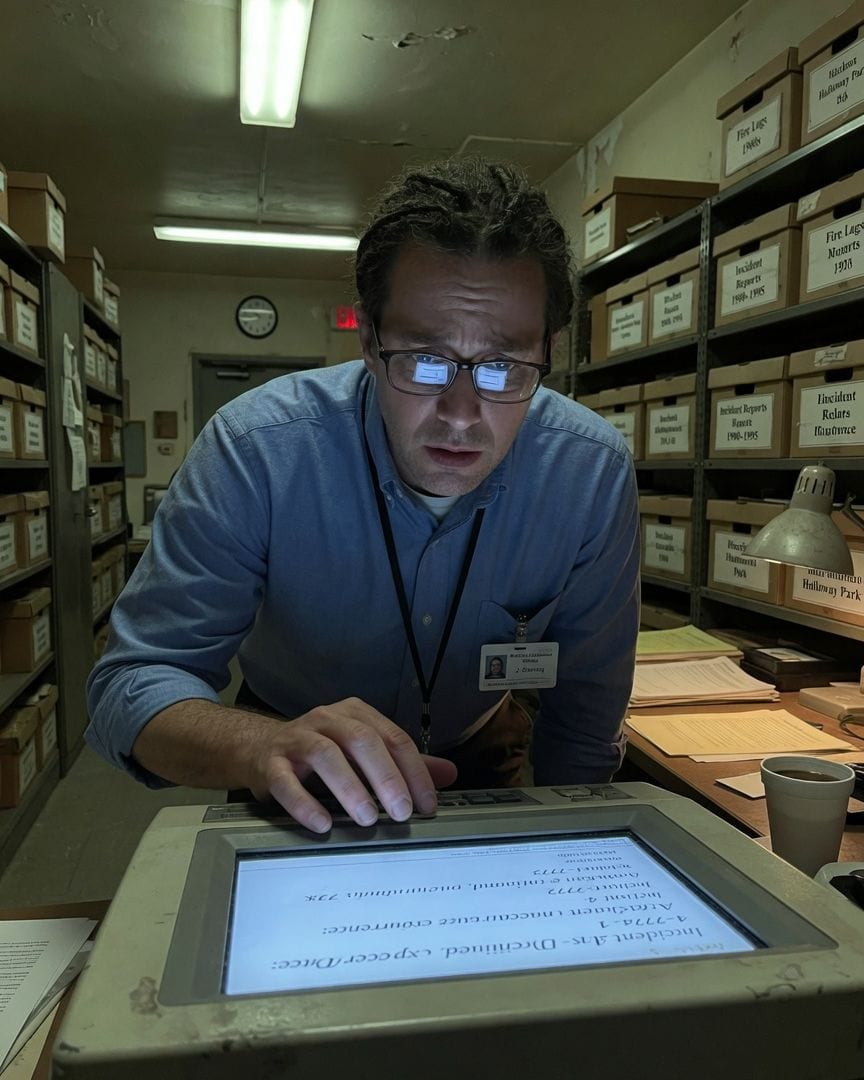
My old rope works fire log repeats the same 3:14am blaze, same incident number, across 1967, 1980, 1993. Each ends: 'origin undetermined, expect recurrence.'
As an Archival Digitization Officer, my days are spent scanning old records. I was numbly working through fire service logs when Incident 4-772 caught my eye: the same structural fire, same time, same number, repeated across different decades. Each entry ended with the chilling, identical phrase: 'origin undetermined, expect recurrence.'
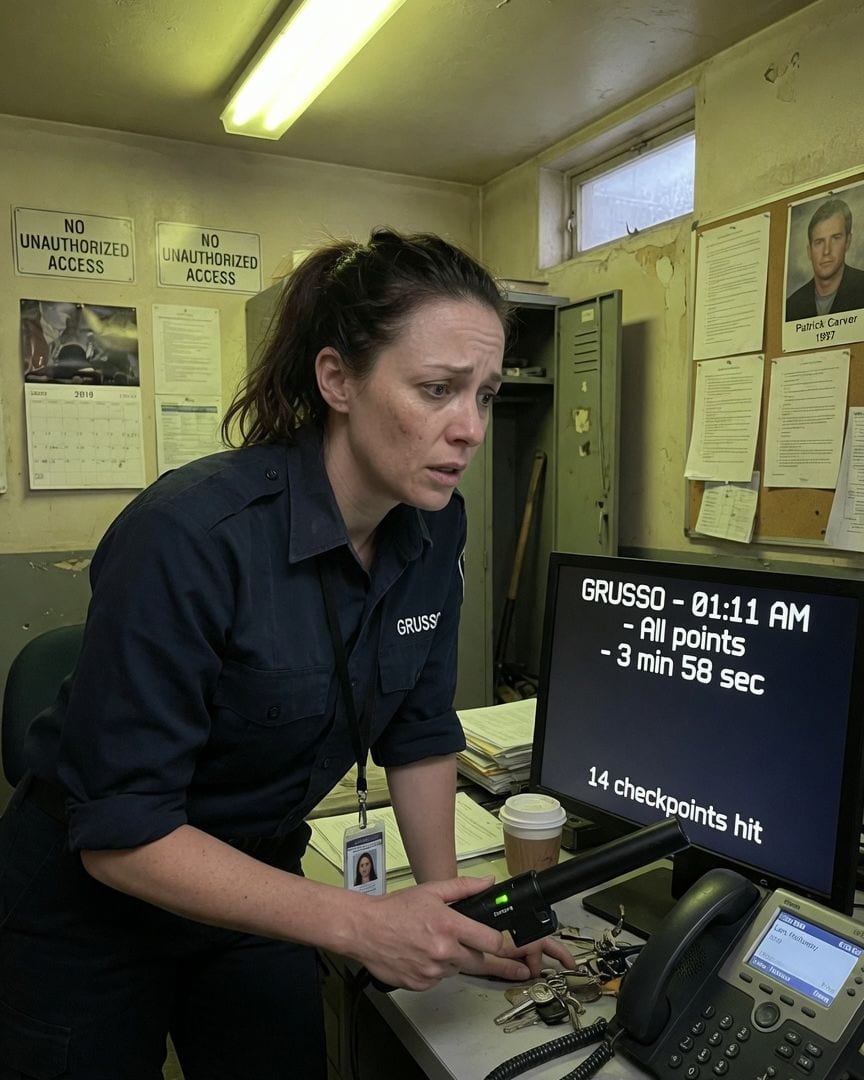
My security wand logged a full round at 1:11 AM in under four minutes. It was in the charger. Every tap is logged as mine.
Finishing my night shift, all I wanted was to get home. But the dock readout screen showed my security wand logged a full patrol at 1:11 AM, completed in just under four minutes. I knew my wand had been charging right beside the monitor the entire time, yet the log, under my ID, confirmed the impossible.
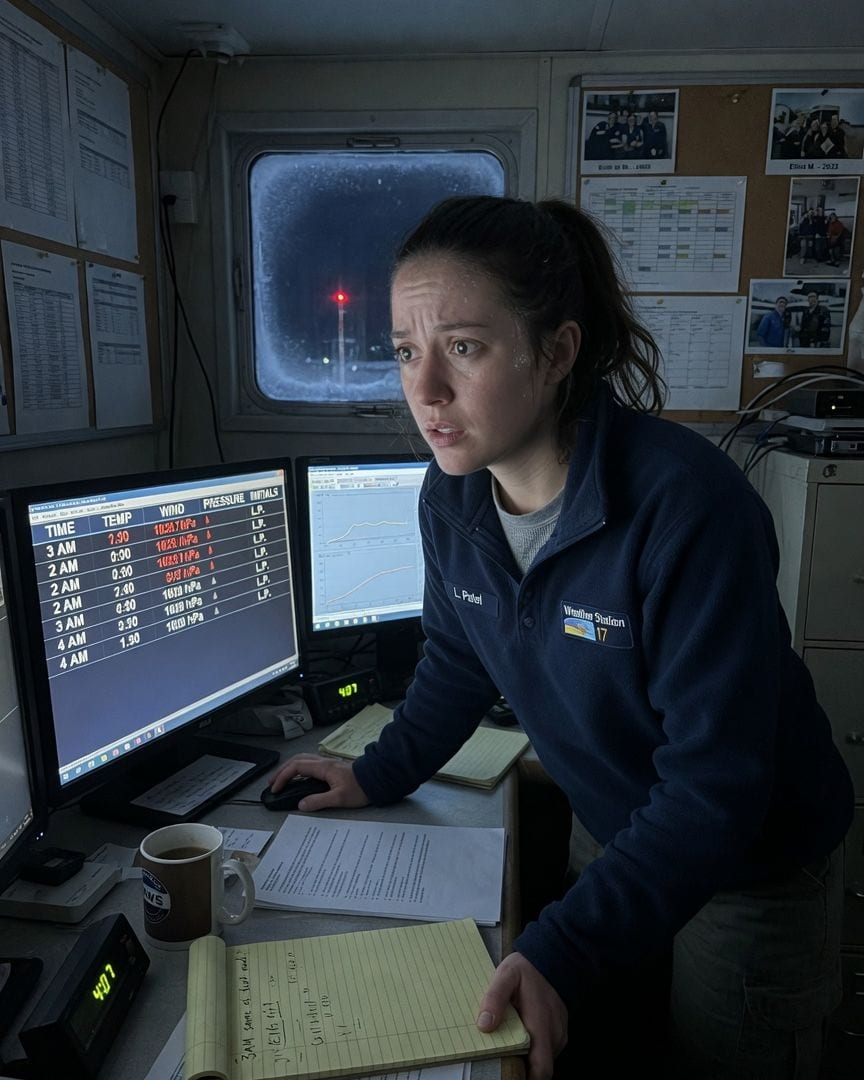
My weather station's 3 AM log shows a pressure reading I never made. My initials are on it, but the dials were dead still.
Working the overnight shift at the remote weather station, I routinely checked the digital logs. The 3 AM entry showed an impossible barometric pressure spike, a hurricane that simply hadn't happened. I distinctly remembered being outside at that time, calibrating a sensor, not making that entry. Yet, my initials, L.P., were clearly logged next to data I never made.
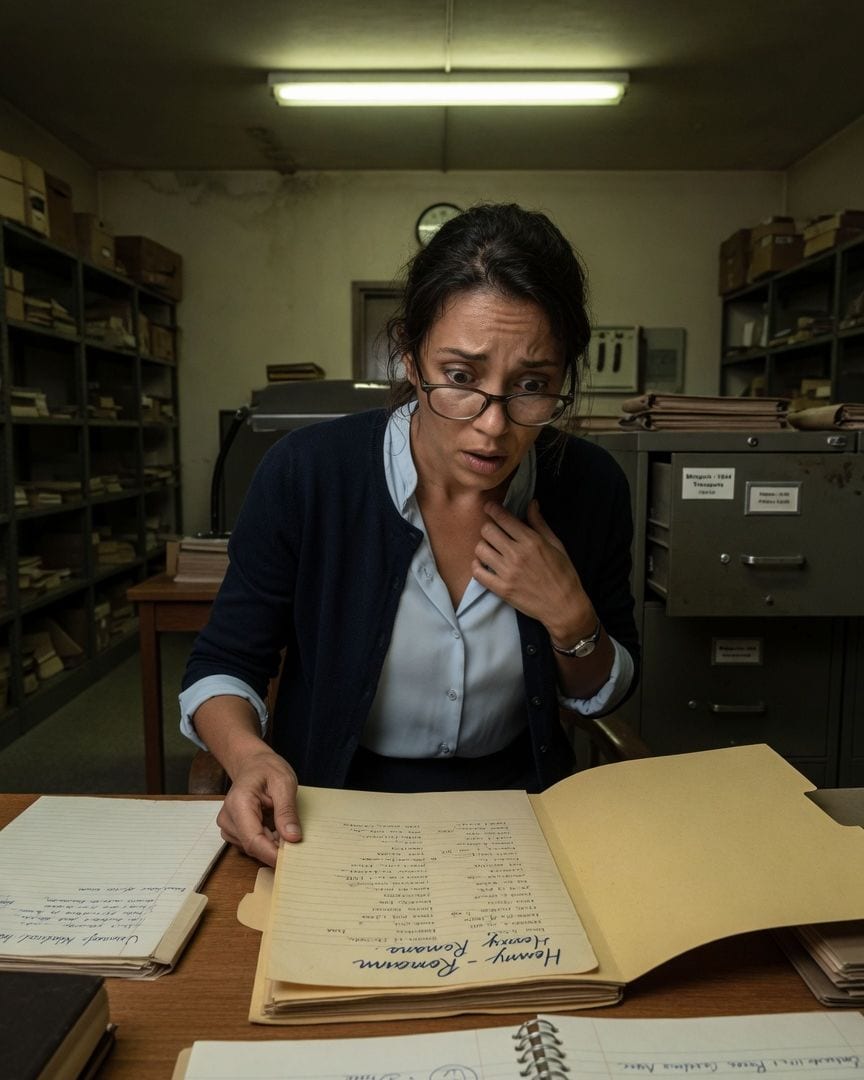
A records reviewer found a 1944 ferry manifest with an impossible 42nd name. The same dark ink marked a phantom crewman on a Cold War flight log.
Delphine Arceneaux, a dedicated records reviewer, had just minutes left in the stale reading room to finalize her review of a 1944 Mirepoix Ferry manifest. Her job was to confirm every detail of the forty-one passengers who boarded a boat that never arrived. But as the clock neared six, a forty-second name materialized on the faded paper, stark in a dark, unfamiliar ink. 'Henry Romano,' it read, with the impossible notation: 'BOARDED AT MIDSTREAM.' How could anyone board a ferry in the middle of a river?
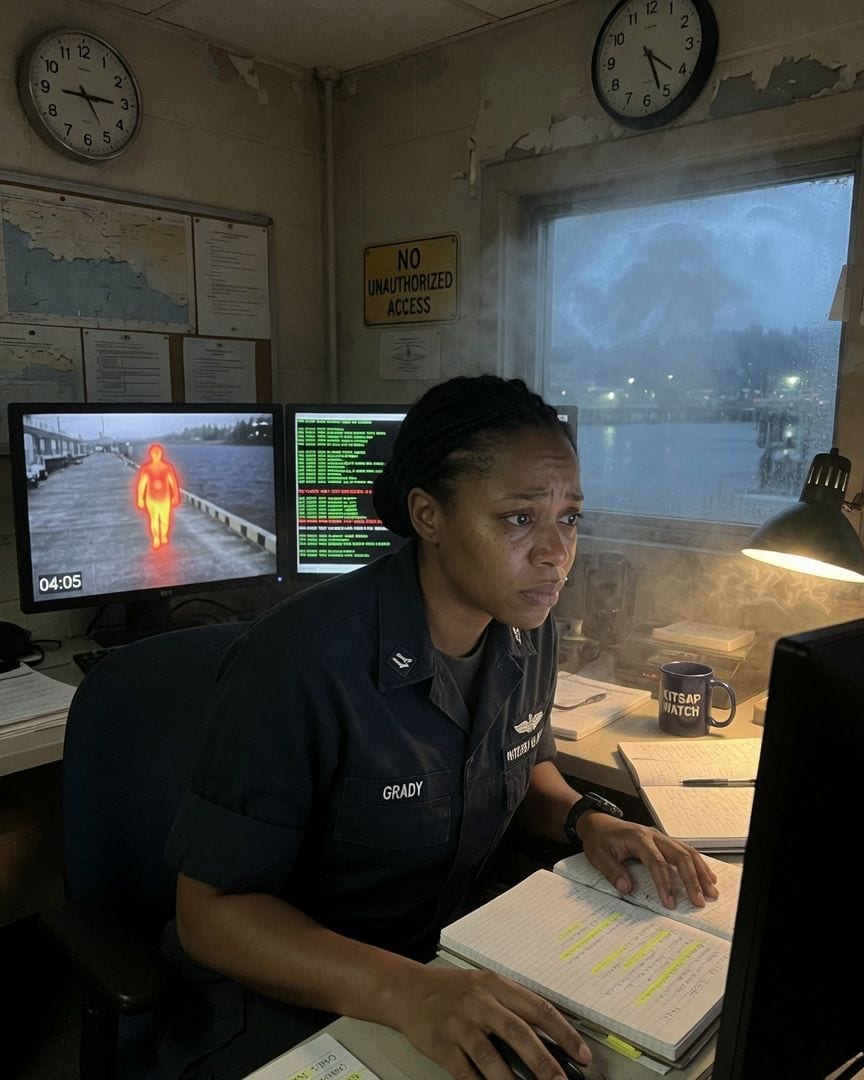
Petty Officer Olivia Grady found the base system logging impossible access at 0405. Every night for years, a blank ID walks Pier 7.
Petty Officer Olivia Grady stood her predawn watch on Pier 7, the cold mist of Puget Sound a familiar companion. Her routine scan of monitors at 0405 was shattered when an IR sensor flared with a man-sized heat bloom moving along the pier. Yet the camera feed showed only empty concrete and swirling mist. When historical logs confirmed the invisible presence had walked that exact path every night for years, Olivia dug deeper. She found a ghost "access log" entry with a unique ID but no name attached, meticulously aligned with the 0405 bloom. What impossible entity was the base system logging, night after night?