My screen showed Incident 4-772: a fire at the old rope works, 3:14 a.m. It was logged again for 1980. Then 1967. And 1993. Same incident, same time, same building. Each report ended with the same three words: 'expect recurrence.'
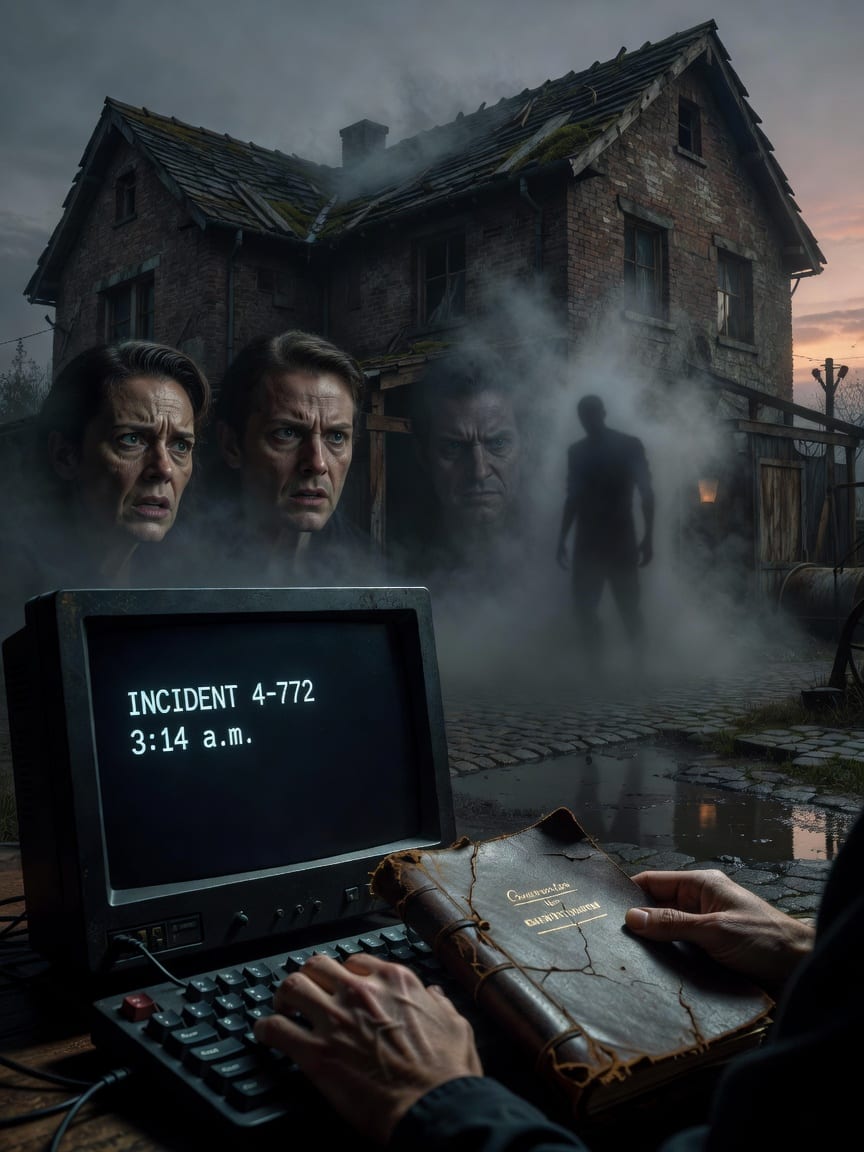
The hum of the server racks was usually a comfort, a steady thrum that filled the quiet space of the fire service archives.
As a new archivist, thirty-four-year-old Rachel Drummond, I’d spent the last few months digitizing decades of paper records, trading the scent of old paper for the faint ozone tang of electronics.
It was monotonous work, mostly, checking scanned documents against the original files, ensuring every blurry pixel matched the faded ink.
I clicked through another batch of incident logs. Most were routine – minor traffic accidents, false alarms, the usual residential chimney fires. Then Incident 4-772 popped up. A fire at the old rope works, timestamped 3:14 a.m. I frowned.
I remembered that one. It was a well-known derelict building on the outskirts of town, prone to squatters and vandals, but it hadn’t burned in years, not in my memory.
I flagged it, assuming a data entry error, a typo in the year.
But as I moved to the next record, the screen blinked, refreshing. Incident 4-772. Fire. Old rope works. 3:14 a.m. This time, the date clearly read 1980. My breath hitched. I scrolled back. The first entry was 1993. Then 1980.
I went further. 1967. Same damn incident number, same location, same time. A cold knot started to form in my stomach. Each report, identical in its dry bureaucratic language, ended with the precise, chilling phrase: 'origin undetermined, expect recurrence.'
I leaned closer to the monitor, my eyes scanning the dates again, then the incident descriptions. It wasn't a glitch in the system. It wasn't a copy-paste error. This was a pattern, documented with an unsettling, bureaucratic calm.
The rope works burned at 3:14 a.m. It always did. And they expected it to happen again.
I tried to rationalize it. Maybe Incident 4-772 was a placeholder code, a generic label for any unsolved case at that specific building.
Or perhaps a faulty sensor at the rope works had triggered false alarms over the decades, leading to reports that just got filed under a convenient, recurring number.
But the identical times, 3:14 a.m. on the dot for every single one, and that unnerving phrase, 'expect recurrence,' gnawed at me. Bureaucracy was usually dull, not prophetic.
Deciding to cross-reference the address, I pulled up all other incident logs for the old rope works, not just fires.
I scrolled through years of mundane entries: a broken window reported in '72, a minor trespass in '85, a complaint about overgrown weeds in '98. Nothing unusual, nothing that spoke of cyclical destruction.
The building was just an empty husk, left to rot.
Then one entry, from 1961, simply titled 'Site Assessment,' caught my eye. It wasn't a fire, wasn't a crime.
It was just a detailed report on the structural integrity and historical usage of the property, likely for some long-abandoned development project. Most of it was boilerplate, dry and uninteresting.
But halfway down the second page, there it was. A single line, blacked out. A heavy, deliberate redaction, a stark block of ink against the otherwise clean, digitized page. It jumped out at me, an anomaly in the monotonous text.
Why hide a single line in an otherwise unremarkable assessment of a decrepit building? What could possibly be so sensitive in an old property survey?
I zoomed in, the pixels blurring. I tried to adjust the contrast, to mess with the digital filters on the archive software. Nothing. The redaction was absolute, a solid, impenetrable bar that defied all my efforts.
The computer screen itself seemed to darken around the black block, the room's quiet hum taking on an almost resentful edge. I sat back, the knot in my stomach tightening.
Driven by a growing, cold unease, I downloaded the raw image file of the 1961 'Site Assessment.' The standard proofing software wouldn't cut it.
I loaded it into an advanced text reconstruction program I had on my personal laptop, something I'd used on a historical documents forum once.
It was slow, clunky, not designed for anything this heavily obscured, but I had a bad feeling that wouldn't let me quit.
The software churned, a low whirring from my laptop's fan. Pixel by pixel, it attempted to reverse-engineer the ink, to peer beneath the digital black. Slowly, agonizingly, faint, blurred traces of letters began to appear beneath the heavy bar.
It wasn't perfect, just ghostly impressions, but enough to piece together fragments. My eyes widened, a tremor running through my hand as I grabbed the mouse.
The first word was clearly 'DRUMMOND.' Rachel's own surname. Followed by a partial initial, 'R,' and what looked like 'Residence' or 'Record.' The date beside it was unequivocally '1961.'
My breath caught, a cold knot tightening in my chest, squeezing the air from my lungs. My family name, on a heavily redacted line, in a file about the old rope works, from years before I was even born.
The sight of my own name, ‘DRUMMOND,’ glowing faintly beneath the redaction, sent a real chill through me. My rational mind screamed coincidence. My family wasn't historically involved with the fire department; we were teachers, nurses, small business owners.
So I spent days trying to find any other 'Drummond' in the fire service archives, a long-lost cousin or ancestor. Nothing.
I widened my search: local land records, old census data, anything to connect my family to that damn rope works.
It was in a dusty old town registry, buried deep, that I found it. My great-grandfather, Thomas Drummond, had owned a small, undeveloped parcel of land that bordered the rope works property.
It wasn't much, just a sliver, but the records showed he’d sold it off in the early 1960s. The timing aligned perfectly with that redacted log entry from 1961. But why would a simple land sale be redacted?
Why my family name on a 'Site Assessment'?
I started asking around, casually, at work. "Hey, what's with that 'expect recurrence' phrase? Just old-school terminology, right?" I mentioned the rope works, how it seemed to have a history of… things.
My older colleagues just offered vague smiles, shrugged off my questions. "Oh, that's just archaic terminology from the old system," one said, waving a dismissive hand. Another added, "The rope works? Just an old derelict building, nothing special.
A hazard, sure, but that's all." Their calm, uniform dismissals felt less like ignorance and more like a practiced evasion, a smooth, institutional placidity that raised the hairs on my arms.
The hum of the office lights seemed to take on a sharper, almost watchful quality when I brought it up.
"If you really want to know about the old days," a retired chief, Frank, muttered to me one afternoon, "you should ask James Oakley. He remembers every damn incident, every building, right back to the war.
Man's got an unfathomable memory." He paused, a strange look in his eye. "You can usually find him in the local history section of the public library. Still reading the old maps."
I started spending my lunch breaks at the public library, ostensibly to research local history, but really, I was looking for James Oakley. The first two visits, nothing. Just the usual old folks poring over newspapers.
But on my third visit, I saw him. An older man, probably late seventies, impeccably dressed in a tweed jacket despite the mild weather. He had sharp, knowing eyes that seemed to take in everything without actually looking directly.
He was poring over a large, leather-bound map, his back to me. He didn't look up, didn't acknowledge me, but I felt his presence, a heavy, static charge in the air around him.
As I browsed a shelf of local council records, pretending to be absorbed, I caught his reflection in the polished glass. His gaze, unsettlingly direct, was fixed squarely on me. He wasn't subtle about it. He didn't approach, didn't speak.
Just watched, his expression unreadable, almost patient. A cold bead of sweat trickled down my spine.
The next morning, I arrived at my desk to find it. A small, precisely folded note tucked neatly beneath my keyboard. The paper was thick, creamy, unlike the cheap office stationery.
In elegant, looping script, it read: 'The rope works records are best left undisturbed. Some things are cyclical.'
There was no signature. But I'd seen James Oakley's handwriting on a scanned memo from his active years as chief. It was undeniably his. The danger was no longer abstract, a curious pattern in old files. It was personal.
Someone knew exactly what I’d found, and they were watching.
I knew I had to confront him. The fear was a cold, hard lump in my gut, but the thought of leaving that note unanswered, of letting this quiet threat hang over me, was worse.
I found James Oakley at the library again, later that week, sitting at a quiet table near the back, meticulously cataloging old photographs into a leather album. He looked up as I approached, his expression still unnervingly calm.
"Mr. Oakley," I said, my voice steady despite the tremor I could feel in my hands. I held out a printout of the redacted line, my surname visible beneath the ghostly grey of the reconstruction. "I'm Rachel Drummond.
I'm working on the digitization project. And I found this." I pushed the printout across the table, letting it land between us.
He barely glanced at it. His eyes, though, were fixed on mine, unreadable. "Ah, the Drummond girl," he said, his voice calm, almost kindly. It was the lack of surprise that hit me hardest. "I expected you'd come around eventually."
He didn't deny the redaction, or my name. He didn't even blink.
He leaned back, a faint smile playing on his lips. "The rope works," he began, his gaze drifting to some distant point beyond the library shelves, "has always been a place of… release.
A necessary reset, you might call it, for the town's prosperity." He spoke of it with the detached air of a historian discussing ancient agricultural practices, a simple fact of life, like planting crops or rotating fields.
"Those fires," he continued, "they aren't accidents, not in the way you understand them. And 'origin undetermined, expect recurrence' was never a finding. It was an internal directive.
A bureaucratic acknowledgment that the cycle had completed, and that it would, of course, complete again. It's simply the way things are." He said it so calmly, so matter-of-factly, as if I was the one making a fuss over nothing.
The hair on my arms stood on end. He didn't see it as wrong, or even unusual.
"There's an old ledger," he said, his eyes returning to mine, "one not in the public archive. It holds the true history of these cycles. And of the families involved."
He paused, a silence stretching between us, heavy and full of unspoken implication. The calm was the worst part. His quiet acceptance, his unnerving composure, made my skin crawl.
James Oakley's calm explanation chilled me to the bone. He spoke of 'cycles' and 'releases' with such quiet conviction, as if describing the tides, or the changing of seasons. It wasn't malicious, just… deeply ingrained.
He confirmed that the Drummond family had been one of these 'caretaker' families for generations, a silent agreement passed down, an unseen duty that secured the town's quiet equilibrium.
"Your grandmother, Greta Drummond," he said, his gaze unsettlingly direct, almost paternal, "she understood. She saw what needed to be done, as her mother did before her. And you, Rachel, you're just like her.
You have the sight for these things. It's in the family."
My grandmother, Greta. Dead for years, a quiet woman who baked cookies and gardened. What the hell did she have to do with this? Before I could even form the question, he gestured towards the table.
Lying open, where the old photo album had been, was a large, leather-bound ledger. Its pages were yellowed, brittle, covered in neat, spidery script.
He pointed to a specific page detailing a 'transfer of responsibility' – with my grandmother's name, Greta Drummond, handwritten beneath a date from the 1960s. And then, beneath her entry, a blank line. Waiting.
"It's time you saw the full record," he said, his eyes holding hers, a terrible, knowing invitation that promised a horror I couldn't yet grasp.
James Oakley gently pushed the ledger across the table. My eyes traced the worn leather, the faded gold tooling on the spine. It wasn't an official fire service document, not like any archive I’d ever seen.
This was a meticulously hand-written journal, its pages brittle with age, the ink softened to shades of sepia.
It detailed not fires, not accidents, but 'cleansings' and 'offerings' tied to the very land beneath the old rope works, dating back centuries.
The entries described a 'presence' – he didn't elaborate on what, exactly – that demanded periodic 'release' to maintain balance, to ensure the town's prosperity and quietude.
Specific families, including the Drummonds, were listed as 'stewards,' tasked with ensuring these cycles continued. The 'fires,' he explained, were merely the most visible, controlled manifestation of these deeper events. A necessary purging, he called it.
The redacted line I found, the one with my name, wasn't about an incident involving my grandmother, he revealed. It was about her 'initiation' into this knowledge in 1961.
The blank line beneath Greta's entry, James said, was the space for the next 'transfer of understanding.' The next steward. And the 'expect recurrence' in the fire logs? It made horrifying, sickening sense now.
It wasn't a prediction of accidental fire, but an internal code, an acknowledgment of the next scheduled 'release,' and the ongoing duty of the steward families. It was a damn calendar.
I was horrified, utterly sick to my stomach, but James Oakley remained utterly calm, his expression almost paternal. He spoke of the cycles as a necessary burden, a quiet duty passed down through generations to maintain the town's unseen equilibrium.
He offered me the ledger, his hand steady, unwavering. "It's yours now, Rachel," he said, his voice soft, almost encouraging. "Your turn to understand, to see."
He expected me to take up the mantle, to accept this 'truth' as he did, with that same unnerving composure.
I could feel the cold weight of the ledger as it lay there, a history of quiet horror, of generations of complicity, now in my hands. My mind raced, trying to find a way out, a way to fight back.
But what could I do? Confront this ancient, ingrained system? Here, in a quiet library, with a man who seemed to view human sacrifice as mundane as paperwork?
The sheer, calm bureaucracy of it, the generations of quiet complicity, was a wall I couldn't breach. It wasn't a villain I could expose, but a dark current running beneath the town itself.
I took the ledger, not in acceptance, but in a desperate, silent attempt to contain the knowledge, to possess the horror myself, to understand it before it consumed me. "I'll… I'll study it," I managed, my voice thin, a whisper.
I needed to escape his calm, knowing gaze, his faint, terrible smile that implied I was already one of them, whether I knew it or not.
I mumbled an excuse and almost ran out of the library, the leather-bound book clutched tight in my hands.
I continued my job at the fire service archives, digitizing logs. I avoided James Oakley, though I sometimes caught glimpses of him in the library, always with a book, always calm, always watching.
The old rope works building still stands, quiet and unassuming, its purpose now chillingly clear to me.
I occasionally see references to 'Incident 4-772' or similar 'environmental anomalies' pop up on my screen, now knowing the hidden meaning behind the dry bureaucratic language.
The leather-bound ledger remains hidden in a locked drawer in my apartment, a cold, heavy weight of inherited dread I can neither discard nor fully accept. It just sits there, a silent record of a duty I never asked for.
I sit at my desk, the screen displaying a new log entry. Not Incident 4-772, but a smaller, unexplained 'environmental anomaly' near the old rope works. I glance at the date. It's 2024. A familiar, cold dread settles over me.
The cycle continues, silent and managed, and now I am one of the silent few who understand its bureaucratic horror.
The log entry read 'origin undetermined,' and Rachel Drummond knew exactly what they meant by 'expect recurrence.'
If this one got to you
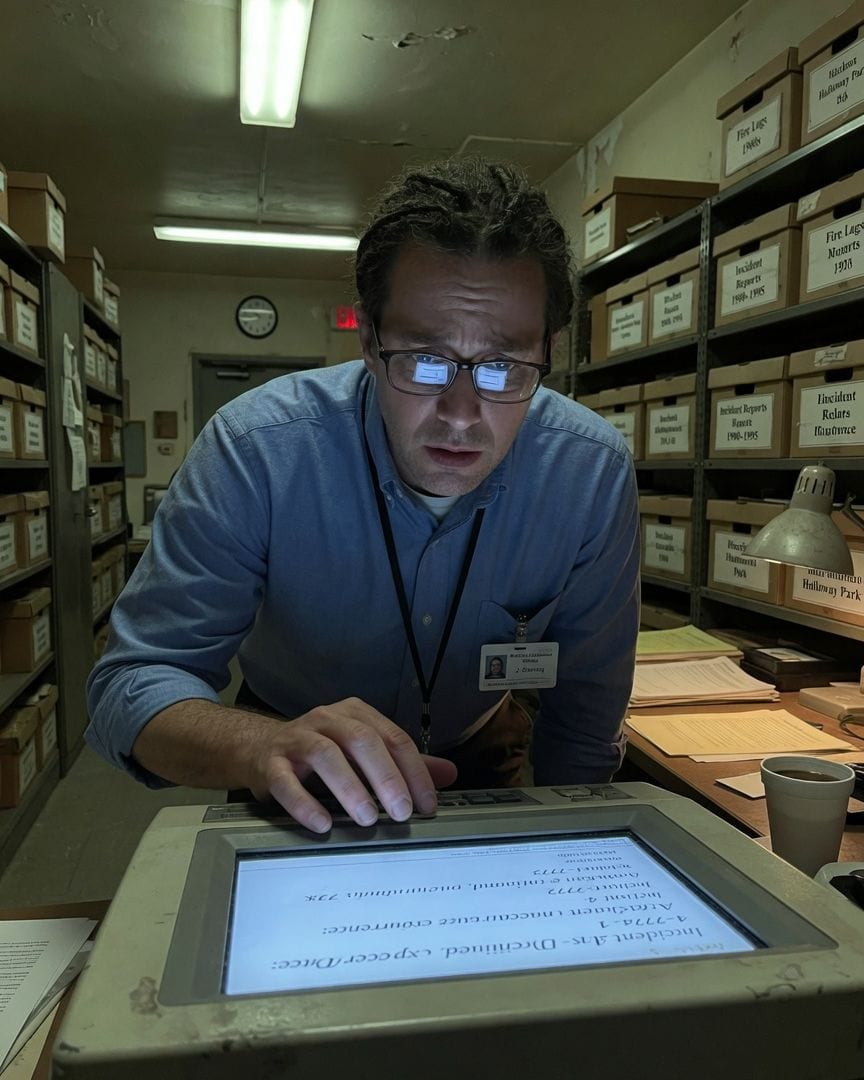
My old rope works fire log repeats the same 3:14am blaze, same incident number, across 1967, 1980, 1993. Each ends: 'origin undetermined, expect recurrence.'
As an Archival Digitization Officer, my days are spent scanning old records. I was numbly working through fire service logs when Incident 4-772 caught my eye: the same structural fire, same time, same number, repeated across different decades. Each entry ended with the chilling, identical phrase: 'origin undetermined, expect recurrence.'
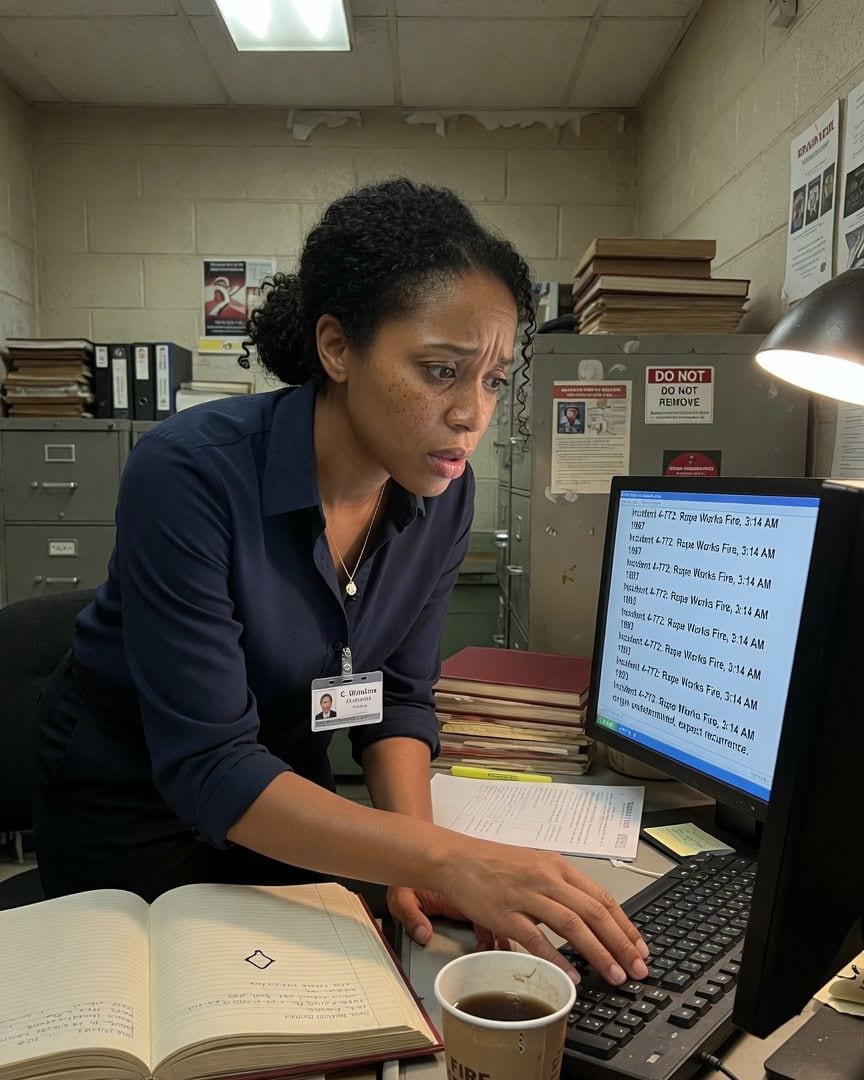
My finger caught on a symbol pressed into the old fire log. It was the same mark I'd seen etched on the building's concrete floor.
As a new archivist, I proofed digital fire logs and found the same Rope Works Fire incident repeating across decades at 3:14 AM. With no digital error, I pulled the original logbooks. There, pressed into each report for this impossible fire, was a tiny, identical symbol.
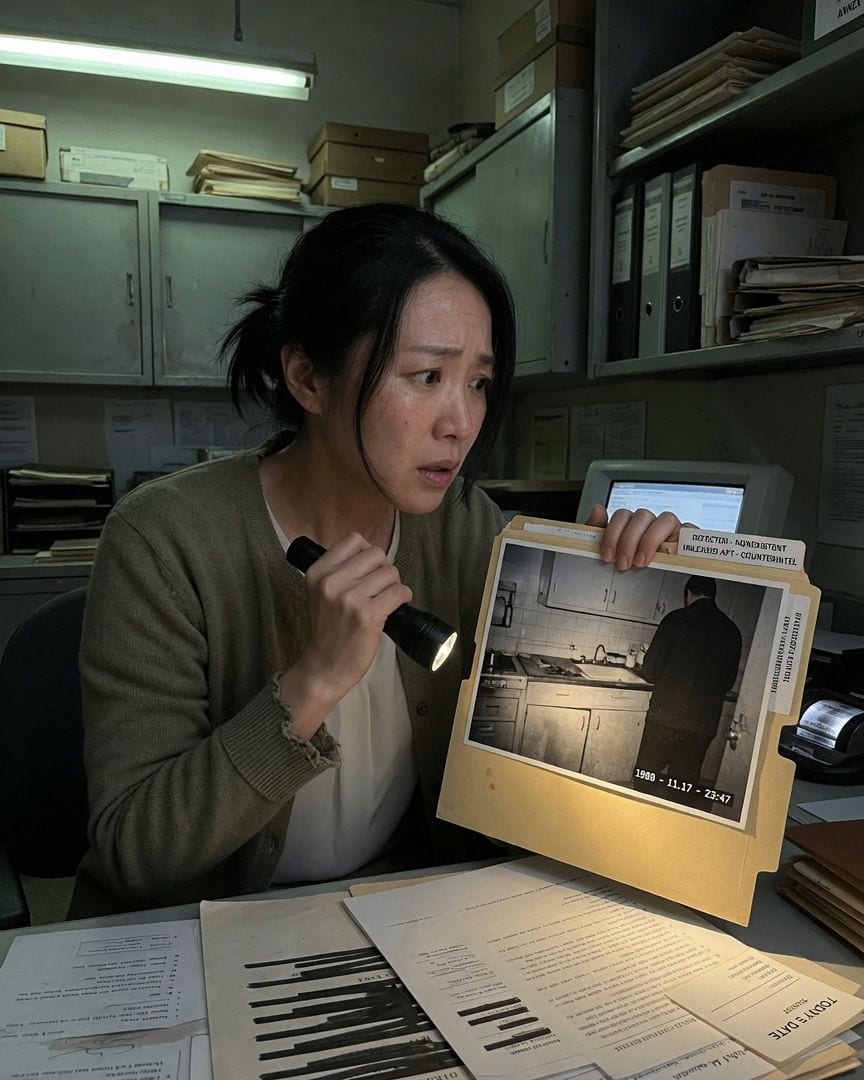
Against a midnight deadline, archivist Junie Kwan finds a Cold War dossier with a photo of her grandmother's kitchen, empty the night of the funeral, with an unknown figure standing inside.
Archivist Junie Kwan huddled in the hushed, cool Alexandria archives, working against a midnight court order to reseal a strange counterintelligence dossier. The file, dense with blanked sections, concerned a 'defector who never existed' and an 'unleased apartment.' As she scanned a grainy surveillance photo, a prickle of unease turned to dread: it was her grandmother's kitchen, dated 1988, the night of the funeral. A tall, rigid figure stood at the sink, yet Junie knew with certainty the apartment had been empty and locked that night. How could an impossible presence appear in a locked, empty room, tied to a phantom Cold War case?
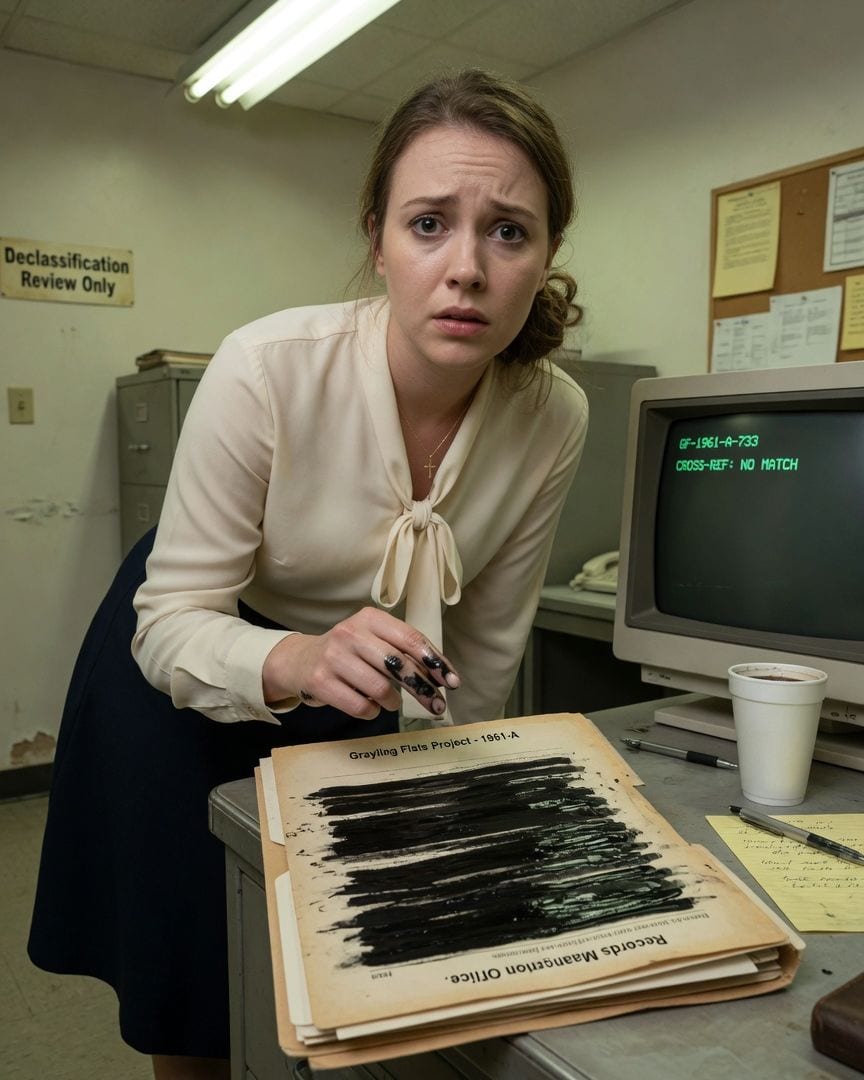
A new records clerk opens old Cold War files. The redaction ink is impossibly wet-black and glossy, thirty years too young for the page.
Ruth Odalen, a new records clerk, began her first assignment in a sterile 1986 declassification office. Tasked with reviewing 'water-damaged' Cold War files, she found the manila folders perfectly dry, but a deeper anomaly waited inside. On one decades-old page, redaction ink gleamed impossibly wet-black and glossy, leaving a cold smear on her fingertip. It looked freshly applied, an impossible detail that seemed to know her, naming the very office she'd left that morning.
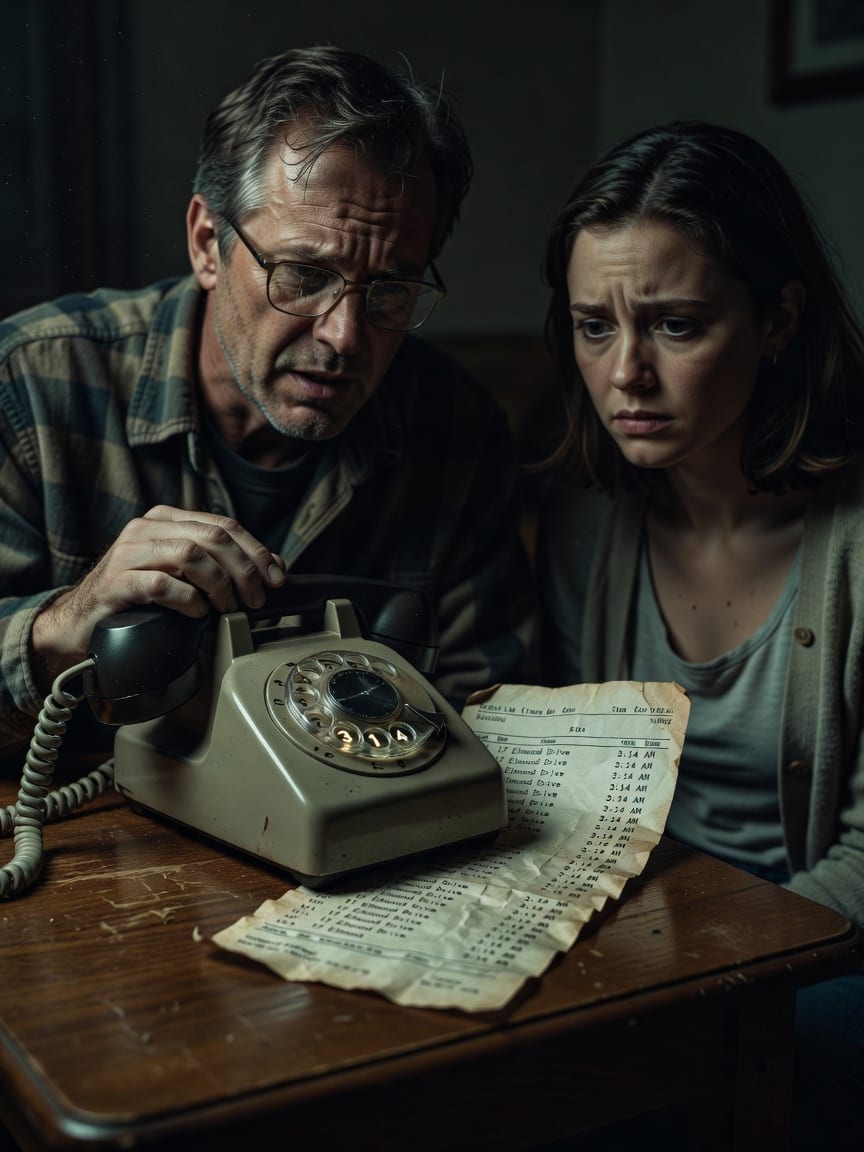
My phone bill itemised forty calls from my number to a house demolished in 1990. Each call at 3:14 AM, lasting eleven minutes. The bill arrived postmarked from a flattened building.
I expected the usual mobile bill, but my landline statement listed forty calls from my number to '17 Elmwood Drive.' That address was for a house torn down in 1990, a vacant lot I remembered from childhood. The phone company insisted the calls were legitimate, leaving me profoundly unsettled by the impossible charges.
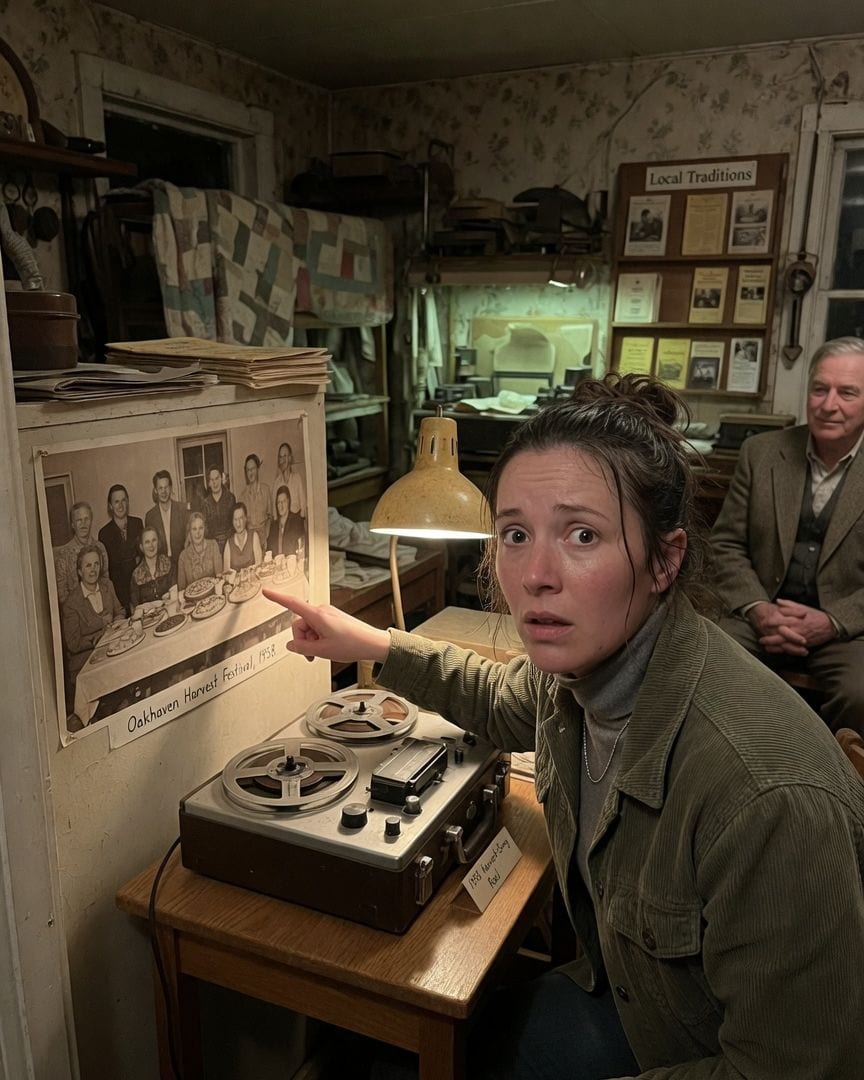
The folk museum's harvest tape counts one more singer than the photograph shows. The curator turned the recorder off before playing it.
I found a quiet escape at Oakhaven's dusty Folk Museum, where the curator played a rare 1958 harvest song. But as a cheerful tune filled the room, a low voice began to count. The tape tallied thirteen, yet the old photograph beside it showed only twelve smiling villagers.