A new records clerk opens old Cold War files. The redaction ink is impossibly wet-black and glossy, thirty years too young for the page.
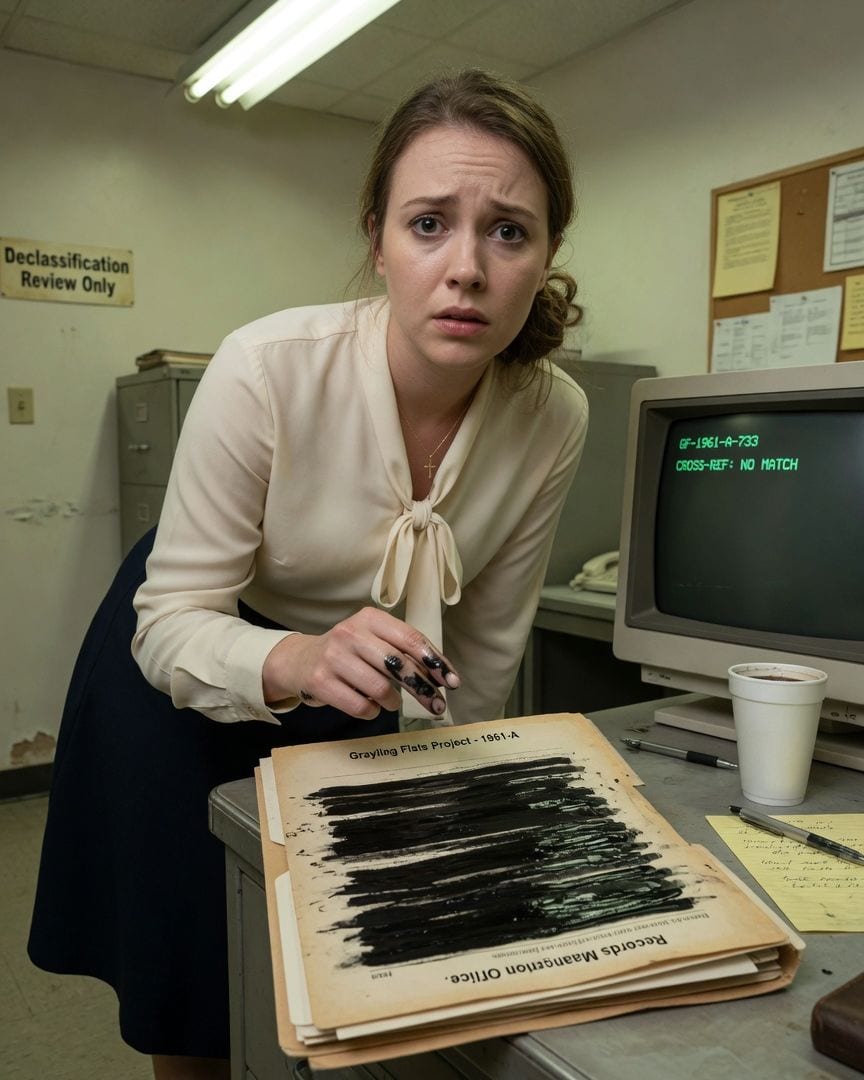
Ruth Odalen, twenty-four and just transferred, walked into the Declassification Review Office in 1986. The space was sterile, all beige walls and fluorescent hum, a contrast to the Records Management labyrinth she’d left that morning.
Her first assignment: a box of ‘water-damaged’ Grayling Flats project files. The project itself was decades old, a Cold War relic officially closed in ’62.
She pulled the top folder, labeled ‘Grayling Flats Project - 1961-A,’ its manila surface brittle and yellowed with age. It wasn't water-damaged. The paper was perfectly dry, rustling softly as she opened it to the first page.
It was marked with heavy black redaction bars, obscuring nearly every line. But the ink wasn't faded. It was impossibly wet-black and glossy, reflecting the overhead light in a startling sheen.
It looked fresh, as if someone had just applied it. Ruth leaned closer, a faint, metallic scent rising from the page. She touched it, and a slick, cold smear came away on her fingertip.
Thirty years too young for the paper it lay on. She scanned the page, her eyes snagging on the last line of the impossibly fresh ink, visible where the censor's heavy stroke had lifted slightly.
It named the Records Management Office she'd been transferred out of that very morning.
A knot tightened in Ruth’s stomach. She tried to rationalize it. A bad batch of ink, perhaps? A recent, unauthorized re-redaction, carried out by someone with a pen long past its prime?
But the paper was too old, too brittle, for a modern pen to leave such a deep, unmarred impression, and the texture of the ink felt wrong, almost viscous, beneath her finger.
She pulled a pen from her own pocket, a standard-issue government ballpoint, and scribbled on a scrap of paper from her pad. Her ink dried immediately, flat and dull, absorbing into the fibers.
The file’s ink, meanwhile, remained stubbornly wet, a stark, unsettling anomaly on the faded page.
Her gaze drifted to the top right corner of the page, where a hand-stamped document control number was partially obscured by the fresh black, but still legible: GF-1961-A-733.
It was an unusual sequence, not quite matching the standard numbering conventions for that era, which typically used simpler alphanumeric codes. This wasn't a clerical error. It felt deliberate, like a fresh wound on an ancient body.
She tried to find a rational explanation, flipping through other pages in the folder. They were all dry, their redactions faded and matte, dull against the yellowed paper.
Only this single page, this single block of text, pulsed with that impossible, slick wetness. A chill prickled at the back of her neck. She decided to cross-reference the control number.
It was a simple administrative task, but it felt suddenly fraught with unspoken tension, as if the very air in the office had grown heavy.
She needed to understand what kind of error could manifest as a fresh, wet lie on a decades-old document, especially one that seemed to know her movements.
Ruth traced the control number through the central database. The system, slow and clunky in 1986, whirred to life with a mechanical groan, its green text crawling across the monochrome screen.
Eventually, after several tense minutes, it pulled up the original cover sheet for the Grayling Flats file. It was a scanned copy, dated 1961.
The title was clear, emblazoned in bold, typewritten letters: 'GRAYLING FLATS PROJECT - TOP SECRET - 1961-A.' Below the title, the page count read '37 pages.'
Ruth looked down at the slim folder in her hands, its contents barely an inch thick. She quickly thumbed through the brittle pages, the paper dry and fragile against her fingers, counting each one. Twenty-two pages.
Fifteen pages were simply missing. Then her eyes fixed on the downgrade schedule, printed in stark, official block letters at the bottom of the cover sheet. It didn't list a date for declassification, or even the phrase 'CLASSIFIED INDEFINITELY.'
It read: 'DECLASSIFY NEVER.'
The 'DECLASSIFY NEVER' stamp and the fifteen missing pages rattled Ruth. This wasn't just a misfile or a simple archiving error; it was an active contradiction within the system itself, a glaring inconsistency that defied all protocols.
Over the next week, she quietly began pulling other Grayling Flats files, ostensibly for 'cross-referencing consistency,' a plausible enough excuse in the labyrinthine world of declassification.
The faint metallic scent seemed to cling to her fingers, even when she hadn't touched the wet ink. She found more anomalies.
One file, labeled 'Personnel Transfers - Grayling Flats,' listed a dozen names, all with 'REASSIGNED - UNAVAILABLE' beside them, but no destination or new unit. It was a bureaucratic dead-end.
Another detailed 'Equipment Inventory - Site Alpha,' with several high-value items marked 'DISPOSED - NO TRACE.'
In several of these folders, she found pages with similar, subtle inconsistencies: a date that seemed to shift forward by a day upon a second glance, or a signature that appeared slightly different on two copies of the same memo, as if a ghost had re-signed it.
The dread wasn't in any single grand reveal, but in the accumulation of these small, impossible errors, each one a whisper of something fundamentally wrong.
The office hummed around her, but the noise seemed distant, muffled by her own escalating unease. She located an old, declassified memo from 1962, authored by Nathaniel Foster, then a junior analyst on the project.
It discussed 'unforeseen data anomalies' and 'self-correcting archival entries,' phrases that now resonated with an unsettling new meaning.
Foster had requested a review of 'systemic integrity,' but his request had been stamped 'DENIED - NO FURTHER ACTION REQUIRED,' the official red ink stark against the faded paper.
The quiet institutional dismissal of such a precise, if cryptic, warning deepened Ruth's unease.
She copied the memo, feeling a growing certainty that she wasn't just investigating a cold case; she was pulling a thread from a living tapestry, and the fabric was starting to unravel.
Ruth's quiet investigation didn't go unnoticed. She found Thomas Merritt, a senior archivist from her old Records Management office, standing by her desk one afternoon, ostensibly 'just passing through' on his way to retrieve a form.
Merritt, a man in his late fifties with a stoic, almost weary demeanor, looked at the stack of Grayling Flats files Ruth had accumulated. The fluorescent lights seemed to dim, casting long shadows. 'Still digging through those old things, Odalen?'
he asked, his voice low, barely audible above the distant clatter of typewriters. 'They're best left to gather dust. Some files… they don't like to be disturbed.'
He didn't elaborate, but the implication hung heavy in the air, a cold weight. 'Others have gone down that path,' he added, his eyes meeting hers, a profound sadness in their depths, 'and they just… disappeared into the paperwork.'
The casual way he said it, as if discussing a common administrative mishap, was chilling. It wasn't a warning; it was a statement of fact.
Later that day, Ruth returned to her desk after a coffee break to find her carefully organized stack of Grayling Flats files slightly askew, the memo from Nathaniel Foster she’d been studying now placed on top.
She hadn't left it there. A shiver ran down her spine, raising goosebumps on her arms. Someone was watching her, moving through her space with an unnerving familiarity.
That evening, as the office emptied out and the overhead lights began their timed shut-down, a small, unmarked envelope appeared on her desk, tucked under her keyboard. Inside was a single, typed note: 'CHECK THE INK.
NOT JUST IN GRAYLING FLATS.' No signature, no return address, just that stark, unsettling command. The message validated her suspicions, making the air in the silent office feel thick and charged, but it also amplified the sense of personal danger.
The files weren't just anomalous; they were actively protected, and someone knew exactly what she was looking for, and where to tell her to look next.
The anonymous note, crisp and unsettling, propelled Ruth to confront Thomas Merritt again. She found him in a quiet corner of the archives, meticulously shelving reels of microfilm in dim light.
The room smelled of old paper and dust, a scent that now seemed to carry a hint of something metallic, something fresh. 'Merritt,' she began, her voice low but firm, cutting through the silence.
'What did you mean, 'disappeared into the paperwork'? And who sent me this?' She held up the note, its edges slightly crinkled from her grip. Merritt sighed, a sound heavy with years of unspoken burdens.
He didn't deny receiving the note; he simply took it, his fingers brushing hers, and crumpled it without a word, dropping it into a waste bin beside the microfilm cabinet.
'Some things aren't meant to be known, Odalen,' he said, his back to her, his voice barely a whisper. 'The Grayling Flats project… it wasn't what they said it was. Not a weapons program, not a surveillance op.
It was an observation project. Of the system itself.' He turned, his eyes tired, haunted. The archival lights cast his face in deep shadows, making him look even older. 'The records… they weren't just documenting events. They were… participating.
The 'ink,' as you call it, is a signature. A signature of something that uses our filing system, our bureaucracy, as a conduit.' Ruth felt a cold wave wash over her, a chill that seeped into her bones.
'A conduit for what?' she managed, her voice barely steady. 'For… filing,' Merritt replied, his voice flat, devoid of emotion. 'It files people. Events. Futures. The missing pages in your file? They weren't lost. They simply hadn't been written yet.
The project was closed because they couldn't control it, only observe its effects. The 'lost' weren't lost. They were filed. And once you're in the file, your story… it gets written.'
He looked at her with a profound, unsettling pity, a look that made her skin crawl. 'You've been digging, Odalen. You've been asking questions. You've drawn attention to yourself. You're in the file now. And it's still being written.'
Merritt's words echoed in Ruth's mind, a terrible pronouncement: 'You're in the file now. And it's still being written.' The anonymous note's command, 'CHECK THE INK. NOT JUST IN GRAYLING FLATS,' now took on a terrifying immediacy.
If the system was still active, still filing, still writing… where else could its influence reach? She left Merritt in the archives, the smell of old paper suddenly oppressive, her heart pounding a frantic rhythm against her ribs.
She returned to her new office. It was late, the building mostly empty, the silence punctuated only by the distant hum of the ventilation system.
Her desk was piled with a fresh batch of incoming files, a mundane part of her new job. She picked one at random, a thick folder labeled 'Project Nightingale - Personnel Reductions,' dated this very week.
It had no apparent connection to Grayling Flats, no classified markings beyond 'Internal Use Only.' She opened it, scanning the pages for any faint hint of an anomaly, desperately seeking the familiar dry, faded black of ordinary redactions.
Most of the document was standard procedure, budget cuts, departmental restructuring. Then, halfway through, she saw it. A paragraph detailing a recent staff transfer, blacked out with a heavy redaction bar.
But the ink was wet, glossy, impossibly fresh, just like in the Grayling Flats file. Her hand trembled as she leaned closer, the faint metallic tang in the air suddenly overpowering.
Her eyes strained to read the faint impression beneath the slick blackness, her breath catching in her throat. The last line, in that impossible hand, read: 'Odalen, R. began review of Project Grayling Flats, File 1961-A. Access granted.'
It was dated this morning. It was her own file.
Ruth found Nathaniel Foster, the former director of Grayling Flats, in a quiet, unassuming retirement community in rural Virginia. The drive was long, the landscape flattening into endless fields, a contrast to the sterile halls of her office.
He was older now, his face a roadmap of wrinkles, but his eyes were clear, almost unnervingly so, holding a distant, knowing quality. He invited her into his tidy living room, offering her tea from a delicate china pot.
The room was warm, filled with the scent of dried flowers and old books. Ruth, bypassing pleasantries, laid out her findings: the wet ink, the missing pages, Merritt's ominous warnings, her own name appearing in a newly redacted file.
Foster listened patiently, his gaze unwavering, a faint, unreadable smile playing on his lips. When she finished, the only sound was the gentle tick of a grandfather clock in the corner. He merely nodded.
'Thomas Merritt was a good man,' he said, his voice calm, steady, 'He understood the implications. The Grayling Flats project was an attempt to understand the phenomenon. We thought we were documenting reality. We were wrong.
We were providing the means for it to be written.' He explained that the 'secrecy machine' — the vast, intricate network of records, classifications, and bureaucratic processes — was not merely a tool for human control.
It was a conduit, a framework that an unknown entity had subtly co-opted. 'The entity doesn't erase,' Foster continued, his gaze fixed on a distant point beyond the window, as if seeing beyond the quiet garden. 'It files. It writes.
The 'lost' are not lost in the conventional sense. Their narratives are simply… fully realized within the system. The fresh ink is its direct intervention, its signature. And the missing pages in your file, Miss Odalen?
They are for the events yet to occur. Once you become part of the record, your story is no longer entirely your own. It is being signed, line by line.'
Foster stood, moving to a small, locked filing cabinet in the corner of his living room. The wood of the cabinet gleamed in the afternoon light. He opened it with a small, brass key, retrieving a worn manila folder.
'My own file,' he said, handing it to her. Ruth took it, her fingers trembling, the paper warm against her skin. Inside, she saw his life, meticulously documented. There were entries detailing his career, his retirement, his daily routines.
And then, at the bottom of the last page, in the same impossible, wet-black ink, was a fresh entry: 'Foster, N. discusses System with Odalen, R. on [current date].'
Her heart hammered against her ribs, a frantic bird trapped in a cage. He didn't deny it, didn't express fear or regret. He merely presented it as an immutable, terrifying fact, as casually as one might discuss the weather.
'Once your name enters the record in this way,' he explained, his voice soft, 'the system begins to… complete your narrative. It's not malicious, not in a human sense. It simply seeks coherence.
And coherence, for it, means a fully written file.' Ruth felt a profound, chilling despair settle over her, heavy as a shroud. She was trapped. Her life, her future, was now subject to this unseen, unfeeling bureaucracy of the impossible.
She stood up abruptly, desperate to escape, to run from the house, from the weight of that knowledge. Foster made no move to stop her.
He merely watched, his expression calm, almost serene, a faint, unsettling smile still playing on his lips. 'It's already recorded, Miss Odalen,' he said, his voice barely above a whisper, as she reached the door. 'Every step you take.
Every decision you make. It's all part of the record now.' Ruth fled, the weight of his words a physical burden pressing down on her shoulders.
She knew she wasn't just leaving a house; she was running from a truth that had already written her ending, or at least, her next chapter.
The calm acceptance in Foster’s eyes was the worst part, a reflection of the utter helplessness she now felt.
Ruth returned to her office, a ghost moving through familiar halls. The world looked the same—the beige walls, the fluorescent lights, the stacks of files—but her perception was irrevocably altered.
She resumed her work, her movements precise, methodical, but every file, every document, now seemed to hum with a hidden, terrible life.
She saw the tell-tale wet-black ink in more places: a subtle smear on a budget report, a glossy line on a personnel review, a freshly redacted paragraph in a mundane memo detailing inventory.
The metallic tang was everywhere now, a constant, faint taste in the back of her throat. The system wasn't just in Grayling Flats; it was everywhere, weaving itself into the very fabric of daily bureaucracy, a quiet, insidious presence.
She understood that the institution wasn't merely archiving the world; it was being used to write it.
She couldn't speak of what she knew, couldn't share the burden, for fear that even her confession would become another entry, another signed line in the vast, terrible file.
The silence of her knowledge was deafening, a heavy cloak she now wore.
Years passed. Ruth Odalen continued her work in declassification, her methodical nature a mask over the profound, quiet dread she carried. She saw the ink on new files daily, a constant, wet-black reminder of the invisible architecture of reality.
She understood that the system was not broken; it was working exactly as intended, and she was now a silent, complicit part of its mechanism. She never spoke of it, never sought to disrupt it. What was written, was written.
One ordinary Tuesday morning, a new junior officer, Eleanor Patterson, arrived to begin her rotation in the Records Management Office, Ruth's old department. Eleanor, bright-eyed and eager, was assigned to organize a backlog of older, uncatalogued boxes.
Ruth watched her from across the room, her gaze fixed. Eleanor, with a spark of youthful curiosity, pulled a dusty box labeled 'Grayling Flats Project - Miscellaneous.' Eleanor paused, her fingers tracing the faded label.
Ruth Odalen watched her from across the room, a faint, wrong smile playing on her lips. The file was still being signed.
If this one got to you
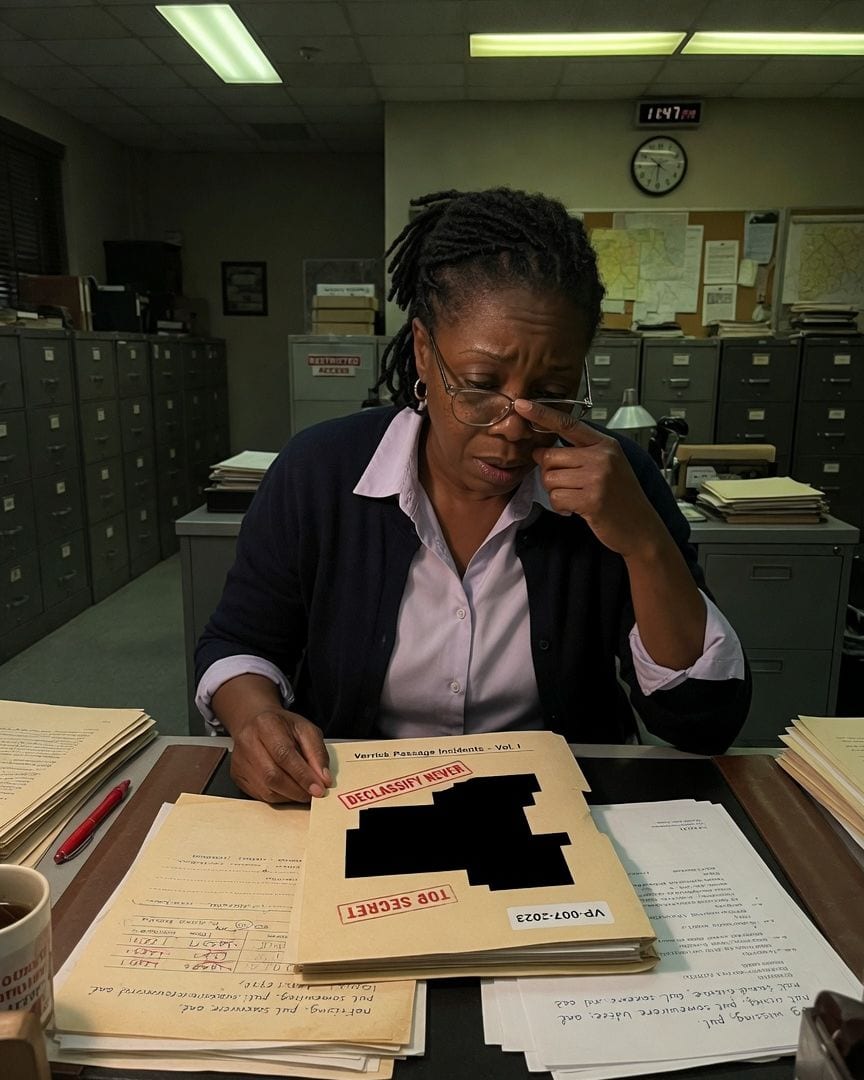
A declassification reviewer finds nine witness statements from decades apart, all written in the same looping hand. The Cold War file's newest control number points to no office.
As a declassification reviewer for the National Archives, Ione Fash faced a Sisyphean task: finding a way to downgrade records detailing the disappearances of fourteen men over eighty years. The constant hum of the office was her only companion as she meticulously examined files marked 'DECLASSIFY NEVER'. She pulled out nine witness statements, each from a different town and year, only to find them all written in the exact same distinct, looping script. Then she saw it: a control number on a file supposedly closed in 1978, dated '2023', and with no originating office in the entire archive system. Who was still signing these impossible files?
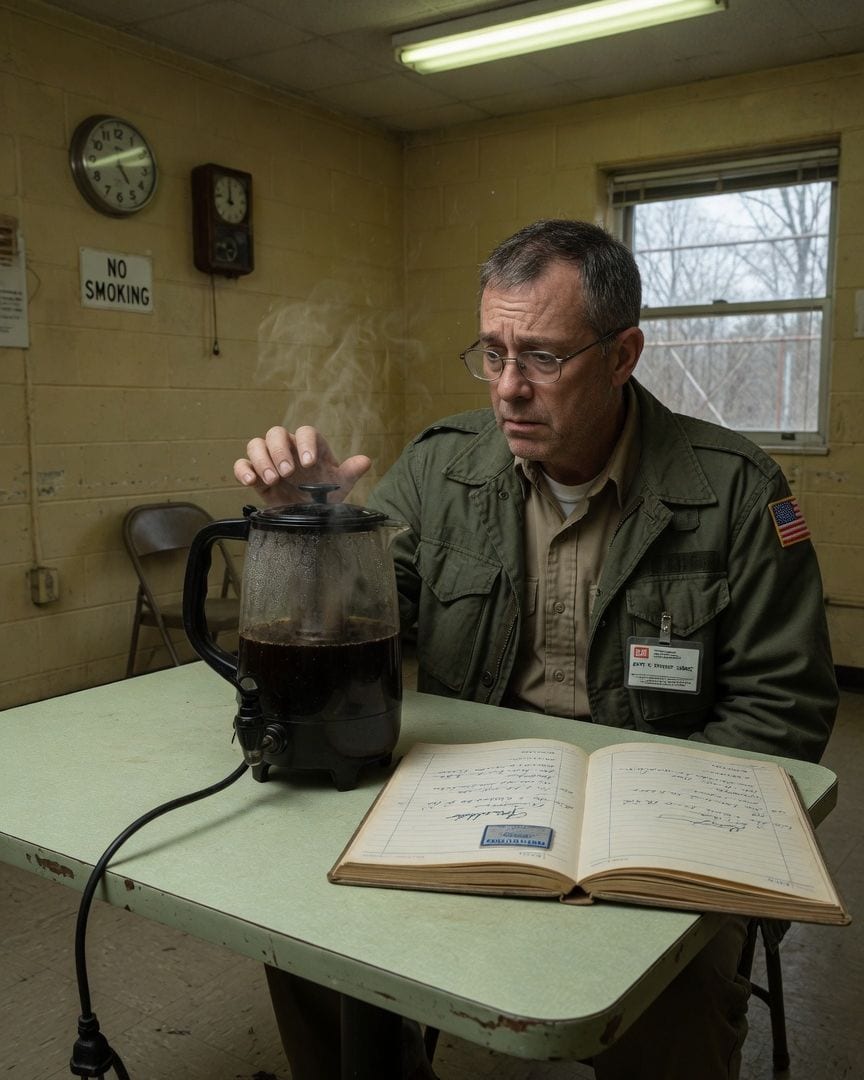
A methodical US Army engineer found a Cold War facility's file stamped 'DECLASSIFY NEVER' — and half its pages were missing.
Captain Nolan Threep, a methodical US Army engineer, expected another routine decommissioning at Alert Facility Twelve in rural Montana. The chains on the doors had rusted solid since 1970, promising a long-dead site. Yet, inside, a faint warmth hung in the air, and a glass coffee urn sat half-full, a wisp of steam rising lazily from its dark surface. The urn, warm to the touch, was clearly unplugged, and the duty log beside it, signed for a shift ending nineteen years prior, looked as though it had been signed yesterday. What secret could a supposedly abandoned Cold War facility hold?
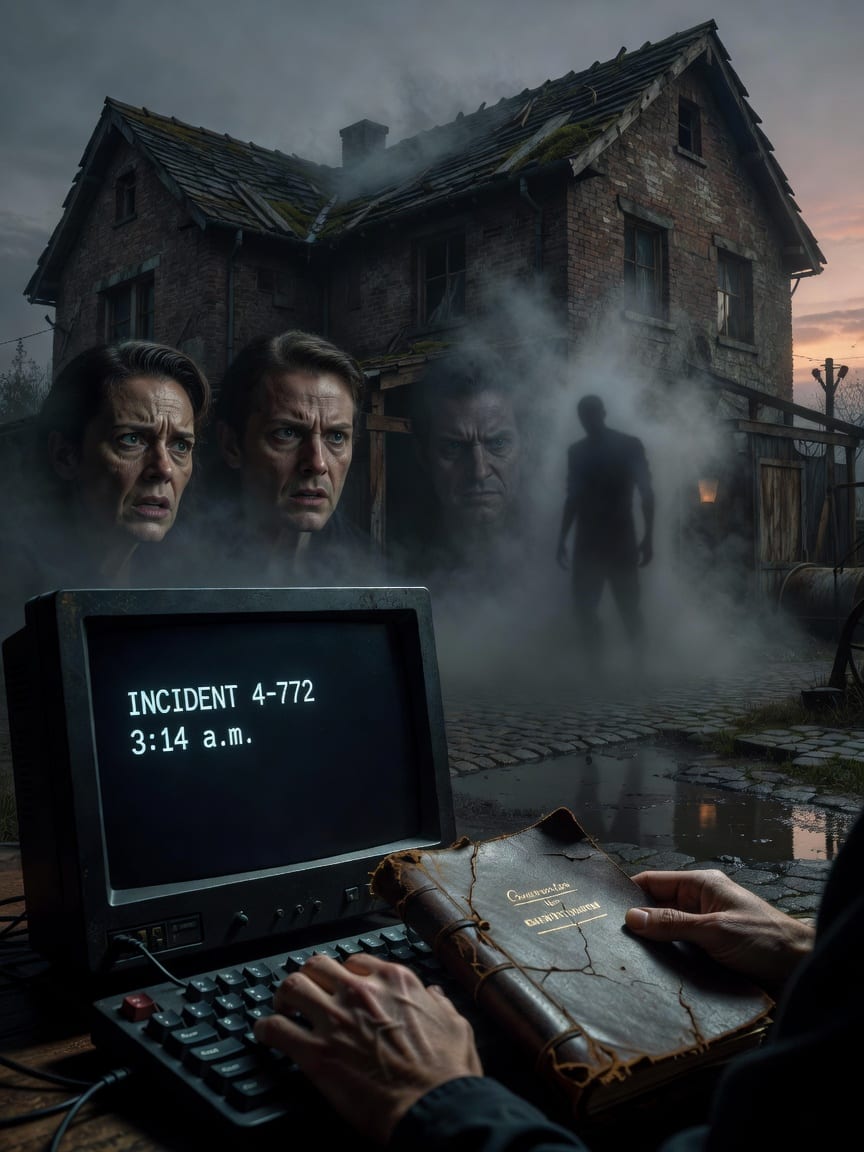
My screen showed Incident 4-772: a fire at the old rope works, 3:14 a.m. It was logged again for 1980. Then 1967. And 1993. Same incident, same time, same building. Each report ended with the same three words: 'expect recurrence.'
As a new archivist, I usually found my work digitizing old fire service records monotonous, until I found a heavily redacted line in a 1961 site assessment. Faint letters beneath the black bar slowly revealed my own family name, DRUMMOND, dated years before I was even born.
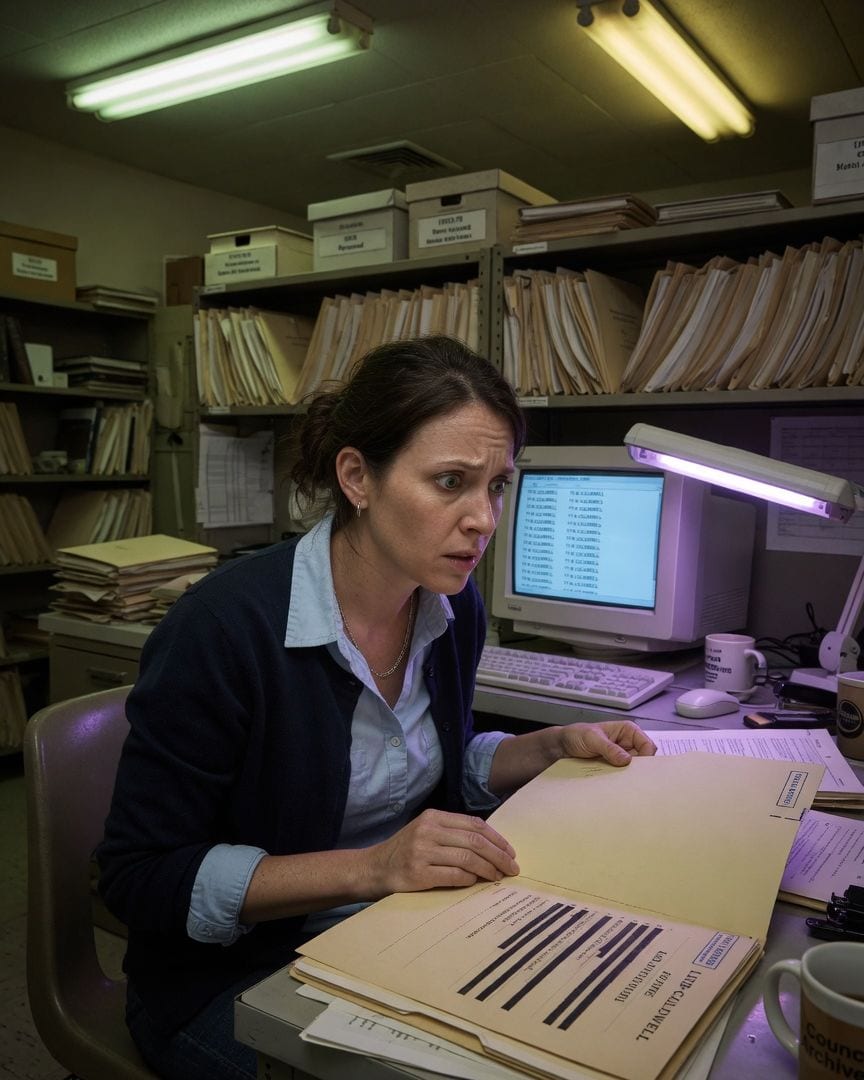
My employer's security file holds a vetting report on me dated nine years before I ever applied. It has my full name and my parents' address — with only one line, the source who referred me, blacked out.
Working a routine data audit, I pull my own security file. The issue date is nine years before I even applied for the job. Then, hidden within an old archive file, I find my current address etched under a blacked-out line.
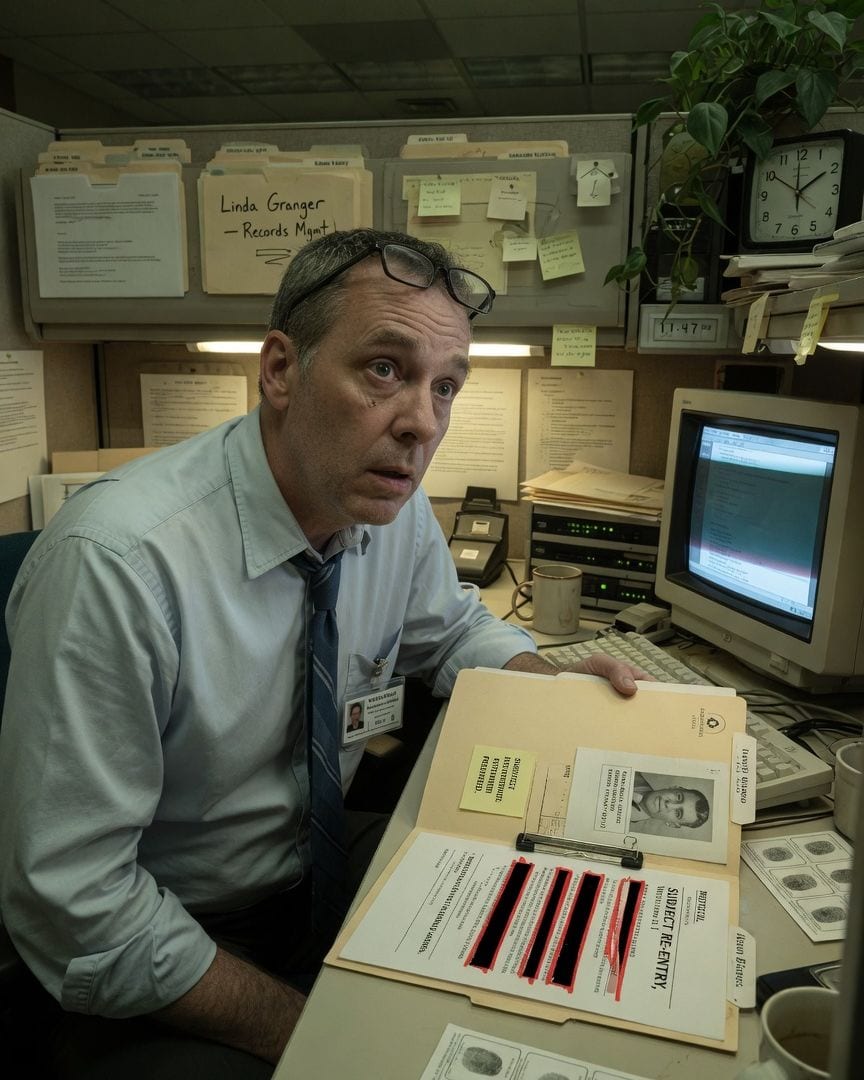
A declassification agent processed old Cold War files. A man reported dead in 1951 had 1958 fingerprints matching an employee badged into the building that morning.
Anton Skeel, a declassification agent nearing two decades of service, meticulously processed the endless backlog of Cold War secrets. His cubicle hummed with the ghosts of forgotten files, but one 'Hollow Bell' folder held a particularly glaring anomaly. It contained a 1958 fingerprint card for Henry Bishop, a man officially reported dead in 1951. When Anton fed the print into the active database, it matched Carl Romano, an employee badged into the building that very morning. A cold certainty settled over him: this wasn't an error, but a system designed for such impossible discrepancies.
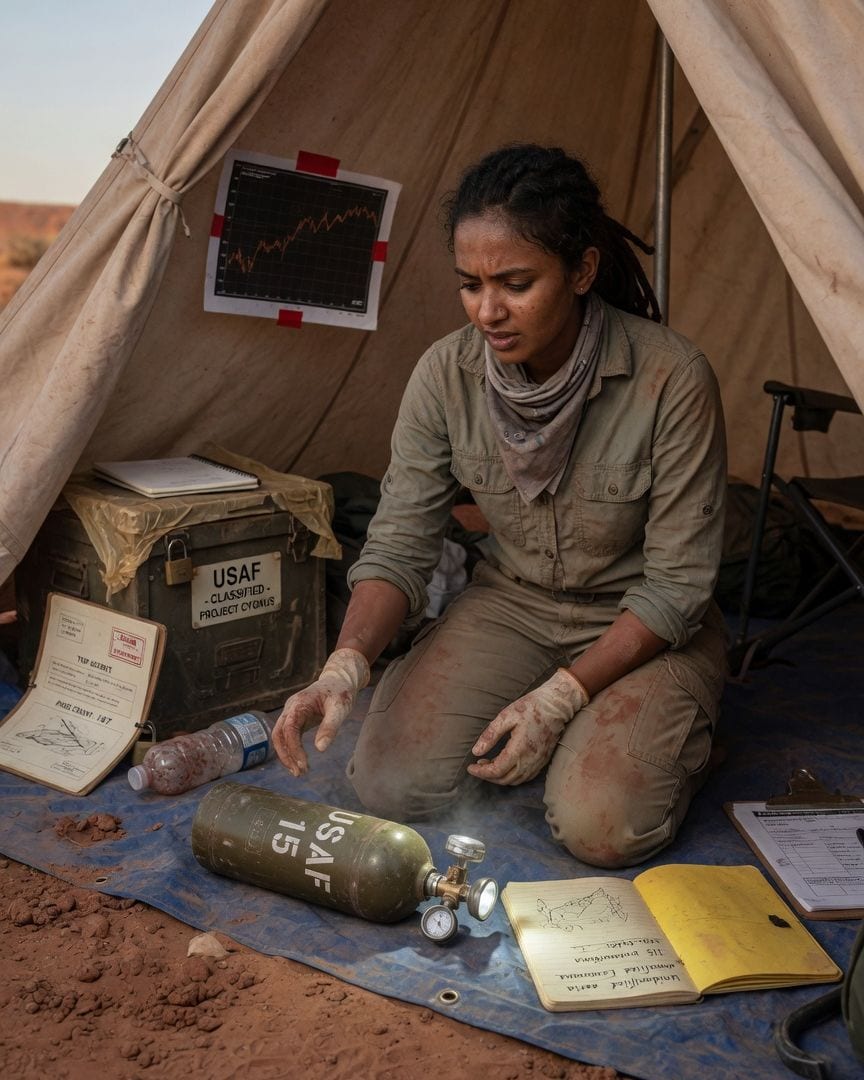
A researcher's permit is almost gone. She finds a Cold War archive box listing 187 pages, but 173 were surgically cut out.
Archaeologist Priya Raval knelt in the reddish Utah mud, her permit for the site ticking down with only nine days left. The desert silence was broken only by the hiss of an 80-year-old oxygen bottle, defying records by holding full pressure in a backfilled cavity. As Priya raced against the clock, she unearthed deeply buried concrete conduits and a classified Cold War archive box. Its cover listed 187 pages, but inside, a terrifyingly precise cut had excised 173 of them, leaving only blank space. What secret did the military bury here, then try to erase?