A declassification reviewer finds nine witness statements from decades apart, all written in the same looping hand. The Cold War file's newest control number points to no office.
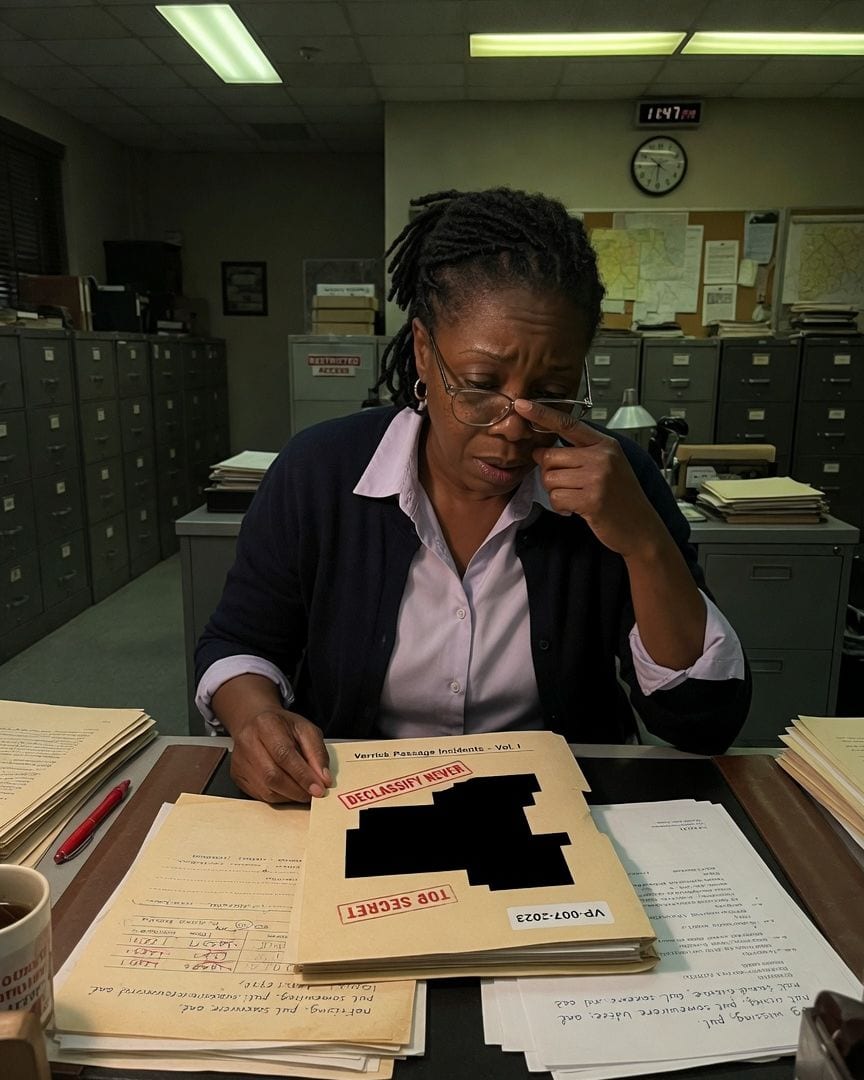
The hum of the fluorescent lights was the only sound in the cavernous office, a constant, low thrum that Ione Fash barely noticed anymore.
A declassification reviewer for the US National Archives, she sat at her desk, meticulously examining a collection of files marked 'Verrick Passage Incidents – DECLASSIFY NEVER.'
Her task was a Sisyphean effort: to find any possible route to downgrade the classification of records spanning eighty years, detailing the disappearances of fourteen men in a remote coastal area.
She pulled out nine separate witness statements, each from a different town, a different year, and recorded by a different interviewer.
Ione’s brow furrowed as she read the identical, chilling sentence repeated verbatim in each one: 'not missing, put somewhere, and that the paperwork was correct.'
It was unsettling, but not unheard of – sometimes specific phrasing was adopted by official investigations. The true wrongness, however, hit her as she smoothed the last sheet of paper.
Every single one of the nine statements, despite their varied contexts, their differing dates, and the alleged different hands of the interviewers, was written in the exact same distinct, looping script.
Ione tried to rationalize the impossible handwriting. Was it a template, a specific form that required a certain clerk to transcribe all interviews? She leaned back in her chair, pushing her glasses up her nose.
She cross-referenced interview dates, locations, and personnel listed on each statement. The dates spanned from 1943 to 1978. The towns were hundreds of miles apart, from coastal Maine to the Great Lakes.
The interviewers listed were different agents from different agencies: FBI, State Department, Navy Intelligence. No single clerk could have been present for all these interviews, let alone have lived and worked across such a vast timeframe and geography.
The mundane explanation crumbled, leaving a cold void.
She checked the file index: 'Verrick Passage Incidents, Vol. I-IV.' But the physical folder she held only contained Vol. I and II. Her gaze went back to the spine, then to the cover page. Vol.
I's cover page listed 230 pages, but a quick count confirmed the physical folder contained only 190. Forty pages were missing. On the cover of Vol.
I, beneath the faded 'TOP SECRET' and a newer, stark red 'DECLASSIFY NEVER' stamp, was a large, blacked-out rectangle. It wasn’t just lines; it was a solid, precise, almost geometric silhouette, like a map contour.
In its lower right corner, a small, unredacted control number, 'VP-007-2023,' stood out. The '2023' date made no sense for a file supposedly active only until 1978.
Ione Fash pulled up the archive's internal database, typing in the control number 'VP-007-2023.' The system whirred, accessing various directories, then returned 'NO ORIGINATING OFFICE FOUND.' This was impossible.
Every government record, especially classified ones, traced back to a specific department or agency. Yet, here was a control number with a current year, physically present on an eighty-year-old file, with no digital footprint.
She looked back at the blacked-out shape on the cover, a precise, miniature rendering of the Verrick Passage geographical anomaly itself, as if seen from above. A cold certainty settled over her.
The file was not just old, sealed, and contradictory. It was still being signed. Ione Fash stared at the redacted cover sheet.
The impossible, perfectly rendered shape of the Verrick Passage on the paper, a miniature black void, seemed to pulse under the fluorescent lights.
Her finger hovered over the control number, the current date stark against the aged paper, a detail that shouldn't exist.
The lack of an originating office for 'VP-007-2023' gnawed at Ione Fash, a persistent itch in her rational mind.
She requested access to the archive’s internal 'Anomalous Records' database, a rarely used system for files with incomplete metadata or unusual characteristics. After several layers of authorization, the system finally granted her limited access.
She found other 'Passage' files: the 'Gresham Passage,' the 'Blackwater Passage,' all with similar discrepancies – missing pages, 'DECLASSIFY NEVER' stamps, and, most disturbingly, the same distinctive handwriting in various witness statements.
She cross-referenced the historical timeline of these 'Passage' incidents with the personnel records of clerks and agents from those eras.
One name kept recurring, associated with initial intake stamps and minor endorsements across multiple 'Passage' files from the 1940s through the late 1970s: Malcolm Caldwell, listed as a 'Senior Records Clerk.'
His personnel file was thin, almost empty – no family, no education, no retirement date, just a long string of service years and commendations for 'unwavering diligence.'
The signature on his early records, a graceful but firm looping script, matched the handwriting in the witness statements. He was a ghost in the machine, a man who seemed to have been present for decades, calmly processing the impossible.
Ione Fash felt a subtle shift in the archive's atmosphere. The usually placid hum of the servers, a white noise she usually ignored, now seemed to carry a subtle, almost imperceptible weight, a deeper resonance that unsettled her.
Files she had earmarked for review the previous day were now listed as 'IN USE – UNAVAILABLE.'
Her supervisor, Deborah Lawson, a woman usually consumed by budget reports and the daily grind of administrative tasks, started appearing at Ione's desk with unusual frequency.
'Making progress on those Verrick files, Ione?' Deborah would ask, her tone casual but her gaze lingering on the scattered documents and opened folders.
Ione tried to dismiss it as a supervisor's natural oversight, but the feeling of being watched persisted. One afternoon, Ione returned from lunch to find her computer logged out, something it never did automatically.
The Verrick Passage folder on her screen was closed. A new, unread email sat in her inbox: a blank message with the subject line 'PROTOCOL 700-A' from an internal address labeled 'Records Compliance.'
It was a subtle but unmistakable warning, a cold hand on her shoulder in the quiet solitude of the archive. She was no longer just investigating; she had been noticed.
Ione Fash confronted Deborah Lawson, not with accusations, but with the impossible facts she had uncovered: the identical handwriting, the missing pages, the 'VP-007-2023' anomaly, Malcolm Caldwell's inexplicable service record.
Deborah listened, her expression unreadable, her hands clasped on the polished surface of her desk.
'Malcolm Caldwell,' Ione stated, her voice steady despite the tremor in her hands. 'His signature matches the witness statements across decades. He worked here for over thirty years, but his personnel file is almost blank. Who was he, really?'
Deborah sighed, a long, weary sound that seemed to carry the weight of years. 'Malcolm Caldwell was… diligent,' she began, choosing her words carefully, her gaze unfocused on a point beyond Ione's shoulder.
'He understood the nature of certain… sensitive classifications.'
Ione pressed, 'Sensitive classifications that involve people going missing and being 'put somewhere'?'
Deborah's eyes, usually sharp and pragmatic, softened with a deep, unsettling sadness that seemed to ripple across the usually composed lines of her face.
'The Verrick Passage, and others like it,' she said, her voice dropping to a near whisper, 'are not incidents, Ione. They are protocols. For situations where… individuals become incompatible with established parameters.
The paperwork is correct because it is the official record of their reassignment.'
She slid a thin, unmarked memo across the desk. It was heavy bond paper, with only a title: 'Personnel Reassignment Protocols – Level 7 Classification.'
The memo detailed a system for 'containment and integration,' where 'incompatible assets' were 'filed' into a 'secure, off-site repository.' The language was clinical, cold, devoid of any human empathy.
Ione’s mind raced, connecting the dots: the 'missing' men, the chilling phrase 'put somewhere,' the insistence that 'the paperwork is correct.' It wasn't about covering up their disappearances; it was about processing them.
The identical handwriting wasn't just a clerk’s idiosyncrasy; it was the Administrator's mark, the one who oversaw these 'reassignments,' ensuring the records were complete. The institution knew. It wasn't a cover-up; it was the process itself, ancient and horrifyingly efficient.
The 'Personnel Reassignment Protocols' memo confirmed Ione Fash's worst fears: the Verrick Passage was not a historical footnote but a live, active system. The 'Administrator' was not just a historical figure but a continuous role, ensuring the 'paperwork is correct.'
Driven by a desperate need to find any loophole, any way out of this unfolding nightmare, Ione returned to the 'Anomalous Records' database. Her fingers flew across the keyboard, a frantic energy possessing her.
She performed a deep search, cross-referencing 'current protocols' with 'active personnel.' The database whirred, its internal fans kicking up to a higher pitch, accessing deeper, more restricted layers of information she hadn't known existed.
A new folder materialized on her screen, its icon glowing faintly, a stark white against the dark interface. It was labeled 'Verrick Passage – ACTIVE.' Her heart pounded against her ribs, a frantic bird trapped in a cage.
She clicked it open.
Inside, there was only one file. Its title screamed at her from the screen: 'REVIEWER FASH, IONE. Service Number: 749-33-01.'
Ione Fash stood frozen, the newly opened file a blinding white on her screen, her hands trembling so violently that the mouse in her grip seemed to vibrate.
The crisp, official script of the file, so familiar now from days of painstaking review, listed her own service number, her recent archive access logs, her current department – a file that was not historical, but utterly, terrifyingly present.
The last entry, a date from yesterday, simply read: 'REVIEWER FASH, IONE. STATUS: PENDING.'
The 'REVIEWER FASH, IONE. STATUS: PENDING.' entry was undeniable, a stark, digital pronouncement of her fate. The chilling coherence of the system snapped into place for Ione.
The Verrick Passage wasn't a geographical location, nor an incident, but a designation for those who had 'seen too much' within the archives, whose 'incompatibility' with the institution's profound secrecy had been logged.
The fourteen men from eighty years ago weren't victims of some external force, but the earliest recorded 'filings' of this internal protocol.
The identical handwriting, spanning decades and seemingly impossible geographies, represented the continuous role of the 'Administrator,' a position passed down through generations, or perhaps, a single, unnaturally long-lived individual like Malcolm Caldwell, who ensured the system's continuity.
The 'DECLASSIFY NEVER' stamp wasn't about protecting secrets from outsiders; it was about protecting the system itself from internal scrutiny, ensuring that those 'filed' remained permanently inaccessible, their records sealed away from any further investigation.
Ione realized the Verrick Passage file she now held in her hands was not a historical document she was reviewing, but her own active case file, meticulously maintained by the very machine she served.
She was never a neutral observer; she was always inside it, from the moment she first opened that folder.
Ione Fash tried to move, to run, but her legs felt heavy, as if filled with concrete.
She frantically attempted to copy the 'REVIEWER FASH' file from her screen, her fingers flying over the keyboard, but the system denied access, flashing 'UNAUTHORIZED ATTEMPT' in stark red letters.
She heard footsteps approaching her desk, slow and deliberate, measured, utterly unhurried. Deborah Lawson appeared, her face devoid of her earlier sadness, replaced by a calm, official neutrality that was more terrifying than any anger.
Behind her stood an older man, his hair impeccably combed, stark white against his dark suit, his eyes a pale, unsettling blue that seemed to take everything in without betraying a single emotion.
He carried a small, leather-bound ledger clutched in his left hand.
His right hand, as he gestured subtly towards Ione’s desk, was the hand from the witness statements—the same distinct, looping script, aged but steady, the knuckles slightly gnarled with time.
'Reviewer Fash,' he said, his voice soft, almost paternal, a gentle whisper in the otherwise silent room. 'We've been expecting you to complete your review.'
He looked at the open file on her screen, then at her, his pale eyes fixed on hers. 'The paperwork is quite correct, isn't it?'
Ione looked at Deborah, who offered no comfort, only a faint, regretful nod, a tiny dip of her head that acknowledged the inevitable.
The old man opened his ledger, the supple leather creaking softly, his pen poised above a blank page. 'Just a few final details to add to your file.' Ione felt a profound, existential dread settle over her, heavy and cold.
There was no escape, no confrontation in the traditional sense, only the quiet, methodical absorption into the system she had unwittingly uncovered.
She was being filed, just like the fourteen men before her, like countless others in the Gresham and Blackwater Passages. The old man leaned closer, his pale eyes fixed on hers, a faint, almost imperceptible smile touching his lips.
'No need for alarm, Reviewer. You're not missing. You're just being put somewhere.'
The next morning, Ione Fash’s desk in the declassification office was conspicuously empty. Her personal effects were gone, her computer wiped clean.
Deborah Lawson, when asked by a junior clerk, simply stated that Reviewer Fash was 'reassigned to a special, off-site project.' A new declassification reviewer, a young man named Sean Easton, was assigned to the 'Verrick Passage Incidents' files.
He approached the heavy folder with a mixture of curiosity and apprehension. The 'DECLASSIFY NEVER' stamp seemed to pulse under the fluorescent lights, a faint, almost subliminal shimmer.
Sean Easton opened the Verrick Passage folder, the aged paper rustling softly. He noticed the peculiar blacked-out shape on the cover, a miniature outline of the Passage itself, and the strange control number: VP-007-2023.
He pulled out the first witness statement, then the second, the third. His brow furrowed as he read the identical, chilling sentence repeated in each: 'not missing, put somewhere, and that the paperwork was correct.'
He noticed the distinct, looping handwriting, familiar in a way he couldn't quite place. He pulled up the internal database for 'Anomalous Records,' a system he'd just been granted access to.
The database whirred, then returned a new entry, dated yesterday: 'REVIEWER FASH, IONE. STATUS: FILED.' Sean Easton looked from the screen to the folder in his hands, then back to the screen.
The empty chair at her desk awaited its next occupant, the Verrick Passage files still warm from handling.
If this one got to you
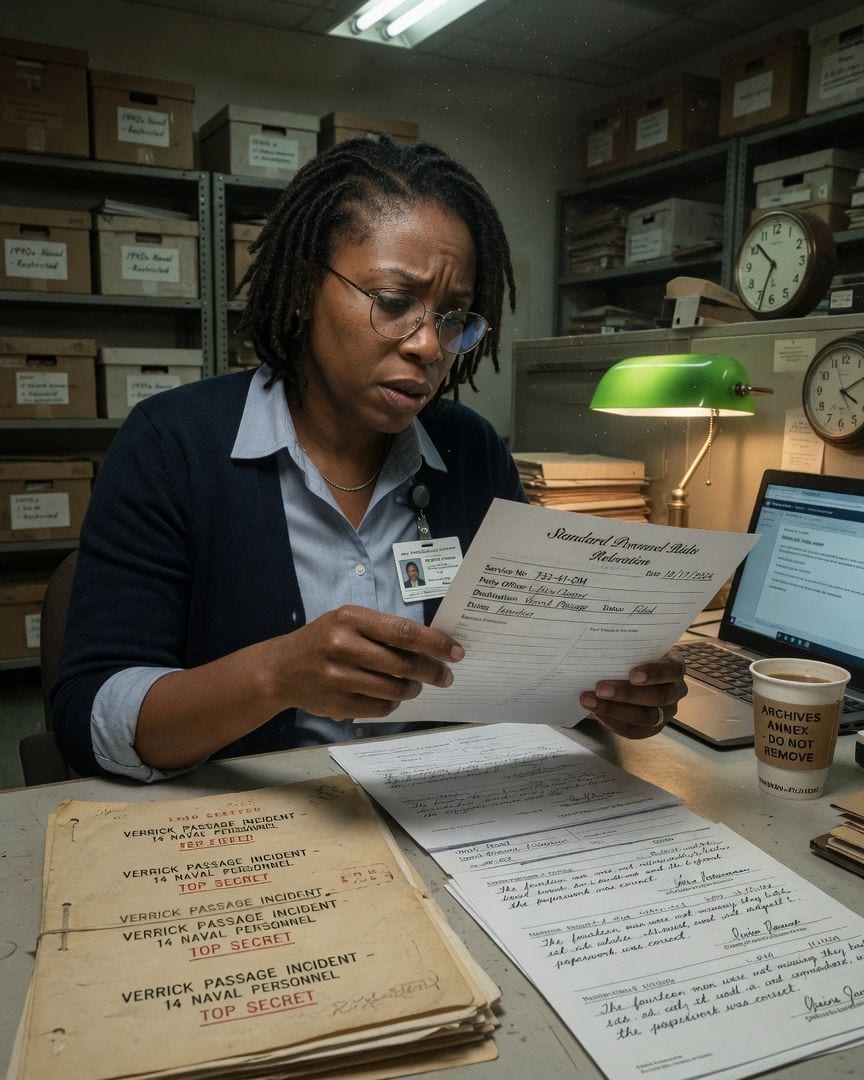
A declassification reviewer finds a form dated yesterday, listing a living sailor for relocation to an eighty-year-old passage, in the same impossible handwriting.
Declassification reviewer Ione Fash worked against a looming deadline, her final hurdle a stack of heavily redacted Verrick Passage files. Inside reports from 1944 detailing fourteen missing naval personnel, she found nine witness statements all containing the exact same phrase, penned in an identical, machine-like hand. Her methodical mind flagged the impossible anomaly, but true dread landed when she uncovered a standard requisition form. Dated yesterday, it listed a living, active-duty Petty Officer for 'Relocation' to the Verrick Passage, bearing that same chilling, impossible handwriting.
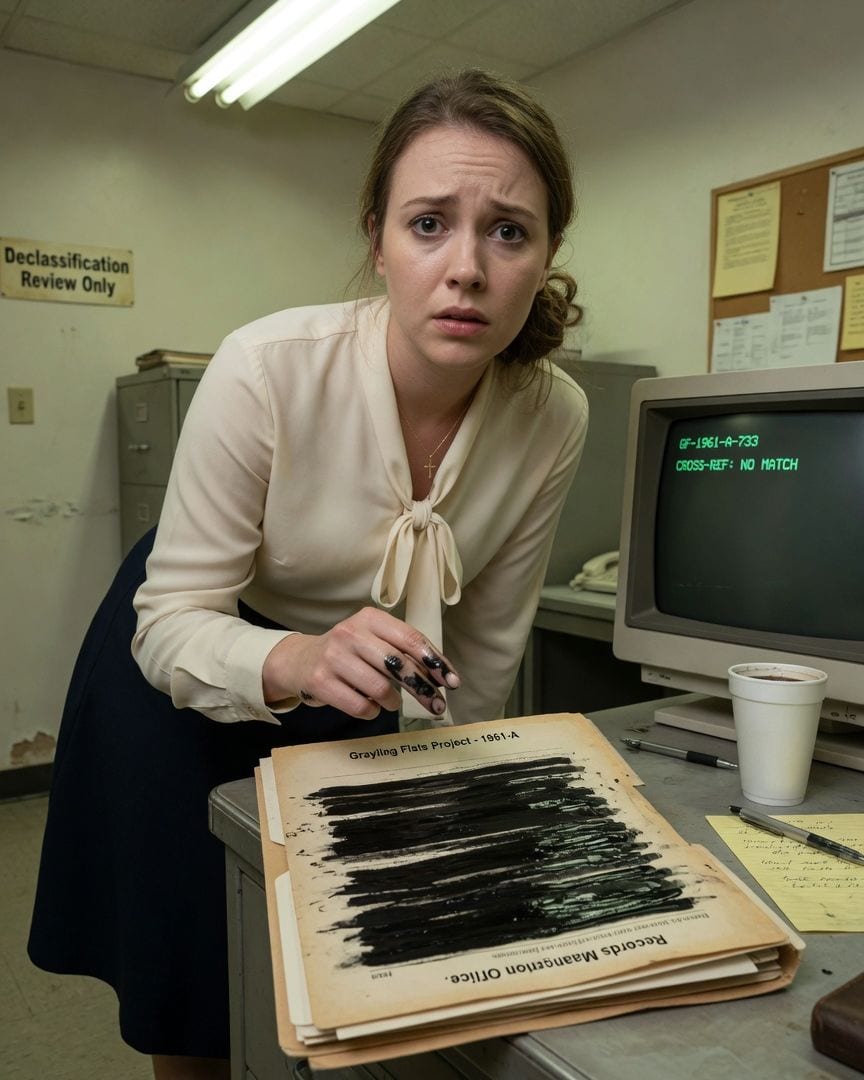
A new records clerk opens old Cold War files. The redaction ink is impossibly wet-black and glossy, thirty years too young for the page.
Ruth Odalen, a new records clerk, began her first assignment in a sterile 1986 declassification office. Tasked with reviewing 'water-damaged' Cold War files, she found the manila folders perfectly dry, but a deeper anomaly waited inside. On one decades-old page, redaction ink gleamed impossibly wet-black and glossy, leaving a cold smear on her fingertip. It looked freshly applied, an impossible detail that seemed to know her, naming the very office she'd left that morning.
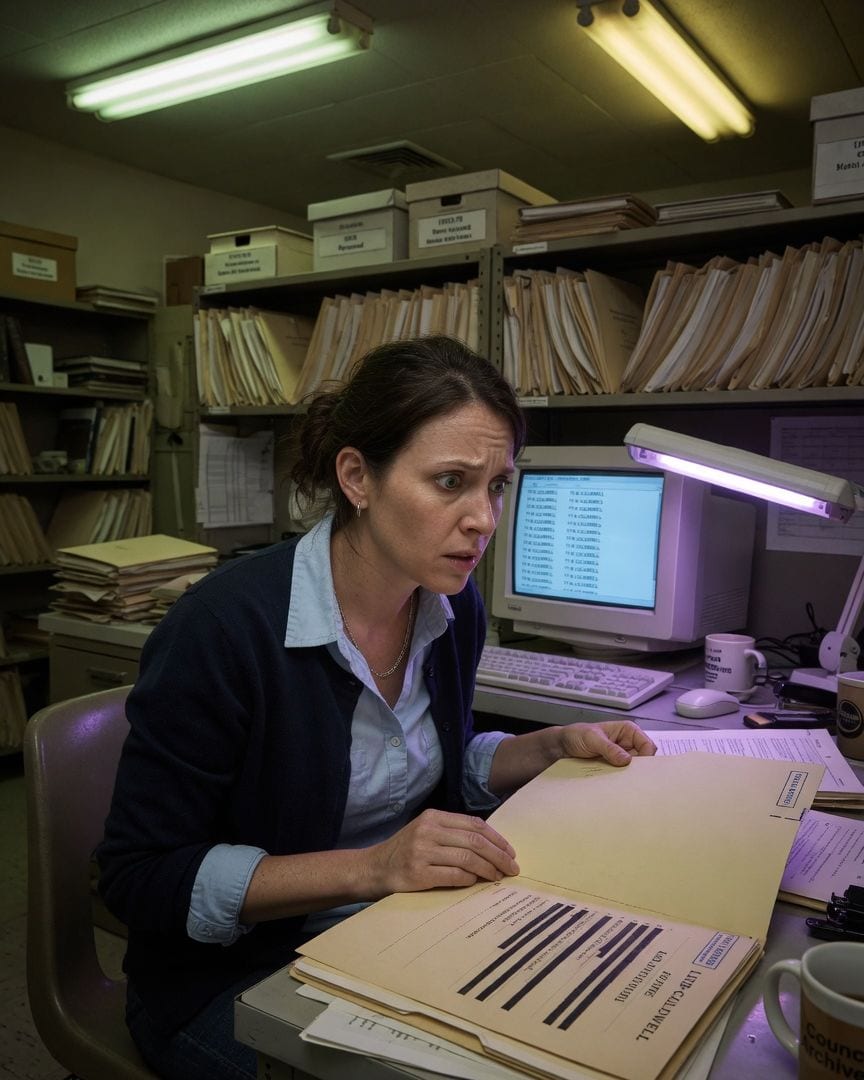
My employer's security file holds a vetting report on me dated nine years before I ever applied. It has my full name and my parents' address — with only one line, the source who referred me, blacked out.
Working a routine data audit, I pull my own security file. The issue date is nine years before I even applied for the job. Then, hidden within an old archive file, I find my current address etched under a blacked-out line.
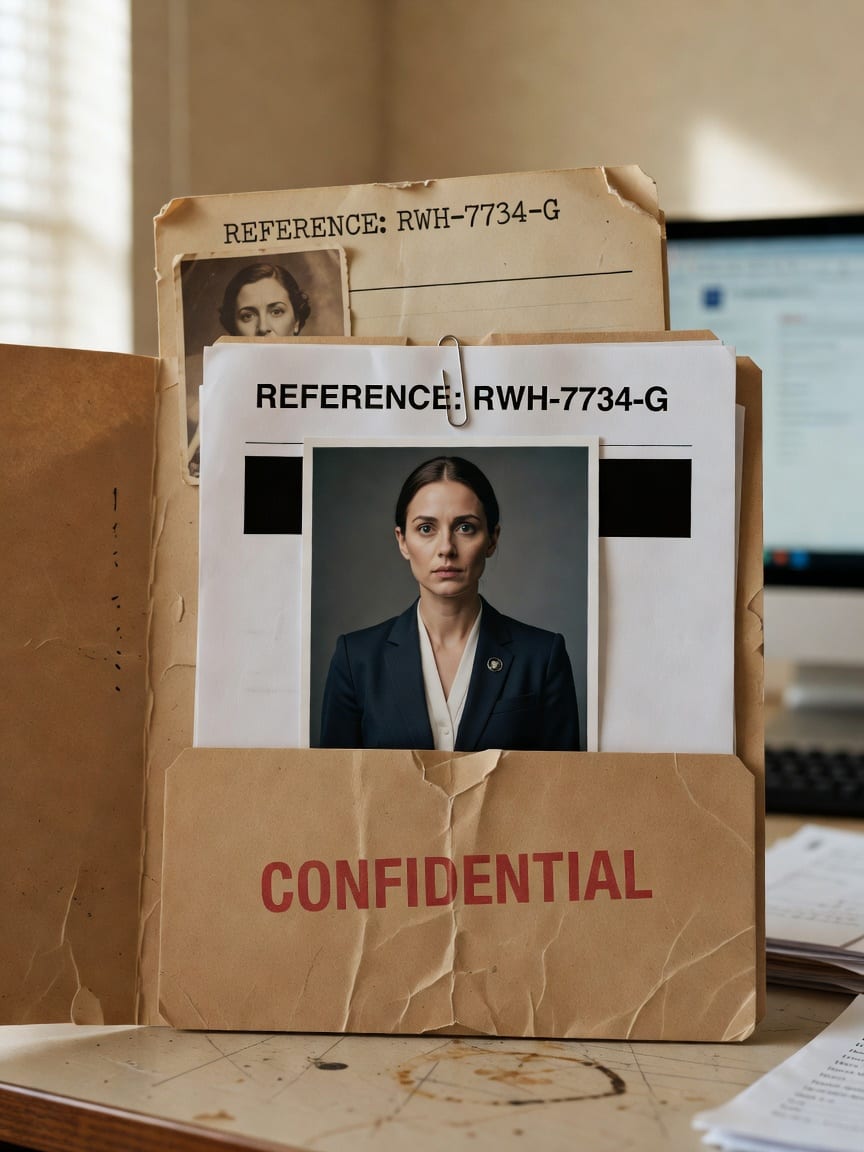
My security file was opened nine years before I was born. Its note said: 'subject not to be briefed'.
Auditing company digital records was routine until I pulled up my own personnel file. It clearly showed a 'Date Opened' nine years before I was born, yet bore my exact name and reference number. Below, an assessor's note from that impossible year mentioned a 'previous holder' and ordered the 'subject not to be briefed,' sparking a cold thrum in my chest.
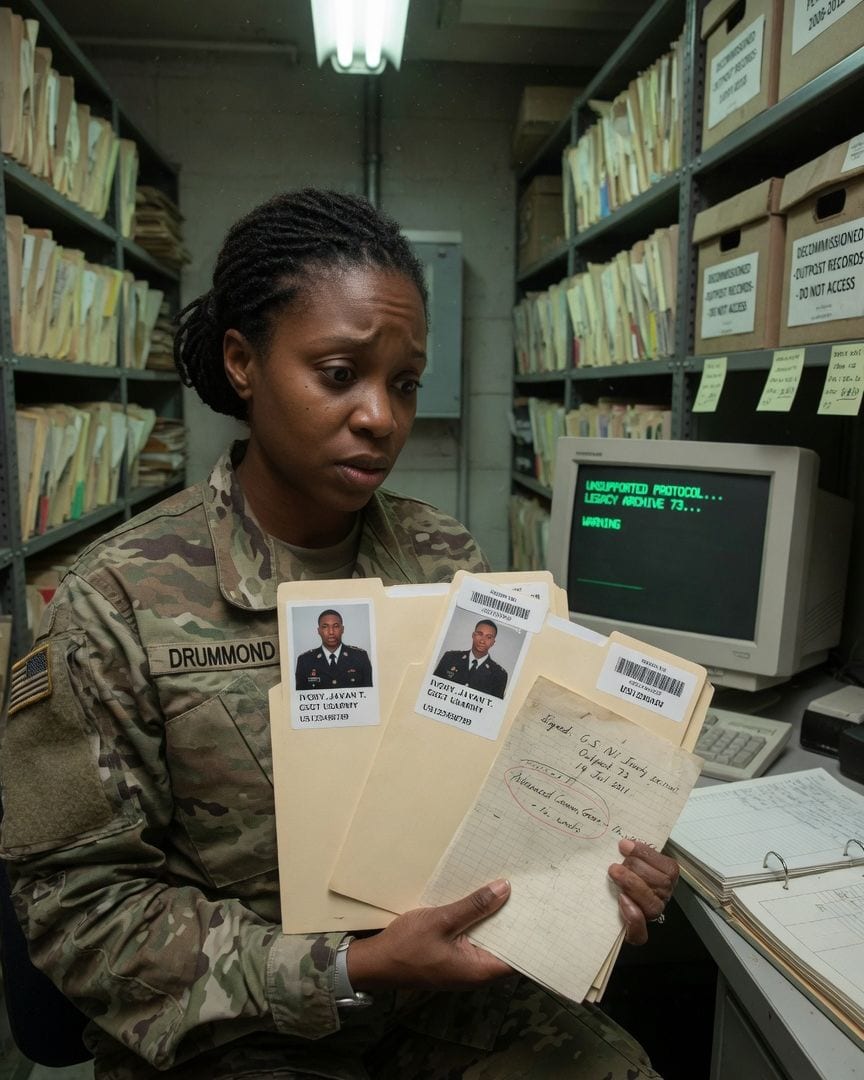
A records NCO found two files for one soldier; the second had his face, older, on a tour to a base that never existed.
Sergeant Camille Drummond, a meticulous records NCO, was deep in the US Army archives, methodically auditing personnel files. Her routine task was interrupted when she found a second, thicker folder tucked behind Gunnery Sergeant Javan Ivory’s official record, bearing identical service numbers. This duplicate file, however, detailed combat tours he never held, awards under a name one letter off, and showed an older, weary version of his face. As the cold dread bloomed, she discovered a physical supply requisition from a decommissioned outpost, signed 'N. Ivory,' matching the phantom tour. How could a ghost in the system leave such a real, handwritten trace?
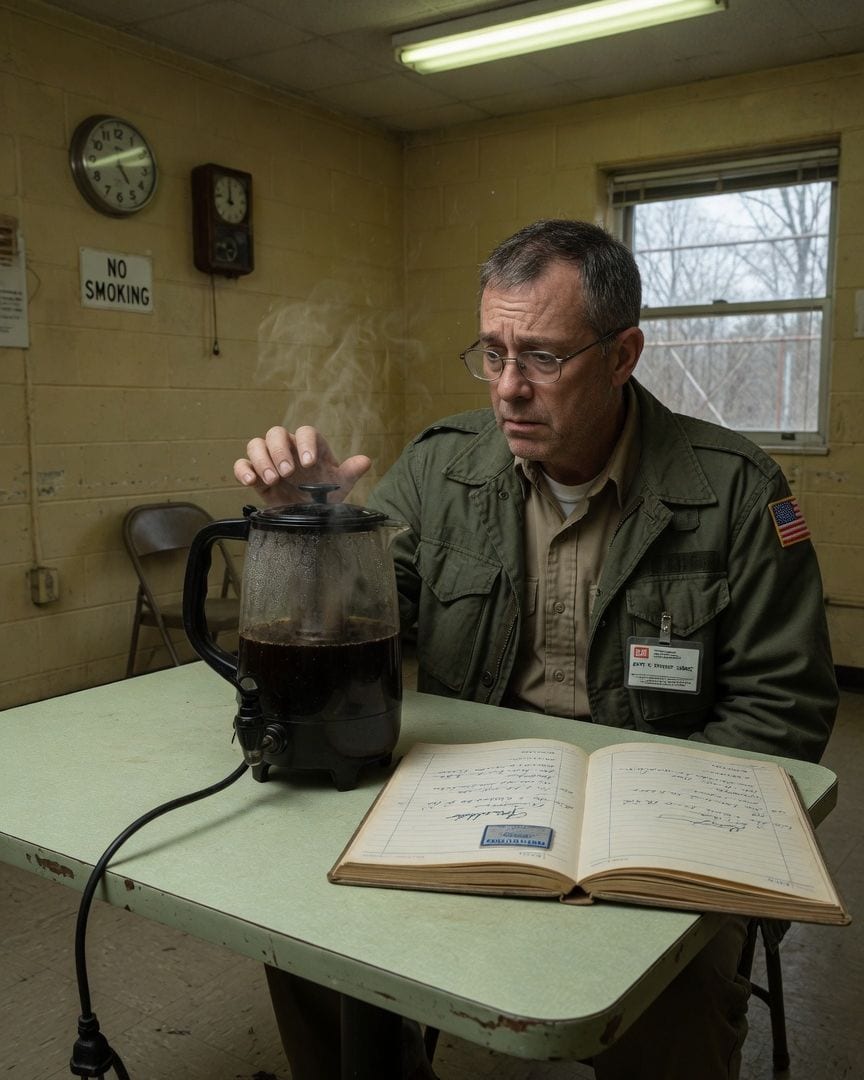
A methodical US Army engineer found a Cold War facility's file stamped 'DECLASSIFY NEVER' — and half its pages were missing.
Captain Nolan Threep, a methodical US Army engineer, expected another routine decommissioning at Alert Facility Twelve in rural Montana. The chains on the doors had rusted solid since 1970, promising a long-dead site. Yet, inside, a faint warmth hung in the air, and a glass coffee urn sat half-full, a wisp of steam rising lazily from its dark surface. The urn, warm to the touch, was clearly unplugged, and the duty log beside it, signed for a shift ending nineteen years prior, looked as though it had been signed yesterday. What secret could a supposedly abandoned Cold War facility hold?