A researcher's permit is almost gone. She finds a Cold War archive box listing 187 pages, but 173 were surgically cut out.
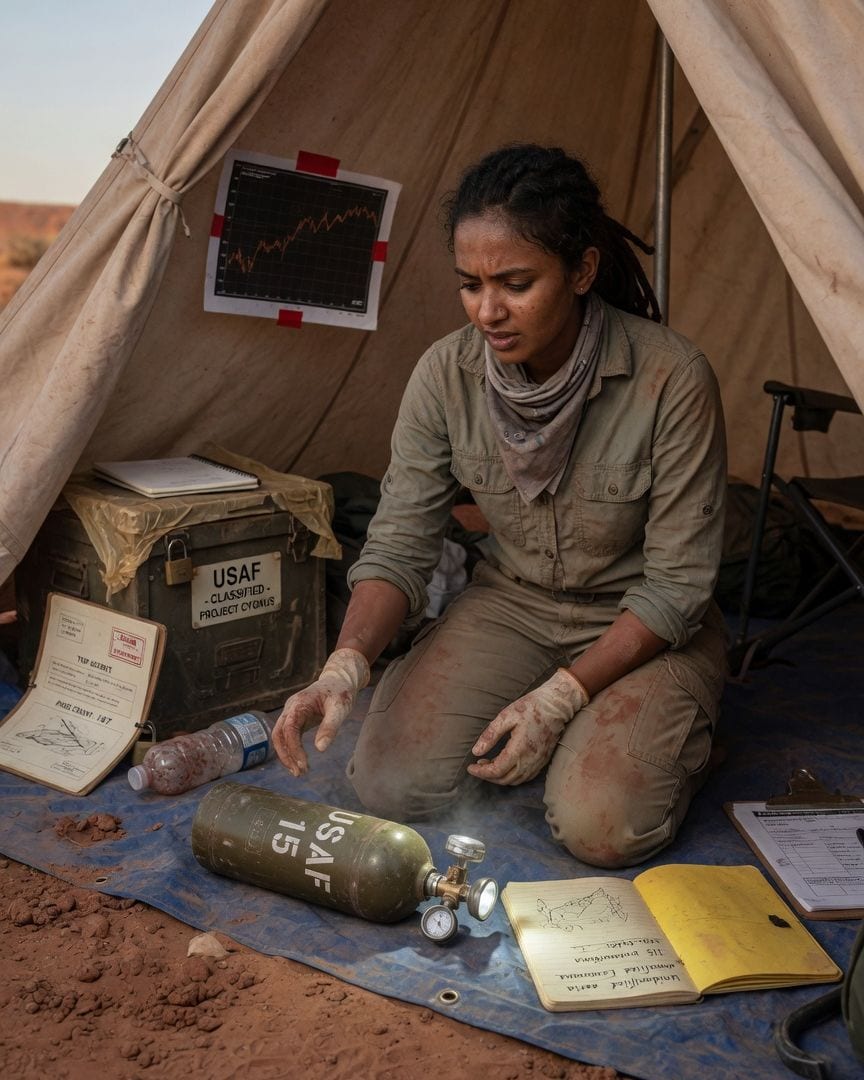
Priya Raval, 38, knelt in the reddish Utah mud. The insistent hiss of the oxygen bottle was a counterpoint to the desert silence.
It was a standard issue, olive-drab tank, its paint scratched and faded, but the pressure gauge still read a staggering fifteen hundred pounds. Eighty years. She looked at it again, a line forming between her brows.
The valve seat should have been brittle dust after that long, not holding pressure like a new seal. Her mind went back to the Air Force site file she’d studied, a thin, declassified stack of papers in her backpack.
It stated unequivocally that this ground had been surveyed and cleared in 1948—nothing recovered, nothing buried, disposition closed. But the bottle, clearly from that era, defied the record.
She’d already made a worrying entry in her field notes, scrawled in the careful, precise hand of a woman who needed her license: "unidentified aerial phenomena."
The bottle sat not on the surface, but in a cavity that men with a grader had deliberately backfilled, its presence a stark, glaring contradiction to every official record.
The hiss, faint but steady, vibrated through the dry air, feeling less like a leak and more like a slow, deliberate breath. It was wrong. Everything about it was wrong.
Priya spent the next two days meticulously excavating the cavity around the bottle. The sun beat down, turning the red dust to a fine powder that clung to her clothes and skin.
Her permit, ticking down its final nine days, was a constant pressure, a deadline looming over every shovel full of dirt. The site, earmarked for a new transmission corridor, would be lost to progress soon.
The official story of 'cleared ground' continued to unravel as her team uncovered not just the bottle, but a series of deeply buried, reinforced concrete conduits, leading away into the bedrock.
These were not the flimsy, temporary foundations of a 1940s survey camp. They were permanent, built to last, meant to protect or contain something significant. Priya traced their path, a cold sense of unease growing in her gut.
Following the conduits, her ground-penetrating radar picked up a significant anomaly: a large, regular structure, too deep to be natural, too precise to be random. It felt like a buried vault, a forgotten chamber humming beneath the earth.
Carefully, she directed the backhoe operator, Samuel Calloway, 62, a grizzled local with sun-weathered skin, to open a trench along the strongest signal.
The heavy bucket eventually scraped against something metallic, a sound that grated on Priya’s nerves, unlike the usual thud of rock or soil. What emerged from the red earth was not another rock, nor some forgotten piece of farm equipment.
It was a military-issue archive box, heavily corroded but still sealed, unlike anything listed in the official site inventory. It was too small to contain a body, too robust for a time capsule, too deliberate to be accidental.
It was a record, waiting to be opened, and its very existence contradicted the Air Force’s assurance that nothing had been buried here. The box pulsed with a silent accusation.
Priya’s hands trembled slightly as she wiped the thick mud from the archive box. The faint stenciled markings became visible: 'USAF - CLASSIFIED - PROJECT CYGNUS'. A cold shiver ran down her spine at the designation.
The padlock was rusted solid, its metal practically fused, but a small, careful pry with a crowbar snapped it with a sudden, echoing crack. Inside, protected by layers of heavy-duty, brittle plastic, was a stack of documents.
She pulled them out, the plastic rustling faintly in the still air. The topmost was a cover sheet, stiff with age, bearing a bold 'TOP SECRET' stamp. Beneath the header, it clearly stated: 'PAGE COUNT: 187'. Priya’s brow furrowed.
That was a substantial document. But as she carefully lifted the cover page, the document beneath it felt impossibly thin, ending abruptly after only fourteen pages. She flipped back, then forward, disbelieving.
The remaining binding, a clean, almost surgical cut, showed where the other 173 pages had been excised with terrifying precision, leaving only the ghost of their attachment, faint indentations in the paper.
The control number beneath the page count was a series of zeros and a single letter 'X', a sequence that traced to no known originating office in any declassified index she possessed.
Her heart hammered against her ribs, the desert wind suddenly seeming to whisper a warning.
The excised document, or what was left of it, became Priya’s obsession. The next day, ignoring the ticking clock on her permit, she tried to trace the 'PROJECT CYGNUS' designation through official channels.
Each inquiry led to dead ends, vague responses, or, more chillingly, records that simply didn't exist for that project number. The administrative labyrinth felt deliberately constructed, a maze without a center.
Frustrated, Priya remembered an old contact: Charles Merritt, 78, a retired Air Force records clerk who used to lecture at her university on the eccentricities of Cold War declassification. He was methodical, almost obsessive about the integrity of the archive.
Priya drove three hours to his quiet home in rural Nevada, a place crammed with filing cabinets, towering stacks of books, and the unmistakable smell of old paper and dust.
Merritt, sharp-eyed behind thick glasses, listened patiently to her story of the oxygen bottle and the redacted document. He nodded slowly, his gaze distant. 'Project Cygnus,' he mused, tapping a finger on a dusty, leather-bound ledger open on his desk.
'That designation… it comes up sometimes. Not in the public records. Not in the classified ones, either. It’s a phantom.' He stood and moved to a metal cabinet, its drawers groaning as he pulled one open.
He pulled out a box of microfiches, old and brittle, handling them with the reverence of an antiquarian. 'I’ve seen files like yours before. Files that refer to more pages than they contain.
Or redactions that don't just hide information, but seem to… outline it.' He threaded a microfiche into an ancient reader, its lamp flickering to life with a soft hum.
On the screen, a faded document appeared, marked 'OBSERVATION LOG - SITE GAMMA-7'. A section was blacked out, but the redaction wasn't a standard rectangle. It was an irregular, almost organic shape, clearly delineating something with a distinct, non-human form.
Priya leaned closer, her breath catching. 'The Redaction That Has a Shape,' Merritt whispered, his voice thin but clear. 'The pattern across decades and classifications.
They don't just hide what they know; they outline it for those who are meant to see.' The air in the cluttered room seemed to grow cold.
Priya returned to her Utah dig site to find a new, official-looking SUV parked discreetly a quarter-mile down the access road, a dark, silent sentinel in the bright desert morning.
As she exited her vehicle, a man in a dark suit, Donald Ashford, 52, emerged from the SUV and approached her. He moved with an unnerving smoothness.
He introduced himself as a 'liaison from the Department of Interior, regarding your permit renewal.' His tone was calm, almost unnervingly polite, a smooth veneer over something hard.
He spoke of 'minor administrative irregularities' in her application, a sudden, unexpected review of her field methodologies. The implication was clear: her digging was noticed, and it was unwelcome.
Priya felt a cold knot tighten in her stomach, a familiar archaeological permit dispute taking on a far more sinister edge.
That night, back at her rented cabin, she found a small, magnetic GPS tracker stuck to the underside of her field vehicle’s chassis. She ran her fingers over the smooth, cold metal.
It was sophisticated, military-grade, not something a disgruntled local would use. Someone had been under her vehicle. The next morning, Ashford called her, his voice still smooth, almost conversational.
'Dr. Raval,' he said, without preamble, 'I understand you had a pleasant chat with Mr. Merritt yesterday? We value his contributions, but his memory isn't what it used to be.'
The line went dead with a soft click, leaving an echoing silence in the cabin. The threat wasn't overt, but it was absolute.
She was no longer just an archaeologist; she was an object of scrutiny, her pursuit of the truth turning into a hunt where she was the prey. The walls of the cabin felt like they were closing in.
Priya called Merritt, her voice tight with urgency, the phone clammy in her hand. He sounded unfazed, almost resigned. 'They've been watching me for years, dear. Comes with the territory when you collect their phantoms.'
He didn't ask how she knew. He simply directed her to a specific, obscure archival index, a cross-reference for 'special projects' that he'd found decades ago, hidden in plain sight.
It wasn't declassified, he explained, just overlooked, a forgotten corner of the digital labyrinth. 'There's a reason they don't want Project Cygnus found,' he said, his voice dropping slightly. 'It’s tied to Site Gamma-7. The Utah site.'
Priya spent a frantic night, hunched over a public library computer, the fluorescent hum overhead her only company. She circumvented firewalls, followed Merritt’s cryptic instructions, and sifted through decades of fragmented, oblique data.
Her fingers flew across the keyboard, driven by a desperate certainty. Then, she found it: a single, heavily redacted memo, dated 1951, referencing 'post-recovery containment protocols' for 'unidentified atmospheric ingress' at 'Site Gamma-7 (Utah)'.
The language was clinical, dispassionate, but the implication hit her like a physical blow. The 'unidentified aerial phenomena' in her field notes weren't just a sighting. Something had come down. Something had been recovered.
The oxygen bottle, still charged to fifteen hundred pounds, wasn't for men working on a temporary survey; it was for those working on the recovered anomaly, deep underground, breathing recycled air.
The 'cleared' status of the site in 1948 wasn't an oversight or a mistake; it was a carefully constructed lie, designed to erase the very existence of a massive, ongoing containment effort.
The reinforced concrete conduits she'd found, leading away into the bedrock, weren't abandoned; they were part of a hidden, active infrastructure, a network of tunnels and chambers.
The Redaction That Has a Shape, the irregular, organic outline Merritt had shown her on the microfiche, now pulsed in her mind, a clear, horrifying outline of an alien form.
It all clicked into place with terrifying coherence: the institution had known since 1948, filed it away, and built a permanent, secret world around it, right under the nose of the public.
The file wasn't just a record of a past event; it was a blueprint for an ongoing reality. The hum of the library lights seemed to intensify, pressing in on her.
Merritt, sensing her imminent danger, didn't wait for Priya to call back. An email arrived late that night, a scanned attachment. It was another document he’d kept hidden for years, a 'contingency plan' for Project Cygnus.
The subject line was chilling: 'Eyes Only'. It was an internal memo, dated 1972, discussing 'monitoring protocols for individuals with inherent proclivity towards Site Gamma-7 signatures.'
The language was dense, coded, filled with scientific jargon she didn't fully understand, but as Priya scrolled, her breath caught in her throat.
There, listed under 'Known Subjects - High Probability', was a block of text, heavily redacted with the signature black bars she now recognized.
But one name, partially obscured by a faint smudge, was just legible beneath the thin paper, the pixels struggling to convey the original's faded ink. It was her own. 'Raval, P.' And next to it, a date: 1948.
Priya stared at the document, her own name staring back at her, blacked out but unmistakable beneath the thin paper. 'Raval, P.' followed by a date from 1948.
Below it, a single, unredacted line read: 'Subject's familial lineage indicates high probability of re-engagement with Site Gamma-7 at critical junctures.' A date before her parents were even born. Her hands trembled, the screen blurring.
The document wasn't just about the site. It was about her. It implied she was a known quantity, somehow tied to the site's secrets from birth, or even before.
The institution hadn't just buried a record; they had buried a future, and she was already named in it. The blood drained from her face as she realized her discovery was never accidental; it was a foregone conclusion.
Priya called Merritt again, the phone clutched tight, her voice barely a whisper. 'My name,' she said, 'it’s in the file. From 1948.' Merritt’s voice was grave, a quiet confirmation of her deepest fear. 'I suspected as much, dear.
Your grandfather, Harold Raval, was part of the original geological survey team in '48. He reported anomalous energy signatures, dismissed as equipment malfunction. He disappeared a month later, officially a hiking accident.'
Priya felt a profound chill run down her spine. The 'Inherited Proclivity' wasn't just a theory; it was a bloodline.
The file, Merritt explained, detailed how certain individuals, often descendants of those initially exposed, exhibited a heightened sensitivity to the entity contained at Site Gamma-7.
They weren't looking for 'UFOs' in the sky anymore; they were looking for people who would find it.
The blacked-out diagrams Merritt had shown her were not just schematics of the entity, but also outlines of its influence, its 'signature' on the landscape and, chillingly, on specific individuals.
The oxygen bottle, the backfilled cavity, the fake 'cleared' status—all were part of an elaborate, decades-long institutional deception to maintain a living, breathing secret.
The pattern across decades and classifications wasn't just a coincidence; it was a deliberate, intergenerational surveillance program. Her permit expiring, the transmission corridor, the 'administrative irregularities'—it was all designed to contain her, just as they contained the entity itself.
The institution’s own record, finally obtained, stated it plainly in black and white: they had known for eighty years, and they had been planning for her.
The next morning, Donald Ashford was waiting for Priya at her cabin, a dark, immaculately dressed figure in the dusty light of dawn. He sat across from her at the small kitchen table, a manila folder resting on his lap.
The air in the cabin felt thin, charged. 'Dr. Raval,' he began, his voice calm, devoid of inflection, 'your permit is officially revoked. All your field notes, all your findings, are now classified property of the Department of Defense.
The site will be permanently sealed, designated a national security exclusion zone.' He opened the folder. Inside were official documents detailing her immediate dismissal from all government contracts, a permanent blacklisting in her chosen field.
Priya stared at the papers, her career dissolving before her eyes. 'You have two options,' Ashford continued, his eyes unwavering, almost pitying. 'You can accept this, walk away, and find a new career. Or, you can choose to cooperate.
Your unique… sensitivity… could be invaluable to Project Cygnus. A secure position, full benefits, a lifetime of research.' Priya felt the crushing weight of it, the absolute, undeniable power of the institution.
She knew she couldn't 'cooperate' with such a deception, couldn't become part of the lie that had swallowed her grandfather. 'I can't,' she said, her voice shaking but firm. 'People need to know.'
Ashford sighed, a faint, almost regretful sound, like air escaping a punctured tire. 'Then you leave us no choice.' He stood, retrieved the GPS tracker from her vehicle, which she had replaced, and placed it on the table.
'This was for your protection. Now, it's just a reminder.' Priya knew her attempts to leak the information would be futile; they would be intercepted, dismissed, or buried. The institution had already won.
As Ashford turned to leave, Priya grabbed her phone, her fingers flying across the screen, composing a final, desperate message, attaching a single photograph of the redacted file with her name, hoping it would find its way to someone, anyone, who might believe.
Priya Raval’s archaeological license was suspended indefinitely. Her academic reputation evaporated under a cloud of 'unprofessional conduct' and 'unsubstantiated claims.' The Utah dig site was indeed sealed, a new, imposing fence erected around its perimeter, patrolled by unmarked vehicles.
Her attempts to publish her findings or leak the redacted file were systematically blocked, her emails flagged, her anonymous submissions dismissed as hoaxes.
She found herself unemployable in her chosen field, taking a quiet, administrative job in a small town library, cataloging local history that rarely extended beyond the last fifty years.
The oxygen bottle, the archive box, the Redaction That Has a Shape—all became ghosts in her memory, impossible to prove, impossible to forget. The institution had moved on, its secrets intact, its mechanisms of control invisible but absolute.
Months later, a small, unmarked package arrived at the library for Priya. Inside, nestled among packing peanuts, was a single sheet of paper.
It was a photocopy of one of her own field notes, the page where she had first tentatively sketched the 'unidentified aerial phenomena.'
But now, superimposed over her faint pencil drawing, was a new redaction, stark and black, perfectly matching the organic, non-human shape she had seen on Merritt’s microfiche.
It was a precise, chilling outline, a signature that proved they were still watching, still filing. They always knew. They always would.
A week later, Priya Raval's library colleagues noted her quiet, almost serene demeanor. She would sometimes pause, looking out the window at nothing in particular, a faint, knowing smile playing on her lips.
One evening, her supervisor, Grace Merritt, 45, asked her, 'Everything alright, Priya? You seem miles away.' Priya turned, her eyes distant, and replied, 'Just cataloging. The file is still being signed.'
If this one got to you
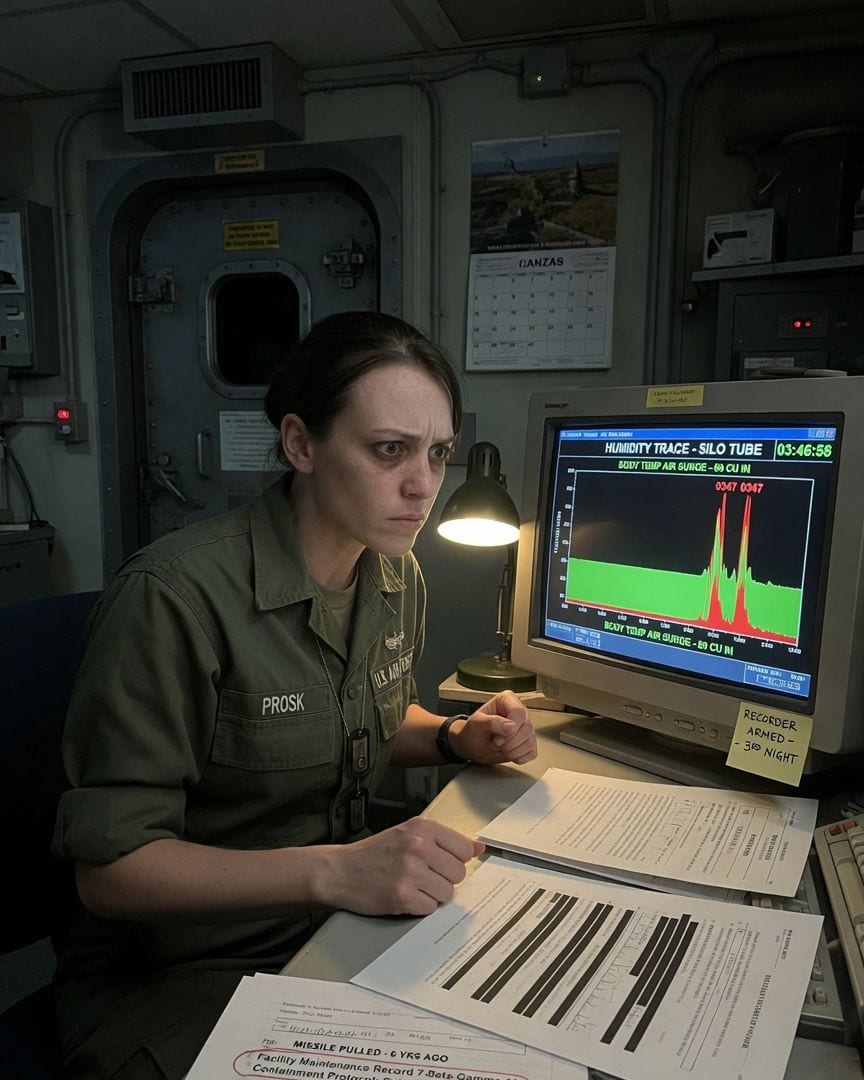
An airman's last weeks before transfer: the empty Cold War missile silo took a warm breath.
Airman Gale Prosk was counting down her final weeks at the silo, eager for her transfer from the isolated Kansas prairie. In the dim control room, the low hum of the ventilation was a constant companion. For years, the environmental monitor for the empty missile tube below had shown a flatline, until three nights ago. A sudden, jagged spike appeared, a surge of air registering at body temperature. She dismissed it as a glitch, but then it happened again. She descended into the vast, echoing chamber where the missile had once stood, finding only cold, polished steel. Back in the control room, redacted declassification files spoke of "biological integrity checks" for the empty space, and Project THRESHOLD documents were missing eight crucial pages. The silence of the silo now hummed with an unseen weight.
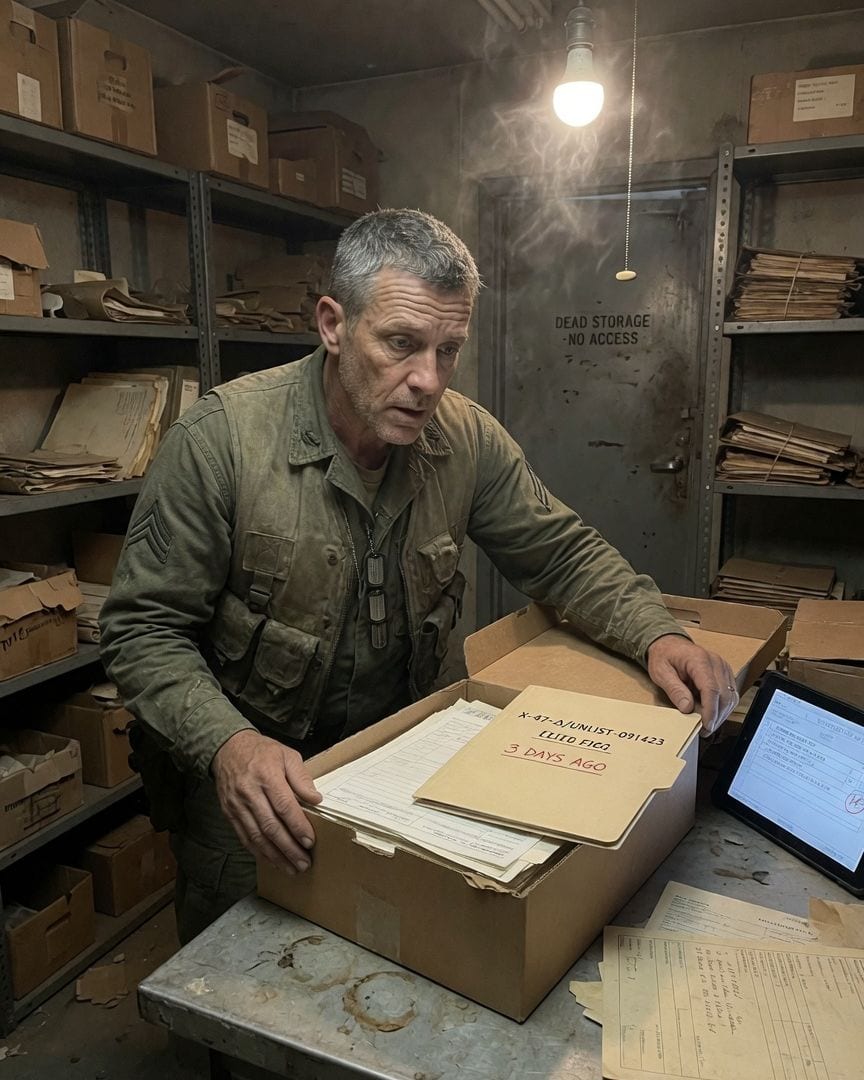
Sergeant Pryor, days from retirement, finds a four-hundred-foot crater. The desert floor is still warm, but no one remembers the blast.
Sergeant Alden Pryor, forty years old and just eleven days from retirement, drove the familiar Ranier Flats fence line for one of his final patrols. The desert stretched out, silent and vast, until he discovered a four-hundred-foot crater, dark and impossibly vast, where the sand had fused into slick glass. The ground within the crater was still faintly warm, a subtle heat defying the cool desert air. Yet, every official log confirmed the blast, while no one recalled a tremor or flash across three states.
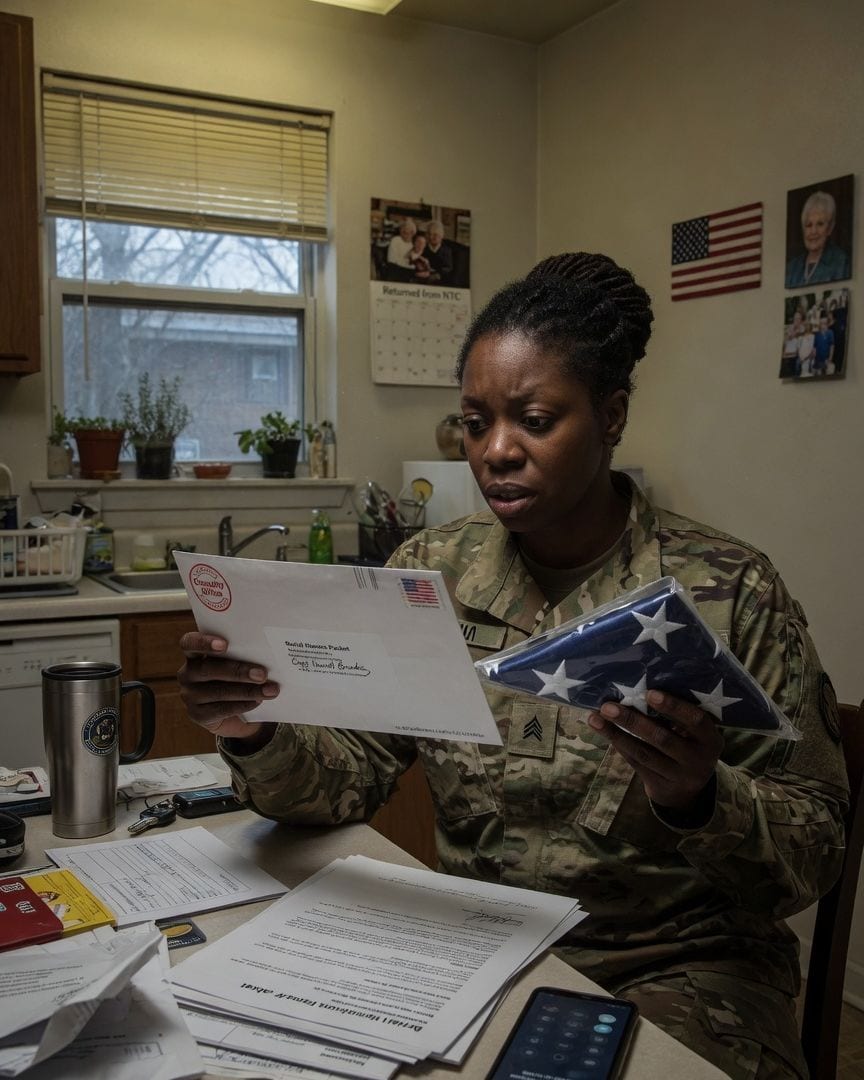
A Sergeant finds her own complete burial packet, dated for the coming spring, then finds a stack of identical ones for others.
Sergeant First Class Bree Alcott returned from a grueling training exercise, looking forward to peace, but found her kitchen table piled with mail, one official package heavy with dread. Inside was her own complete burial-honors packet, every detail filled, from Arlington plot to her grandmother’s chosen hymn, all dated for a specific day in the coming spring. The casualty office dismissed it as a 'glitch,' but Bree found a cryptic code leading to a decommissioned desert station and a stack of identical packets for other soldiers. What meticulous hand had prepared these packets, and why was Bree Alcott’s name on a list for a future she shouldn't have known?
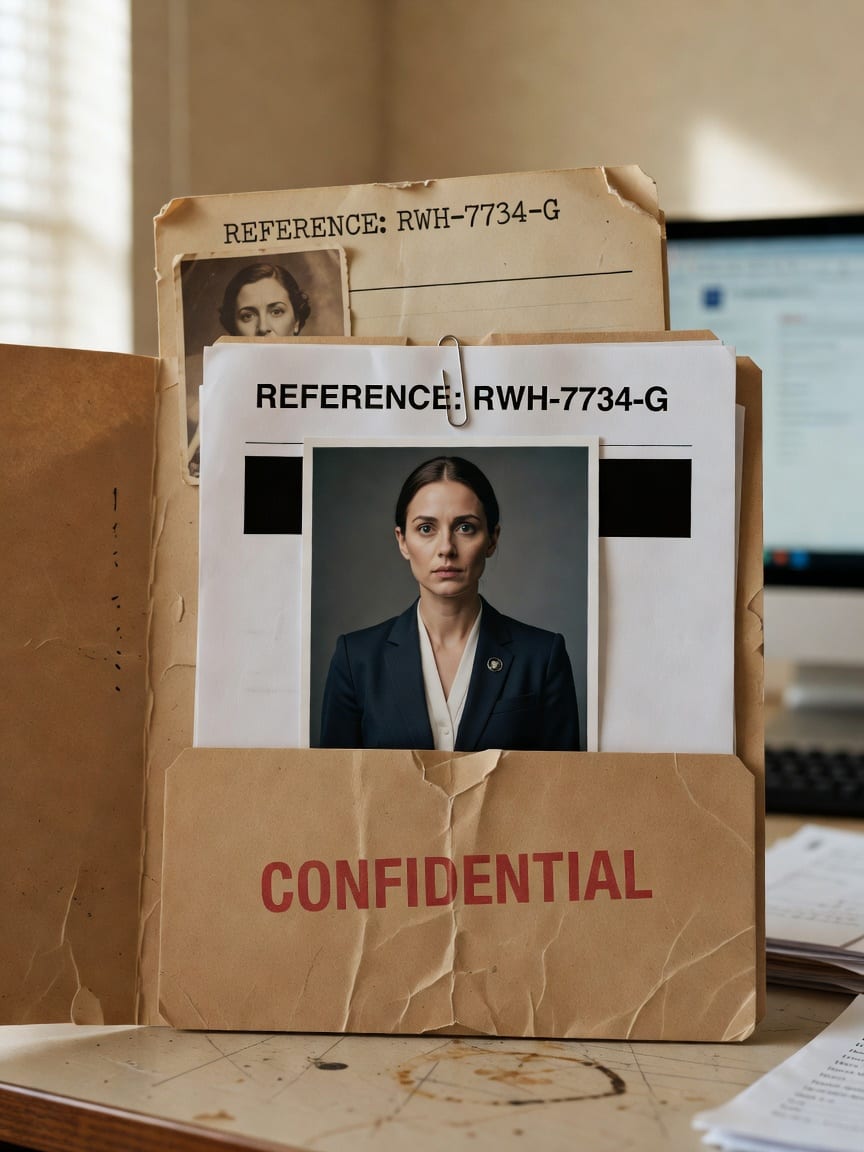
My security file was opened nine years before I was born. Its note said: 'subject not to be briefed'.
Auditing company digital records was routine until I pulled up my own personnel file. It clearly showed a 'Date Opened' nine years before I was born, yet bore my exact name and reference number. Below, an assessor's note from that impossible year mentioned a 'previous holder' and ordered the 'subject not to be briefed,' sparking a cold thrum in my chest.
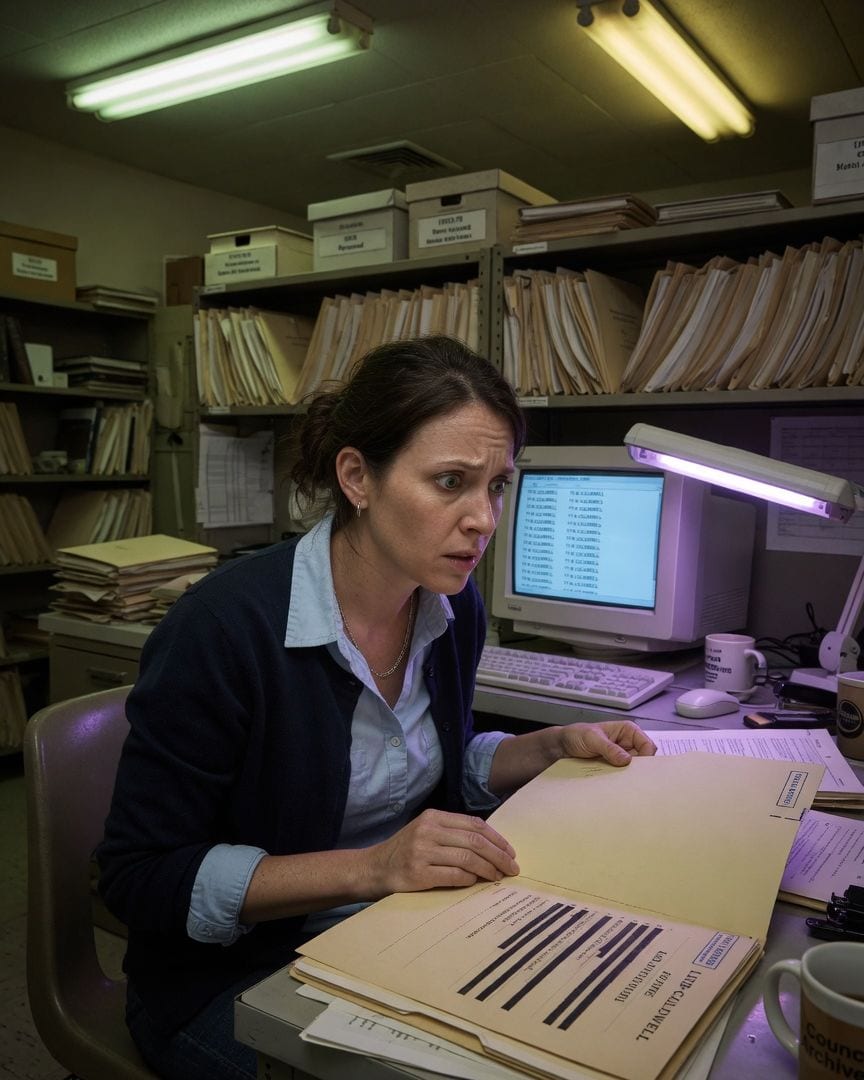
My employer's security file holds a vetting report on me dated nine years before I ever applied. It has my full name and my parents' address — with only one line, the source who referred me, blacked out.
Working a routine data audit, I pull my own security file. The issue date is nine years before I even applied for the job. Then, hidden within an old archive file, I find my current address etched under a blacked-out line.
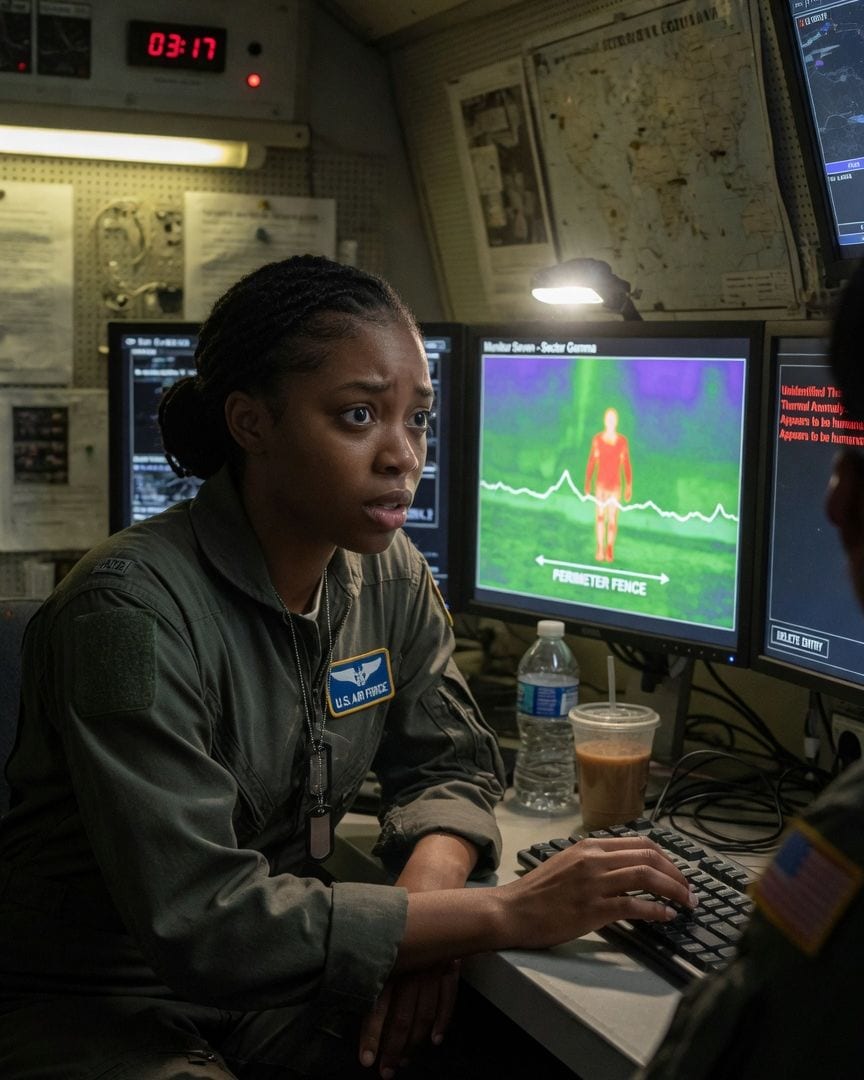
An airman’s thermal feed shows a figure moving in the restricted desert. Her captain orders it scrubbed, but the heat signature appears to tilt its head and look right at her.
Airman First Class Olivia Kade was new to her remote high-altitude outpost, fresh from advanced training, and the isolation pressed in, amplifying every hum. Her duty was to monitor the desert perimeter, but one shift, a faint thermal signature appeared on Monitor Seven: a solitary, upright figure moving with impossible precision beyond the barbed wire. No personnel were authorized in that sector. Her mission commander quickly ordered the anomaly scrubbed, but as it dissolved, the featureless outline seemed to tilt its head, looking directly into the camera. Now, the signature returns night after night, forcing the airman to wonder what impossible thing patrols the dark beyond the wire.