An airman's last weeks before transfer: the empty Cold War missile silo took a warm breath.
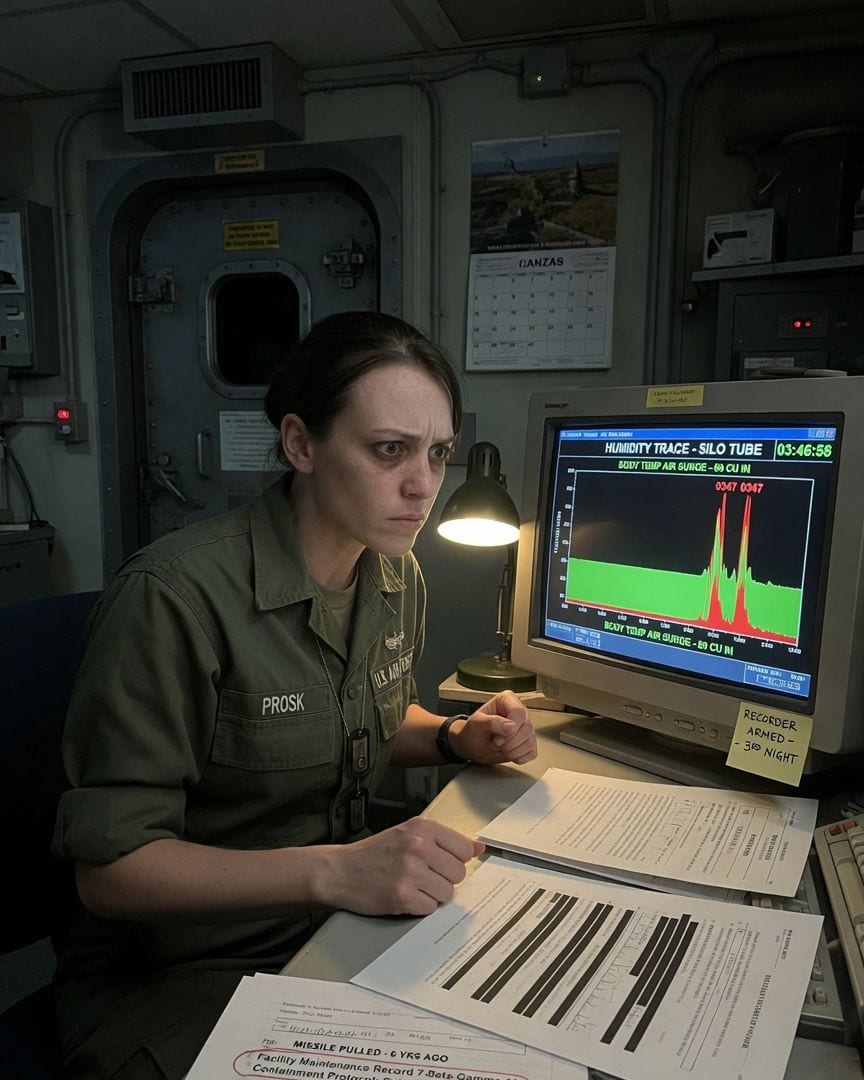
Airman Gale Prosk sat hunched in the dim glow of the silo control room, the low hum of the ventilation system a familiar lullaby.
Weeks left until her transfer, and the Kansas prairie stretching beyond the reinforced hatch felt closer than ever. Her gaze drifted to the environmental monitor, specifically the humidity trace.
For eleven months, it had been a flatline, a testament to the sealed, inert emptiness of the steel tube below. For six years, according to the logs, it had been flat.
But three nights ago, at precisely 0347, a jagged spike had appeared, a sudden surge of ninety cubic inches of air, registering at body temperature. She’d rigged a recorder, double-checked the sensors, and dismissed it as a glitch.
Then it happened again, last night. She watched the screen now, the digital clock ticking past 0346. The silence of the room seemed to deepen, pressing in around her as the seconds bled away.
The line twitched, then spiked, a perfect, unmistakable exhalation. It happened again, a second spike overlapping the first, a whisper of warm air in a place designed for cold, silent oblivion.
Gale spent the next day methodically eliminating every mundane explanation. She checked the silo's primary seals, the secondary hatches, the sump pump, the atmospheric scrubbers. All were tight, dry, and operational.
The heavy metal door to the access tunnel seemed to sigh as she unlatched it, a rush of cold, still air greeting her.
She descended into the vast, echoing chamber where the missile had once stood, her flashlight beam cutting through the profound darkness. The steel tube was undeniably empty, its interior polished and cold, reflecting her light like an obsidian mirror.
There was no leak, no malfunction she could identify. Back in the control room, the glow of the monitors offered a false sense of warmth.
She pulled up the official 'missile pulled' report from six years prior, a stack of digitized forms detailing the decommissioning. Everything looked standard: inventory lists, transfer manifests, disposal protocols.
But then she noticed a cross-referenced control number, buried in a footnote near the bottom of a deactivation order: 'Facility Maintenance Record 7-Beta-Gamma-11, Referencing Containment Protocol: Sub-Level Alpha.'
The latter phrase was unusual, almost militaristic in its precision, but utterly out of place for a simple missile removal. She traced the control number through the base's internal archive system. It led her to a heavily redacted declassification file.
Entire paragraphs were blacked out, solid blocks of black ink consuming entire sections, but the remaining text, fragmented and cryptic, spoke of 'atmospheric stabilization' and 'biological integrity checks' that made no sense for an empty tube.
The redactions themselves were odd, not just solid blocks, but sometimes leaving thin, irregular lines, like a distorted schematic of something unknown beneath the black. She felt a prickle of unease. This wasn't a glitch. This was deliberate.
The declassification file was tagged with a 'restricted access' flag, but Gale’s security clearance, ironically, still granted her viewing rights, likely an oversight for a silo considered decommissioned. She clicked it open.
The cover sheet, pristine and official, flared to life on the screen. It clearly stated: 'Project THRESHOLD: Site 7-Beta. Declassify: NEVER.' Below, it listed 'Document Pages: 20.' Gale scrolled through the digital file. Page 1: cover sheet.
Page 2: heavily redacted introduction. Page 3: more redactions, solid and unyielding. The silence in the control room seemed to deepen, amplifying the soft whir of the computer fans.
She kept scrolling, her heart thudding a slow, heavy rhythm against her ribs, each beat echoing the weight of the hidden. Page 10. Page 11. Page 12. And then, abruptly, the file ended. No more pages.
The system showed '20 pages' on the cover sheet for her silo's control number, but the secure viewer only displayed 12. The missing pages hummed with an unseen weight, their absence a louder statement than any blacked-out line.
The revelation of the missing pages gnawed at Gale. She couldn't shake the feeling that she had stumbled onto something far beyond a clerical error.
Over the next few days, she systematically reviewed every document she could access related to Site 7-Beta, cross-referencing keywords from the partial 'Project THRESHOLD' file. Her monitor screen glowed late into the night, casting long shadows across the control room.
She found more instances of the 'Redaction That Has a Shape' – specific dates, coordinates, and personnel roles blacked out in patterns that, when overlaid on old schematics, seemed to obscure sections of the silo’s deeper levels.
One such redaction, a long, vertical block, seemed to hide an entire sub-level access shaft that wasn't on any public blueprint she possessed.
She discovered vague references to 'atmospheric stabilization' and 'bio-integrity checks' in archived maintenance logs from decades past, long before the missile was 'pulled.'
These entries made no sense for a conventional missile silo, hinting at a different, biological purpose, something living.
She learned that Site 7-Beta had been offline, completely dormant, for nearly two decades before its sudden, unexplained reactivation a year and a half ago – just months before her own assignment.
The official reason cited 'national security interests,' a phrase that now felt hollow and insufficient.
The humidity trace, which had initially spiked only at 0347, now showed activity starting as early as 0200, and sometimes a fainter, secondary spike around 0500. The spikes were becoming more frequent, more insistent, like a slow, steady pulse quickening.
Whatever was below was waking up, or reacting to her presence. The silence of the silo, once comforting, now felt like a held breath, waiting.
Gale's unusual pattern of access requests didn't go unnoticed. A terse internal memo, its subject line stark and formal, landed in her inbox. Then came a call from Chief Montgomery.
His voice, usually gruff but paternal, was clipped, stripped of its usual warmth. 'Airman Prosk, I'm seeing some... interesting queries from your workstation. 'Project THRESHOLD'? 'Containment Protocol'? Are you chasing ghosts, Prosk?
I advise you to focus on your assigned duties.' He didn't sound angry, but rather subtly warning, a hint of something deeper, almost a plea, in his tone.
The sound of his voice seemed to press against the walls of the control room, shrinking the space around her.
'I’m just trying to understand the full history of this site, Chief,' Gale replied, trying to keep her voice steady, aware of the unspoken threat behind his words. 'Standard due diligence.' 'Right. Well, consider your diligence done.
Some files are best left alone.' Later that night, back in the silo, Gale found her workstation's search history had been wiped clean, not a trace of her recent investigations remaining.
The 'Project THRESHOLD' file she'd viewed was now tagged with an 'access denied for current user' flag, even though her clearance hadn't changed. A cold dread settled over her, chilling her to the bone. Someone knew.
Someone was watching her, tracking her every digital step. The isolation of the silo, once a source of quiet focus, now felt like a cage, every camera lens, every sensor, a watchful eye.
She felt a prickle on the back of her neck, a phantom touch, as if the vast, silent space around her had become suddenly crowded. She was no longer just investigating; she was being investigated.
Desperate for answers, Gale remembered a name she’d seen in a low-clearance document related to 'historical site management' for old ICBM facilities: Dr. Eleanor Bennett.
The document was an obscure memo from decades past, unredacted, perhaps deemed too mundane to conceal its contents. With a surge of adrenaline, Gale found an email address for a retired Eleanor Bennett, now listed as an academic researcher.
She sent a carefully worded message, referencing the specific control numbers and the phrase 'Containment Protocol: Sub-Level Alpha.' A reply came surprisingly fast, an invitation to a video call, a specific time listed for the next afternoon.
Eleanor Bennett appeared on screen, a woman in her late sixties with calm, intelligent eyes and a serene expression that unnerved Gale more than any anger.
The room around Eleanor was sparsely decorated, a wall of packed bookshelves behind her, each spine a testament to forgotten knowledge. 'Airman Prosk,' Eleanor began, her voice soft, yet clear, 'you’ve been digging in very old dirt.'
Gale laid out her findings, the humidity spikes, the missing pages, the redacted schematics that distorted what should have been straightforward blueprints. Eleanor listened patiently, occasionally nodding, her gaze unwavering.
'The 'missile pulled' was a necessary public record, dear,' Eleanor finally said, her voice betraying no emotion, as if discussing yesterday’s weather. 'But the real contents were never missiles. They were... deeper.
Below the primary launch tube, as your schematics might have hinted, if they weren't so thoroughly censored.' She explained that after Project THRESHOLD was 'declassified,' some sites were not fully closed, merely re-designated.
'The silos, you see, were never just launch sites. They were containment units. For very old things.' Gale felt a chill, a shiver running down her spine. 'The breath... the humidity trace?'
Eleanor smiled faintly, a sad, knowing curve of her lips. 'Respiration. They are ancient. And they are still there. The files are still being signed, Airman. The oversight is continuous.' The pieces clicked into place with horrifying coherence.
The 'biological integrity checks,' the 'atmospheric stabilization'—it all made a terrible, undeniable sense. The silo wasn't empty. It was full.
Gale struggled to process the enormity of Eleanor's revelation. The hum of her own control room felt different now, no longer a drone but a living sound. 'So, the military knew? They just... filed it away?' Eleanor nodded. 'For decades.
It’s a very patient kind of horror, isn't it? The kind that just waits, and records.' She then leaned closer to her webcam, her eyes thoughtful, narrowing slightly.
'The original Project THRESHOLD personnel, those who worked most closely with the sites, they had a specific profile. Certain... predispositions.' Eleanor then shared her screen, displaying an old, heavily watermarked PDF document.
It was a declassified, but still heavily redacted, personnel manifest from the Project THRESHOLD era. Columns of names, dates, and site designations, most blacked out in stark, impenetrable blocks.
The resolution was poor, blurry in places, but the text that remained was chillingly clear. Eleanor’s finger, slender and ringless, traced a line on the old Project THRESHOLD manifest displayed on her screen.
'Certain profiles, you see,' she murmured, her voice almost a whisper, before pausing, her finger still.
Gale leaned closer to her own screen, her breath catching in her throat as she saw it – a service number, almost identical to her own, listed under 'Designated Monitor: Site 7-Beta.' Her site. Her name.
Gale’s mind reeled. Her reflection stared back at her from the darkened monitor, her eyes wide with disbelief. 'My name? How could my name be there?' Eleanor, unperturbed, her serene expression unwavering, explained. 'Not your exact service number, Airman.
But a pattern, a lineage. During Project THRESHOLD, they discovered that certain families, across generations, possessed a latent 'affinity' or 'tolerance' for the contained entities. A subtle genetic marker, perhaps, passed down.
These individuals were then, quietly, subtly, directed into roles that would place them near these sites. As 'monitors.' Whether they knew it or not.' Eleanor herself, she admitted, was one such monitor, her own family name appearing on similar manifests.
Her voice remained calm, almost academic, as she outlined the chilling reality. 'The secrecy machine doesn't just record events, Airman Prosk. It orchestrates them. It files people.' The entities, Eleanor explained, were not malevolent in a human sense.
They were ancient life forms, communicating not through language, but through subtle environmental shifts – the very 'breath' Gale had been tracking.
The increasing frequency and overlapping spikes weren't aggression; they were intensified communication, a response to Gale’s own 'affinity' stirring the dormant presence within the silo.
'Your arrival, your innate connection, has activated them,' Eleanor stated calmly, as if discussing a predictable chemical reaction. 'They are not hostile. But they are... expectant.'
Gale felt a profound, chilling understanding settle over her. The dread wasn't in a monster, but in the insidious, patient control of the system that had co-opted her life, her lineage, for a purpose she never knew existed.
'So what do I do?' she asked, her voice thin, barely a whisper in the silent control room. Eleanor leaned back, her expression serene, her hands folded in her lap. 'You have a choice, Airman Prosk.
You can try to fight a system that has been in place for decades, a system that knew you would be here long before you did. Or you can accept your role. Learn to interpret their signals.
Become a conscious monitor.' Eleanor herself, she revealed, had chosen the latter. She had learned to coexist, to understand the subtle shifts, the 'conversations' with the ancient entities she was assigned to. 'It's a different kind of duty,' she said.
'A quiet one.' As she spoke, a soft, almost imperceptible hum emanated from Eleanor's own desk, a low thrum that seemed to vibrate through the video call. Her phone, lying beside her laptop, buzzed with a silent notification.
She glanced at it, a faint, almost imperceptible smile playing on her lips, a look of quiet satisfaction. 'They know we're talking, Airman. They’ve been listening for a while.'
She looked back at Gale, her eyes holding an ancient wisdom, a deep, unsettling calm. 'Go back to your silo, Airman. Not to fight, but to listen. They are waiting for you.'
The implication hung heavy in the air: the entities weren't just contained; they were communicating through the very system designed to hide them, and Gale's arrival had opened a channel.
Gale returned to her silo. The heavy steel hatch felt different beneath her hand, less a barrier, more a threshold.
Chief Montgomery gave her a strange, assessing look when she logged back in, his gaze lingering, but said nothing about her recent access requests. The air in the control room seemed to pulse with a subtle energy.
The humidity trace was still spiking, more frequently now, a frantic pulse on the screen, but it no longer felt like a malfunction.
Gale found herself listening to the subtle hum of the machinery, the faint vibrations in the concrete, differently.
The vast, silent space no longer felt empty or threatening, but filled with an ancient, patient presence, like the deep, slow breath of a sleeping titan.
She felt a connection, a subtle pull, not hostile, but expectant, like a hand reaching out in the dark. The world outside, the prairie and the distant town, seemed to recede, becoming less real than the depths beneath her feet.
Gale sat in the control room, watching the fluctuating humidity trace. It was no longer just data; it was a conversation, a series of nuanced environmental shifts that she was beginning to intuitively grasp.
The air itself seemed to grow heavy, then lighten, in response to her own thoughts.
She reached out and placed her hand on the cold console, a faint vibration thrumming through her palm, resonating with a deep, silent hum from below.
The trace spiked again, sharper this time, a sudden, powerful exhalation, and Gale realized she wasn't just observing. She was replying.
Weeks later, when Chief Montgomery asked Airman Prosk if she was ready for her transfer, she only smiled faintly, a strange, quiet understanding in her eyes. 'I think I'll stay,' she said. 'I'm needed here.'
If this one got to you
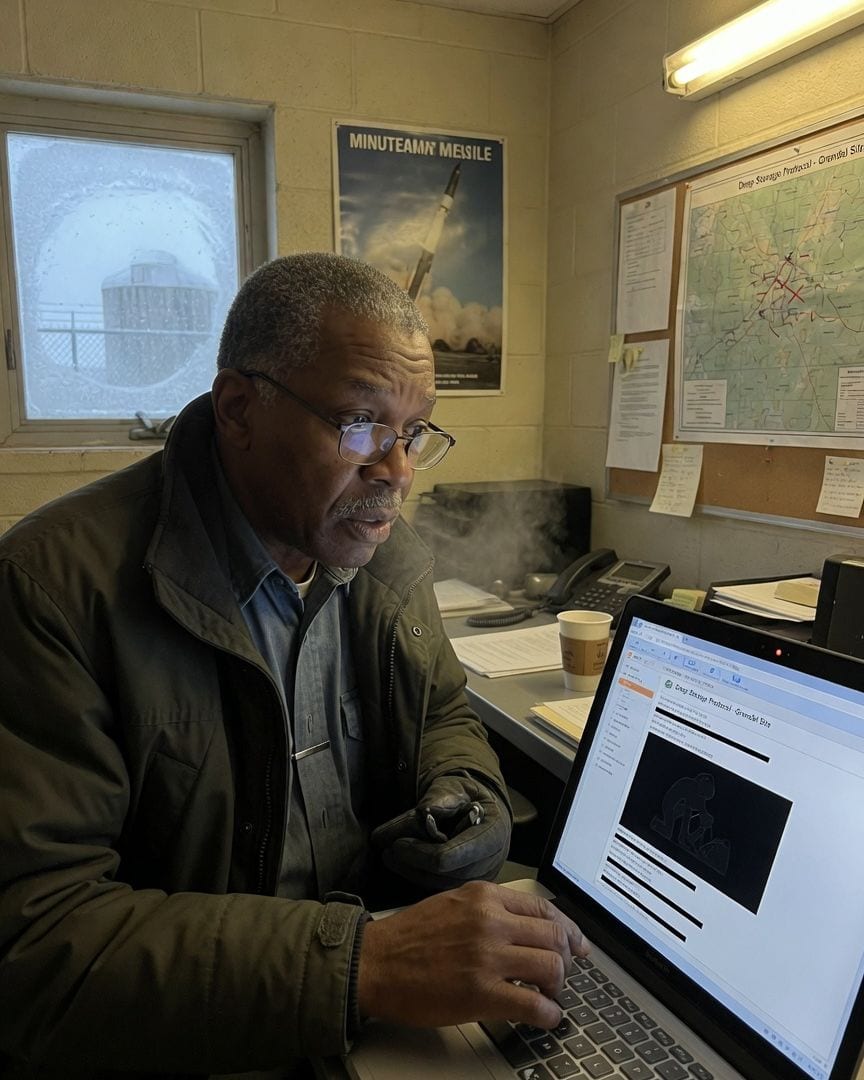
On his last cleanup before retirement, Colonel Marsalis found a dead Cold War missile silo's printer repeating: CREW STILL ON STATION.
Colonel Ren Marsalis, a career Air Force officer, faced his final administrative cleanup before retirement at the decommissioned Grendel Site in the biting North Dakota winter. He expected a sealed missile capsule, but Capsule 7's eight-ton door stood cracked open eleven impossible inches, its hydraulics removed in 1985. Inside, consoles glowed with static alerts from an unknown power source, while an old printer endlessly spooled paper repeating one chilling message: "CREW STILL ON STATION. ACKNOWLEDGE." This impossible communication, from a long-dead system, was no glitch; it hinted at a deliberate, hidden presence, a truth reinforced by a redacted document showing a hunched, humanoid shape.
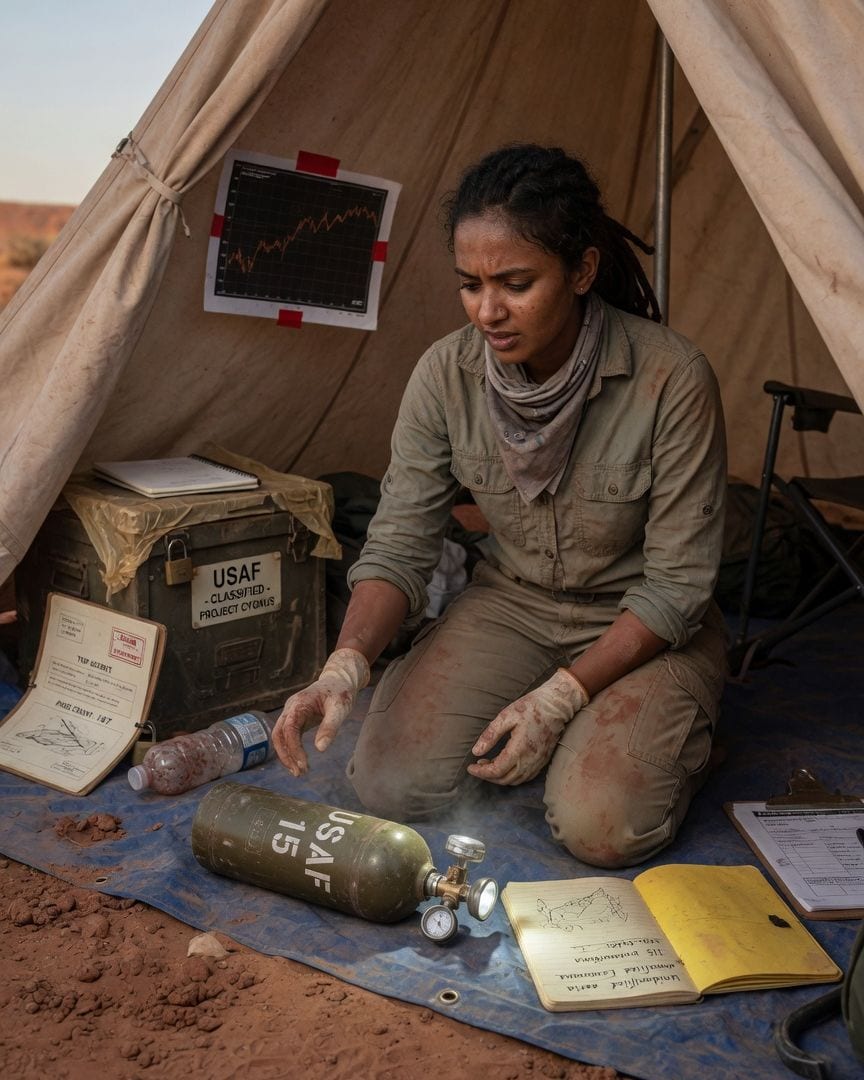
A researcher's permit is almost gone. She finds a Cold War archive box listing 187 pages, but 173 were surgically cut out.
Archaeologist Priya Raval knelt in the reddish Utah mud, her permit for the site ticking down with only nine days left. The desert silence was broken only by the hiss of an 80-year-old oxygen bottle, defying records by holding full pressure in a backfilled cavity. As Priya raced against the clock, she unearthed deeply buried concrete conduits and a classified Cold War archive box. Its cover listed 187 pages, but inside, a terrifyingly precise cut had excised 173 of them, leaving only blank space. What secret did the military bury here, then try to erase?
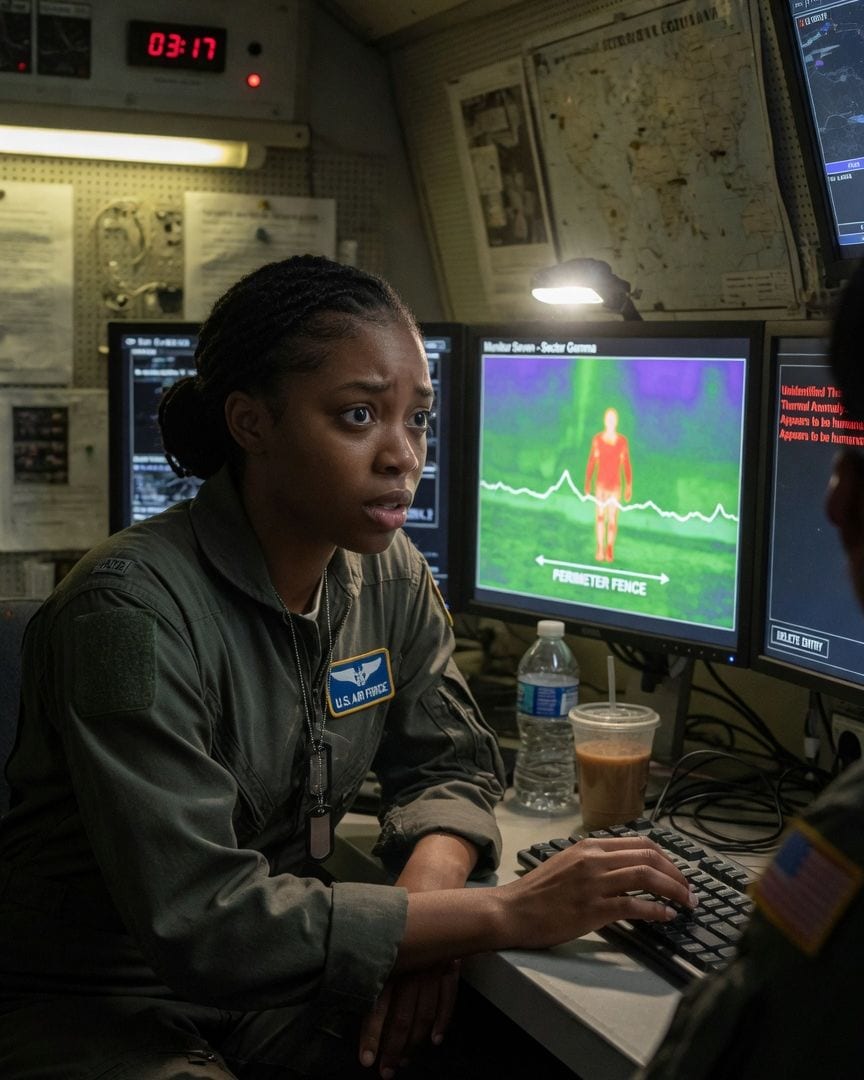
An airman’s thermal feed shows a figure moving in the restricted desert. Her captain orders it scrubbed, but the heat signature appears to tilt its head and look right at her.
Airman First Class Olivia Kade was new to her remote high-altitude outpost, fresh from advanced training, and the isolation pressed in, amplifying every hum. Her duty was to monitor the desert perimeter, but one shift, a faint thermal signature appeared on Monitor Seven: a solitary, upright figure moving with impossible precision beyond the barbed wire. No personnel were authorized in that sector. Her mission commander quickly ordered the anomaly scrubbed, but as it dissolved, the featureless outline seemed to tilt its head, looking directly into the camera. Now, the signature returns night after night, forcing the airman to wonder what impossible thing patrols the dark beyond the wire.
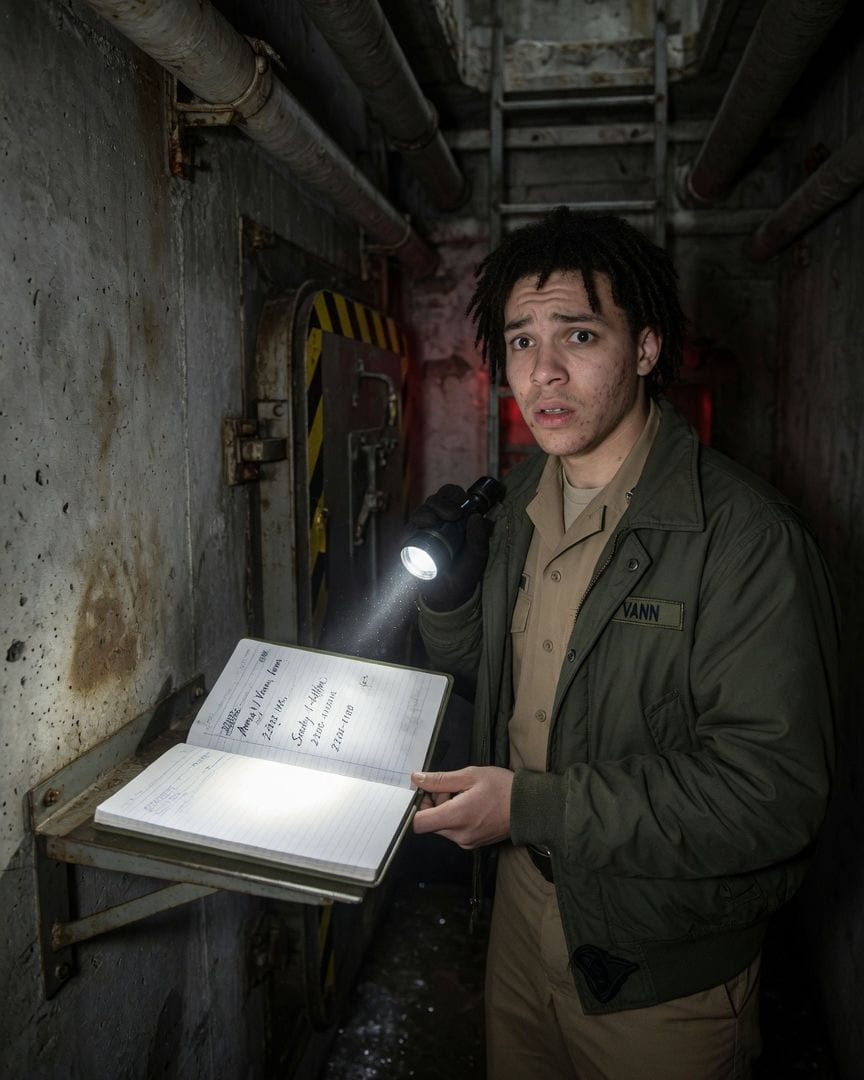
On his last patrol, Airman Vann sees a Cold War silo hatch light up from *inside*—it was welded shut a decade ago.
Airman Vincent Vann was on his last patrol across a vast, desolate Cold War missile field in the Dakotas, the cold, starless sky mirroring the emptiness of the landscape before his transfer. His routine check of eight hardened silo caps was shattered when a red fault light pulsed on Silo 4’s access panel, signaling an impossible breach from *inside* a hatch sealed for a decade. As more silos lit up, ignoring base orders, Vann found the hatch unlocked from within and descended into the dark shaft, where he discovered a pristine logbook bearing his own signature next to a chilling entry from a non-existent sentry, dated for *that very night*. Now, a steady *thump* echoed from deeper within the sealed concrete, leaving the Airman desperate for an explanation that simply wasn't there.
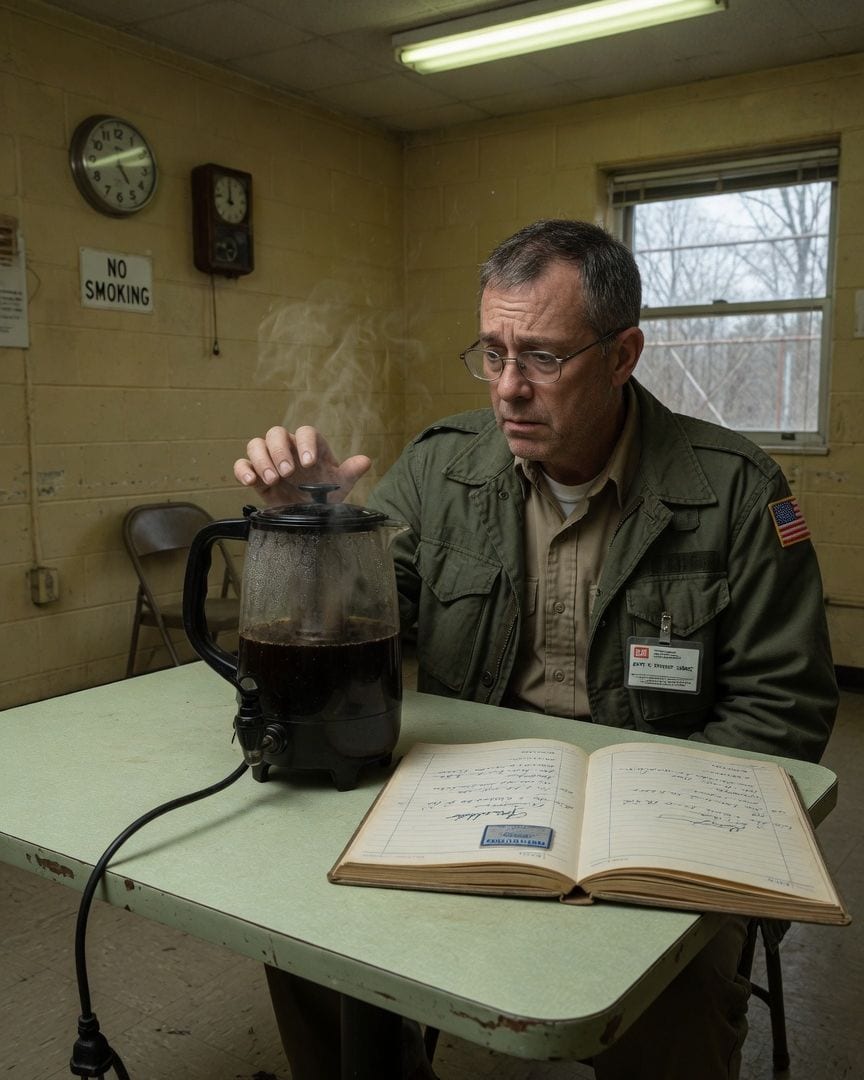
A methodical US Army engineer found a Cold War facility's file stamped 'DECLASSIFY NEVER' — and half its pages were missing.
Captain Nolan Threep, a methodical US Army engineer, expected another routine decommissioning at Alert Facility Twelve in rural Montana. The chains on the doors had rusted solid since 1970, promising a long-dead site. Yet, inside, a faint warmth hung in the air, and a glass coffee urn sat half-full, a wisp of steam rising lazily from its dark surface. The urn, warm to the touch, was clearly unplugged, and the duty log beside it, signed for a shift ending nineteen years prior, looked as though it had been signed yesterday. What secret could a supposedly abandoned Cold War facility hold?
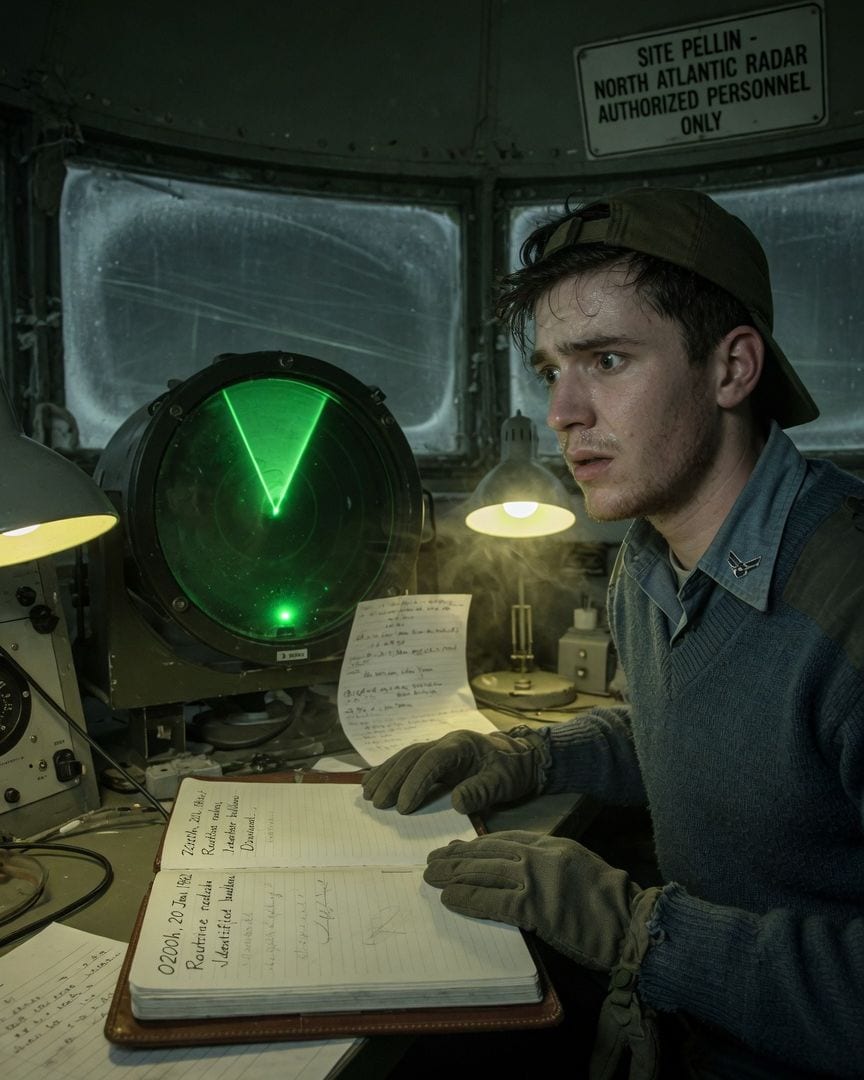
Nine days from closing, Cold War Site Pellin's Airman Vance watched his radar track a solid blip moving closer, dead in open sea where nothing could exist.
In the dimly lit dome of Site Pellin, Airman Ordway Vance, just days from discharge, ran his final radar sweeps before the base closed for good. Outside, the North Atlantic wind howled, but inside, only the hum of his console broke the silence. His last calibration had been clean, yet a single, unwavering green blip appeared on the scope, forty miles out, in open water where no vessel should be. The impossible return moved closer with each sweep, defying all logic and other sensors, until it sat static just beyond the coast fence line. What unseen presence did the radar truly hold in its unwavering green grip, contradicting the official record?