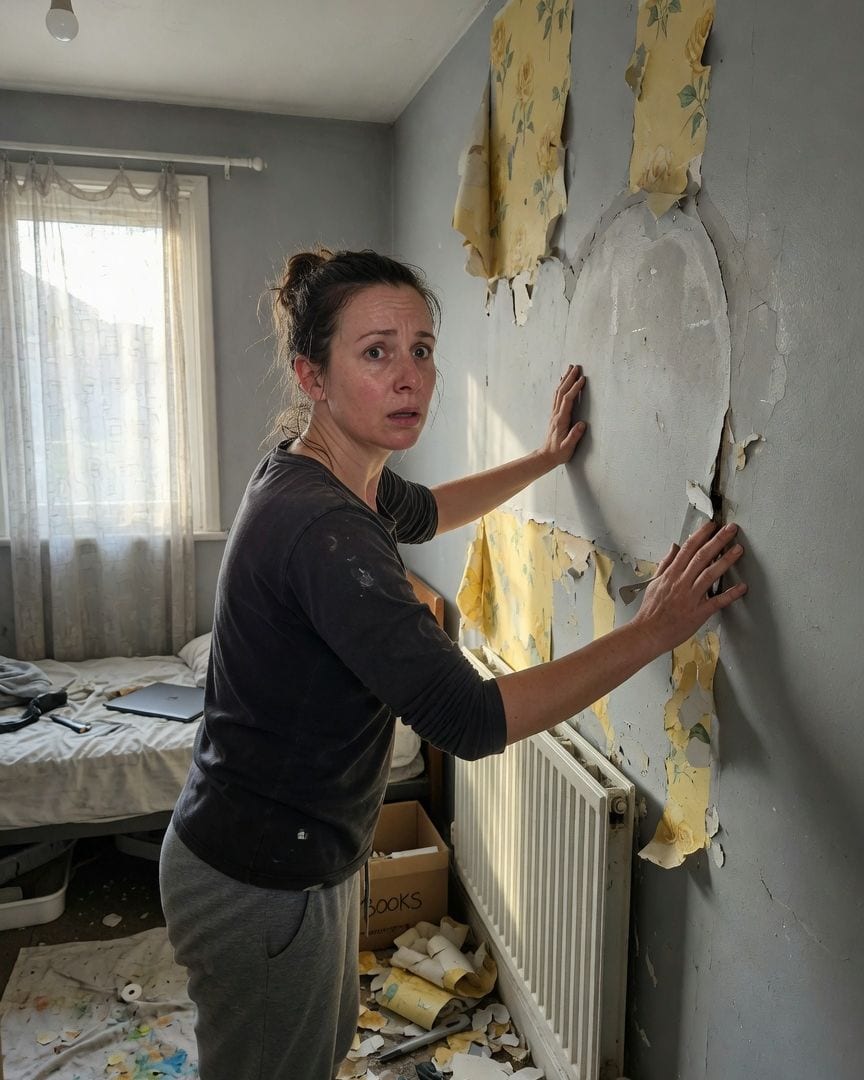
I painted the box room grey, but twice I've woken to find it papered in yellow roses I never bought — seams lifting exactly where the empty-flat photos show bare plaster.
The third time was the one that broke me. I moved into this flat in March, a fresh start, you know?
The box room, it was small, but I had plans for it – a little reading nook, maybe a home office. First thing I did was paint it. A nice, calm, flat grey.
It took two coats to cover the pale blue the previous owner had. I remember the smell of fresh paint, the clean lines. It was my grey.
Then, about a month later, early April, I woke up, walked past the box room, and stopped dead. The wall opposite the window, the one I'd painted grey myself, was covered in wallpaper.
Old-fashioned yellow roses, faded green leaves, like something out of a Victorian teashop. The seams were lifting, just slightly, particularly behind the radiator where the pipe ran. I thought I was losing it.
I went to the estate agent's photos on my phone, the ones from January, before I’d even viewed the place. Bare plaster. Definitely bare plaster. I tore it down, every strip, angry at the impossible mess, the sticky, old-fashioned glue.
It felt like a prank, but who? And how?
Two weeks later, it was back. Same wall, same pattern, same lifting seams behind the radiator. The faint, sweet smell of old adhesive in the air. This time, I didn't touch it.
I just stared, trying to find a rational explanation. A faulty memory? Sleep deprivation? But I could feel the texture of the paper under my fingertips, the distinct pattern of the peeling. It wasn't a trick of the light.
I ran my hand over the smooth, still-grey wall where the roses weren't, then glanced back at the impossible wallpaper, a cold dread settling in my gut.
The yellow roses seemed to shimmer slightly in the faint morning light, almost inviting.
My hands were shaking as I started to strip the paper, again. This wasn’t a prank. This wasn't a hallucination. The paper was there.
I scored a line near the top with a utility knife, just above the radiator, and began to pull.
The old adhesive crackled and gave way, but as I peeled back a particularly stubborn section, my fingers snagged on something solid beneath the plaster. It wasn’t the brick wall.
It was a faint, almost invisible seam that suggested a hidden archway or doorframe. My blueprints, the ones I'd agonized over with the mortgage broker, showed nothing of the sort. No estate agent photos had ever hinted at it.
I dropped the paper, grabbed a scraper, and started to meticulously chip away at the plaster. Beneath the grey, and then the original pale blue, was another layer of rough plaster, and then, unmistakably, the distinct outline of a panel.
It was perfectly integrated into the wall, a ghost in plain sight. I tapped it with my knuckles. It echoed, a hollow sound, entirely unlike the solid brick around it.
A cold draft seemed to emanate from the barely visible crack. I considered calling a builder, my first, rational instinct. But an inexplicable urge, a strange, quiet pull, made me pause.
I remembered the estate agent, a woman named Sarah. When we were viewing the box room, she’d paused right in front of this wall, her eyes distant, a strange, almost wistful look on her face.
I’d brushed it off then, assuming she was just trying to sell the flat, but now it felt different. A memory, perhaps, of something she couldn’t articulate.
I ran my hand over the hidden panel, feeling a subtle warmth emanating from it, a warmth that had no source in the unheated room. My heart quickened, a frantic bird in my chest.
I traced the outline, searching for a latch, a handle, anything to open it. There was nothing. Just the subtle seam, and the warmth, and the inexplicable feeling of being watched by a wall.
I leaned against the newly exposed, rough plaster of the faint archway, my breath catching in my throat. My fingers traced a faint indentation, almost a hairline crack, that wasn’t there a minute ago.
With a soft, almost imperceptible click, a small section of the plaster shifted inward. Just a sliver of darkness, like a half-opened eye.
I tugged gently, and the hidden panel gave way, not into a dusty void as I expected, but into a perfectly preserved, sunlit corner of the very same room.
It was furnished, somehow. A small, ornate writing desk stood against the far wall, polished to a gleam. On its surface, a delicate porcelain teacup and saucer rested, steam visibly rising from it.
A calendar tacked to the wall behind the desk clearly showed a date: "May 12, 1978." Forty-five years ago. A faint, sweet scent of lavender and roast lamb drifted through the opening, warm and inviting.
Then, with a soft, final pop, the panel snapped back, sealing the impossible view, leaving me staring at the blank, grey wall. The scent lingered in the air, a physical impossibility.
The next few days were a blur of frantic research. I needed answers, a rational framework for what I’d seen. I scoured local property records online.
The flat, it turned out, had belonged to a Charlotte Sutton for over fifty years. She’d passed away just a year before I bought it. My fingers flew across the keyboard, leading me to the local historical society's online archives.
And there it was: a collection of 'Homes of Yesteryear,' featuring Charlotte Sutton’s flat. A faded, grainy photo of the box room from the late 70s. The ornate writing desk. The same porcelain teacup and saucer.
Even the yellow rose wallpaper. Every detail was exact. It wasn't a prank. It wasn't my mind playing tricks. It was real.
I called David Crane, the archivist whose name was on the historical society's website. I gave some vague story about tracing my flat's history, hoping he wouldn’t press. He remembered Charlotte.
"A bit of an eccentric," he’d said, his voice flat, almost distant. "Deeply attached to that home after her husband, Oscar, passed away. Been decades since he went, but she kept things just so. Especially around certain dates, I recall."
He didn't elaborate, and I didn't push. Not yet.
Back in my flat, the subtle changes intensified. The faint, sweet smell of lavender and roast lamb, a dish I never cook, started to linger in the air for hours, sometimes a full day.
I’d wake up to the distinct, rhythmic creak of floorboards in the empty hallway at the same time each morning, a slow, measured pacing. And then the hum.
A faint, almost imperceptible humming sound, emanating from the box room itself when I wasn't directly in it. Like a quiet generator, or a muted song.
The flat wasn't just showing me the past; it was reliving it around me, in fragments. The walls felt thin, stretched.
The creeping sense of not being alone intensified. I found myself constantly glancing over my shoulder, a prickling sensation on my neck whenever I entered the box room, as if someone was just out of sight.
One evening, I was working at my laptop in the living room, trying to distract myself with overdue emails, when I heard it. A distinct, rhythmic tapping sound, coming from the box room.
It was like someone meticulously sorting small, hard objects, a steady click-click-click. I froze, my fingers suspended above the keyboard, listening. It stopped abruptly.
I waited a full minute, my breath held tight, before cautiously rising. The box room was empty. No sound. No movement.
But on my freshly made bed, where I’d left nothing but a neatly folded blanket, rested a small, silver thimble. Intricately engraved. I’d never seen it before. It wasn’t mine.
The next day, after a particularly unsettling night of faint whispers and creaks that seemed to emanate from the very fabric of the walls, I returned from work to find my front door slightly ajar. I knew I’d locked it.
I’m meticulous about locks. Nothing appeared to be stolen. My laptop was still on the table, my wallet untouched. But on the doormat, just inside the threshold, lay a single dried yellow rose petal.
It felt like a deliberate message, a boundary crossed.
I called David Crane again, my voice tight with suppressed fear. "Mr. Crane," I started, "did Charlotte Sutton ever mention... visitors? Or unexplained occurrences in the flat?"
He hesitated for a long moment. I could hear a soft sigh on the other end of the line. "Charlotte had her own way of seeing things, Miss Montgomery," he finally said, his voice calm, almost unnervingly so.
"Her memories… they were very vivid to her. Very real." The implication hung heavy in the air, cold and undeniable. Someone, or something, was aware of my investigation and my presence. And it was starting to make itself known.
"Tell me more about Charlotte Sutton, David," I pressed, discarding any pretense of casual interest. I needed the full story. He eventually conceded, his tone shifting from guarded archivist to someone sharing a quiet, unsettling truth. "She was… devoted.
After Oscar died, she just kind of… stopped living her own life. Said the flat was where he still was. That she could almost… see him there, sometimes. Especially around their anniversary."
My mind raced, connecting the scattered fragments. The yellow wallpaper, the specific scent, the calendar date of May 12, 1978. "She had a meticulous routine," David continued. "Every year, in May, she’d decorate that box room with yellow roses.
Oscar’s favorite, she’d say. And prepare his favorite meal – roast lamb with lavender. Even though she ate alone." He paused, as if weighing his next words.
"It was like she was trying to bring him back, just for a night."
"Did she ever talk about a door?" I asked, my voice barely a whisper, afraid to break the fragile thread of his confession.
David shifted uncomfortably, a rustling sound over the phone. "She mentioned a 'memory room.' Said it would open for her, show her things. Said it was how she kept Oscar close."
He explained Charlotte believed her love for Oscar was so strong, so absolute, it could manifest their past together.
He described her growing frail in her final years, her mind blurring the lines between memory and reality, but always calm, always certain about her 'memory room.'
I felt a cold wave wash over me. Charlotte wasn't just eccentric; she was living in a recurrence, or perhaps, creating one.
The flat wasn't just haunted by Charlotte; it was haunted by Charlotte's profound, living memory, a memory so strong it was now bleeding into my reality.
The flat isn't just a place; it's a living archive of Charlotte's grief, actively replaying her past.
David’s voice softened. "She said it was a comfort, to see him again. To be with him, just for a moment." He stopped short of saying, 'just like you did.' But the implication was clear.
Back in the box room, the faint scent of lavender and roast lamb was stronger than ever, almost overwhelming. I ran my hand along the grey wall, the smooth paint.
My eyes fell on a loose floorboard beneath the window, a detail I hadn't noticed before, camouflaged by a rug I’d shifted. My heart hammered, a frantic beat against my ribs. I knelt, fingers fumbling. It wasn’t nailed down.
I pried it up.
Tucked inside, wrapped in a faded silk handkerchief, was a small, leather-bound diary, brittle with age. Charlotte Sutton's. With trembling hands, I opened it, the pages rustling softly, whispering secrets.
I flipped past dated entries detailing mundane routines, records of grocery lists, notes on gardening. Then I stopped dead.
On a page dated 'May 12, 1978' – the exact anniversary date David had mentioned, the date on the calendar in the impossible room – the elegant script described the 'sudden appearance of the yellow roses,' the 'faint scent of his favorite lamb and lavender,' and then, a line that makes my blood run cold: 'The door opened again tonight, showing me our anniversary, exactly as it was.'
The passage continued, describing Oscar's smile, the warmth of his hand, the joy of that specific, remembered day. But then, the tone shifted, growing more frantic.
The entry ends with a trembling question, scratched almost illegibly at the bottom of the page: 'Am I slipping back, or is he finally coming home? And if he does, what will become of me?'
I reread Charlotte’s diary, the pages a chilling echo of my own experiences. Every detail that had baffled me, every impossibility, was laid bare in her elegant, then frantic, script.
Charlotte wasn't just seeing the past; she was actively trying to recreate it, to pull it back into being.
The diary entries detailed her increasing efforts to 'keep the memories fresh,' to 'furnish the room as it was,' always around the specific anniversary of May 12th.
The 'door' wasn't just a vision for Charlotte; it was a pathway, a fragile tear in time that she widened with her intense longing.
I realized the yellow roses, the specific meal, the teacup, the furniture in the 'wrong year' room – they were all meticulously curated details from Oscar and Charlotte's life, specifically from a cherished anniversary in 1978.
The flat, saturated with Charlotte's enduring grief and powerful will, had become a loop, a physical manifestation of her desire to relive her past.
The horror of it crystallized: Charlotte, in her final years, was not just remembering; she was becoming absorbed by her own memories, effectively living in a recurring loop of 1978.
The pattern snapped into place, clear and brutal: Charlotte's life, her rituals, her unwavering belief, had turned the flat into a living, repeating memory, and I, by occupying it, had become the next 'host,' drawn into the same inescapable cycle.
The flat remembered Charlotte, and now, it wanted me to remember with it, to continue the routine.
The realization detonated in my mind, a silent, sickening explosion. I wasn’t just observing a haunting; I was being drawn into it, pulled into a current I couldn't fight. Desperate, I tried to break the cycle.
I found myself tearing at the phantom yellow wallpaper again, ripping it from the wall, scrubbing at the adhesive until my hands ached, until the grey paint was raw beneath. I tried to permanently seal the hidden door.
I bought bags of cement, plaster mix, a trowel. But as I mixed the plaster, a strange, lilting, old-fashioned melody began to hum itself on my lips, a tune I'd never heard before.
I tried to leave. I packed a bag, threw my passport and a change of clothes into it.
But an inexplicable inertia rooted me to the spot, a sense of belonging that wasn't mine, a powerful pull drawing me deeper into the flat. The flat hummed around me, a low, resonant vibration, a living thing.
I found myself in the kitchen, instinctively reaching for ingredients I didn't own, for a recipe for roast lamb I'd never learned. My own thoughts felt distant, muffled by a growing certainty that this was 'what must be done.'
I fought it, clenching my fists until my nails dug into my palms, but my body seemed to move with a will of its own, an unsettling autopilot.
I caught my reflection in the darkened window – a faint, almost imperceptible shift in her expression, a softening around the eyes, a ghost of a smile that isn't mine, the faintest hint of Charlotte.
The door to the box room, which I had tried to seal only an hour ago, stood ajar, a warm, inviting glow emanating from within.
I felt an overwhelming urge to go to it, to open it fully, to step inside, to belong. The flat wasn't letting me go. It wanted me to continue Charlotte's life, to become the new occupant of its endless memory.
I fled the flat. That's the only way to describe it. Not moved, not left. Fled. I sold it at a significant loss to a distant property developer, never looking back, never reading the emails, ignoring the calls.
I moved into a sterile, modern apartment on the other side of the city, scrubbing every surface, discarding most of my old possessions, trying to cleanse myself of the flat's memory.
I tried to erase every trace of it, every memory of the yellow roses and the Door Onto The Wrong Year.
But small, inexplicable things remained. A single, dried yellow rose petal, flat and brittle, pressed between the pages of a book I hadn't packed, a book I swore I hadn't touched since before I moved into that flat.
The faint, comforting scent of lavender and roast lamb, wafting through my new, empty kitchen on certain evenings, an impossible, delicious ghost.
And then the silver thimble, intricately engraved, found in a box of cutlery I swore I’d bought new, still sealed in its plastic wrap.
The routines I had known, the rhythms of my own life, felt hollow, replaced by a subtle, unsettling sense of anticipation, like waiting for something to begin again.
I sit in my new apartment now, the white walls blank, the silence absolute. I have tried to rebuild, to forget. But the quiet feels heavy, expectant.
I find myself setting the table for one, then pausing, a strange, unfamiliar urge to add another place setting, just in case. I don't know why.
One morning, I wake up with the scent of old roses faint in the air, and my gaze drifts to the bare wall opposite my bed.
A strange sense of anticipation fills me, a quiet certainty that something will appear, something familiar and comforting, just for me. I wait, a faint, almost imperceptible smile touching my lips. The quietest walls are the ones that are waiting.
If this one got to you
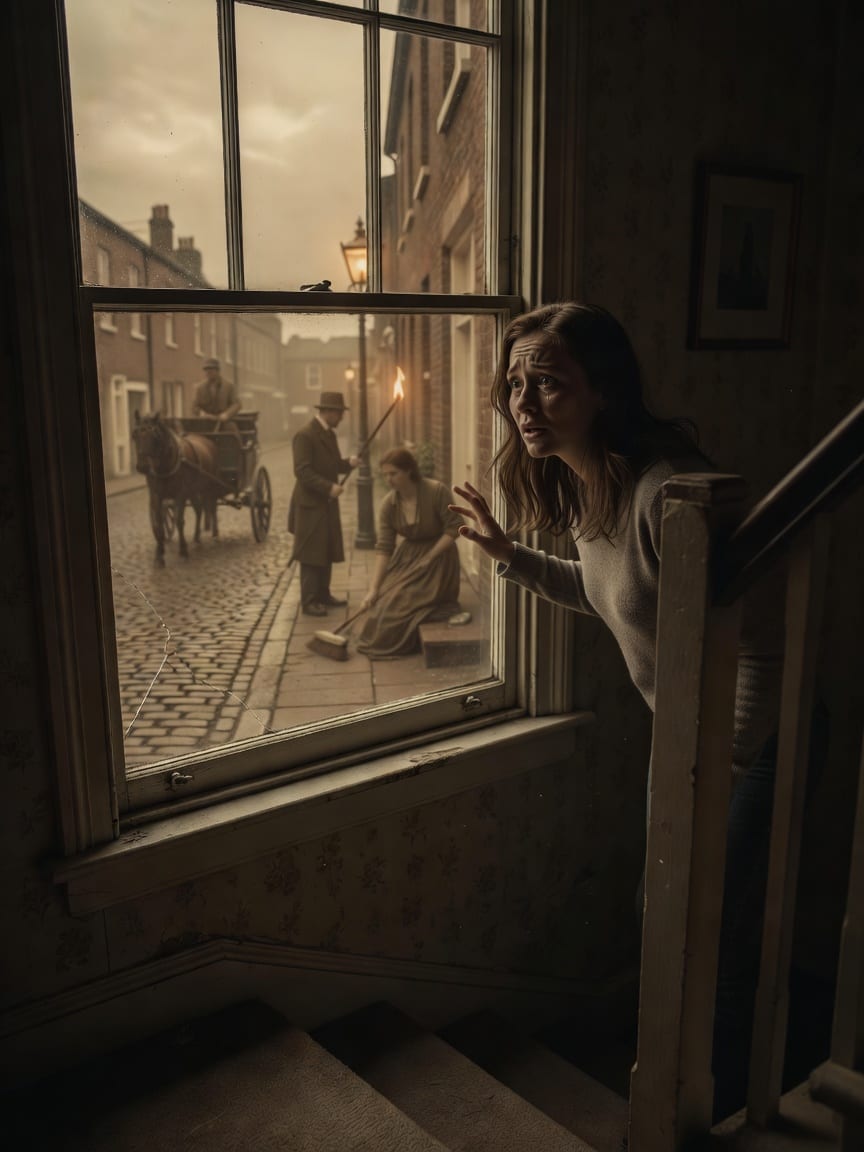
My half-landing window looked down on a cobbled street, a horse and cart. My panes, same crack. Below, only the bins.
I moved into this inherited house for a fresh start, living alone in the quiet. But the third stair on the main flight is deeply worn, a ghostly scoop hinting at decades of unseen footsteps. It feels hollow, and the wall beside it hides a faint, inexplicable seam.
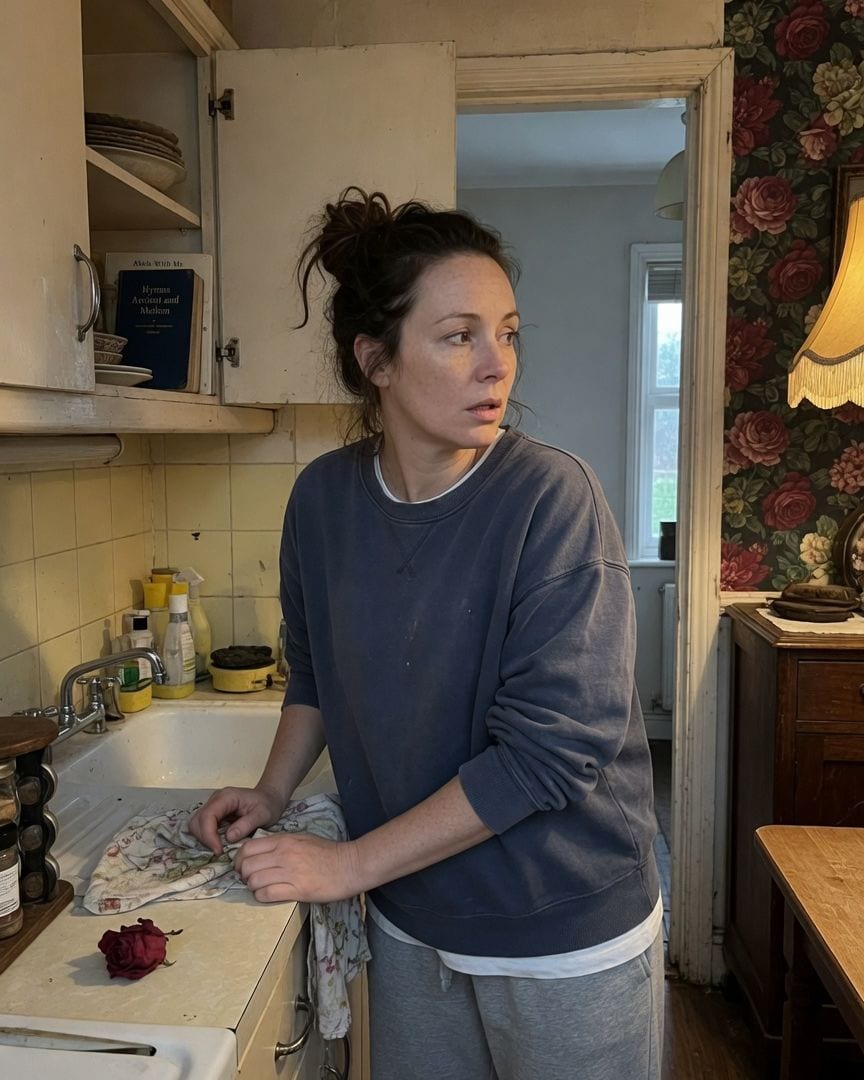
My kitchen taps run themselves on Sundays while a woman hums 'Abide With Me.' I live alone.
I moved into this quiet 1928 house for a fresh start, living alone. But for three months now, every Sunday morning, a low, tuneless hum and the distinct sound of running water drift from my kitchen sink. A plumber found no explanation.
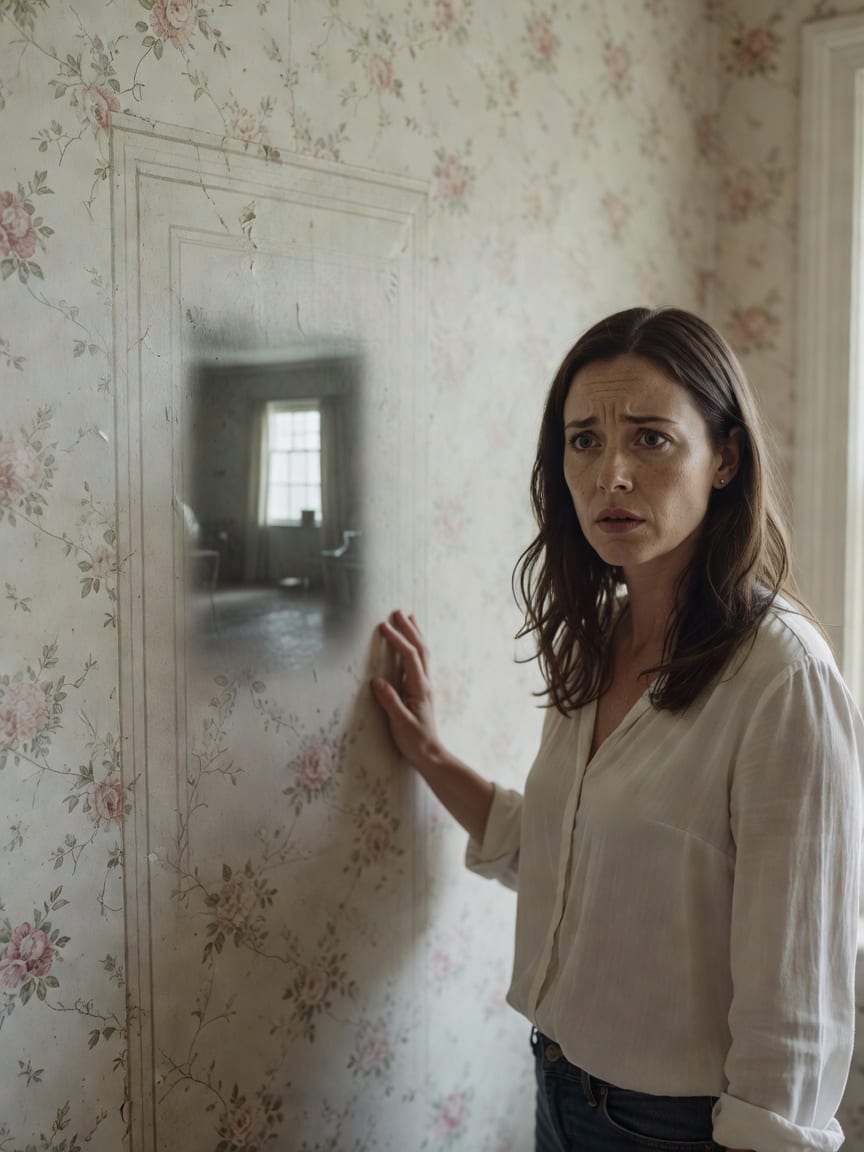
My neighbor’s house plans show a room in my bedroom that doesn’t exist. The surveyor described its door, but my wall is solid.
I was signing off on my neighbor's loft plans when I saw it: a small, square room off my own bedroom. My house, where I’d lived for five years, had no such room. But a surveyor confirmed its presence on paper, and older blueprints showed it had been there for decades. Now, I can feel a faint coldness from a hidden doorframe behind my wallpaper.
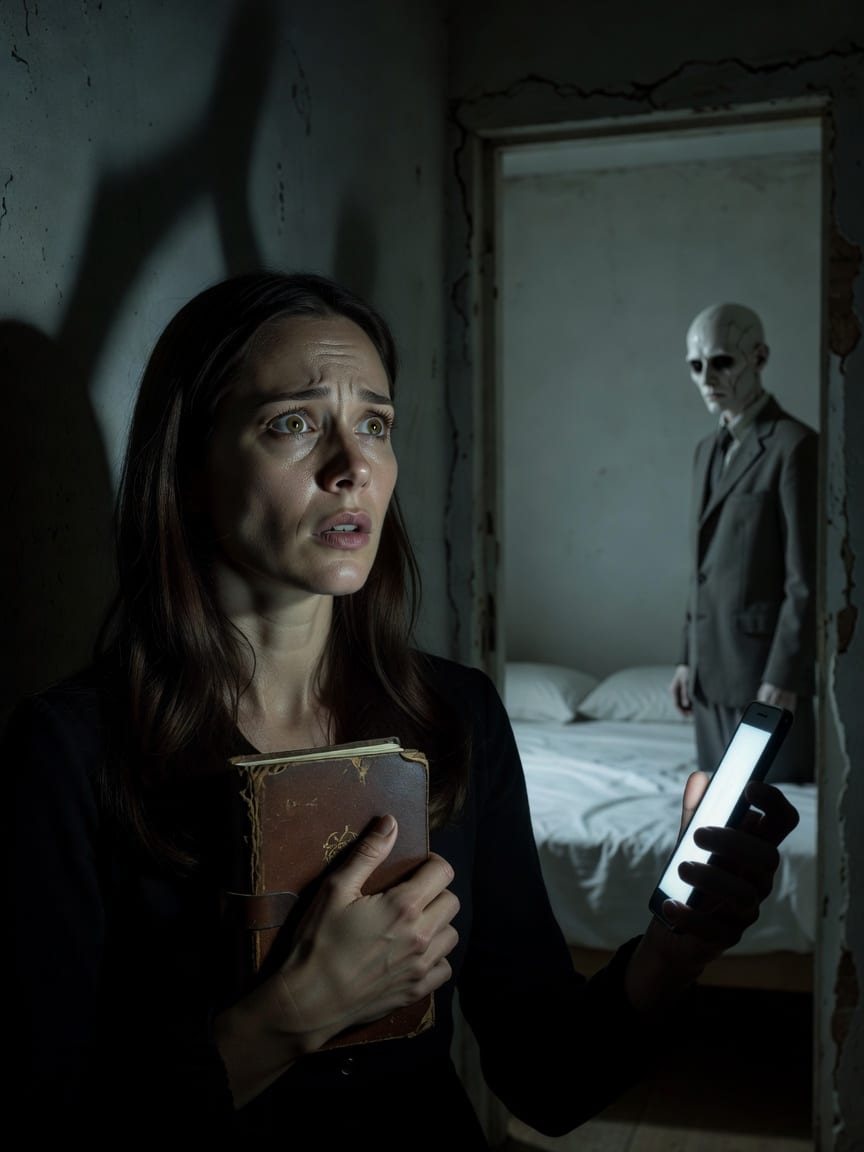
Behind a plastered-over doorway, I found a room. Papered, carpeted, and furnished with a made bed, sealed for decades. The air was dead still, but the bed wasn't dusty. My council tax bill only lists five rooms.
I'm Claire, an architect, meticulously planning my new Victorian terrace renovation. But when I uncovered a hidden room behind a wall, everything I knew about time and decay shattered. The bed was perfectly made, the air still, yet there was no dust, only an unnerving cold.
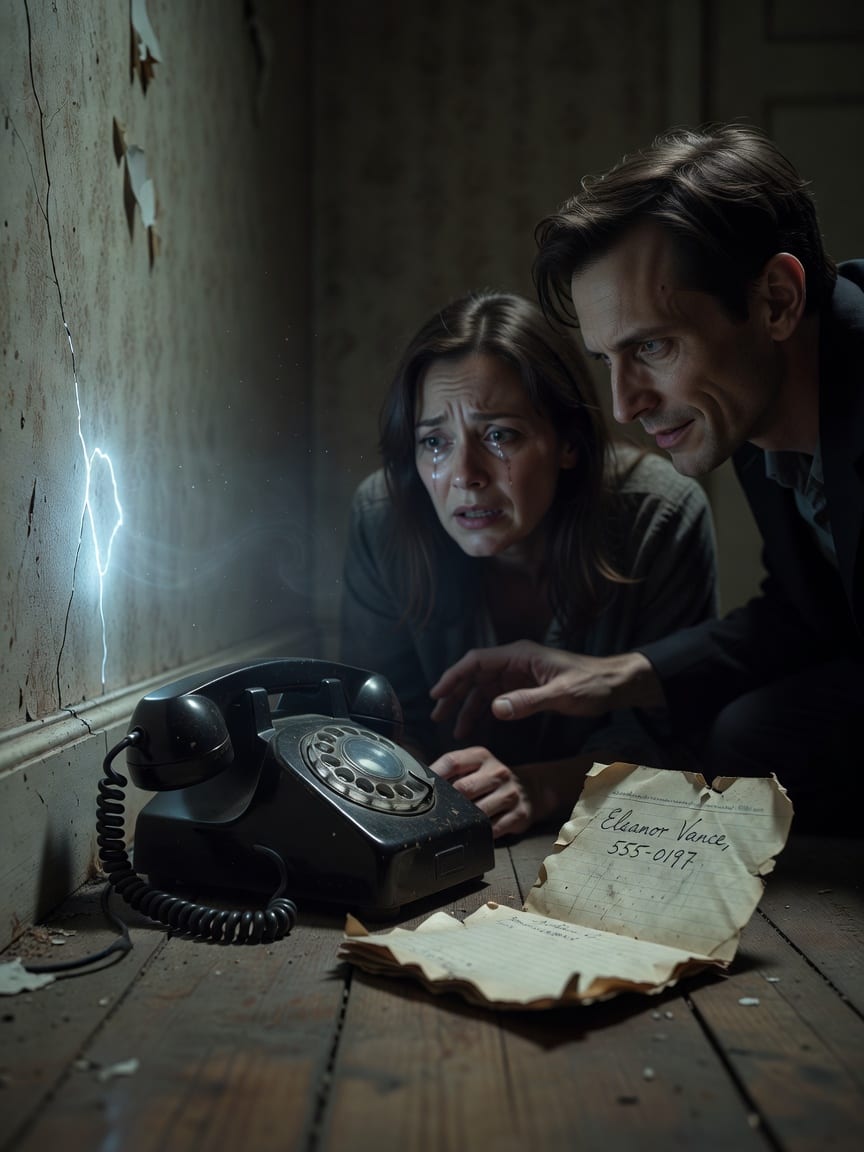
My house's walls ring when I dial a phone number from a 1974 directory. My neighbors said that directory was trash.
I was sifting boxes in my new house when I found an old 1974 telephone directory for my street. It listed my address, 12 Elm Street, under the name "Mr. & Mrs. Sheppard." On a whim, I called the faded seven-digit number. My cell phone rang, but a low, muffled sound also vibrated from the wall beside me.
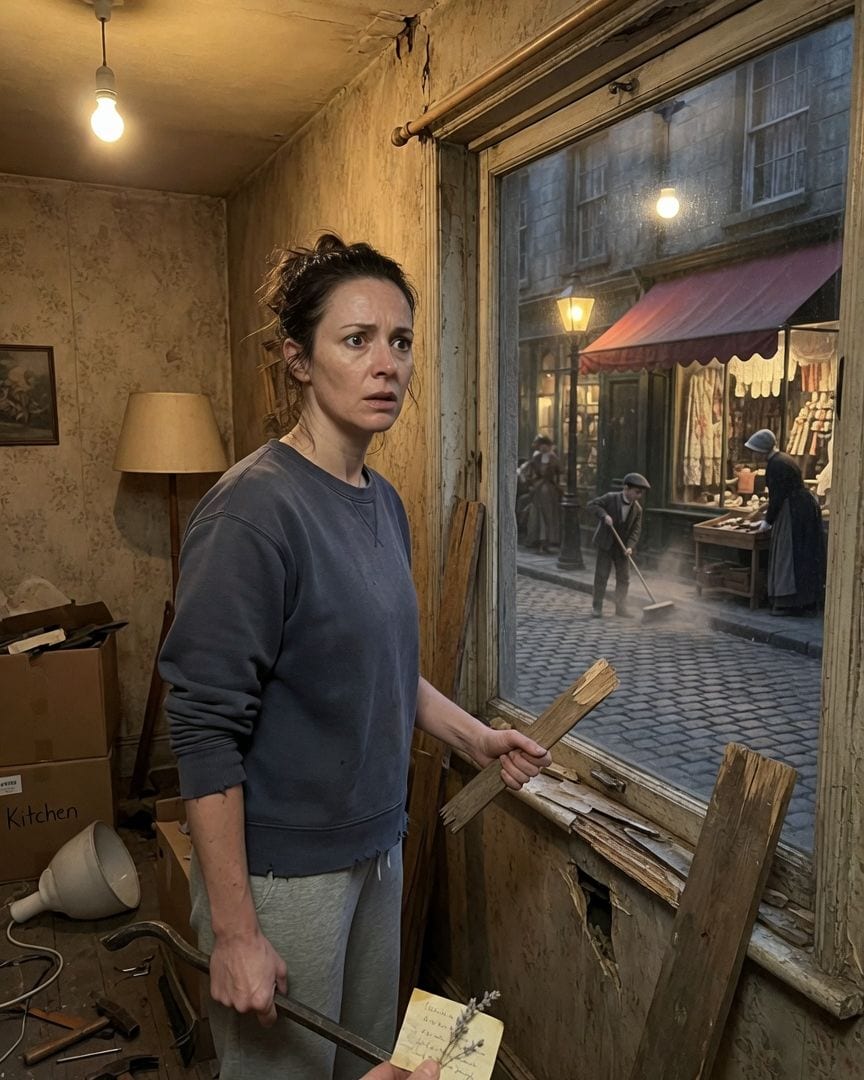
My boarded window showed a gaslit Victorian street. Across my flat, only a brick shaft. The wood felt soft, new when I nailed it back.
Moving into my new flat, I expected to find a grimy brick lightwell behind the boarded-up window. But as the last plank came free, my view wasn't a shaft at all. Instead, a bustling Victorian street, complete with gaslight and a boy sweeping, stretched out before me – a vibrant, living scene that simply shouldn't exist.