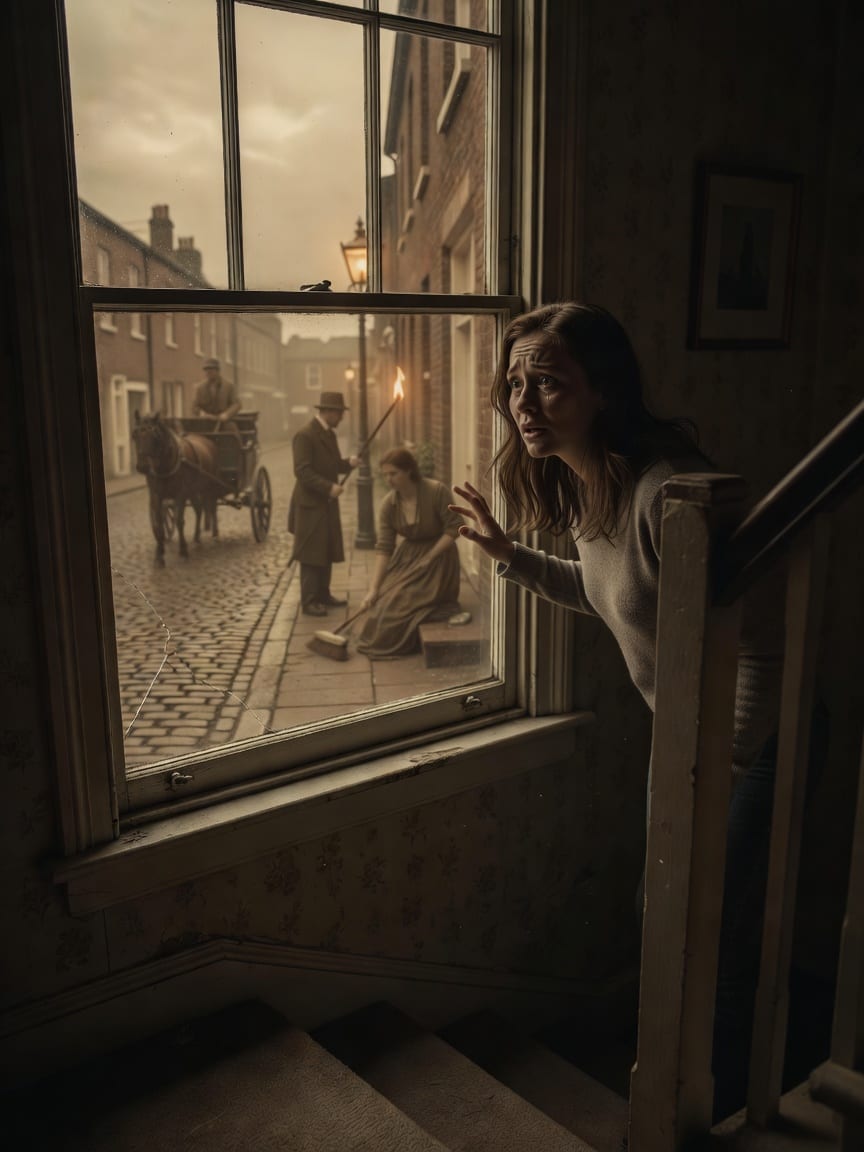
My half-landing window looked down on a cobbled street, a horse and cart. My panes, same crack. Below, only the bins.
The house was meant to be a fresh start, inherited after a quiet life in the city. Late autumn when I moved in, and by December, the frosts had started, along with the first oddities.
It began with the half-landing window. I remember precisely: 7:20 AM, December 12th. I was heading downstairs with my coffee, still half-asleep, and I glanced out.
Instead of Mrs. Henderson’s parked car and my wheelie bins, I saw a cobbled street. A heavy horse, pulling a delivery cart laden with barrels, clip-clopped by.
A lamplighter, pole slung over his shoulder, was extinguishing a gas lamp three doors down. And a woman, in an apron, knelt on the step of the house opposite, scrubbing vigorously. It was so vivid, so utterly real. I blinked.
My panes, the same hairline crack in the top right corner, were undeniably there. I ran down, threw open the front door, half expecting to see it, to smell the horse, to hear the clatter. Nothing.
Just the bins, and Mrs. Henderson’s car, and the grey December morning.
It happened again two days later, precisely at 7:20 AM. The same street, same horse and cart, same lamplighter, same woman scrubbing her step. I tried to rationalise it away: a trick of the light, a waking dream, residual sleep.
But the crack in the glass was too specific, too consistent. It wasn’t a hallucination if the details were identical. The window felt like a frame.
And then there was the tea. Every morning, around 6 AM, a faint, sweet smell of brewing tea would drift from the kitchen. Strong and clear, like someone had just made a fresh pot.
But I drink coffee, and I live alone. The old, heavy iron kettle, which I’d found on the hob and hadn’t bothered to replace, was always stone cold. I'd put my hand on it, just to be sure. Nothing.
And the third stair. It’s on the main flight, halfway up. The wood, dark oak, is worn smooth in the middle, a deep, ghostly scoop as if someone had habitually trodden that exact spot for decades.
I found myself unconsciously avoiding it, stepping wide, around the invisible imprint of another’s habit. The house was supposed to be empty of history, a clean slate, but it hummed with something I couldn't name.
The window visions continued, intermittently, but always at 7:20 AM, always the same scene. I started to dread that specific time, a knot of unease tightening in my stomach as the minute hand crawled towards it.
The tea smell persisted too, a phantom warmth in the otherwise cold morning, a ghost of routine. But the worn third stair, that bothered me more. It wasn't just worn; it felt hollow somehow, subtly different from the others.
Running my hand along the wall beside it, I noticed a faint seam in the old plaster, almost perfectly camouflaged. It wasn’t a structural seam; it was too precise, too uniform, running horizontally, then vertically. A peculiar repair?
I tapped it, and the sound was different, less solid, a soft thud instead of the sharp rap of plaster over brick. A hidden cupboard? A previous owner's secret stash?
My mind raced through possibilities, from the mundane to the truly fantastical, before settling on "quirky renovation choice." But even that felt flimsy.
Armed with a utility knife and a flashlight, I carefully began to score along the seam. The plaster gave way with surprising ease, flaking into dust, revealing a small, square section of loose floorboard, slightly recessed.
It was tucked into the wall behind the stair, a perfect fit for the cavity. I ran my fingers along its edge, feeling the grit and dust of decades, the dried mortar that had held it in place.
It was almost perfectly disguised, clearly intended to be forgotten. I tried to pry it open with the knife, but it was too tight, too stubborn.
This wasn't a casual hiding spot; someone had gone to great lengths to conceal it. The ordinary explanation felt thinner, almost transparent. This felt deliberate.
I found an old, rusted screwdriver in the toolbox in the cellar, a relic the previous owner had left behind.
Back on the half-landing, my breath hitched in my throat as I inserted the flat head into the narrow gap of the loose floorboard on the third stair.
With a grunt, I twisted, and the wood creaked, then shifted with a faint pop. A gust of stale, musty air puffed out, smelling of damp earth and old paper.
I pulled the board free, revealing a small, dark cavity in the wall. My flashlight beam cut through the gloom, illuminating a small, unmarked wooden box, nestled deep within. My fingers, trembling slightly, reached into the dark, pulling it free.
The box was old, the wood smooth from handling, its surface scratched and faded with time. No lock, no clasp – just a simple lid. I lifted it slowly, the hinges groaning faintly.
Inside, nestled on a bed of brittle, yellowed lace, was a single, sepia-toned photograph. It depicted a woman, perhaps in her late twenties, and a small child, a boy, no older than five.
They stood smiling, not outside, but inside a house. And the background was unmistakable: the distinctive arch of the half-landing window, its panes clearly visible, even the small hairline crack in the corner.
The woman was standing right beside it, her hand resting on the frame. Her clothes, the child's attire, the style of the heavy, dark furniture visible in the background – it all screamed late 19th or early 20th century.
This wasn't just an old photo; it was my house, my window, but in a different time. A cold dread settled in my stomach, like a lead weight. This wasn't a trick of light or a dream.
Someone else had seen this view, lived in this space, and perhaps, known something about the window's strange visions. They had hidden this box, this photograph, in a place designed to be secret, not just forgotten.
I carefully put the photo back, then wrapped the box in a spare cloth and hid it away in a drawer, suddenly uneasy about its discovery.
My next step was clear: I needed to know who lived here before, and when that photo was taken.
I started with the local archives, searching property deeds and census records, looking for anything that connected a woman and child to my address in that specific era.
The archive search was slow, yielding fragmented names and dates that didn't quite fit the photo or the timeline I was imagining. I returned home exhausted, the uncanny feeling of the house heavier than usual.
It was no longer a silent observer; it felt like a presence, watching me. That evening, as I was making dinner, the clatter of pots and pans was suddenly interrupted.
I heard a faint scrape from the living room – the distinct sound of a heavy wooden chair being dragged across the polished floorboards. I froze, panicking slightly. I lived alone. The house was locked.
I grabbed the heavy iron poker from beside the fireplace, my hand sweating on the cold metal, and crept towards the living room door. Pushing it open slowly, heart hammering against my ribs, I saw nothing amiss.
The old armchair by the fireplace, previously pushed back against the wall, was now nudged forward, its worn cushion facing the empty fireplace, as if someone had just risen from it.
I checked the windows, the back door, the cellar – all locked, undisturbed. My heart hammered, a frantic drum against my ribs. This wasn't a replay; this was something happening now, something reacting to my presence, my investigation.
The house wasn't just showing me things; it was moving things.
Later that week, I noticed Leonard Ingram, the elderly neighbor from across the street, watching my house.
He was often on his porch, a fixture of the street, but his gaze seemed more pointed, more lingering than usual, as if tracking my movements.
One afternoon, as I was leaving for another trip to the archives, he called me over. "Everything alright, dear?" he asked, his eyes sharp, missing nothing. "You've been spending a lot of time in the library.
Researching the house, are we?" His tone was mild, almost conversational, but his knowing glance, the subtle lift of an eyebrow, sent a shiver down my spine. He knew.
I decided to confront Leonard. I baked a batch of shortbread, a peace offering, and brought him a plate, sitting with him on his porch swing. The sun was weak but pleasant.
"Mr. Ingram," I began, trying to keep my voice steady, "I've been finding some… odd things in the house. Things that suggest a history I don't know about." I paused, watching his face for any reaction.
He remained impassive, calmly sipping his tea. "Like what, dear?" he prompted gently, his gaze fixed on a distant point.
"Like an old photograph," I continued, pressing, "of a woman and child, standing by my half-landing window, but dressed like they're from a century ago." Leonard's gaze sharpened, losing its geniality.
He sighed, a deep, weary sound that seemed to carry the weight of years. "Ah. The window." He looked past me, at my house, its brick façade bathed in the afternoon light.
"Vivian, the old owner, Vivian Thatcher… she saw things in that window too. Said it was like looking through time, sometimes. Always around 7:20 in the morning."
A jolt went through me, a cold shock. Vivian. My predecessor. "And the tea," I pressed, "do you remember Vivian drinking tea at 6 AM?" Leonard nodded slowly, his eyes still on the house. "Every morning. Without fail.
Even in her last years, when she was barely moving, that kettle would whistle at six. A heavy iron one, it was. You’ve still got it, haven't you?"
The pieces clicked into place with an unnerving precision.
The faint smell of tea, the worn third stair, the visions in the half-landing window – they were all traces of Vivian Thatcher's routine, a pattern imprinted on the house, replaying itself.
"Vivian," I asked, my voice barely a whisper, "she didn't just move out, did she? No one seems to know where she went." Leonard closed his eyes for a moment, a flicker of pain crossing his face. "No, dear.
She didn't move. She just… stopped being there. One day she was, the next she wasn't. Like a memory fading, like she simply… dissolved."
I pulled the wrapped wooden box from my bag and gently uncovered the photograph. "This," I said, holding it out. "Is this… from her time?"
Leonard took the faded photograph of the woman and child, his old fingers surprisingly steady, and studied it intently. His gaze lingered on the woman's neck, specifically a small, distinctive locket she wore, a dark spot against her high-necked dress.
"This locket," he said, his voice barely a whisper, "Vivian Thatcher, the last owner, she had one just like it. Never took it off. Said it was a family heirloom."
He paused, tracing the locket in the photograph with his thumb, his brow furrowed in concentration.
"And before Vivian, there was old Mrs. Albright, who vanished in '85. My grandmother spoke of her. Before her, a young mother, back in '41, just before the war really hit, who also disappeared. And a Miss Eleanor, late 1800s.
All from that house. All of them just… gone, leaving nothing but their routines behind. Always on a cycle, every forty, fifty years or so."
He looked at the photograph again, then back at me, a profound, chilling sadness on his face. "The locket," he whispered, "Vivian never took it off. And neither did the others. It’s what they leave behind, just before they… leave."
He gestured vaguely at the house, then at me, his gaze lingering on her for a beat too long.
Leonard’s words hung in the air between us, cold and heavy, settling like a shroud. "It’s a cycle," he reiterated, his voice strained, as if recalling a deeply ingrained, painful truth. "The house, it calls them. Shows them things.
Makes them remember. And then it takes them." He explained that his family had lived opposite my house for generations, passing down the quiet dread of its history like a grim inheritance.
Each time, an occupant would grow increasingly peculiar, absorbed by strange routines, then simply vanish. No body, no note, no trace. Just the faint echo of their habits, like the tea or the worn stair.
"They’re not ghosts, Daphne," he said, shaking his head slowly, "they're… memories. The house remembers, and it wants company." He pointed to the photo again. "This woman, she's one of them. The locket connects them.
It’s not an heirloom passed down, it’s… part of the pattern. A token left by the disappearing, found by the next."
The window, he explained, wasn't a portal to the past; it was the house’s memory, replaying the last moments of its previous occupants, a final glimpse of the world before they stepped into another.
The cobbled street, the horse and cart, the lamplighter – that was the street outside the house, in 1898, just before Miss Eleanor vanished.
The house was a trap, a temporal eddy, slowly drawing its inhabitants into its own past, to join the others, to become part of its repeating memory.
I felt a surge of terrifying clarity. The house wasn't just haunted; it was a living, breathing mechanism of recurrence, a hungry maw cloaked in brick and timber. I had to get out. But the house seemed to know.
That night, the tea smell was overwhelming, cloying, filling every room.
The light flickered in the living room, a slow, deliberate pulse, and then the distinct sound of the kettle boiling came from the kitchen, a piercing whistle, though I knew it was cold.
It was followed by a faint, rhythmic rocking from the armchair, a sound that meant presence without form.
I saw a flicker of movement by the half-landing window – a shadow, impossibly tall and thin, standing perfectly still, watching the darkness outside.
The house was actively manifesting, urging me to join the routine, to become another memory, another echo in its repeating cycle.
I grabbed my car keys, my phone, and the hidden wooden box with the photograph. My heart hammered, a frantic drum against my ribs.
As I reached the front door, the knob twisted slowly from the inside, the lock clicking open with a soft, deliberate sound, like an invitation.
The air grew cold, heavy with the scent of old tea and dust, pressing in on me. I didn't look back.
I flung the door open and sprinted out, not stopping until I was in my car, fumbling with the ignition, driving away, the silent house looming in my rearview mirror like a predator I had barely escaped.
I didn't pack, didn't retrieve anything else. The cost was everything I owned, everything I had planned for my new life. But I had the box, the photograph – proof. Proof no one would ever believe.
I never returned to the house on Elm Street. I tried to explain my story to friends, to a sympathetic estate agent, even to a disbelieving police officer.
They listened politely, or with thinly veiled concern, and offered explanations of stress, grief, or an overactive imagination. I showed them the photograph, but it was dismissed as an old family photo, its origins untraceable, its significance lost on them.
The house eventually went back on the market, its strange history unspoken, unacknowledged, waiting.
Leonard Ingram, I heard, would occasionally leave a small bunch of flowers on the doorstep, a quiet act of remembrance for those who had gone before, and a silent warning for those who might come next.
I found a small, cheap flat across town, far from anything that resembled a terrace house. I kept the wooden box and the photograph hidden, a chilling reminder of what I had escaped.
Every morning, I still woke at 6 AM, a phantom scent of tea clinging to the edges of my awareness, and I would find myself instinctively stepping around an invisible worn spot on my new flat's third (and only) stair.
The fear was gone, replaced by a cold, quiet certainty. I knew.
I had escaped, but the house's memory had imprinted itself on me, a persistent echo of the routines I had witnessed, a constant, low hum beneath the surface of my new, ordinary life.
Months later, a new 'For Sale' sign appeared outside the house on Elm Street. On the porch, Leonard Ingram watched the fresh paint sparkle in the morning sun.
He saw the new buyer, a young woman, unlock the front door and step inside.
He barely noticed the faint, sweet smell of brewing tea that wafted from his own kitchen window at 6 AM each morning, or the way he always took a slightly wider step when climbing his own third stair.
It always began with the window.
If this one got to you
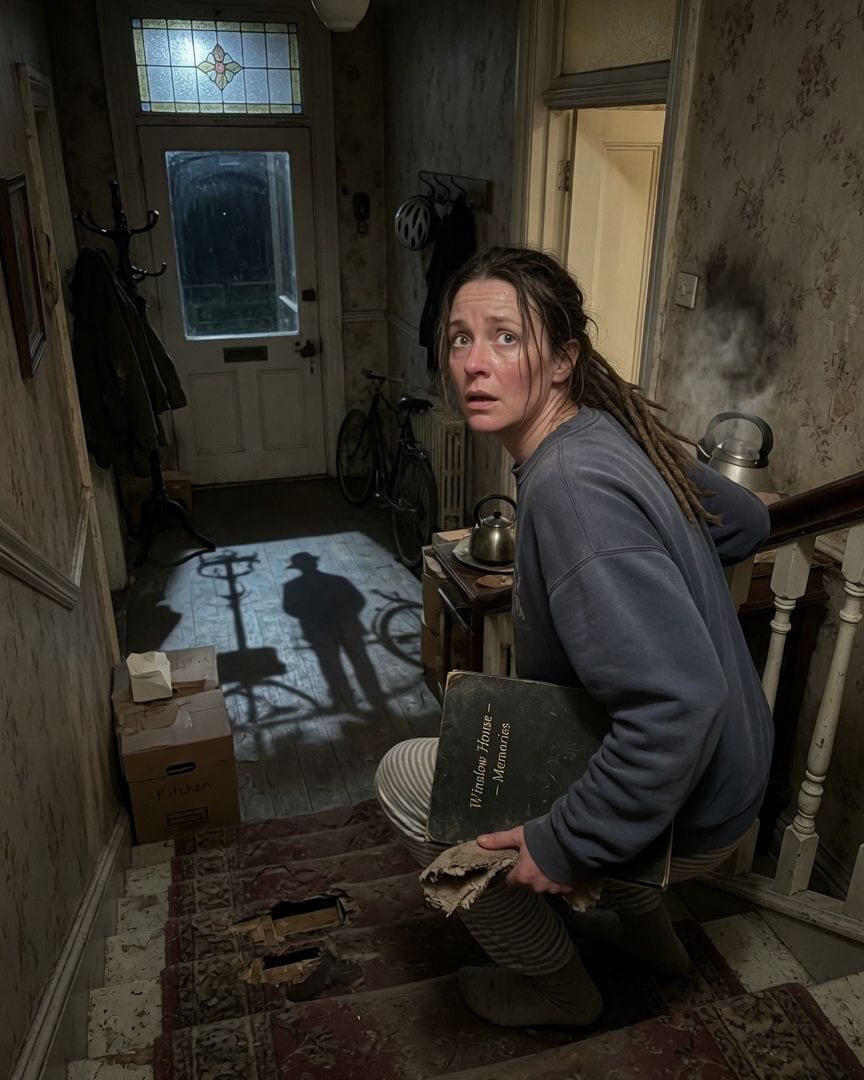
At 3am my dark porch throws grey shadows onto my hall floor — a coat-stand, a bicycle, and the outline of a man standing outside. I open the door and no one's there.
I'd just moved into Winslow House, struggling with new-house jitters and sleep. Then, at 3 AM for the second time, a stark grey light woke me, casting distorted shapes onto my hall floor. The undeniable shadow of a man stood beyond the threshold, impossibly still, even though I lived alone and the porch light was off.
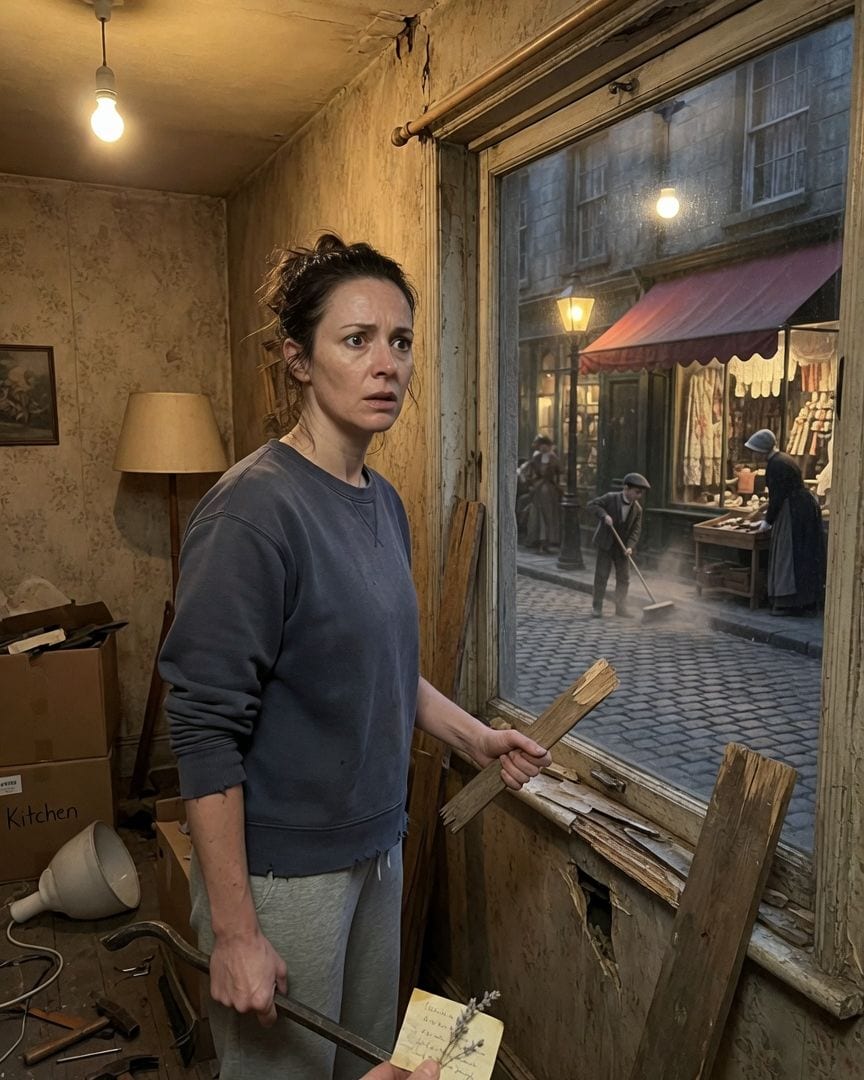
My boarded window showed a gaslit Victorian street. Across my flat, only a brick shaft. The wood felt soft, new when I nailed it back.
Moving into my new flat, I expected to find a grimy brick lightwell behind the boarded-up window. But as the last plank came free, my view wasn't a shaft at all. Instead, a bustling Victorian street, complete with gaslight and a boy sweeping, stretched out before me – a vibrant, living scene that simply shouldn't exist.
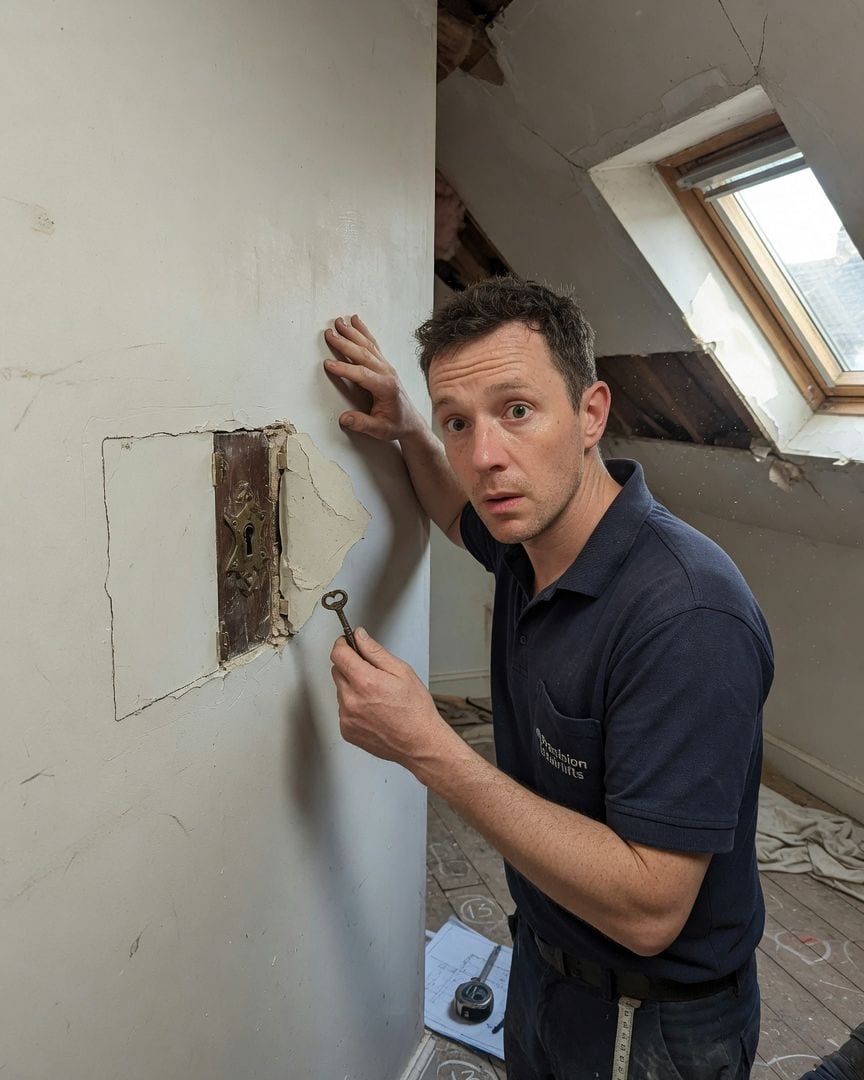
My stairlift tape measures thirteen steps, but my own feet always find a fourteenth — to a door that isn't there.
As a meticulous fitter, I measured my client's new loft stairs, confirming thirteen solid steps. But my foot found a shallow, impossible half-step, leading to a plain wooden door that shouldn't exist. Now the door is gone, leaving only a ghost outline.
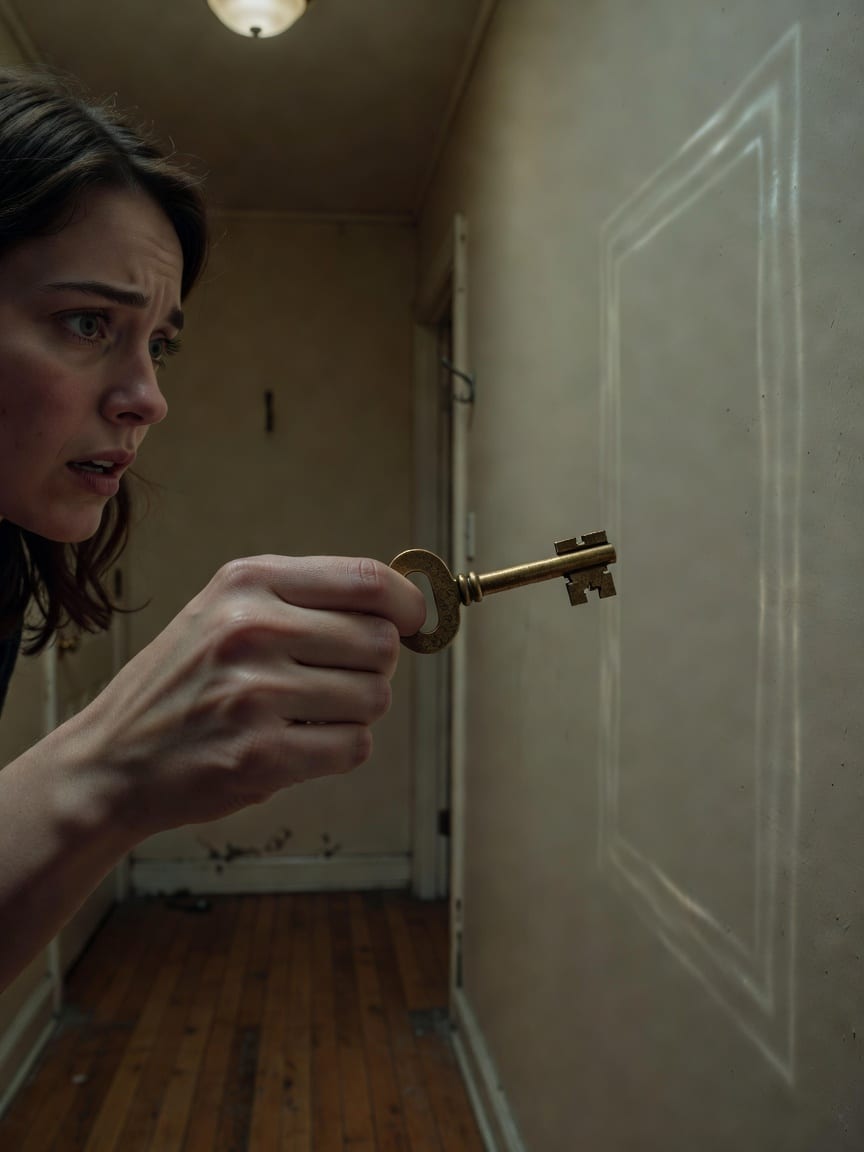
My new house has seven rooms. The removal men counted six. Now one of them asks who's in the locked seventh, on a landing with only six doors.
Moving into my new house, I supervised the removal men hauling boxes. But on the landing, Paul, the senior man, asked about a locked seventh room upstairs, pointing to a blank wall. His quiet certainty, despite the clear absence of a door, filled me with a sudden, icy dread.
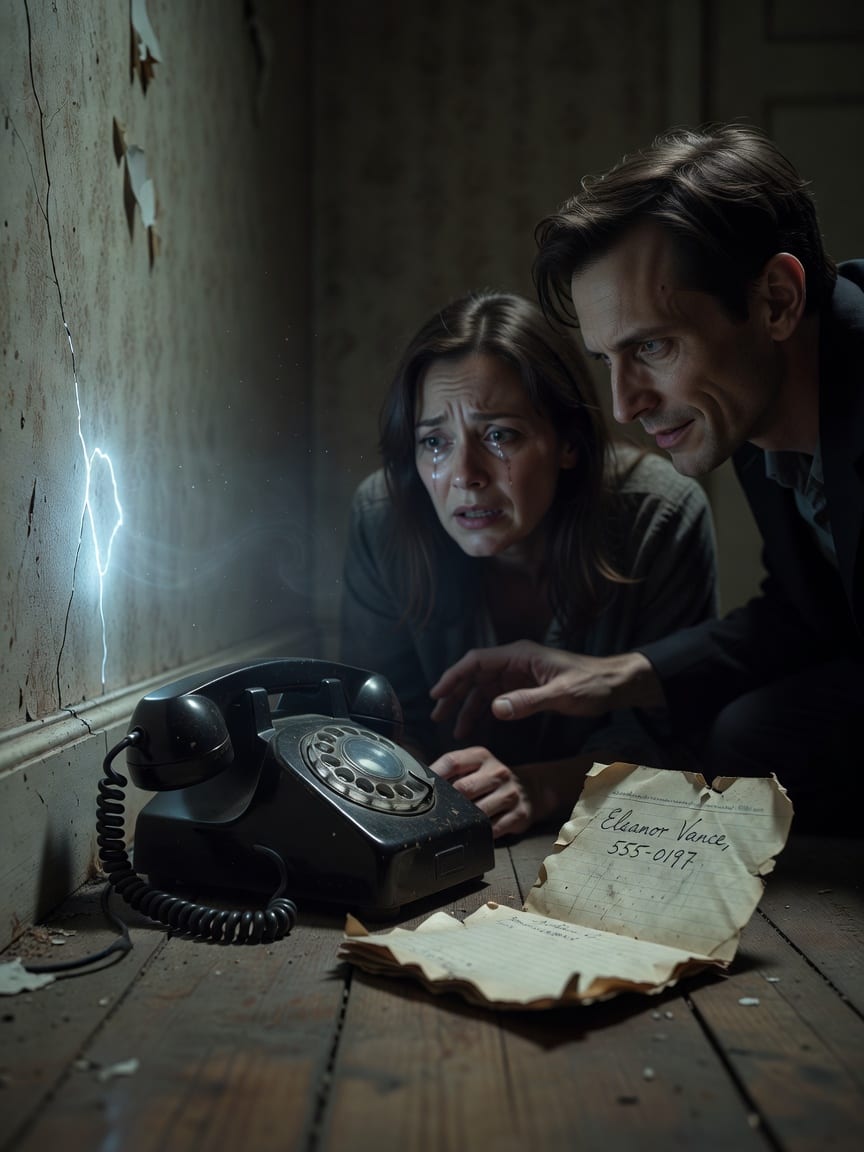
My house's walls ring when I dial a phone number from a 1974 directory. My neighbors said that directory was trash.
I was sifting boxes in my new house when I found an old 1974 telephone directory for my street. It listed my address, 12 Elm Street, under the name "Mr. & Mrs. Sheppard." On a whim, I called the faded seven-digit number. My cell phone rang, but a low, muffled sound also vibrated from the wall beside me.
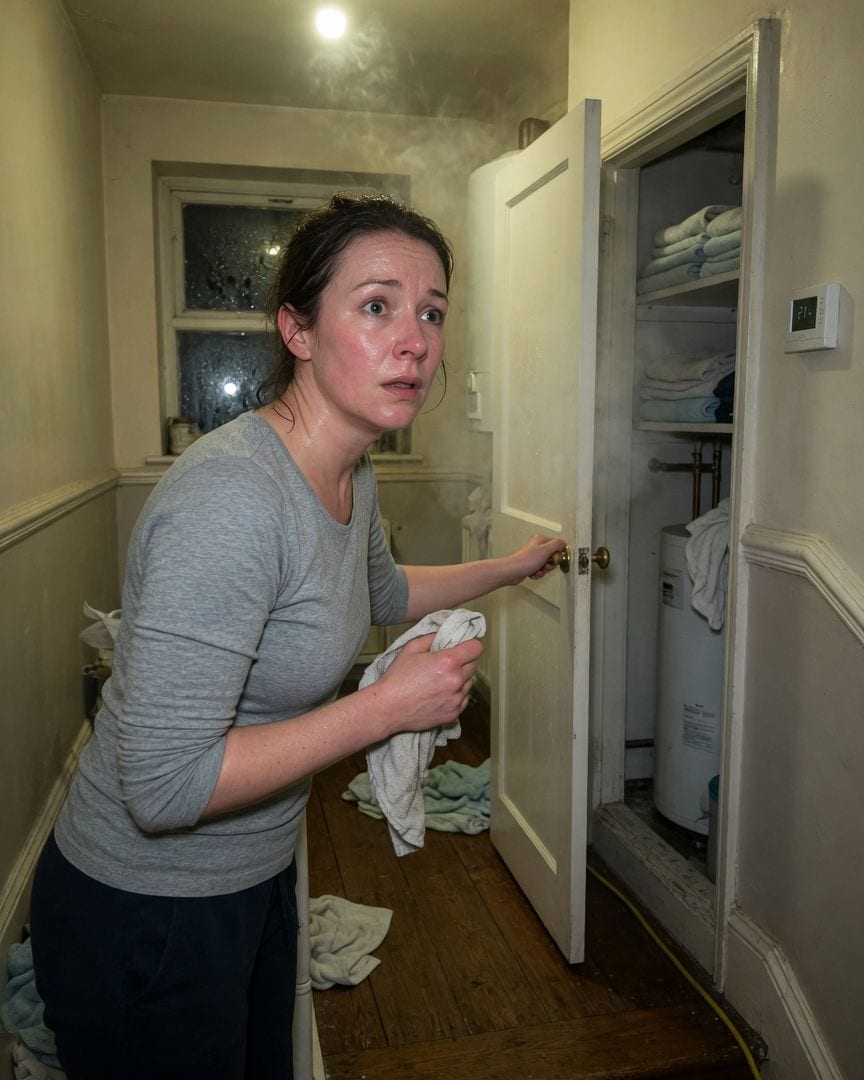
My airing cupboard opened onto a burning brick copper, sheets boiling. The heat rolled out, smelling of soda and wet linen. I shut it; my boiler was back.
My new house, bought just last spring, felt colder than expected. When I opened the airing cupboard, it wasn't mine at all, but a blast of steam and a roaring fire from an impossible past. Days later, a faint, metallic smell still drifted from the landing, and a worn path on the floorboards led to a hidden, ancient sampler beneath my feet, dated 1892.