My new house has seven rooms. The removal men counted six. Now one of them asks who's in the locked seventh, on a landing with only six doors.
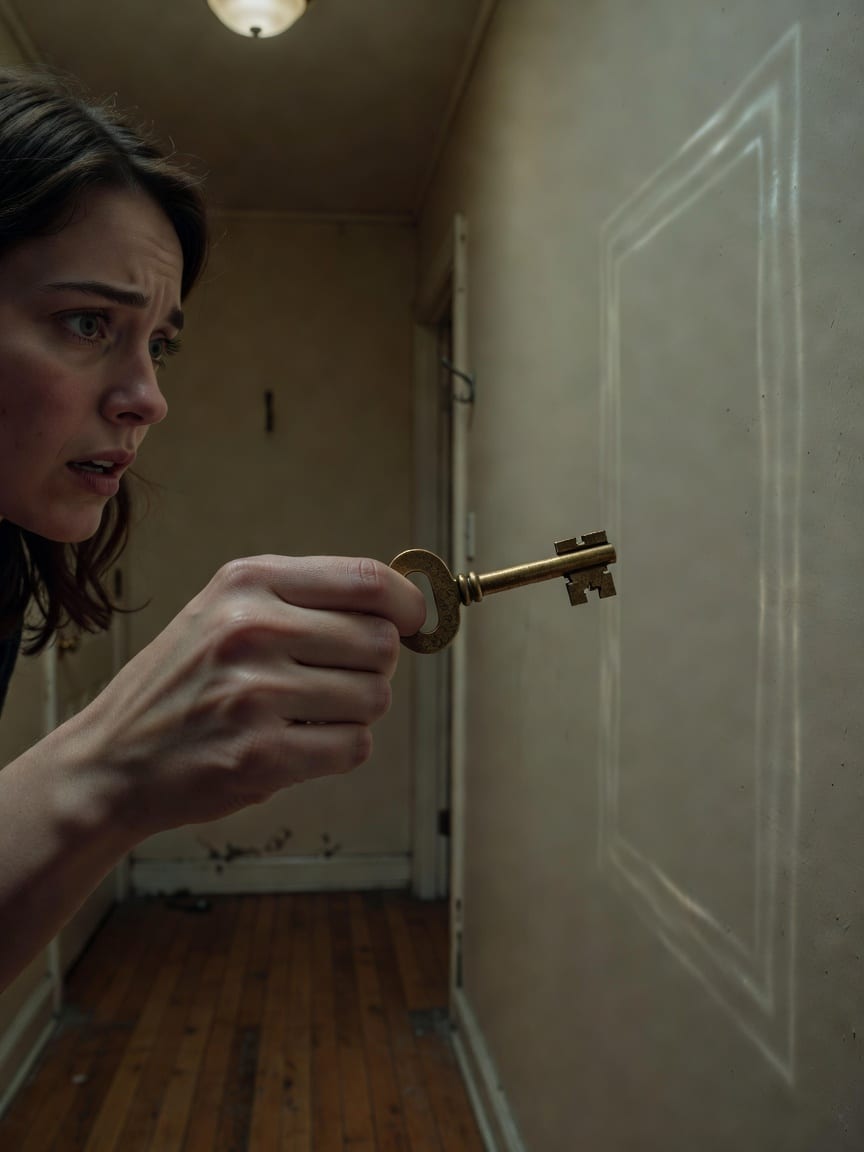
The empty house smelled of fresh paint and old wood. I stood in the living room, listening to Paul Sutton, the senior removal man, tick off boxes on his clipboard.
He had that weary, experienced air of a man who’d seen a thousand moves. "Okay, Miss Montgomery, that's six rooms downstairs, and six upstairs for the quote," he said, scribbling a neat 'six' next to "Upper Floor."
Moving day was a blur of boxes. Paul and Scott Ellison, his younger, muscled partner, hauled the heavy stuff up the narrow staircase.
I was bringing up a smaller box of kitchen essentials when I heard Paul stop on the landing.
"Who’s in the seventh room, the locked one?" Paul asked Scott, his voice oddly flat.
Scott grunted. "Seventh? There ain't no seventh room, boss. Just six."
Paul didn't move. I watched him from the bottom of the stairs, a box of mismatched cutlery digging into my ribs.
He was looking directly at the blank stretch of wall between the bathroom and what would be my new office, where no door was. Then he slowly turned to me, a puzzled frown creasing his forehead.
"Miss Montgomery, sorry, but is someone in that room? The locked one, right here?" He pointed to the empty wall.
I stared at him. "Paul, there are only six rooms upstairs. Three on each side. Six doors. No seventh."
His brow furrowed deeper. "No, I swear to God. When I did the quote, I distinctly remember a seventh door, locked. Right here. Maybe the light was playing tricks." He shook his head, looking back at the wall.
"But it felt solid."
I tried to laugh it off, though the sound caught in my throat. "It must have been the light, Paul. Long day."
But the quiet certainty in his voice, the way his eyes kept flicking back to that blank wall, made my stomach clench.
"Let's go, boss," Scott said, already halfway into the spare bedroom.
Paul nodded slowly, but he didn't move right away. He just stood there for another beat, staring at the wall. The house felt suddenly colder. He finally joined me, and we walked up together.
He counted the visible doors again, once, twice, a third time, his lips moving silently. His face was pale now, not just from effort. "Damn," he mumbled, shaking his head. "Must be tired eyes. Long damn day."
He tried to smile, but it didn't reach his eyes. I saw his face. The dread settled, cold and heavy, not in my stomach anymore, but in my chest.
The next morning, the removal men gone, the house quiet, I found myself drawn to the landing. The sun poured in through the skylight, bright and unforgiving. I counted the doors, again: three on the left, three on the right.
Six. Just as the blueprints, which I’d reviewed countless times, showed. No seventh.
I ran my hand along the wall where Paul had gestured, searching for any seam, any faint outline of a forgotten door. Nothing. The plaster was smooth, continuous. Yet the memory of his pale face, his insistence, gnawed at me.
I tapped the wall, listening for differences in sound. It was solid, just like any other wall.
I even pressed my ear against it, half-expecting to hear a murmur, a whisper, but there was only the hollow silence of an old house.
I tried to rationalize it away, chalking it up to Paul’s fatigue, or maybe a trick of the old house’s eccentric design, a shadow from the dormer window playing a cruel joke.
The brain sees what it expects to see, right? Or what it thinks it saw.
But then, a tiny, almost imperceptible gap between two floorboards at the base of the wall, directly beneath the spot Paul had pointed to, caught my eye. It wasn’t a natural crack.
It was too neat, too deliberate to be accidental, like a hidden seam. The wood was darker there, as if a small section had been repeatedly disturbed.
I knelt, feeling a strange thrumming in my fingers. I went back to a half-unpacked box in the kitchen, grabbed a butter knife, and returned to the landing.
My hands were shaking slightly as I inserted the blade into the gap. With a soft groan of old wood, a section of floorboard, about six inches wide and a foot long, lifted.
Inside, nestled in the dust and cobwebs of decades, lay a single object.
It was a heavy, tarnished brass key. Intricately carved, its head was a swirling pattern of leaves and vines, unlike any key I’d ever seen.
It felt ancient, cold in my hand, and seemed to hum with a silent, unsettling question.
I stared at the key, its weight strangely significant, pressing into my palm. It was too elaborate for a garden shed, too old for the new locks I’d just installed on the front and back doors.
It felt like a secret, a tangible piece of the wrongness Paul had sensed, a physical manifestation of the impossible. I looked up at the blank wall, then back at the key, then back at the wall.
The space where the seventh door wasn't, the space where the key now felt like it belonged, a cold, silent partner to the empty plaster.
A chill that had nothing to do with the draft from the open window ran down my spine. The house, I realized, had just given me a weapon, or perhaps, a hidden map to its own impossible heart.
The key became an obsession. For days, I walked around the house, the heavy brass lump in my pocket, trying to find a lock it fit.
Every door, every cabinet, every antique chest or cupboard I could find – I tried them all. It remained stubbornly useless, a beautiful, anachronistic piece of metal that seemed to mock my efforts.
I tried the rational approach. I researched the house's address online, digging through local archives, old real estate listings, and historical society forums. Most information was mundane: property transfers, minor renovations over the years, previous owners listed.
Nothing about a seventh room, nothing about strange architecture.
I found a grainy black-and-white photo from the 1970s, a wide shot of the house exterior.
Squinting at the printout with a magnifying glass, I could almost make out a faint irregularity on the second floor where the landing would be – a slight indentation in the brickwork that could suggest a filled-in window or, impossibly, a bricked-up door.
It was too ambiguous to be proof, too easy to dismiss as a shadow or a trick of the old camera, but it fueled my unease. It was enough to stop me from letting go.
Then, tucked away in an obscure digital archive of local newspaper clippings, I discovered a brief, single-paragraph mention from 1958. It spoke of the unexplained disappearance of a young woman named Isabella Radcliffe from a "local residence."
The address wasn't specified, but the timing felt too coincidental, too close to the possibility I was beginning to dread.
I tried to find any mention of a seventh room in the house's history, but all official blueprints and deeds consistently showed six. Six, six, six.
The key felt heavier with each dead end, a constant, silent reproach that I was missing something vital.
I drove past the local historical society building several times, a red-brick edifice with ivy creeping up its walls. I debated whether to go in, feeling foolish for even considering it. What would I say?
"Excuse me, does my house have a phantom seventh room that only appears to removal men?" The thought was absurd.
Yet, the house, meanwhile, felt larger than it should. The landing seemed more expansive, the air around the blank wall thicker, heavier, as if it were holding its breath, waiting.
Finally, driven by a growing sense of urgency that I couldn't ignore, I visited the historical society. The volunteer at the desk, Carl Hayes, was a man in his mid-seventies with sharp, knowing eyes that seemed to take in everything.
He greeted me with an unnerving calm.
When I mentioned my address – "34 Elmwood Drive" – his gaze sharpened, a faint, almost imperceptible smile playing on his lips. "Ah, the old Montgomery place," he said, his voice surprisingly robust for his age.
"Been in the family for generations, until Mrs. Montgomery passed, bless her. Things change, but some things… they have a way of changing back, don't they?"
I felt a prickle of alarm. He said "Montgomery place," not "Radcliffe place" or even "my place." He knew. "I'm Rachel Montgomery," I clarified, ignoring the sudden chill down my spine. "I bought it recently.
I'm trying to find some old plans. Specifically, I'm wondering if there was ever a seven-room layout? All the modern records show six."
Carl leaned forward, his voice dropping to a low, conspiratorial tone. "Property records are funny things, Miss Montgomery. They tell you what people want you to know. Not always what is." He paused, his eyes still fixed on mine.
"Some houses have a memory. They remember things that people try to forget." He spoke of "the old ways" and "the house's memory" in a tone that was both matter-of-fact and deeply unsettling.
He didn't answer my direct questions about the seventh room. Instead, he offered cryptic remarks about "spaces that don't quite settle" and "things lost that want to be found."
I felt observed, as if Carl knew exactly what I was searching for, and perhaps even knew about the key in my pocket.
"You know," he mused, "it's funny you ask about that house. There was a young woman, Isabella Radcliffe, lived there back in the fifties. Went missing. Very sad business." He confirmed it was indeed from my house.
"Some say she just left," Carl added, leaning back, his expression unreadable. "But the house… it remembers differently. Especially the landing."
He rummaged through a box behind the counter and handed me a faded, uncatalogued photograph. It was of my house from the 1930s, taken from an unusual angle, showing the side facade.
But even in that old image, the landing still showed only six windows, neatly spaced. No sign of a missing seventh.
He watched me intently as I left, his gaze following me until I was out of sight, an unreadable expression on his face, as if he'd just imparted a dangerous secret.
The photograph was a dead end, a red herring, but Carl's words echoed in my head. "The house… it remembers differently. Especially the landing." I couldn't shake the feeling he knew far more than he was letting on.
I returned to the historical society the next day, determined to get answers.
"Mr. Hayes," I began, approaching his desk, my voice firmer than I felt. "You mentioned Isabella Radcliffe. And you said the house remembers differently. What does that mean?"
Carl sighed, a long, weary sound that seemed to carry the weight of decades. He gestured for me to sit. "Isabella was a beautiful girl, barely nineteen. Full of life. She lived there with her parents back in '58.
Her room was… special."
"Special how?" I pressed, leaning forward. "Was it the seventh room?"
Carl nodded slowly, his eyes fixed on some distant point. "The house was built with seven rooms, originally. Back in 1910. A nursery, they called it, though it was rarely used for its intended purpose.
After Isabella… went missing in 1958, that room… it just wasn't there anymore. Not for anyone else, anyway."
A cold wave washed over me, a dread far deeper than anything I'd felt before. "It vanished? How?" My voice was barely a whisper.
Carl shrugged, a movement that seemed to ripple through his frail frame. "The geometry changed. The walls, the distances. People swore it was physically gone. The official records were updated, plans redrawn. As if it never existed."
He explained how my house had always been known locally for its "shifting spaces," a quiet anomaly accepted by generations, murmured about in hushed tones. "Isabella disappeared from that room. No body, no note. Just… gone.
And the room went with her."
My mind reeled, pulling disparate threads together. Paul Sutton’s pale face, his insistence on counting a seventh door. The loose floorboard, the ancient key, waiting patiently in the dust. It all clicked into a horrifying, impossible coherence.
The key wasn't for a forgotten lock on an existing door; it was for a forgotten place, a room that had been erased.
The house wasn’t just old; it was a living, breathing memorial to a disappearance, its very structure warped by loss.
"But why did the removal man see it?" I whispered, my gaze fixed on Carl. "Why did I find this?"
I pulled the tarnished brass key from my pocket and held it up, its intricate head glinting in the dim light of the society office.
Carl's eyes widened slightly, a flicker of genuine surprise – the first real emotion I’d seen from him. He stared at the key as if it were a ghost. "So it's coming back," he murmured, his voice hushed with awe.
"The house… it’s showing you what it saw."
Carl leaned back, a new gravity in his eyes. He looked at the key in my hand, then at me. "There was one document," he said, his voice barely a whisper, as if sharing a sacred secret.
"An original survey map from 1910. Showed the house as it truly was. Seven rooms. It disappeared from the county archives around the same time Isabella did. I always suspected…" He trailed off, his gaze distant.
Then, with a sudden decision, he rose and went to a locked cabinet behind his desk.
He fumbled with a small, silver key, its jingle loud in the quiet room, then pulled out a tightly rolled, brittle document, tied with a faded ribbon. "I made a copy, years ago. Just in case.
Never thought I’d need it."
He unrolled it carefully on the dusty table between us, its yellowed edges crumbling slightly. It was undeniably official, bearing the embossed seal of the county surveyor, faded but distinct. Rachel's gaze went straight to the second floor.
There it was: a clear, undeniable seventh room on the landing, labeled 'Nursery.' Not a trick of the light, not a hallucination, but a factual, architectural blueprint of a room that, for decades, had ceased to exist.
The impossible geometry wasn't a myth; it was a documented fact, a record that could not be, yet lay before her, irrefutable proof. Her breath hitched. The house had swallowed a girl, and then it had swallowed a room.
And now, it was showing her the receipt.
Carl Hayes pressed a brittle, folded document into Rachel's hand – a 1910 survey map of her house, yellowed with age, showing a clear, undeniable seventh room on the landing, labeled 'Nursery,' a room that officially cannot exist.
I spent the next few days verifying the survey map. Its paper, the ink, the faint, embossed seal – everything was consistent with 1910 documents. It was real. Carl Hayes, when I showed him the authentication, simply nodded.
He explained the house's peculiar nature in more detail: "It's a memory, Miss Montgomery. A scar. When Isabella vanished, the house folded in on itself. That room became an absence.
But sometimes, when the conditions are right, or when someone is looking, really looking, the house… it remembers. It lets the seventh room show itself, for a moment.
It's not always there for everyone, but it’s always there, in a way."
He spoke of Isabella's final hours, how she’d been distressed. She’d had an argument with her parents, locked herself in the nursery. Her mother heard her crying, then silence. The door was still locked from the inside.
When they finally broke it down, the room was empty. No window open, no hidden passage. Just… gone. And the room itself, shortly after, faded from reality for everyone else.
Carl believed the house hadn't just 'erased' the room; it had somehow absorbed it, trapping Isabella within its impossible geometry.
The recurrence of the room was the house's way of trying to 'return' what it held, or perhaps, to show others what happened.
The pattern was clear: the house held a secret, a geometric anomaly tied to a human tragedy, manifesting only to those who dared to seek it.
Armed with the map and Carl’s chilling story, I returned to the landing. I held the tarnished brass key. The wall where the seventh door should be felt different today.
Not visibly different, but a subtle shift in the air pressure, a faint, almost imperceptible shimmer in the plaster if I squinted just right. A cold draft, like a breath, brushed my cheek.
I pressed the key against the wall, not trying to find a lock, but sensing, feeling for a connection. My fingers traced the blank surface, moving slowly, deliberately, over the spot where the map showed the ‘Nursery’ door.
The wall felt solid, cold, then for a fraction of a second, I felt a faint vibration, a hum that seemed to come from inside the house's very bones.
Then, with a soft, distinct click that resonated deep within the old house, a hairline seam appeared in the plaster.
It wasn't a door, but a faint outline, tracing the edge of a small, rectangular panel, no bigger than my hand. The key wasn't for a door, but for a hidden compartment. My breath caught in my throat.
I twisted the key, gingerly, and the panel, with a barely audible groan, swung inward. It revealed a dark, dusty cavity, smelling faintly of old wood and something else, something dry and earthy, like forgotten time.
Reaching inside, my fingers brushed against something hard and smooth, tucked deep within. I pulled it out.
It was a small wooden locket, intricately carved, its surface worn smooth with age, almost polished by countless touches. My hands were trembling as I opened it.
Inside were two tiny, faded photographs: one of a smiling young woman with bright, hopeful eyes – Isabella Radcliffe. The other, a handsome young man, his smile a mirror of hers, presumably her sweetheart.
Engraved on the back in delicate script were the initials 'IR' and the date '1958'.
It was an artifact that could not exist, found in a room that could not exist.
I held the locket, the weight of it a tangible connection to Isabella, to the impossible geometry, to the house's enduring memory. The ordinary explanation for everything I’d experienced—Paul’s fatigue, my imagination, mere coincidence—died a final, quiet death.
The locket was real, dated, and checkable, proving the house’s impossible truth.
I sealed the locket in a fireproof box, a silent testament to Isabella and the house’s secret. I didn't try to alert authorities; what could I tell them?
That my house swallowed a girl and a room, and occasionally manifests them? They’d think I was crazy.
Carl Hayes, upon seeing the locket, simply nodded, a look of profound, quiet understanding on his face, as if a long-held suspicion had finally been confirmed.
The house still stands, its six rooms solid and real. But now, I see the landing differently.
I know the seventh room is always there, a whisper behind the plaster, waiting for the right moment, the right gaze, to reveal itself once more.
I live with the knowledge, the constant, low thrum of impossible geometry beneath my feet.
The house is quiet now, the bustle of moving long over. I still live there. I haven't seen the seventh room manifest again, not since I found the locket.
But sometimes, late at night, when the house settles and the old timbers creak, I walk to the landing.
I run my hand along the blank wall, and sometimes, for just a fleeting second, I feel a cold draft, a breath from an invisible space. I know the house holds its secrets close, but it showed me one.
It showed me Isabella. The impossible geometry is a permanent resident, a quiet hum beneath the surface of my ordinary life. I keep the locket in my bedside drawer, a tangible piece of the impossible.
I know the seventh room is still there, waiting for its next moment. And sometimes, when I’m alone on the landing, I wonder if it’s looking back at me.
If this one got to you
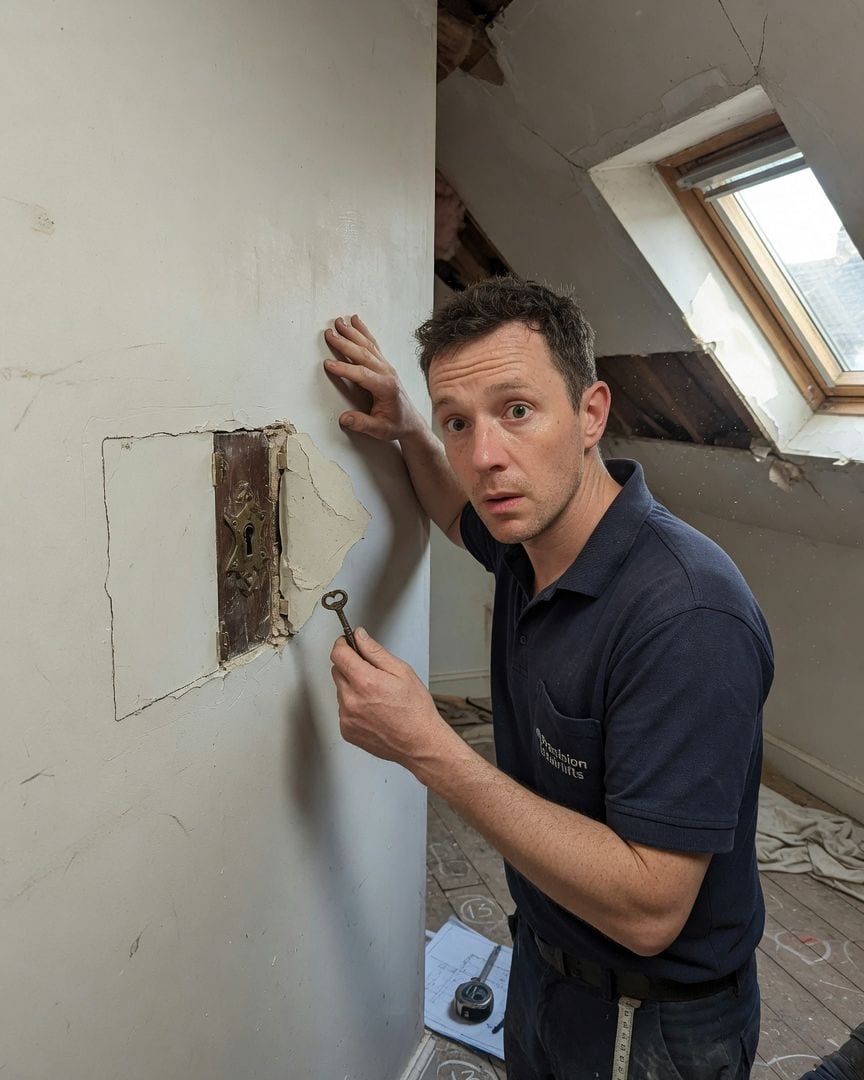
My stairlift tape measures thirteen steps, but my own feet always find a fourteenth — to a door that isn't there.
As a meticulous fitter, I measured my client's new loft stairs, confirming thirteen solid steps. But my foot found a shallow, impossible half-step, leading to a plain wooden door that shouldn't exist. Now the door is gone, leaving only a ghost outline.
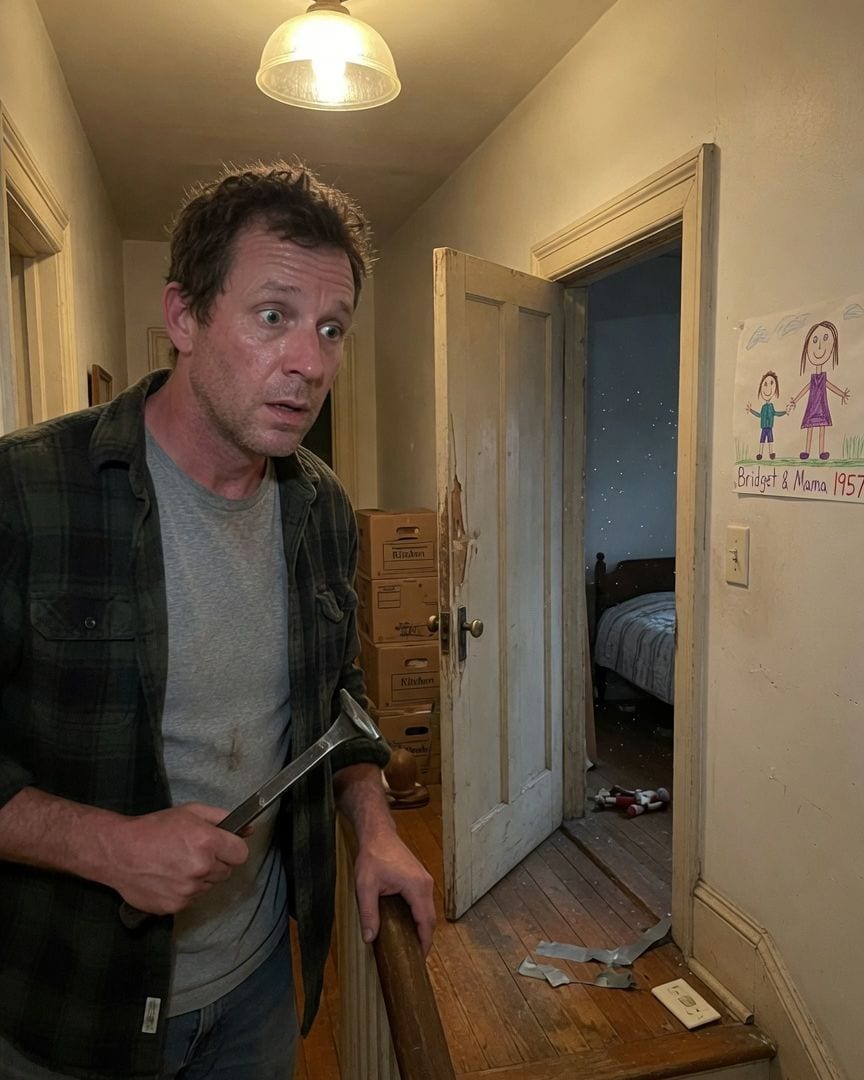
My landing light switches itself off at 9:40 every night. I've watched the switch flick down under nothing, the tape peeled back. The house holds its breath.
My great-uncle's old house was a quiet gift, a place to finally settle. But as I unpacked, a strange worn path on the floorboards led me to a small, barely visible door, perfectly blended into the wall. It was undeniably locked, and felt like a deliberately obscured secret.
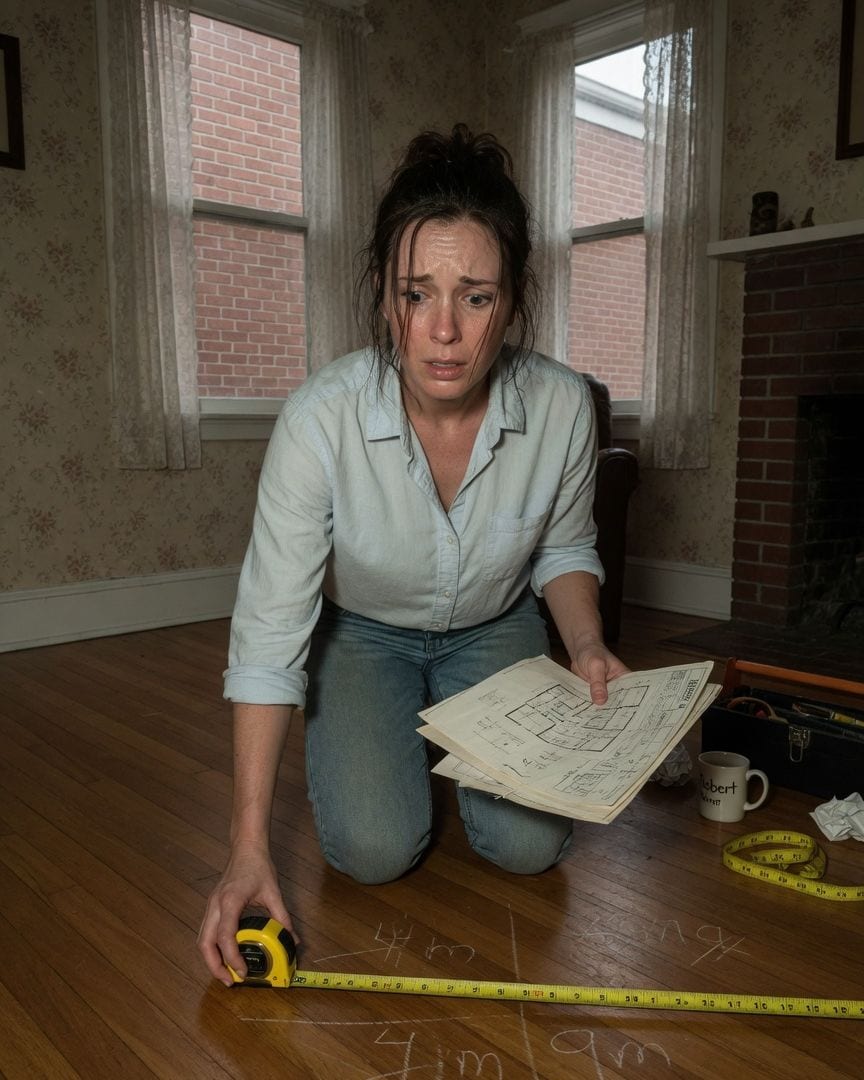
Our living room measures four by five metres. But the outside wall is nine metres long. A metre of house, gone, and I can't find it.
After moving into our charming 1920s house, I was meticulously measuring the living room when the dimensions refused to add up. My calculations of the interior space led me to discover a narrow, unpainted fifth door in the hallway, tucked almost out of sight. It wasn't on any original plans, and it opened to absolute, impenetrable darkness.
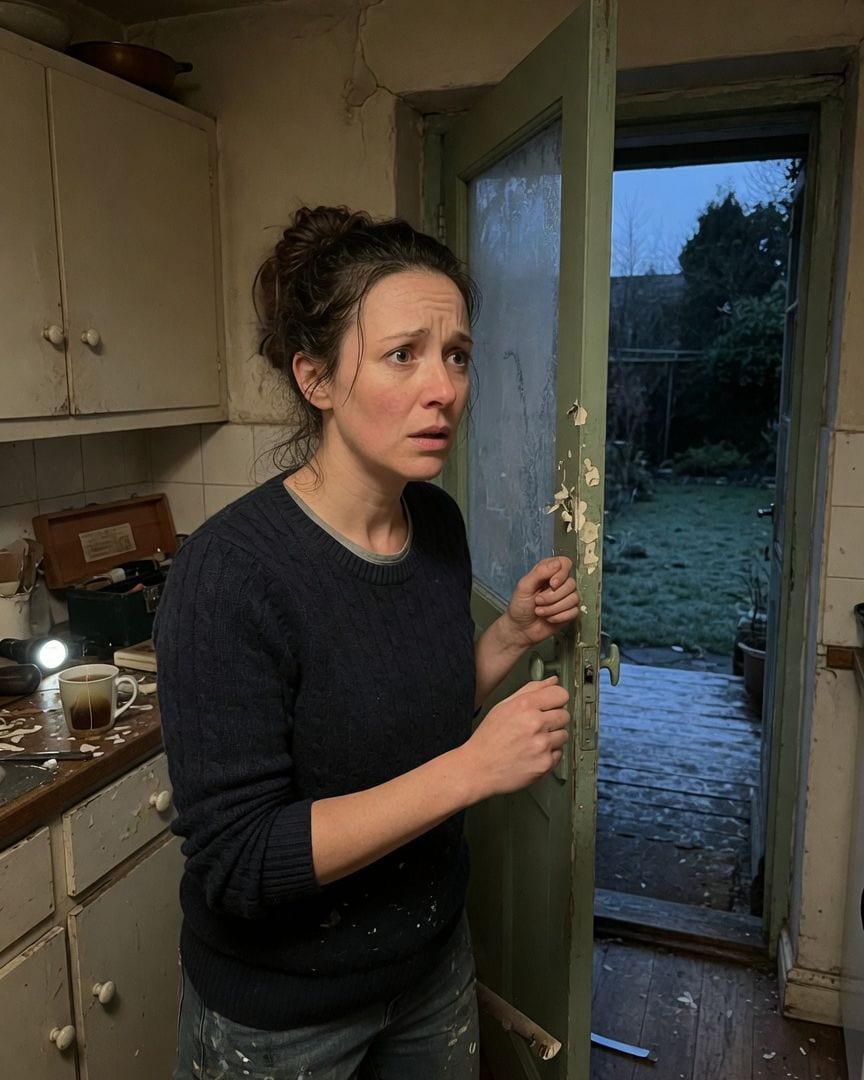
My 1950s cottage doorframe has '1923' carved into it, a date that simply cannot exist here.
I'd poured my heart into renovating my new cottage, especially the back door to my patio. But when I opened it, I wasn't looking at my frost-kissed garden. Instead, a cramped, reeking scullery with a bone-chilling dampness stared back, an impossible image that wouldn't leave my mind, even after the door closed.
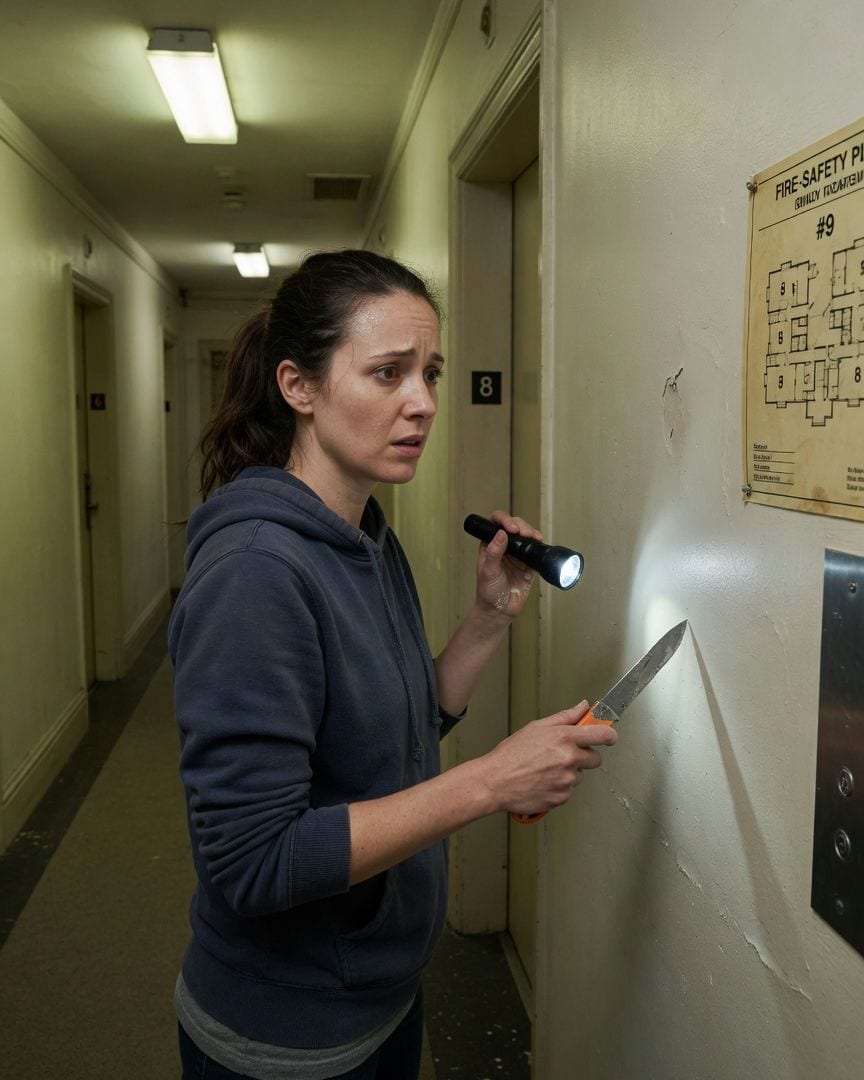
That blank wall in my hallway has a hidden metal plate. Tonight, after eleven years, it just clicked.
For eleven years, my apartment building's fire plan has shown nine apartments on my floor. But I've only ever counted eight doors, the space for the ninth a blank wall. Now, I've found a hidden metal plate behind the plaster, and from deep within, I just heard a soft *click*.
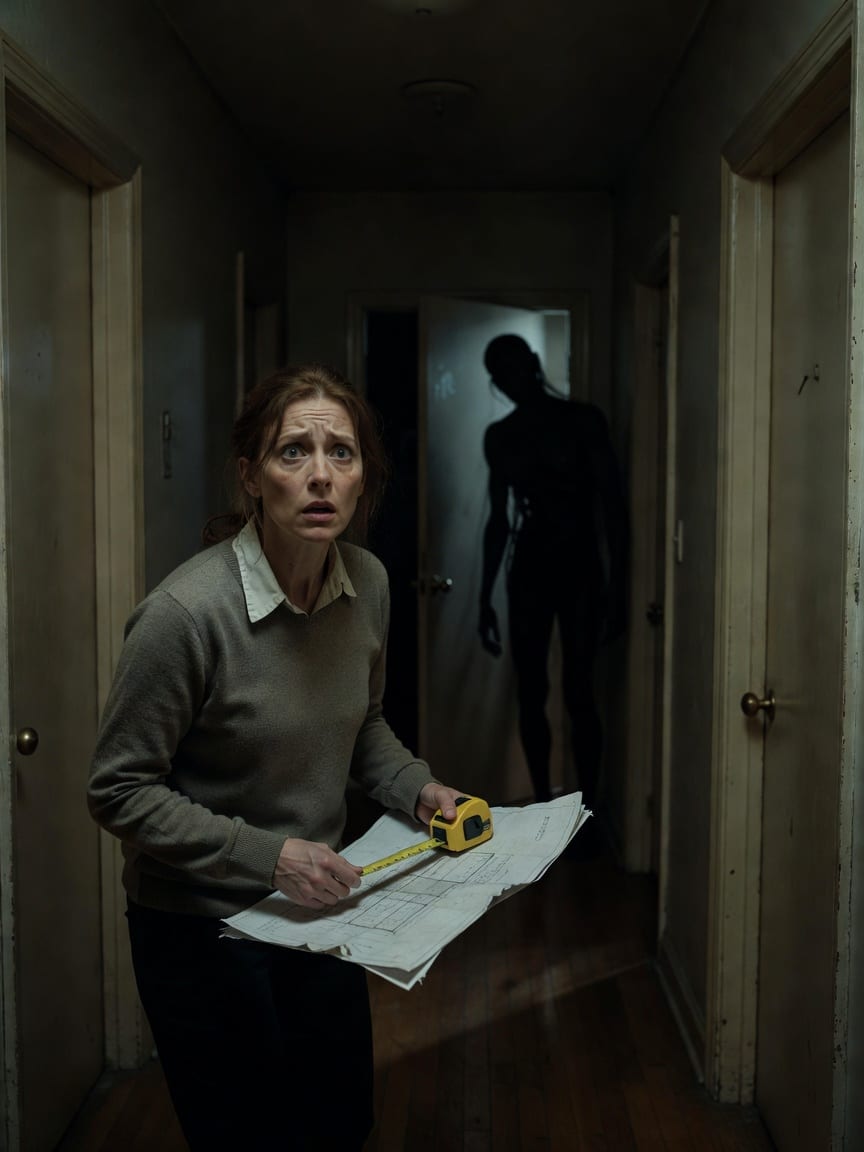
My front door has a dented gate and a dead hydrangea. I walked past it six times, trying to reach the corner shop just a hundred yards away. The pavement kept bringing me back to my own porch, and the shop's light never moved.
My morning started like any other, a quick walk to the corner shop from my home at Number 14, Elm Terrace. But after walking what felt like two minutes, I found myself back at my own front door, the shop no closer. I tried six times, faster and slower, but my street kept compressing, refusing to let me leave.