My front door has a dented gate and a dead hydrangea. I walked past it six times, trying to reach the corner shop just a hundred yards away. The pavement kept bringing me back to my own porch, and the shop's light never moved.
The morning started like any other. Crisp air, a weak sun trying to burn off the fog, and the familiar sight of my front door, Number 14, Elm Terrace.
I was out of milk, so a quick hundred-yard walk to the corner shop was in order.
I locked the door, stepped onto the pavement, and turned left, past the dented gate and the withered brown stalks of what used to be a hydrangea.
The shop’s neon sign, a blurry red glow even in daylight, was clearly visible down the street.
I walked. Then I walked some more. The street was quiet, the usual Tuesday morning hum. But after what felt like two minutes, I stopped. Something was wrong. The dented gate. The dead hydrangea. My front door.
I was back where I started. I must have been distracted, took a wrong turn, maybe looped around the block without realizing. Ridiculous. It was a straight shot.
I laughed, a little, to myself. Tired, I told myself. Too early. I set out again, deliberately this time, focusing on the paving slabs, the faded paint on the houses, counting off the distance.
One hundred yards, maybe a hundred and twenty. I kept my eyes fixed on the shop’s red light. It remained ahead, a steady, unmoving beacon. And yet, the crunch of my own gravel path underfoot was unmistakable.
There it was again: the dented gate, the dead hydrangea, my own front door. This time, my breath hitched.
I tried again. Faster. Slower. Staring at the shop, then looking down, trying not to notice anything. Each time, the world felt… compressed. The distance was there, yet it wasn’t traversed.
My feet carried me forward, but the destination remained fixed, and the origin point kept reappearing. Six times. Six damn times, I walked away from my house, only to walk straight back to it.
The red neon sign of the corner shop never once seemed to get closer. It was always there, a hundred yards away, mocking me.
Shaken, I finally retreated inside, yanking the dented gate shut with more force than necessary, as if its flimsy metal could keep the impossible street out.
My hands were trembling as I made a strong coffee, the bitter aroma doing little to settle my nerves. This was just… exhaustion. A momentary lapse. I needed to ground myself.
I decided to clean. Something mundane, something physical. I started with the rarely-used guest bathroom, wiping down the dusty shelves. It was a small room, tucked away, no windows. As my cloth traced the cool tiles, I noticed something.
A faint seam in the wallpaper, almost invisible against the floral pattern, where the wall met the far corner. It looked… like a doorframe. A ghost of one. I pressed against it, expecting nothing, a solid wall.
Instead, a small, perfectly ordinary, unpainted wooden door swung inward, silent and smooth. Beyond it, a small, featureless room was revealed.
The coffee cup almost slipped from my grasp. I stared. I’d lived in this house for seven years. Seven years.
I’d walked every inch, scrubbed every corner, pulled up the property plans from the council archives when I bought the place. This room. It wasn’t on those plans. It couldn't be.
I stumbled out of the bathroom, my heart thudding. I started counting, aloud, like a madwoman. The kitchen, the living room, the study, the guest bath, my bedroom, the main bath. That was six rooms on the first floor.
I walked outside, peered at the windows from the garden. Six windows on the ground floor. Six rooms.
But inside, there was now a seventh. A small, empty box, no windows, no furniture, just plain, unpainted walls, and the strange, still air that felt colder than the rest of the house. It shouldn’t be there.
I walked into it, the floorboards silent under my shoes. It was just a space. An extra space. But it shouldn’t be there.
Driven by a cold certainty that had nothing to do with rationality, I knelt in the center of the 'extra' room. The floorboards were old, uneven beneath my fingers. One felt slightly loose, just barely.
My mind raced, connecting the impossible room to the impossible walk. I went to the kitchen, grabbed a knife, and returned. With trembling hands, I pried up the loose board.
It groaned, then lifted, revealing a small, dusty cavity underneath. Inside, folded and brittle with age, was a single sheet of paper. A newspaper clipping. Yellowed, ink faded, but still legible. The date, 1993, was clear at the top.
The headline, stark and chilling, read: 'Local Woman Vanishes From Elm Terrace Home – Reports of Disorientation Preceded Disappearance.' My breath hitched, a cold knot tightening in my chest.
And beneath it, in smaller print, the address: 'Number 14, Elm Terrace.' My own address.
The newspaper clipping became my obsession. I spread it out on my kitchen table, studying every faded word, every grainy detail. The woman’s name, Evelyn Thorne. She’d vanished without a trace.
Her neighbors reported her acting strangely in the weeks prior – talking about her street ‘stretching,’ her house ‘feeling bigger on the inside.’
Days bled into weeks at the local library. I sat hunched over microfiche readers, the hum of the machine a constant drone in my ears, poring over dusty archives and old property deeds.
I found more articles, not just from the 90s, but from the 60s, describing similar, inexplicable disappearances in the Elm Terrace area. Always preceded by accounts of 'getting lost on familiar roads' or 'rooms appearing and vanishing.'
The dates weren't random. There seemed to be an irregular but distinct pattern, a pulse that quickened and then faded, only to return years later.
I cross-referenced old town maps with current ones, tracing property lines, trying to find discrepancies around my street. Subtle shifts emerged. Roads that once curved differently, a whole block that seemed to have shrunk by a few yards, almost imperceptibly.
My own house, Number 14, always seemed to be at the epicenter of these ghost shifts.
The 'extra' room in my house remained. A silent, impossible testament to the fact that my mind wasn't breaking. I drew diagrams, counted windows from the outside, then from the inside, measured external walls, then internal ones.
The numbers never reconciled. My house was demonstrably larger from the inside than the outside, or vice versa, by the exact dimension of that impossible room.
The dread wasn't just that it was wrong, but that it was consistently wrong, always by the same inexplicable margin. It felt like a mathematical equation that stubbornly refused to balance, yet always arrived at the same impossible answer.
Every time I thought I had it figured out, the numbers would mock me.
My research extended to the library’s local history section, where I sought out obscure folklore. Anything that might explain what I was seeing.
One afternoon, tucked away on a dusty bottom shelf, I found a slim, leather-bound volume titled 'Echoes of the Shifting Ground,' detailing local legends of paths that lead nowhere and houses that 'breathe.'
I checked it out, feeling a cold ripple of recognition.
The next morning, I stepped onto my porch for the newspaper, and saw something else. A different, much older book lay on the welcome mat: 'Local Oddities and Unexplained Phenomena.'
It was a book I hadn't seen in the library's catalog, not even listed.
It was open to a specific page, a passage underlined in neat, faded red ink: 'The spaces between places are not always empty, and sometimes, they return.' My heart hammered against my ribs.
I checked my front door security camera footage from the night before. Nothing. Just an empty porch, then suddenly, the book was there.
Later that day, I saw an old man, Roland Davenport, sitting on a bench in the small park across from my house, reading a newspaper. He looked to be in his late sixties, maybe early seventies.
He’d been there for hours. When I caught his eye, he offered a faint, unsettlingly calm smile, a smile that seemed to hold too much knowledge, before returning to his paper. He wasn't just a passerby.
He was watching my house. I remembered seeing him in the library, always near the local history section, always observing, never checking anything out. He was always just there.
I decided to confront him. It was a stupid idea, maybe, but the not-knowing was worse than any potential danger he posed. I walked across the street to the park, clutching the old book he'd left on my porch.
'Mr. Davenport?' I asked, my voice tight, trying to sound braver than I felt.
He looked up, his expression unreadable, not a flicker of surprise in his calm, pale eyes. 'Gloria Reynolds, isn't it? You live at Number 14.'
His calm familiarity unnerved me, a cold prickle on my skin. 'You left this on my porch,' I said, holding up the book, the old pages rustling slightly in the breeze. 'And you've been watching my house.'
He didn't deny it. He simply folded his newspaper with deliberate slowness, placing it beside him on the bench. 'You've been digging, haven't you? About the geometry, the loops, the rooms that aren't counted.' He paused, his gaze steady, unwavering.
'You found the clipping, I imagine. From '93.'
I just nodded, stunned by his directness. There was no point in pretending. 'What is it, Mr. Davenport? What's happening?'
Roland sighed, a sound of weary acceptance, as if he'd answered this question a thousand times before. 'It's a pattern, Gloria. A recurrence. Certain places, like your house, are… anchors. Points where the geometry of this place becomes permeable.
It folds in on itself, creates redundancies, or absences. That woman in '93, Evelyn Thorne, she got caught in one of the deeper folds. Lost her way, even inside her own home. Couldn't find her way out.'
He paused, meeting my gaze, and I felt a chill that had nothing to do with the cool park air. 'It's happened before. Centuries of it. The record that cannot be, the place that isn't on the map.
It's all the same thing.'
A cold dread spread through me, chilling me to the bone, as Roland spoke. My mind was reeling, trying to make sense of his dispassionate words.
'So, it's happened before,' I whispered, the words barely audible, 'and it's happening again now?'
Roland nodded slowly, his eyes still holding mine. 'Indeed. The cycles are predictable, to an extent. They intensify, peak, and then recede. The problem isn't the happening, Gloria. It's the being caught.
The loops you experienced on the street, the extra room that shouldn't exist… those are just the early signs. Your house, Number 14, is a particularly active node in this current cycle. It's not just affecting the street, Gloria.
It's affecting the very structure of your home, and by extension, you.'
He leaned forward, his voice dropping to a low, even hum, his gaze unnervingly steady. 'This house, Number 14,' he said, 'it's always been an anchor. The last cycle, 1993, it claimed the woman who lived here.
This one, Gloria, is reaching its peak. And you are at its very center.'
He gestured vaguely at the walls around them, and I felt the faint, impossible shift of something deep within the structure, a sighing or settling that wasn't structural, but something far more unsettling.
Roland explained the full, horrifying truth with dispassionate clarity. We remained in the park, the ordinary sounds of birdsong and distant traffic a surreal counterpoint to his words. 'The loops, the rooms, the shifting paths… they are not random.
They are the physical manifestations of a spatial anomaly, a persistent 'scar' on reality in this locale. It's like a tide, Gloria. It comes in, it goes out.
During its peak, the geometry of this area, particularly your house, becomes fluid. Distances become arbitrary, spaces become recursive, and sometimes, new spaces open up, or old ones close off, temporarily.'
He continued, his voice steady. 'The 'extra' room you found? That's one such opening, a direct conduit to the 'place that isn't on the map' — a non-space, a void of disorientation.
The clipping you found, the other disappearances… they were individuals who couldn't reconcile the impossible. They tried to fight it, to force rational sense onto an irrational phenomenon, and they became lost in the folds, essentially erased from this reality.'
He gestured around them, at the mundane park, the houses beyond. 'I've observed this for decades. My family, before me, for generations. We don't fight it. We learn its rhythm. We learn to navigate the wrongness.'
His calm explanation was more terrifying than any scream, for it implied a permanent, unchangeable order to the chaos. This wasn't a monster I could fight. It was a natural law, only one that bent the laws of physics.
I stared at Roland, my mind reeling, trying to absorb the enormity of what he was telling me. 'So, what do I do?' I asked, the question raw, a desperate plea for guidance. 'How do I survive it?'
Roland's eyes held no pity, only a quiet understanding, a deep, ancient wisdom. 'You don't fight the tide, Gloria. You learn to swim with it. The house will shift. Rooms will appear and disappear. Familiar corridors will become unfamiliar.
You must accept the wrongness. When a door appears where none should be, if you must enter, measure it. Count your steps. Always have a fixed point, something you can trust, even if it's just the dented gate outside.
The danger isn't the shift itself, but the panic, the refusal to adapt.'
He paused, letting his words sink in. 'The 'extra' room, it is a point of entry. During the peak, it can draw you in completely. You must not try to close it, or force it back.
You must learn to simply… exist around it.'
I returned home, the knowledge a heavy, chilling weight. The house felt different already, not just in my perception, but physically. As dusk fell, I heard a faint creak from the guest bathroom.
The 'extra' room's door was ajar, a sliver of impossible darkness visible within. I walked to my kitchen, my hand brushing the familiar counter. It felt subtly different, the texture alien, as if the wood had subtly changed its grain.
The floorboards underfoot seemed to sigh. The house was breathing.
I forced myself to breathe with it, to acknowledge the subtle, impossible shifts, to count the windows from the outside again, then from the inside, knowing they would not match.
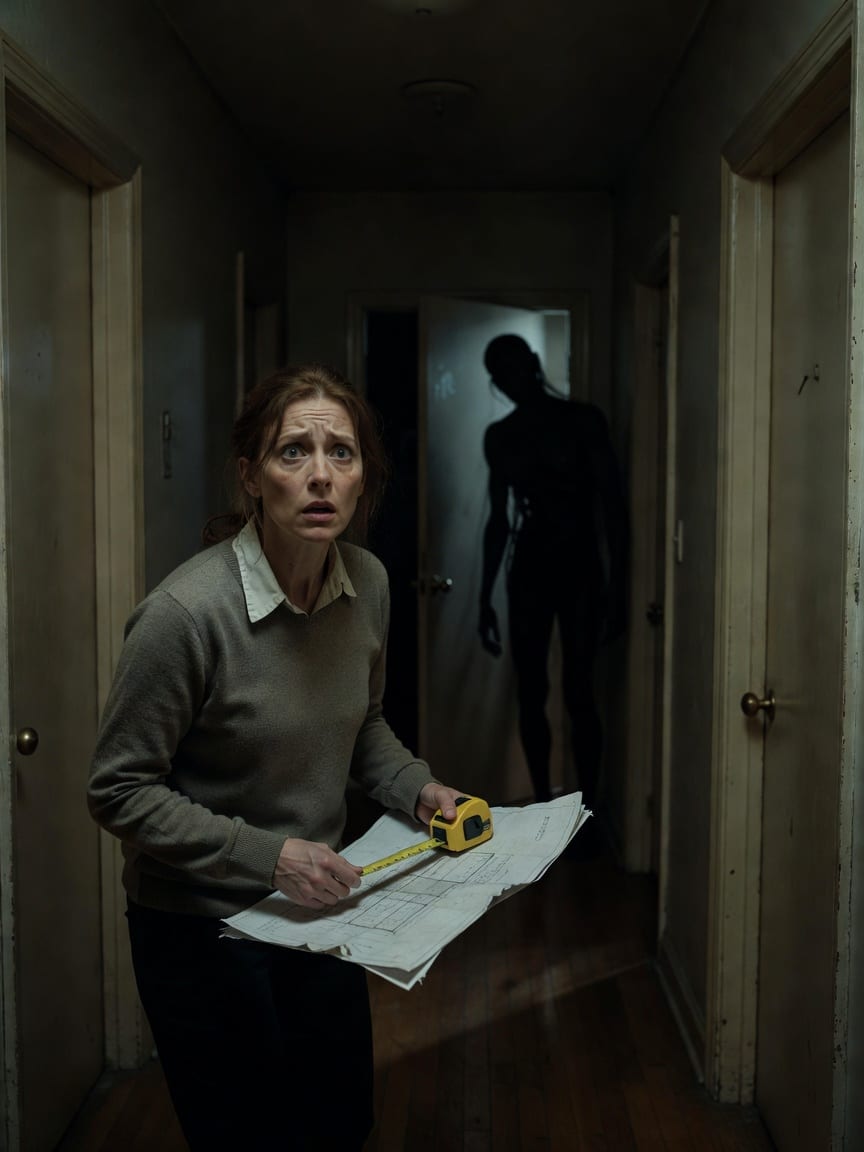
I grabbed a tape measure, a notebook, and my house plans, spread them out on the kitchen table. I would not be lost. I would not.
The days that followed were a blur of heightened awareness. The house hummed with a quiet, internal wrongness.
Sometimes I would walk into the living room and feel a distinct cold spot where there had been none, or catch a faint, metallic scent in the air that wasn't there minutes before.
The 'extra' room's door sometimes stood wide open, a gaping mouth in the wall, sometimes was barely a crack, a dark sliver. I learned to navigate the subtle distortions, counting my steps, measuring distances, accepting the impossible.
I even found a slight, inexplicable bulge in the hallway wall that I swear wasn't there before, a soft, yielding curve. Roland Davenport was no longer seen in the park.
His presence, like the anomaly itself, had receded, leaving me with the heavy burden of my new understanding. My home was still my home, but it was also something else entirely.
The dread was no longer fear of the unknown, but the chilling certainty of what I now understood.
Months later, the house feels almost normal. The loops on the street are gone; I can walk to the corner shop without being pulled back to my porch.
The extra room's door is shut tight, a faint seam in the wallpaper once more, almost invisible. But Gloria Reynolds is not the same.
I still check my measurements, pace my floors, my eyes constantly searching for the subtle signs of the next recurrence. I never found Roland Davenport again, though I looked.
Sometimes, late at night, I hear a faint sigh from the walls, or a door creaks in a part of the house I know is empty. I don't fight it. I just listen. I know it will return.
And I will be ready.
The place that isn't on the map is always just a measurement away.
If this one got to you
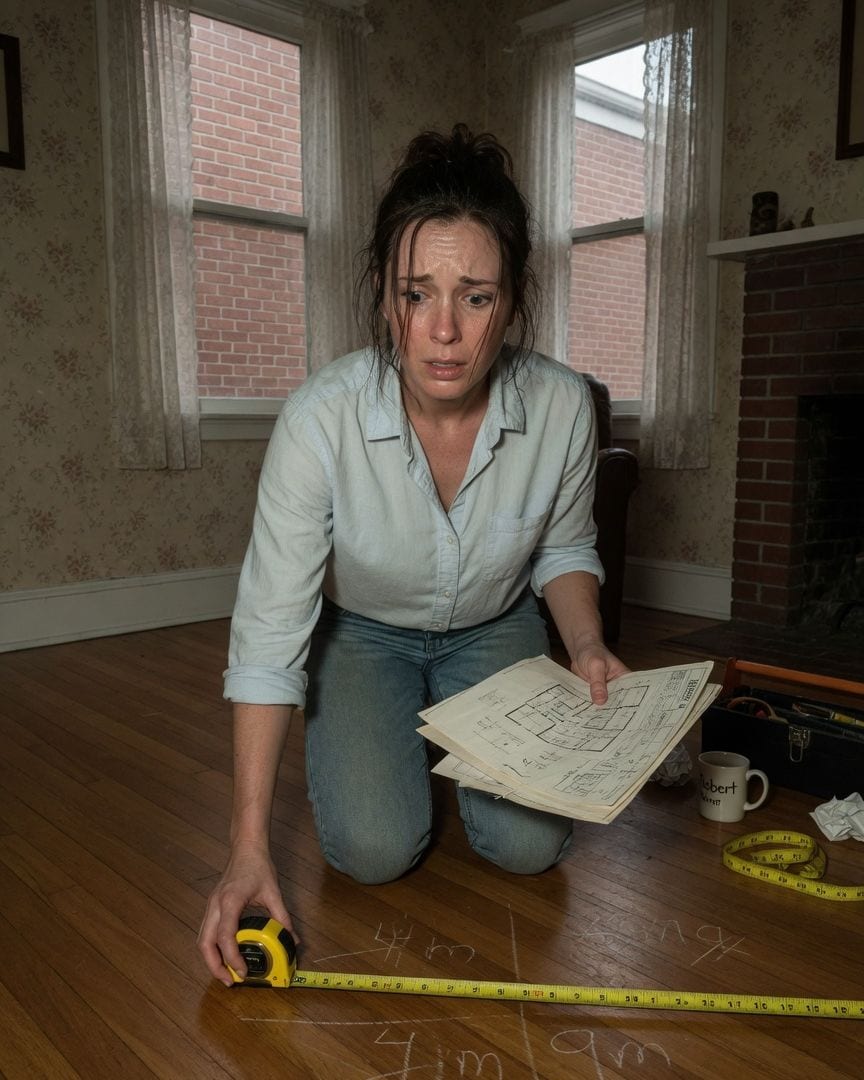
Our living room measures four by five metres. But the outside wall is nine metres long. A metre of house, gone, and I can't find it.
After moving into our charming 1920s house, I was meticulously measuring the living room when the dimensions refused to add up. My calculations of the interior space led me to discover a narrow, unpainted fifth door in the hallway, tucked almost out of sight. It wasn't on any original plans, and it opened to absolute, impenetrable darkness.
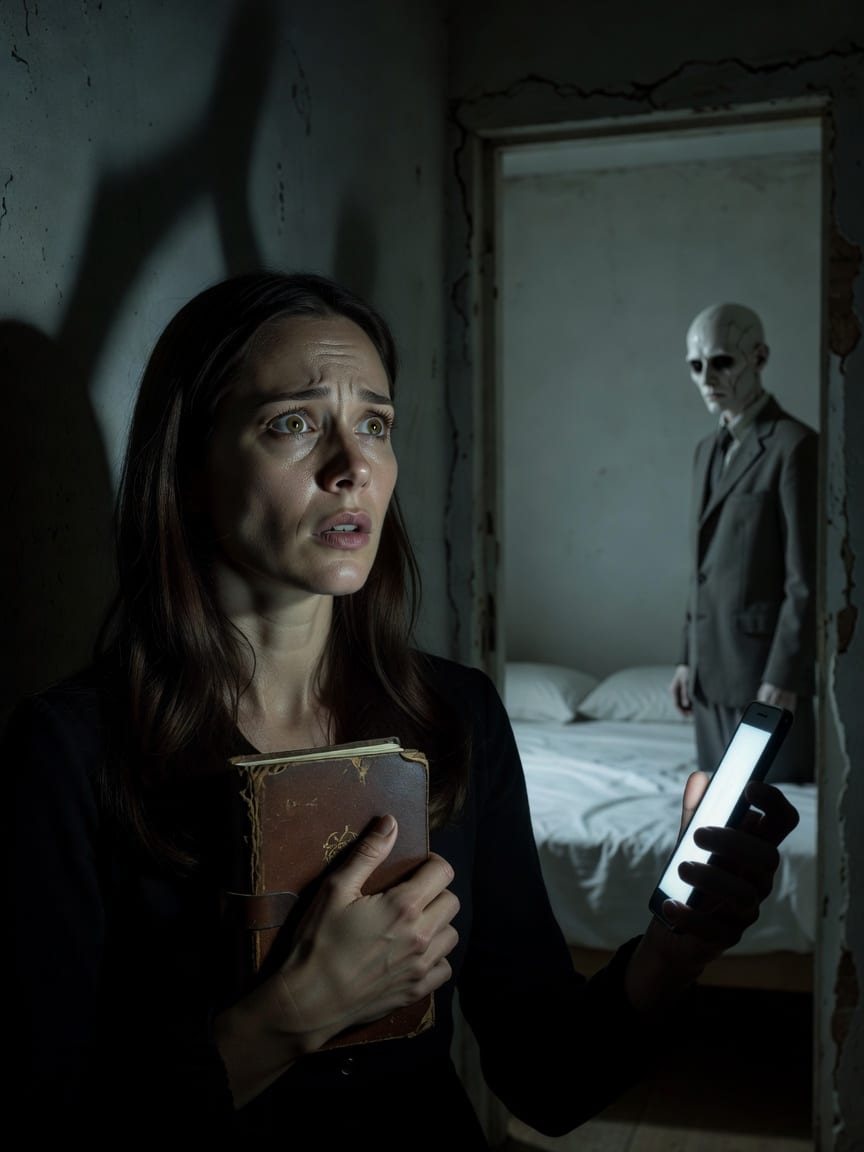
Behind a plastered-over doorway, I found a room. Papered, carpeted, and furnished with a made bed, sealed for decades. The air was dead still, but the bed wasn't dusty. My council tax bill only lists five rooms.
I'm Claire, an architect, meticulously planning my new Victorian terrace renovation. But when I uncovered a hidden room behind a wall, everything I knew about time and decay shattered. The bed was perfectly made, the air still, yet there was no dust, only an unnerving cold.
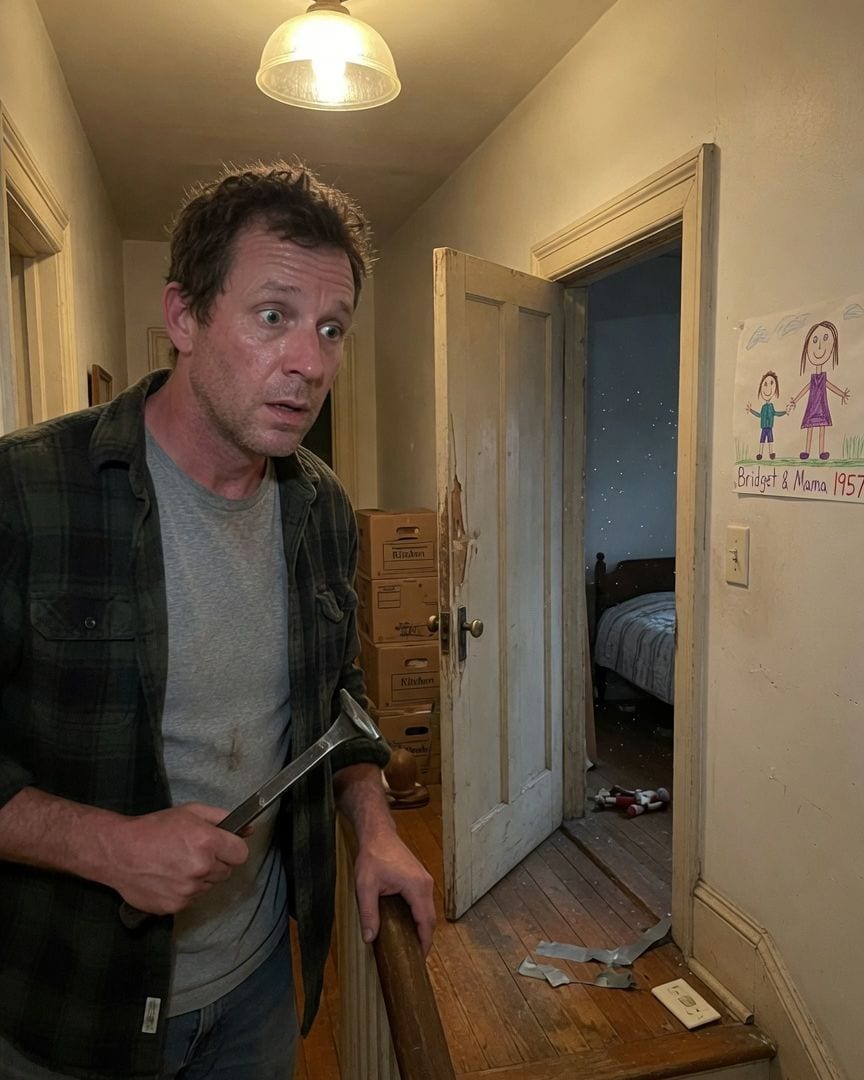
My landing light switches itself off at 9:40 every night. I've watched the switch flick down under nothing, the tape peeled back. The house holds its breath.
My great-uncle's old house was a quiet gift, a place to finally settle. But as I unpacked, a strange worn path on the floorboards led me to a small, barely visible door, perfectly blended into the wall. It was undeniably locked, and felt like a deliberately obscured secret.
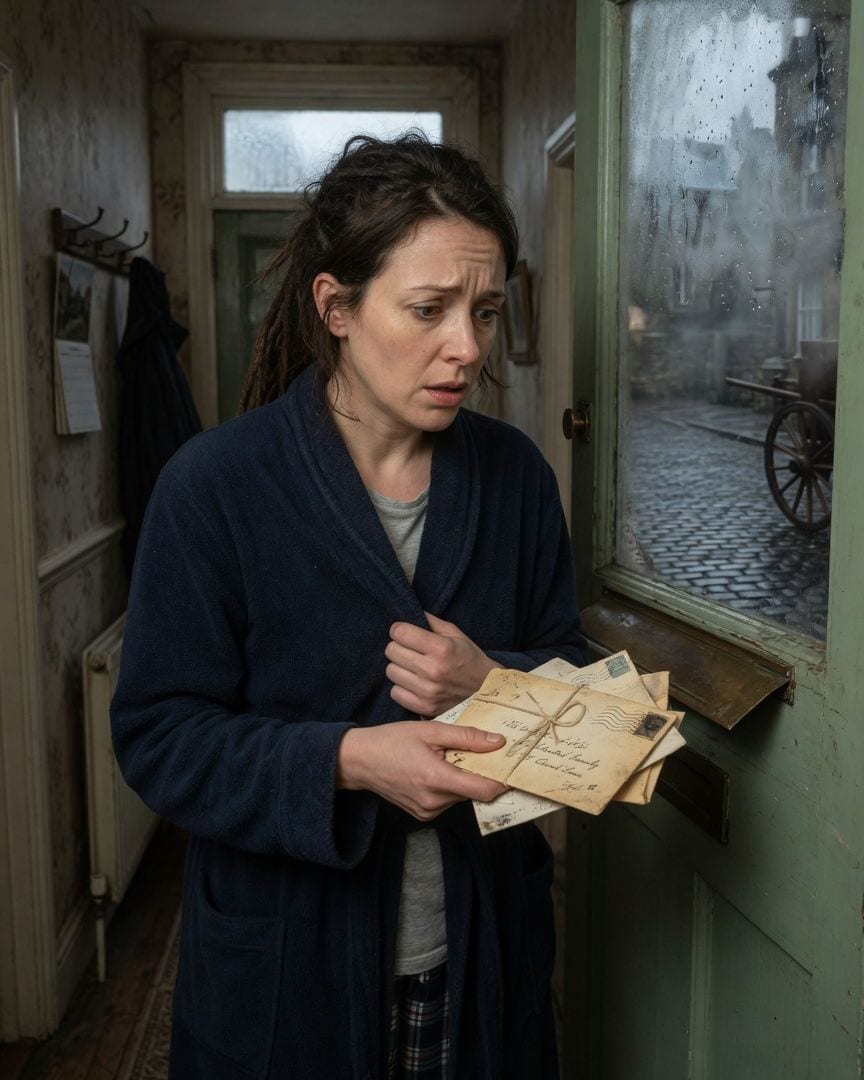
Seventy years ago, a hidden journal recorded my door opening to the wrong street and receiving Lockwood post.
I'd only recently moved into my inherited house, a quiet place on the edge of town. One grey morning, a distinct clatter from the front door's post flap caught my attention. Reaching down, I expected my gravel path, but instead, the flap showed a dark, cobbled street that wasn't mine. A bundle of warm, old letters, addressed to 'The Lockwood Family,' slid through, before the vision flickered and was gone.
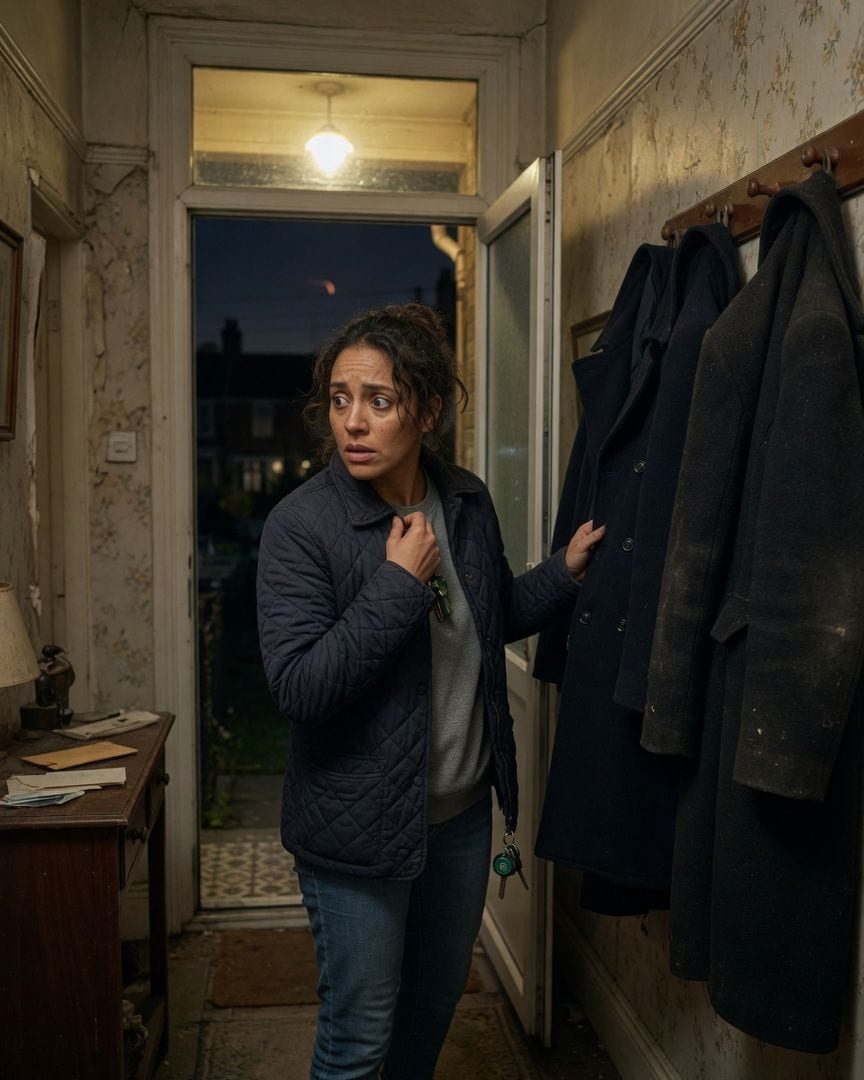
My tiled path was new, my front door green. Then three dark coats hung in my hallway.
After a late night watching the lunar eclipse, I returned to my Victorian house, only to find the path and front door inexplicably changed. Though the house seemed to revert to normal, strange things started appearing: a kettle warm from boiling, a distinct impression on my armchair. Then, an antique, lavender-scented handkerchief appeared on my bedside table, an undeniable presence in my private space.
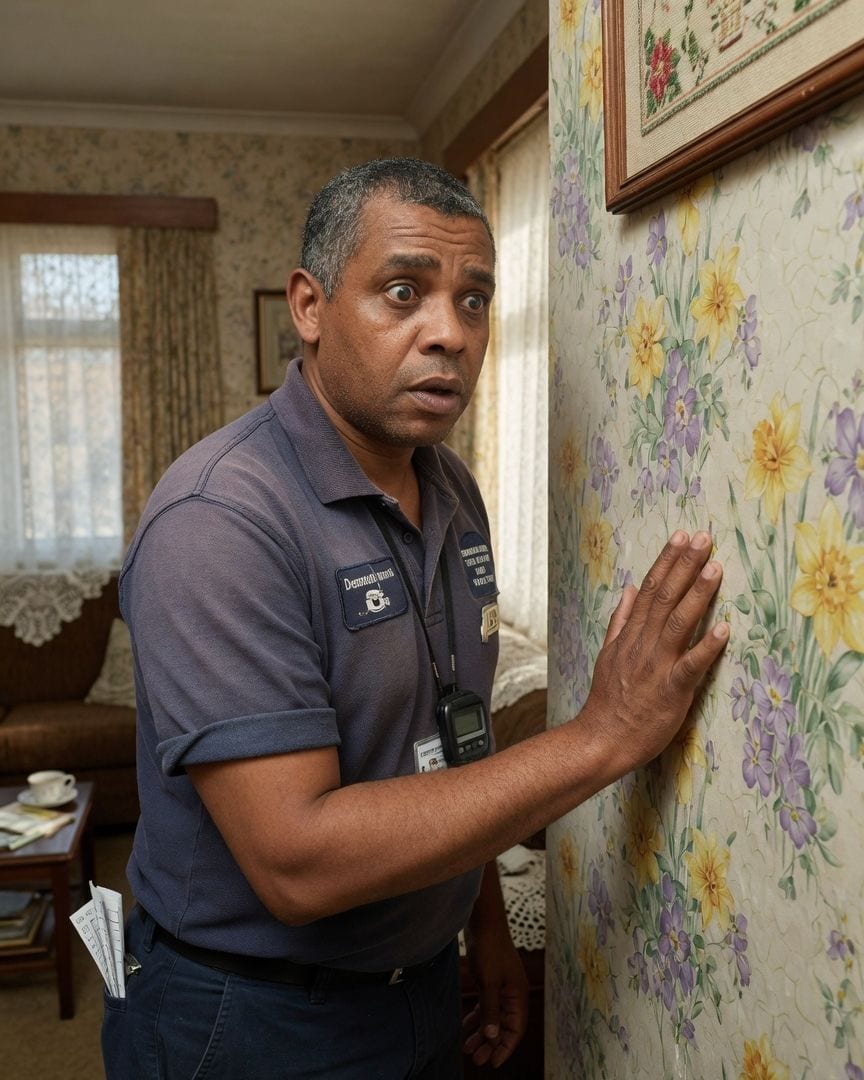
I read the water meters on this street, and this month number 30 grew a second one in pavement that was solid last month — its pipe runs back under a front door I cannot find.
I'm Desmond Drummond, a city water meter reader, used to the predictable rhythm of my fifteen-year route. But this month, Mrs. Crane's house on Elm Street showed a second meter reading. It led to a new meter pointed at a blank brick wall, and later, to a hidden door behind her living room wallpaper where no door should exist.