My stairlift tape measures thirteen steps, but my own feet always find a fourteenth — to a door that isn't there.
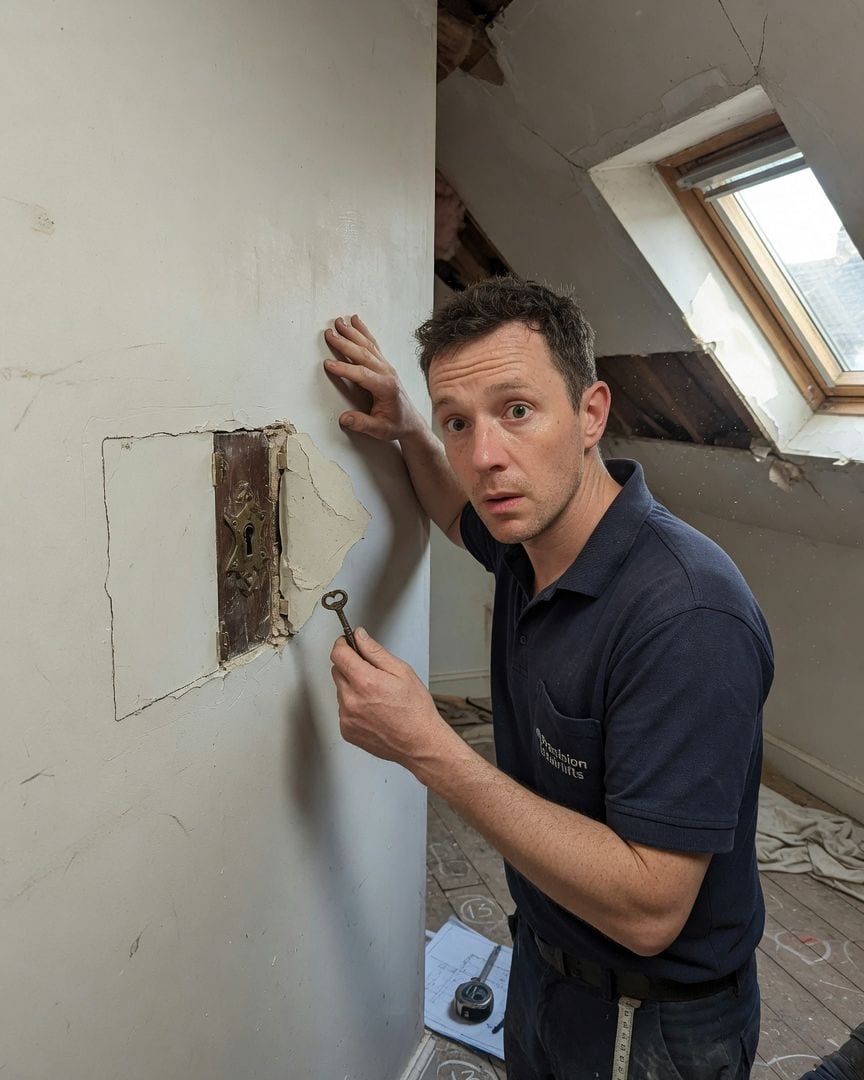
“Thirteen steps, Mrs. Drummond,” I said, letting the end of my steel tape measure retract with a soft whizz. It was a good, solid number.
Constance Drummond, all seventy-eight years of her, nodded from the bottom of the new loft conversion stairs.
She’d lived in this house on Hill Street for forty years, and this was her big project: a new stairlift for her aging knees. As a meticulous fitter, I always triple-checked.
My tape stretched from the landing to the bottom step, clearly marking the end of the run at thirteen. I walked up, counting them out loud, the familiar rhythm of wood under my boots. One, two… thirteen.
My foot landed on the loft floor, solid and unambiguous. “Perfect fit, Constance,” I called down. “We’ll have you gliding up here in no time.”
I turned, already visualizing the track placement. But as I shifted my weight, my left foot landed on something that wasn’t quite the loft floor. It was a shallow, half-step, barely six inches deep, leading to a small square landing.
And on that landing, about three feet up from where the actual loft ceiling met the wall, was a plain wooden door. Not a small access panel, not a cupboard. A proper door, with a frame and a handle.
I blinked. “Mrs. Drummond,” I said, my voice sharper than I intended. “What’s this?”
Constance peered up, her hand cupped to her ear. “What’s what, dear?”
“This door,” I said, pointing. “On this… extra step.”
She squinted. “Never seen it, dear. Must be a trick of the light.”
A trick of the light? I pulled my tape measure out again. From the bottom of the stairs, stretched taut, it still read thirteen steps to the loft floor. I walked it again, slowly, pressing my foot into each riser.
One, two, three… thirteen. My foot landed. But then, it did it again. My foot found the fourteenth. It was unmistakable, a slight shift in elevation, a shallow, impossible step. I felt a cold prickle on my neck.
I knelt, drawing a chalk line on the floor where my boot felt the run should end, at the top of the thirteenth step. Then I ran my tape over it.
It stretched past the chalk, past the thirteenth step, and continued for another three feet, into the space where the door hung in the air. The door was undeniably there, solid wood, a dark, heavy presence.
But by all rights, it was floating in the middle of a wall, on a step that couldn’t exist, inside a loft that contained no such space.
I checked my tape, my eyes, even ran a hand over my forehead, convinced I was overtired. But the door didn't waver. It was there. And it wasn't.
I left Constance's house that day, unnerved, the image of that impossible door burned into my mind.
I couldn't shake it. The image of that plain wooden door, hovering above an extra step that only my foot seemed to find, played on a loop in my head.
It defied everything I knew about construction, about measurement, about reality. A few days later, I called Constance. “Just need to double-check a few measurements, Mrs. Drummond,” I said, the lie feeling heavy in my throat. “Standard follow-up, you understand.”
She let me in, cheerful and oblivious as ever. I went straight up to the loft, my heart thumping a nervous rhythm. The light was different today, harsher, streaming through the dormer window.
It cut through the dust motes dancing in the air, revealing every detail. I measured the stairs again, slowly, painstakingly. Thirteen steps. Exactly. I walked up, counting aloud, my voice echoing slightly in the empty space. One, two… thirteen.
My foot landed on the solid loft floor. Nothing. No shallow half-step, no landing, no door. Just plain, painted plaster wall.
I pulled out my phone, took photos of the wall where the door had been, convinced I’d captured something, some residual proof.
But the screen showed only an unbroken expanse of plaster, no seam, no tell-tale line, not even a discoloration. I paced the loft, checking the dimensions against the blueprint I had in my pocket. Everything aligned.
This was a standard loft conversion, textbook. I tried to dismiss it, again, as exhaustion, a trick of the eye. Maybe the light had played some weird game that day. Maybe I’d imagined the whole thing.
The rational part of my brain, the one that relies on numbers and solid surfaces, desperately wanted to believe it.
But then, as I turned to leave, my hand brushed against the wall just above the thirteenth step. Not where the door had been, but a little lower, where the frame would have met the wall.
A faint, almost imperceptible seam. A hairline crack in the plaster. I ran my finger along it. It was there. Not a door, but a memory of one. A ghost outline.
I pressed lightly, my thumb finding the exact spot where the doorframe would have been.
A tiny, almost inaudible click.
A small section of the plaster, about a foot square, gave way. It wasn’t a hole, but a carefully concealed panel, now hinged inwards, revealing a keyhole.
Not a modern, cylindrical keyhole, but an old, intricate brass one, set into dark, aged wood. My breath hitched. I carefully pulled the section of plaster away, fully detaching it.
It revealed a shallow recess, just deep enough to hold something. Tucked inside, resting on a bed of dry, crumbling plaster dust, was a small, ornate key.
It was cold to the touch, heavy, and clearly very old, dark with tarnish.
I held the key, my breath catching in my throat. It was solid, undeniable. The brass of the key was a perfect, intricate match for the keyhole now revealed in the wall.
Downstairs, I could hear Constance humming a jaunty tune from the kitchen. She was oblivious. I looked at the key, then at the wall.
The hairline crack was now unmistakably visible, a thin, dark line outlining a square in the otherwise seamless plaster. This wasn’t a trick of the light. This was real.
I inserted the key, carefully, feeling the worn metal slide into place. I turned it. A soft, ancient thunk echoed in the silent loft. The small plaster panel, no longer a disguised section of wall, swung inwards.
It didn't reveal a cupboard, or a ventilation shaft, or even a blank wall. It opened onto a dark, narrow opening. Beyond it, a faint, metallic smell, like old copper and damp earth. I pushed the panel wider.
A short, dim landing stretched into absolute blackness. It was three feet deep, maybe four. A space that could not, by any logical extension of the house’s architecture, exist.
I stepped across the threshold, onto something solid but unseen, my hand still on the edge of the panel. The air was dead, still, and colder than the loft. The panel swung back, silently, with a soft click.
I fumbled for the doorknob. It was gone. The wall where the door should be was smooth, cold plaster, unbroken and seamless.
I was trapped in absolute blackness, on a landing that didn’t exist, with no way back.
Panic flared, sharp and cold, a shock of adrenaline. My breath hitched, but then, my rational mind kicked in. Get a grip, Preston. I pulled out my phone, fingers fumbling in the utter dark.
The flashlight beam cut through the oppressive blackness, revealing the small landing. It was exactly as I’d estimated: barely three feet deep, leading to another, identical wooden door directly opposite where I’d entered.
The space was utterly silent, airless, like a tomb.
I spun around, trying the door I’d just come through. No, not a door anymore. Just a solid, unbroken wall of dark, unpainted wood. The ornate keyhole was gone. The hairline crack, the panel, everything. Just wood.
I measured the small landing with my tape. Three feet by four. Exactly. Nowhere in Constance’s loft, or indeed, the entire house, was there a three-by-four-foot space like this. I checked my phone for signal. Nothing. The bars were gone.
I tried the other door. The one leading deeper into this impossible space. Locked. I pounded on it, a dull, flat sound in the dead air. “Hello?” I called out, my voice swallowed by the silence. “Constance? Anyone?”
No sound returned. The space simply absorbed it. I tried to reconcile this space with the house’s blueprints, with the very fabric of physical reality. It simply didn't exist. It couldn't exist.
I slid down onto the cold floor, forcing myself to breathe, to slow my racing heart. Think. Rationalize. An hour passed. Maybe more. Time felt… thick here. My phone battery, which had been at 70%, was now down to 30%.
The air grew colder. I tried the first door again, pushing, pulling, searching for any give, any seam. Nothing. It was a solid wall.
I tried the second door again. The one leading deeper. My hand twisted the knob instinctively. It clicked. It opened.
I blinked in the sudden light, my eyes adjusting. I was standing in Constance’s loft, right where I’d started, the original thirteenth step beneath my foot. The wall was solid plaster, no seam, no keyhole.
No sign of the impossible door or the keyhole or anything. My heart hammered against my ribs, a frantic drum. I checked my phone. An hour and seven minutes had passed. My battery was down to 25%.
I went downstairs, finding Constance in the kitchen, making tea. “Everything alright, dear?” she asked, looking up from stirring.
“Just… checking the wiring,” I said, my voice rough. She nodded, satisfied.
Driving home, my mind raced. An hour in a non-existent space. The door that appeared, then disappeared. The road usually took me about twenty minutes.
Today, I decided to take a different route, one I knew like the back of my hand, winding through the old town, through the industrial park, then back towards my place. I made turn after turn, meticulously noting landmarks.
I passed the old oak tree, then the abandoned mill, then the crossroads I always took before turning right onto Elm Street.
I drove for what felt like twenty minutes, maybe twenty-five, the late afternoon sun starting to dip below the horizon. Then suddenly, there it was: the familiar curve of Hill Street, and Constance Drummond’s house.
I was back where I started.
My odometer read exactly 20 miles. My fuel gauge was noticeably lower. My clock showed 45 minutes gone. I pulled over, staring at the house. No. I tried again. Even more carefully.
Made a left where I should have gone right, took the long way around the bypass. Same result. After what felt like an eternity, the road returned me to Hill Street.
The Road That Returns terrified me more than the invisible landing. The landing was a discrete anomaly, an impossible room. But this… this was a fundamental betrayal of space itself, a silent, insidious warping of the world outside Constance’s house.
It made me question everything I thought I knew about distance and direction.
I spent the next few days researching. I scoured the internet for local anomalies, old maps, anything that might explain what was happening. ‘Thin places’, ‘ley lines’, ‘urban legends’—nothing quite fit. The sheer physical impossible of it all.
Eventually, I visited the local historical society. It was a quiet building, smelling of old paper and dust, presided over by Malcolm Fairfax, a calm, precise man in his sixties, with neat grey hair and spectacles perched on his nose.
I tried to frame my questions vaguely, asking about “unusual architectural features” or “local folklore regarding strange occurrences in older properties.”
Malcolm, unbothered by my vague nervousness, merely smiled faintly. “The past is often stranger than fiction, Mr. Sheppard.” He offered old maps and property deeds, patiently guiding me through the archives.
As I pored over a brittle 19th-century survey map of Hill Street, my finger tracing the familiar street names, I noticed a faint, almost erased pencil mark near Constance’s property line.
It was a small, irregular circle, barely visible beneath the faded ink. It was labeled simply: ‘Anomaly.’
I looked up, startled, to find Malcolm watching me from across the room, his faint, unreadable smile still in place. The air in the room suddenly felt heavy, thick with unspoken knowledge. “Find anything interesting, Mr. Sheppard?”
Malcolm asked, his voice smooth, devoid of curiosity or surprise.
I quickly closed the map, my heart thumping. “Just… old boundaries,” I mumbled, feeling a prickle of unease.
The next day, I drove past the Hill Street house again, trying to see if the road still pulled me back. It didn't. I parked a few streets away and walked, approaching the house cautiously.
As I rounded the corner onto Hill Street itself, I saw a dark sedan parked further down, its windows tinted, almost completely black. It looked out of place. I felt a distinct prickle on the back of my neck.
I ducked into an alley, pretending to tie my shoe, watching. The sedan didn’t move. No one got in or out. It just sat there, silent and watchful.
I waited for ten minutes, then circled back, taking a different route to my car. The sedan was gone.
But just as I reached my car, my phone buzzed. A text message. Unknown number. The screen glowed, illuminating the cold dusk.
‘Some things are best left undisturbed, Mr. Sheppard. Especially old foundations.’
The text message chilled me to the bone. Someone knew. Someone wasn't just observing, but actively warning me. My blood ran cold, fear tightening its grip around my throat. I didn't even think.
I drove straight back to the historical society, the old building now dark against the evening sky. Malcolm was still at his desk, sorting through a pile of old photographs by the soft glow of a desk lamp.
I confronted him directly, my voice raw. “What do you know about that house on Hill Street? About the ‘Anomaly’?”
Malcolm slowly put down a sepia-toned photograph of a horse-drawn carriage. His gaze met mine, calm and unruffled. “Ah, the old Drummond place. Always a fascinating property.” He gestured to a worn wooden chair opposite his desk. “Sit, Mr. Sheppard.
You’ve clearly stumbled onto something. It’s not a secret, exactly. Just… not something most people perceive. Or, if they do, they quickly rationalize it away.”
I sat, my knuckles white as I gripped the arms of the chair. Malcolm began to explain, in a calm, almost academic tone, that certain places, like the Hill Street property, were what some old texts called ‘thin places.’
Not haunted by spirits, he clarified, but by geometry itself. “Space,” he said, removing his spectacles and cleaning them with a practiced hand, “is not always as rigid as we assume. Sometimes it folds. Sometimes it recurs.”
He pulled out a faded, hand-drawn diagram from a folder tucked beneath his desk. It was a crude floorplan of the Hill Street house, dated 1952.
And clearly marked, with precise measurements, was a small, three-by-four-foot landing, leading to a ‘secondary egress.’ My stomach clenched. “Before the loft conversion,” Malcolm explained, replacing his spectacles, “it manifested differently.
Usually as a pantry that was one foot too deep, or a back door that opened onto a wall, or sometimes, simply a doorway that would appear and disappear, leading nowhere.”
I thought of the Road That Returns, the twenty miles that brought me back to Hill Street. “The road… does it loop?”
Malcolm nodded slowly. “The geometry isn’t confined to the house itself. It’s a localized field. A spatial distortion. The road is merely responding to the same distortion. It wants to keep things… contained.”
My mind raced, connecting the dots. The 14th step, the impossible landing, the road that returned. It all fit. A terrible, unsettling coherence. “And the key?” I asked, pulling it from my pocket and holding it up.
Malcolm’s eyes widened slightly, a flicker of something new in their depths. “A key? That’s new. Or rather, a very old return.” He took the key from my trembling hand, examining the intricate brass. “This is a craftsman’s key.
From before modern locks. It suggests a time when someone needed to access that space, consistently.” He handed it back, his touch cool.
Malcolm then pulled out a thick, leather-bound ledger, its pages yellowed and brittle. He opened it carefully, revealing columns of elegant, spidery handwriting. “The society keeps records of these ‘anomalies.’ The recurring ones.
The one on Hill Street has been noted, subtly, for over a century. A persistent fold in reality.”
A persistent fold in reality. The phrase echoed in my mind, cold and terrifying. I felt a cold dread settle in my stomach, heavier than anything I’d experienced on the impossible landing. A persistent fold.
I asked Malcolm if anyone had ever tried to map it, or understand why it happened, why this house. Malcolm merely shook his head. “Understanding is one thing. Changing it… that’s another. It simply is.
These places seem to defy conventional causation.”
Malcolm then gestured to a dusty cardboard box filled with old photographs, labeled ‘Hill Street Area - 1970s’. “Perhaps these old street scenes might offer some context. Sometimes people leave traces, even unwittingly. Sometimes the geometry itself does.”
I began sifting through the black and white photos, my hands shaking slightly. Mundane street scenes: children playing hopscotch, cars parked haphazardly along the curb, families gathered on front lawns.
Then I found one, slightly creased, taken in the late 1970s.
It showed the Hill Street house, before its loft conversion, looking much as it does now, but with an odd ripple in the brickwork near the roofline, almost like a heat haze distorting the solid lines.
And in the background, partially obscured by a lamppost, was a young man. He was looking intently at the house, a tape measure clutched in his hand, held just like I hold mine.
I froze. My breath caught in my throat. The posture, the way his head was tilted, the careful, almost analytical set of his jaw. It was me. Not a resemblance, not a vague similarity. An exact, unsettling match.
Decades before I was born.
I stared at the faded photograph, my own face staring back from forty years ago, a silent, knowing observer to the impossible geometry, caught in the act of measuring something only he could see.
I dropped the photo, a sudden, violent chill running through me, deeper than any I’d felt. My hands were suddenly slick with sweat. I wasn't just investigating it. I was never just investigating it. I was always inside it.
Malcolm Fairfax picked up the dropped photograph, his gaze calm and unhurried. “Ah. You found that one. An interesting recurrence, wouldn’t you say?”
I could only stammer, my voice tight in my throat. “That’s… that’s me. How?”
Malcolm gestured to the ledger, then back to the photograph. “The geometry doesn’t just fold space, Mr. Sheppard. It seems to have a peculiar effect on observers. Not quite time travel, no. More like… a resonance. A drawing-in.
Certain individuals, often those with a precise, almost obsessive nature for measurement and order, are drawn to these places. And sometimes, their presence echoes.”
He explained that the ‘Anomaly’ on Hill Street seemed to pull certain ‘types’ into its orbit, almost like a magnetic field attracts metal filings.
These individuals, like me, become witnesses, drawn to measure and understand the impossible, and their experiences, their very presence, can subtly recur.
The figure in the photo, Malcolm suggested, isn’t me from the past, but an echo, a reflection of my own future self, drawn into the geometry’s pattern. It’s an imprint.
The key, he added, might have belonged to one of these previous ‘witnesses,’ someone who tried to map or contain the space, only to become part of its history.
It wasn’t just a house with a weird spot. It was a living, recurring pattern, and I was now part of its tapestry. The threat wasn't a malevolent entity, or some external force.
It was the quiet, relentless unmaking of my reality, the insidious way the geometry weaves me into its own fabric. And then I understood the text message. It wasn't a warning to stop investigating. It was a warning about what I was becoming.
I knew then what I had to do. I had to go back to the house, to the impossible landing. I needed to see what else was there, what other echoes might linger.
Malcolm, unbothered, handed me the old brass key. “Be careful, Mr. Sheppard. The geometry rewards curiosity, but it doesn’t always release its subjects.”
I drove to Hill Street. This time, the road behaved. It led me directly there, no loops, no detours. Constance was out; her car was gone. I let myself in.
I went straight to the loft, my heart thumping a hollow rhythm against my ribs. I found the subtle seam in the plaster, inserted the key, and with a familiar soft thunk, opened the hidden panel.
The dim landing was there, waiting, a pocket of dead air. I stepped in, and the panel closed silently behind me. This time, I was prepared. My phone light cut through the gloom, illuminating the space. The second door.
I walked towards it, my boots making no sound on the unseen floor. I tried the key. It slid in perfectly. It fit. I turned it.
The door swung inwards. This time, it didn't lead back to the loft. It opened into a small, dust-choked room, barely lit by a single, grimy window high up near the ceiling.
It was clearly a storage space, filled with forgotten junk: old paint cans, lengths of warped wood, an ancient, cobwebbed bicycle frame. I stepped inside, my footsteps echoing unnaturally in the confined space.
In the corner, half-hidden under a grimy tarp, was a workbench. On it, amidst old tools and sawdust, lay something else. A wooden surveyor's rule. The kind with brass hinges, folded up.
It was old, weathered, but perfectly preserved, as if time had forgotten it here. I picked it up. On one side, faintly carved into the dark wood, were the initials ‘P.S.’ On the other, the date: ‘1978’.
I stared at it, my hand trembling so hard I almost dropped the rule. I wasn't born until 1985.
This rule, my rule, with my initials, existed seven years before me, in a place that shouldn’t exist, in a house that warped time and space. This wasn’t an echo of me.
This was me, somehow, always here, always drawn to this place, always measuring. The ordinary explanation died, truly and finally. This artifact, this impossible object, proved it.
I held it tight, the smooth, dark wood under my thumb, a chill running through me that had nothing to do with the stale air in the room. I understood now.
The geometry didn’t just fold space; it folded me into its story.
I left the wooden rule on the workbench, exactly where I’d found it. I didn’t take it with me. I found my way back to the loft, the hidden panel closing silently behind me.
I never told Constance what I found, and she never asked. She remained oblivious, content in her house.
I continue my work, installing stairlifts, measuring, counting. But every now and then, I find myself driving an unfamiliar road, only to realize I’re back on Hill Street.
The impossible geometry is still there, a quiet hum beneath the surface of my life. I check my own measurements more often now, double-checking, sometimes triple-checking, the numbers that add up, but feel subtly wrong.
I still measure every step, every rise, every run. But now, when I count thirteen, I always feel for the fourteenth, even when it isn’t there.
Constance Drummond, now 80, still lives on Hill Street. She often sees Preston Sheppard pass by, sometimes parking and just staring at her house for a long moment before driving away.
She waves, and he waves back, a faint, distant look in his eyes, as if he’s measuring something only he can see.
If this one got to you
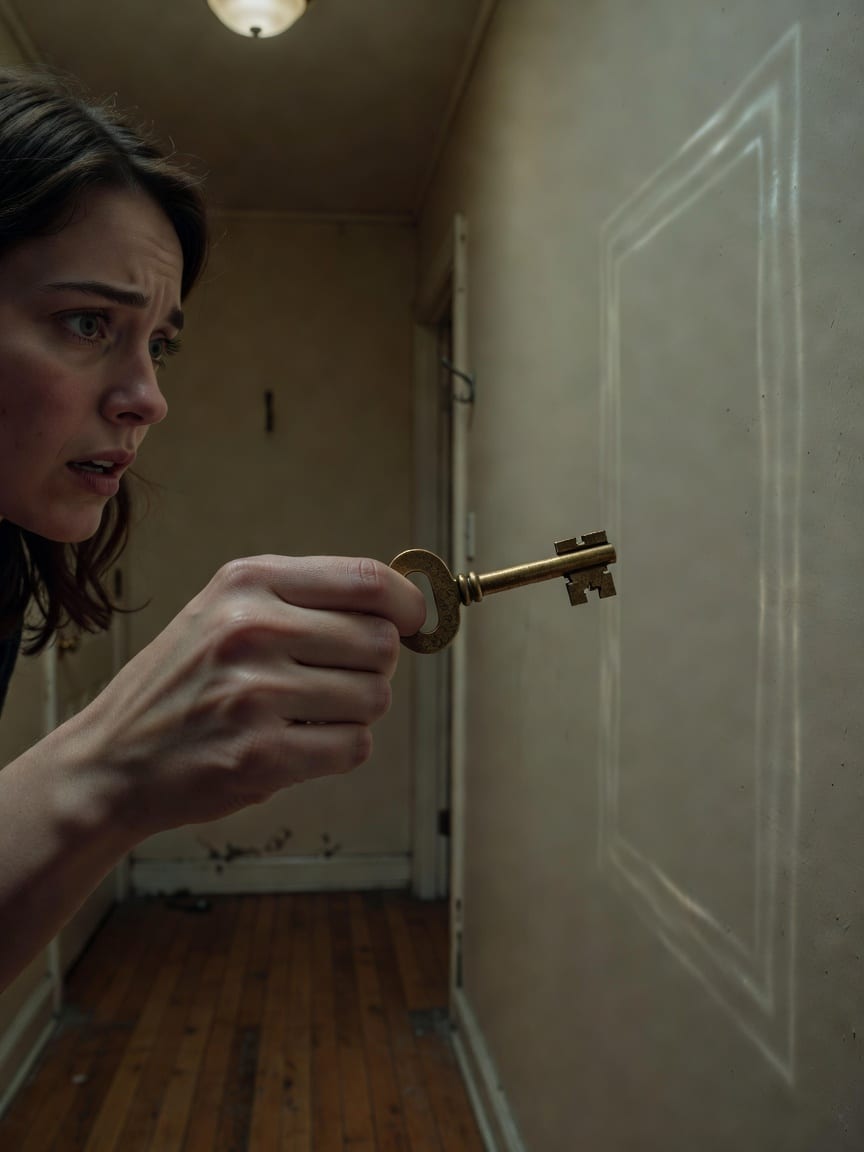
My new house has seven rooms. The removal men counted six. Now one of them asks who's in the locked seventh, on a landing with only six doors.
Moving into my new house, I supervised the removal men hauling boxes. But on the landing, Paul, the senior man, asked about a locked seventh room upstairs, pointing to a blank wall. His quiet certainty, despite the clear absence of a door, filled me with a sudden, icy dread.
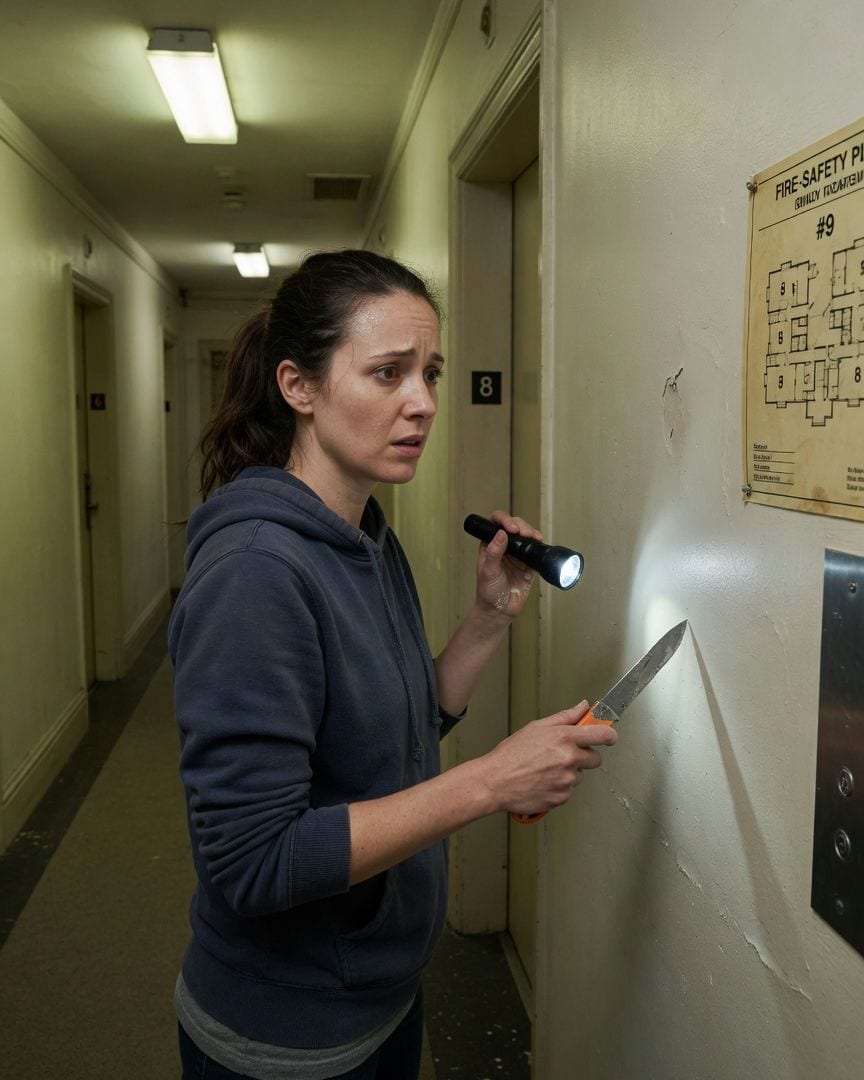
That blank wall in my hallway has a hidden metal plate. Tonight, after eleven years, it just clicked.
For eleven years, my apartment building's fire plan has shown nine apartments on my floor. But I've only ever counted eight doors, the space for the ninth a blank wall. Now, I've found a hidden metal plate behind the plaster, and from deep within, I just heard a soft *click*.
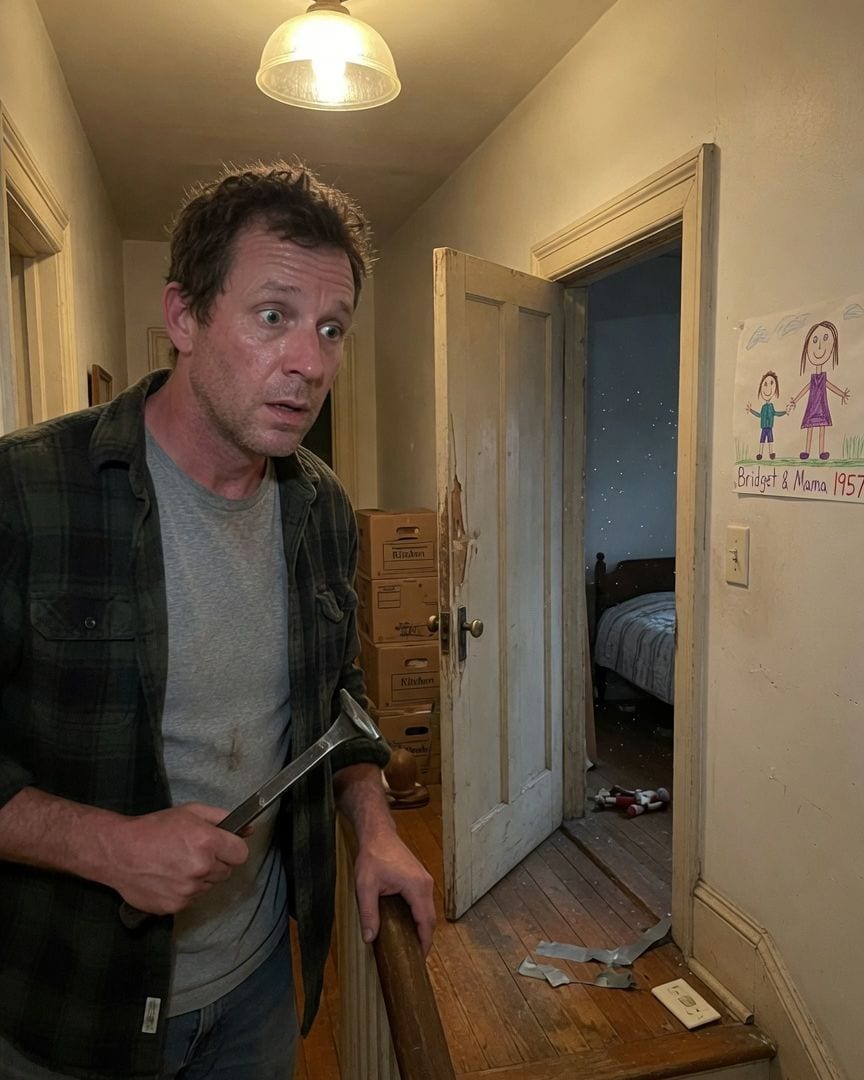
My landing light switches itself off at 9:40 every night. I've watched the switch flick down under nothing, the tape peeled back. The house holds its breath.
My great-uncle's old house was a quiet gift, a place to finally settle. But as I unpacked, a strange worn path on the floorboards led me to a small, barely visible door, perfectly blended into the wall. It was undeniably locked, and felt like a deliberately obscured secret.
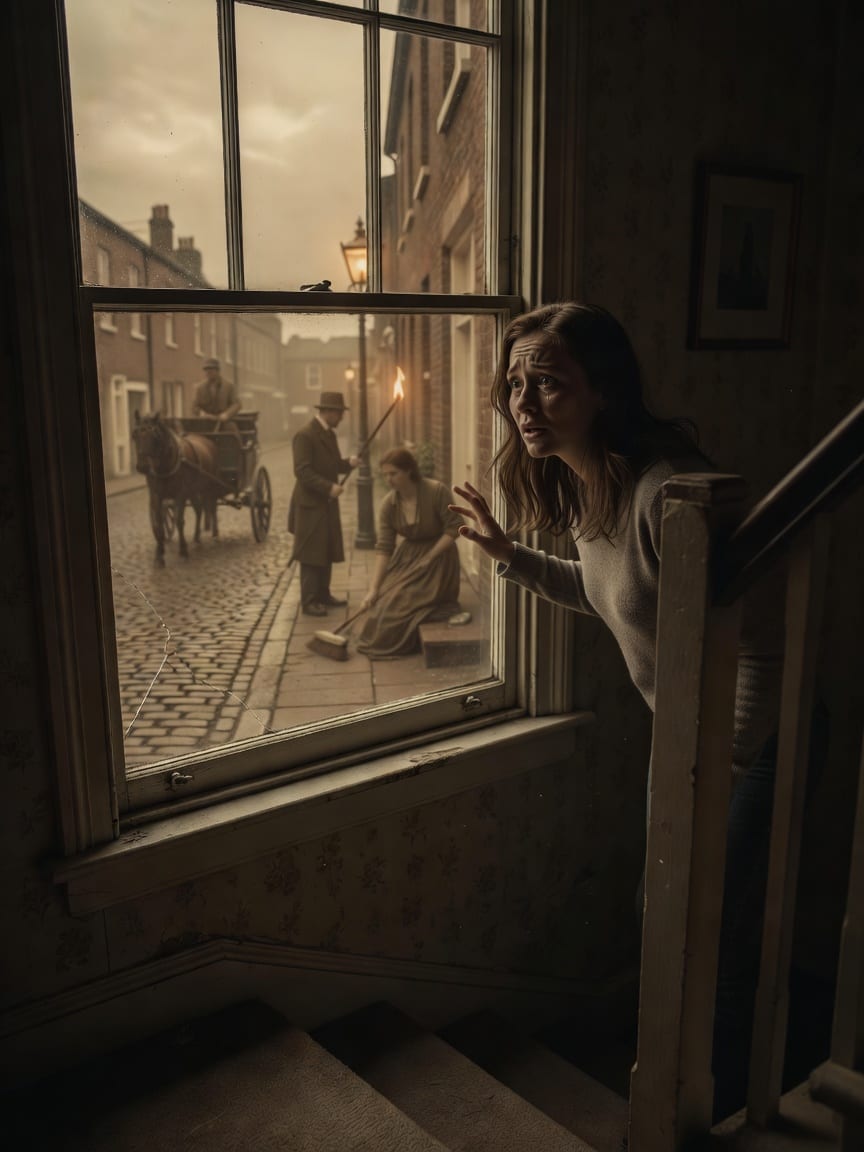
My half-landing window looked down on a cobbled street, a horse and cart. My panes, same crack. Below, only the bins.
I moved into this inherited house for a fresh start, living alone in the quiet. But the third stair on the main flight is deeply worn, a ghostly scoop hinting at decades of unseen footsteps. It feels hollow, and the wall beside it hides a faint, inexplicable seam.
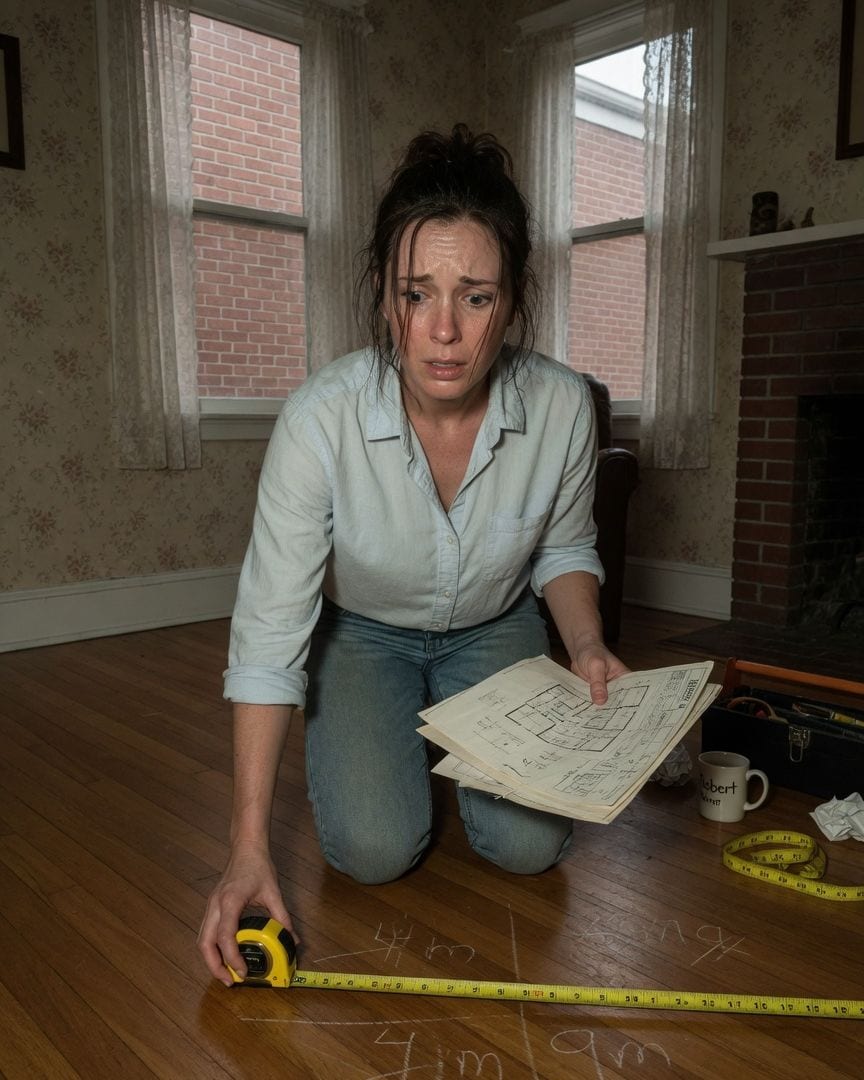
Our living room measures four by five metres. But the outside wall is nine metres long. A metre of house, gone, and I can't find it.
After moving into our charming 1920s house, I was meticulously measuring the living room when the dimensions refused to add up. My calculations of the interior space led me to discover a narrow, unpainted fifth door in the hallway, tucked almost out of sight. It wasn't on any original plans, and it opened to absolute, impenetrable darkness.
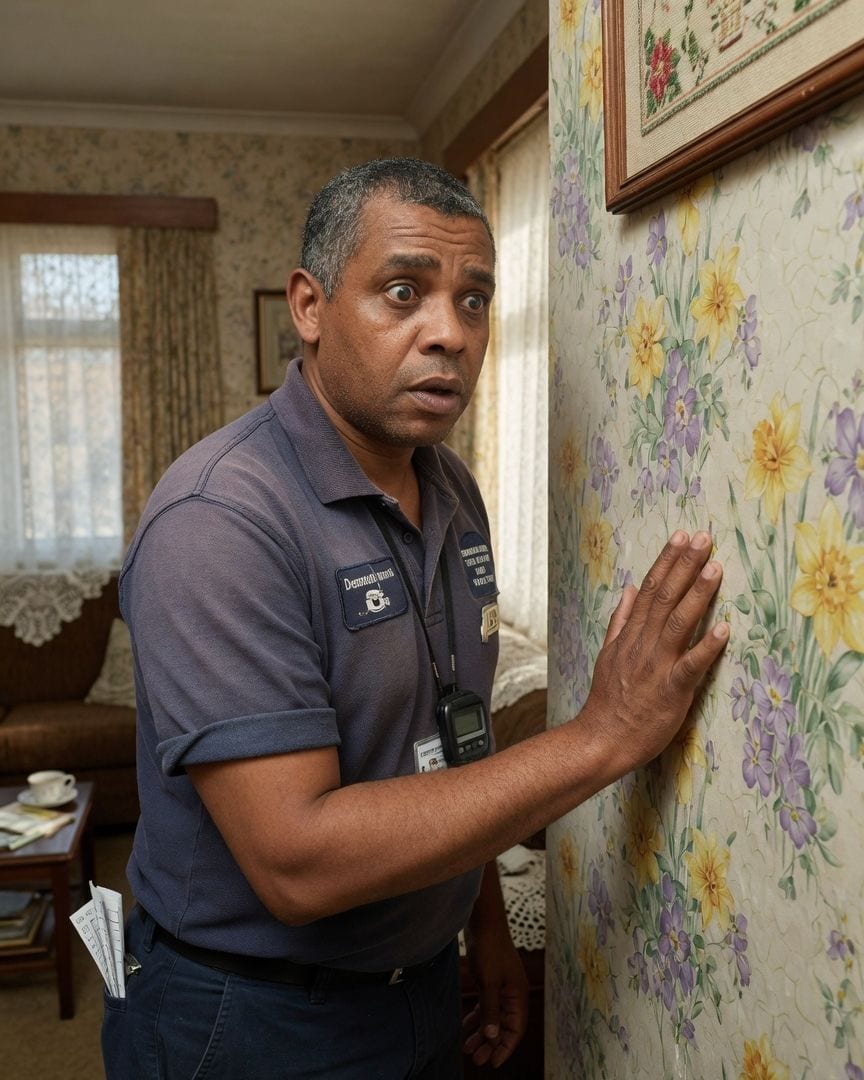
I read the water meters on this street, and this month number 30 grew a second one in pavement that was solid last month — its pipe runs back under a front door I cannot find.
I'm Desmond Drummond, a city water meter reader, used to the predictable rhythm of my fifteen-year route. But this month, Mrs. Crane's house on Elm Street showed a second meter reading. It led to a new meter pointed at a blank brick wall, and later, to a hidden door behind her living room wallpaper where no door should exist.