My airing cupboard opened onto a burning brick copper, sheets boiling. The heat rolled out, smelling of soda and wet linen. I shut it; my boiler was back.
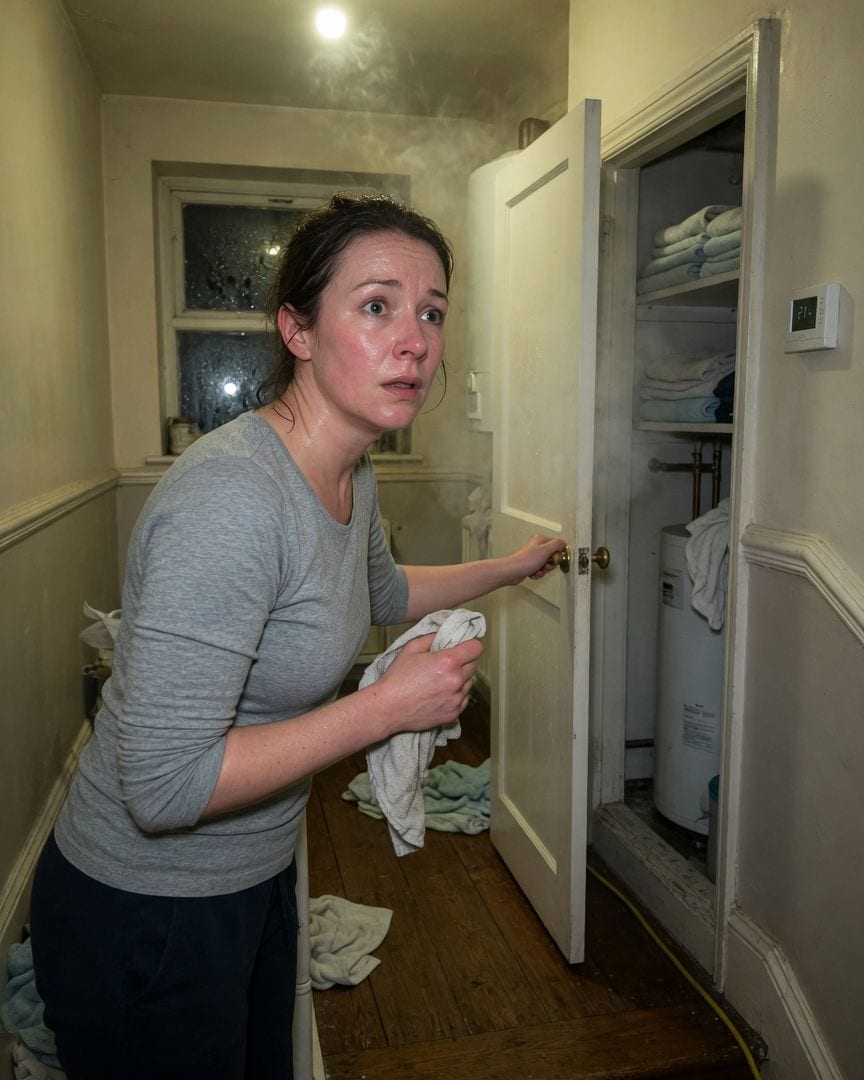
The first snow of Winter 2024 arrived without warning, a thick, silent blanket. My new house, bought last spring, felt colder than I expected, despite the thermostat being cranked.
I was rummaging for extra towels, shivering a little, and decided to check the airing cupboard on the landing. It was a standard built-in, no older than the house itself, which was from the 1920s.
I pulled the small, white-painted door open.
But it wasn't my airing cupboard.
The shelves, where my neatly folded towels usually sat, were gone. Instead, a squat, brick-lined copper boiler dominated the space, a small, fiercely burning fire roaring beneath it.
Jets of steam billowed up, engulfing a tangle of white sheets that thrashed and roiled in the boiling water. A long, smooth wooden dolly, like something from a museum, leaned against the bricks.
A blast of thick, humid heat hit me, so dense I could almost taste it. It smelled of something metallic, like soda, mixed with wet, boiled linen. My eyes burned.
It was a physical assault, a sudden, impossible pocket of the past.
My hand slapped the door shut before I even consciously registered doing it. My heart hammered against my ribs. I stood there, staring at the plain white door, listening to the pounding in my ears.
No sound from behind it now. Just the quiet hum of my own modern house settling around me.
After a long moment, I forced myself to reach out again. My hand trembled slightly on the brass knob. I took a deep breath and pulled the door open.
There. My airing cupboard. Neatly stacked towels, the faint, familiar warmth of the boiler's pipe running through the back. Nothing out of place. No steam, no smell, no fire. I ran my hand over the pipe, a solid, reassuring warmth.
I checked the thermostat on the wall, showing a steady 21 degrees. My boiler unit, a sleek white box, was firmly in place in the utility room downstairs. It made no sense.
But the phantom heat still prickled my skin, and the ghost of that strange, chemical-linen smell lingered stubbornly in my nose. It felt like I’d walked through a wall.
I spent the entire next day trying to make sense of it. I emptied the airing cupboard, pulling out every towel, every linen sheet, checking the back panel, the floor, the ceiling.
I ran my hands over every inch of the smooth, painted wood. Solid. Impenetrable. No hidden hinges, no false backs, no secret compartments. It was just a standard, shallow cupboard, maybe thirty inches deep.
There was nothing to suggest it could have transformed, even for a second, into anything else.
Yet, occasionally, a faint scent would drift from the landing. A wisp of something like old detergent, or wet, boiled cloth, mixed with that odd metallic tang.
I’d sniff the air, but it would dissipate as quickly as it appeared, leaving me feeling foolish, as if I’d imagined it. The house, typically, was quiet. Almost too quiet, sometimes.
As the days turned, I started noticing other small, unsettling details. There was a specific section of the hall floorboards, right outside the airing cupboard, that was worn smooth.
Not a general wear pattern, but a distinct path, almost a shallow groove, leading from the kitchen toward the cupboard, then back again. It didn't align with my own movements, or the way anyone would naturally walk through this house.
I was neat, almost meticulous, and I certainly didn't pace the same route constantly. The house was built around 1920, and I’d only bought it this past spring. It was an old worn path, but not my path.
I tried researching the house's history online. Scoured local archives for old photos, building permits, anything that might explain a previous structure or an unusual boiler setup. There was surprisingly little.
The deeds confirmed construction around 1920, but no detailed floorplans or photographs from before my ownership. It was a blank slate, apart from the basic property transfer records.
I went back to the worn floorboard. It was old oak, dark with age, and the smooth track was undeniable. I knelt, running my finger over the wood. There was something else.
A faint edge, almost imperceptible, where one board was slightly lifted. It was barely a millimeter, but enough. I pressed it with my thumb. It moved. My heart gave a little jump.
I needed to see what was under it. I fumbled for a small penknife in my pocket, slid the blade into the minuscule gap, and tried to pry. It was stiff, wedged tight by years of grime and dust.
I put my weight into it.
With a grunt, I managed to lift the edge of the floorboard. The knife slipped, making a faint scrape. I pushed with my fingers, and the board lifted a fraction more, enough for me to get a better grip.
Beneath it, nestled in the dust and insulation, was a small, tightly folded piece of yellowed linen. It looked ancient, almost fragile. My heart began to pound a slow, heavy rhythm against my ribs. This wasn’t just a loose floorboard.
I carefully extracted it, the dust clinging to my fingers. It was surprisingly heavy, substantial. Unfolding it, I saw a faded, hand-stitched sampler. The fabric was coarse, the threads muted colours of green, brown, and grey.
It depicted a rustic cottage, clearly not my current house – this one had a thatched roof and a tiny, crooked chimney, surrounded by sparse, gnarled trees.
Below the image, meticulously stitched in neat, slightly uneven black thread, were the words: '1892. C.B.'
The sampler pulsed in my hands, a cold, hard fact contradicting everything I thought I knew. 1892. My house, I knew, was built around 1920. This cottage, this date… it was almost thirty years too early. And 'C.B.'?
I spent the next frantic days in the local archives, not just online now, but sifting through microfiche and dusty registers. I looked up property deeds for the land my house stood on, tracing back through generations.
That's when I found it. Records mentioning a small cottage and the Carver family, dating to the late 19th century. My current house, the documents confirmed, was indeed built around 1920, replacing what was vaguely described as "the previous structure."
I needed to talk to someone who remembered. Florence Ellison, my 87-year-old neighbor, was a fount of local gossip and history.
I walked over with a basket of fresh muffins, ostensibly to ask about the best local plumber, but really, to ask about the house. She invited me in, her living room smelling of lavender and old books.
We sat with teacups—hers a delicate floral pattern, a little chipped—and I steered the conversation to previous owners.
Florence took a slow sip of her tea. 'Oh, this house? Before you, it was Mr. Henderson for a spell, but before him, for decades, was Clara Brooks.
She moved in when the place was practically brand new, lived here right up until the sixties. A creature of habit, Clara was,' Florence reminisced, a faint smile on her lips. 'Always boiling laundry in that old copper, mind you.
Used a wooden dolly, too, like her mother taught her. Thursdays, always baking day. The smell of lemon curd would waft down the street, regular as clockwork.'
I felt a sickening lurch in my stomach. Copper boiler. Wooden dolly. Wet linen and soda smell. Baking on Thursdays. The pieces clicked, terrifyingly. My mind flashed back to the worn path on my floorboards, the distinct groove.
It led from the kitchen – where Clara would have baked, where she would have prepared her laundry – straight to the airing cupboard. A path Clara Brooks would have walked every single day, for decades.
A routine etched not just into time, but into the very wood of the house.
The feeling of not being alone intensified. It wasn't just smells and sounds now; it was a definite, unsettling presence.
One afternoon, I was in the kitchen, grinding coffee beans, the familiar whir of the machine loud in the quiet house.
I glanced at the window above the sink, and for a split second, the reflection showed a figure standing directly behind me. It was a woman, in an old-fashioned apron, her form faint, almost wispy, like a photographic negative.
I didn't even process it consciously, just reacted. I whirled around, coffee grinder still buzzing.
Nothing. Just the empty kitchen, the afternoon sun streaming through the window, illuminating dust motes dancing in the air. My heart hammered, a frantic drum against my ribs. A trick of the light, I told myself, my eyes playing tricks.
But the image was so clear, so precise, even for a moment.
Later that week, I came home from errands, my arms full of groceries. I dropped the bags on the counter, then froze. On my kitchen table, neatly placed on the polished wood, was a teacup and saucer.
A delicate floral pattern, exactly like the one Florence had been using. It wasn't mine. I didn’t own anything like it. And it wasn't empty.
A wisp of faint steam still rose from the liquid inside, and a faint, sweet smell, like Darjeeling tea, hung in the air. The cup was still faintly warm to the touch.
I live alone. My keys were in my pocket; the door had been locked. No one else had a key. My hands shook as I picked up my phone. I called Florence, trying to keep my voice casual, light.
'Mrs. Ellison, just wondering, did you happen to pop by while I was out? I thought I might have heard someone…'
Florence chuckled, a dry, papery sound. 'Oh, dearie, no. Not today. Though Clara, she was a one for her tea. Always had it at three o'clock sharp. You could set your watch by her. Old habits die hard, you see.
Even for a house, dearie.' Her calm, knowing voice, utterly devoid of surprise or concern, sent a deep, profound shiver down my spine. It wasn't a trick. It was happening. And she knew.
I couldn’t pretend anymore. I walked back to Florence’s house the next day, the sampler tucked into my bag, a cold resolve settling over me.
'Mrs. Ellison,' I began, without preamble, 'what do you mean, 'old habits die hard for a house'? What exactly was Clara Brooks like? And what about her tea?'
Florence, unperturbed, set down her knitting, her needles clicking softly against each other. Her eyes, magnified by her thick glasses, fixed on me. 'Clara Brooks,' she began, her voice even and calm, 'was a quiet woman. Never married, no children.
Lived here from when the house was new, as I said. Very particular about her home. Very. Everything had its place, its time.
She did her laundry by hand, used that old copper boiler in the airing cupboard, boiled all her whites till they shone. Always on a Tuesday. Always made lemon curd on Tuesdays too, you’d smell it baking.
And on snowy nights, like the one you had a while back, she'd make a hearty stew. Had her tea at three, precisely, every afternoon. Always Darjeeling, from that little floral cup.'
I felt a sickening lurch as the details clicked into place, one after another, like tumblers in a lock.
The smells, the airing cupboard, the teacup, the timing, even the specific stew I’d thought I’d imagined smelling on that first snowy night. They weren't random intrusions or my imagination playing tricks. They were a precise, undeniable replay.
'She never truly left, you see,' Florence continued, her voice soft but firm, a statement of fact, not a theory. 'The house remembers. It holds onto the strong ones. Their routines, their little ways. Not a ghost, not exactly.
More like… an echo. A very clear echo. Sometimes, it just… plays them back. Like a gramophone record, winding itself up again.' She looked at me, her gaze steady. 'You've seen them, haven't you? Heard them?'
My mind raced, replaying every impossible moment. The blast of heat from the cupboard, the wet linen smell, the wooden dolly. The specific worn path on the floor. The reflection of the woman in the apron. The warm teacup.
It wasn't a ghost haunting me. It was a recording. A memory, playing itself on a loop, and I was caught in the act of witnessing it.
The danger wasn't a malevolent spirit, but the sheer, unsettling reality of what the house was. And Florence knew.
I stared at Florence, the knowledge cold and heavy inside me. She was so calm, so matter-of-fact. It was Clara. All of it was Clara, playing out her life, her habits, her memory in the physical space of the house.
I pulled the sampler from my bag, the faded linen feeling rough beneath my fingers. The '1892' date still nagged at me, a persistent splinter in this otherwise coherent, horrifying explanation.
'Mrs. Ellison,' I asked, holding out the sampler, 'the date on this… 1892. And it shows a cottage, not this house. My house wasn't built then. Was there something here before Clara's time? On this land?'
Florence took the sampler, her ancient fingers tracing the embroidered date. She sighed, a deep, weary sound, and a distant look came into her eyes, as if she were staring through me, into another time. 'Oh, that old cottage?'
she replied, her voice barely a whisper. 'Before Clara's time, long before. A family lived there, the Carvers. A fire, you see. Sad business, 1892. All of them. They had their own routines, too, I imagine.
Children playing in the yard, a father tending his garden, a mother baking bread… Some say the land remembers everything, dearie. Not just the bricks that sit on it, but the lives that lived upon it. The joy, the sorrow.
It all just… cycles.'
My blood ran cold. It wasn't just Clara. The house's memory, this terrifying cyclical replay, went back further. Much further. To a tragic fire, a whole family, decades before Clara even moved in.
It suggested the phenomenon wasn't tied to the building, but to the very ground it stood upon. Repeating another life, an older, more terrible one, whose memory might still be cycling, waiting for its cue.
The full, cold truth settled over me like a shroud. The land remembered. Not just the house, but the earth beneath it, held onto the echoes of every life lived there, every routine, every tragedy.
Driven by a bone-deep dread, I plunged back into the local archives, this time searching specifically for the Carver family and the 1892 fire. I found it.
Old newspaper microfiches, their headlines stark and grim: "Tragic Blaze Claims Carver Family," "Cottage Inferno in Early Hours."
The reports detailed a family, including two young children, who had perished when their small cottage burned down on a cold winter night, a fire believed to have started in the hearth. 1892. The sampler, I realized, was a memorial.
Not made by Clara Brooks herself, but perhaps passed down, or simply left behind, a quiet testament to a lost home and lost lives, depicting the cottage that stood on the land before Clara’s house was built.
'C.B.' on the sampler, I now understood, was Clara Brooks' initial, marking her later possession of the land, not necessarily the creator of the sampler. It was a detail that had been waiting for its full context.
And the wooden dolly. The one I’d seen in the impossible airing cupboard, leaning in the steam. It was not Clara’s. It was likely one of the Carver children’s, snatched from the flames, held tight in the house's memory.
The house doesn't just hold memories; it re-enacts them. On a cycle. Triggered by specific environmental cues, like the first snow of winter, or the chill of autumn.
The airing cupboard wasn't just Clara’s domestic routine; it was the house showing the start of a domestic cycle, which sometimes bled into even older, more tragic cycles of the land itself.
The ‘Door Onto The Wrong Year’ moments, like the reflection of the woman in the apron, weren't random glitches.
They were the house shifting between its retained memories, pulling me, the current occupant, into a direct, unchangeable replay of the routines of its dead.
The terror wasn't in what I might find; it was in what the house already was. An archive of lives, playing on repeat, and I was now a part of its audience.
It was a quiet evening, the first real chill of autumn in the air, a precursor to the snow that would trigger Clara's cycle. I was in my living room, trying to read, but my nerves were strung tight.
I heard it then: faint, muffled laughter, unmistakably children's, coming from what sounded like my garden. It was too late for neighborhood kids, the dusk already settling. A knot of ice formed in my stomach.
I moved slowly, cautiously, towards the window.
Outside, for a terrifying, sickening moment, my modern garden was gone. The carefully tended flowerbeds, the patio, the small shed—all vanished.
In its place, I saw a small, rustic cottage, exactly like the one on the sampler, only this one was real, solid, smoke curling ominously from its crooked roof.
Two small figures, children in old-fashioned clothes, were playing in the yard. Their laughter echoed, high and clear, but it was a desperate, frantic sound, laced with a strange, rising panic.
One of them, a little girl, dropped a wooden dolly, the same one I'd seen in the airing cupboard, on the patch of grass.
As if on cue, the laughter warped, morphing into faint, distant screams, swallowed almost immediately by the sight of flames licking higher, brighter, from the cottage windows. The smoke billowed, black and thick, obscuring the figures, swallowing the cottage whole.
Then, as suddenly as it had appeared, the scene flickered. My quiet, modern garden returned, bathed in the soft, fading light of autumn. The only sound was the rustle of dry leaves in the wind.
The faint smell of woodsmoke, however, lingered in the air, acrid and real.
I stumbled back from the window, my hands pressed to my mouth, a choked gasp escaping my lips. My legs felt like jelly. I understood. The house didn't just replay memories for me to observe, like a detached film.
It pulled me into them. Made me a witness. It made me a participant. I was part of the memory. The cycle was unchangeable, unescapable.
I was not just an observer; I was caught, fixed, a new layer in the house's perpetual loop.
Rosemary stopped trying to explain it away. She learned to live with the sudden smells of stew or wet linen, the faint sounds of a kettle boiling, the fleeting glimpses of a past that wasn't hers.
She no longer opened the airing cupboard on snowy nights, nor did she look out certain windows when the light was just so, especially in autumn.
The house was a living archive, and she was merely its current, silent curator, part of its ongoing, unchangeable story. She understood that leaving wouldn't break the cycle; it would just mean another observer would eventually step into her place.
The house would simply continue its slow, endless replay, irrespective of who occupied its present.
Rosemary sits in her quiet living room now, the evening drawing in, a gentle hum resonating through the floorboards—or perhaps, it's just the house breathing. She knows the routines, the triggers, the lives that unfold around her, unseen by others.
She no longer questions them. She just observes. She is settled now, a part of the house's quiet rhythm, its endless memory. The house has absorbed her, just as it absorbed Clara, and the Carvers before her.
She is another layer in its long, looping story, another echo.
Rosemary Ingram never moved out. She learned to anticipate the smells, the sounds, the brief, impossible glimpses. Sometimes, on a quiet night, her neighbor Florence Ellison would remark, 'You're getting to be just like Clara, aren't you, dear? So settled.'
The air in the house was always still, but sometimes, I could swear it held its breath.
If this one got to you

The bath filled itself at 9:30 PM. My main house water was off. Wet footprints led from the tub to a locked airing cupboard.
As an architect, I pride myself on logic. Moving into my inherited Victorian house was supposed to be a quiet fresh start, but on the third night, I heard the impossible. Even after I shut off the main water to the entire house, my clawfoot bath upstairs ran full, warm, and steaming at 9:30 PM.
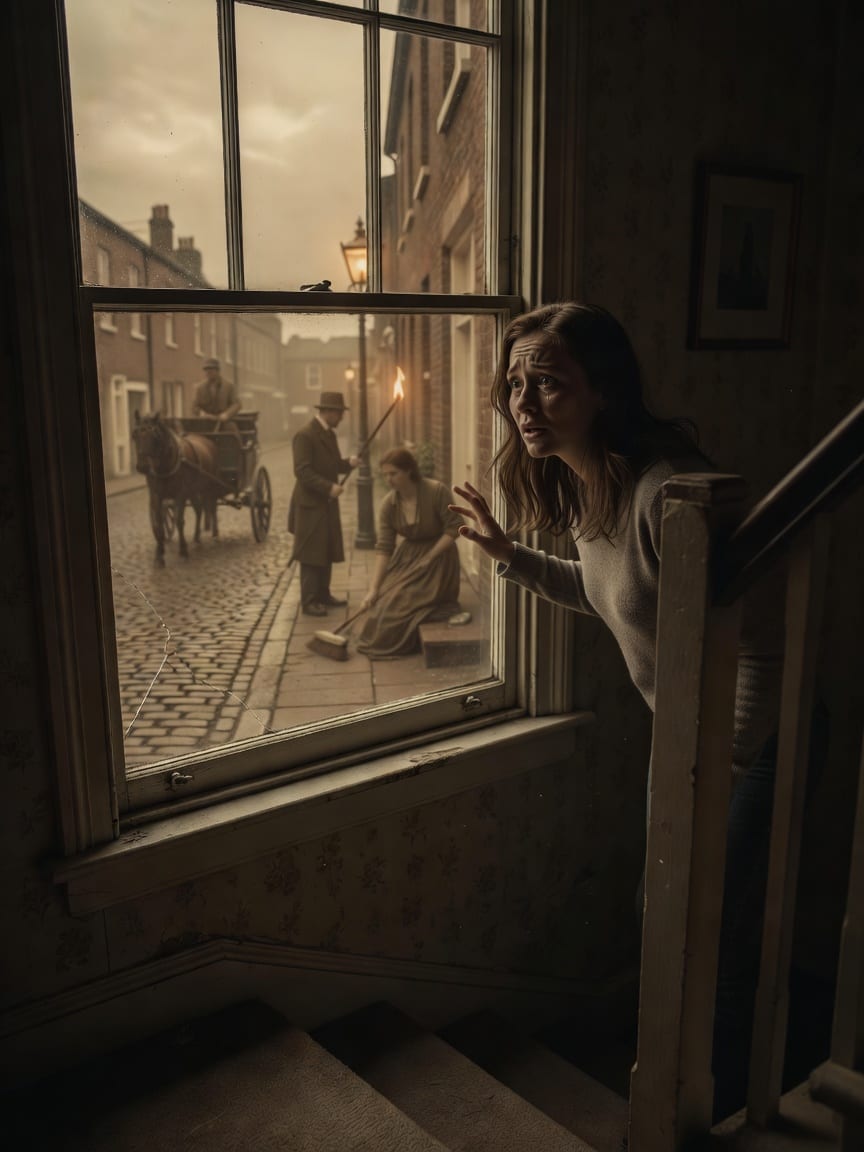
My half-landing window looked down on a cobbled street, a horse and cart. My panes, same crack. Below, only the bins.
I moved into this inherited house for a fresh start, living alone in the quiet. But the third stair on the main flight is deeply worn, a ghostly scoop hinting at decades of unseen footsteps. It feels hollow, and the wall beside it hides a faint, inexplicable seam.
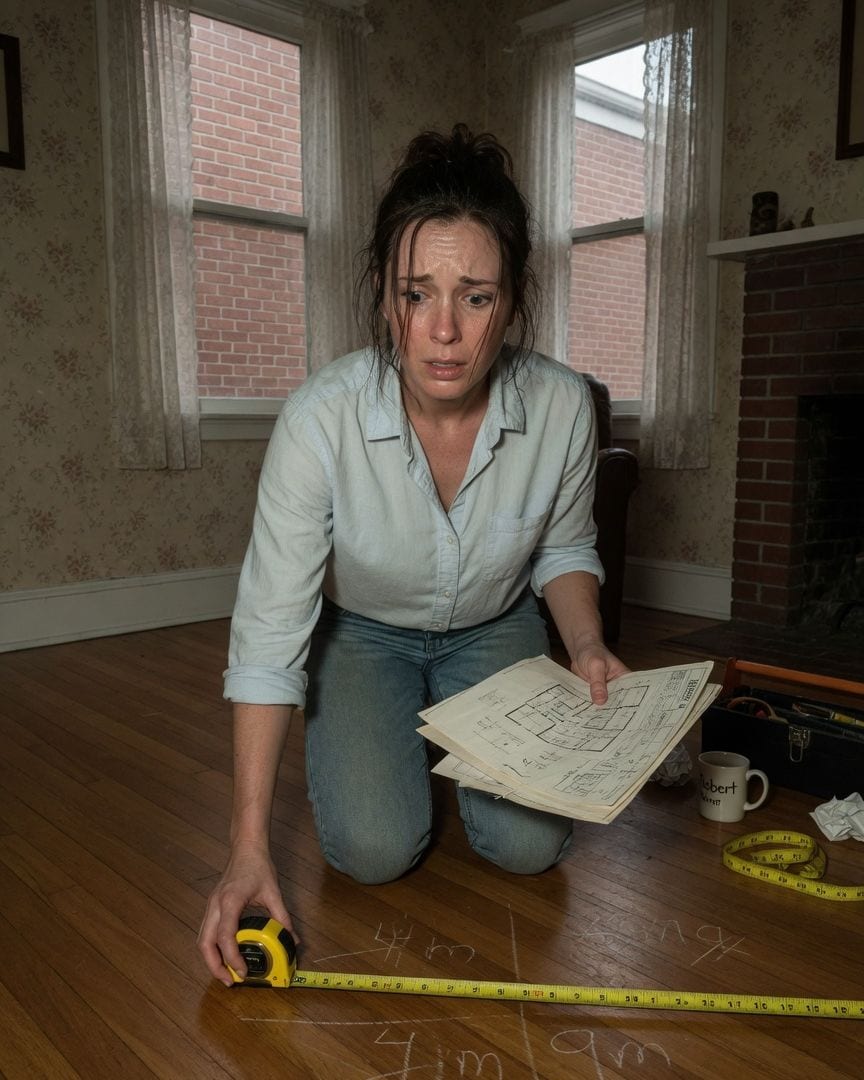
Our living room measures four by five metres. But the outside wall is nine metres long. A metre of house, gone, and I can't find it.
After moving into our charming 1920s house, I was meticulously measuring the living room when the dimensions refused to add up. My calculations of the interior space led me to discover a narrow, unpainted fifth door in the hallway, tucked almost out of sight. It wasn't on any original plans, and it opened to absolute, impenetrable darkness.
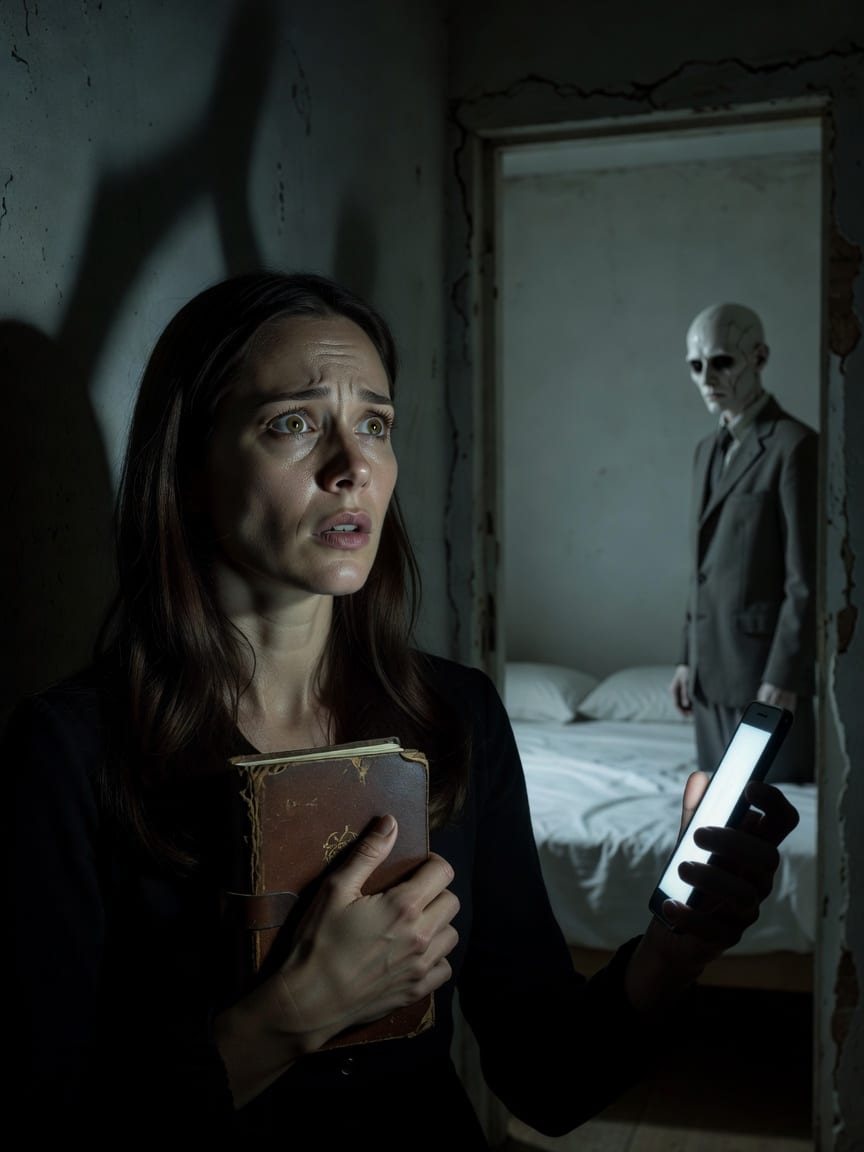
Behind a plastered-over doorway, I found a room. Papered, carpeted, and furnished with a made bed, sealed for decades. The air was dead still, but the bed wasn't dusty. My council tax bill only lists five rooms.
I'm Claire, an architect, meticulously planning my new Victorian terrace renovation. But when I uncovered a hidden room behind a wall, everything I knew about time and decay shattered. The bed was perfectly made, the air still, yet there was no dust, only an unnerving cold.
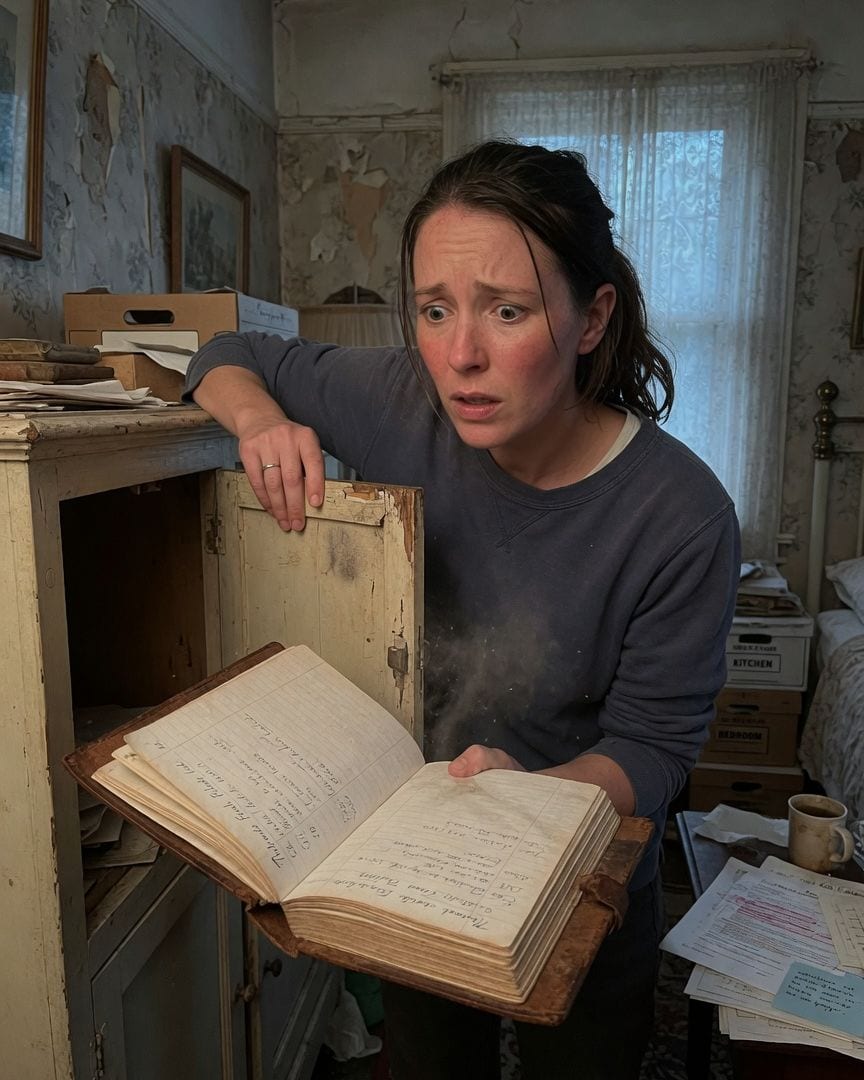
My house’s 1962 valuation has a redacted line, but the surveyor’s note says 'condition as attaches to each owner in turn.' It’s the same code on my own mortgage completion statement.
Moving into my new Victorian house, I found a redacted line in an old mortgage report. It mentioned a condition that 'attaches to each owner in turn,' a phrase my solicitor dismissed as an 'archival quirk.' But then, a hidden ledger in a bedroom cupboard revealed a chilling chain: every past owner's name, followed by 'Condition Fulfilled'.
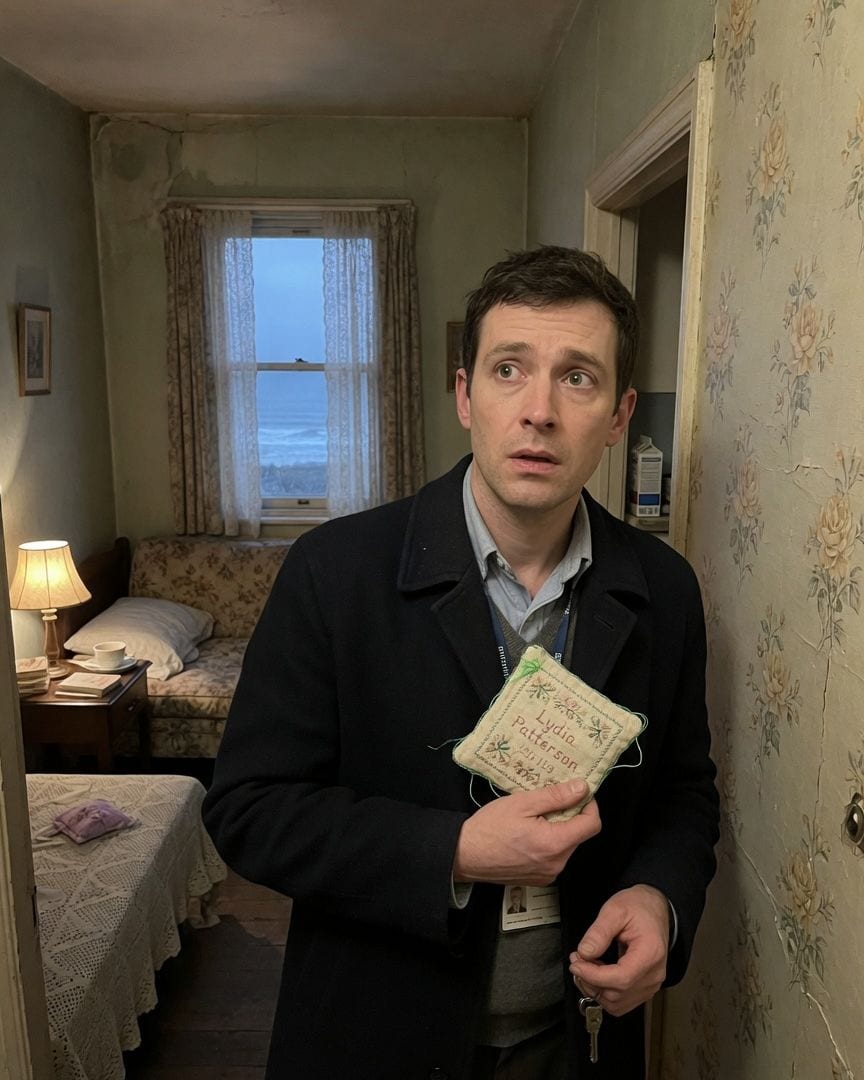
The 'empty' almshouse I was auditing wasn't empty. I heard a bare foot *thump-thump* from next door.
My new charity role involves auditing the supposedly 'empty' almshouse units. But from the unexplained activity outside to a fresh carton of milk inside, something is deeply wrong. Then, in one unit, I found a dead woman's sampler with a jarringly new thread, and heard bare feet thumping next door.