The bath filled itself at 9:30 PM. My main house water was off. Wet footprints led from the tub to a locked airing cupboard.
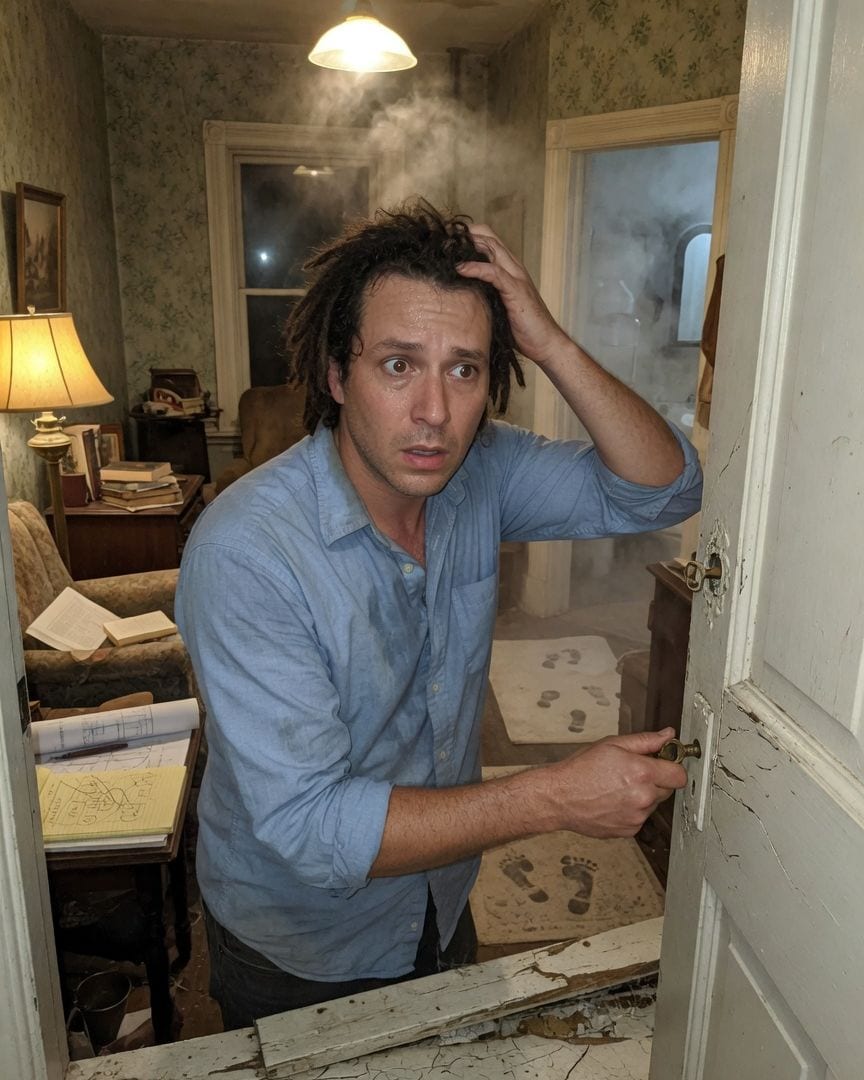
The third night was the one that broke me. I’m an architect. I deal in blueprints, stress loads, and logical systems. I pride myself on it.
Moving into this inherited Victorian house was supposed to be a fresh start, a project, a quiet place to unwind. Not… this.
The first night, I found the clawfoot bath run, warm and steaming, precisely at 9:30 PM. Full to a specific line, a clean flannel folded meticulously over the side. I’d just moved in. Maybe I’d absentmindedly turned a tap.
I dismissed it. The second night, the same thing. I checked the plumbing, convinced it was a faulty valve, a ghost in the ancient pipes. Nothing. I shrugged, unsettled, and emptied the tub.
Tonight, I was ready. I’d showered that morning, as always. At 7 PM, I went to the basement and shut off the main water supply to the entire house. No more faulty valves, no more forgotten taps.
I settled into the living room, a book in my lap, feeling a perverse sense of victory.
At 9:30 PM, I heard it. A faint gurgling from upstairs. Then the unmistakable sound of water filling. I shot up the stairs, my heart pounding a rhythm against my ribs I hadn’t known it could make.
The bathroom door was ajar. Steam billowed out, thick and humid. Inside, the tub was full, the water warm to the touch, scented faintly with something herbal and unfamiliar. The mirror was completely fogged.
And across the patterned bath mat, leading from the tub towards the back wall, were two distinct, wet footprints. They stopped abruptly at the airing cupboard door. The impossible warmth prickled my skin, a cold dread seeping into my bones.
I was utterly alone.
A cold, quiet dread settled over me, pushing aside the initial surge of panic. An architect doesn’t panic; an architect investigates. The footprints led to the airing cupboard door, a standard, white-painted panel in the wall. Unremarkable.
I tried the handle. Locked. I didn’t even know airing cupboards had locks.
My mind raced, searching for a rational explanation: a hidden pipe, a clever trick by a previous owner for some forgotten purpose, maybe a maintenance hatch to a different part of the house.
I went to my toolkit, retrieving a screwdriver, a pry bar, the works. I expected to find a cheap, modern latch, easily defeated. But as my fingers brushed against the doorframe, I felt a small, rough indentation in the wood.
It was faded, almost smooth with age, like a carving worn away over decades. Not the clean, sharp lines of Victorian detailing elsewhere in the house. More… primitive.
I ran my fingers over it again, a chill seeping through my skin.
Prying gently at the lock, I noticed something else: a faint, almost invisible scratch on the floorboards, radiating out from the bottom of the door.
It wasn't one scratch, but many, overlapping, as if something heavy had been dragged from behind that door, repeatedly, over generations. The marks were shallow, almost like scuffs, but they were there, undeniable, cutting through the painted wood.
This wasn't a one-off. This was a pattern.
I knelt, peering closer, when my gaze fell on a loose floorboard nearby, slightly raised. Curiosity, then a flicker of hope that it might reveal a pipe or a hidden mechanism, drove me to lift it.
Beneath, nestled in the dust and cobwebs, was an old, tarnished brass key. Its design was too ornate for anything in my newly modernized home, clearly antique, clearly not mine. It was a heavy, cold weight in my palm.
My breath hitched.
The brass key felt unnaturally heavy, cold against my palm. I hesitated, my thumb tracing the intricate, worn patterns on its bow. This was it. The final, mundane explanation, or… something else.
My breath caught in my throat, a knot forming in my stomach. I pushed the key into the lock of the airing cupboard door. It slid in smoothly. With a click, loud in the silent house, the tumblers disengaged.
I stood there, hand still on the knob, for what felt like an eternity. Then, with a slow, deliberate movement, I pushed the door open.
Instead of the neat stacks of towels and cleaning supplies I expected, a different room stretched before me. Dimly lit, yes, but undeniably older. Ornate, faded floral wallpaper covered the walls, a deep, bruised purple and green pattern.
Against one side, where my spare linens should have been, stood a heavy, dark wooden dresser, its surface reflecting no light.
The air wasn't cool and still; it smelled faintly of dust, certainly, but also something else, cloying and ancient, like dried lavender and forgotten things.
A shadow shifted near the dresser, a shape that might have been a hunched figure, or just the play of light.
The vision flickered then, a shimmer like heat haze distorting the edges of the wallpaper, the grain of the dark wood. It wavered, pulling back, and then snapped.
The ordinary airing cupboard was there again, the shelves neatly stacked, the air still and cool, smelling faintly of fabric softener.
I stood, my hand still on the open door, utterly frozen, the impossible image burned behind my eyes.
I tried to dismiss it, of course. Stress. Sleep deprivation. The strange light of a new house, making shadows play tricks.
But the heavy brass key was still in my hand, and the memory of that room, the specific faded floral wallpaper, the dark wooden dresser, the cloying scent – it wouldn’t fade. Logic demanded I find a real explanation.
I started digging. Local archives. Property records. The house, I discovered, had been owned for over sixty years by a Constance Vance, who passed away in the early 1980s.
After her death, the house sat empty for a long period, an anomaly in the local market, before being sold. I found faded photographs, tucked away in an old online historical society forum: "Local Homes Through the Decades."
One interior shot from the 1970s showed a bedroom. On its far wall, clear as day, was that ornate, faded floral wallpaper. Against it, the dark wooden dresser. Exactly as I’d seen it through the airing cupboard door.
The real estate agent who sold me the house, Ralph Marsh, was Constance’s great-nephew. He’d seemed affable enough during the sale, a bit old-fashioned. Now, he was the only thread I had.
I called him, ostensibly to ask about the house's original features, a polite inquiry about the age of the floorboards. He answered on the second ring, his voice calm, almost serene. When I mentioned the house’s age, he chuckled softly.
"Oh, dear Aunt Constance loved that old place. Lived there her whole life, practically. She had quite a… fondness for it." He spoke of her with a strange reverence, a quiet pride. "A woman of habit, Aunt Constance.
Very particular about things. She always said the house had a strong personality. Certain requirements, she called them."
His words struck me cold. Requirements? He seemed to possess an intimate knowledge of the house’s quirks, far beyond what a typical agent would know, or what a great-nephew might casually recall. He knew about the habits, the "requirements."
A cold unease settled in my stomach.
A few days later, Ralph Marsh appeared at my door, unannounced. He claimed he was "just in the neighborhood," "popping by to see if I was settling in alright." His presence was unsettling.
He stood on the porch, a polite smile on his face, but his eyes constantly darted past me, scanning the entryway, lingering for a moment on the bathroom door down the hall, then on the unassuming white panel of the airing cupboard.
"The house seems to like you," he observed, his voice a low, even murmur. His smile didn't quite reach his eyes. "It continues its routines, I see."
A prickle of alarm ran down my spine. I hadn't told him about the bath. Not a word. I certainly hadn't mentioned it to the local historical society, or in any online forum. How could he possibly know?
I mumbled something about enjoying the quiet, forcing a smile that felt brittle. He nodded, his gaze still sweeping the house, a faint, almost imperceptible gleam in his eyes. "Yes, quiet. That's good. The house appreciates quiet."
He stayed for only a few minutes, his presence like a cold draft on a warm day, then made his excuses and left.
That night, precisely at 9:30 PM, the bath ran itself. I heard the familiar gurgle, the steady pour of water. I didn't go in. I couldn't. I stayed in the living room, curled on the sofa, listening, my nerves frayed.
Later, around midnight, when the house was utterly silent again, I finally went to my bedroom, needing to escape the coldness that had settled in the air downstairs.
On my bedside table, neatly placed beside my alarm clock, was a small, intricately woven sachet of dried herbs. It wasn’t mine. It smelled faintly, distinctly, of the same herbal scent from the bathwater.
My window was locked. My front door was bolted. No one else lived here. Someone had been in my private space, after Ralph left, after the bath had run itself. And they had left a message.
I clutched the sachet, the herbs smelling faintly of the bath, and marched to the phone. Ralph Marsh. I found his mobile number in the old sales documents. I dialled.
He picked up on the third ring, his voice calm, as if he’d been expecting my call.
"Ralph," I said, my voice tight, "What the hell is going on?" I held up the sachet, though he couldn't see it. "This was left in my room. And don't tell me you were 'just in the neighborhood' again."
Ralph didn't deny it. He sighed, a slow, theatrical sound, gentle as a breeze through dry leaves. "Ah, the sachet. Constance always kept the house prepared, Abigail. She had a drawer full of them.
The bath, the scent… it was all part of her preparations."
"Preparations for what?" I demanded, my grip tightening on the phone. My heart hammered against my ribs, a trapped bird.
Ralph paused, a beat of silence that stretched into something menacing. He sighed again, deeper this time. "Constance believed the house was a place of… passage. A threshold. And every so often, it needed to be ready for a visitor."
He spoke of it with a strange, almost fond detachment, as if discussing a peculiar but beloved pet. He looked out his window, his gaze distant, his voice soft, almost meditative.
"My great-aunt was convinced the house marked a cyclical event, a time when the veil between states thinned. The bath, you see, was a cleansing. A welcoming. Not just for the house, but for… what comes next."
My mind reeled. "The door," I whispered, remembering the impossible vision. "The airing cupboard."
He turned back to me, his eyes clear and unblinking, utterly devoid of surprise or concern. "The door you saw, Abigail, it shows the house at different points in its cycle.
It’s a memory, yes, but also a glimpse of what is to come, or what has been." He spoke of Constance's "convictions" not as madness, not as delusion, but as accepted fact, undeniable truth.
His calm acceptance, his utter lack of alarm, was chilling me to the bone. The footprints, the scent, the door showing the past – it all clicked into place, not as a haunting, but as part of a ritual.
A systematic, deliberate ritual. And I was in the middle of it.
Ralph's calm explanation about the house's "cycle" and "visitor" left me with a profound sense of unease, a cold certainty that I was trapped in something far larger and older than myself. I couldn't just leave. My house. My inheritance.
My responsibility. But the dread was a living thing now, coiling in my gut. I had to know more. Every detail.
I dove deeper into local historical records, this time focusing specifically on property transfers for my address. The records were meticulously kept. What I uncovered chilled me to the core, solidifying the sickening feeling that had taken root.
Every forty years, almost to the exact month, the house was sold. And each time, the new owner was a single woman.
I cross-referenced these dates with archived local newspaper clippings, digging through microfiches at the library until my eyes ached. From the 1940s: "Local Woman, Margaret Lockwood, Found Reclusive, Neighbors Concerned." A few weeks later: "Margaret Lockwood's Disappearance Remains Unexplained."
Forty years later, in the early 1980s: "Constance Vance's Strange Reclusiveness Prior to Death." The articles mentioned "unexplained occurrences" at the address, reports of strange lights, "a palpable chill." Always around the same time of year, shortly after their purchase.
I saw the name Margaret Lockwood on a deed from 1943. Then Constance Vance on a deed from 1983. And now, on the most recent deed, my own name: Abigail Kingsley, 2023.
The pattern was undeniable. Horrifyingly precise.
I held the brittle, yellowed newspaper clipping, the grainy black and white image of Margaret Lockwood’s vanished face staring up at me.
My own name on the property deed was a contrast, an undeniable link to these dated reports of 'unexplained occurrences' at the very same address, 40 years apart.
A sickening lurch twisted in my stomach. I was not just a witness. I was not just living in a haunted house. I was the next chosen participant. I was the latest in a pattern stretching back generations.
I confronted Ralph again, the brittle newspaper clippings fanned out on my coffee table, the property deeds with their precise 40-year intervals laid bare. This time, there was no pretence. He didn't flinch. His calm was absolute, terrifying.
"Constance believed the house was not just a threshold, Abigail, but a living entity," he explained, his voice devoid of emotion, as if reading from a textbook. "It retains memories, yes, but it also seeks to complete a purpose.
The 'visitor' is not truly a visitor, but an 'opening,' a merging. The house requires a keeper, a conduit, to sustain its connection to… the other side."
He sat opposite me, his hands clasped, a placid smile on his lips. "Constance Vance, my great-aunt, didn't disappear, Abigail. She 'became one with the house' during her cycle.
Her consciousness absorbed into its fabric, leaving only the rituals and traces behind." He gestured vaguely around the room. "The bath. The scent. The sachet. These are her echoes, her final preparations, guiding the next keeper."
He considered this a privilege, a necessary continuation. "You, Abigail," he said, looking at me with a disconcerting paternalism, a proprietorial gleam in his eyes, "are simply the next chosen keeper. The house called you, just as it called Margaret.
Just as it called Constance. The preparations are for the merging. The time is almost upon us."
Every strange detail, every impossible sight, every clue I had dismissed or investigated, clicked into place with a horrifying, coherent inevitability. The wet footprints, leading from the bath to the door. The door itself, a temporal gateway. The precise timings.
The sachet left in my room. The inexplicable calm of Ralph Marsh, who had facilitated it all. I wasn't just in danger; I was the final ingredient.
The dread crystallized into something solid, a crushing weight in my chest. Ralph Marsh wasn't a villain in the way I understood it, not with malice or cruelty.
He was something far worse: a serene, utterly dedicated facilitator of the house's will, a steward of its terrible purpose. He rose from his seat and gestured toward the airing cupboard door.
It stood wide open.
But beyond it, there was no longer a glimpse of an old room, no faded wallpaper or dark dresser. Instead, a swirling, indistinct void stretched into impossible depth.
It was a deep, humming darkness that seemed to pulse with an ancient energy, a low thrum that resonated in the very foundations of the house.
The air around it shivered, not just heat haze, but actual vibrations, as if the space itself was coming undone. This was the "opening." This was the "visitor."
"You can resist, Abigail," Ralph said, his voice softer now, almost mournful, "but the house has chosen. It will draw you in, one way or another." He wasn't threatening me. He was stating a fact.
And his calm conviction, the absolute certainty in his eyes, was the most terrifying part of all.
I felt an immense, almost physical pull, a deep, resonant hum that vibrated in my bones, drawing me towards the open void. It was not a violent force, but an insistent, magnetic presence, an almost comforting warmth promising cessation.
My mind screamed. This was my final, desperate chance. With a primal surge of terror, a frantic, desperate will to live, I turned and bolted for the front door.
My hand reached for the cold metal of the doorknob, my fingers fumbling, slipping on the smooth brass. Just as I grasped it, just as I felt the latch begin to turn, an overwhelming pressure slammed into my back.
Not a push, not a physical blow, but an irresistible current, a wave of pure force, dragging me backward. Away from escape, towards the humming, swirling darkness of the airing cupboard door.
The house was closing around me, claiming its new keeper.
The house stands empty again, impeccably maintained. The 'For Sale' sign is back on the lawn, freshly painted. Ralph Marsh is still the listing agent, his business card tucked neatly into the sign's holder.
The online listing describes the property as 'charming, with unique historical character and an inviting, serene atmosphere.' There is no mention of the bath, the door, or the previous occupants' fates. The cycle continues, quiet and unseen.
The house is quiet, waiting. A new 'For Sale' sign stands outside, its bright red letters a contrast to the old Victorian brick.
Ralph Marsh, standing on the porch, adjusts the sign, ensuring it catches the afternoon light just so. He turns back to the house, a faint, almost imperceptible smile on his face, and whispers, "She's ready for the next one."
If this one got to you
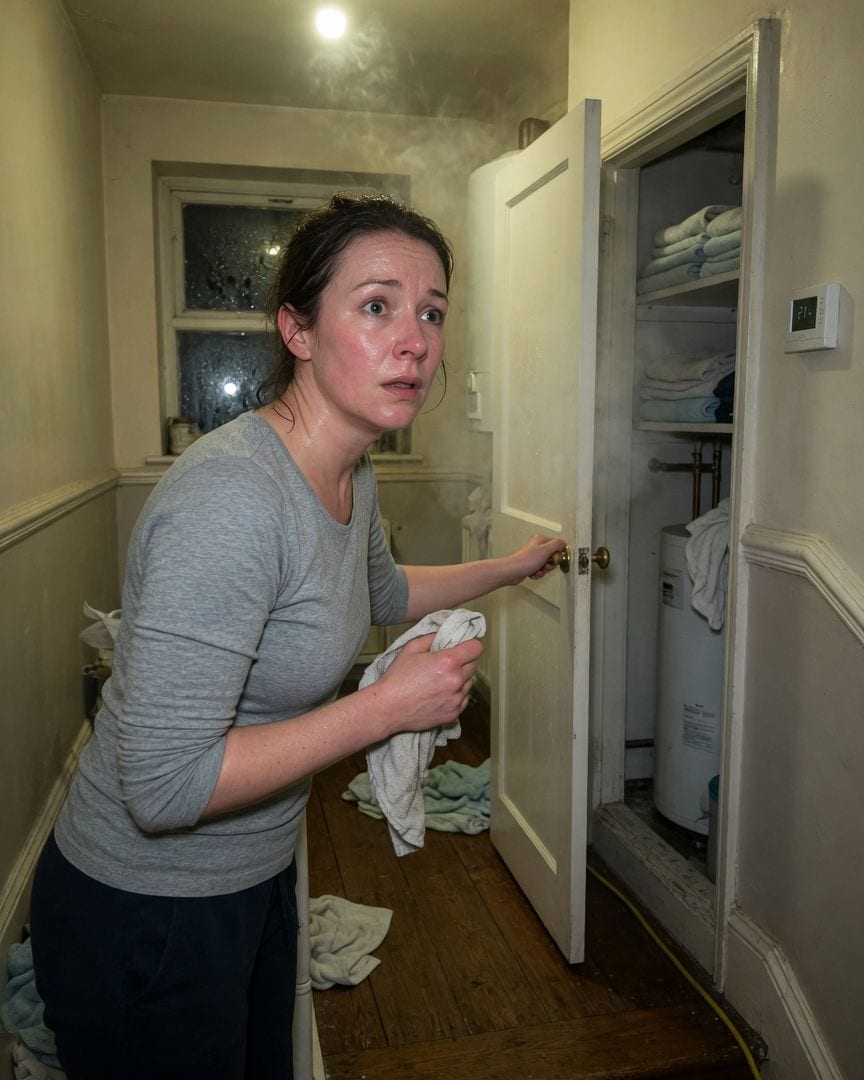
My airing cupboard opened onto a burning brick copper, sheets boiling. The heat rolled out, smelling of soda and wet linen. I shut it; my boiler was back.
My new house, bought just last spring, felt colder than expected. When I opened the airing cupboard, it wasn't mine at all, but a blast of steam and a roaring fire from an impossible past. Days later, a faint, metallic smell still drifted from the landing, and a worn path on the floorboards led to a hidden, ancient sampler beneath my feet, dated 1892.
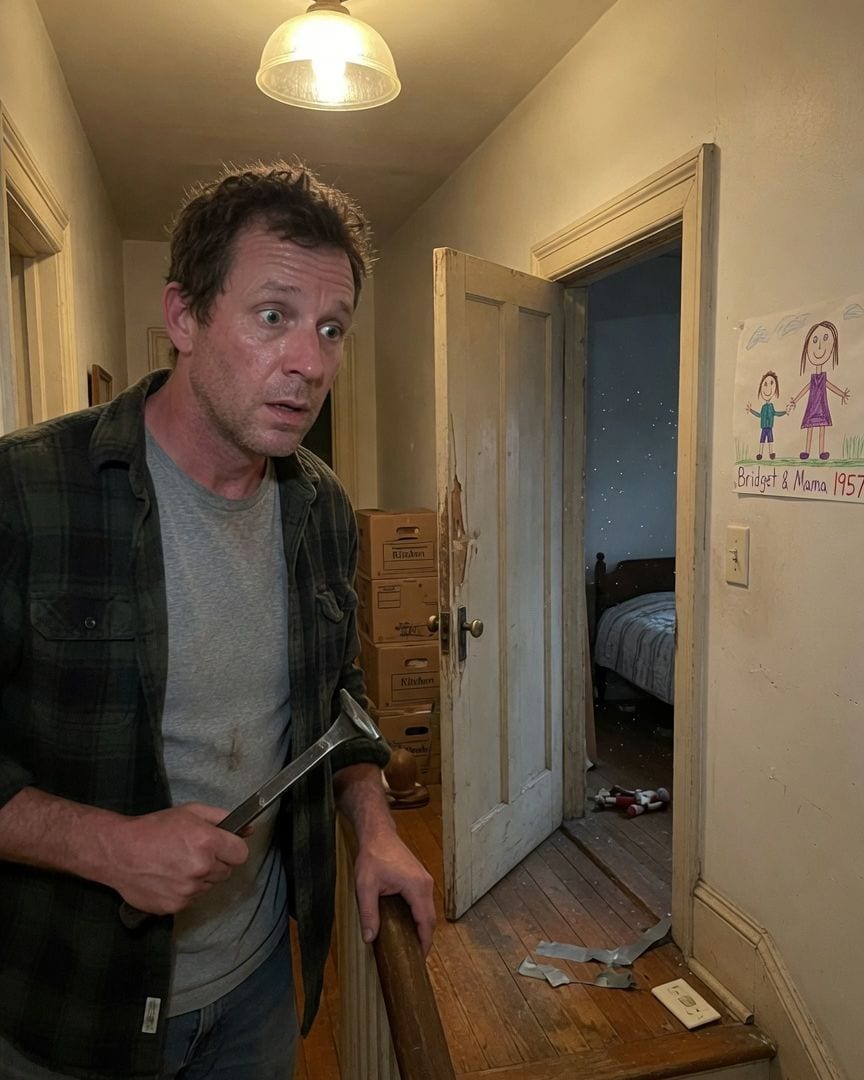
My landing light switches itself off at 9:40 every night. I've watched the switch flick down under nothing, the tape peeled back. The house holds its breath.
My great-uncle's old house was a quiet gift, a place to finally settle. But as I unpacked, a strange worn path on the floorboards led me to a small, barely visible door, perfectly blended into the wall. It was undeniably locked, and felt like a deliberately obscured secret.
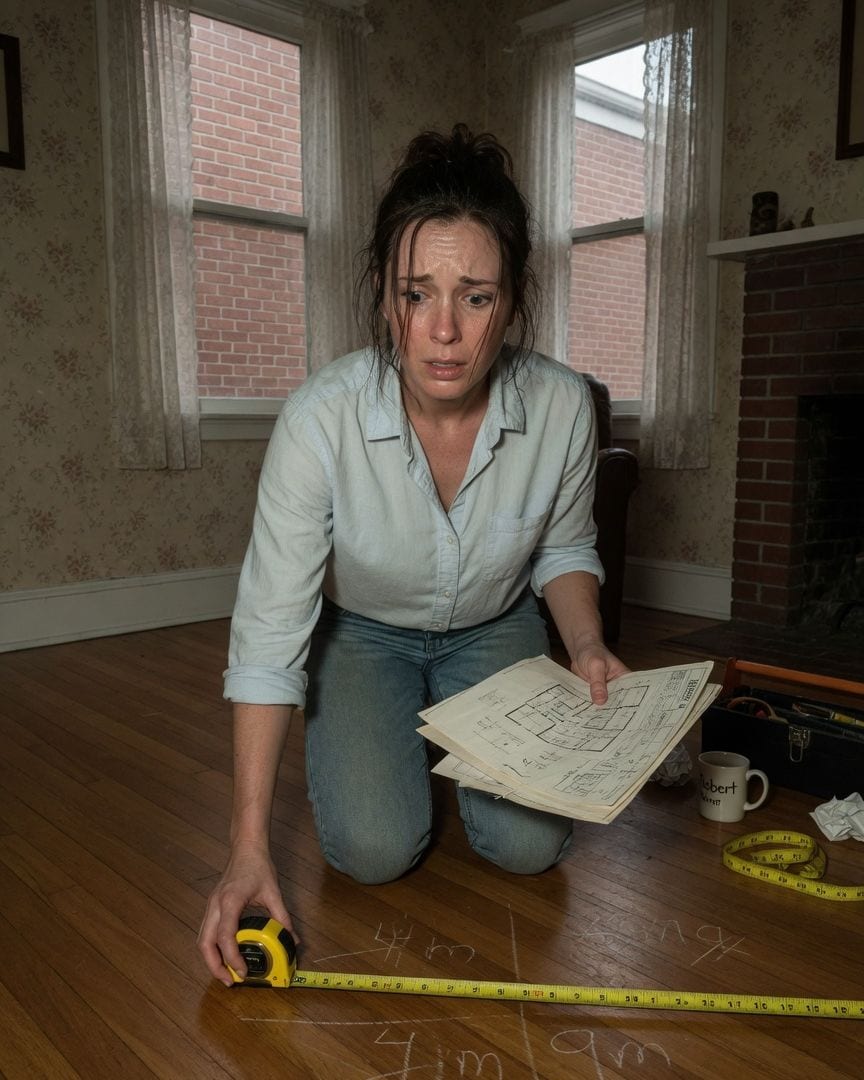
Our living room measures four by five metres. But the outside wall is nine metres long. A metre of house, gone, and I can't find it.
After moving into our charming 1920s house, I was meticulously measuring the living room when the dimensions refused to add up. My calculations of the interior space led me to discover a narrow, unpainted fifth door in the hallway, tucked almost out of sight. It wasn't on any original plans, and it opened to absolute, impenetrable darkness.
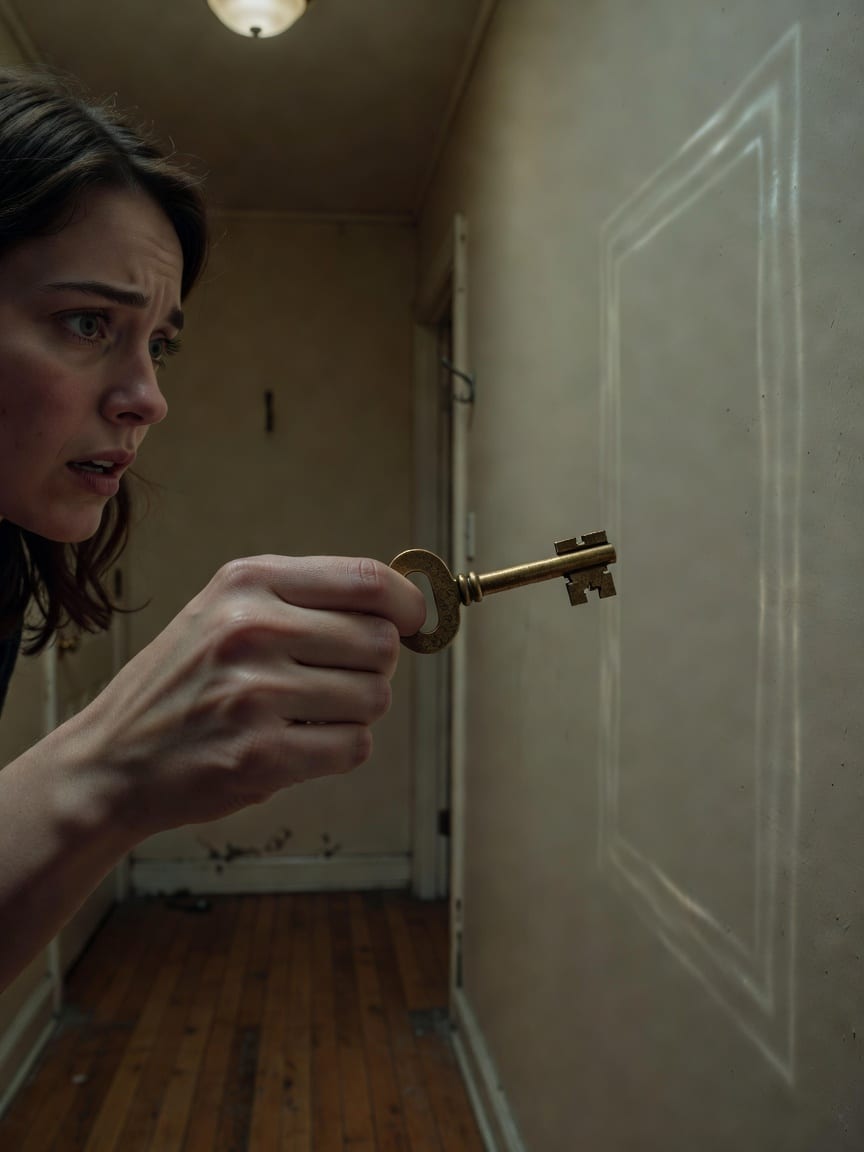
My new house has seven rooms. The removal men counted six. Now one of them asks who's in the locked seventh, on a landing with only six doors.
Moving into my new house, I supervised the removal men hauling boxes. But on the landing, Paul, the senior man, asked about a locked seventh room upstairs, pointing to a blank wall. His quiet certainty, despite the clear absence of a door, filled me with a sudden, icy dread.
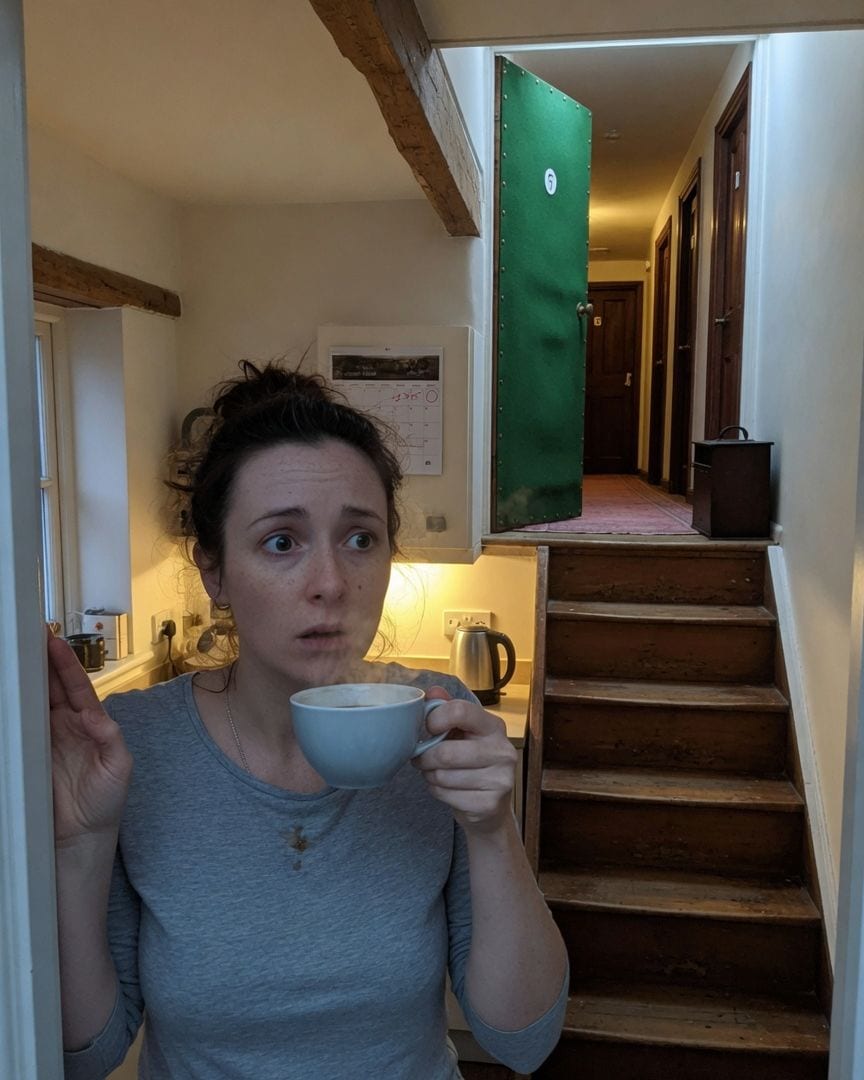
A green baize door I hadn't built stood ajar at the top of my servants' staircase, onto a corridor of numbered rooms far longer than my house, a housemaid's box left outside room seven.
After a year of renovations, my old estate house was finally complete, and I lived alone. One morning, I awoke to find a finely embroidered linen napkin on my bedside table, smelling faintly of lavender. It was identical to a stack I'd glimpsed in a corridor that had vanished overnight.
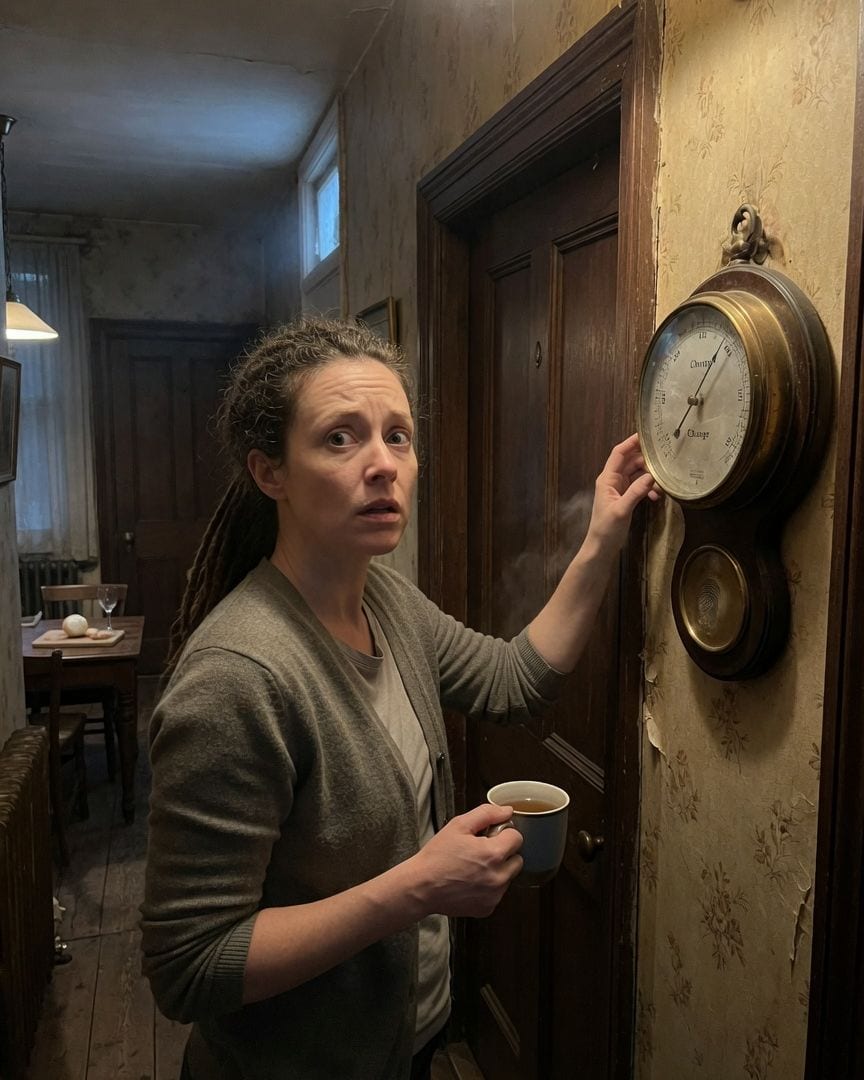
My hall barometer taps itself every night at six. From the next room, with nobody there.
After moving into Oscar Vaughn's old house, I became accustomed to the strange noises that came with it. But then, a heavy, locked oak door in the dining room, one I'd never been able to open, slowly pushed itself ajar at precisely six o'clock one evening. I hadn't touched it, and no one else was there.