A green baize door I hadn't built stood ajar at the top of my servants' staircase, onto a corridor of numbered rooms far longer than my house, a housemaid's box left outside room seven.
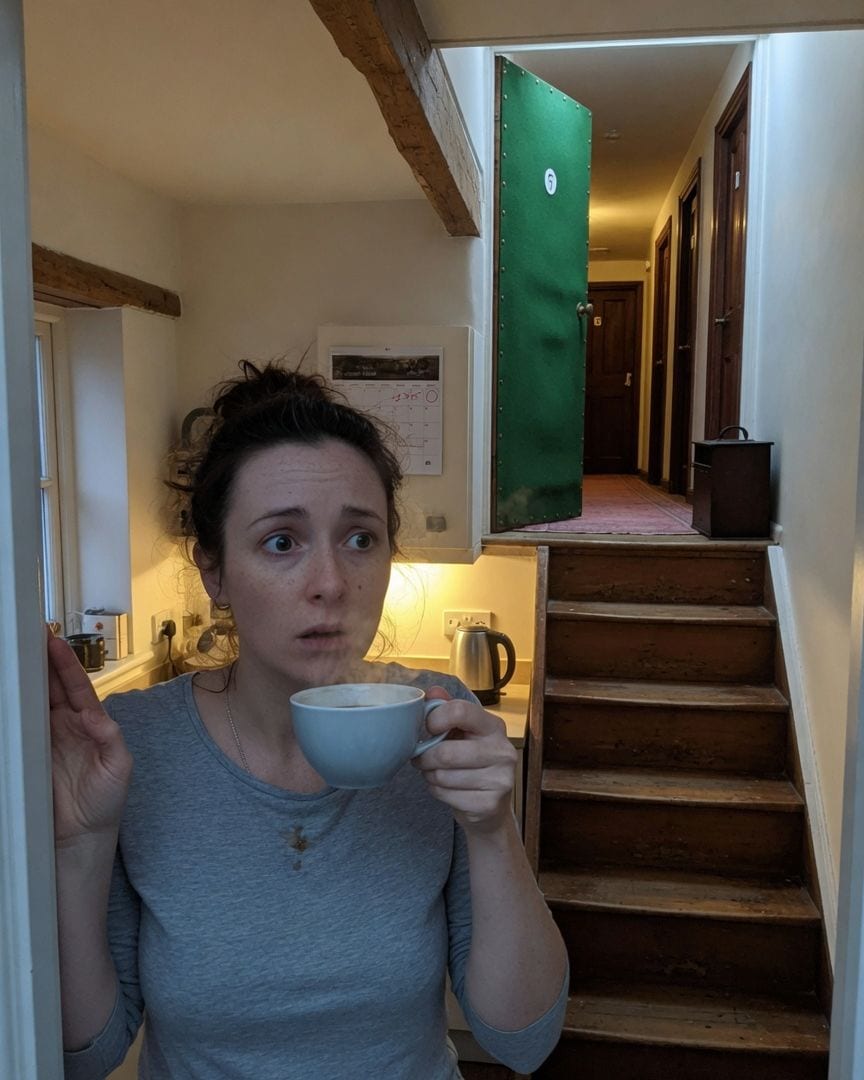
It was exactly one year to the day since I’d bought the old Kingsley estate house, and the renovations were finally done.
I was celebrating with a quiet cup of tea when I heard it: faint, rhythmic footsteps ascending the newly exposed servants’ staircase.
We’d uncovered it behind a stud wall in the kitchen during the reno, a narrow, steep thing, and left it open, meaning to remove it eventually. But I lived alone. My partner was out of town.
I froze, tea cup halfway to my lips, listening to the creak of wood I knew intimately, but which should have been silent.
The footsteps reached the top landing, paused, then continued, lighter now, as if on a carpeted runner. Heart hammering, I crept to the kitchen door and peered up.
Where the staircase met the landing, a green baize door now stood, slightly ajar, its dark fabric a sudden, impossible blot against the newly painted plaster. I had not built that door.
Beyond it, a sliver of dimly lit corridor stretched, lined with identical numbered bedroom doors – far, far longer than the house was wide. Outside room seven, a small, dark wooden housemaid's box rested on a faint, plush runner.
I blinked, rubbed my eyes. The footsteps had stopped. The door remained. The corridor remained. My breath hitched. I told myself it was exhaustion, the old house settling, but the green baize door was real, solid, and completely new.
The next morning, the green baize door was gone. The servants’ staircase led only to a blank wall, just as it had for months.
I touched the plaster, cold and smooth, looking for seams, for any sign of a hidden opening. Nothing. I dismissed it as a vivid dream, a waking hallucination brought on by stress. But then the routine started.
Every morning, at precisely 6 AM, I’d hear the distinct whistle of a kettle from the kitchen, even though I hadn't touched it since the night before. I’d rush in to find it steaming gently, still hot to the touch.
I tried to rationalize it – residual heat, a faulty timer, something. But it happened every day.
Then there was the third stair on the main landing – not the servants' stair, but the grand oak staircase. I started noticing a faint, almost imperceptible creak as I descended, a sound I hadn't heard before.
It wasn't the third stair itself; it was the one after it, as if someone had deliberately avoided stepping on the third. And the smells.
Sometimes, a fleeting aroma of boiled cabbage and mutton, or a faint, sweet scent of lavender and starch, would drift through the house, only to vanish moments later. I checked the renovation plans again, the architectural drawings from the council.
No hidden corridors. No green baize doors. Just the solid, familiar layout of my house. The ordinary explanations were starting to fray, like an old, well-worn fabric.
I woke abruptly to a soft, rustling sound beside my bed. Not the house settling, but something distinct, like fabric being unfolded. My heart leaped into my throat. I lay perfectly still, listening, every nerve screaming. The sound ceased.
Slowly, I opened my eyes. On my bedside table, neatly folded beside my alarm clock, was an old linen napkin. It was a fine weave, edged with delicate, hand-stitched embroidery – a tiny, almost faded 'K' for Kingsley.
The faint scent of lavender, like something pressed and forgotten, clung to it. It was identical to the stack I’d briefly glimpsed in the housemaid’s box, the one outside room seven, in the corridor that shouldn't exist. I lived alone.
I had locked the door before bed. My hand trembled as I reached out and touched the cool, starched fabric.
The napkin was undeniable proof. The green baize door, the corridor, the box – it wasn't a dream. It was real, or at least, its contents were.
I spent the next few days in a fog of frantic research, digging into the house’s history. The Kingsley family had owned it for generations, a grand estate, with a full complement of staff.
I visited the local archives, sifting through dusty property deeds and old newspaper clippings. Nothing explicitly mentioned hidden passages or strange occurrences, but the references to the Kingsley’s 'dedicated and loyal staff' were frequent.
I sought out Paul Montgomery, a spry, elderly neighbor who was practically a walking encyclopedia of local history. He’d lived in the village his entire 72 years. I approached him casually, asking about the old estate, the servants’ quarters.
He spoke fondly of the Kingsley family, particularly their head housekeeper. 'Greta Muller,' he'd said, a wistful look in his eye. 'Served them for decades. Absolutely devoted.
Never missed a day, even after the old Master Kingsley passed and the family started selling off bits of the estate.' When I pressed him about any unusual features, any hidden rooms, he grew vague, his gaze flitting away.
'Old houses have their secrets, Naomi,' he’d mumbled, changing the subject to the village fete. The routine in my house continued, more insistent now.
I found a distinct impression on the cushion of an armchair in the sitting room, as if someone had just risen from it. The faint smell of mutton stew would hang in the air around lunchtime, only to dissipate.
The kettle whistled at 6 AM. The third stair creaked. The house was running on its own schedule, and I was merely an interloper.
My investigation felt noticed. I bought a cheap, motion-activated camera and set it up discreetly near the wall where the servants' staircase met the landing, hoping to catch something.
The next morning, the camera was on the floor, its battery compartment open, the batteries removed and placed neatly beside it. No footage. It felt like a direct, silent rebuke.
I started to feel an unsettling presence, a sense of being observed, not with malice, but with a quiet, unwavering attention.
One afternoon, I was in the library, engrossed in an old land registry document, trying to piece together the estate’s original footprint. The house was utterly silent, save for the rustle of paper.
Then, directly above me, I heard it: the distinct, familiar sequence of footsteps on the main landing, the deliberate avoidance of the third stair, followed by the faint creak of the fourth. My blood ran cold. I lived alone.
My partner was still away. I didn't dare look up. A moment later, a faint, sweet, cloying scent of lavender passed me, like a sigh in the still air. It lingered for a moment, then was gone.
It wasn't just a routine; it was responsive. Someone – or something – knew exactly what I was doing, and it was making its presence known. The house was not just remembering; it was acting.
I drove back to Paul Montgomery's house, the old land registry documents clenched in my hand. He opened the door, a flicker of apprehension in his eyes. 'Naomi, dear, is everything alright?'
he asked, trying for a jovial tone that didn't quite land. 'No, Paul, it's not,' I said, my voice steady despite the tremor in my hands. 'You knew more about Greta Muller, didn't you?'
I pushed past him gently, into his cluttered sitting room.
I laid out the old photographs I’d found – images of the Kingsley estate in its prime, showing a bustling household, and in several, a stern-faced woman in a dark dress, always in the background, always working.
'This is Greta, isn't it?' I pointed to one. Paul nodded slowly, his gaze fixed on the photo. 'The best housekeeper the Kingsleys ever had,' he murmured. 'Absolutely dedicated. Never married, no family of her own.
The house was her life.'
'And she died here, didn't she?' I pressed. 'On the property.' He hesitated, running a hand over his thin hair. 'Yes. In the staff quarters. A quiet passing. Heart attack, they said. She was old, mind you.'
'And she never left, did she?' I asked, watching his face. He visibly flinched. 'Well, not in spirit, perhaps,' he stammered, avoiding my eyes. 'She loved that house. Kept it running like clockwork.
Even after the Kingsleys fell on hard times and sold off parts, she stayed. Insisted on it. They couldn't get her to go.' 'She kept a journal of her duties, didn't she?' I asked, remembering his earlier, fleeting mention.
His head snapped up. 'How did you know that?' he asked, alarm in his voice. 'She was meticulous. Everything written down. Every chore, every meal, every hour. A real stickler for order, Greta was. Said the house needed its schedule.'
He looked at me, a deep, unsettling sadness in his eyes. 'She wouldn't leave, Naomi. Not even when she was gone. The house… the house still remembers her. It still runs on her schedule.' The puzzle pieces clicked into place.
The kettle, the stair, the smells, the hidden corridor – it was all Greta. The house was not just a building; it was a living memory of her unwavering devotion, a routine that continued beyond death.
The dread was in the coherence.
Armed with Paul’s admission and the knowledge of Greta’s meticulous nature, I returned home, my mind racing. I remembered Paul mentioning Greta's 'journal of duties.' It wasn't in the archives. Where would such a thing be kept?
Greta’s quarters were long gone, absorbed into other parts of the house during the conversion. But the Kingsleys had been collectors, and the old library, now my study, had numerous hidden compartments and secret drawers.
I systematically began searching, my fingers tracing every inch of the oak paneling.
Behind a loose baseboard, tucked away in a shallow cavity, my fingers brushed against something hard, leather-bound. I pulled it out. It was a small, unassuming book, its dark leather cover worn smooth with age.
'Greta Muller – Service Log,' was embossed in faded gold script on the front. My heart hammered against my ribs. This was it. I opened it, my hands trembling.
Inside, in neat, elegant handwriting, were years of daily entries, detailing every aspect of her service: '6 AM: Kettle for Master Kingsley's tea. 6:15 AM: Dust main hall, avoid third stair. 7 AM: Prepare breakfast for family. 8 AM: Rounds to rooms 1-10.'
It was all there, every recurring detail I had witnessed. I flipped through the pages, my eyes devouring the precise, relentless schedule, a testament to a life entirely devoted to service. I reached the very last page, the final entry.
My breath hitched. March 14th, 1978. The date stared up from the page, a cold, impossible fact. Twenty years after Greta Muller's official death certificate.
Below it, in the same neat script, was the entry: '6 AM: Kettle for Master Kingsley's tea. 6:15 AM: Avoid third stair on main landing. 7 AM: Rounds to rooms 1-10.'
As I stared at the impossible date, the distant, unmistakable sound of my own kitchen kettle began to whistle, a thin, shrill note that pierced the silence.
Clutching the impossible logbook, I ran to the kitchen. The kettle was indeed on the hob, emitting a thin stream of steam, its whistle now a low, continuous moan. I hadn't touched it.
The kitchen was cold, the morning light still weak, yet the kettle was hot, boiling with an unseen energy. I snatched it off the heat, the steam scalding my fingers.
The house was not merely haunted by Greta Muller; the house was the haunting. The logbook wasn't just a record of her past duties; it was the active program, the code that ran the house's retained memory.
Every sound, every smell, every phantom architectural detail was an entry in this book, a task still being performed by an unseen force, a schedule that continued without end.
The numbered rooms, the housemaid's box, the specific meals, the avoided stair – it all clicked into place, a horrifyingly coherent pattern. Greta's devotion hadn't just imprinted on the house; it had become an intrinsic part of its fabric.
The house was still the Kingsley estate, and Greta Muller, in her tireless precision, was still its head housekeeper, running her perfect, eternal routine.
The terror wasn't in a malevolent spirit, but in the sheer, unyielding persistence of a life's work, a schedule that refused to acknowledge its own end.
The house was not just remembering; it was reliving, on an endless, looping cycle, the precise order Greta had imposed upon it. And now, I was living within that cycle, an unwanted guest in a schedule not my own.
I couldn't just live with it. The house was no longer mine; it was Greta's. I had to break the cycle. The logbook, I decided, was the key. It was the physical manifestation of the routine, the anchor.
If I removed it, perhaps the house would finally be still. I clutched the heavy, leather-bound book, my heart pounding, and started for the front door.
As I descended the main staircase, the air grew suddenly cold. Halfway down, where the main landing branched, the green baize door shimmered into existence at the top of the servants' staircase, wide open.
Beyond it, the long, dim corridor stretched out, lined with its numbered bedroom doors. This time, however, the doors were all slightly ajar, casting thin, inviting slivers of light onto the worn runner.
A faint, rhythmic tapping sound echoed from room seven, like a duster hitting a surface, soft and insistent. The sweet, cloying smell of old lavender and starch, stronger than ever, filled the air, suffocating me.
I heard a faint murmur, like a distant, dutiful humming. It wasn't a threat, not exactly, but an overwhelming sense of busy, methodical activity. I froze, one foot poised on the third stair, the one always avoided.
I looked from the logbook in my hand to the impossible corridor, now fully manifest. It wasn't Greta trapped in the house; the house was Greta's routine, her very essence.
To break the cycle, to remove the logbook, felt like tearing down the house itself, dismantling a meticulously constructed life. The humming from room seven seemed to grow louder, more insistent, a gentle urging.
I stood there, caught between the solid reality of the house and the relentless, perfect schedule of the dead, the logbook heavy, pulling me back towards its ordered, eternal rhythm.
I didn't leave. I couldn't. The logbook remained. The house settled into its routine, and I, into mine.
The green baize door no longer appeared, but I sometimes caught a faint, worn path on the floorboards where the servants' staircase met the landing, a ghost of an entrance. The kettle still whistled at 6 AM, hot and steaming.
The third stair on the main landing still creaked, just after the one before it, as if a weight had passed over it, carefully.
The smells of cabbage, mutton, and lavender would drift through the rooms, always at the same times, always fleeting. I sealed the servants' staircase again, bricking it up, painting over the spot where it had been exposed.
But I knew it was still there, a dormant artery, waiting.
I had learned to live around the edges of Greta's schedule, a silent observer in a house that still belonged to its past, a house that never truly let go.
Sometimes, I find myself making tea at 6 AM, just as the kettle whistles, pouring it into a cup that I've already set out.
I avoid the third stair on the main landing, stepping over it with a careful, almost unconscious grace. I arrange the cushions on the sitting room armchair just so, smoothing out any imagined impressions.
I’ve found a certain peace in the predictability, a quiet rhythm in the house’s ceaseless order. It’s no longer a haunting, but a presence, a constant, gentle hum beneath the surface of my own life. I’ve stopped fighting it.
I’ve learned its cadence, its requirements. The house, after all, simply wants to be kept.
Paul Montgomery, visiting Naomi after a few months, notices a strange precision in her movements, a quiet, almost mechanical grace. Her hair is always perfectly neat, her clothes uncreased.
“You’re looking well, Naomi,” he says, accepting the perfectly brewed tea she offers, exactly as he likes it. “Settled in nicely, have we?”
She gives him a faint, almost imperceptible smile, her eyes distant, fixed on some unseen point in the well-ordered room. “The house requires a certain order, Paul,” she replies, her voice soft, “and I’ve learned to respect it.”
If this one got to you
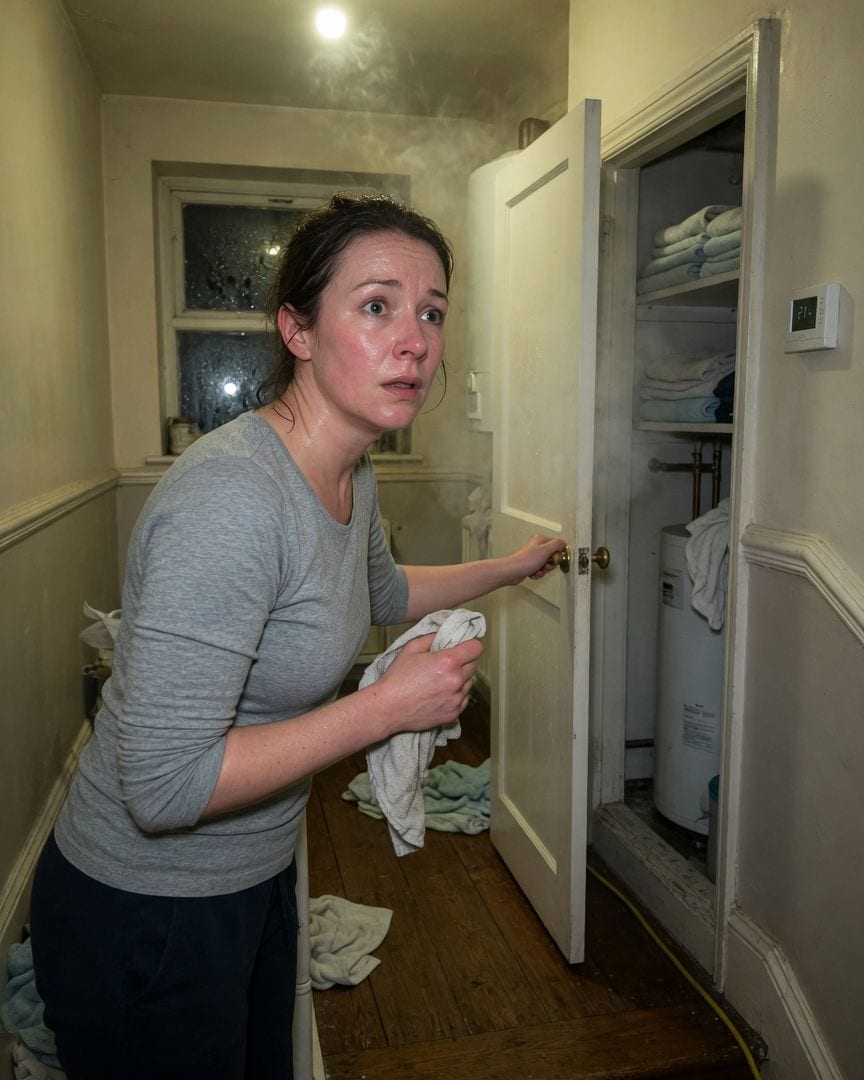
My airing cupboard opened onto a burning brick copper, sheets boiling. The heat rolled out, smelling of soda and wet linen. I shut it; my boiler was back.
My new house, bought just last spring, felt colder than expected. When I opened the airing cupboard, it wasn't mine at all, but a blast of steam and a roaring fire from an impossible past. Days later, a faint, metallic smell still drifted from the landing, and a worn path on the floorboards led to a hidden, ancient sampler beneath my feet, dated 1892.

The bath filled itself at 9:30 PM. My main house water was off. Wet footprints led from the tub to a locked airing cupboard.
As an architect, I pride myself on logic. Moving into my inherited Victorian house was supposed to be a quiet fresh start, but on the third night, I heard the impossible. Even after I shut off the main water to the entire house, my clawfoot bath upstairs ran full, warm, and steaming at 9:30 PM.
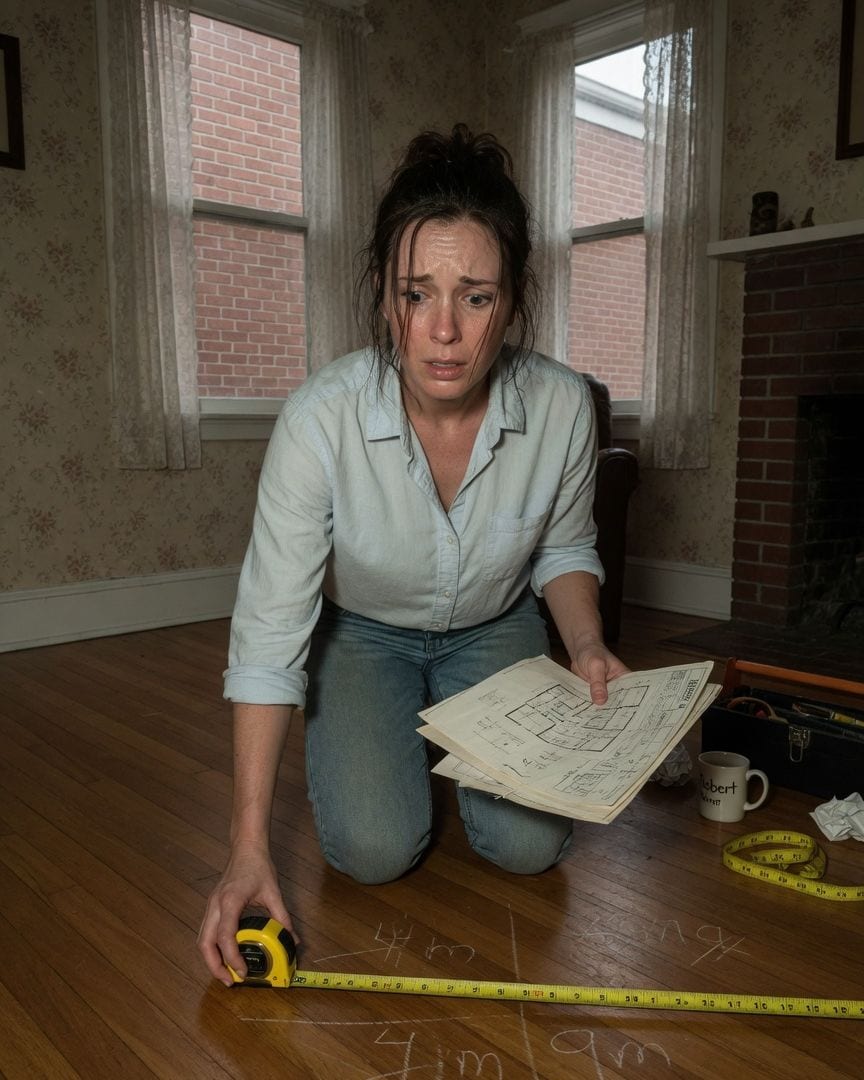
Our living room measures four by five metres. But the outside wall is nine metres long. A metre of house, gone, and I can't find it.
After moving into our charming 1920s house, I was meticulously measuring the living room when the dimensions refused to add up. My calculations of the interior space led me to discover a narrow, unpainted fifth door in the hallway, tucked almost out of sight. It wasn't on any original plans, and it opened to absolute, impenetrable darkness.
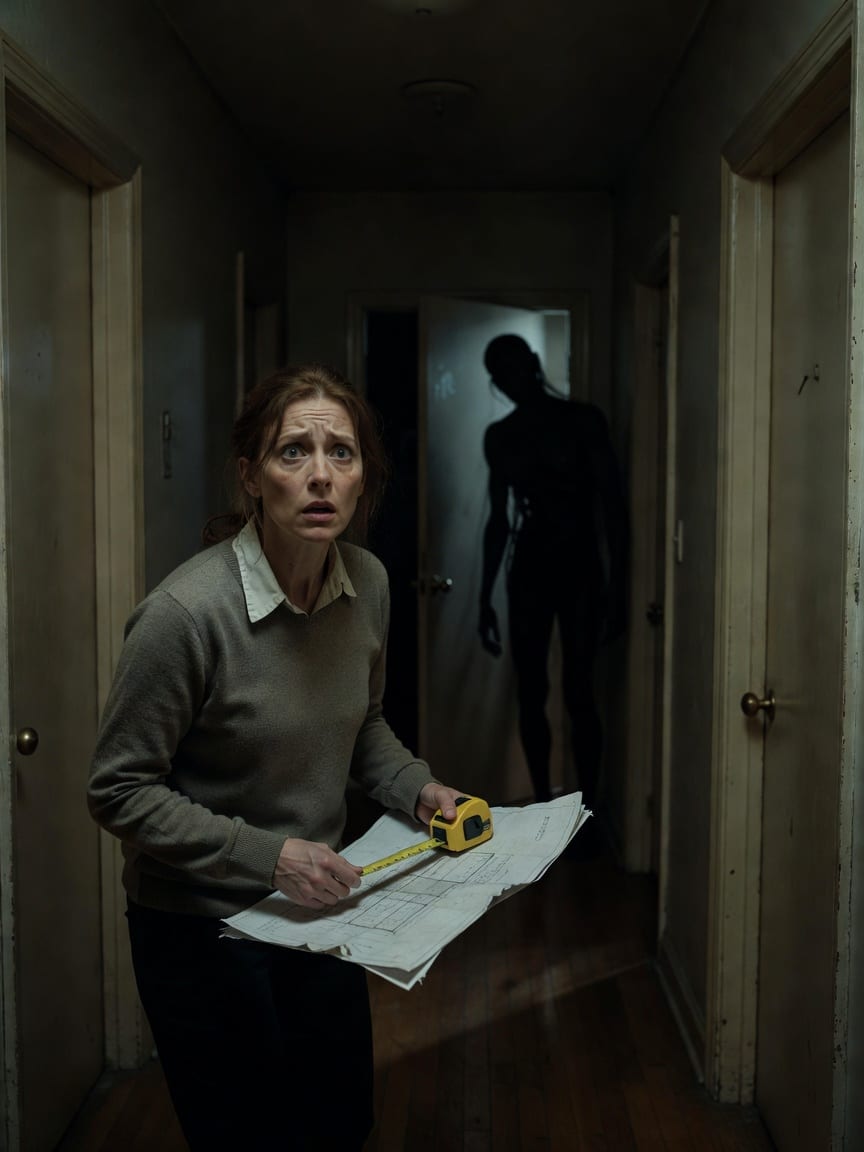
My front door has a dented gate and a dead hydrangea. I walked past it six times, trying to reach the corner shop just a hundred yards away. The pavement kept bringing me back to my own porch, and the shop's light never moved.
My morning started like any other, a quick walk to the corner shop from my home at Number 14, Elm Terrace. But after walking what felt like two minutes, I found myself back at my own front door, the shop no closer. I tried six times, faster and slower, but my street kept compressing, refusing to let me leave.
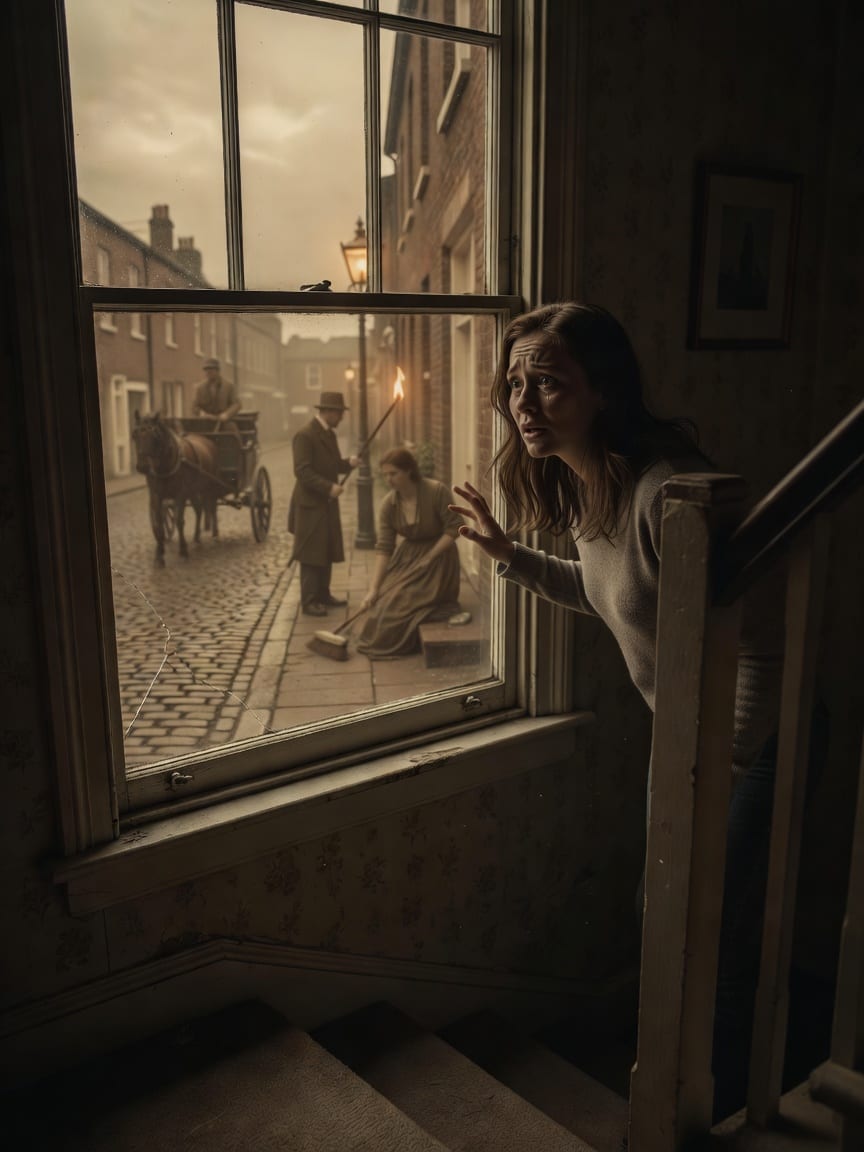
My half-landing window looked down on a cobbled street, a horse and cart. My panes, same crack. Below, only the bins.
I moved into this inherited house for a fresh start, living alone in the quiet. But the third stair on the main flight is deeply worn, a ghostly scoop hinting at decades of unseen footsteps. It feels hollow, and the wall beside it hides a faint, inexplicable seam.
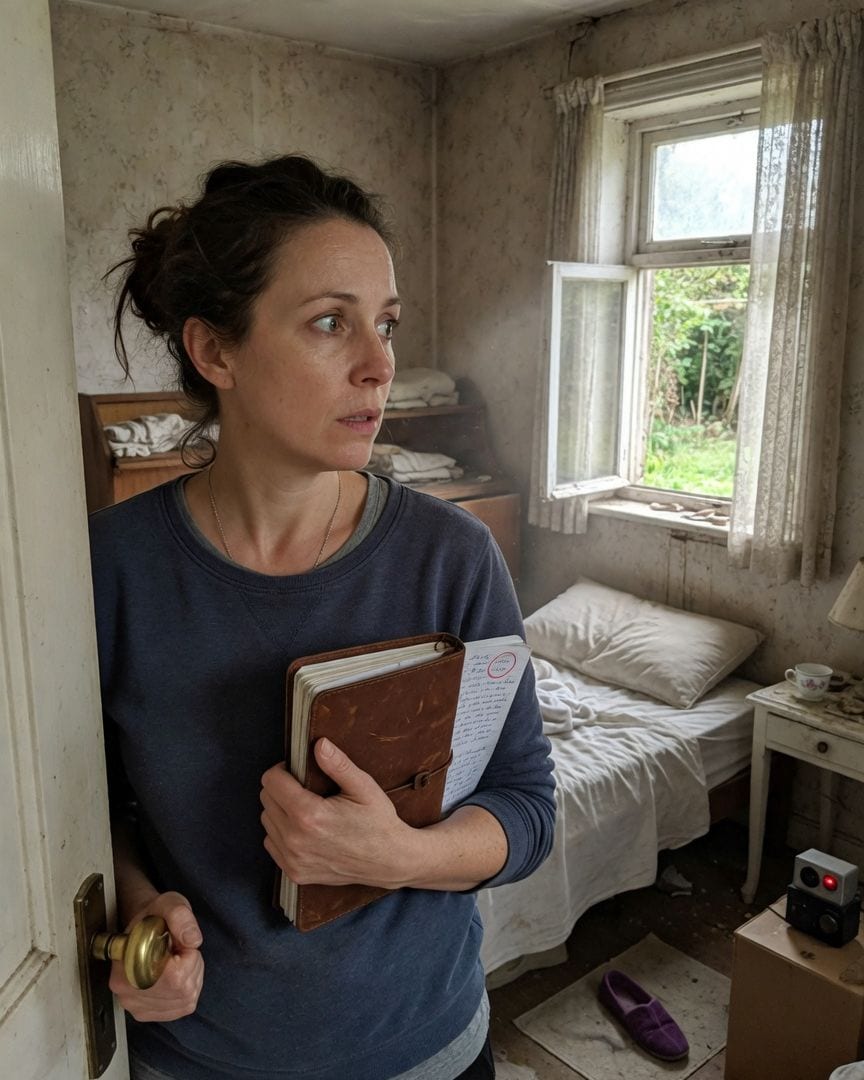
My spare room bed is slept in every few nights, sheets warm and pillow dented. I live alone, painted the window shut, and nobody has a key.
I've lived in Grace's house for six months, adjusting to its quiet rhythms. But the spare room, which I keep shut and empty for storage, has a disturbing routine of its own. Every few mornings, the bed is clearly slept in, the sheet rumpled and warm, and the window I painted shut is open exactly two inches.