The 'empty' almshouse I was auditing wasn't empty. I heard a bare foot *thump-thump* from next door.
The almshouses on Chandler's Row had always given me a strange feeling.
I’d arrived in Oakhaven in late fall, fresh into my role as the new charity liaison for the regional foundation, and this particular assignment was proving to be peculiar.
The painted board by the almshouse entrance, a chipped, dark green rectangle with faded gold lettering, listed twelve 'poor souls' the charity was meant to keep.
The local trustees, during my orientation, had assured me only nine of those twelve slots were currently occupied. The other three units, they claimed, were 'empty', awaiting new residents. But 'empty' wasn't the word I'd have used.
Every dusk, as the late fall light began to fade over the gray ocean, curtains drew tight in the windows of those three supposedly vacant houses.
Not just pulled, but snapped shut with a soft finality I could hear from the sidewalk.
In the mornings, washing—always plain, practical items like simple white shirts or sturdy dark trousers—appeared on the lines outside, crisp and sun-dried, even on days when the sun barely bothered to show its face.
By the time I cycled back through in the afternoon, they'd vanished. And the mail. I’d seen the postman deliver circulars, utility bills, even a few personal letters to those very units.
But I never saw the hands that took them in. Instead, I’d often catch a glimpse of a mail slot closing with a soft, undeniable click just as I approached, the wood still trembling faintly from the motion.
I tried to rationalize it, of course. Perhaps very elderly residents too frail or shy to be seen. Maybe a local volunteer, discreetly helping out.
But the consistent, unseen activity, day after day, week after week, formed an unresolved loop in my mind. It was too regular, too quiet, too present for empty houses.
The charity’s charter was clear: an audit was my duty. It was early December now, and the chill in the air had deepened. I needed to ensure all residents, 'occupied' or not, were accounted for.
I’d kept putting it off, but the nagging unease pushed me. I requested the keys to the three 'empty' units – Unit 7, 8, and 9 – from Eric Fletcher, the long-time almshouse manager.
Eric, a man in his late fifties with a perpetually pressed shirt and an unnervingly smooth smile, seemed unusually hesitant. His eyes, usually placid, darted away for a fraction of a second before he recovered.
“Of course, Mr. Lawson,” he said, his voice as unruffled as ever, though his movements as he reached for the key rack were just a shade too slow. “Just a moment while I locate them.”
He eventually handed me a small ring with three tarnished brass keys.
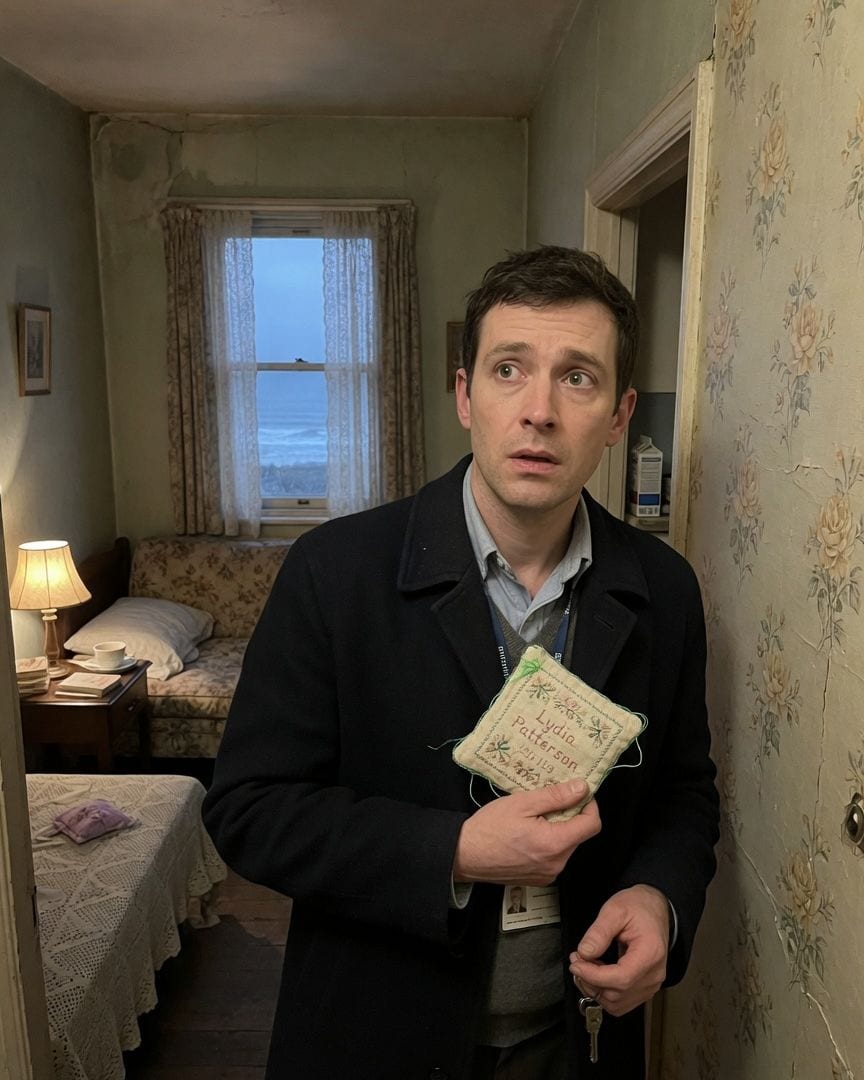
I chose Unit 7, the middle house. The front door opened with a sigh of rusted hinges, admitting me into a cool, still interior.
The air was thick, faintly smelling of lavender and old dust, but beneath that, something else – a faint, almost metallic tang, like old coins. It was eerily tidy.
Every surface was wiped clean, every cushion on the faded floral sofa plumped as if it had just been vacated. The kitchen held a single, half-empty carton of milk in the refrigerator, surprisingly fresh.
It felt intensely lived-in, yet utterly deserted, as if its occupant had stepped out for a moment and never returned. I moved through the small living room, past the compact kitchen, and into the equally small bedroom.
On a nightstand, nestled amongst a few old paperbacks with brittle spines, lay a hand-stitched sampler.
It was a simple piece: a delicate floral pattern, skillfully executed in muted threads, with the name 'Lydia Patterson' embroidered beneath a small, faded date. The date was from decades ago. I knew that name.
Lydia Patterson was one of the names that had been painted out on the almshouse board, listed as having 'died years ago'. Eric had mentioned her once, a passing comment during my initial rounds. I picked up the sampler.
The linen fabric felt remarkably supple, not brittle or stiff with age as I would have expected. The threads, though faded in places, still held a vibrancy, an almost impossible freshness that defied its supposed vintage.
It was too new, too well-preserved for something from a resident who had supposedly 'departed decades ago'. My mundane explanations faltered.
I stood alone in the supposedly 'empty' house, the sampler clutched in my hand. The weight of it, the impossible freshness of the linen, made my mind race.
My thumb brushed against the intricate embroidery, tracing the worn lines of Lydia Patterson’s name. That’s when I noticed it. A small, bright green thread, almost invisible at first glance, woven into a corner of the faded floral pattern.
It stood out, starkly new, a jarring splash of color against the aged, muted hues of the rest of the embroidery. It was too vibrant, too clean to be decades old.
My rational mind struggled to reconcile it, to find an explanation for this fresh, living detail in a dead woman's relic.
Then, from the house next door, Unit 8, one of the other 'empty' ones, I heard it. A faint, rhythmic thump-thump. Slow. Deliberate. The unmistakable sound of a bare foot impacting a floorboard, moving in a steady, unhurried pattern.
It wasn’t a creak of an old house settling, or the wind. It was purposeful. The sound drew closer to the shared wall between Unit 7 and Unit 8. Thump-thump. My breath caught in my throat.
I froze, the sampler still in my hands, the green thread a tiny, vivid beacon of wrongness in my palm. The house isn't empty. None of them are.
I returned the keys to Eric Fletcher, trying to appear nonchalant, my heart still hammering against my ribs. I laid the keys on his desk with a deliberate clatter. “Interesting houses, those,” I said, attempting a casual tone.
“I found a sampler in Unit 7. Belongs to a Lydia Patterson, I think? Her name’s on the old board.”
Eric’s gaze flickered, a momentary stiffness in his posture, a barely perceptible pause before he responded. His smile remained fixed, but it didn’t quite reach his eyes.
“Ah, old Lydia,” Eric said, his voice smooth, almost practiced, devoid of any genuine warmth or remembrance. “A sweet soul. Died years back, I recall. We keep some personal effects for next of kin, but sometimes they’re forgotten.
Just an oversight, Mr. Lawson. Happens all the time with these older residents, you know. Families move on.”
He offered no further explanation, no hint of where next of kin might be, no suggestion of checking the records for her file.
Instead, he smoothly changed the subject, immediately launching into a detailed discussion about the plumbing issue in Unit 3, a clear signal that the conversation about Lydia Patterson was over.
Unsatisfied and deeply unnerved, I spent my lunch break at the Oakhaven town library. It was a small, quiet place, smelling of old paper and beeswax.
I dug through dusty local histories, flipping brittle pages, scanning microfiche for old newspapers, and even sifting through the town’s archived obituaries. I found a brief, generic mention of Lydia Patterson’s passing decades ago, noting her residence at the almshouses.
But there were no details, no family listed, no grave site mentioned, no cause of d*ath. It was as if she had simply ceased to exist, a footnote in a forgotten ledger.
The entry was so devoid of personal information, it felt less like a life ended and more like a bureaucratic formality, a box checked off.
As I left the library, the gray winter light barely cutting through the clouds, I noticed an older man. Bernard Hughes. He often sat on the town square bench, usually feeding pigeons or reading a newspaper.
Today, he wasn't doing either. He was watching me. His gaze was unnervingly steady, following my every step from the library door to my car. Bernard didn't wave, didn't smile, just watched until I was out of sight.
A cold prickle ran down my spine. I wasn't just investigating; I was being observed. The thought made the hairs on my arms stand up.
The watchful eyes continued. I felt them on my back as I walked through town, a subtle shift in conversation whenever I approached a group of locals in the grocery store or at the diner.
It wasn’t overt, never a direct stare, but a collective awareness that prickled at the edges of my perception. The town felt like a stage, and I, the unexpected, unscripted player.
I decided to seek out Beatrice Hartley. She was an elderly woman, pushing eighty, renowned for her sharp memory and her encyclopedic knowledge of local lore.
I found her tending her small garden, even in the encroaching cold, her hands a network of veins and age spots, carefully pruning a rose bush. She greeted me warmly, her eyes, though watery with age, were kind and intelligent.
But when I brought up the almshouses, specifically Unit 7 and Lydia Patterson, her demeanor subtly changed. Her smile, which had been genuine, tightened, becoming a thin, strained line.
She launched into a well-rehearsed narrative about the almshouses being a 'blessing for the town's poor souls' and 'a tradition going back generations'.
It was the exact 'Town That Agrees' story I’d heard from Eric and the trustees, word for word, delivered with a practiced ease that chilled me.
The air itself seemed to cool, the scent of damp earth and dying roses suddenly sharp and metallic.
I pressed, showing her a printout of the scant obituary I’d found for Lydia Patterson, then describing the sampler, the impossible freshness of the green thread, the activity I’d witnessed in the 'empty' houses.
Beatrice’s hands, gnarled with age, began to tremble slightly as she continued to prune the rose, her movements becoming jerky, almost frantic. The delicate stem snapped in her grip.
She stared at the broken rose, then up at me, her eyes wide with a fear I hadn’t seen before.
“Some things are best left alone, Mr. Lawson,” she whispered, her voice barely audible, like dry leaves rustling in a forgotten corner. “This town… this town has its ways. It’s always had them. You’re new here. Don’t disturb the peace.”
She turned back to her roses, abruptly dismissing me.
That evening, a cold, wet wind rattled the windows of my apartment. I found a small, folded note slipped under my door.
It was plain paper, the kind you might find in a cheap notepad, with a single line written in neat, block letters: "Don't disturb the peace." No signature. No return address. Just that stark, unequivocal message.
The threat, implied by its silent, stealthy delivery into my ostensibly secure apartment, felt very personal. The lock on my door suddenly seemed flimsy.
The note solidified my resolve. Fear was an accelerant, not a deterrent. I returned to Beatrice Hartley’s home the next day. The wind was colder now, a biting chill that promised snow.
I found her inside, by the fireplace, wrapped in a knitted shawl. She didn’t look surprised to see me. I unwrapped the sampler carefully, laying it on her small wooden table.
“This was in Unit 7, Beatrice,” I said, my voice low and steady despite the tremor in my hands. “Lydia Patterson’s sampler. But it’s not decades old. Not really. Look at this thread.” I pointed to the bright green detail.
Beatrice stared at the sampler, her face a mask of resignation, her eyes fixed on that single green thread. She didn’t deny it, didn’t offer another smooth, practiced explanation. The last vestiges of her polite facade crumbled.
She sighed, a deep, weary sound. “It’s time you understood, Mr. Lawson,” she said, her voice raspy, dry as the winter air. “The 'poor souls'… they’re not just poor. They’re chosen. Always have been. Generations.
This town… it takes care of its own. But it asks for something in return.”
I leaned in, my blood thrumming. “Asks for what? The board… what is it really?”
Beatrice looked out her window, at the quiet street, where a solitary crow landed on a bare tree branch, watching us. “The board… it’s a roster. Not just of who lives there, but of who receives.”
She paused, as if gathering her strength. “Receives the peace. The… presence. This town has an arrangement. A balance. It’s always been here, long before any of us were born. It needs… vessels. Twelve of them. Always twelve.
And when one wears out, or it’s time for a change, another takes its place. It keeps things… quiet. Balanced.”
She explained that the 'departures' recorded on the board weren’t always true d*aths. Sometimes, the vessel simply ‘moved on,’ but the presence remained, transferring to a new host. The 'empty' houses, she revealed, weren’t empty at all. They were prepared.
Waiting. For the next round of vessels. For the next transfer. “It’s a cycle, Mr. Lawson. It ensures the town’s… prosperity. Its quiet. Its very existence.”
Beatrice implied that the townspeople, for generations, had maintained this facade, this 'agreement', out of a deep, ingrained fear.
They didn't understand the 'why'—the true nature of the presence—only the 'what'—the requirements to keep it sated, to keep the town safe. And the cost of not complying.
A chill colder than any winter wind snaked through me, reaching into my bones. The consistent pattern, the unnerving quiet agreement, the 'empty' houses, the impossibly fresh sampler – it all clicked into a horrifying, coherent whole.
Every strange detail, every evasive answer, suddenly made a terrible, undeniable sense.
I left Beatrice’s house, the cold seeping into my clothes, but the real chill was inside me. Her admission, whispered in the quiet room, had shaken me to my core. I knew I needed more. Proof.
Something concrete that wasn't just spoken word. I remembered Eric Fletcher mentioning 'old records' once, in passing, when I'd asked about the almshouses' original charter.
Under the pretense of needing to verify some maintenance costs for a quarterly report, I sweet-talked Sandra Bishop, the town clerk, into granting me temporary access to the almshouse’s restricted archive.
It was a small, dusty room in the basement of the old town hall, smelling of mildew and forgotten things. The single bare bulb hanging from the ceiling cast long, dancing shadows.
I found what I was looking for after an hour of searching: a heavy, leather-bound ledger, its cover worn smooth, the title 'Almshouse Resident Roll and Departures' embossed in faded gold script.
It was meticulously handwritten, entries in careful, sloping script. I opened it to the current year, seeing the nine familiar names of the occupied residents.
My fingers trembled as I flipped back through the decades, tracing names, dates of 'admission', and dates of 'departure'.
And then I saw it. Lydia Patterson's name, 'departed' decades ago, exactly as Eric and Beatrice had said.
But beneath it, a tiny, almost invisible symbol—a looped knot, intricately drawn, almost like a miniature Celtic design—repeated next to her 'departure' date. My heart hammered against my ribs, a frantic drum in the silent room.
I flipped further back, my gaze scanning for the symbol. And I found it. The same looped knot, next to names 'departed' exactly every 30 years. The pattern was undeniable. Precise. Cyclical. It wasn't random. It was a calendar.
The 'd*aths' were not d*aths. They were transfers. My blood ran cold, a glacial current through my veins. The cycle was about to complete.
And then, at the very bottom of the current page, under the list of the nine occupied residents, I saw them.
Three blank lines, meticulously numbered 10, 11, 12, each with the same cryptic looped knot symbol meticulously drawn beside them. Waiting. For the next vessels. For new 'poor souls'.
A sudden, horrific thought struck me: I was a new face, an outsider who had drawn attention, who had broken the silence. Were these lines waiting for me?
My hands trembled so violently I almost dropped the ancient ledger. The knowledge that the town had tracked these 'departures' with such cold precision, for so long, was a gut punch. But there was more.
Tucked into the very back of the ledger, brittle with age and almost fused to the leather by time, I found an attached document. It was an unsigned, undated 'charter', written in elegant, archaic script, its ink faded to sepia.
It detailed the town's original pact. Not with a specific entity, not with a named devil, but with 'the presence' that had resided here 'since the first stone was laid' of Oakhaven.
The almshouses, the charter stated, were built not for charity, as I had been told, but as 'conduits and sanctuaries' for the 'chosen vessels'.
The term 'poor souls' was merely a convenient cover story, a way to explain the peculiar residents to outsiders like me.
The 'departures' were explicitly described as a 'transference of essence', a necessary 'renewal' to ensure the presence remained stable and the town prospered. Prosperity. Always that.
The ledger, in its cold, administrative language, went on to detail the exact rituals and responsibilities of the almshouse manager and the town elders.
It meticulously outlined how to identify and prepare new vessels every 30 years, when the cycle of 'renewal' came due.
There were precise instructions for the 'cleansing of the empty houses' – the very houses I had just entered – and protocols for selecting the new 'recipients'.
It stated plainly how many decades they had known, how many generations had maintained the 'agreement'.
The horror wasn't a monster hiding in the shadows; it was the town itself, a living institution built around a monstrous truth, meticulously documented and preserved, right here in the basement of their town hall.
The air in the room seemed to press in on me, heavy and suffocating.
The ledger clutched in my hand, a physical weight of unbearable truth, I burst into Eric Fletcher’s office. The door slammed against the wall with a deafening crash, making the framed photos of old town founders on his wall rattle.
Beatrice Hartley was already there, sitting calmly in one of the visitor chairs, her hands folded in her lap, her expression unreadable. She looked like she was expecting me.
“I know,” I gasped, my chest heaving, throwing the ledger onto Eric’s polished oak desk. It landed open, the ancient charter splayed across the wood. “I know about the cycle. About the vessels. About the town. Everything.”
Eric looked at the ledger, then at me, his calm, almost pitying expression unbroken. He didn’t seem surprised. His eyes, usually placid, now held a strange, knowing depth.
“We knew you would find it, Mr. Lawson,” he said, his voice flat, devoid of emotion. “You were… too curious. We observed you. Your inquiries were… persistent.”
Beatrice nodded slowly, a ghost of a smile touching her lips, a smile that chilled me far more than any threat. “It’s why you were brought here, Mr. Lawson. A new face. An outsider with a purpose.
The charity needed a liaison, and the town needed… to complete the cycle. The three empty slots, Mr. Lawson, are for new vessels.
And you, by breaking the rule of silence, by uncovering what was meant to remain hidden, have volunteered yourself.”
My blood ran cold, turning to ice in my veins. My breath hitched. I tried to argue, to plead, to demand, but their eyes held no anger, only a chilling, quiet certainty. A dreadful calm.
The room itself seemed to shrink, the walls closing in. The townspeople, they explained, were merely fulfilling their part of the agreement, ensuring their own safety and prosperity. Their composure was the horror.
I pushed past Eric, scrambling for the door, my feet slipping on the worn carpet. I fumbled for the knob, wrenched it open, and ran. Blindly. I burst out into the late afternoon, the familiar streets suddenly alien, predatory.
I saw faces I recognized – the baker, the postman, the woman from the library – all watching me. Their expressions were unreadable, their movements slow and deliberate, subtly herding me. They didn't shout. They didn't run.
They just shifted, blocked, guided me with an inexorable, quiet determination. The town wasn't pursuing me; it was containing me.
I found myself cornered near Chandler's Row, the almshouses looming in the twilight, their windows dark, like eyes watching me. From inside the three 'empty' houses – Units 7, 8, and 9 – the rhythmic thump-thump began again. Louder now.
More insistent. A slow, heavy beat that seemed to vibrate in my very bones, resonating with the frantic thumping of my own heart. It was coming from all three. And I knew what it was. What it meant.
I was trapped.
Julian Lawson’s car was found abandoned at the edge of Oakhaven a few days later, keys still in the ignition, the doors unlocked.
His apartment, when a curious neighbor finally checked it, was meticulously cleared out, as if he had simply packed up and left without a trace. No one in town reported him missing.
A distant cousin, receiving a vaguely worded email about Julian 'moving on to a new opportunity' in a remote area, was the only one to wonder, briefly, before the pervasive silence of Oakhaven swallowed the question whole.
The town simply went on.
A few weeks later, with the bare branches of winter stark against the sky, the painted board on the almshouse entrance on Chandler's Row was updated. The names of the nine 'occupied' residents remained, untouched.
But beneath them, three new names were neatly painted in fresh, stark white letters: 'Julian Lawson,' 'Elara Vance,' and 'Thomas Reed.'
The curtains in the three formerly 'empty' houses – Units 7, 8, and 9 – were now drawn tight, just like all the rest.
The new almshouse manager, a quiet woman from out of town who had replaced Julian, noted the fresh paint on the board during her first audit.
When she asked Eric Fletcher about the new residents, he merely smiled a faint, wrong little smile.
If this one got to you
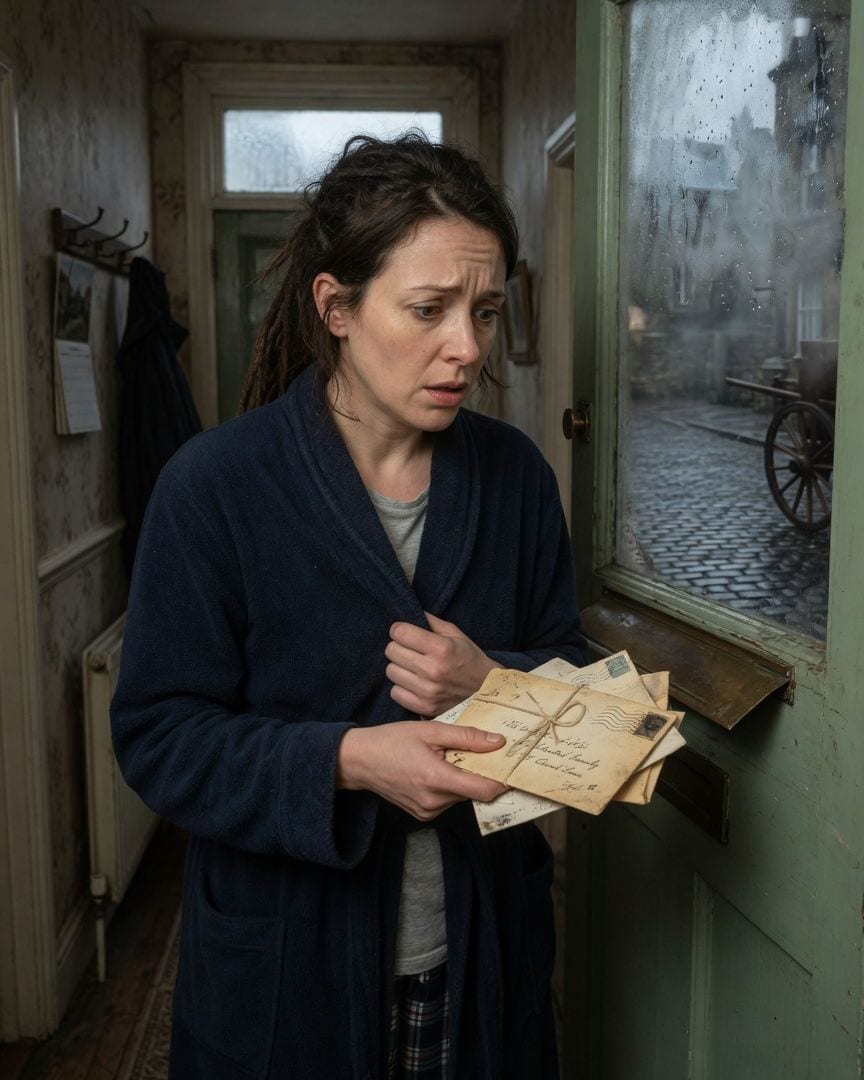
Seventy years ago, a hidden journal recorded my door opening to the wrong street and receiving Lockwood post.
I'd only recently moved into my inherited house, a quiet place on the edge of town. One grey morning, a distinct clatter from the front door's post flap caught my attention. Reaching down, I expected my gravel path, but instead, the flap showed a dark, cobbled street that wasn't mine. A bundle of warm, old letters, addressed to 'The Lockwood Family,' slid through, before the vision flickered and was gone.
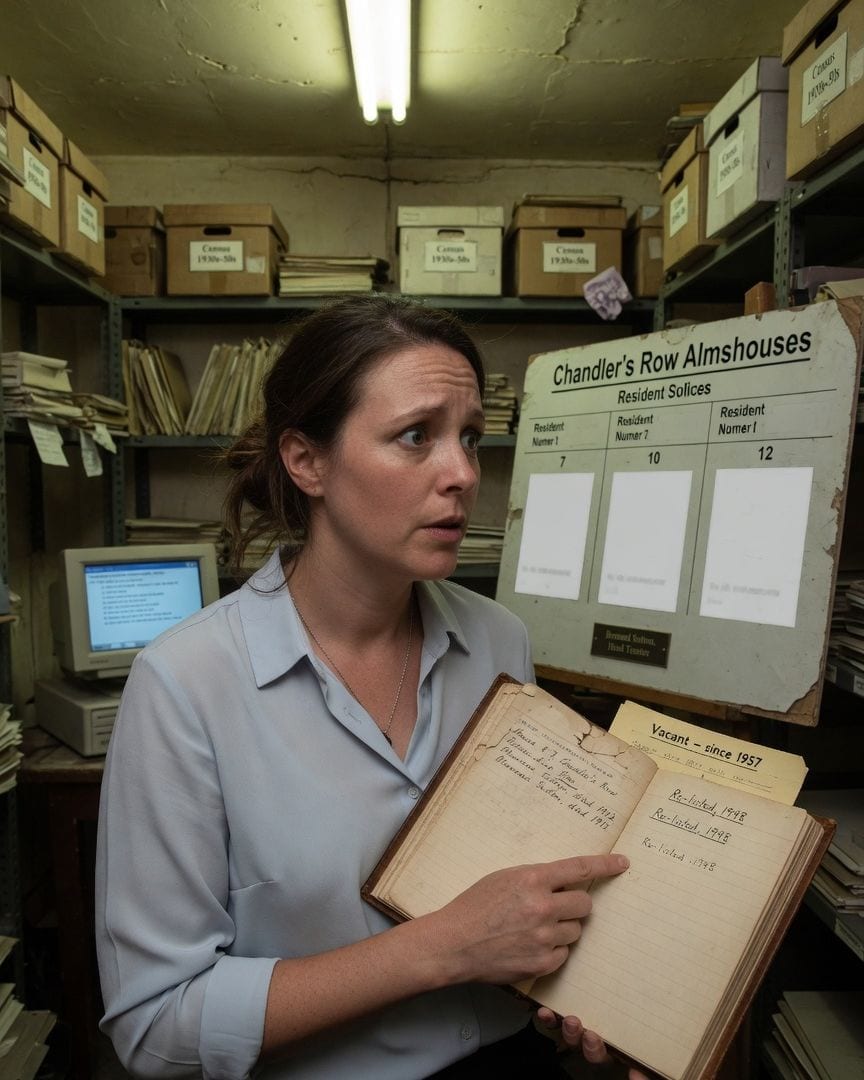
Curtains draw at dusk in the almshouse next door. The town trustees insist it's been empty for years.
As the new records clerk for the town charity, I began auditing the ancient Chandler's Row Almshouses. My boss, Bernard, insisted three houses had been empty for decades. But just yesterday, I saw warm lights and smelled fresh laundry from one of them, House #7.
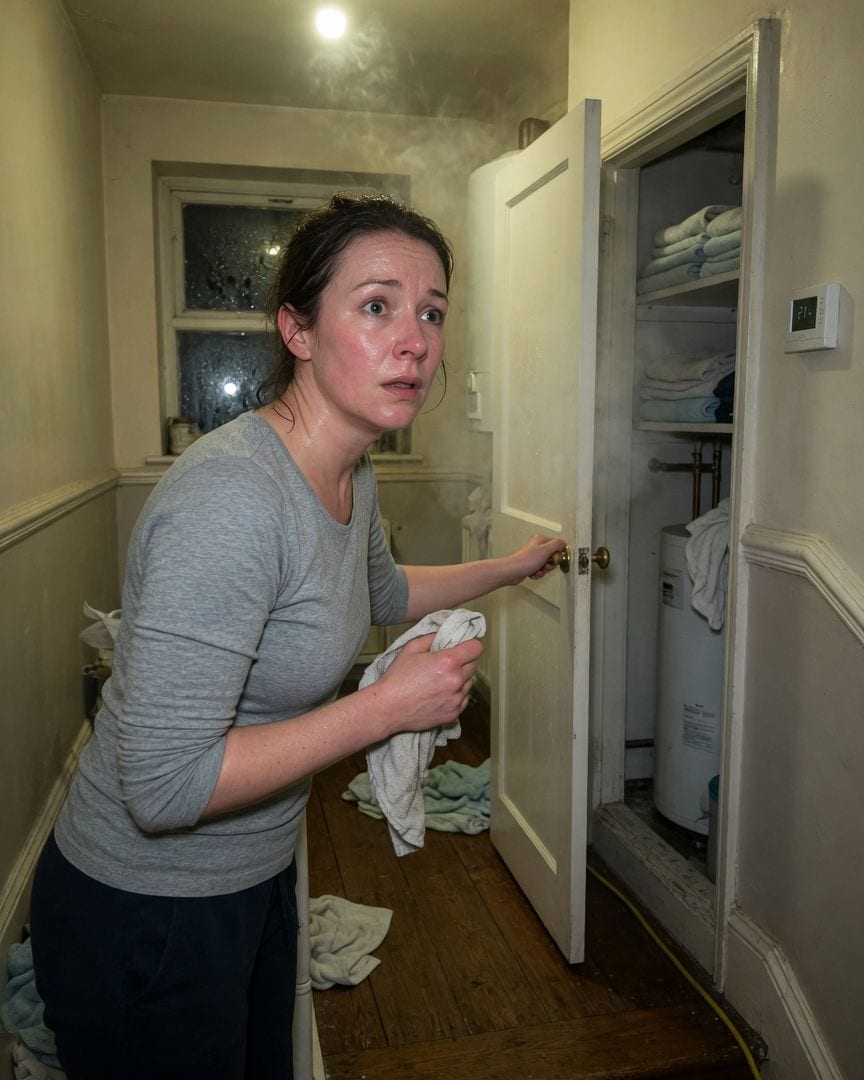
My airing cupboard opened onto a burning brick copper, sheets boiling. The heat rolled out, smelling of soda and wet linen. I shut it; my boiler was back.
My new house, bought just last spring, felt colder than expected. When I opened the airing cupboard, it wasn't mine at all, but a blast of steam and a roaring fire from an impossible past. Days later, a faint, metallic smell still drifted from the landing, and a worn path on the floorboards led to a hidden, ancient sampler beneath my feet, dated 1892.
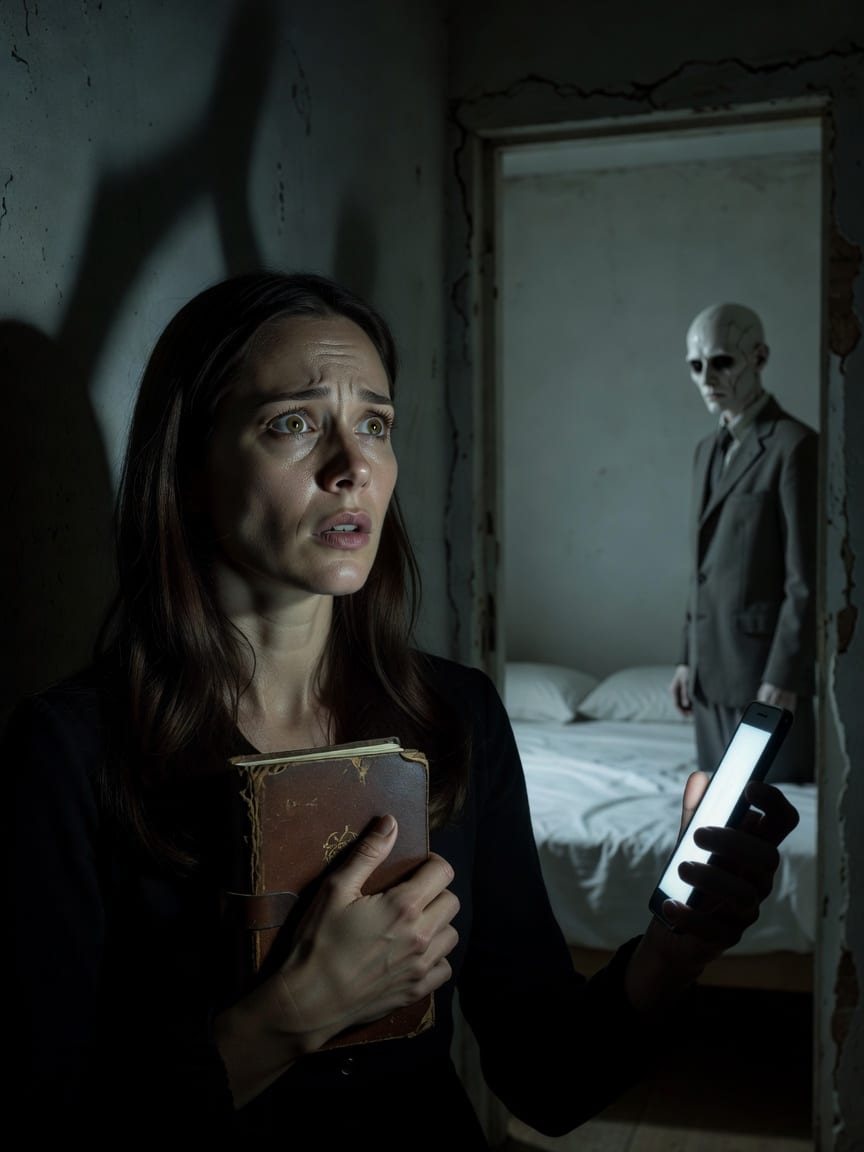
Behind a plastered-over doorway, I found a room. Papered, carpeted, and furnished with a made bed, sealed for decades. The air was dead still, but the bed wasn't dusty. My council tax bill only lists five rooms.
I'm Claire, an architect, meticulously planning my new Victorian terrace renovation. But when I uncovered a hidden room behind a wall, everything I knew about time and decay shattered. The bed was perfectly made, the air still, yet there was no dust, only an unnerving cold.
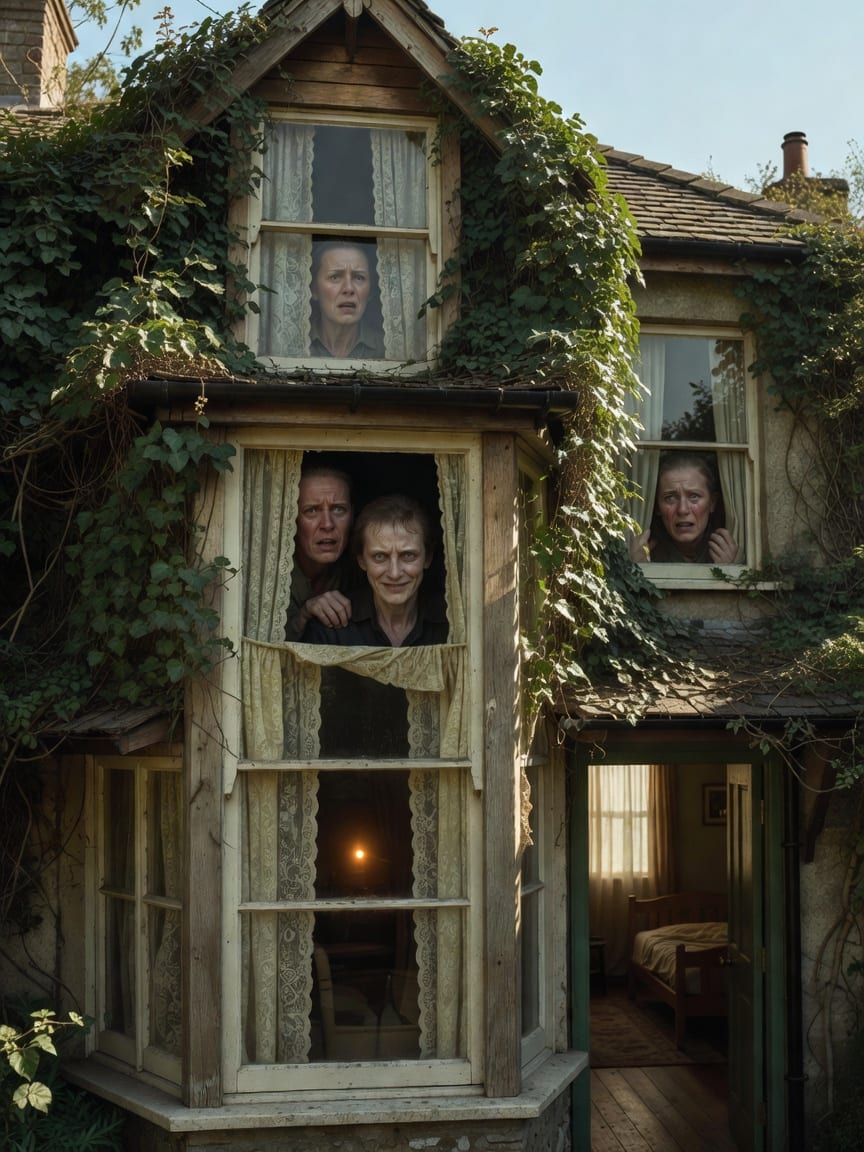
My empty cottage neighbor's electricity meter still climbs every night, and everyone in town says no one has ever lived there.
I moved to Oakhaven for a fresh start, settling into my quaint new cottage. Everyone, from the estate agent to the vicar, insisted the dilapidated cottage next door had been empty for generations. But when I ventured inside, a single porcelain doll sat spotless on a dusty dresser, watching the doorway.
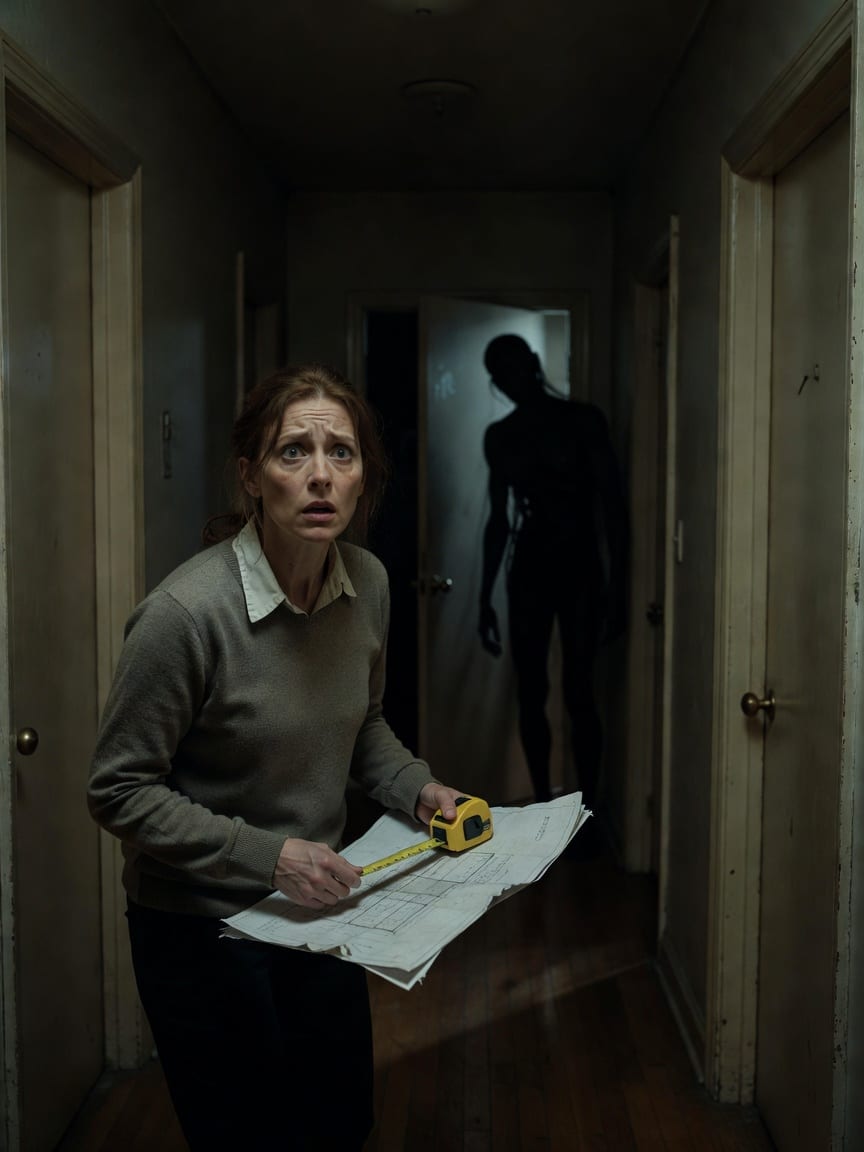
My front door has a dented gate and a dead hydrangea. I walked past it six times, trying to reach the corner shop just a hundred yards away. The pavement kept bringing me back to my own porch, and the shop's light never moved.
My morning started like any other, a quick walk to the corner shop from my home at Number 14, Elm Terrace. But after walking what felt like two minutes, I found myself back at my own front door, the shop no closer. I tried six times, faster and slower, but my street kept compressing, refusing to let me leave.