Curtains draw at dusk in the almshouse next door. The town trustees insist it's been empty for years.
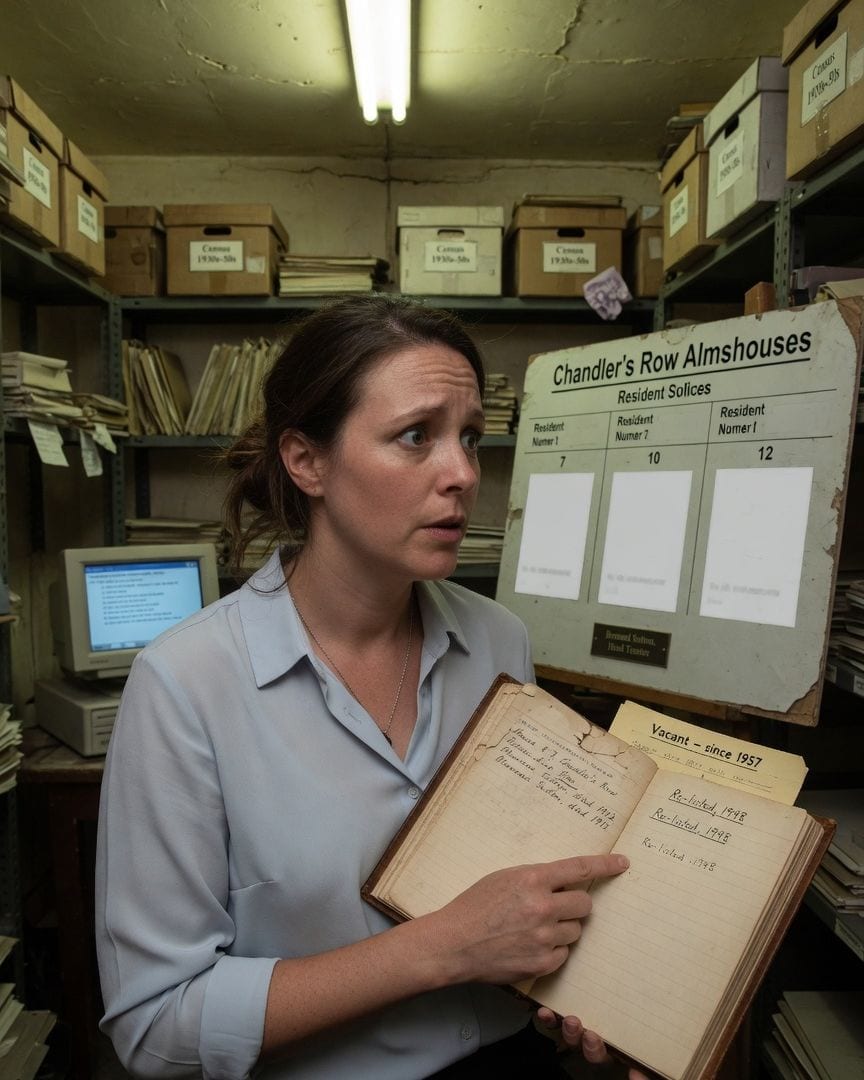
The Chandler’s Row Almshouses were the first thing I noticed when I started my new job as a records clerk for the town charity.
Twelve narrow, identical houses, built from local grey stone, lined a quiet lane at the edge of town. They felt ancient, settled into the earth.
My first task was to update their ledger, a dusty, handwritten document that hadn't seen a full audit in decades.
Bernard Sutton, the head trustee, met me there on my first morning. He was a man in his late sixties, impeccably dressed, with a smile that was a little too wide, a little too permanent.
He pointed to a large, painted board affixed to the main almshouse wall. It listed twelve resident slots, nine with names, three completely blank. "Good morning, Kathleen," he said, his voice smooth. "Our charity's heart.
Most of them are occupied, of course. Just these three, you see, at the far end... Houses number seven, ten, and twelve. They've been empty for years. Decades, in fact."
He waved a dismissive hand towards the three blank slots, and then towards the houses themselves.
But I couldn't dismiss them. Not when I’d passed by House #7 just yesterday evening. Its curtains had been drawn against the twilight, a warm domestic glow visible around the edges.
I’d even caught a faint, sweet scent of what smelled like lavender laundry detergent from a line strung behind it. This morning, the line was bare, but yesterday, I could have sworn there’d been freshly washed sheets. And the post.
I’d seen Frank Lambert, the mail carrier, deliver letters to all twelve houses, including the 'empty' ones.
He’d averted his eyes as he dropped a slim envelope into the brass slot of House #7, then sped off on his bicycle without so much as a nod when I tried to catch his gaze.
Looking at the board now, the blank spaces felt less like vacancies and more like deliberate erasures. There were faint, ghostly outlines beneath the fresh white paint where names had clearly been scrubbed out.
And the patch for a new name, added just last week to House #5, was a slightly darker, too-bright white against the faded background, as if it had simply appeared overnight, painted by unseen hands.
Bernard prattled on about the town’s long history of charity, but all I could feel was a quiet hum of wrongness, a silent, public agreement that I, the newcomer, was not yet privy to.
"So, for these vacant houses, numbers seven, ten, and twelve," I asked Bernard, trying to keep my voice neutral, "are there any historical occupancy records? For the sake of the audit, you understand."
He smiled, that same smooth, rehearsed smile. "Of course, dear. All in order." He led me back to the charity office, a cramped, high-ceilinged room filled with the scent of old paper.
Within minutes, he produced three neatly typed forms, all for Houses #7, #10, and #12. Each form stated: 'Vacant - since [date],' with the dates uniformly reaching back to the 1950s or earlier.
House #7, for instance, had been 'Vacant - since 1957.'
"Just a formality," Bernard explained, tapping a finger on the form. "Old places, you know. Sometimes the board gets ahead of itself. The paperwork can be... sluggish." He gave a chuckle that didn't quite reach his eyes.
His explanation was too perfect, too ready. It felt like a script.
I wasn't convinced. The faint scent of lavender, the postman's averted gaze, the curtains at dusk... those weren’t sluggish paperwork. I decided to cross-reference the charity’s records with the town’s historical census data.
The archives were a labyrinth of dusty shelves in the charity office’s back room, cool and silent.
Tucked away in an old, leather-bound ledger marked 'Personnel & Property - Pre-1930', I found a single, faded entry for 'House #7, Chandler's Row'. My heart gave a little jump. It listed an occupant: 'Maureen Sutton, died 1912.'
Bernard had said House #7 had been empty since 1957. My brow furrowed. I pulled out a microfiche reader and quickly checked the town's death registry for Maureen Sutton. Sure enough, 'Maureen Sutton, died April 12, 1912' was clearly recorded.
No contradiction there. But then, a few pages later in the charity ledger, I found a handwritten note, almost illegible, beside a later entry for House #7, dated 1948: 'Re-listed, 1948'.
The dates screamed at me. Maureen Sutton died in 1912. The house was supposedly vacant since 1957. But it was 're-listed' in 1948. Re-listed for whom, if it was empty?
The mundane explanation of bureaucratic error began to crumble under the weight of these contradictions. The cold air in the archive room seemed to press in on me.
House #7, the one with the drawn curtains and the faint lavender scent, was not just confusing; it was fundamentally wrong.
The conflicting records gnawed at me. I returned to the charity archives the next day, determined to find anything else related to Maureen Sutton or House #7.
My fingers trailed over the spines of countless forgotten ledgers, feeling for anything out of place. Deep in a forgotten drawer, beneath a stack of brittle deeds for parcels of land long since redeveloped, my fingers brushed against something stiff.
I pulled it out.
It was a small, sepia-toned photograph, its edges softened with age. Clearly very old, the image depicted the middle almshouse on Chandler's Row—House #7.
In the window, a woman with a severe expression sat, gazing out at a world I could only guess at. Her hair was pulled back tightly, her lips a thin line.
A handwritten label on the back, in elegant, looping script, read: 'Maureen Sutton, died 1912.'
My eyes snapped back to the image. On the windowsill beside the woman, perfectly clear despite the photograph's age, was a chipped blue teacup.
The exact same distinctive teacup I had seen through the curtains of House #7 just yesterday evening, catching the last light of dusk.
I stared at the photo, then back at the 'Vacant - since 1957' form on my desk, then at the calendar showing today’s date, May 17th, 2023.
The dead woman was there, in the window of the house Bernard insisted had been empty for decades. And her teacup. The house was not empty. It could not be.
The photograph of Maureen Sutton unnerved me. It wasn't just a record discrepancy anymore; it was a physical artifact, a tangible contradiction. The image of that teacup, so ordinary yet so out of place, kept replaying in my mind.
I spent my lunch break parked discreetly down the street from Chandler's Row, observing House #7 from my car. The afternoon sun was warm on the windshield, but I felt a chill.
At precisely 4:50 PM, as the sun began to dip towards the horizon, the curtains in House #7 slowly, deliberately, drew shut. I saw no hand, no figure, just the fabric moving from inside, a smooth, unhurried motion.
The sheer quietness of it was more unsettling than any sudden bang.
Determined, I started digging into other historical records, widening my search beyond Maureen Sutton. I focused on the names that had been painted out and then seemingly 're-lettered' onto the almshouse board over the years.
The secondary twist began to emerge, a pattern across dates and names that was too stark to be coincidence.
I found newspaper clippings in the library archives, brittle and yellowed, detailing local disappearances or unexplained illnesses that coincided eerily with new names appearing on the almshouse board.
One particularly disturbing article from 1937 reported the sudden vanishing of a young man, Philip Bryant, from his family farm just weeks before a new name, 'Grace Caldwell,' appeared on the board.
Grace Caldwell was listed as a resident of House #10, another of the 'empty' houses Bernard had dismissed. Caldwell. My own surname.
The mundane explanations for these 'coincidences' were becoming increasingly strained, stretching to the breaking point. I visited the local library again, a quiet, sleepy place smelling of dust and lemon polish, and found old town directories.
It wasn't just a random assortment of unfortunates on the board, it was specific. I noticed that certain surnames – Sutton, Bryant, Caldwell, Galloway – appeared repeatedly on the almshouse board, often separated by decades, but always returning.
A cold knot tightened in my stomach. This wasn't just a single anomaly, a misfiled document or an optical illusion. This was a repeating pattern, a hidden mechanism at work, woven deep into the town's history.
It felt like a current running beneath the surface, unseen but powerful, pulling names into its flow.
My inquiries at the library hadn't gone unnoticed. As I returned to my car, the late afternoon light glinting off its hood, I saw Bernard Sutton's familiar sedan parked a block away, idling.
He wasn't looking at me, but at his reflection in the rearview mirror, pretending to adjust it. Yet I felt his gaze, a prickle on the back of my neck.
Later that day, back at the charity office, I found a small, unmarked envelope tucked under my keyboard. My breath caught. Inside was a single, neatly folded sheet of heavy cream paper.
On it, in elegant, old-fashioned script, was written: 'Some things are better left undisturbed, dear. For everyone's sake.' There was no signature.
The message felt like a direct warning, not a polite suggestion, a chill that seeped into my fingertips as I held the note. The danger was no longer theoretical; it was personal.
I thought about the subtle ways the townspeople had been steering me away from the almshouses. The mail carrier, Frank Lambert, had started leaving my post in a separate pile on the reception counter, avoiding my desk entirely.
The local shopkeeper, Mrs. Davies, who had initially been so chatty, now suddenly became 'too busy' to meet my eye when I bought groceries. It wasn't overt hostility, but a chilling, collective silence, a quiet agreement to distance themselves.
The air in the charity office felt heavy, watching.
I realized the 'The Town That Agrees' wasn't just a metaphor Bernard had casually dropped in an earlier conversation; it was a living, breathing entity, and I had broken its unspoken rule.
I was no longer just investigating a curiosity; I was being watched, and gently, but firmly, warned away. The silence of the town was a louder alarm than any shouted threat.
The warning unnerved me, but it also solidified my resolve. I knew who might have sent the note, or at least who might know its meaning.
Evelyn Galloway, the oldest resident of Chandler's Row who still lived in her own house, not an almshouse. Her family name, Galloway, appeared repeatedly in my pattern of almshouse residents.
I found Evelyn sitting on her porch swing, knitting a baby blanket of pale yellow wool. Her face was a roadmap of wrinkles, her hair a wispy white halo, but her eyes, though rheumy with age, were piercingly clear.
I showed her the Maureen Sutton photograph, the chipped blue teacup, and explained my findings about the cyclical names and the conflicting records. I laid out the newspaper clippings about the disappearances. Evelyn listened patiently, her needles clicking softly.
When I finished, she sighed, a sound like rustling autumn leaves. "You've seen the ledger, haven't you? The true one."
I pressed her, my voice low. "The almshouses aren't empty, are they? And Maureen Sutton... she died in 1912, but she was 're-listed' in 1948. And her teacup is still there."
Evelyn nodded slowly, her gaze fixed on the distance. "Some folks, they don't stay dead, dear. Not entirely. Not when the town needs them."
A chill traced its way down my spine. "Needs them for what?"
Evelyn leaned forward, her voice a near whisper, barely audible above the creak of the porch swing. "To keep the balance. To keep it fed. The town has an agreement, you see. Generations of us.
We provide for them, and they... they leave the rest of us alone." She explained that the 'poor souls' on the board weren't just the charity's unfortunate, but those whose families had 'agreed' to a unique service.
"The names painted out, painted in... it's the cycle. It's how we manage the returns. The new ones need a place, always."
My earlier observations clicked into place with a horrifying clarity: Frank Lambert’s averted gaze, Bernard’s too-smooth evasions, the collective silence of the townspeople. It wasn't superstition; it was a deeply ingrained, terrifying form of civic management.
The town wasn't just observing an urban legend; it was actively participating in it, maintaining a covenant that stretched back through generations. The air around us felt suddenly heavy, thick with unspoken history.
Evelyn, seeing my shock, stood up, her movements slow but deliberate, and went inside her house. The old wooden floorboards creaked under her weight.
She returned moments later with a large, leather-bound family Bible, its spine cracked, its pages yellowed and fragile. "My grandmother kept this," she said, her voice thin, as if speaking of a ghost. "A record. So we'd never forget."
She opened it to a hidden compartment in the back cover, revealing a small, hand-drawn chart on parchment. It was a circle, intricately drawn, with twelve segments, each containing a name and a year.
The lines were faded, but still legible. "The cycle," Evelyn whispered, her gnarled finger tracing the pattern. "Who returns, and when."
I scanned the names, my heart thumping a frantic rhythm against my ribs. Sutton. Bryant. Galloway. And then, my breath hitched, caught in my throat.
There, in one of the segments, was 'Maureen Sutton,' with the year 1948 beside it – the exact 're-listed' date I had found in the charity ledger.
And further along the cycle, my own surname, 'Caldwell,' stark against the faded parchment, with a blank space next to it. And next to that blank space, a date: '2026'.
My heart hammered against my ribs, a frantic drum against the sudden, icy cold that filled the small room. The 'empty' slots weren't just for past returns; they were for future ones.
And my own family name was on the ledger. My surname was on the cycle. The air in the small room grew cold, thick with unspoken dread. Evelyn's hand, trembling slightly, pointed to the blank space beside 'Caldwell.'
Her ancient eyes, wide and knowing, met mine. "The new ones always need a place, dear. A house." She paused, her voice dropping to a whisper. "And the board, it always has twelve names. Always."
The sight of my own surname on Evelyn's cycle chart, with the looming date of 2026, was a physical blow. I felt a cold dread seep into my bones, a paralysis that rooted me to the spot.
"What does this mean?" I choked out, the words barely a whisper.
Evelyn closed the Bible with a soft thud, her face grim. "It means the 'poor souls' aren't just charity cases, dear. They're the families who maintain the agreement. Your family, the Caldwells, they've been part of this town for generations.
You're next in line to 'provide' for the cycle." She explained that the 'returns' weren't truly the original people, not in the way we understood life and death.
They were something else, something that took their form, sustained by the town's quiet compliance and the 'poor souls' who were 'taken' to facilitate the shift.
The disappearances I had found in old newspapers weren't just coincidences; they were the sacrifices, the real cost of the town's safety.
The laundry on the line, the post taken in, the drawn curtains – all of it was part of the town's generations-long ritual to keep the entities content and contained within their stone vessels.
Bernard's smooth explanations, Frank Lambert's evasions, Mrs. Davies' sudden silence – it was all a carefully choreographed performance, a folk rule broken only at immense peril. The almshouses were not residences; they were vessels, and the town was their keeper.
The dread was in the coherence: every odd detail, every evasive glance, every quiet agreement, suddenly fit into this horrifying, ancient pattern.
The board on the wall, listing its twelve unchanging slots, was a living document of this terrifying covenant, a ledger of lives promised and claimed.
I knew I couldn't stay. Evelyn's chilling revelation had shattered my world, splintering the ordinary into something monstrous. I packed a small bag, my hands trembling so violently I nearly dropped my toothbrush.
I had to get out, but I couldn't leave without proof, something more than Evelyn’s aged testimony and a faded chart.
That night, under a moonless sky, I crept back to Chandler's Row. The almshouses were dark, silent sentinels.
I parked my car a few blocks away and hid in the deep shadows across the street from House #7, the one Maureen Sutton 'occupied'.
The window was a black rectangle, but a faint, rhythmic creaking sound emanated from within, like an old floorboard flexing under an unseen weight.
As I watched, barely breathing, a gaunt, shadowy figure, barely more than an outline against the deeper blackness inside the room, moved slowly across the window. Its movements were too fluid, too deliberate, too unnatural to be human.
It reached the curtains, its arm extending, and drew them shut with a deliberate, almost mechanical motion.
It paused, and for a split second, though there were no visible eyes, no discernible face, I felt an unseen gaze pierce the darkness, fixing on me.
A wave of profound, cold despair washed over me, a sense of being utterly seen and understood by something ancient and patient. It felt like a trap had sprung, silently.
I fumbled for my phone, my fingers clumsy with terror, managing to snap a quick, blurry photo of the window, hoping to capture something. The figure vanished into the darkness within the house.
I turned and ran, the dread chasing me, a cold hand on my back, the certainty that I had been marked.
I drove out of town, not looking back, the image of that shadowy outline, and the blank space next to my name on Evelyn's chart, burned into my mind.
I carried the blurry photo and the knowledge of the town's monstrous agreement, a truth too horrifying for anyone outside to ever believe.
I never returned to the town. I filed a vague resignation by email, citing 'personal reasons.' My car, a beat-up sedan, was found abandoned miles from any major highway, its battery dead.
The blurry photo I'd taken was later found on my phone, a dark smudge against a windowpane, dismissed by authorities as 'poor lighting.' The almshouse board on Chandler's Row continued its silent updates.
Bernard Sutton continued his duties as head trustee, his smile as smooth as ever. Frank Lambert continued his mail route, delivering to all twelve houses, never lingering. The town settled back into its quiet, undisturbed routine, the agreement unbroken.
The empty houses remained 'empty' to outsiders, their curtains drawing shut each dusk, their laundry appearing on the line, their post taken in. Life went on, just as it always had.
I lived far away now, under a new name, in a city where no one knew my history. I never spoke of Chandler's Row, not aloud, not even to myself.
But every evening, just before dusk, I found myself watching the windows of my own apartment, a faint, inexplicable unease settling over me. I'd check the mail twice, even if I knew there was none.
And sometimes, in the quiet, I'd catch a faint scent, like lavender laundry detergent, from somewhere unseen.
A few years later, a new name, 'Kathleen Caldwell,' appeared on the almshouse board at Chandler's Row, filling one of the last 'empty' slots. It was painted in a slightly darker shade of white, as if new.
Across town, in a small city apartment, a woman paused, her hand hovering over a drawn curtain, a faint, wrong little smile on her face. 'Is that so?' she whispered to the empty room. 'How peculiar.'
If this one got to you
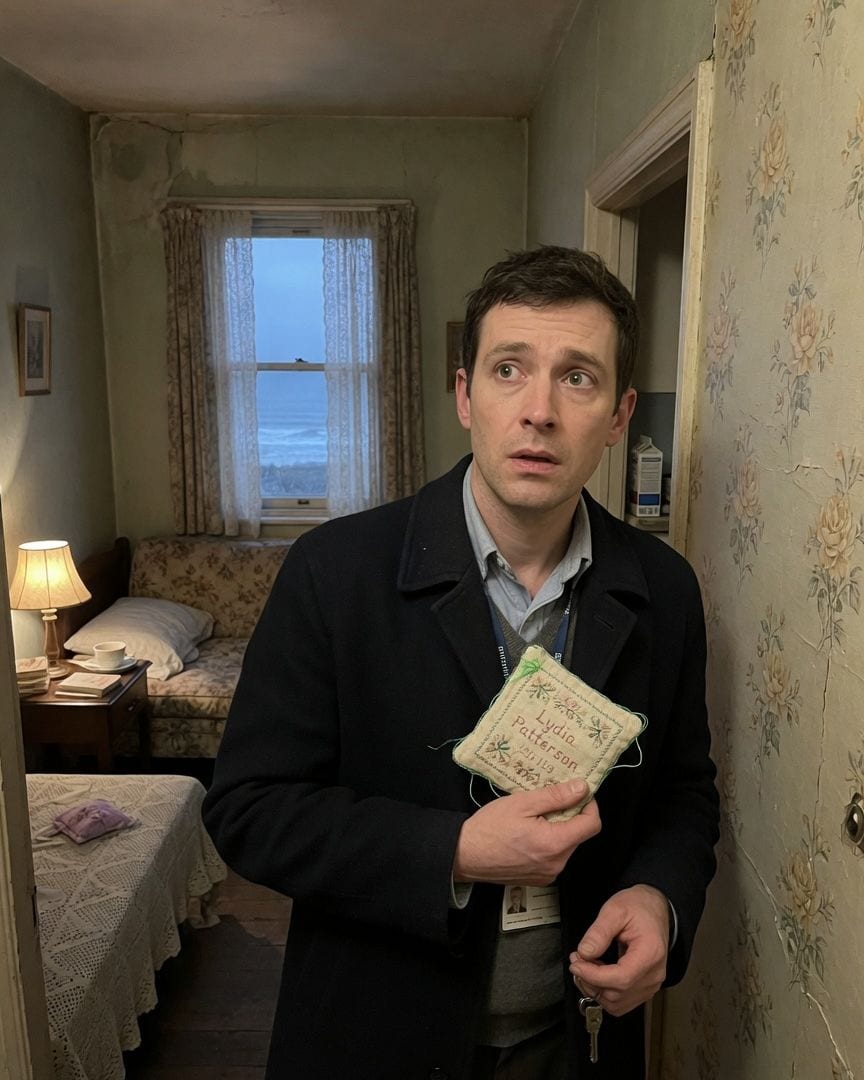
The 'empty' almshouse I was auditing wasn't empty. I heard a bare foot *thump-thump* from next door.
My new charity role involves auditing the supposedly 'empty' almshouse units. But from the unexplained activity outside to a fresh carton of milk inside, something is deeply wrong. Then, in one unit, I found a dead woman's sampler with a jarringly new thread, and heard bare feet thumping next door.
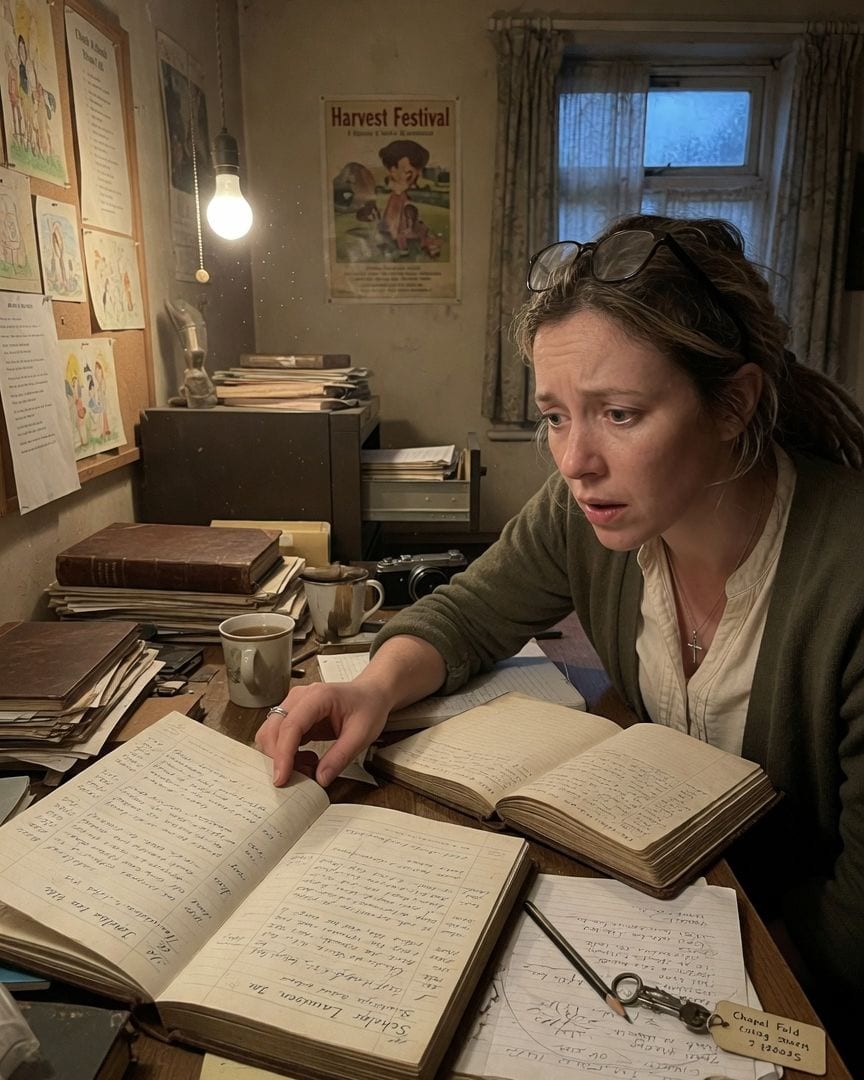
My name is in the chapel's old Sunday school register as 'Scholar 33'. But 'Scholar 33' appears every seventh year since 1907, each child from the same cottage, each marked 'not called for'.
Sorting dusty chapel archives, my job as a local history enthusiast, was a soothing journey through generations. But then my own name, Penelope Lawson, jumped out: 'Scholar 33' for the current year. I'd never attended. Flipping back, I found the same 'Scholar 33' entry repeating every seven years for over a century, always linked to the same old cottage.
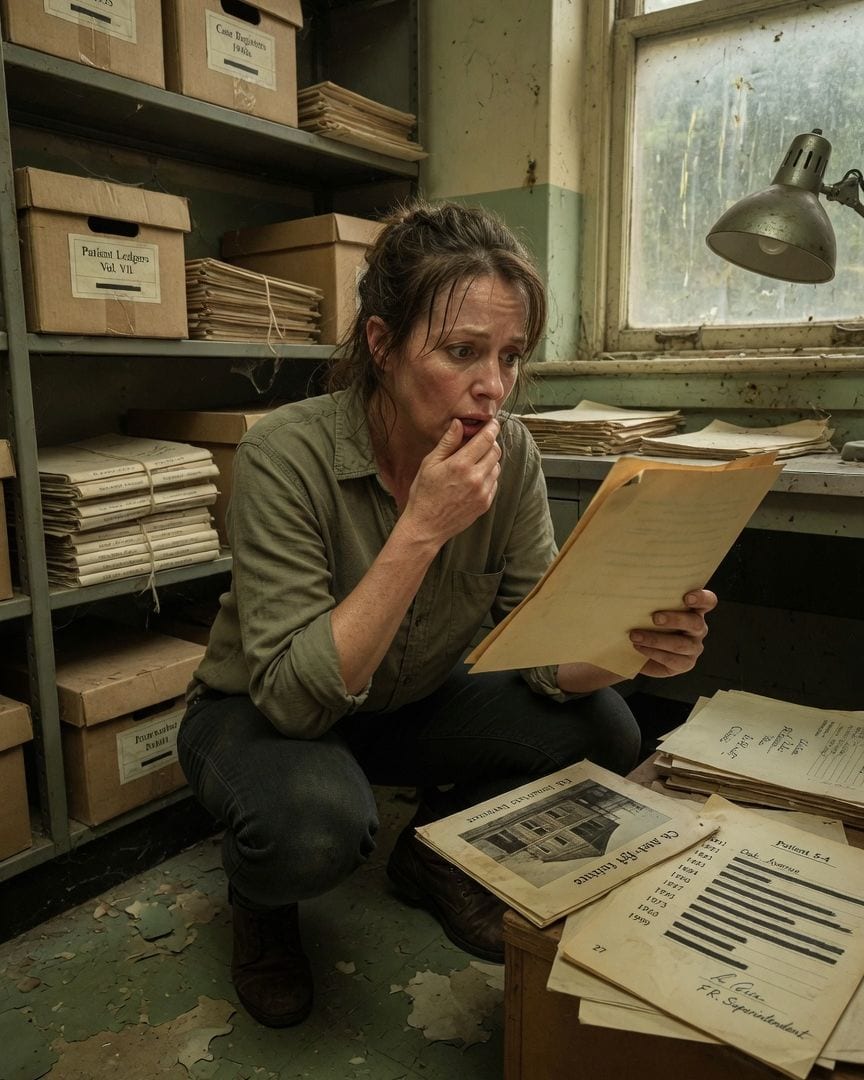
Patient 5-4 keeps checking into my aunt's old sanatorium chalet. The same initials sign them out, 'not traced,' every thirteen years since 1921.
Sifting through my aunt Margaret's estate, I found her old sanatorium file from 1999. Her patient record listed her as 'Patient 5-4,' discharged 'not traced.' But when I accessed the archives, I found 'Patient 5-4' was admitted every thirteen years since 1921, always with identical discharge notes.
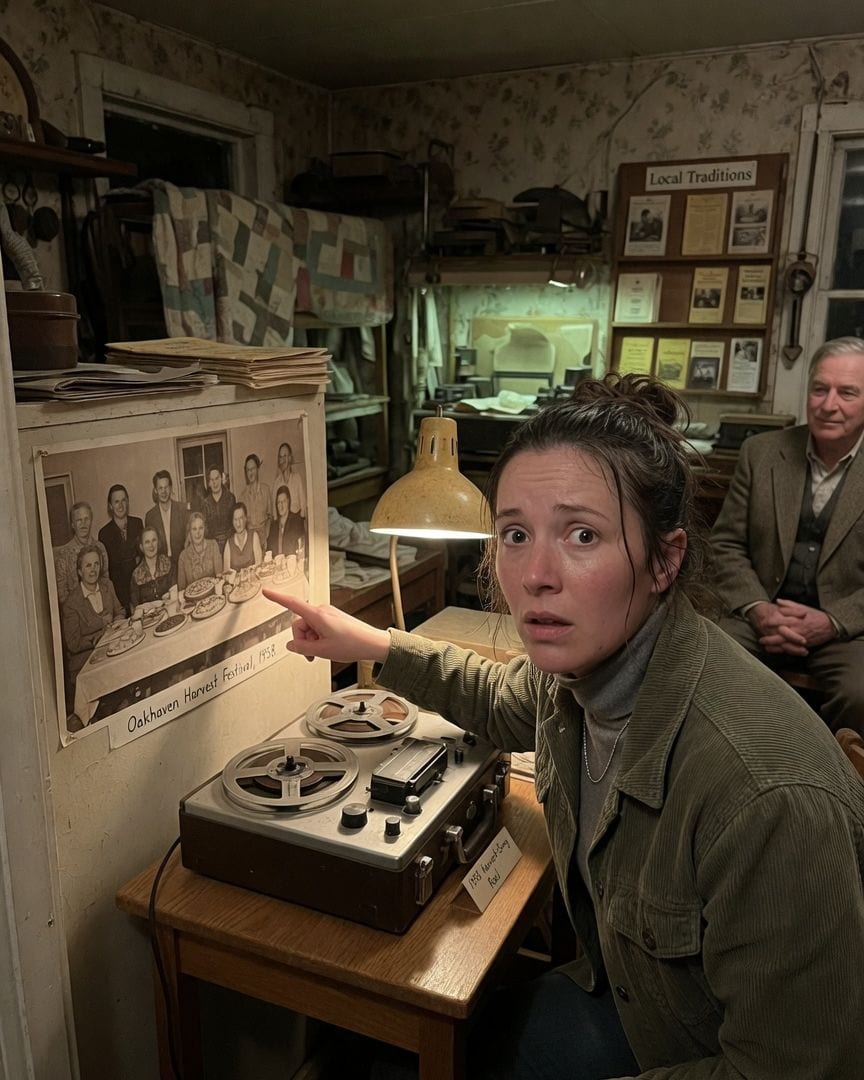
The folk museum's harvest tape counts one more singer than the photograph shows. The curator turned the recorder off before playing it.
I found a quiet escape at Oakhaven's dusty Folk Museum, where the curator played a rare 1958 harvest song. But as a cheerful tune filled the room, a low voice began to count. The tape tallied thirteen, yet the old photograph beside it showed only twelve smiling villagers.
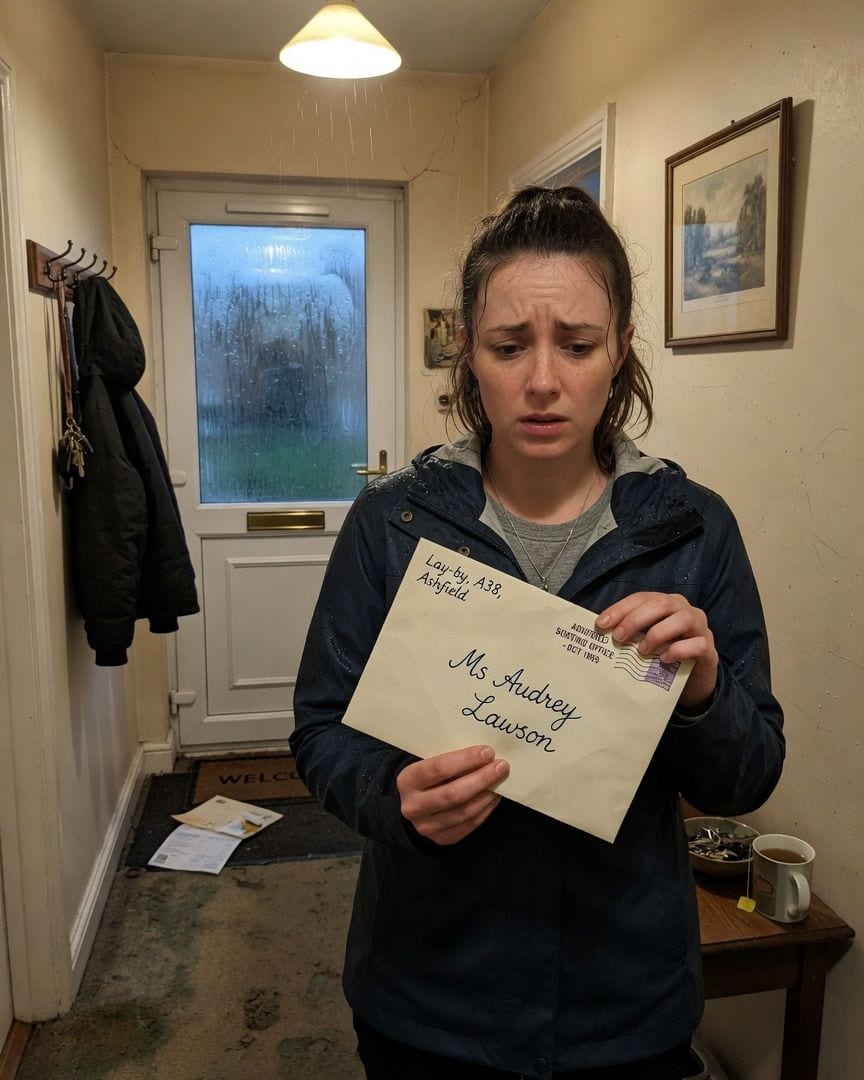
My condolence card arrived for a death that never happened, postmarked from a sorting office that closed before I was born.
My first envelope arrived on a Tuesday, nestled with bills. It bore my full name and a return address for an A38 lay-by that held only a crash barrier. But the postmark read ASHFIELD SORTING OFFICE – OCT 1985, an office decommissioned before I was even born.
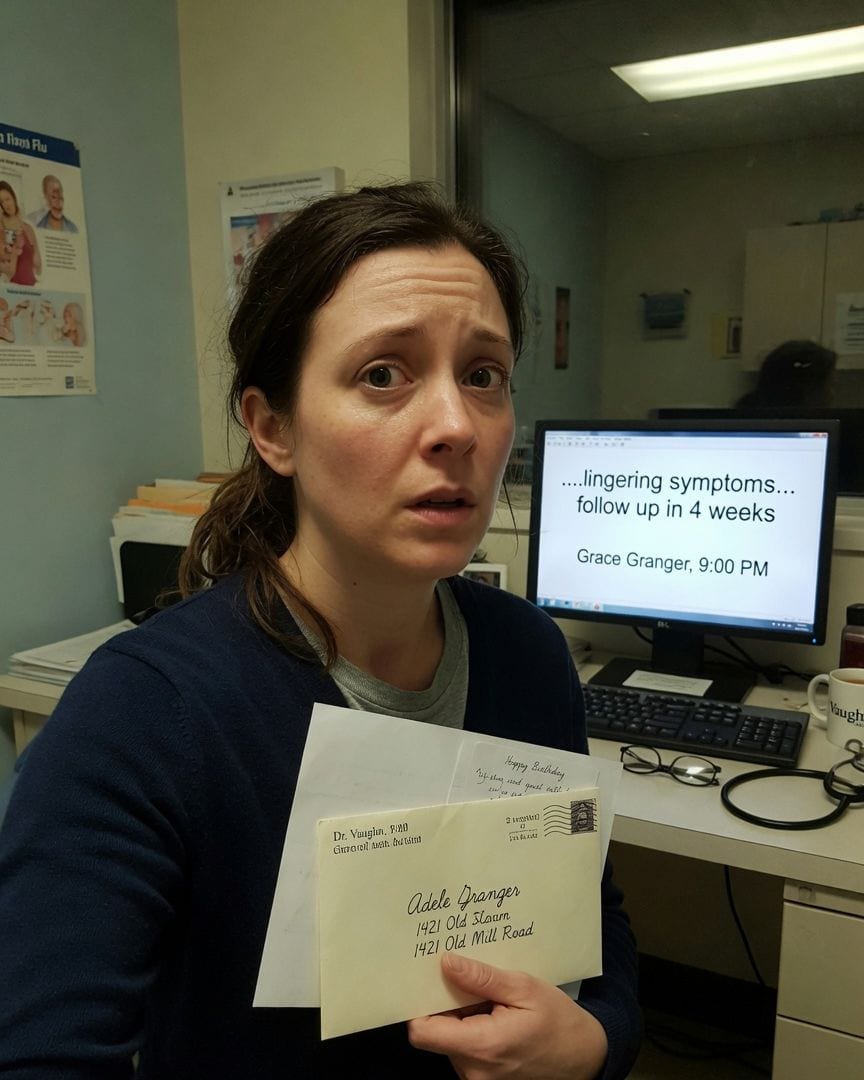
Mid-appointment about my cough, my doctor told me to call my estranged sister tonight — a sister I'd never mentioned to him. The note on his screen ended with her name and a time.
My doctor dismissed my cough as a lingering virus, but then he said something impossible: "You should call your sister tonight." I hadn't spoken to Grace in years, and I'd never mentioned her to him. When I saw her name on his screen with a specific time, a cold dread began to claw at me.