My grandmother’s name is on a blacked-out line from a 1954 drowning inquest, on our street, with a note: 'do not send a second notice.'
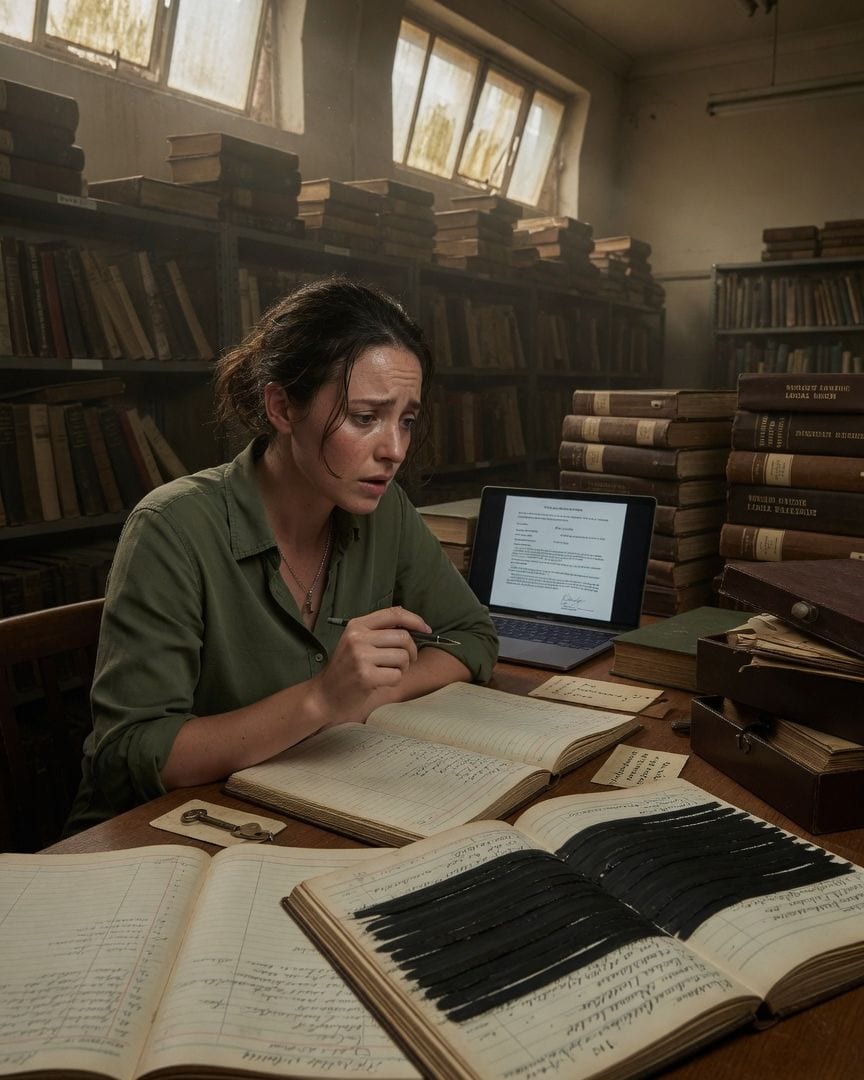
The rhythmic scratch of my pen was the only sound in the vast, quiet archive room. Dust motes danced in the slivers of sunlight that pierced the high windows, illuminating the ancient volumes stacked to the ceiling.
I was transcribing a 1954 inquest register, its pages brittle, for the county’s new digital database. The details were routine, the usual litany of names, dates, and mundane causes of death.
I copied down the victim’s name, the date of the discovery at Weir Lane, the cause: accidental drowning.
Then my pen hovered. Under the column labeled 'next of kin notified,' a single line had been savagely blacked out, a thick, inky bar of what looked like India ink smeared across the page.
I frowned, a small, involuntary twitch of annoyance. Redactions were rare in these old records, and usually much neater. Leaning closer, I tilted the page, catching the light just right.
Beneath the heavy, almost violent black-out, the clerk’s underlying index, faintly impressed into the paper from the original writing, named 'Patricia Kingsley.' And next to it, an address on Weir Lane.
My grandmother. Patricia Kingsley.
A quiet, irrational thump started in my chest. Patricia hadn't moved to Weir Lane until 1965. I remember the stories, the family photos of her new house. That was eleven years after this 1954 entry.
My gaze dropped further, to the margin beside the blacked-out line. A handwritten note, small and precise, in a different hand than the clerk's original script, read: 'do not send the notice a second time.'
I tried to logic it away. A common name. Kingsley wasn't that unique. A clerical error, perhaps, the wrong family on the wrong line. Or a misfiled entry from another year entirely.
The archive was vast, a labyrinth of paper and microfiche; mistakes, though rare, did happen. I pulled up the 1965 property deeds on my terminal, confirming my grandmother’s relocation to Weir Lane, the dates precise, undeniable.
No, the 1954 entry couldn’t be right. It simply couldn’t.
But the name, my grandmother’s name, on that blacked-out line, with an address that would later be hers, on the very street where the 'drowning' occurred. And that chilling instruction: 'do not send the notice a second time.'
It gnawed at me. I couldn't just dismiss it. It felt too deliberate.
Discretely, I used my archive access card to search for other Weir Lane incidents in the inquest records, not just drownings, but any 'unexplained' deaths. The results were sparse at first, scattered across decades.
But as I scrolled, a cold pattern began to emerge.
A 1948 entry, a 'disappearance' at Weir Lane. Again, a heavily redacted 'next of kin' line. A 1930 entry, a 'found body' near the weir, cause undetermined. Again, a blacked-out name.
None of them named my grandmother, but the consistency of the redaction, that aggressive, inky bar, and the specific location, Weir Lane, was unsettling. I cross-referenced the addresses where possible.
Some were familiar, old family names in the district—the Lawsons, the Montgomerys. Families who had lived around here for generations.
It wasn’t an isolated mistake. It was a deliberate act, repeated over decades, always focused on Weir Lane, always with that obscured name.
The next morning, I arrived early, a cold certainty hardening my resolve. This wasn't a glitch; it was a thread, and I had to pull it.
I submitted a formal request for access to the 'Miscellaneous Local Inquests' section, a rarely accessed collection of fragmented or odd records that were usually reserved for in-depth historical research.
The Head Archivist, Quentin Harlow, gave me a long, unreadable look from behind his ancient mahogany desk before handing over the heavy brass key. He must have been close to ninety, but his eyes were sharp, his movements precise.
He looked like a man in his fifties, maybe sixty at a stretch. It was something I’d always vaguely noticed but never questioned.
Deep within the dusty, forgotten shelves of that restricted section, the air thick with the scent of old paper and something else, something vaguely metallic and cold, I found a series of unmarked, leather-bound boxes. I opened the first.
Inside, tucked beneath bundles of unrelated ephemera, were more inquest registers. Not just one or two, but a stack, each from a different decade, some dating back to the late 1800s.
I pulled them out, heart hammering against my ribs, each thud echoing in the sudden silence of the restricted aisle. Each one was for an incident at Weir Lane. Each one had a blacked-out line under 'next of kin notified.'
And each one, without fail, bore the same chilling, precise margin note: 'do not send a second time.'
Over the next few days, I methodically worked through the unearthed registers, my fingers stained with the dry dust of forgotten lives. The pattern solidified into something horrifyingly coherent.
The 'incidents' at Weir Lane – drownings, disappearances, 'accidental falls' – occurred with an unnerving regularity, roughly every 25-30 years. It was almost… cyclical.
I began cross-referencing the faint, underlying names in the redacted lines, using a high-intensity lamp to make out the indentations on the fragile paper. A handful of surnames recurred, a chilling, familiar roster: Kingsley, Lawson, Montgomery, Hale.
My own family name, a recurring fixture, like a blight that skipped generations only to reappear. I traced these names through local census records, land deeds, and old parish registers.
The families, always residents of or with deep ties to Weir Lane, seemed to simply… vanish.
Not all at once, but individuals from these families, often young adults or children, were listed as 'deceased' or 'relocated' with no further trace beyond the initial vague record. No graves, no follow-up addresses, just a blank.
Then I found them. Cryptic entries in old town council minutes, tucked away in microfiche from the 1960s, then the 1930s. 'Allocation of Weir Lane Relocation Fund for designated families.' 'Review of Weir Lane Civic Contribution Protocol.'
The euphemisms were chillingly transparent, stripped bare of any comforting ambiguity by the context of the inquests. These weren't accidents; they were managed disappearances. Someone had been orchestrating this, systematically, for generations.
The sheer bureaucratic calm of it, documented in ledger after ledger, was worse than any monster. It suggested a system, not a madman. A slow, grinding, institutional horror.
My quiet digging didn't go unnoticed. Quentin Harlow, the Head Archivist, began appearing near my desk with unusual frequency, ostensibly checking on my progress with the 'miscellaneous' records. His presence was a cold current in the room.
His gaze lingered, cool and assessing, on my open registers, on my face.
I noticed my archive access card, which I used to log my research hours and access restricted documents, had been 'pinged' more often than usual in the system logs – not by me. Someone else was checking my activity.
One afternoon, while retrieving a file from a section I rarely entered, a folder slid from a shelf above, landing at my feet with a soft, papery thud. I stared at it. It was my own family file.
My heart leaped, a sudden, panicked beat. Marked prominently on the cover, in a precise, antique hand, were the words: 'Kingsley, Patricia. Weir Lane Candidate - Pre-notification 1964.' Beneath it, in the same unsettling script, 'Vivian Kingsley - Follow-up Required.'
A cold dread washed over me, a physical sickness that made the stale air catch in my throat. Someone knew. Someone had placed that file there. For me to find.
Later that day, as I was leaving, the heavy archive doors echoing my footsteps, Quentin stopped me. He stood framed in the archway of his office, silhouetted against the dim interior light.
'Still stirring up dust with those old records, Miss Kingsley?' he asked, his voice unnervingly smooth, carrying effortlessly across the vast, empty reading room. 'Some things are best left buried, wouldn't you agree?
For the good of the community, of course.' His eyes, ancient and calm, held mine, utterly unbothered by whatever he saw there. The room itself seemed to hold its breath.
I confronted Quentin the next morning, the 'Kingsley, Patricia' file clutched so tightly in my hand the corners bent.
I laid out the pattern on his desk: the redacted lines, the repeating surnames, the 'Weir Lane Protocol' in the council minutes. My voice was tight, a thin wire stretched taut.
'My grandmother's name, on a drowning inquest years before she lived there. My name, on a file, marked "Follow-up Required." What is this?'
Quentin listened, his expression utterly impassive, almost serene. He didn't deny a word. Instead, he offered me a cup of tea, the gesture incongruous with the horror I was unveiling.
'It's a long story, Miss Kingsley,' he began, his voice calm, measured. 'One that predates this archive, predates this town in its current form.'
He spoke of an 'arrangement,' a 'compact' made centuries ago by the founding families of the area, including the Kingsleys. 'Weir Lane,' he explained, gesturing vaguely towards the window, 'is… special.
It demands a certain… contribution, to maintain the prosperity of the entire community. A generational duty.'
He retrieved a heavy, leather-bound volume from a locked cabinet behind him, its pages filled with elegant, copperplate script. It was an ancient covenant, thick with age, listing families and their 'obligations.'
My grandmother, Patricia, was listed there, alongside other names I now recognized from the inquests.
'Your grandmother understood her duty,' Quentin said, turning a a page with a soft rustle. 'She was "pre-notified" in '64, before she even moved to Weir Lane. She accepted the terms, as her parents and grandparents had.
The "do not send a second notice" is simply an internal note. Once a family is in the system, they are always in the system.' He paused, his gaze fixed on the ancient script.
'No need to remind someone who already knows, or is due to know.'
He pointed to a faded photograph tucked into the covenant, brittle with age. It showed a younger Patricia, smiling, holding a document, at a formal gathering of villagers.
Her face, so familiar from my childhood photos, looked full of a quiet, almost serene acceptance. Quentin's calm, matter-of-fact tone, the sheer bureaucratic normalcy of this horrifying 'compact,' was more terrifying than any monster.
The scattered pieces of my research clicked into place with sickening clarity, forming a coherent, institutionalized horror.
Quentin closed the covenant, his gaze fixed on me, unblinking. 'There's one more thing you should see, Miss Kingsley. A small detail from that 1964 'Pre-notification' meeting.'
He gestured to a projector screen that descended from the ceiling of his office. He powered it on, and the faded image of my grandmother, Patricia, standing with the other villagers, bloomed onto the screen, larger, clearer now.
He zoomed in on a figure standing directly behind Patricia: a man in a council uniform, holding a similar document to hers. His face was unmistakable.
It was Quentin Harlow himself, only younger, unlined, without the faint, age-related creases I was accustomed to, and looking directly at the camera with an unsettlingly calm expression.
'A family tradition, you might say,' Quentin murmured, his eyes twinkling with an ancient, knowing amusement that was far older than his apparent age.
He then pointed to a faint inscription on the back of the projected photo, barely legible, which he'd highlighted with a red circle: 'Next Harvest Cycle: 1965, 1989, 2024.'
My breath caught in my throat, a dry gasp. 1965, the year my grandmother moved to Weir Lane. 1989, my own birth year. And 2024. The current year.
I was the next 'candidate.' The realization hit me like a physical blow, a cold, crushing weight. The entire archive suddenly closed in, suffocating me.
Quentin stepped away from the projector, the harsh light from the screen casting long shadows across his unnaturally unlined face. 'You see now, Vivian,' he said, his voice devoid of malice, 'it's not a disappearance, but a transition. A return.
The entity at Weir Lane sustains us, protects us. In return, it requires sustenance. A periodic offering from the bloodlines who made the original pact.'
He explained the 'harvest cycle' in clinical detail: specific years, specific families, a quiet, almost ritualistic 'transfer.'
The redacted lines in the inquests were not to conceal the identity of the next of kin, but to indicate that the family was already 'notified' – they were part of the compact.
My grandmother, Patricia, had fulfilled her 'duty' in 1965. I, born in 1989, a designated harvest year, was simply the next in line.
He spoke of the town’s prosperity, its lack of serious crime, the rich harvests, all directly attributable to the 'Weir Lane Compact.' 'Your ancestors understood this,' he concluded, 'and now, so do you. Your moment has come.'
Every clue, every cryptic note, every impossible date, every calm, unbothered glance from Quentin, snapped into place, forming a coherent, horrifying tapestry of generations of quiet horror.
I scrambled back, knocking my chair over with a loud, clattering crash that echoed in the silent office. 'No!' I gasped, the word raw, tearing from my throat. 'This is insane! I won't—'
Quentin stepped forward, his movements surprisingly agile for a man who should be nearing ninety.
'It is not a choice, Vivian,' he said, his voice losing its calm, conversational tone, taking on a deeper, resonant quality that seemed to hum through the very floorboards of the archive. 'It is a duty. A sacred trust.'
He reached for me.
I tried to bolt for the door, my legs clumsy with terror, but he anticipated my movement, blocking my path with an arm like solid oak.
The archive, once my sanctuary, now felt like a tomb, its high shelves pressing in. I grabbed a heavy, metal-bound ledger from a nearby shelf, swinging it wildly, desperate.
It connected with Quentin’s arm with a sickening thud, a sound that should have caused pain, but he barely flinched. His grip on my arm was like iron, cold and unyielding, already moving to restrain me.
I struggled, screaming, but the sound was swallowed by the thick walls, absorbed by the vast, silent paper-filled space. He pulled me close, his breath on my face smelling faintly of damp earth and something ancient, metallic.
His eyes, fixed on mine, were no longer merely calm; they held a vast, impersonal hunger, a cold, predatory light that seemed to look right through me, not at me.
I fought, desperate, clawing, kicking, but my strength was nothing against his, like flailing against a granite statue.
He began to drag me towards a section of the back wall, behind a towering stack of forgotten county maps, where a faint, almost invisible seam in the stonework suggested a hidden passage.
The dread wasn't just for myself, but for the chilling realization that this had happened countless times before, and the institution was merely continuing its ancient, horrific work.
Days later, the county archive hummed with its usual quiet efficiency. Vivian Kingsley's desk was conspicuously neat, her personal effects—a favourite mug, a framed photo of her sister—gone.
Her colleague, Constance Hughes, glanced at it occasionally, a slight frown on her face. 'Vivian took some time off,' Quentin Harlow explained smoothly, when Constance asked. 'Personal reasons. She needed a change of pace.'
Quentin himself was seen quietly filing new, freshly printed documents into the 'Weir Lane Protocol' section, his movements precise and unhurried.
The town council announced a new 'civic beautification project' for the area around Weir Lane, promising new walking paths and improved access to the weir itself. Life in the town continued, undisturbed, prosperous.
The silence of the archive felt heavier now, a vast, ancient weight.
A week after Vivian's sudden absence, Constance received an email from Vivian’s official archive account. The subject line read: 'Update - Research on Historical Anomalies.' The message was short, terse, and oddly formal.
It explained that Vivian had taken an 'extended leave of absence' for 'personal reasons,' and that her recent research on 'historical anomalies' had been 'misguided' and based on 'misinterpretations.'
The email concluded by stating that she has accepted a new, temporary role as 'Weir Lane Liaison' for the town council. Constance frowned, the tone utterly unlike Vivian’s usual informal style, almost robotic.
She shrugged, deleting the email, a small, uneasy feeling lingering, like a bad taste in her mouth she couldn’t quite place.
As she reached for her own keyboard, she noticed a faint, almost imperceptible discoloration on her own left wrist, like a faint, old bruise, just beneath her watch.
If this one got to you
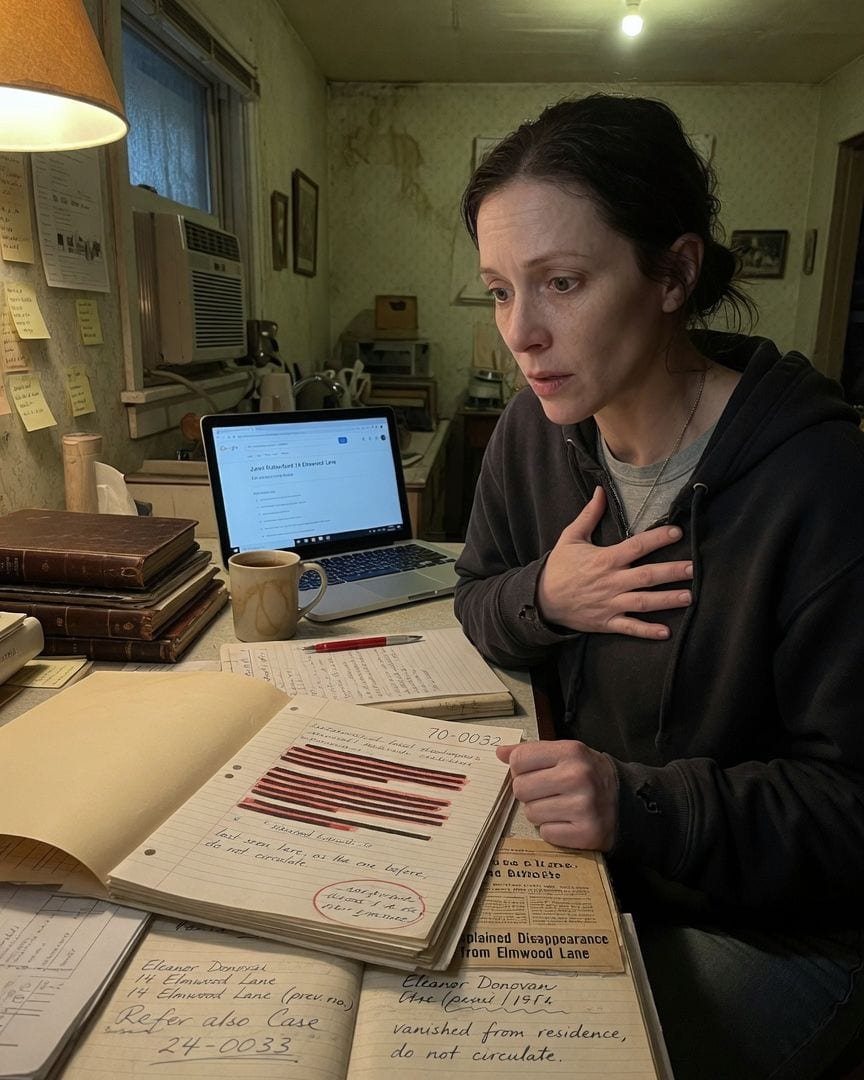
My own address is on a missing person's file from 1970. The blacked-out line names my street. She never lived here.
When my neighbor vanished, I started digging into old local missing persons cases. In a police file for a woman who disappeared in 1970, I found my own address, 14 Elmwood Lane, framing a blacked-out section of the duty log. Janet Rutherford never lived here, and the file contained a chilling handwritten note: 'do not circulate.'
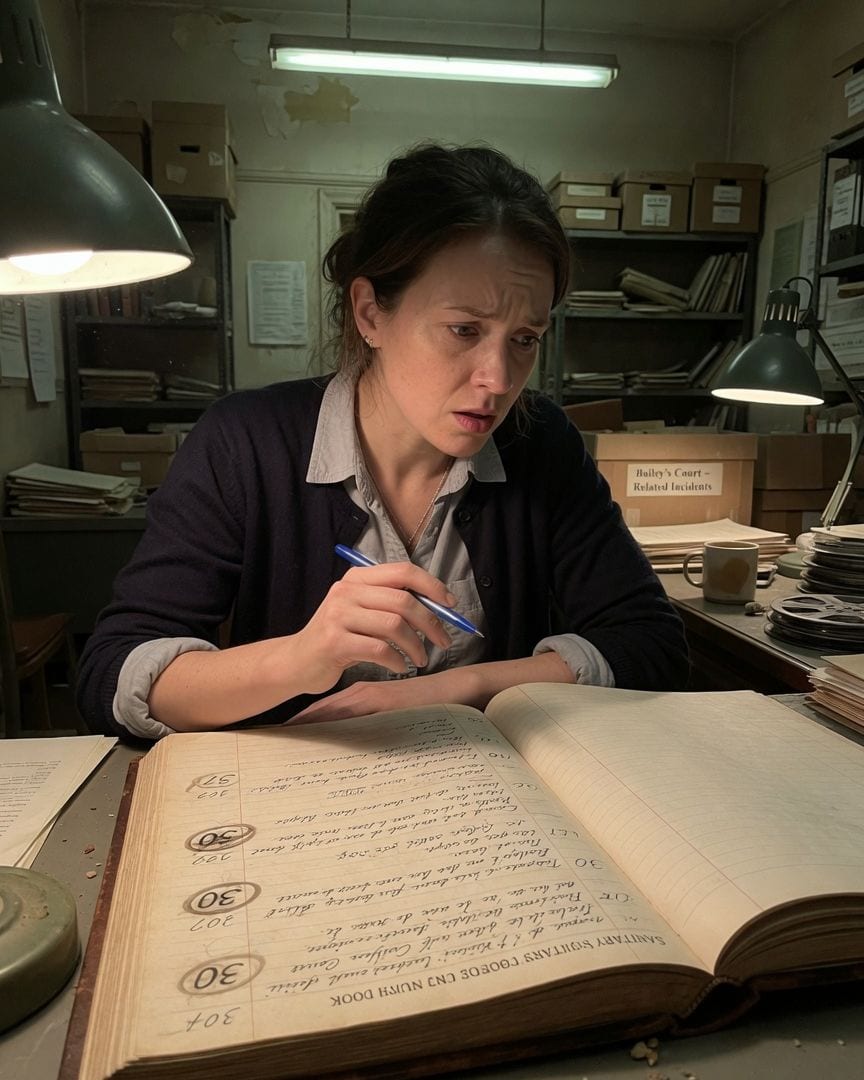
Entry 30 in the old records was re-inked for decades, always the same 'foul drain,' same order: 'do not act.' Then I found it on my street.
My job as a transcriber is usually tedious, but then I found Entry 30. The same complaint, a foul drain, logged for decades, was always re-inked with a chilling instruction: 'nuisance as before, enter it, do not act.' Then I found the same entry again, this time for my own street.
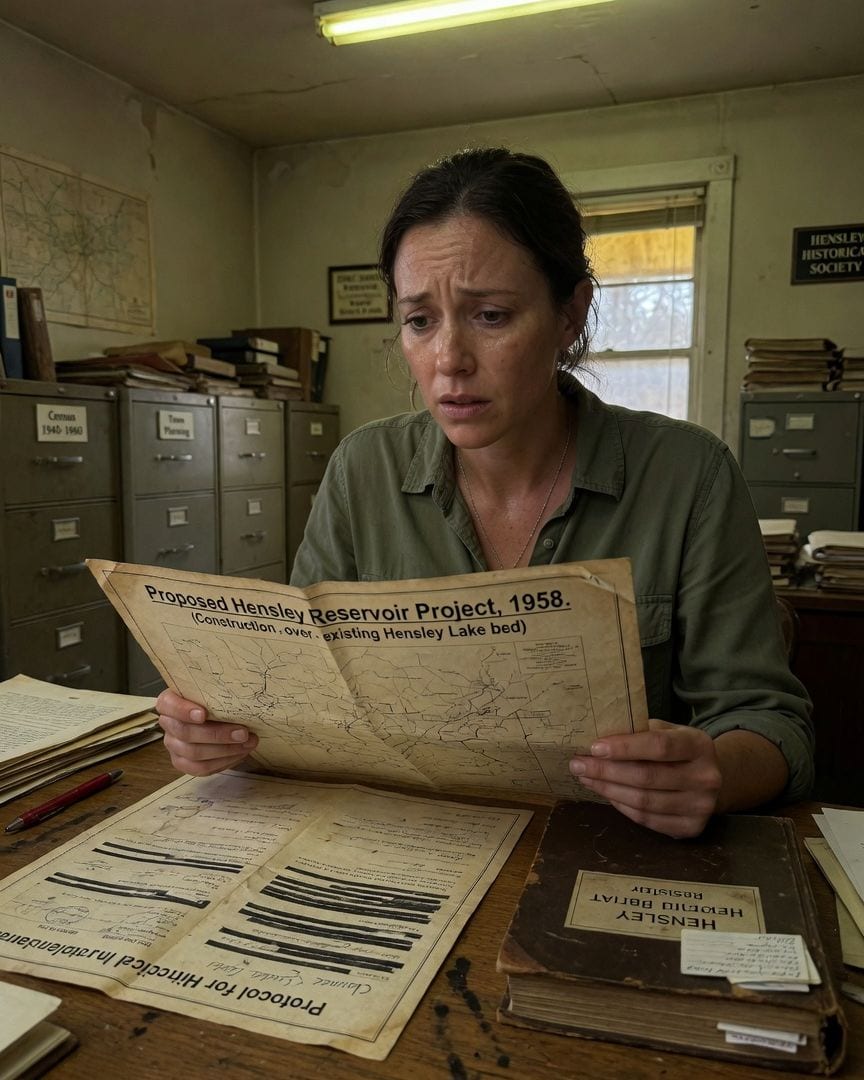
Our town reservoir was finished in 1961. But the old church records show forty-one people drowned in that same reservoir, all decades before it was ever built.
I moved to Hensley, a quiet town where everyone proudly mentioned its reservoir, built in 1961. As a history buff, I found the old parish burial register. It listed 41 people who drowned in 'Hensley Reservoir' between 1903 and 1959, decades before the town says it even existed.
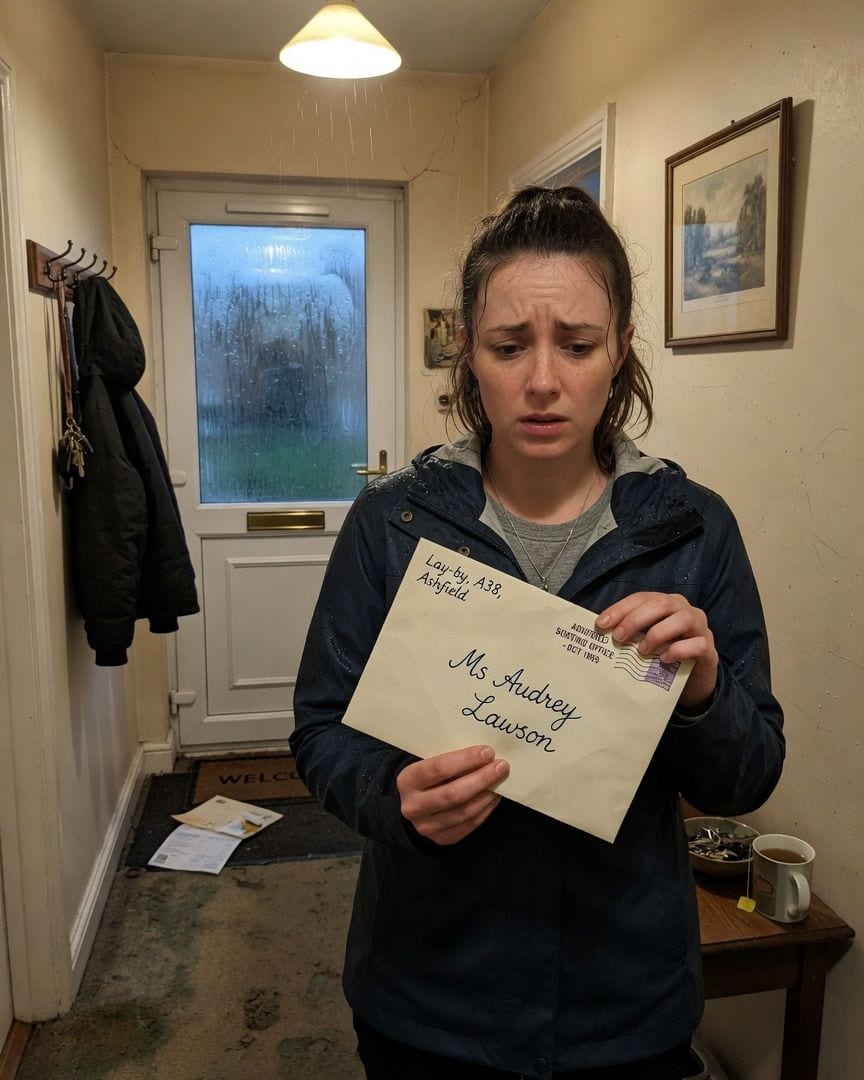
My condolence card arrived for a death that never happened, postmarked from a sorting office that closed before I was born.
My first envelope arrived on a Tuesday, nestled with bills. It bore my full name and a return address for an A38 lay-by that held only a crash barrier. But the postmark read ASHFIELD SORTING OFFICE – OCT 1985, an office decommissioned before I was even born.
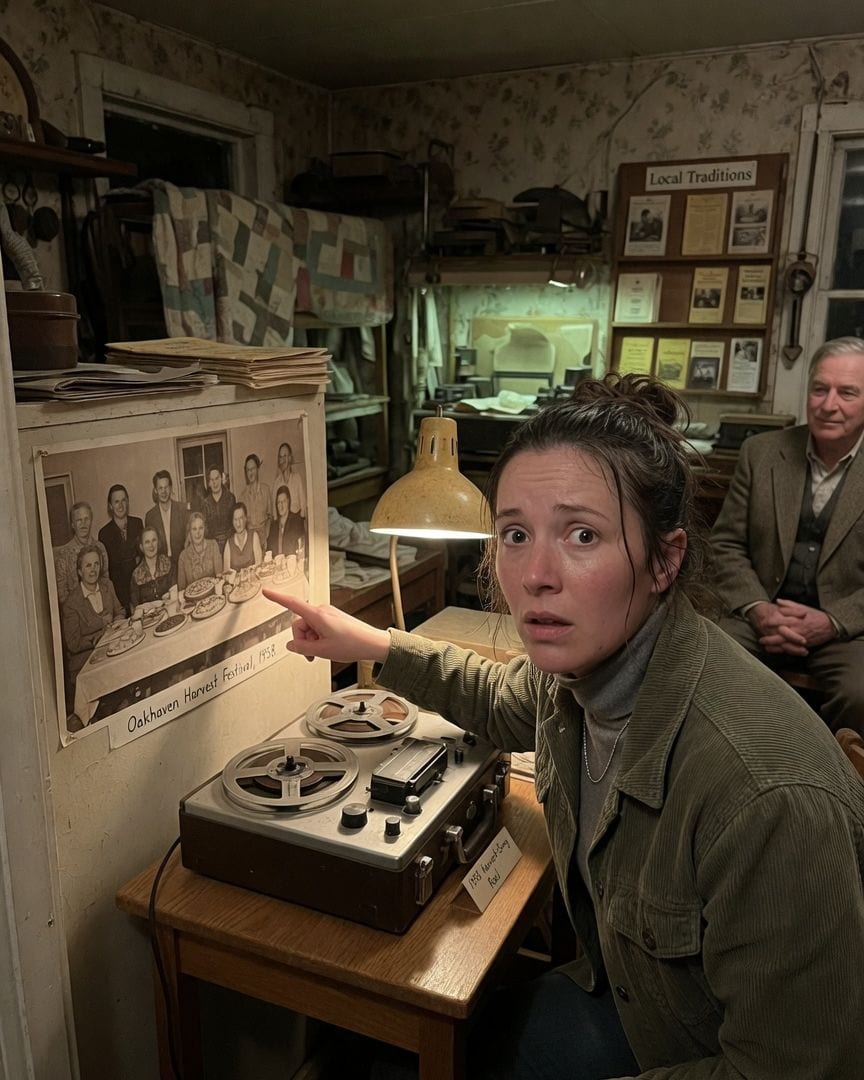
The folk museum's harvest tape counts one more singer than the photograph shows. The curator turned the recorder off before playing it.
I found a quiet escape at Oakhaven's dusty Folk Museum, where the curator played a rare 1958 harvest song. But as a cheerful tune filled the room, a low voice began to count. The tape tallied thirteen, yet the old photograph beside it showed only twelve smiling villagers.
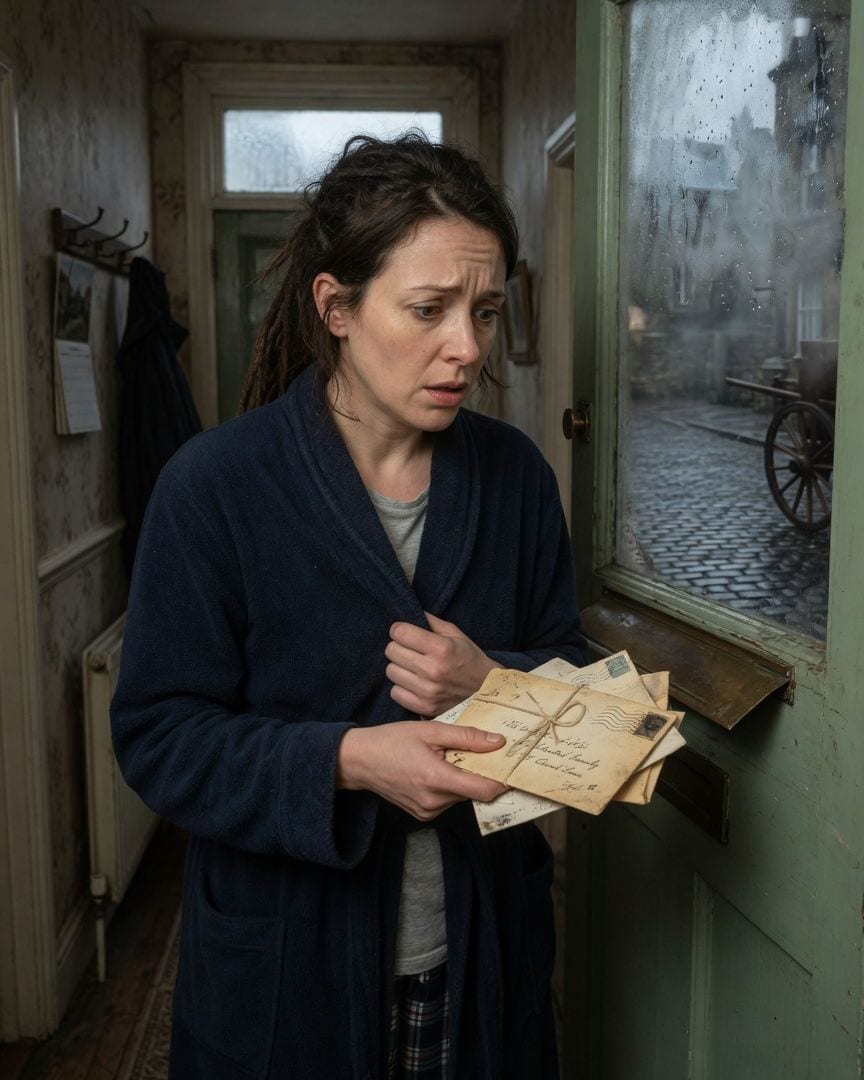
Seventy years ago, a hidden journal recorded my door opening to the wrong street and receiving Lockwood post.
I'd only recently moved into my inherited house, a quiet place on the edge of town. One grey morning, a distinct clatter from the front door's post flap caught my attention. Reaching down, I expected my gravel path, but instead, the flap showed a dark, cobbled street that wasn't mine. A bundle of warm, old letters, addressed to 'The Lockwood Family,' slid through, before the vision flickered and was gone.