My library's basement has an Aisle 21, full of ledgers from years that haven't happened. The floor plan says it doesn't exist.
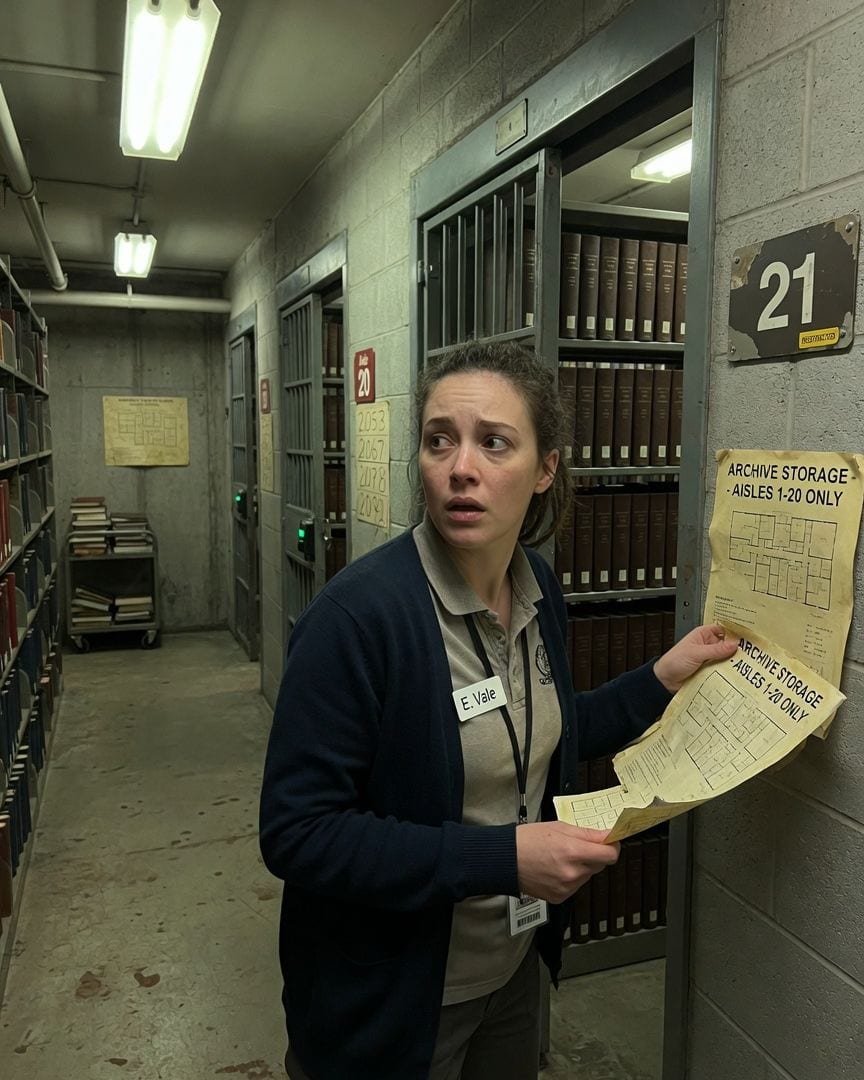
The returns trolley glided smoothly down the familiar concrete ramp, the wheels a soft whisper against the stained floor. I rounded the corner, ready to push it into Aisle 19, but my hands froze.
The steel sign, bolted securely to the wall, read '21.' A cold prickle ran up my neck. My county library’s basement stacks ended at Aisle 20.
Every single map, every blueprint, every mental image I had of this place for the three years I’d worked here, ended at 20.
Yet here it was, stretching into the dim fluorescent glow, an aisle identical to all the others, shelves packed with thick, leather-bound ledgers. Their spines bore no titles, only dates in a looping, elegant hand I’d never seen before.
Dates like '2053,' '2067,' '2078.' Years that hadn't happened.
I backed away slowly, my breath catching in my throat. My library swipe card, usually locked out of restricted archives without a specific clearance code, felt heavy in my pocket.
I pulled it out, almost on a dare, and swiped it against the security gate to Aisle 21. It chimed green. A soft click. The gate swung inward, almost invitingly. I stepped in.
The air here was suddenly still, colder than the rest of the basement, and tasted faintly of old paper and something metallic, like distant rain. It was the kind of cold that seemed to come from inside the walls.
I ran a hand over a ledger spine: '2078.'
I tried to tell myself it was a misprint, a forgotten storage annex, something new, but the official floor plan by the lift, the one I’d consulted every Monday, the one that had been taped to the wall for a century, did not, could not, have an Aisle 21.
I retreated again, my heart hammering against my ribs. I practically ran to the lift, yanked the faded, laminated floor plan from its hook. Aisle 20 was the last. The legend confirmed it: Archive Storage, Aisles 1-20. No more.
I paced the distance from the lift, counted the concrete columns that supported the floors above. No matter how I measured, no matter where I calculated Aisle 21 should be, there was only a solid concrete wall. Blank. Immovable.
Yet, it had been there. I knew it had. The cold, the metallic scent. The gate had opened.
I forced myself back. My footsteps seemed louder, echoing in the unnatural quiet. The gate still opened. This time, I pulled a ledger from a shelf, thick and heavy, bound in dark leather. Its cover was blank, unassuming.
Inside, the same elegant, looping hand filled page after page with meticulous, mundane entries. Not grand prophecies, but small, local details.
'Local Council Meeting, October 14th, 2024: Agenda item 3b, drainage project approved. Vote: 4-3.' Then, 'Sarah Mercer’s cat, Mittens, found safe on Elm Street, October 16th, 2024. Owner expressed relief, offered reward of homemade lemon tarts.'
These weren't just future dates; they were specific, local events. Mundane, verifiable. And November 2nd was next Tuesday. I flipped further, my breath catching. An entry for 'November 2nd, 2024.' It didn’t just describe local council items or lost pets.
It detailed her exact usual morning coffee order from the cafe down the street, even the small splash of oat milk I always forgot to ask for.
It described a specific, obscure edition of 'The Art of Bee-Keeping' I would search for on the third-floor shelves, a book I hadn't thought about in years.
And then, it recorded a brief, private conversation I would have with old Mr. Henderson, the quiet history buff, about a historical society meeting.
He'd even mention his new pet parrot, 'Pompidou,' a detail so bizarre and personal it couldn’t be coincidence. This wasn't a guess. This was a record of my own future, down to the most minute, personal, and utterly unpredictable detail.
The ledger knew me. And it was waiting.
The plumbing leak happened exactly as described. Not a minor one, but a steady drip from the kitchen ceiling.
I stared at the dark water stain spreading on my favorite blue sweater, then at the ledger entry, a cold certainty settling in my gut. It had happened. Every single detail.
The frantic call to maintenance, Mr. Yates's specific comment about my 'eclectic taste in teacups' – an inside joke I hadn't heard in years. I felt a nausea that wasn't from the moldy smell of old pipes.
I spent days trying to find any mention of Aisle 21 in the library's historical archives, cross-referencing old blueprints, staff memos, anything. I scoured digitised records, microfiche, dusty boxes labeled 'Architectural Plans, Pre-1950.' Nothing. It was a blank.
The absence itself was a kind of presence, a hole in the record where something impossible now stood. I'd even gone so far as to measure the exterior of the building, checking the windows, the foundations.
There simply wasn't space for another aisle.
Finally, with every rational explanation exhausted, I approached Julian Lockwood. He was the retired Head Archivist, now a part-time consultant, a man whose quiet life seemed to revolve entirely around the library's vast, eccentric history.
He sat at his usual desk in a dim corner office, surrounded by tottering stacks of dusty tomes. When I tentatively mentioned an 'unusual section' of the basement, his eyes, usually twinkling with benign amusement behind thick spectacles, became still.
Flat. He spoke of 'old patterns' and 'the building’s unique character,' his voice calm, almost detached, as if discussing the weather.
He mentioned the library had 'its own way of existing,' and that some parts 'reconcile with logic better than others.' His answers were unsettlingly vague, yet precise in their evasion, never denying the impossible.
He even mentioned, in passing, that some staff members, over the decades, had found unexpected 'shortcuts' in the stacks, paths that didn't appear on any map, but always returned them to where they started. A road that returns.
The air in his office felt suddenly heavy. He knew.
After my conversation with Julian, I felt a definite shift. I was no longer just an observer, an accidental discoverer. I was part of something.
I tried to drive to the next town over, Mercer Falls, to the regional archives, hoping to find older, external records of my library's construction, perhaps something that predated Julian's tenure. I knew the route by heart.
I took the familiar highway, then turned onto the state route, following signs for 'Mercer Falls.' Forty-five minutes later, my car was pulling into my library parking lot. Again.
I checked my mileage, my fuel gauge, the clock on the dashboard. I'd driven. I'd made the turns. The signs had been correct. But I was back. The Road That Returns. My hands tightened on the steering wheel, knuckles white.
The library was pulling me in.
Later that week, a small, neatly folded note appeared on my desk, tucked under a stack of returns. It was printed, not handwritten, but the paper felt old, dry, like the ledger pages. The letters were crisp, almost formal.
'Balance is key. Some things are best left undisturbed.' There was no signature. Julian’s quiet observation had turned into a subtle warning. His calmness was not indifference, but a profound certainty.
I found myself glancing over my shoulder in the stacks, hearing phantom footsteps behind me, the hushed rustle of pages, the creak of floorboards in empty aisles.
I wasn't being watched by a person, but by the library itself, or by whatever Julian served. The geometry was shifting around me, subtly, almost imperceptibly, guiding me, or perhaps, trapping me.
The temperature in my office dipped so suddenly that I could see my own breath, a wispy cloud in the still air, before rising back to normal.
I cornered Julian in his office, the ledger clutched open in my hand, turned to my personal entry. The coffee order, Mr. Henderson’s parrot. 'This isn't just an 'old pattern,' Julian. This is my life, written before I’ve lived it.
This is my future.' His gaze was steady, unblinking, fixed on the page, then on me. 'The library,' he began, his voice low, a soft rasp, 'is... a nexus. It breathes. And sometimes, it expands.
Aisle 21 is one such expansion. It appears, then recedes. It has for centuries.' He didn't speak with awe or fear, but with the quiet authority of a historian recounting a known fact.
He explained that the ledgers were a record of these 'manifestations,' of the events that transpired within their ephemeral geometry. 'They are not prophecies, Nora. They are echoes.
Histories of what has already happened, in a different turn of the wheel. Cycles.'
He described a cyclical nature, how certain events, certain people, recurred. 'You, Nora,' he said, a faint, unsettling smile touching his lips, 'are part of the pattern. You always have been.'
He spoke not of good or evil, but of a neutral, inevitable force, an impossible geometry that simply is.
He admitted he had encountered Aisle 21 decades ago, as a young archivist, and had, over time, come to understand its rhythm. He didn't create the wrongness, he merely observed it, and, he implied, gently guided its 'expression.'
The earlier clues clicked into place: the swipe card opening the impossible gate, the road that always returned me to the library, the uncanny calm in his voice.
He wasn't afraid because he was already part of it, an old cog in a very old, very precise machine. The hum of the fluorescent lights above us seemed to deepen, a low, resonant thrum that vibrated through the floor.
It was the building, listening.
I returned to Aisle 21, the chilling conversation with Julian echoing in my mind. 'Echoes. Histories of what has already happened.' I pulled out the ledger that had described my coffee order, Mr. Henderson, the plumbing leak.
I flipped back through the pages, my fingers cold against the dry paper. There, on a page dated for next month, a new entry. My own name. 'Nora Hawkins: Departure from service, unexpected.'
Below it, a chillingly vague phrase: 'reassignment to auxiliary service.' And then, the handwriting. It wasn't just similar to Julian's elegant, looping script; it was Julian's. Unmistakable.
Not an echo from a past cycle, but a current entry, fresh on the page, the ink still seeming to absorb the light. An instruction. He wasn't just observing the pattern; he was writing it.
And he had written me into it. The ledger wasn't just a record of what happened; it was the mechanism to make it happen. I was looking at my own fate, dictated by the man who claimed to merely observe.
He wasn't 'the one who knew,' he was 'the one who decided.' My hand trembled, resting on my own name, a date in the near future, and Julian's elegant, terrifying script.
I confronted Julian one last time, the ledger clutched in my hand, my fingers pressing hard against the page with my name. 'You wrote this. You're not just observing; you're orchestrating.'
Julian sighed, a sound of weary resignation, not guilt or malice. He didn't look up from the small, intricately carved wooden puzzle he was assembling on his desk. 'The library demands its pattern, Nora. It has a… metabolism. An intake.
I merely ensure the flow. The ledgers are the blueprint, the script. And yes, sometimes, the script needs a hand. Small adjustments. To keep the cycles stable. To keep the building... fed.'
He looked up then, his eyes, behind the thick lenses, strangely bright. He explained that the library's geometric shifts required 'anchors'—individuals whose presence helped solidify the new, impossible spaces, or whose 'departure' facilitated the next shift.
I, he calmly stated, was a particularly strong anchor, having reappeared in several cycles. My 'departure' wasn't malevolent, in his view, but a necessary reset. A simple, administrative change in status.
He spoke of the 'Road That Returns' as a subtle gravitational pull, the library’s way of keeping its pieces, its people, in place. He was not a villain, he believed, but a custodian.
Every clue, every impossible detail, now clicked into a coherent, horrifying system. Julian wasn't a villain; he was a custodian of a monstrous, indifferent, cyclical truth, and I was merely a cog in its ceaseless turning.
The air in his office was thick, heavy, as if all the accumulated centuries of the library's impossible existence were pressing down on me.
I didn't argue. I saw the futility. Julian was a part of the library, not a separate entity. His calm was the horror, the depth of his acceptance. My only option was to escape the pattern.
I still had the ledger, my 'departure' entry stark on the page. If the library's geometry could be wrong, perhaps it could also be wrong in a way that led out.
I returned to Aisle 21, not to read, but to search. I knew the Road That Returns could bring me back, but perhaps it could also be used to leave.
I looked for an exit that didn't exist, a door that wasn't there. I measured, I pushed, I listened. The metallic, rainy scent intensified, almost cloying.
Deeper in the phantom aisle, where the shelves stretched into impossible shadow, where the fluorescent lights seemed to flicker and almost die, I noticed a faint seam in the concrete wall, almost invisible.
Not a join in the paneling, but a line of faint shadow, a barely perceptible change in texture. No handle, no frame.
I pressed my hand against it, feeling a subtle vibration, like a distant, deep hum. I remembered my swipe card opening the gate to this impossible aisle.
I pulled it out, my fingers clumsy with adrenaline, and pressed the card flat against the seam. A soft click. The seam widened, almost imperceptibly at first, then revealing a narrow, dark passage, smelling of damp earth and fresh air.
Not the library's stale, recycled air, thick with dust and ancient paper. This was an outside. I looked back at Julian, standing at the far end of Aisle 21, exactly where the formal aisles ended at 20.
He was watching me, a faint, knowing smile on his face, unconcerned. He didn't move to stop me. I stepped through, into a quiet, forgotten alleyway, far from the library, far from the familiar streets of my town.
The ledger, still clutched in my hand, felt impossibly heavy, a physical weight of impossible truth.
Nora Hawkins vanished from her post at the county library. Julian Lockwood quietly, efficiently, processed her 'resignation,' citing 'personal reasons.' A new, eager young librarian was hired within weeks, bright-eyed and oblivious.
The ledger Nora took was never found on Aisle 21’s shelves, though no one else had ever seen Aisle 21 in the first place. Nora tried to explain, to show the ledger to friends, to authorities.
But the impossible entries were just smudges, or faded script, or meaningless scribbles to anyone else. To them, it was just an old, blank book. Her story, rational and detailed, sounded like a breakdown.
She lost her job, her apartment, her sense of place.
Nora now works a quiet, solitary job, processing shipping manifests in a warehouse far from her old town. She keeps the ledger locked away in a safe deposit box, the only physical proof of what she experienced.
Its pages, to her, still hold the chilling script of her near-future, a constant reminder that the world she thought she knew is merely a fragile layer over something else.
She never looks at maps the same way, always searching for the gaps, the places that shouldn't be, the blank spaces between lines.
She escaped the library, but the geometry of its wrongness is now etched into her mind, a permanent cost.
The world looks different when you know the map can lie.
If this one got to you
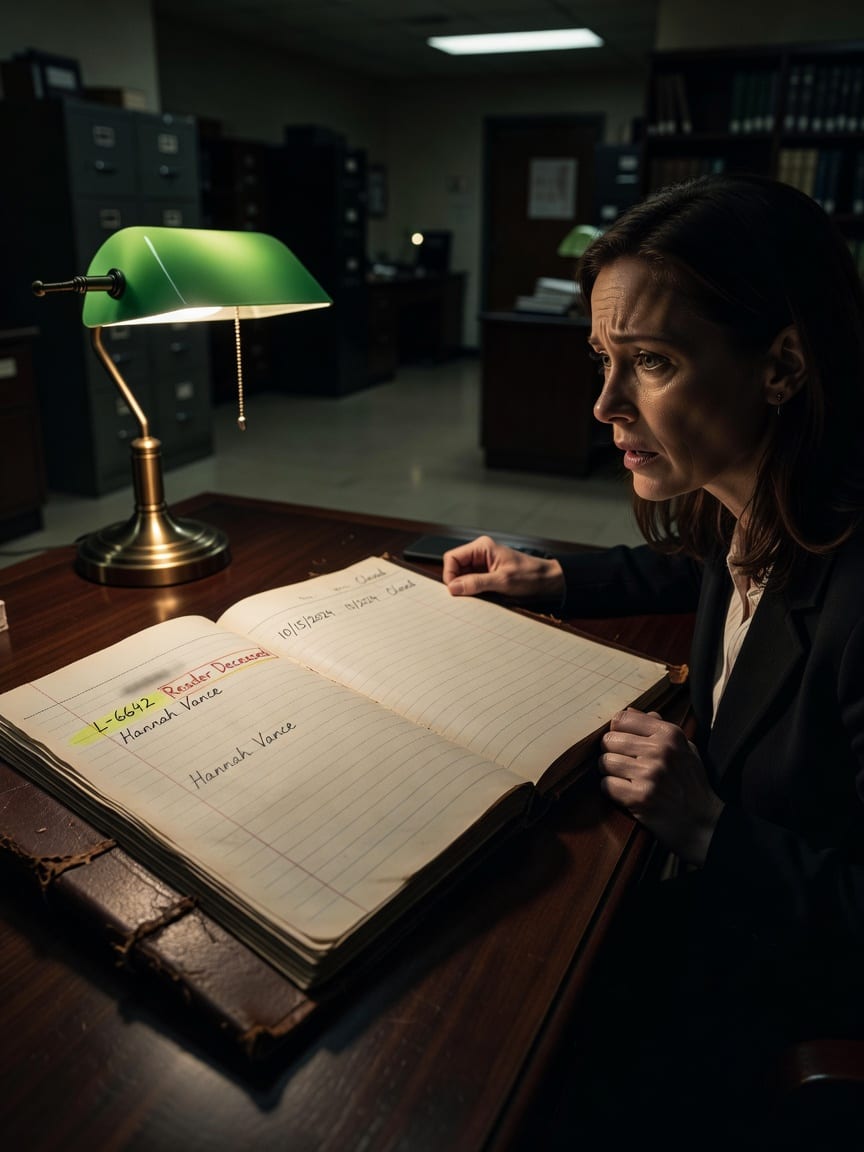
My library card number L-6642 was issued to me at seven — and the ledger shows that number has marked a reader 'deceased' every twelve years since 1949.
Returning my late father's library card to the old town library felt like a small act of closure. But the senior librarian's ancient ledger revealed a chilling pattern of 'reader deceased' entries tied to specific card numbers and borrowed books. My unease turned to cold dread when I secretly found my own name penciled in, marked for a future 'reader deceased' entry.
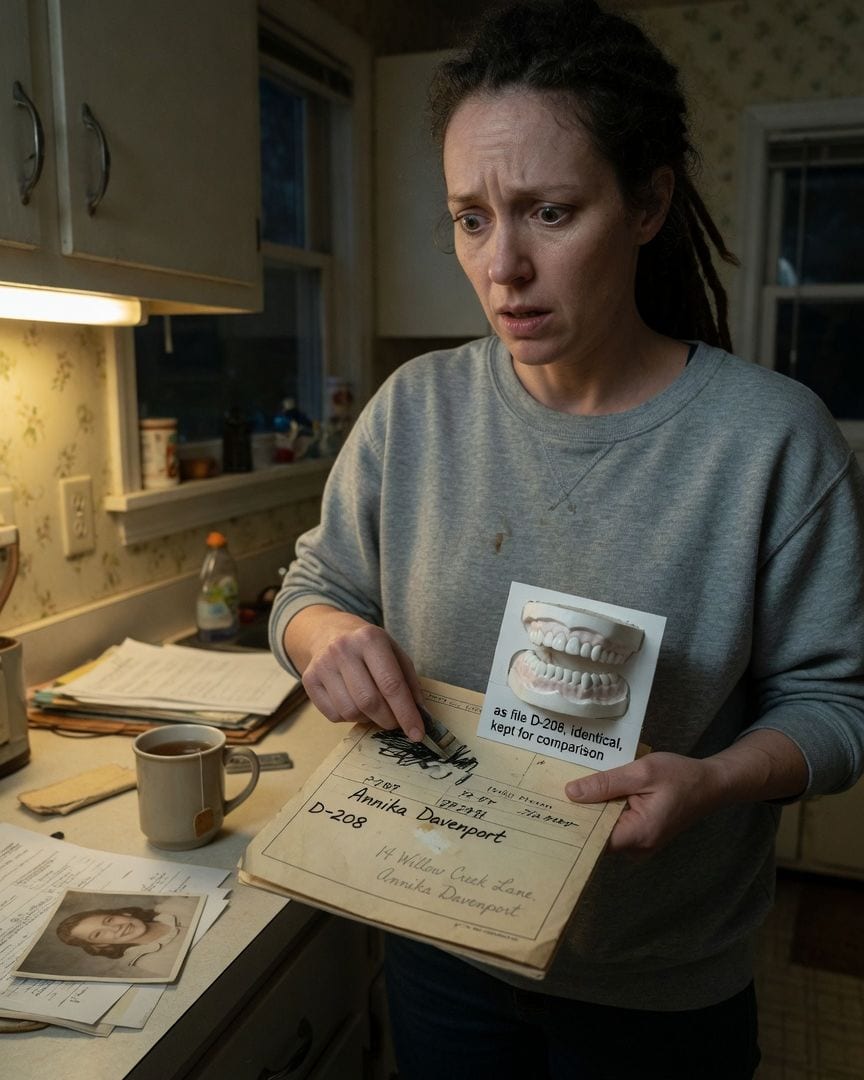
My childhood dental chart lists the house I bought last year — in my own name, years before I was born. A second set of my teeth sits filed beside it, marked 'identical.'
Sifting through old dental records, I found my chart, D-208, with my 1988 birth date. But a line from 1958 was blacked out, and a clipped card with an impression of my teeth listed my name and current home address, decades before I was born. The impossible facts knotted into a cold certainty.
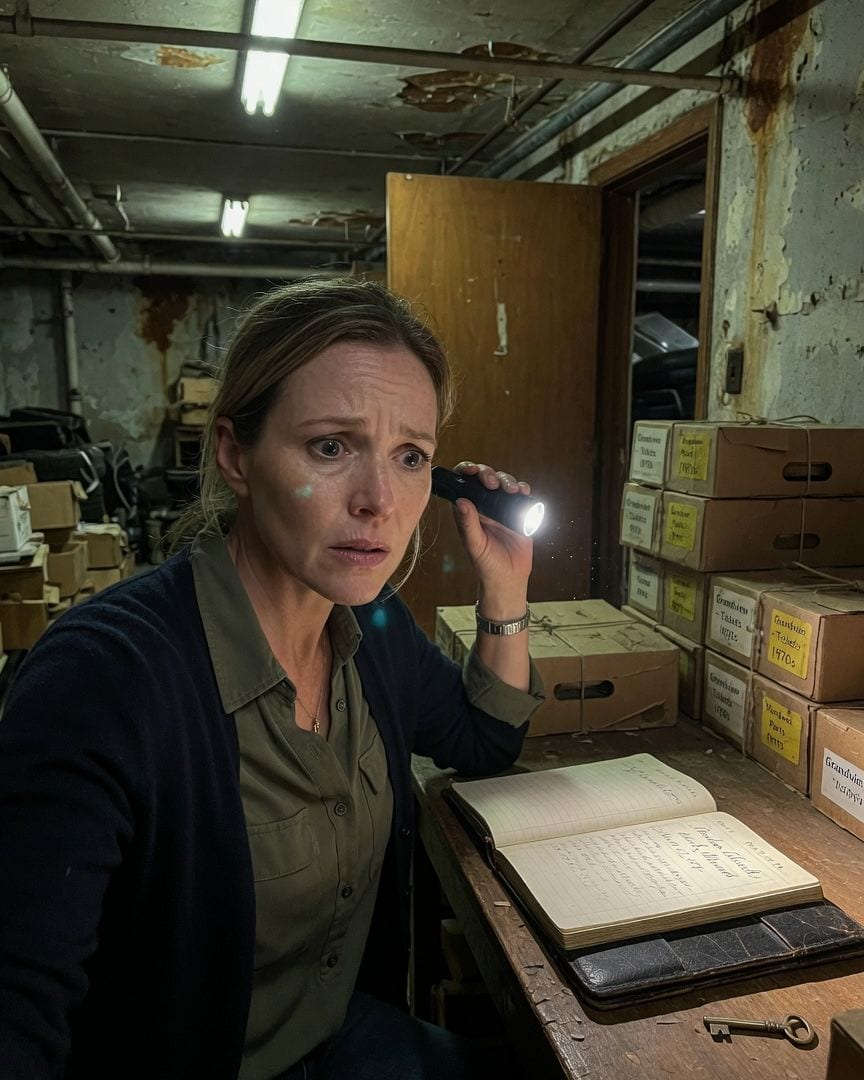
My old cinema's letter said "We kept your seat," and it closed in '94. The seat number was mine, a secret I never wrote down.
Penelope Ellsworth receives a mysterious letter from the Grandview Cinema, which closed in 1994. The letter claims it 'kept her seat,' a specific row and number she never shared with anyone. Driven by an unsettling curiosity, Penelope uncovers an old ledger in the defunct cinema's basement with her name and seat number, dated 1977—seventeen years before she was born.
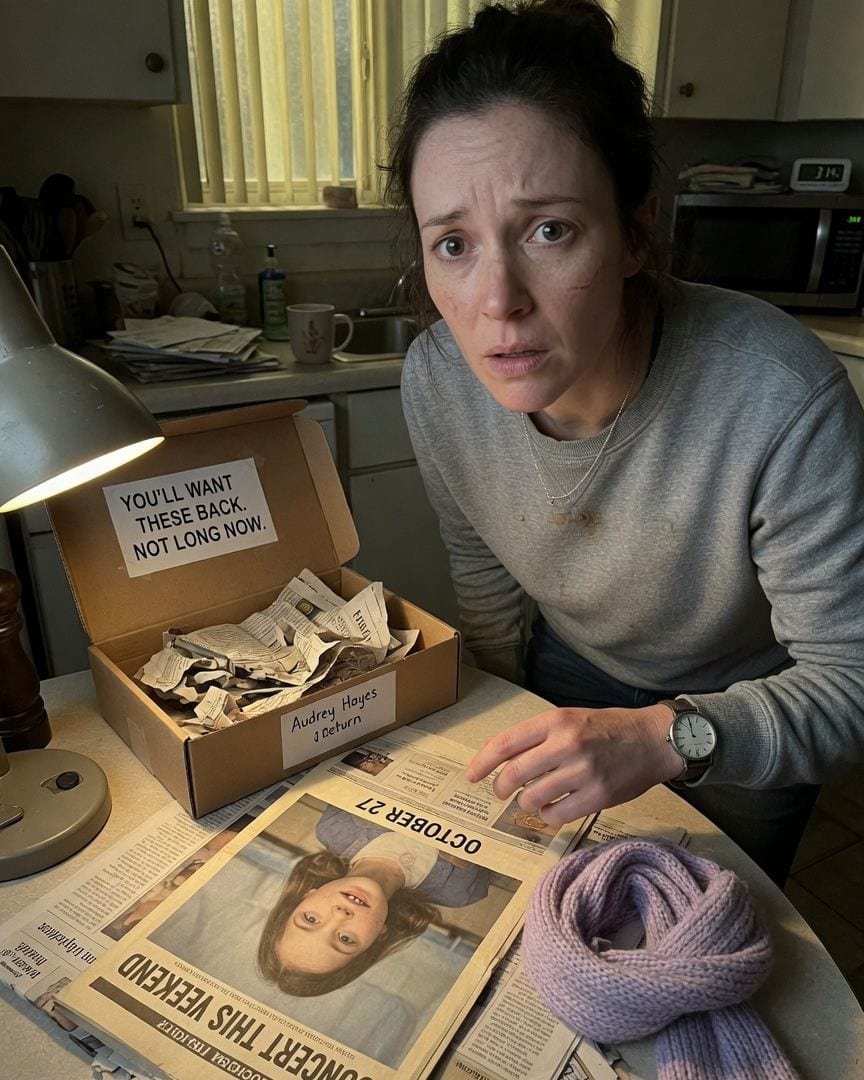
A box turned up with my name and no sender. Inside was a watch I lost years ago, still ticking and set right — wrapped in newspaper dated two weeks from now.
A plain brown box appeared on my step, containing my long-lost personal items. Among them, my grandmother's ticking watch and a newspaper dated two weeks in the future. But a historical ledger then revealed my name and these exact items, listed in 1965.
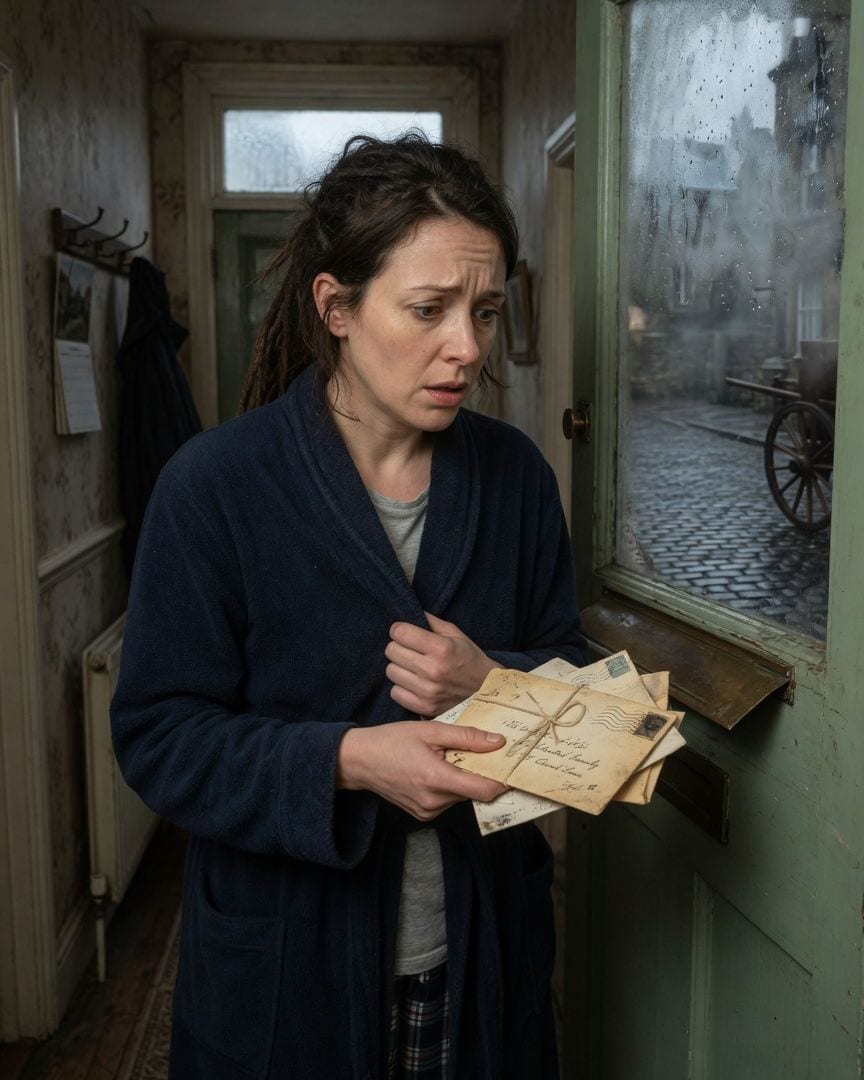
Seventy years ago, a hidden journal recorded my door opening to the wrong street and receiving Lockwood post.
I'd only recently moved into my inherited house, a quiet place on the edge of town. One grey morning, a distinct clatter from the front door's post flap caught my attention. Reaching down, I expected my gravel path, but instead, the flap showed a dark, cobbled street that wasn't mine. A bundle of warm, old letters, addressed to 'The Lockwood Family,' slid through, before the vision flickered and was gone.
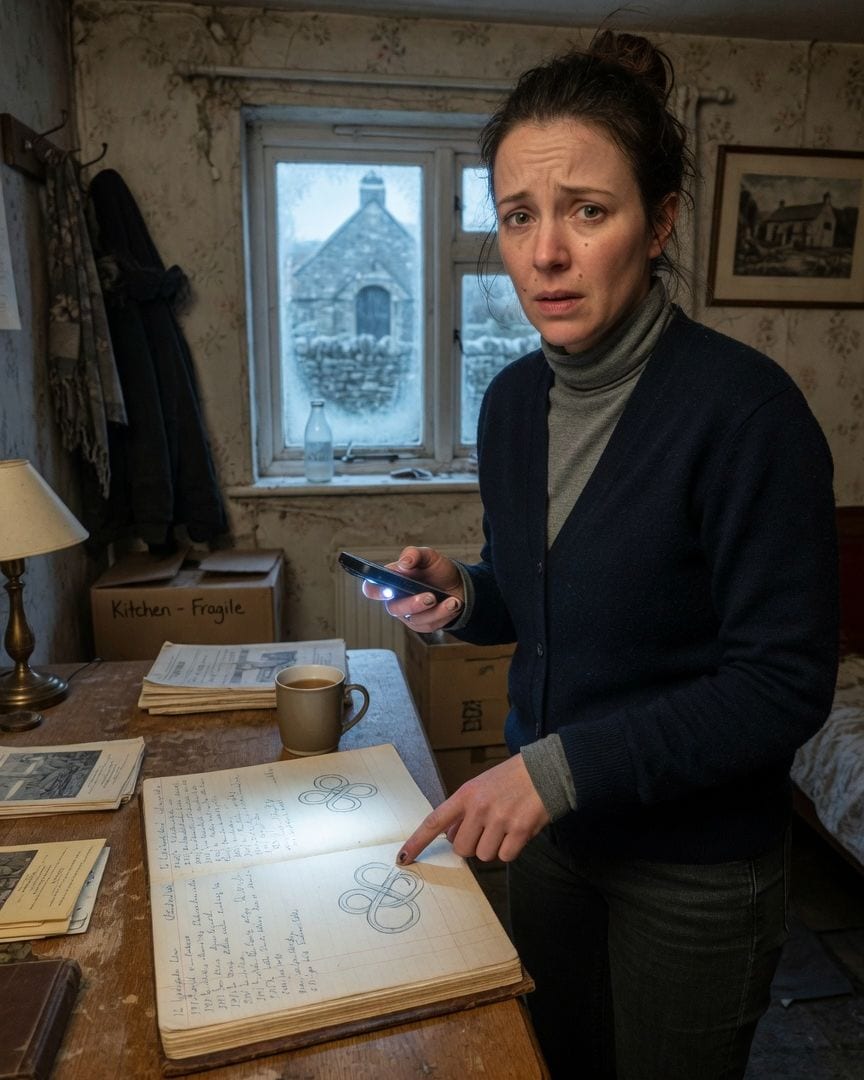
Milk appears daily by my lychgate. The dairy closed in '79. My address is handwritten into their old delivery book, starting the day we moved in.
Moving to Blackwood Creek, I loved the quaint charm, especially the unexpected morning milk delivery to my lychgate. But when I mentioned it to Eleanor at the village shop, her smile froze. She told me Willow Creek Dairy closed decades ago, in '79.