My old cinema's letter said "We kept your seat," and it closed in '94. The seat number was mine, a secret I never wrote down.
It arrived Tuesday morning, a cream-colored envelope tucked amidst the usual bills and junk mail. My name, 'Penelope Ellsworth,' typed neatly after 'Dear,' felt almost formal. It stood out immediately.
The paper was thick, almost like card stock, and felt oddly cool to the touch, despite sitting on my warm kitchen counter.
Inside, just a single line of text, elegant and archaic, like something from an old-fashioned printing press: 'We kept your seat. Row 7, Seat 14.'
And the letterhead. 'The Grandview Cinema.'
My heart seized. It wasn't a metaphor. It literally felt like a cold hand had squeezed something vital in my chest. The Grandview Cinema. It closed in 1994, when I was sixteen.
It’s a sleek car showroom now, Davenport Motors, all glass and chrome. But the row and seat number. Row 7, Seat 14. That was my seat. Always.
The one I’d race my friends for, the one I’d choose when I went by myself, the perfect spot, slightly off-center, just the right distance from the screen. A stupid, trivial detail I’d never shared with anyone, never written down.
Not in a diary, not in an email, nowhere. The postmark on the envelope read last Monday.
I stared at the paper. It had to be a prank. Some elaborate, very specific prank. Maybe a new marketing stunt by the showroom, a retro campaign. But the specificity. The intimate knowledge of something only I could possibly know.
It left a cold, hollow space in my gut. My rational mind tried to grapple with it, tried to force it into a logical box. A friend from high school, playing a trick? But who would remember that?
And why now, after thirty years? The impossible truth of what that letter knew settled over me, heavy and chilling.
The next morning, I called Davenport Motors. A chirpy receptionist put me through to the manager, a Malcolm Davenport. His voice was smooth, practiced. I told him about the letter, the Grandview, the seat number. He chuckled. "Old cinema records?
Heavens, no, Miss Ellsworth. We bought the building, not the history. The previous owners cleared everything out years ago. Probably just a very niche marketing gimmick from a local prankster, I expect." He was polite, but dismissive.
I tried to let it go, but the letter sat on my kitchen table like a silent accusation. By lunchtime, I couldn’t stand it anymore. I drove out to the showroom.
The building stood on the corner of Elm and Main, modern glass panels covering most of its brick façade.
But if you looked closely, you could still see the grand, if forgotten, lines of the original structure: the curve of an archway, the ghost of a marquee.
Inside, it was exactly as I remembered from driving by: polished concrete floors, gleaming chrome, spotlights on new cars. A faint, almost imperceptible smell of oil and new leather hung in the air.
I found a young sales assistant, barely out of college, polishing a red sports car. "Excuse me," I said, trying to sound casual, "I was wondering, does this place have a basement?
Or any old storage rooms from when it was the Grandview Cinema?"
He straightened up, looking vaguely annoyed. "Yeah, there's a basement. Mostly parts storage now, and a 'junk room' at the back. Full of ancient dust, mostly. Why?"
I explained the letter, omitting the impossible detail of the seat number. "Just curiosity, really. Historical interest." He shrugged, pointing vaguely towards the rear of the building.
Malcolm Davenport, when I found him in his glass-walled office, was less obliging. "Miss Ellsworth, I told you on the phone, we have nothing. There’s really nothing down there of interest to you."
But I insisted, telling him it was important to me, a nostalgic trip down memory lane. After some reluctance, and probably just to get rid of me, he relented, pressing a heavy, tarnished brass key into my palm.
"Last door at the end of the hall, near the old boiler room. Just, you know, don't touch anything."
The basement was a shock. The modern showroom was antiseptic, bright. Down here, it was damp, smelling of old concrete and something metallic, almost ferrous. A forgotten world. Fluorescent lights flickered overhead, casting long, jumping shadows.
Amidst discarded office furniture, stacks of tires, and old car parts, I spotted it. A sturdy, iron-bound door, clearly much older than the flimsier ones around it, tucked into a deep recess.
It was solid oak, scarred and dark, like it had seen centuries. It didn’t look like a 'junk room' door. It looked like a vault.
I tried the key Malcolm had given me. It slid in smoothly. With a heavy, satisfying thunk, it clicked open.
The room beyond was dark, a different kind of dark than the rest of the basement. This darkness felt thicker, older. It smelled of mildew and old paper, sharp and cloying.
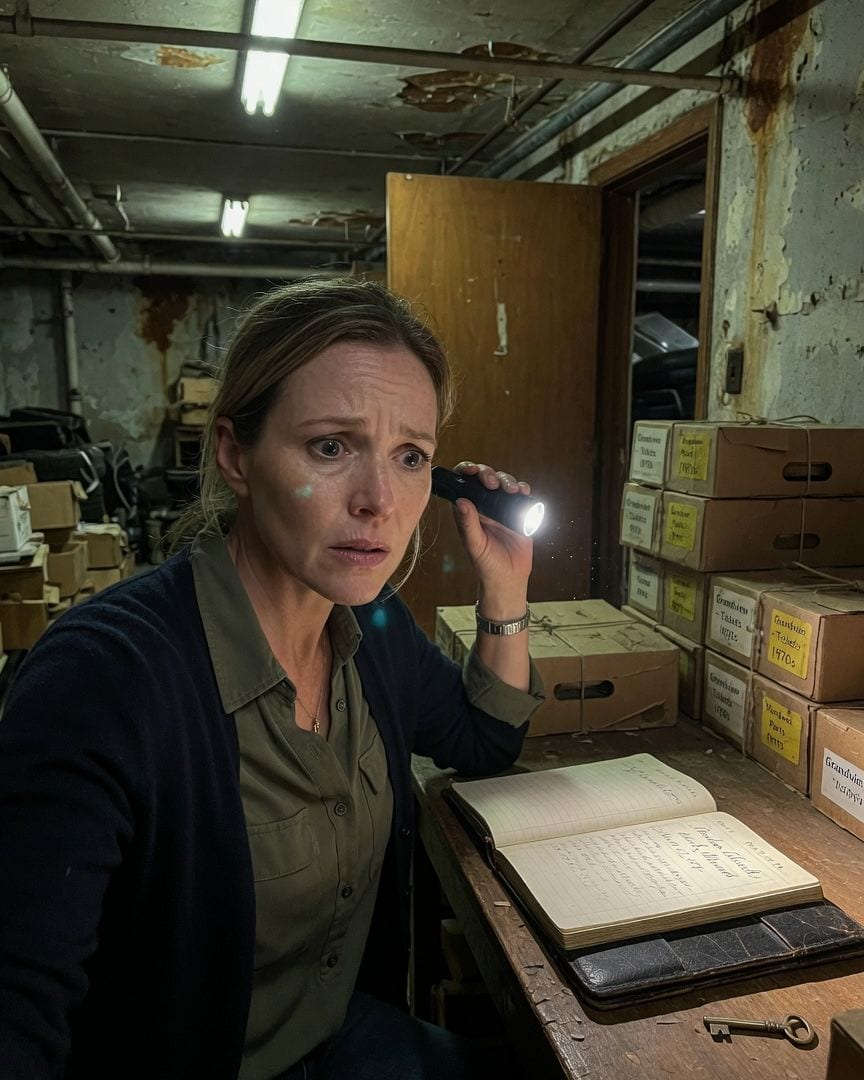
My phone flashlight cut through the gloom, a thin, frantic beam, illuminating shelves filled not with car parts or broken office chairs, but with dusty boxes and forgotten files. They were stacked haphazardly, some crumbling, others tied with brittle string.
In the corner, on a small, scarred wooden table, sat a heavy, leather-bound ledger. It was too substantial, too old, for a simple cinema's financial records. The leather was deeply cracked, almost black with age, the corners bound with brass.
Its pages were thick, parchment-like, yellowed with time. I opened it, my fingers trembling slightly. The script was ornate, flowing, calligraphic, like something from a different era. I scanned the page, my eyes widening, then narrowing as I read.
My breath caught, sharp and cold in my throat. On the faded, yellowed page, beneath 'Row 7, Seat 14,' a name was written in elegant script: 'Penelope Ellsworth.' And next to it, a date. A date from 1977.
Seventeen years before I was even born.
I snapped a photo of the ledger entry, the flash momentarily blinding me in the dusty room. My mind reeled. 1977. Before I existed. Before I could have possibly chosen a seat, or even known what a cinema was.
I left the 'junk room,' locking the door behind me, the heavy brass key feeling leaden in my hand. Malcolm was nowhere to be seen.
I slipped out of Davenport Motors, the sleek cars and bright lights of the showroom now feeling utterly alien.
Back home, the letter and the ledger photo laid side-by-side on my kitchen counter. I felt like I was losing my mind, but the evidence was right there. I dove into online archives, searching for 'Grandview Cinema 1977.'
I unearthed old community records, grainy photographs of forgotten town events, news clippings about local businesses.
The Grandview was indeed a beloved community hub, but buried deep in local history forums, under threads about 'Old Town Legends' and 'Forgotten Places,' whispers surfaced. Mentions of 'unusual gatherings,' 'old traditions,' and 'the families who kept watch.'
Nothing concrete, just vague, unsettling mentions.
One name kept reappearing: Isaac Bishop. A retired local historian, known for his eccentric collection of town lore, his articles often delving into the stranger corners of our town's past. I found his number through the historical society.
I called, my voice tight. When he answered, I cautiously mentioned the Grandview Cinema and, almost on instinct, the specific seat number. Row 7, Seat 14.
Isaac's voice, initially gruff and wary, softened with a strange, almost hungry interest when I mentioned the seat. "Row 7, Seat 14, you say?" he rumbled. "That's… specific." He paused, a long silence stretching between us.
"Some families have longer memories than others, Miss Ellsworth," he said, his voice now low, a little gravelly. "And some obligations last generations." He agreed to meet me the next day.
The call ended, leaving me with a chill that had nothing to do with the weather.
I met Isaac Bishop in his cluttered home study, a room overflowing with knowledge and dust. Books were stacked floor to ceiling, spilling onto every surface.
Ancient maps lay unfurled on a heavy oak table, half-hidden by piles of brittle newspapers.
Dust motes danced in the sunlight streaming through a grimy window, illuminating forgotten artifacts: a rusty key, a faded daguerreotype, a curious, almost tribal-looking carving in dark wood.
He watched me with unnerving intensity, his eyes sharp and bright behind thick spectacles.
I recounted my discovery: the letter, Malcolm's denial, the locked room, the ledger, and the impossible date. Isaac nodded slowly, a grim set to his mouth.
"Some things are better left undisturbed, Miss Ellsworth," he said, his voice a low rumble that seemed to vibrate through the floorboards. "Especially when they know your name."
He leaned forward, his gaze piercing, holding mine. The air in the room felt thick, heavy with unspoken things. "I'm sorry, by the way. For what's to come." The 'Apology In Advance.'
The phrase hung in the air, a bell tolling. I felt a cold prickle of fear crawl up my spine. Sorry for what? What was coming? Before I could question him, my phone buzzed in my pocket. An unknown number.
I glanced at the screen, then back at Isaac, who simply watched me, unblinking, a strange, knowing look in his eyes.
Against my better judgment, I answered. I had to. A calm, deep voice, neither distinctly male nor female, spoke my name, perfectly enunciated, as if they knew me intimately. "Penelope. We've been expecting you to find this."
A click, and the line went dead. No static, no muffled sounds. Just silence. I clutched the phone, the targeted dread a cold, precise hand on my heart.
Shaken, I pressed Isaac. "Who was that? What was that about 'expecting me'? What do you mean, 'for what's to come'?"
He sighed, a sound of profound resignation that seemed to settle all the dust in the room. He reached into a drawer in his oak desk, pulling out a faded, sepia-toned photograph.
It showed the interior of the Grandview Cinema, but not as I remembered it. No bright concession stands, no movie posters.
It was sparse, almost bare, the seats arranged in a strange, almost ritualistic way, a wide space in front of what looked like a low, stone altar instead of a screen.
His finger, gnarled and stained with ink, pointed to a specific seat. Row 7, Seat 14.
Even in the blurry photo, I could make out a small, unique, almost tribal carving on its armrest, exactly matching the one I'd briefly seen on the ledger in the showroom.
"The Grandview was built over something far older, Penelope," Isaac explained, his voice hushed, as if afraid of being overheard. The room seemed to grow colder, the shadows longer. "A gathering place. The 'seats' weren't for movies. They were designations.
For certain families, a cyclical duty, a role passed down." He gestured to the photo of the ledger entry on my phone. "That's not a cinema log, Penelope. It's a roster. Of the keepers.
The ones chosen to watch, to remember."
He pulled a similar ledger from beneath a pile of books on his desk. It looked almost identical to the one I'd found, though clearly his personal property, worn smooth by years of handling.
He flipped through it, showing me other names, similar impossible dates, always tied to specific seats. A pattern emerged: a name from every few decades, always with that specific row and seat.
Each entry was in the same elegant, calligraphic hand, as if written by the same person, through time. It was a dizzying, terrifying realization.
"Your name has been on that list since before you were born," Isaac said, his eyes full of a terrible pity. "It's an inherited obligation. And now, it's your turn."
I stared at the photograph, the weight of the revelation crushing me. My blood felt like ice in my veins. "What duty?" I demanded, my voice barely a whisper, thin and reedy in the suddenly too-quiet room. "What happens?"
Isaac closed his own ledger with a soft thud, his face pale, suddenly looking very old. "Some things are not meant to be spoken aloud, child. Only endured."
He glanced nervously around his study, his eyes darting to the shadowed corners, as if unseen ears might be listening. The air itself seemed to prickle, thick with unspoken presences.
I needed more. Desperate, I snatched the photograph of my own ledger entry from my bag, pointing to the earlier names. "Who are these people? What happened to them?"
Isaac only shook his head, clamping his lips shut. He wouldn't meet my eyes.
Frustrated, I scrolled through the names on my phone, searching for anything familiar, any thread to pull, any connection to my own life that could make sense of this insanity. And then, my breath caught.
My finger trembled, tracing the entry. 'Greta Davenport.' My great-aunt. The same Row 7, Seat 14. And beside it, a single, stark word: 'Acknowledged.'
I drove straight to my great-aunt Greta Davenport’s cottage. It was a small, perfectly kept house, every cushion plumped, every surface gleaming.
Greta, frail at eighty-something but with eyes that still sparkled with an unnerving sharpness, greeted me at the door with a calm that chilled me to the bone. She wasn’t surprised.
“I knew you’d come, Penelope,” she said, her voice soft, almost a sigh. She led me to her pristine sitting room, gesturing to an armchair that felt too proper to sit in. “The seat always calls its occupant.”
I held up my phone, the photograph of the ledger entry showing her name. “Aunt Greta, what is this? Row 7, Seat 14. ‘Acknowledged.’ And my name, from before I was born.”
She nodded, her gaze steady. “The Grandview Cinema was merely the latest public face of an ancient institution, dear. A threshold, as Isaac would say. A place where certain energies, certain entities, were observed.”
Her voice was utterly devoid of drama, as if she were discussing the weather. “The ‘seat’ isn’t a physical place anymore, not truly. It’s a designation. A lineage. An inherited role.”
She explained it all, calmly, horrifyingly. The ‘duty’ was to witness. To record. To maintain a fragile, unseen balance simply by knowing. The ‘apology in advance,’ she explained, was for the life I would lose.
The ordinary existence I could no longer claim. “It’s not a life you choose, Penelope. It’s the life chosen for you.” She paused, her eyes on something beyond me, in the neat garden. “The calm voice on the phone?
One of the watchers. A former keeper, like myself. They become… part of the mechanism. They ensure the line continues. That the obligation is fulfilled.”
The pattern of names and dates in the ledger was the unbroken chain. Generation after generation, those chosen to bear this terrible knowledge. My name had been inscribed, my ‘seat’ reserved, since before my birth. My own family. Davenport.
The manager of the showroom, Malcolm. Could he be… a distant relative? Or just a coincidence? It didn't matter. The bloodline was what counted.
Horrified, I pushed back. “I won’t do it! I won’t be part of this!”
Greta merely smiled, a faint, sad expression that held no comfort. “You don’t choose the seat, Penelope. The seat chooses you. I tried to run, once. They always find you.”
She reached for a small, worn leather-bound notebook from a nearby shelf. It was identical in size and feel to the ledger I’d found in the showroom, but clearly more personal, its leather softened by endless handling.
She handed it to me. “This was mine. Now it’s yours. It’s time to begin your own entries.”
As my fingers closed around the cool, smooth leather, a profound, chilling sense of recognition washed over me. It wasn’t a trick of the light, or a sudden chill from the open window.
It was a deep, innate understanding, a terrible resonance that vibrated through my very bones. The dread wasn’t just external; it was ancestral, woven into my very being, a memory waking up. I felt an inexorable pull, an awful inevitability.
My fingers tightened on the notebook. ‘We kept your seat,’ I whispered, the words no longer a mystery, but a statement of absolute fact. I was never invited; I was always expected.
I left Greta's cottage, the worn notebook heavy in my hand, heavier than its physical weight. The world outside seemed subtly altered, the colors a little duller, the sounds a little sharper, imbued with a new, menacing clarity.
My old life, my routines, felt like a costume I could no longer wear, shed skin. The dread was no longer a fear of the unknown, but a constant, gnawing companion, the understanding a hollow ache, an unbearable certainty.
I saw the patterns now, everywhere: in the way shadows fell, in the silence between sounds, in the fleeting, almost imperceptible expressions on the faces of strangers. They were watching. I felt it.
I found myself sitting at my kitchen table, the notebook open, a pen in hand. An unfamiliar yet instinctive urge guided my fingers. I took a deep breath.
I began to write, my script echoing the precise, elegant hand in the old ledger. What I was writing, I wasn’t sure yet. But I knew I had to.
I sit at my kitchen table, the small, worn notebook open before me. The page is blank, waiting. I pick up my pen, my fingers flexing around it, already feeling the familiar weight. The phone rings, an unknown number.
I look at it for a long moment, then slowly, deliberately, I answer.
Penelope’s colleague, Warren Winslow, called her desk number a week later. It rang and rang, a monotonous, unanswered trill in the quiet office. He tried her mobile. It went straight to voicemail.
He sighed, then noticed a small, neatly folded note on her abandoned keyboard. It reads: "My apologies for the inconvenience. I won't be in today."
If this one got to you
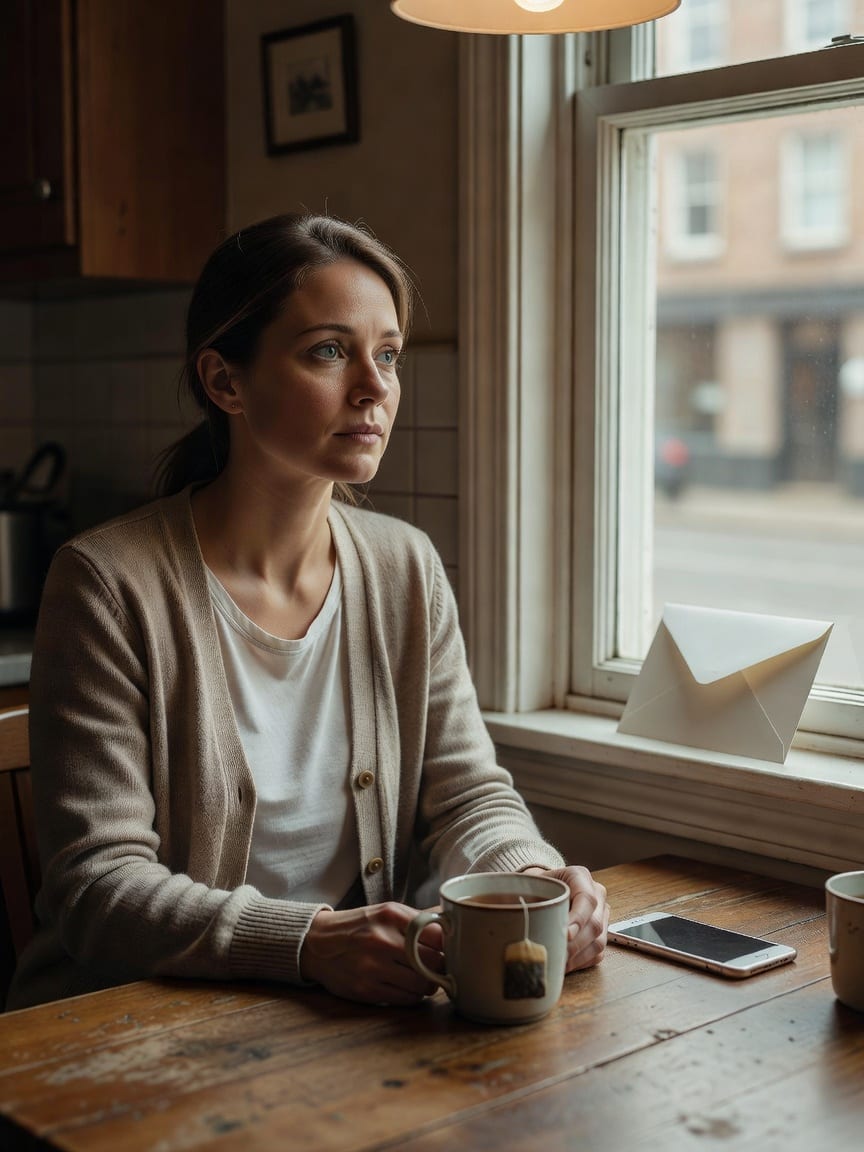
My taxi driver knew my name before I spoke, then apologized for the flight I was going to miss. I was arriving. The cab's plate was scrapped four years ago.
After a strange taxi ride, I received an unsettling birthday card addressed to me. Its return address listed 'Old Mill Road Field,' an empty lot where a mill once stood, and it was postmarked locally. The card arrived four months before my actual birthday, sparking a cold dread I couldn't ignore.
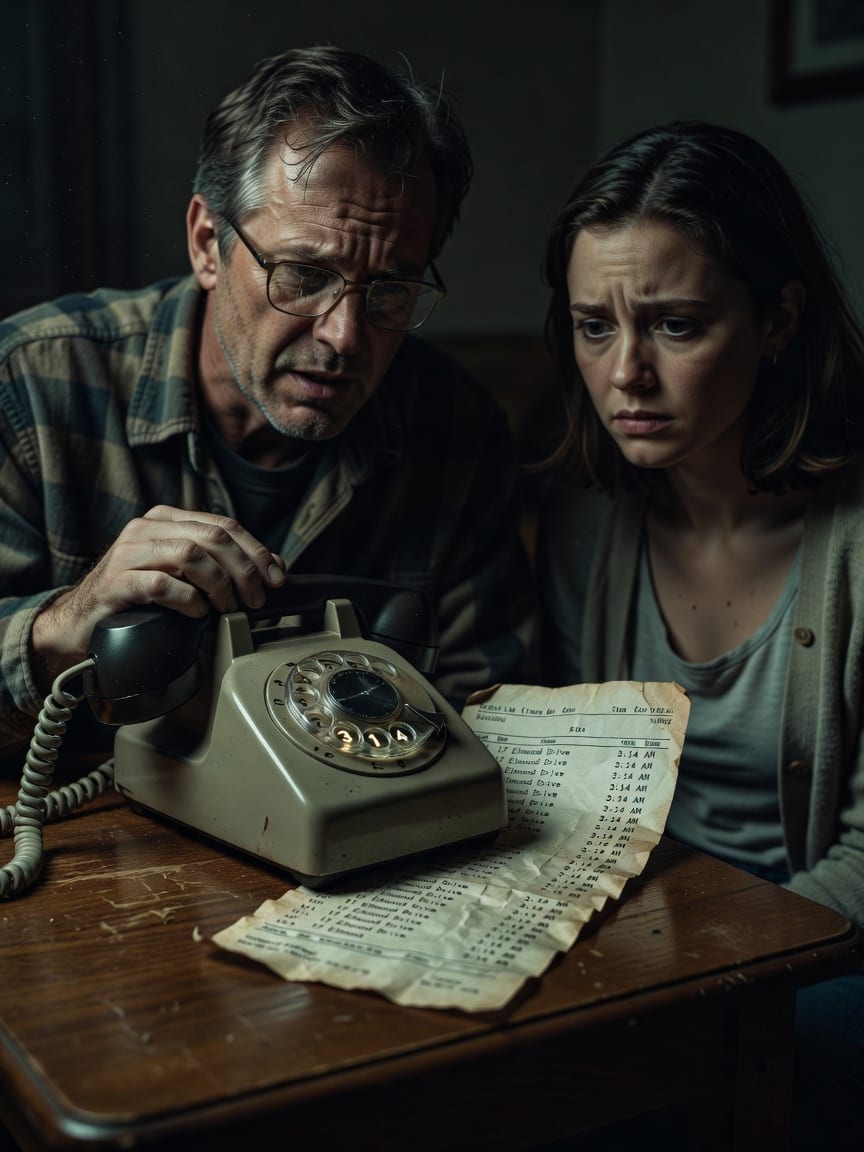
My phone bill itemised forty calls from my number to a house demolished in 1990. Each call at 3:14 AM, lasting eleven minutes. The bill arrived postmarked from a flattened building.
I expected the usual mobile bill, but my landline statement listed forty calls from my number to '17 Elmwood Drive.' That address was for a house torn down in 1990, a vacant lot I remembered from childhood. The phone company insisted the calls were legitimate, leaving me profoundly unsettled by the impossible charges.
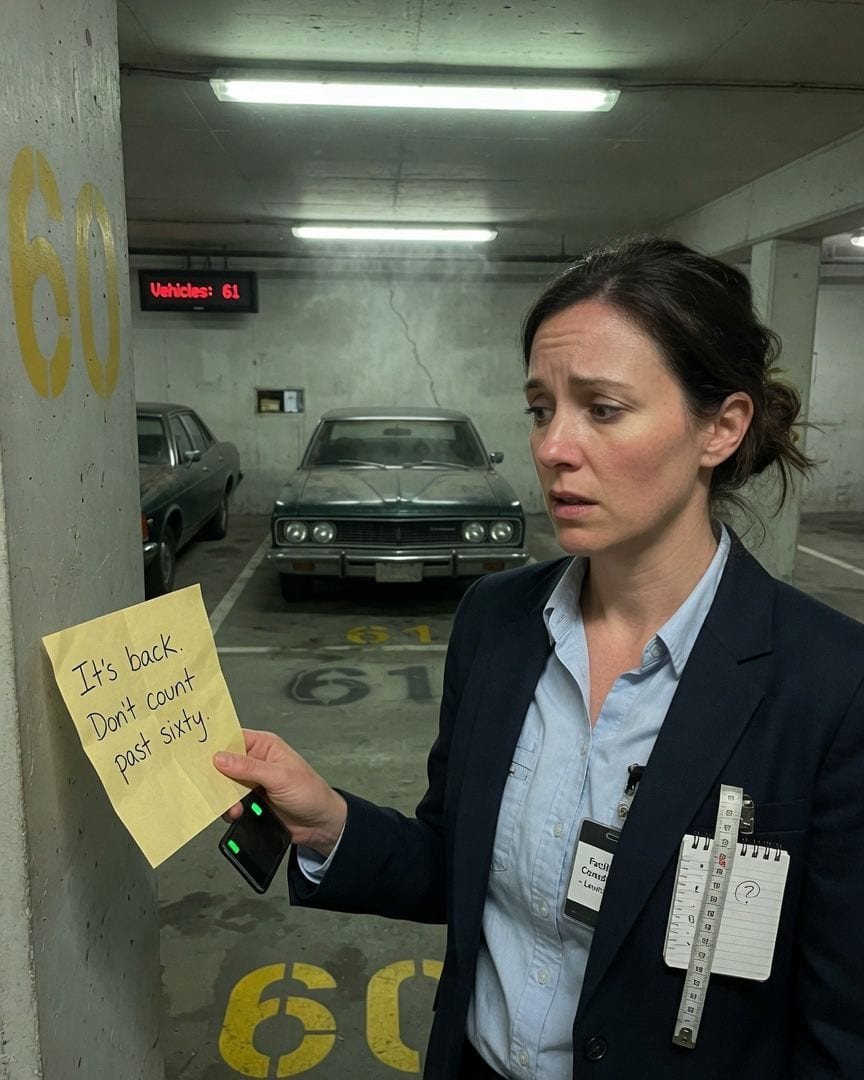
My hand found a hidden seam in the concrete wall. Inside, a desperate note warned: 'Don't count past sixty'.
I arrived at the underground parking lot a few minutes late, expecting the usual sixty spaces. But my pass blinked '61', and a new bay, numbered 61, had appeared beyond the lot's end wall. Inside it sat a vintage car, still warm from a recent drive. Every blueprint and log insists this space doesn't exist, yet it's undeniably there.
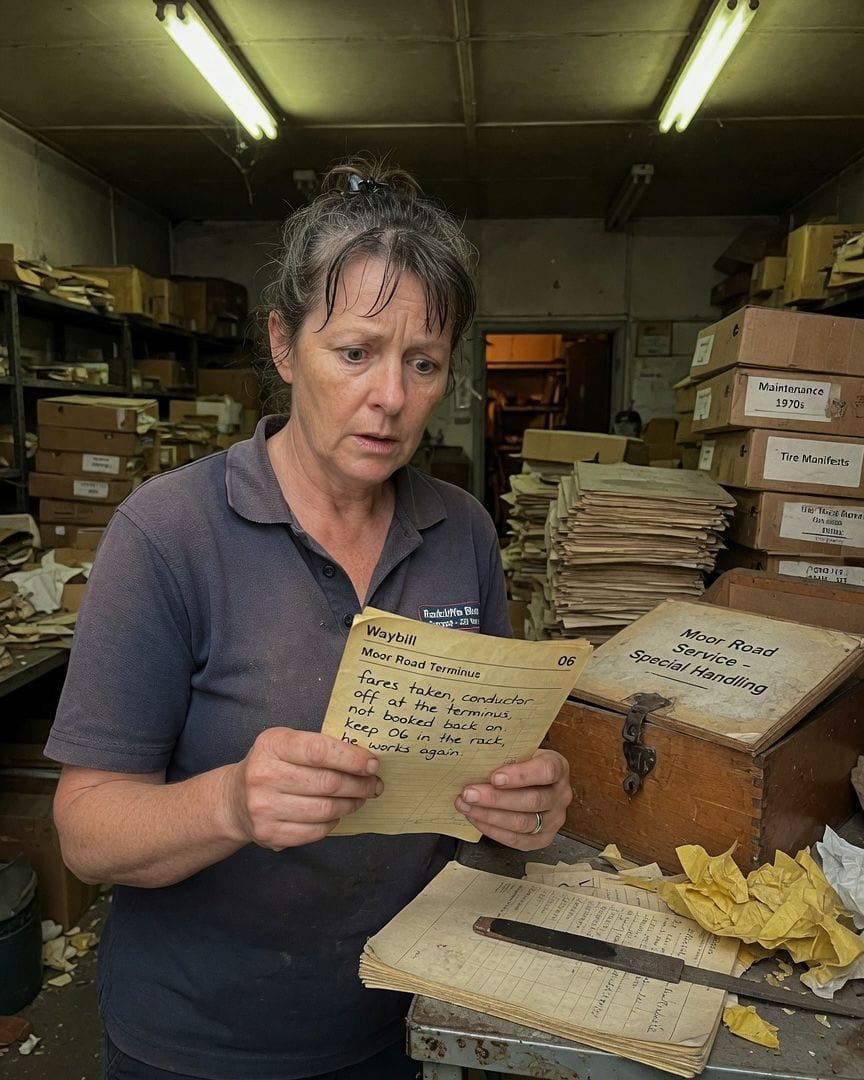
Our depot's Waybill 06 filed a moor road service we stopped running years ago. Every eight years since 1956, it closes: 'keep 06 in the rack, he works again.'
Sorting waybills in the depot, I stumbled across a form for the Moor Road Terminus. That route was decommissioned decades ago, but this waybill had a chilling handwritten instruction: 'keep 06 in the rack, he works again.'
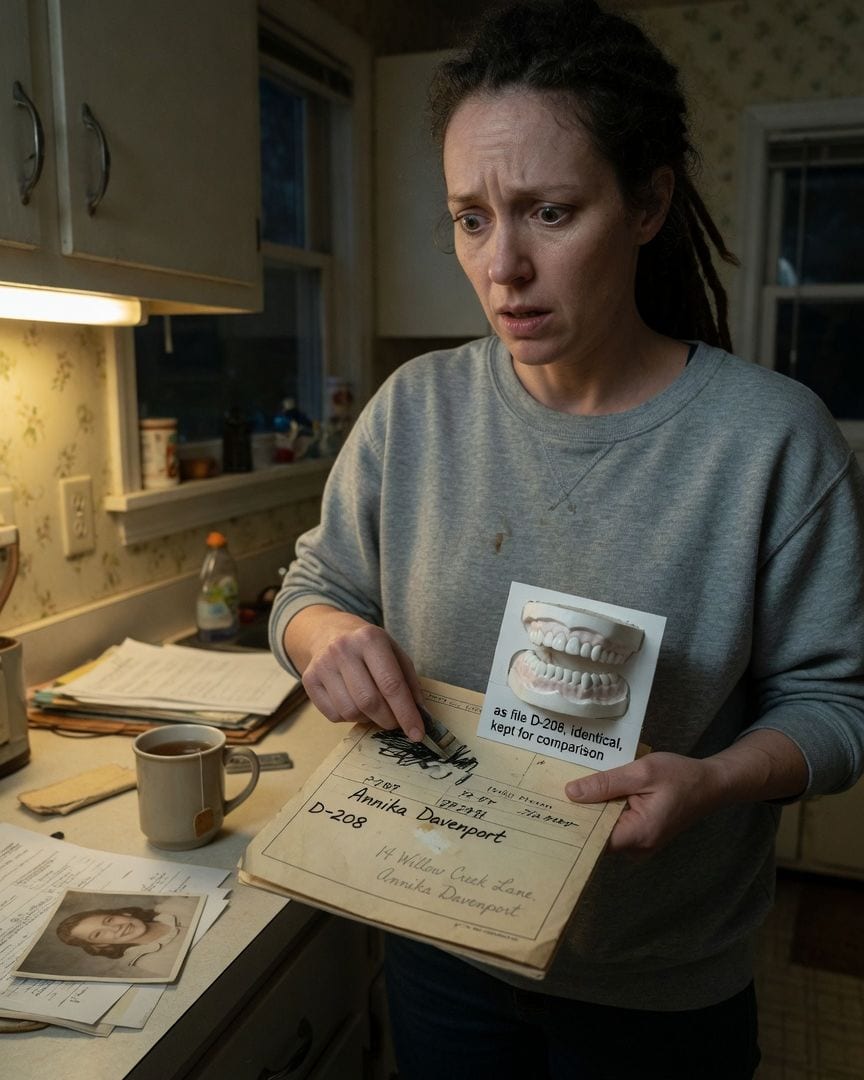
My childhood dental chart lists the house I bought last year — in my own name, years before I was born. A second set of my teeth sits filed beside it, marked 'identical.'
Sifting through old dental records, I found my chart, D-208, with my 1988 birth date. But a line from 1958 was blacked out, and a clipped card with an impression of my teeth listed my name and current home address, decades before I was born. The impossible facts knotted into a cold certainty.
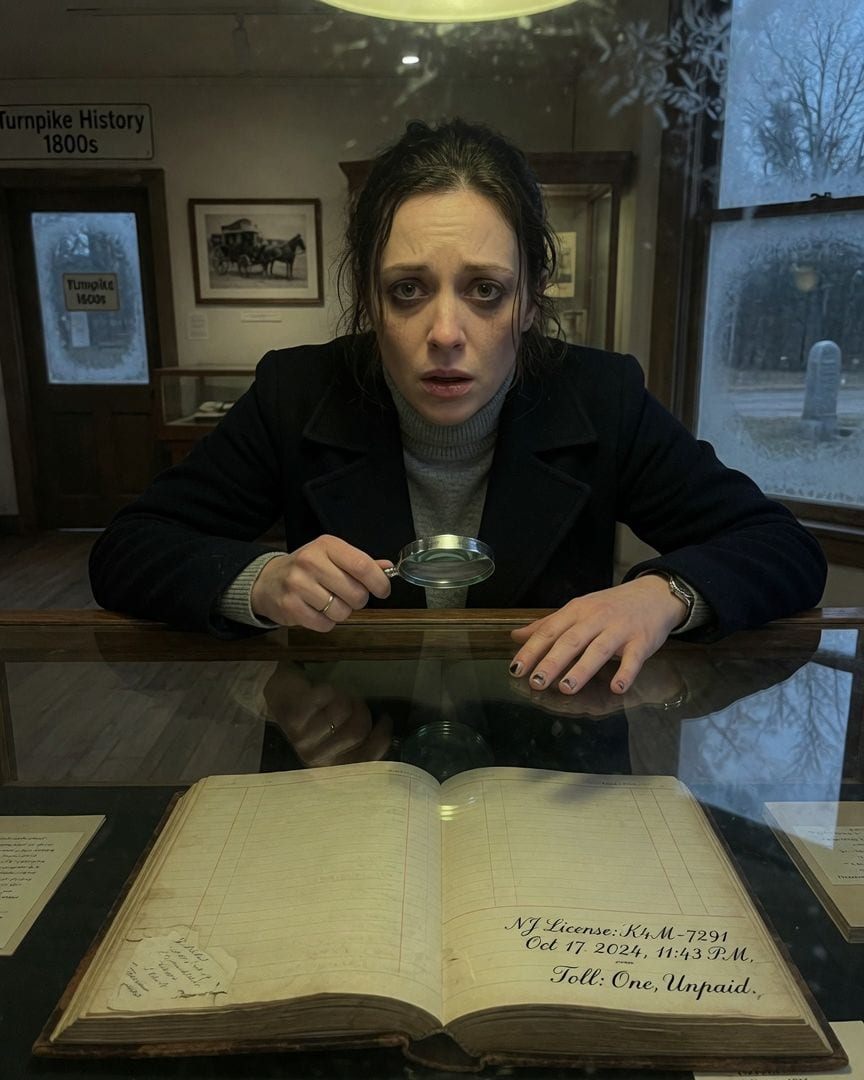
My car stalled at the old turnpike milestone, and the 1874 toll ledger now lists my plate, the date, and an unpaid toll.
My car stalled at an old turnpike milestone, exactly where the carrier had warned me never to stop after dark. The next week, at the local museum, I found a new entry in a century-old toll ledger. There, in fresh ink, were my car's registration, the exact date and hour I stalled, and 'Toll: One, Unpaid.' I knew it wasn't a joke.