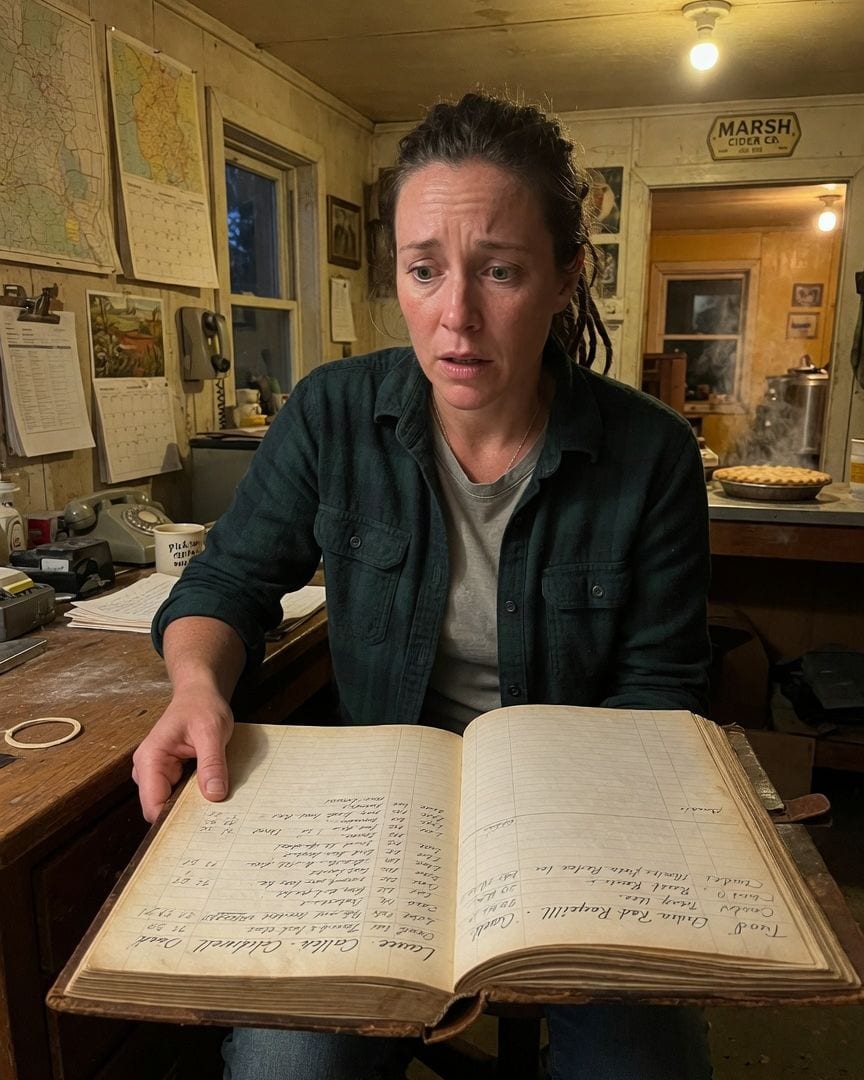
My orchard ledger already had my harvest, dated two weeks early, with one chilling word: 'owed.' The same book holds a name, 'Sylvia Radcliffe,' next to another 'owed' entry from 1987.
The smell of baked apples usually brought me comfort, a warm, sugary hug in the air. Tonight, it just felt heavy. I pulled the pie from the oven, its crust a perfect golden lattice, steam curling up like an invitation.
My first harvest pie from the new orchard, a small victory in this quiet, apple-obsessed town.
I’d spent all day picking, even reaching for the highest apples, a small, stubborn defiance against the hushed local lore of leaving a "birds' share."
Daniel Marsh, the elder cidermaker, had given me a polite but firm lecture about it when I first moved in, something about "old ways and respecting the land." I’d just smiled and nodded, thinking him charmingly old-fashioned.
He showed up at my cidery door just as the pie cooled, ostensibly to check on a fermenter, but his eyes kept drifting to the counter where the pie sat. He ran a hand over his chin, his gaze distant.
"That pie," he said, his voice softer than usual. "Smells good. Did you... leave the birds their share, Laura?" I laughed, a little too brightly. "Not a single one, Daniel!
I wanted to see what kind of pie I could make with the best of the best." He just nodded slowly, his eyes dark. "Some things," he murmured, "are best left to tradition. Saves trouble down the line."
He caught my eye, a fleeting look of something I couldn't quite place – regret? Sadness? – then shrugged. When I pressed him for more, he just shook his head. "Don't you worry your head over it, child.
Old man's ramblings." He steered the conversation to yeast strains, but the quiet intensity in his eyes left a faint, unsettling echo in my mind.
Later, with the pie still warm on the counter, I went to the cidery office, ready to log my harvest in the antique orchard ledger, a heavy, leather-bound book that looked like it held more secrets than apples.
I opened the ledger to the current year's entries, the brittle pages rustling. My finger traced down the page to where my name, Laura Caldwell, was already scrawled in the familiar, elegant script of Daniel Marsh. My hand stilled.
The row detailing the apples I’d picked was there, but it was dated a full fortnight before my actual harvest. I distinctly remembered the sweat on my brow just yesterday, the faint ache in my shoulders from the ladders.
And beside the precise weight I’d taken from the top branches—the 'best of the best'—in that same neat, distinctive hand, was a single, chilling word: 'owed.'
My heart hammered against my ribs. Owed? What was owed? And how could he have logged it two weeks ago? I found Daniel in the main pressing room, humming to himself amidst the rhythmic grind of machinery.
The ledger felt heavy and cold in my grasp. "Daniel," I said, my voice tight. "What is this?" I pushed the open page towards him. He glanced at it, then at me, his expression unreadable, almost placid.
"Ah, that," he said, taking the book from my hands without ceremony. "Just old ways, Laura. The ledger, you see, it runs on its own time, sometimes. Nothing to worry about. A quirk of the system."
He flipped the page, his movements deliberate, then quickly steered the conversation to the new press, asking if I'd properly oiled the gears, avoiding my gaze completely.
The casual dismissal, the lack of explanation, left a sour taste in my mouth, far worse than any faulty cider.
Unsatisfied by Daniel’s dismissive explanation, a cold prickle of unease spreading through me, I returned to the ledger later that evening after he’d gone home. The cidery was silent, save for the drip of condensation.
I flipped back through the brittle pages, searching for other anomalies. It couldn't just be my entry.
My breath caught as I found similar 'owed' entries, always for the highest apples, scattered across decades, some for small amounts, some for much larger. The dates were always slightly off, sometimes by days, sometimes weeks.
One particular entry from 1987 jumped out at me, standing stark against the faded ink of surrounding years. Beside the 'owed' notation, a name was scrawled in the exact same neat hand as mine, though slightly fainter: 'Sylvia Radcliffe.'
I remembered a hushed local story about Sylvia, a young woman who had 'left town suddenly' that year, never to return, her name only spoken in whispers. The page beneath my fingers felt impossibly cold.
Driven by a cold certainty that Sylvia’s disappearance wasn't just a coincidence, I began to research her. Town records from 1987 were frustratingly sparse, almost intentionally so.
I spent days hunched over a flickering microfiche reader at the small public library, dust motes dancing in the projector beam.
I found a few old newspaper snippets: a brief mention of a Sylvia Radcliffe's house being sold in a hasty "estate sale," but strangely, the accompanying inventory noted almost nothing was actually sold. Most items were simply "disposed of."
No forwarding address, no family contacted, just a blank space where a life used to be.
Ruth Pierce, the elderly librarian with a memory like a steel trap, sat crocheting quietly at her desk. She’d worked here since I was a child, she once told me. When I asked about Sylvia, Ruth’s needles stilled.
Her gaze became distant, laced with a peculiar, almost pre-scripted sadness. "Sylvia Radcliffe," she mused, her voice soft. "Lovely girl. Just… left town suddenly that year. Moved on to bigger things, I suppose. It happens."
She recited the phrase with a rehearsed, almost robotic quality, then quickly pivoted. "Are you finding what you need, dear? These old microfiches can be a bit of a rabbit hole. Some old stories are best left undisturbed, you know."
Her eyes, usually kind, held a fleeting, cautionary flicker.
Back at the cidery, I compiled a meticulous timeline of every 'owed' entry from the ledger.
A chilling pattern emerged: each 'owed' year, sometimes every ten years, sometimes fifteen, corresponded to a family either vanishing entirely from the public records or undergoing a profound, unexplained shift in circumstances.
Homes abandoned, businesses closed abruptly, people simply fading from local memory, often around harvest time. It wasn't just Sylvia. There were dozens of them.
As I delved deeper into the town's quiet history, a creeping sense of being observed began to settle over me.
It started subtly: a shadow in my peripheral vision when I was alone in the cidery, the faint impression of someone having just walked past my window. Then it became more concrete.
One morning, I found a small, hand-carved apple figurine, made of dark, ancient wood, placed precisely in the center of my kitchen counter. I knew for certain it wasn't there when I'd gone to bed. My skin prickled.
It felt like a message, though I couldn't say what.
Later that week, while working alone in the orchard, the air grew heavy, thick and still, as if the very trees were holding their breath. I was pruning an old branch, the snips making sharp reports in the unnatural quiet.
Daniel Marsh approached me silently, his footsteps muffled by the fallen leaves. I hadn't heard him coming. He didn't accuse, didn't threaten. Instead, his gaze held a profound, quiet pity that was somehow worse than anger.
"You're digging where you shouldn't, Laura," he said, his voice barely a whisper, carried on a gust of suddenly cold air. The wind chimes on the old farmhouse porch, usually silent, gave a sudden, jarring clang.
"Some debts are older than we are. And they always come due." He didn't wait for my response.
He simply turned and walked away, his back straight, leaving me with a prickle of fear on my skin and the small, smooth wooden apple feeling impossibly heavy in my pocket.
I returned to Ruth, the ledger and my compiled timeline clutched in my hands, the wooden apple a small, hard knot in my pocket. The library was empty, the quiet oppressive.
I laid out the evidence, the names, the dates, the chilling pattern of disappearances. Ruth’s composure finally cracked. Her hands, usually steady as she crocheted, trembled visibly.
She looked around the empty library, then back at me, her eyes wide with a desperate fear I hadn't seen before. "It's not a superstition, Laura," she whispered, her voice barely audible. "The 'birds' share'... it's a pact. An agreement."
She spoke of generations past, when a devastating blight had threatened the town's survival, leaving the orchards barren, the people facing starvation. An agreement was struck, she explained, with something tied to the very land, to the orchard itself.
The harvest would be spared, year after year, in exchange for the "highest fruit"—a symbolic offering from those who took from the land. A tribute.
"If the rule was broken," Ruth continued, her voice gaining a desperate urgency, "a 'debt' was incurred. And the payment..." She paused, her gaze locking with mine, "was a 'hollowing out.'"
She described it not as a violent death, but a quiet disappearance, or a profound, unnatural change in the person. Their very essence, their memories, their personality, slowly draining away, until they became... agreeable. Empty.
"The town," she concluded, her voice thick with the weight of centuries, "has quietly 'managed' this for generations. Ensured the pact is honored. Secured the harvest. Secured our own safety."
The horror wasn't malice, she insisted, but an ancient, impersonal agreement, a balance kept. I realized, with a sickening lurch, that the ledger wasn't just a record of apples. It was a record of these payments.
Ruth, her face pale and drawn, stood abruptly. "There's more," she whispered, her eyes darting towards the library's old oak floorboards. She knelt, her aged fingers fumbling, and found a loose section near the ancient hearth.
Beneath it, in a hidden compartment, she extracted a brittle, leather-bound town register, far older than the orchard ledger. Its pages, stiff and yellowed, were filled with names and strange, cryptic symbols, spanning centuries.
This, she explained, was the true record.
She traced a finger down the long list of names, each marked with a symbol that matched the 'owed' entries in the picking ledger. A chilling testament to the cyclical nature of the pact.
Her finger stopped at an entry from 1955. Beside the 'owed' mark, in faded, elegant script, was a name. My breath hitched. It read: 'Daniel Marsh.'
I looked up at Ruth, her face a mask of grief and fear, then back at the name, a cold dread seizing me as the horrifying truth of Daniel's deeper, personal connection to the 'debt' and its cyclical, inescapable nature clicked into place.
I found Daniel Marsh under the gnarled branches of the oldest apple tree, its bark like an ancient, scarred face. He was staring at the highest, skeletal branches reaching towards the darkening sky.
He didn't seem surprised to see me, or by the wild accusation in my eyes. He did not deny it. His face was etched with a lifetime of quiet sorrow, his composure unsettlingly calm.
"It wasn't me, Laura," he said, his voice flat, devoid of emotion. "Not my name, not directly. That was my father." He ran a calloused hand over the rough bark. "He broke the rule too.
Thought he could get away with it. Young, proud. Said the birds got enough anyway." Daniel, then a young boy, had witnessed his father's slow "fading"—not a death in the usual sense, but a gradual emptying.
"His memories," Daniel recalled, his voice barely a whisper, "his laughter, his temper... his very personality. Slowly siphoned away until only an agreeable, blank husk remained. Then, just a few years later, his body gave out."
Daniel took on the role of 'keeper' after that. He meticulously logged the debts, ensuring no one else had to watch their loved ones disappear piece by piece.
"The entity," he explained, gesturing vaguely towards the deepest part of the orchard, "isn't evil. It's merely ancient. It adheres strictly to the terms of the pact. A balance.
You take the highest fruit, you owe a different kind of harvest." He looked at me, his eyes full of that same quiet pity. "Your 'owed' entry means you are now the designated payer.
The apple figurine you found," he said, pulling an identical, small, dark wooden apple from his pocket, "is a 'marker.' It signifies the start of the process."
My voice was thick with horror. "There has to be an escape," I pleaded, the words raw in my throat. "A way to reverse it!" Daniel shook his head, his eyes full of resignation.
"There is no escape from this debt, Laura. It is noted, and the process has begun."
He gestured again to the oldest apple tree, its highest, skeletal branches reaching towards the darkening sky, silhouetted against the bruised purple of the coming night.
"The hollowing is gradual," he explained, "starting with small memories, then feelings, until nothing is left but an agreeable husk." He held up the withered apple in his hand, a twin to the one in my pocket.
"This is the marker. It's already begun, Laura. You just haven't noticed yet."
A strange, quiet calm started to settle over me then, pushing back against my panic. It felt like a warm blanket, a gentle reassurance.
I tried to remember my life before the orchard, my reasons for moving here, my old friends, my old job, but the details felt hazy, distant, like someone else’s story.
A faint, pleasant emptiness began to bloom in my chest, easing the tight knot of fear.
I attempted to pack my belongings later that evening, a vague notion of leaving town flickering at the edges of my mind.
My old photo albums, my favorite books, the clothes I wore for interviews – each item I placed in a box felt less important, my reasons for departure less clear.
The urgency, the fear, were fading, replaced by a soft, insistent pull back to the quiet solitude of the orchard, the rhythmic, comforting hum of the cidery. I found myself unpacking, setting things back in their place.
My memories of my life before this place began to blur, becoming indistinct, replaced by a soft, growing contentment. The apple pie I’d baked from the highest apples, now forgotten, sat molding on the counter.
Days later, Daniel Marsh walked through the orchard, checking the trees, his practiced eye noting the ripening fruit. He saw Laura, pruning a branch near the northern edge, a faint, placid smile on her face.
She hummed a tune he hadn’t heard in years, an old local folk song about the harvest. He approached her, his footsteps quiet on the damp earth. "Laura," he said, his voice gentle. "Are you enjoying the quiet?"
She turned, her eyes clear but strangely distant, and nodded. "Yes, Daniel," she replied, her voice soft and even. "It's quite peaceful here. Nothing to worry about at all."
Later that week, a new entry appeared in the orchard's picking ledger, in a neat, unfamiliar hand, beside the column for the highest apples. It simply read: 'Paid in full.'
If this one got to you
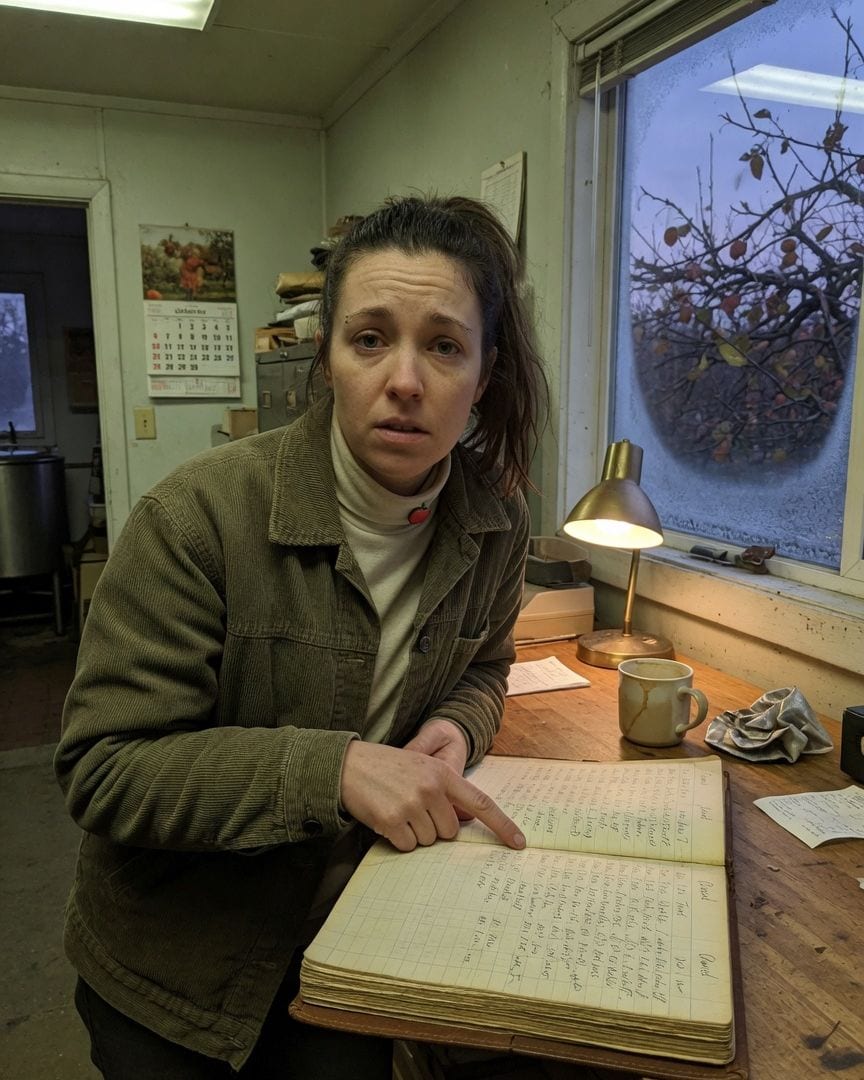
My orchard's picking ledger listed my apples two weeks early, showing the exact weight I took and, beside it, 'owed'.
Seeking quiet, I settled into a cottage by Felix Carver's apple orchard, dismissing his traditions about leaving 'the birds' share' apples. After I picked them, I found his old ledger. There, my exact apple weight was marked "Owed" in stark, new ink, dated a fortnight before I'd even touched the trees.
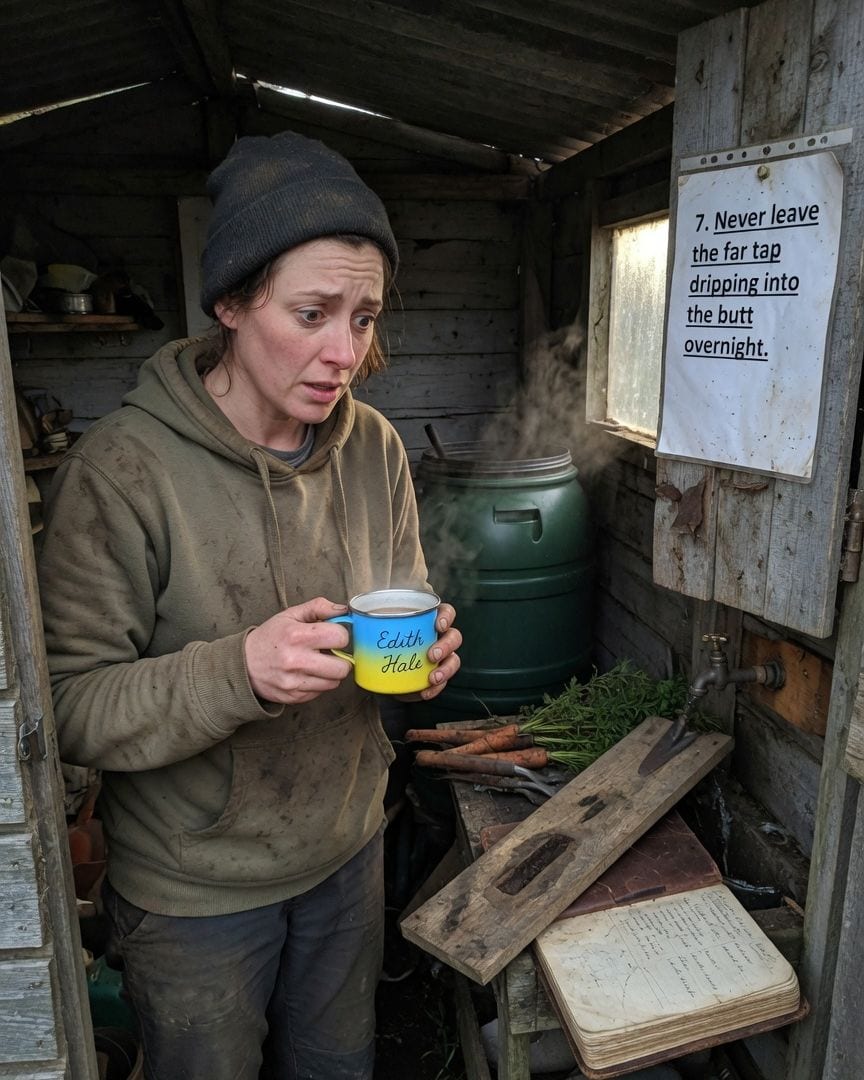
The one night I left the tap dripping, my allotment water butt was full to the brim and warm to the touch — with a child's unrusted tin cup floating on top.
Moving to Blackwood, I hoped my allotment would be a fresh start. But the shed's rulebook warned, 'Never leave the far tap dripping.' One morning, my water butt was full and steaming, an unnerving warmth rising from it. Inside, a child's tin cup floated, unrusted, etched with the name 'Edith Hale'.
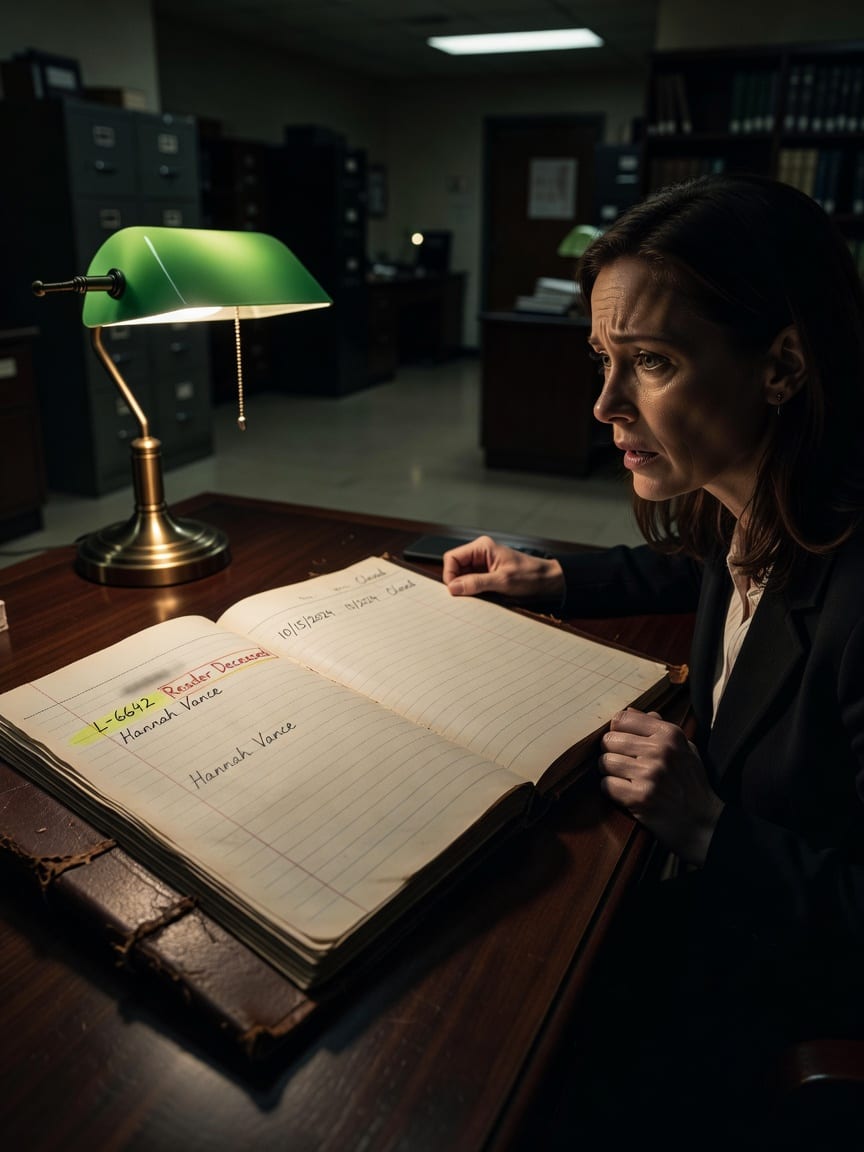
My library card number L-6642 was issued to me at seven — and the ledger shows that number has marked a reader 'deceased' every twelve years since 1949.
Returning my late father's library card to the old town library felt like a small act of closure. But the senior librarian's ancient ledger revealed a chilling pattern of 'reader deceased' entries tied to specific card numbers and borrowed books. My unease turned to cold dread when I secretly found my own name penciled in, marked for a future 'reader deceased' entry.
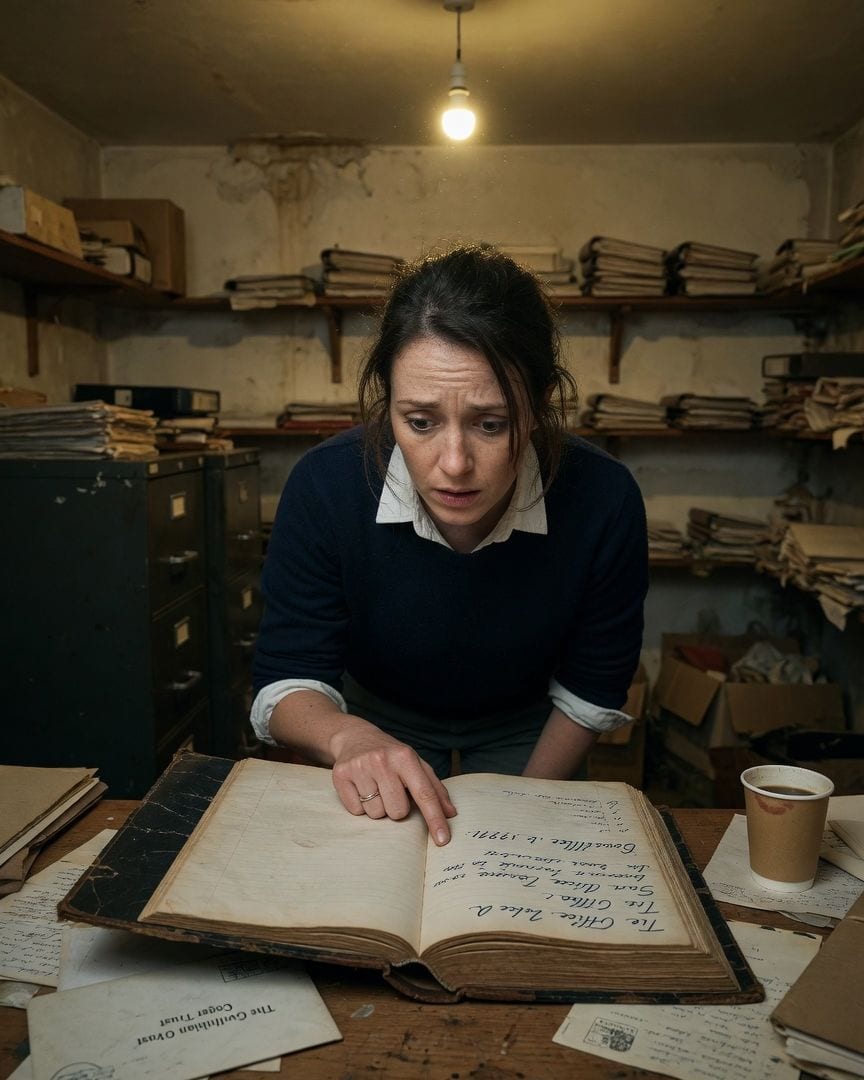
A charity thanked me for a donation 'in loving memory of' my own name. The letter posted from an office lost to the sea decades ago.
A letter arrived, thanking me for a 'generous donation' made in my own loving memory. When I pressed the charity for answers, their historical ledger confirmed the impossible: an entry for Sarah Bishop, born 1991, recorded in 1988. Three years before I was even born.
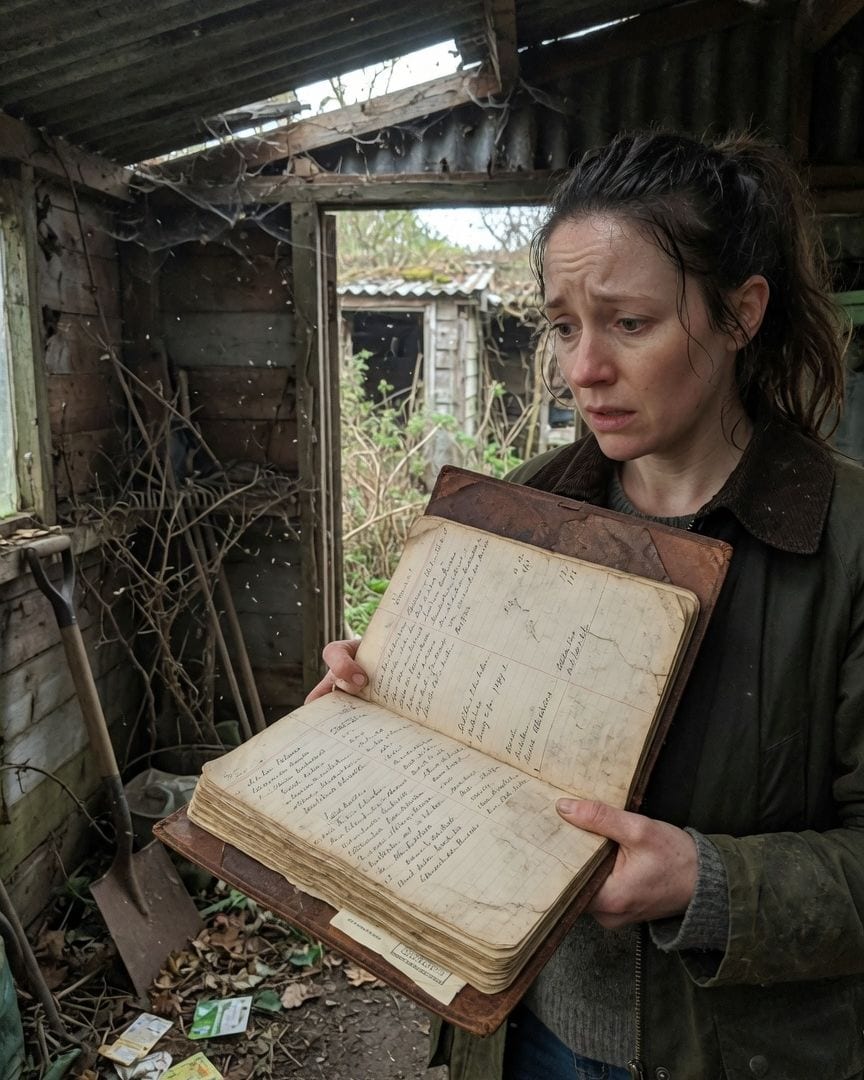
My mailbox holds my own obituary, updated weekly. The postmark reads Cold Ashby allotments, where there's only a standpipe and sheds.
Every Wednesday, a crisp white envelope arrives, containing my own obituary. It's mailed from the desolate Cold Ashby Allotments, a place with no post office, and each week a new, accurate detail of my life is added, leaving only the death date chillingly blank.
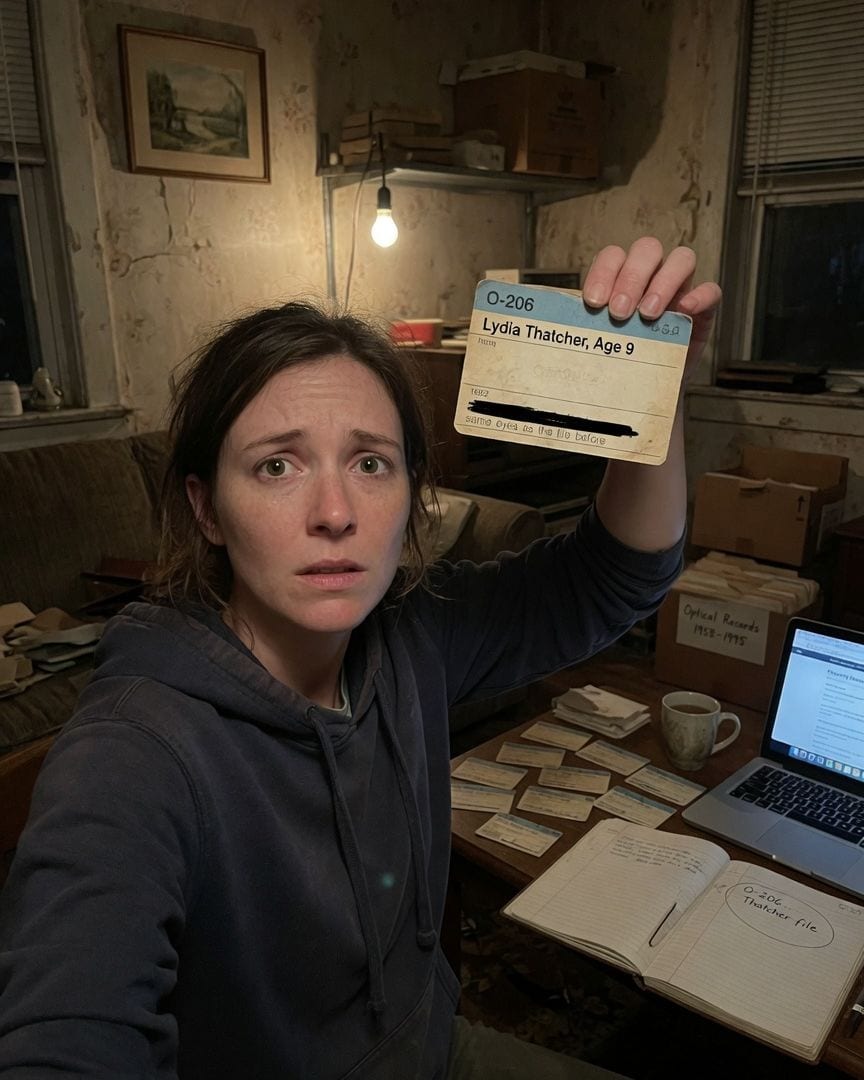
My own optical card is dated 1962, with my name on it. I wasn't born until 1993.
Sifting through old patient files from my former optical practice, I found my own O-206 card. It had my name, Lydia Thatcher, and my current home address printed on it. But the card was dated 1962, decades before I was even born, and a redacted note mentioned 'same eyes.'