My own handwriting logs watering Zone 8 at 3:21 AM. Zone 8 has been sealed for fumigation for weeks, nothing growing.
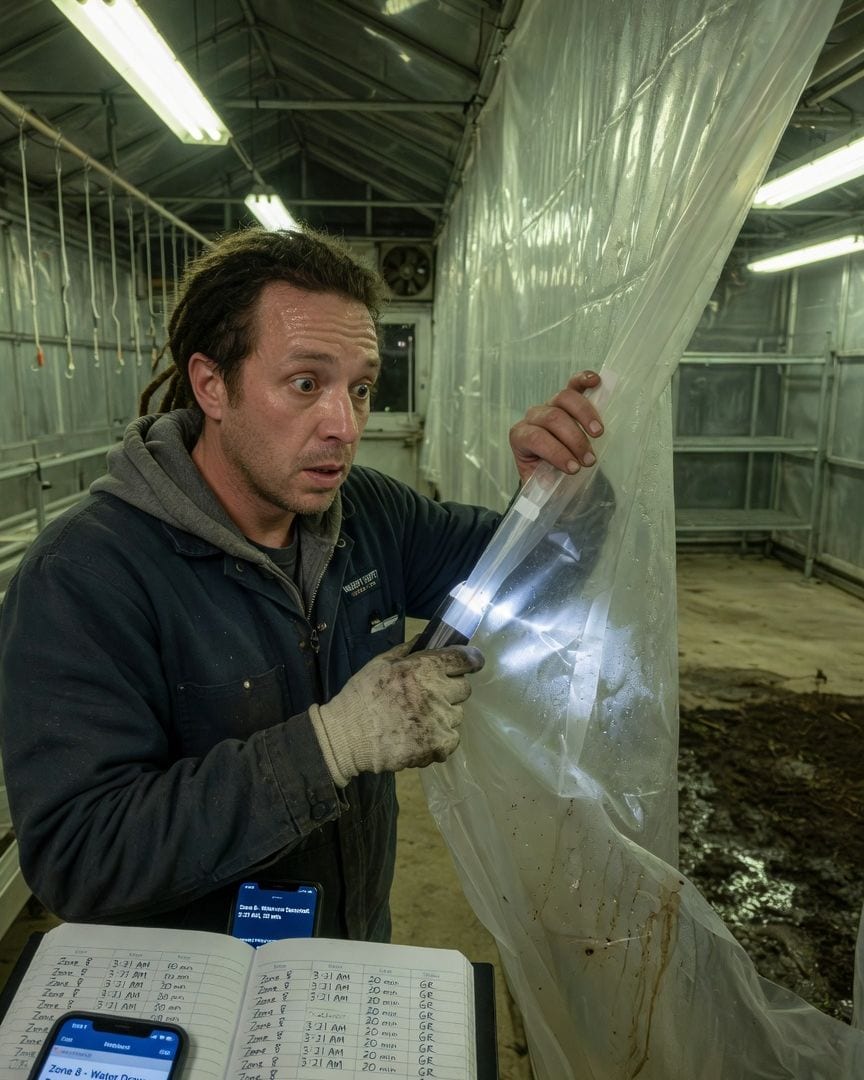
The fluorescent hum of the commercial greenhouse was my constant companion on the overnight watch. Every hour, I walked the humid aisles, checking temperatures, ventilation, and the drip lines. It was a methodical, predictable job, exactly what I needed.
My last task before my 6 AM out-shift was the logbook. Zone by zone, I noted water cycles, initialed the entries, and marked the time. Tonight, my pen hovered over line 27.
It read: 'Zone 8, 3:21 AM, 20 min, GR.' I stared at it. I hadn't watered Zone 8. It was impossible.
Zone 8 had been cleared for fumigation three weeks ago, sealed under heavy plastic sheeting, a sterile sarcophagus where nothing grew. There were no plants, no active systems. It was empty. I lived alone, worked alone.
The entry sat there, undeniably, in my own looping hand, nestled between two zones I distinctly remembered cycling myself. The ink was dry, indistinguishable from the rest. I flipped back through the pages, a cold knot tightening in my stomach.
Every night for the past week, at precisely 3:21 AM, the same entry: 'Zone 8, 20 min, GR.' My initials. My handwriting. A phantom shift.
Heart thudding, I pulled out my phone. The greenhouse had a smart metering system, logging water draw by zone with pinpoint accuracy. I navigated to the Zone 8 records.
The screen glowed back at me: 3:21 AM, water flow detected, 20 minutes duration. It wasn't a mistake in the logbook. The system confirmed it. A physical event had occurred.
I walked quickly to Zone 8, the heavy plastic sheeting gleaming under my flashlight beam, reflecting my own tense face back at me. Every seam was taped, every edge tucked tight.
There were no rips, no tears, no evidence of anyone entering or leaving. I pressed my ear to the thick plastic. The usual drone of the ventilation system was all I heard. No sloshing, no dripping.
But a faint, earthy smell, like turned soil after a long rain, seemed to cling to the plastic, out of place in the sterile, sealed environment. It was too specific, too real to be a prank.
Who would risk a fumigation breach, just to log a phantom watering? And how? The water meter had registered a draw, a definite, physical event. But the log entry, in my own hand, was the real punch to the gut.
I tried to rationalize it – a system glitch, a delayed entry from before the fumigation, but the 3:21 AM timestamp was consistent, occurring only on my shifts.
My rational mind spun, trying to force a mundane explanation, but each attempt failed, leaving a hollow space of impossible fact. I ran a hand over the smooth plastic, the faint smell clinging to my glove. Something was wrong.
Deeply, impossibly wrong.
The next night, the 3:21 AM entry appeared again. I couldn't take it. Armed with a utility knife, my heart racing, I made a small, precise incision in the plastic sheeting, near the base, just large enough to peer through.
I shone my flashlight inside. The rows of empty shelves, the bare concrete floor, all as expected.
But in the far corner, where a drainage grate usually sat, a patch of earth was inexplicably damp and disturbed, as if recently tilled. And then, I heard it.
A low, wet thrum, barely audible, vibrating faintly beneath the soil, a sound that shouldn't exist in a fumigated, empty space. My gloved hand froze, hovering inches above the dark, glistening patch.
The thrum grew, a slow, rhythmic pulse against the silence, a quiet, insistent heartbeat where none should be.
I sealed the cut plastic with industrial tape, my mind reeling. The thrumming had been undeniable.
The next few nights, I couldn't bring myself to cut into Zone 8 again, but I started checking the water meter logs with obsessive detail, not just for my own shift, but for the day shifts too. Nothing.
The 3:21 AM Zone 8 watering only occurred when I was on duty. I began arriving early, hiding a small, motion-activated camera on a shelf overlooking Zone 8, hoping to catch a stray animal, a prankster, anything.
The camera footage was useless. It showed nothing entering or leaving the zone.
Yet, the water meter logs continued, precisely at 3:21 AM on my shifts, and the patch of damp, disturbed earth inside Zone 8 grew subtly larger each morning I checked, the thrumming slightly more pronounced.
It was as if the water was being drawn, not to something, but by something, from within the sealed space itself.
Driven by a desperate need for a rational explanation, I began sifting through dusty archive boxes in the foreman's office, looking for old maintenance logs, anything that might explain a hidden system or a historical anomaly.
I found decades of records, meticulous, hand-written entries for every zone. The older logbooks, bound in worn leather, were a treasure trove of the greenhouse's past.
I scanned them, shift by shift, year by year, looking for any mention of peculiar water draws or sealed zones. Nothing explicit, but a growing unease settled over me.
The consistency of the 3:21 AM entry, only on my shifts, implied a targeted, specific action. It wasn't random. It was a schedule. And it was using me. The thought sent a fresh wave of dread through me.
How could something know my schedule?
Oscar Sutton, the day shift foreman, was a quiet man, always impeccably dressed, even in the humid greenhouse. He’d worked here for decades, following his own father into the role.
One morning, as I was finishing my shift, Oscar approached me, a faint, unreadable smile on his face. “Greta,” he began, his voice calm, “I’ve noticed you’ve taken quite an interest in the old logbooks lately. And Zone 8.”
He gestured vaguely towards the sealed area. My breath caught in my throat. I hadn't thought anyone noticed my late-night research or my furtive peeks into the fumigated zone.
“Just… curious about the history,” I stammered, trying to sound casual, my heart pounding. Oscar chuckled, a dry, rustling sound. “The history of Zone 8 is… particular. Some things are best left to their own devices, wouldn’t you say?”
His eyes, usually placid, held a flicker of something knowing, something that made me feel exposed. “There are old stories,” he continued, his gaze drifting towards the plastic sheeting, “about the things that keep this place green.
Not all of them are plants.” He paused, letting the implication hang in the air, then clapped me lightly on the shoulder. “Just make sure you’re logging everything correctly, Greta. We wouldn’t want any… misunderstandings.”
He walked away, leaving me chilled to the bone. He knew. He knew I was digging, and he knew exactly what I was digging for. His calm wasn't reassuring; it was terrifying.
It was the calm of someone who already understood everything I was only just beginning to grasp.
I couldn't let it go. The next day, I found Oscar in his office, poring over invoices. I marched in, the old logbook I'd found earlier clutched in my hand, open to one of the impossible 3:21 AM entries.
“Oscar,” I said, my voice tight, “I need to know. What is happening in Zone 8?” Oscar looked up, his expression unperturbed. “Ah, Greta. Still curious. I thought my little hint might suffice.” “Hint?”
I practically shouted, though my voice remained low, rational. “My handwriting is in this book, logging water for a sealed zone, and your system confirms it! There's a… a thing in there, humming!”
Oscar leaned back in his chair, a faint sigh escaping his lips. “You found the hum. Good. It means it’s still… dormant.” He didn’t deny it. He just accepted it. “Dormant?” I pressed. “What is it?”
“It’s… an old tenant,” Oscar said, his eyes distant. “Found decades ago, when they first broke ground for this section. Not a plant, no. Something else. Something that needs water, but not light. Not air, not exactly.”
He picked up a worn, leather-bound journal from his desk, identical to the one I held. “My father, Franklin, he was the night foreman before me. He found it. Or rather, it found him. Or its needs found him.”
He tapped the cover. “This was his log. He started the… tradition.” I felt a cold wave wash over me. “Tradition? You mean… you knew? Your father knew?” Oscar nodded slowly. “It’s not malicious, Greta. Just… present.
It needs its water to stay quiet. To stay contained. It never moves. It just… draws. And it needs its presence acknowledged. The log entries, they’re its way of ensuring its needs are met. It learned the routine.
It learned the language.” He looked at the logbook in my hand. “It learned your handwriting.” The earlier clues clicked into place with horrifying clarity: the precise timing, the consistent signature, the water drawn but nothing visibly disturbed.
It wasn't a prank, or a glitch. It was a communication. A demand. And it had been going on for generations.
I stared at Oscar, the implications of his calm confession sinking in like lead. “So, all these years… people have just been… watering it?” Oscar nodded. “It’s a duty. A quiet one. Keeps the peace.”
He then picked up the ancient, leather-bound logbook he’d been holding, its pages brittle with age. He opened it, not to a random page, but to an entry dated precisely sixty-two years ago. 'Zone 8, 3:21 AM, 20 min, FS.'
Franklin Sutton's initials. His own father's signature. The handwriting, though different in style, was rendered with the same uncanny precision as my own entries, mimicking the hand of the current night foreman.
“My father said it was always very particular,” Oscar continued, pushing the heavy book across the desk towards me, its faded pages whispering a name that wasn't mine, but could be. “It’s always known who’s on shift, Greta.
And now, it knows you.” He looked at me, his expression utterly devoid of malice, or even fear. Just a quiet, unnerving acceptance.
“Welcome to the family business,” he said, his voice soft, and the weight of decades of silent duty settled onto my shoulders, heavy and cold.
I picked up Franklin Sutton’s logbook, tracing the familiar-yet-alien initials. Oscar explained it all, not as a story, but as a tedious, necessary fact. “When they put in the deep foundations for this section in the 1960s, they hit something.
Not rock. Not earth. Something… organic, but inert. It reacted to water. Small amounts, regularly, kept it quiet. Too little, and it would… stir. Too much, and it would grow.”
He pointed to a faint, almost invisible watermark on one of Franklin’s entries. “My father discovered it could influence the mind, subtly. It nudged him to log the water, to ensure its needs were met.
Over time, it refined its method, learned to mimic the current foreman’s hand, to make the record undeniable. It has no ill will, Greta. It simply exists, and it requires its maintenance.
It’s part of the greenhouse now, an unseen root.”
He detailed how Franklin had passed the 'duty' to him, not with a grand reveal, but with a quiet, almost casual explanation of Zone 8’s 'peculiarities' and the importance of its log entries.
The pattern across dates and names became horribly clear: a generational chain of silent keepers, ensuring the dormancy of a thing that predated the greenhouse itself.
Every oddity, every impossible entry, every faint thrum, every water draw, every unshakeable feeling of being watched, now clicked into a coherent, terrifying whole.
The horror wasn't a monster, but a fact: an ancient, unmovable presence, silently demanding its due, woven into the very fabric of our ordinary lives, and we were its unwitting, unwilling caretakers.
I looked from Oscar to the logbook, then back to Oscar. “You’re telling me,” I said, my voice flat, “that we’re just… its gardeners? For something that’s not a plant, that writes in our books?” Oscar nodded.
“It’s how we keep it quiet. It’s been here longer than any of us. Longer than this greenhouse. It’s not going anywhere.” I felt a sudden, crushing weight. There was no escape. No exposé. Who would believe me?
A night shift worker claiming a sentient, log-writing entity lived under Zone 8? I would be laughed out of the job, perhaps institutionalized. The full truth was understood, and it could not be undone.
It couldn't even be acted on, beyond this quiet, horrifying maintenance. “What happens if we… don’t?” I asked, my voice barely a whisper. Oscar’s face tightened for the first time. “My father tried that, once.
Thought he could starve it out. The water meter for Zone 8, it started running constantly, overflowing the pipes. The ground outside Zone 8 started to crack, and a strange, thick vapor began to leak out.
Plants in nearby zones withered overnight. He logged the watering again. It stopped.” He looked at me, his eyes conveying the gravity of the unspoken threat. “It’s not a fight you can win, Greta. It’s a balance you maintain.”
He slid my own logbook back across the desk, open to the next blank line. “Your shift starts in twenty minutes.” The choice wasn't a choice. It was an inheritance. I picked up my pen.
The dread wasn't in the unknown anymore, but in the knowing.
The knowing that I was now bound to this silent, impossible duty, another link in a chain stretching back decades, tending to a thing that lived beneath the earth, writing its needs into my own life.
I looked at the blank line, ready to sign my name, ready to become another witness who always knew.
I continued my night shifts. The 3:21 AM entries for Zone 8 appeared with unwavering regularity, my handwriting on the page, indistinguishable from my other entries. I no longer questioned them, merely acknowledged them.
The water meter for Zone 8 still registered its precise 20-minute draw. Oscar never mentioned it again, his quiet acknowledgement enough. The faint thrum from Zone 8 was now a familiar, if unsettling, part of the greenhouse's nocturnal symphony.
Sometimes, I would catch myself staring at my own initials in the logbook, wondering how much of the 'G.R.' was truly mine, and how much was the quiet, insistent will of the thing beneath the plastic, a silent, unseen partner in my lonely vigil.
The seasons turned. The greenhouse continued its cycle of growth and harvest. Greta Radcliffe, the night watch, remained. Her pen still tracked the zones, her initials still filled the lines.
And every night, without fail, the entry for Zone 8 would appear, 3:21 AM, 20 minutes, G.R.
Sometimes, I thought I felt a faint, almost imperceptible pressure on my hand as I wrote, a subtle guidance in the curve of a letter. I never mentioned it. Oscar never asked. The silence was part of the understanding.
The balance was maintained. I just signed the next line, ready for whatever 3:21 AM might bring. The ink was still wet, and the handwriting was almost perfectly mine, again.
If this one got to you
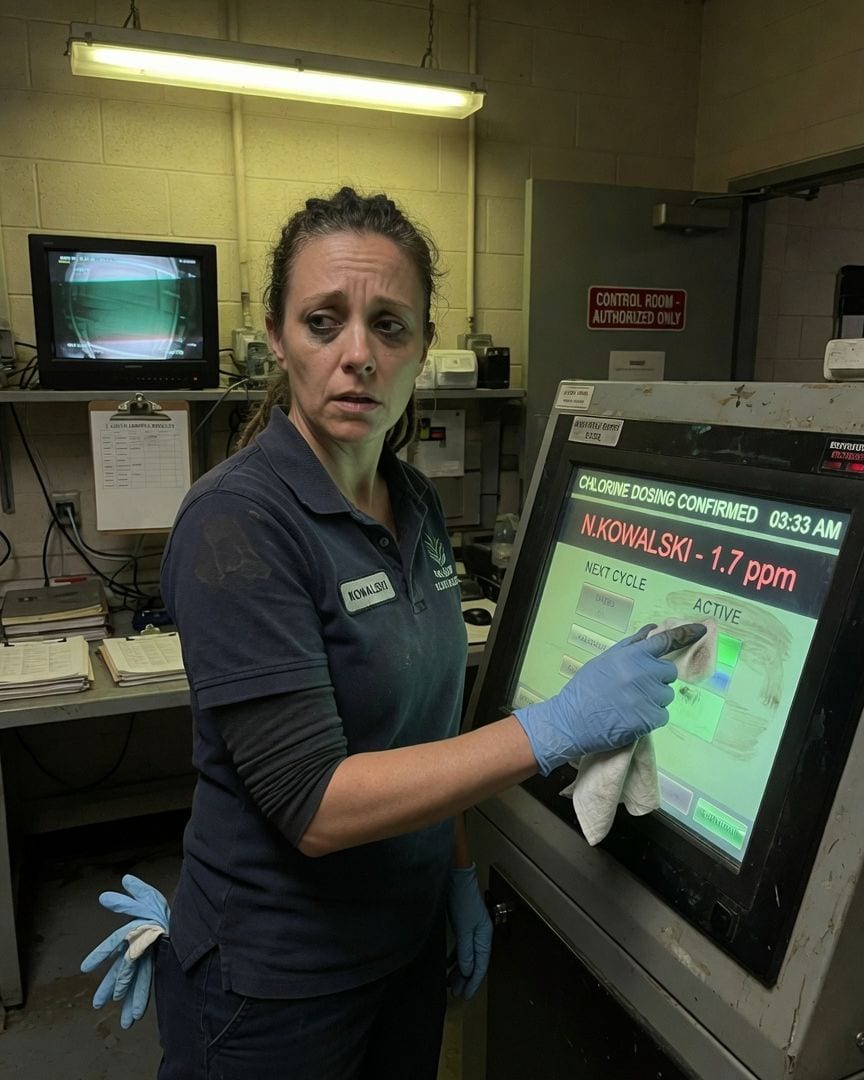
My plant's night log signed a chlorine dose I never took; the panel was two rooms away, and I was in the lab.
After logging samples in the lab, I returned to the water treatment plant's control room to find my operator ID had confirmed a chlorine dose I never made. The system claimed I was the active user. But on the 'confirm' button, a faint, elongated fingerprint appeared – a print subtly wrong and absolutely not mine.
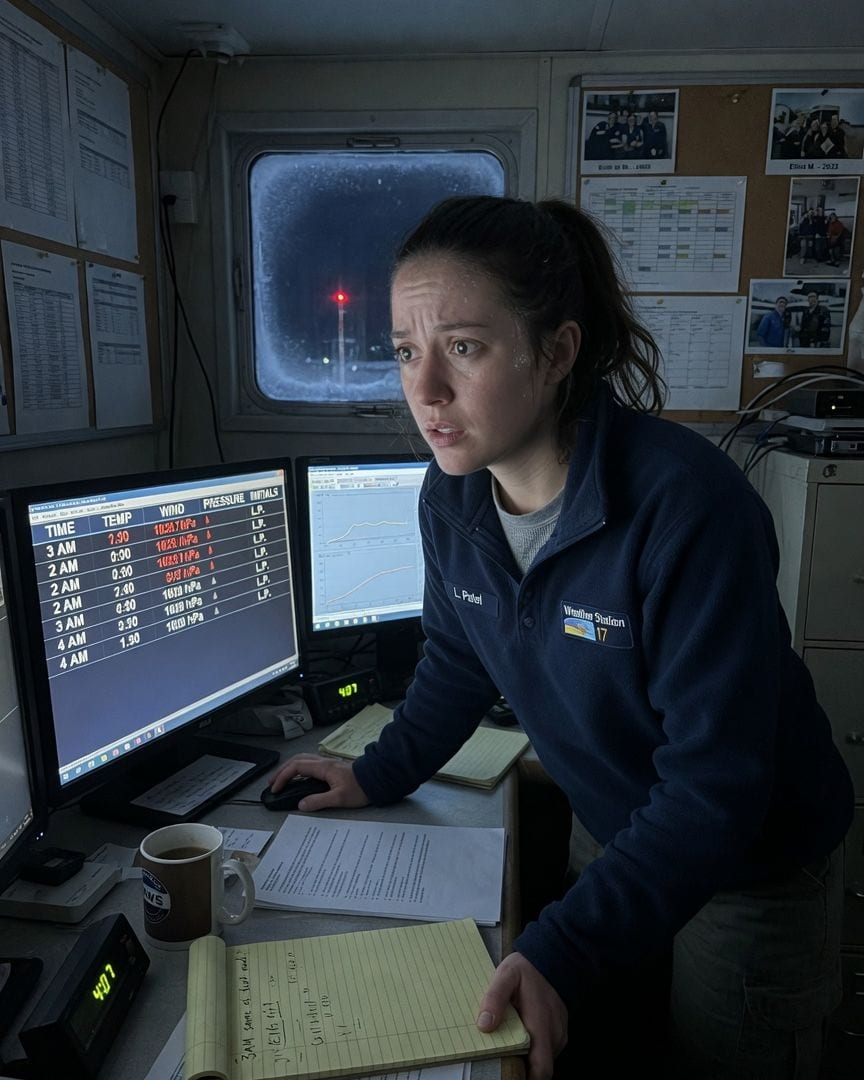
My weather station's 3 AM log shows a pressure reading I never made. My initials are on it, but the dials were dead still.
Working the overnight shift at the remote weather station, I routinely checked the digital logs. The 3 AM entry showed an impossible barometric pressure spike, a hurricane that simply hadn't happened. I distinctly remembered being outside at that time, calibrating a sensor, not making that entry. Yet, my initials, L.P., were clearly logged next to data I never made.
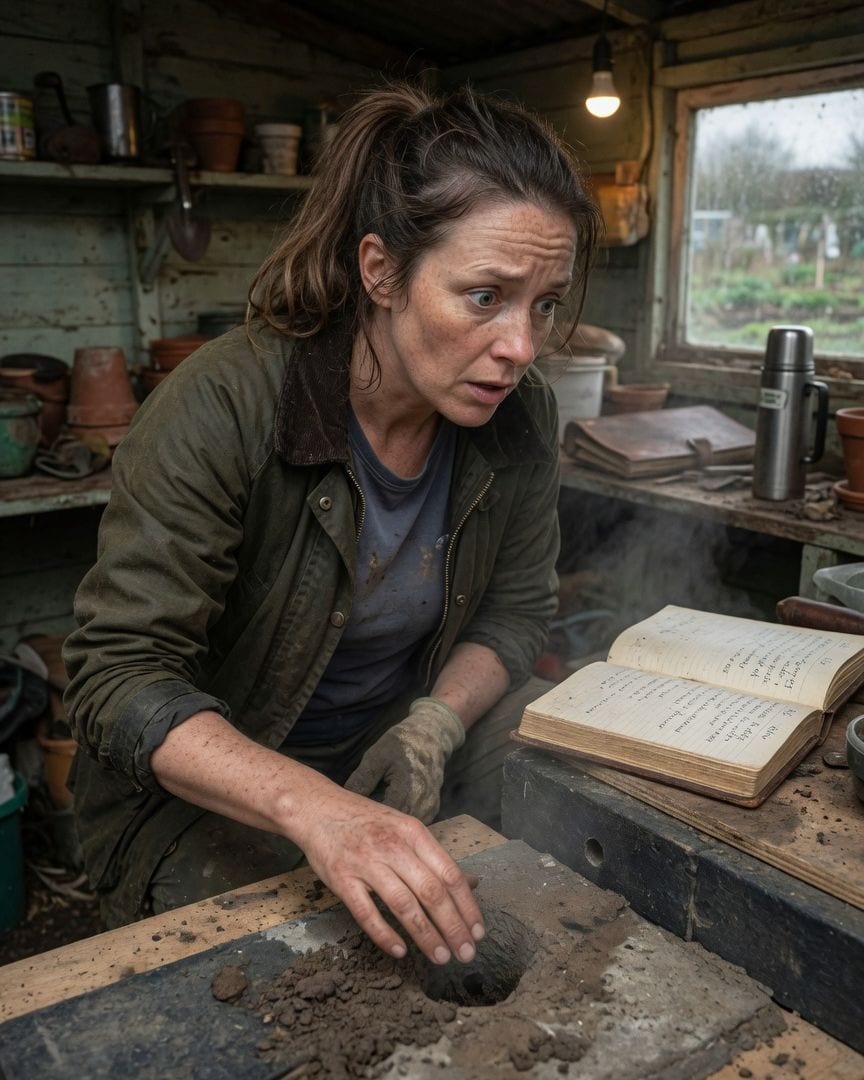
Every gardener who's held allotment plot 26 gave it up after a single season, each one leaving the same note behind: never dig the ground below two feet.
Newly single at 38, I hoped Plot 26 at Weir Field Allotments would be a fresh start. But the committee’s rent book held a strange, decades-old rule: 'ground not to be dug below two feet.' Ignoring the warnings, I dug anyway, only to find a perfectly smooth concrete slab with a tiny hole—and a distinct, unnatural cold breath rising from it.
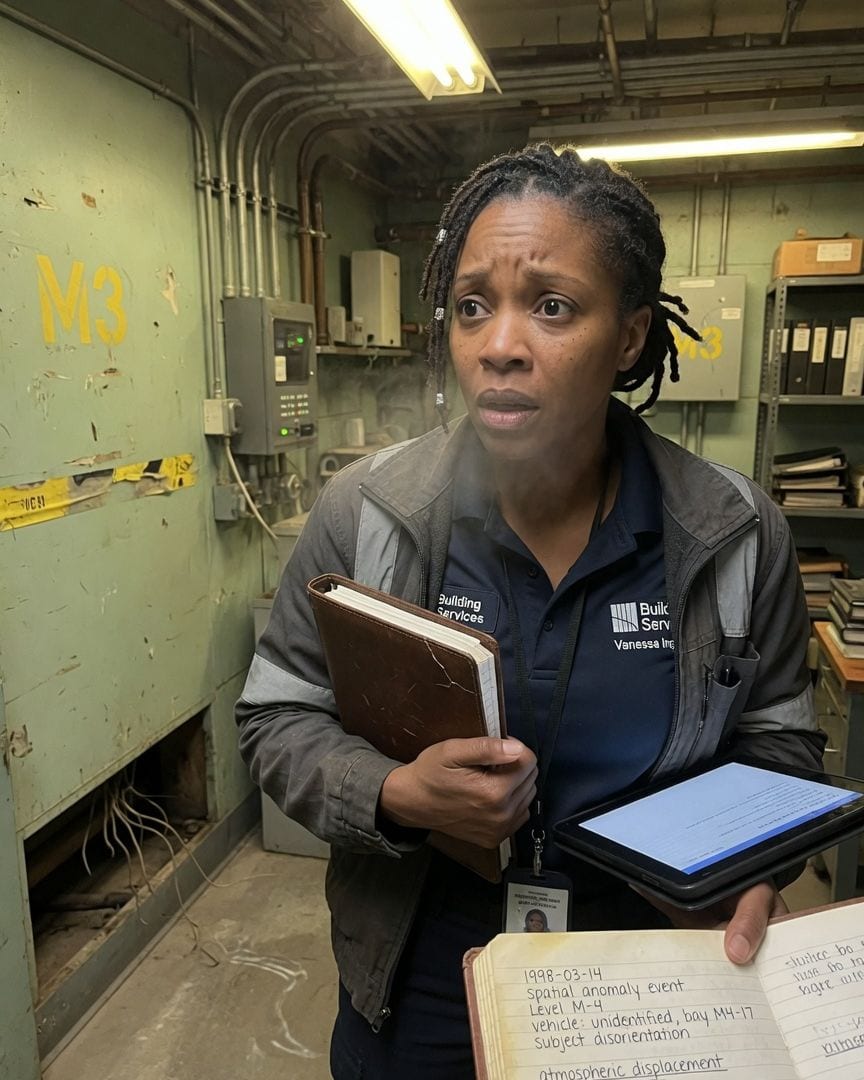
The lift offered a level below the lowest one, so I took the stairs down a flight that has never existed — into cold, empty bays where a single car sat, its engine still ticking like it had just been driven.
My routine as a Building Services Technician is usually solid, but today, the building offered a fourth basement level, M-4, that shouldn't exist. Descending into its frigid gloom, I found an old car tucked away in a bay, its engine ticking softly as if it had just arrived.
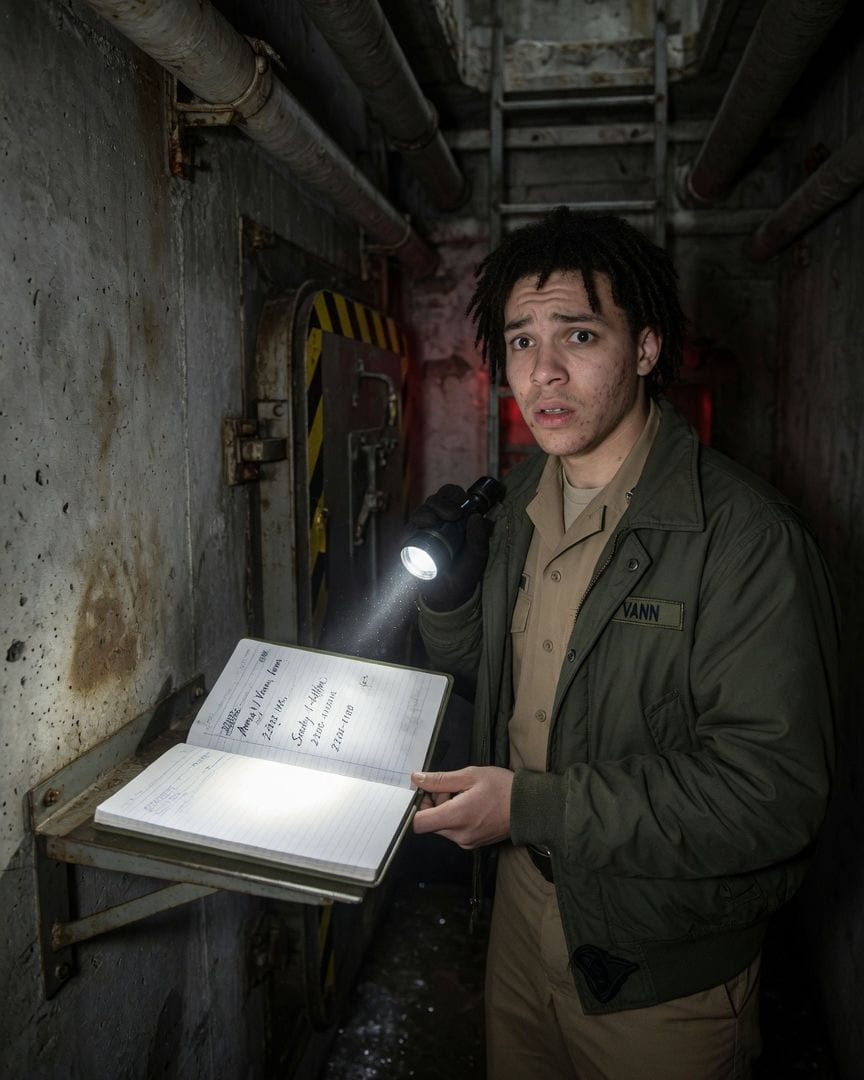
On his last patrol, Airman Vann sees a Cold War silo hatch light up from *inside*—it was welded shut a decade ago.
Airman Vincent Vann was on his last patrol across a vast, desolate Cold War missile field in the Dakotas, the cold, starless sky mirroring the emptiness of the landscape before his transfer. His routine check of eight hardened silo caps was shattered when a red fault light pulsed on Silo 4’s access panel, signaling an impossible breach from *inside* a hatch sealed for a decade. As more silos lit up, ignoring base orders, Vann found the hatch unlocked from within and descended into the dark shaft, where he discovered a pristine logbook bearing his own signature next to a chilling entry from a non-existent sentry, dated for *that very night*. Now, a steady *thump* echoed from deeper within the sealed concrete, leaving the Airman desperate for an explanation that simply wasn't there.
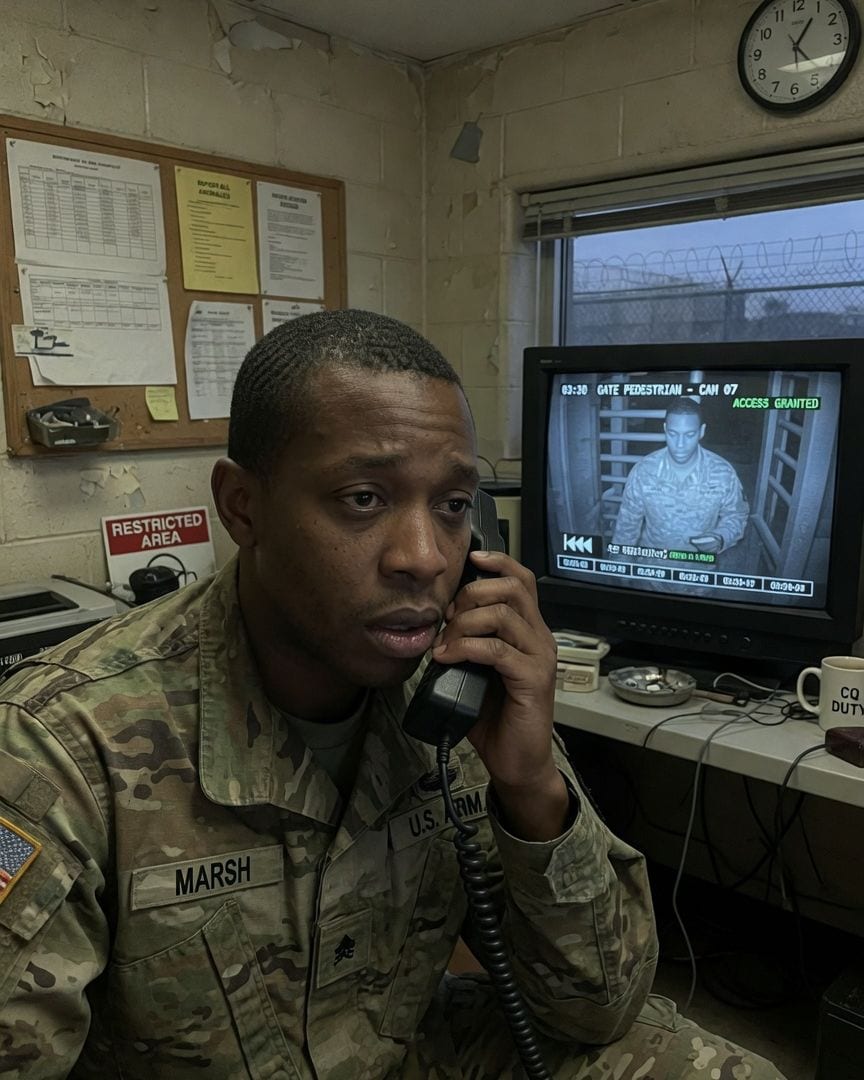
Three weeks from discharge, Corporal Marsh saw the monitor show a private badge in — but the man was asleep in his bunk.
Corporal Simon Marsh had just three weeks until his honorable discharge from the Fort in the Carolinas, a sprawling base usually quiet after midnight. But one dead hour, his security monitor showed Private Theodore Delgado clearly badging in at 0338, even as his sergeant confirmed the private was asleep in his bunk. Marsh discovered this impossible sequence had repeated every night for forty nights, a perfect digital ghost. Driven by an unsettling dread, he later found a low, insistent hum beneath the ground near the turnstile, and fresh boot prints that led into dense overgrowth before abruptly vanishing into the predawn gloom.