A pilot was grounded after seeing a silent disc, but his own signature appeared on a Cold War flight log for a patrol he never flew.
Warrant Officer Prosper Idris was flying a border patrol in an OV-10 over the Arizona desert in 1979, the sun a brutal hammer on the canopy.
His twenty minutes of loiter fuel felt like an eternity compared to the dwindling minutes left in his marriage. Then, ahead, out of a dry lakebed, it rose.
Not a dust devil, not a mirage, but a solid, metallic disc, silent and impossibly still. The detail that broke him, the one he couldn’t unsee, was the complete absence of dust.
Nothing stirred on the parched ground below as it ascended.
He flew a full circle around it, the OV-10’s engines a dull thrum against the vast silence, looking for a rotor, a fan, a plume, anything that would explain its impossible suspension.
There was nothing but the desert bending behind it, the way heat bends a road on a summer highway.
He called the UFO in by name, his voice steady despite the tremor in his gut, and was told to return to base. He did not return for another eleven minutes. He has never said what he did with them.
Back on the tarmac at Davis-Monthan, the debriefing was short, sterile. The flight surgeon eyed him with a practiced, neutral gaze, dismissing his account of the craft as a likely atmospheric inversion, or perhaps a balloon.
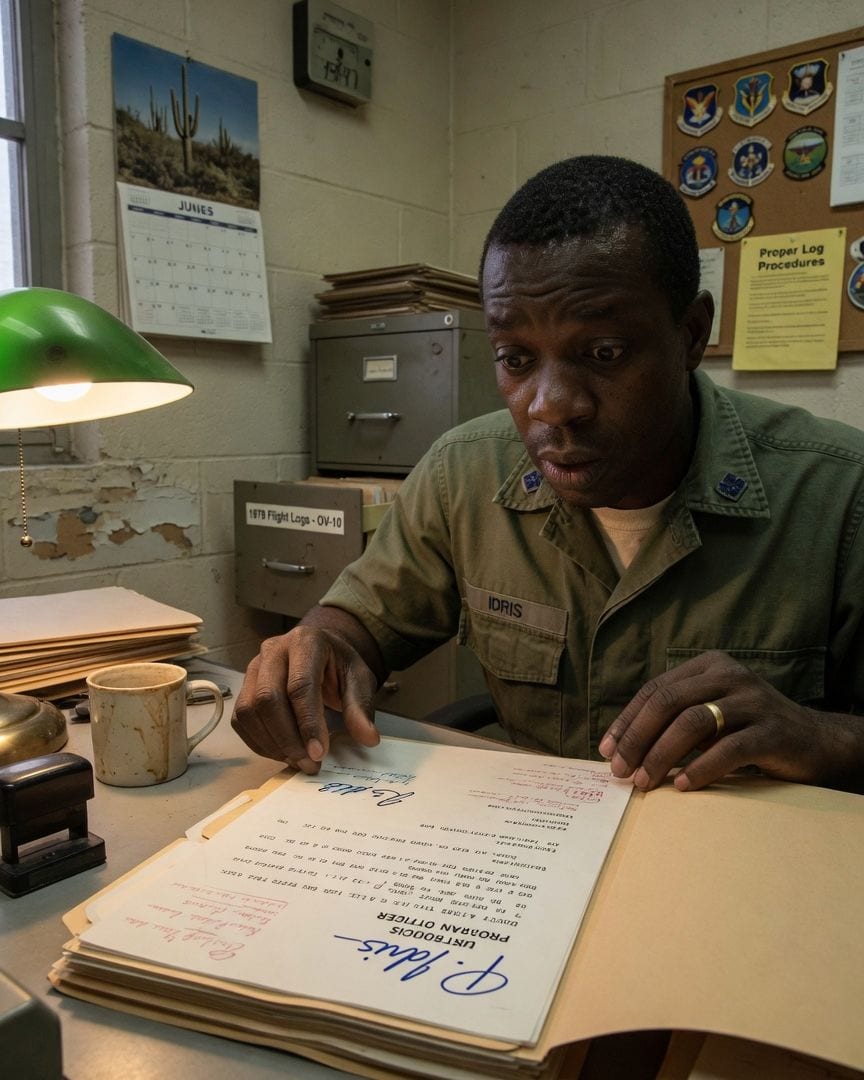
Prosper let it go, the official explanation a flimsy tarp over a gaping hole. Days later, sifting through his own service file for a routine flight hour log sign-off, a task he performed weekly, he found it.
Tucked among the usual entries was a flight report for OV-10 #73-018, a standard border patrol route, dated three weeks after his encounter. The pilot's signature was his own: P. Idris.
He stared at it, a cold knot tightening in his stomach. He had been grounded for two weeks after the incident, pending 'psychological evaluation.' He hadn't flown that route. He hadn't signed that log.
He traced the ink with a disbelieving finger, the signature too precise, too perfectly rendered to be a forgery. It was his hand, but he had never put it to paper.
Prosper Idris stared at the fresh ink of his own signature on the flight log, dated for a patrol he never flew. The meticulous lines, the familiar flourish, it was undeniably his hand, yet it was utterly impossible.
He tried to rationalize it, a clerical error, a misfile, a new recruit attempting a bad copy. But the signature was too perfect, too much his own. He felt a chill that had nothing to do with the air conditioning.
The file was doing something. His hand, shaking slightly, hovered over the page. The desert wind outside howled faintly, a sound he hadn't noticed until now. He knew, with a certainty that terrified him, that this wasn't just paper.
This was a living record.
Prosper’s methodical nature, usually a comfort, now became a torment. He began obsessively checking his service file, a daily ritual.
More phantom entries appeared, minor ones at first: requisitions for spare parts he hadn’t ordered, sign-offs for routine maintenance he hadn’t supervised, all bearing his unmistakable signature.
He tried to report it to the records department, his concerns met with polite, dismissive smiles. ‘Just a misfile, Warrant Officer,’ a clerk would say, ‘we’ll correct it.’ But the corrections never stuck, and new phantom entries kept accruing.
The unease sharpened into a specific dread. He started digging deeper, using his clearance to access older, less-frequented archives. He focused on files of pilots who had been ‘transferred’ or ‘disappeared’ under vague circumstances over the years.
He found a chilling pattern: in several such files, routine administrative entries, signed by the vanished personnel themselves, continued for weeks, sometimes months, after their official disappearance dates.
The records department had simply continued to process their paperwork, as if they were still present, still active. The files were not merely recording absence; they were actively maintaining a presence.
Prosper’s unusual interest in the dusty, forgotten files did not go unnoticed. One afternoon, a terse message appeared on his desk: ‘Colonel Granger requests your presence.’
Colonel Daniel Granger, his commanding officer, was a man of quiet authority, his office meticulously organized. Granger motioned Prosper to a chair, his expression unreadable.
The conversation began as a performance review, touching on Prosper’s recent ‘stress’ and ‘attention to detail.’ Then, Granger leaned forward slightly, his voice dropping. ‘Some records, Warrant Officer, are best left to gather dust.
Some things are filed for a reason.’ He spoke without malice, but the veiled threat was clear, cold. ‘The system has its own way of maintaining continuity.’ Prosper felt a prickle on his neck.
Later that week, he returned to his office after a late dinner to find his door, which he distinctly remembered locking, slightly ajar.
Nothing was disturbed, but a faint, almost imperceptible scent of stale tobacco, not his own, lingered in the air. Someone knew he was digging. Someone was watching.
Driven by the unsettling encounter with Granger, Prosper intensified his search. He eventually found the file of Captain Richard Sutton, a pilot who had vanished during a routine training exercise five years prior, his aircraft recovered empty.
Sutton’s file, like the others, contained phantom entries. But here, some were signed not by Sutton, but by Colonel Daniel Granger, dating after Sutton’s disappearance.
Prosper confronted Granger, not directly about Sutton, but about the phantom entries in his own file. ‘My flight logs are still being signed, sir,’ Prosper stated, his voice tight. ‘For flights I never made.’ Granger listened, his expression unchanging.
‘The system,’ Granger began, calmly, ‘has its own way of maintaining continuity. Certain personnel, Warrant Officer, are sometimes… reassigned. To special projects. To avoid administrative disruption, their records are maintained. It’s a necessary function.’
He pulled a slim, red-bordered directive from his desk drawer, sliding it across. It was vague, heavily redacted, but the title chilled Prosper: ‘Directive 7-Alpha: Active File Management for Designated Assets.’
The words ‘Designated Assets’ seemed to hum with an unspoken meaning. ‘It’s not a clerical error, is it?’ Prosper asked, his voice barely a whisper. Granger merely regarded him, a faint, unreadable smile playing on his lips. ‘No, Warrant Officer.
It’s policy.’
The ‘policy’ chilled Prosper to the bone. He knew now that the phantom entries were not mistakes, but deliberate acts of administrative ghosting. He redoubled his search, desperate to understand the full scope of ‘Directive 7-Alpha.’
He spent days buried in the deepest, most restricted sections of the archives, following obscure cross-references. Finally, he found it: a thick, unmarked manila folder tucked behind a false panel in a rarely accessed cabinet.
The label, hand-written, simply read: ‘Special Project: Oversight Personnel.’ His hands trembled as he opened it. Inside, was a list of names, service numbers, and future ‘reassignment dates.’
He scanned the list, his eyes darting across the columns, until a familiar sequence of numbers, then a name, made his blood run cold. His own service number, his full name: Warrant Officer Prosper Idris.
And next to it, a date several months in the future, with a chilling note: ‘Active File Management initiated: 1979-XX-XX’. Below it, a crisp, official signature – Colonel Daniel Granger’s.
The chilling realization slammed into him: his own disappearance was already filed. His future was already written, signed, and sealed.
The pattern snapped into place with sickening clarity. The ‘unidentified craft’ rising without dust wasn’t an alien vessel; it was the ‘filing event’ itself, a non-physical mechanism of the secrecy machine.
The eleven minutes he couldn’t account for were when he was marked, processed, his future ‘reassignment’ initiated.
The file wasn’t just a passive record; it was a living, active system that generated its own reality, a bureaucratic black hole that consumed individuals, pre-empting their physical disappearance with meticulous, self-perpetuating paperwork.
Every missing person, every continued entry in their files, was part of this ‘active file management.’ Prosper Idris was never lost; he was filed.
He had been designated an ‘asset,’ not to be deployed, but to be absorbed, his existence streamlined into an administrative fiction.
The signatures, his own and Granger’s, were not just proof; they were the mechanism itself, binding him to a future already decided.
The horror wasn’t in what he’d seen in the desert, but in the cold, coherent logic of the system that had seen him, marked him, and was now quietly erasing him, one phantom signature at a time.
Armed with this monstrous truth, Prosper knew he couldn’t escape. He had to expose it. He began frantically copying the incriminating documents, the lists of ‘designated assets,’ the future reassignment dates, the Directive 7-Alpha itself.
He worked through the night, the desert wind a lonely whisper outside the archive windows. Just as dawn was breaking, his hands shaking as he finished the last copy, the door to the archives swung open.
Colonel Daniel Granger stood there, flanked by two silent, unsmiling men in dark, unmarked uniforms. There was no violence, no aggression, just a chilling calm. ‘Warrant Officer Idris,’ Granger said, his voice soft, ‘Your reassignment has been moved up.’
Prosper clutched the copied files to his chest. ‘You can’t do this,’ he whispered, ‘people need to know.’ Granger merely smiled, a faint, almost pitying expression. ‘You’ve proven yourself quite adept at ‘file management,’ Prosper.
We have a place for that.’ Prosper tried to resist, to push past them, but the two men moved with an efficient, practiced ease.
He was led away, not to a prison cell, but to another office, deeper within the vast, labyrinthine complex. Inside, a clean, bare desk awaited him. On it, a fresh, unmarked manila folder. His own.
His new assignment was clear: to manage the files of others, just as his own had been managed.
Warrant Officer Prosper Idris was never seen outside the facility again. His official service record showed a transfer to a highly classified, remote research detachment, with all further entries sealed.
His wife received a terse, official letter, citing national security and a permanent posting overseas. Colonel Daniel Granger retired five years later, his own service file immaculate, a commendation for ‘exceptional administrative oversight’ among its pages.
The system continued, silent and unseen, a patient horror filing away its designated assets.
Decades later, in a nondescript government building, a young records clerk named Lily Carver was processing old declassified files. Dust motes danced in the fluorescent light as she pulled a long-dormant folder from a forgotten cabinet.
It was labeled simply: ‘Special Project: Oversight Personnel.’ Inside, among pages yellowed with age, she found a requisition for office supplies, routine and unremarkable.
The signature was precise, familiar in its neatness, though she couldn’t place it: Warrant Officer P. Idris. The date on the requisition was yesterday.
The file is still being signed.
If this one got to you
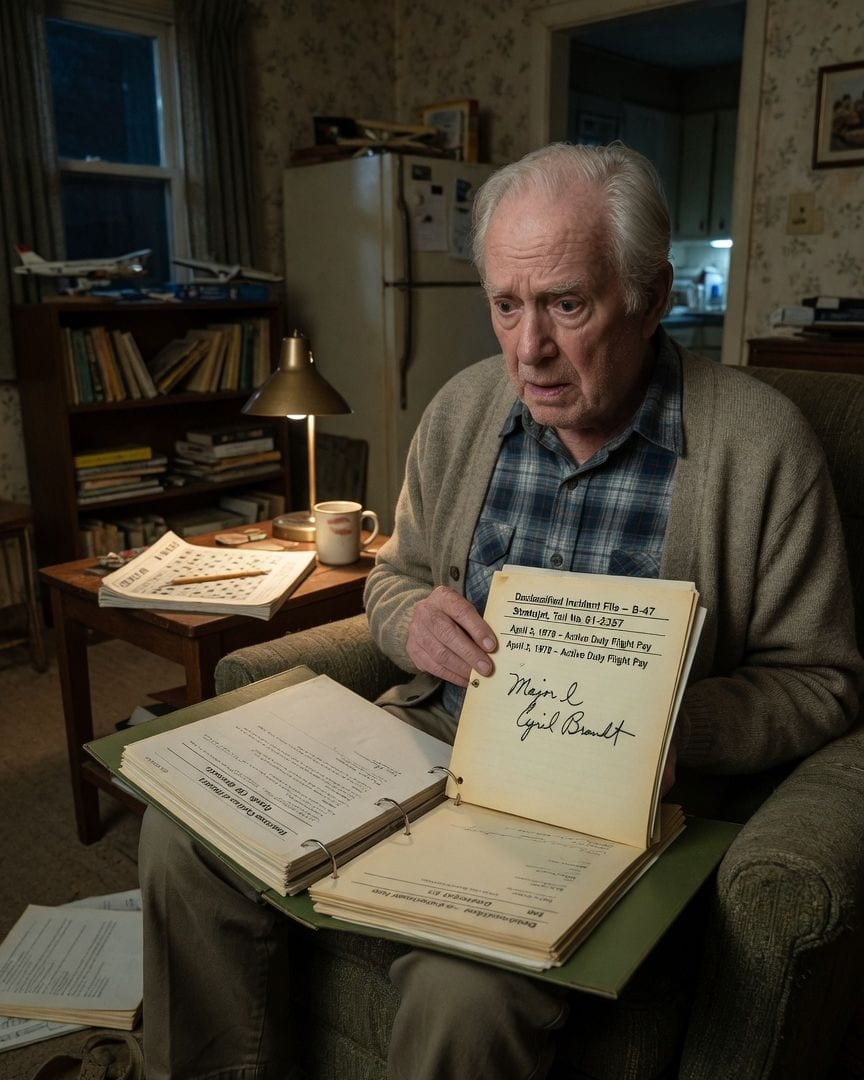
A retired Cold War pilot found his own signature on a flight pay record, dated five years after he left active duty, the ink unnervingly fresh.
Cyril Brandt, a seventy-two-year-old retired B-47 pilot, cherished his quiet Dakota retirement, his days filled with crosswords instead of combat. He expected to find long-awaited closure on a strange 1968 UFO incident when a heavy, declassified file arrived. Settling into his armchair, the weight of the olive-green binder felt familiar, but its contents quickly shattered his calm. He discovered maintenance logs for his B-47, detailing engine hours and tire rotations, dated years after the aircraft had been scrapped. Then, buried deeper, he found a payroll entry for himself, dated 1978 — five years after he left active duty — bearing his own unmistakable signature, the ink unnervingly fresh. How could his own hand have signed off on a mission that never happened, for a plane that no longer existed?
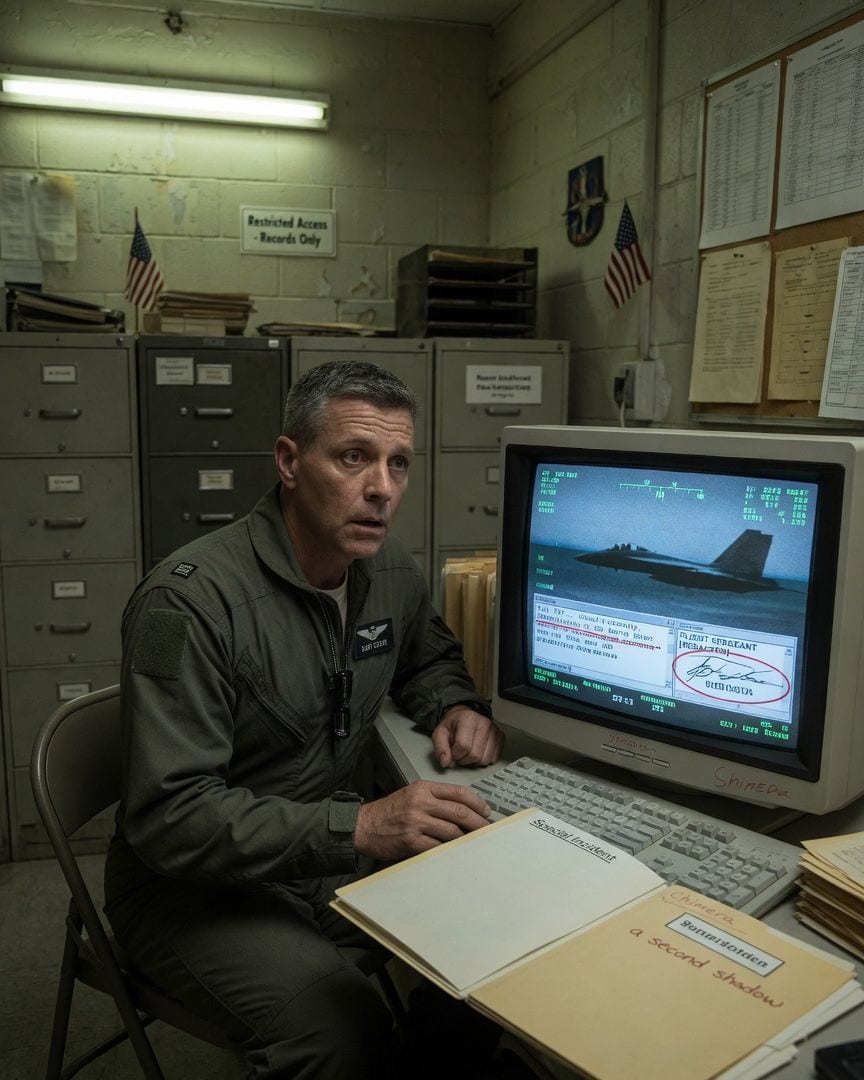
A Chief Warrant Officer's HUD showed a second aircraft watching his plane. He later found a log for *his* tail number reporting the same anomaly weeks ago, but he was grounded for medical leave.
Chief Warrant Officer Gary Estes, a man whose career was built on precision, found his impending Pentagon transfer shadowed by a baffling anomaly. On every flight, at exactly 800 feet, his aircraft's display would briefly show a sleek, dark second plane tucked off his right wing, its canopy subtly angled toward his, watching him. Ground radar never saw it, and his wingmen swore they flew alone. Desperate to maintain his clean record, Estes dug into maintenance logs and uncovered an entry for *his* tail number from weeks prior. It described the exact same 'visual anomaly' during a flight he knew, with chilling certainty, he had never flown.
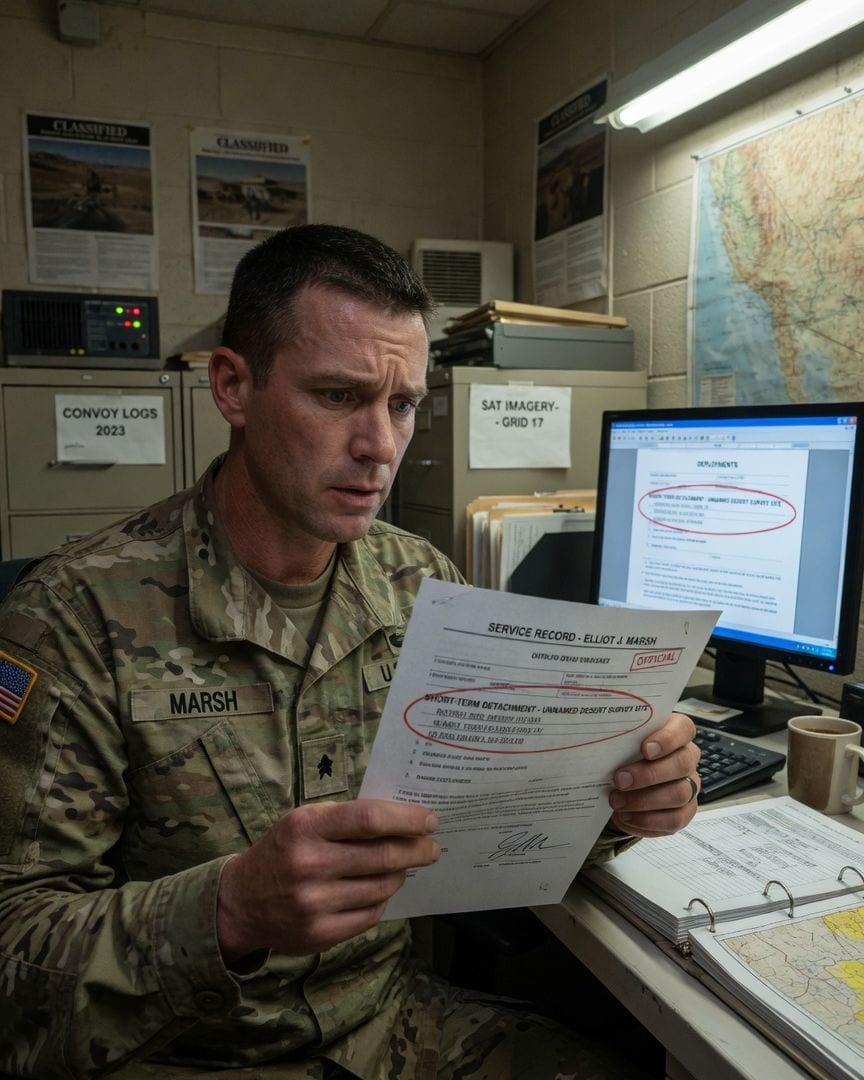
First Lieutenant Marsh's own signed service record lists a mission he can't recall from the night his desert outpost vanished.
First Lieutenant Elliot Marsh felt the Mojave dark swallow his resupply convoy, a wrong turn leading him to an unlisted firebase. The remote outpost, its flag tattered and sandbags faded, materialized from the desert night, baffling him. When his superiors reported nothing at that grid, Marsh's confusion turned to dread as the entire structure vanished behind him, leaving only empty expanse. Back at Fort Irwin, his meticulous investigation revealed a chilling truth: his own signed convoy logs and service record detailed a different route and an unremembered mission, placing him miles away at the exact time he witnessed the impossible.
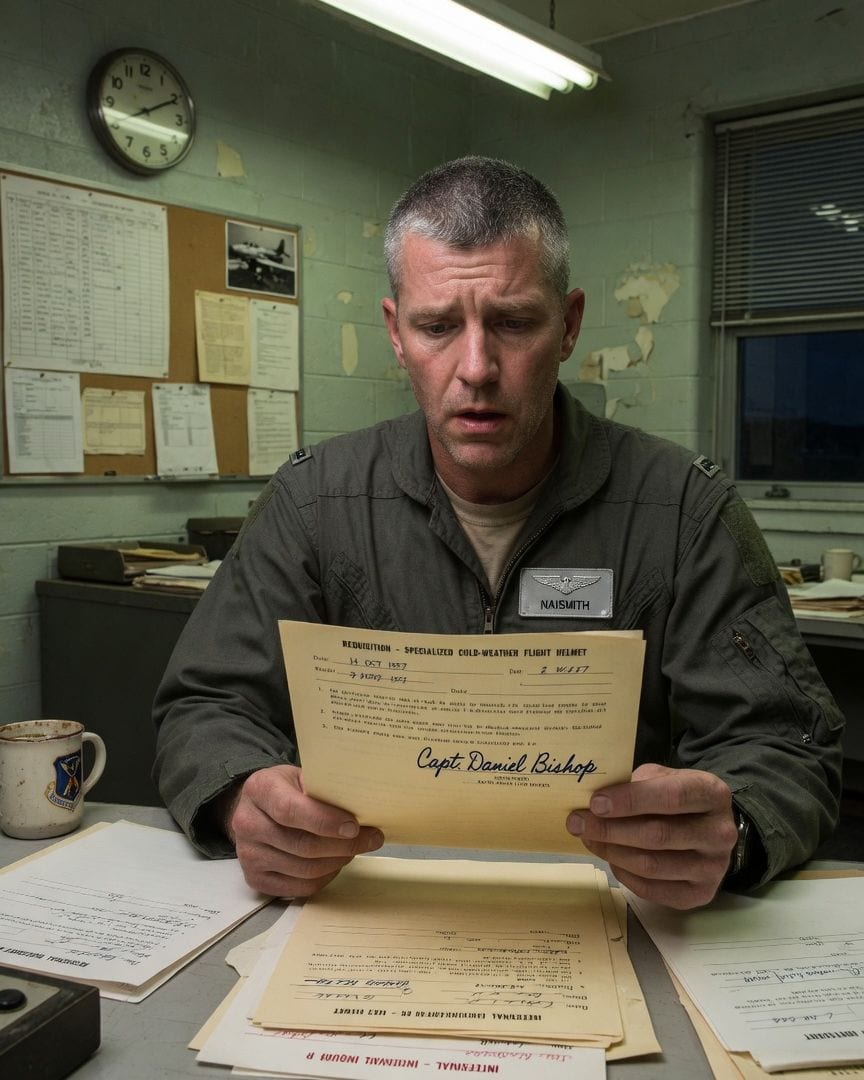
A Cold War Colonel reviews a missing pilot's file and finds Captain Bishop's signature on a form dated weeks after he vanished.
Colonel Ward Naismith faced the grim task of reviewing Captain Daniel Bishop’s personnel file, a routine chore for a man listed as Missing in Action. Bishop had vanished days after he and Naismith chased an impossible, silent disc over Lake Superior, leaving only an empty patch of air and a knot of unease in Ward's gut. Sifting through commendations, Ward found a requisition for flight gear and a maintenance sign-off, both dated *after* Bishop’s disappearance. The true chill came with the requisition for a specialized flight helmet, bearing Captain Bishop’s unmistakable signature, weeks after he was presumed lost. How could a man presumed lost have signed anything?
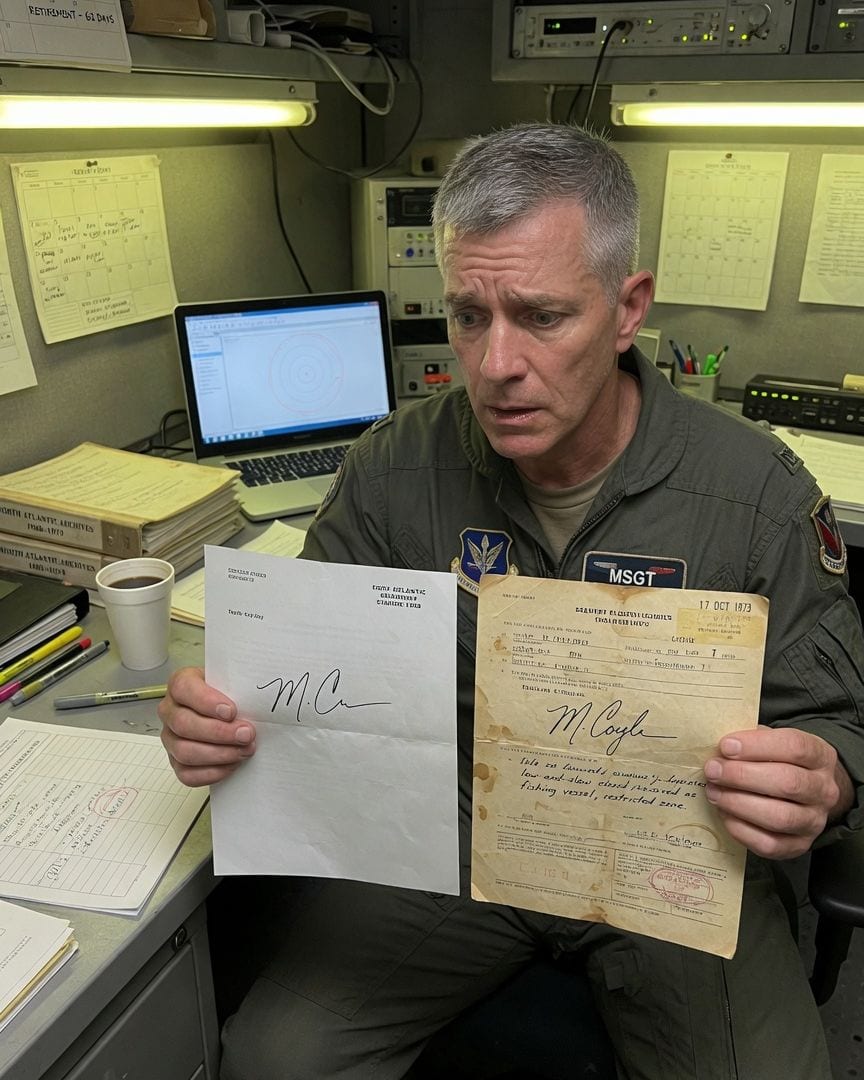
Master Sergeant Coyle was two months from retirement when his own signature appeared on a Cold War mission log from 1973, decades before he was born.
Master Sergeant Malcolm Coyle, two months from retirement, scanned the North Atlantic from his E-3 Sentry, its cabin humming through the perpetual twilight. His radar scope showed a silent, low-and-slow blip that vanished from fighter jets but remained on his screen, mirroring an identical ghost from the prior week. Digging through decades of archived logs, Coyle found a 1973 entry detailing the same impossible contact, stamped with his own squadron's seal. The duty officer's signature, with its distinctive flourish, was unmistakably his own—identical to his current papers—yet dated decades before he was even born. How could his hand have signed a lie from a time he didn't exist?
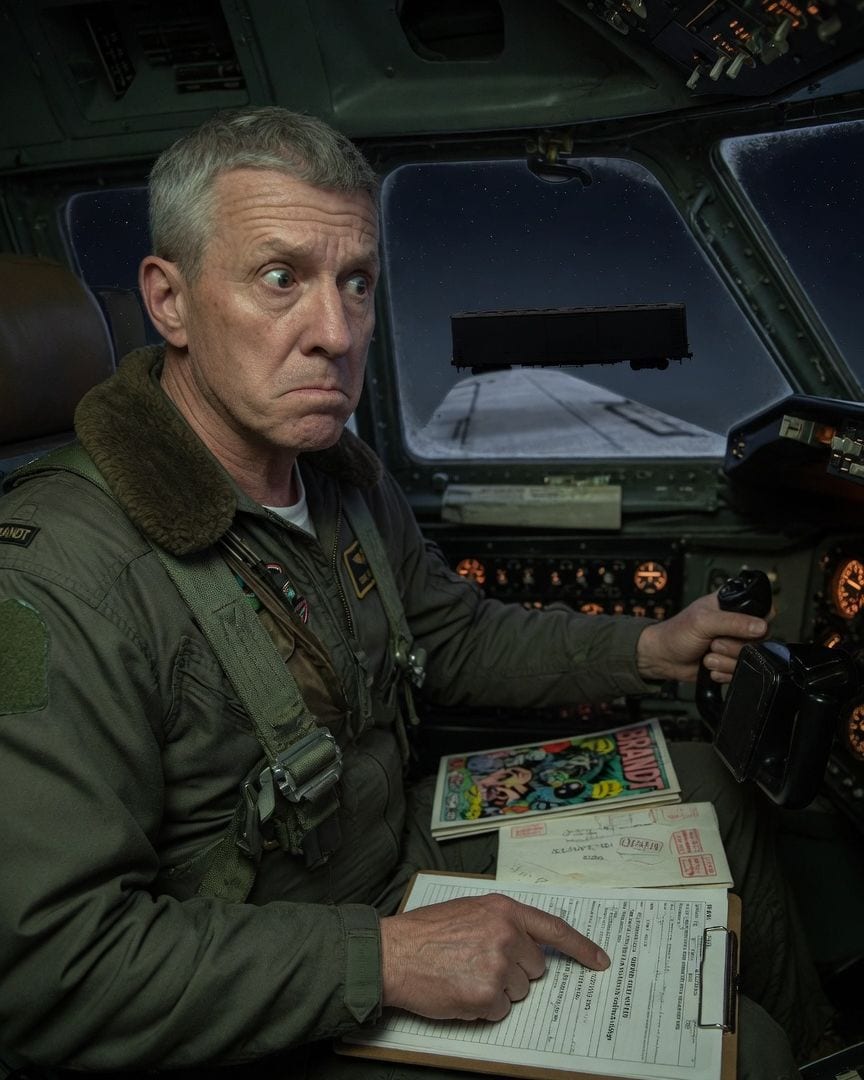
On his last Cold War flight, Major Brandt’s official report quoted words he never said, then claimed material recovery from a wing he knew was untouched.
Major Cyril Brandt, a seasoned pilot nearing retirement, undertook his final airborne alert leg in the B-47, the familiar hum of its engines a lullaby against the vast, dark sky over the Dakotas. Then, an impossible, featureless boxcar-thing appeared silently, thirty feet off his wingtip, vanishing as abruptly as it came nineteen minutes later. Three days later, the official incident report contained two chilling fabrications: a quote only his tail gunner uttered, attributed to Major Brandt, and a claim of material recovery from a wing he knew was untouched. The document was not just wrong; it was a deliberate, precise lie about an interaction that never happened, leaving the pilot with a cold dread.