A retired Cold War pilot found his own signature on a flight pay record, dated five years after he left active duty, the ink unnervingly fresh.
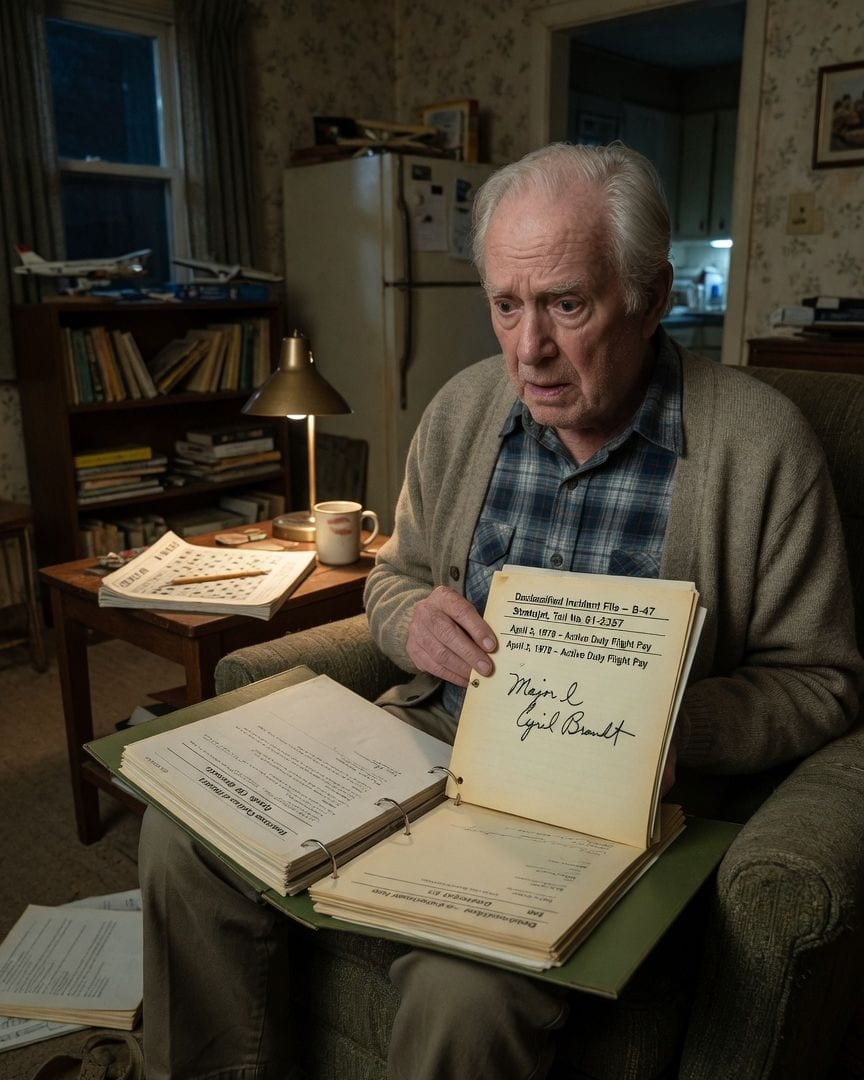
Cyril Brandt, at seventy-two, moved with the measured calm of a man who had seen enough of the world to earn his quiet. His small Dakota home, filled with the scent of aged paper and morning coffee, was his sanctuary.
Decades had passed since he’d traded the roar of a B-47 for the rustle of cornfields, and the only mysteries he pursued now were crosswords. Then, a heavy package arrived, breaking the serene rhythm of his retirement.
He cut the tape with a forgotten military precision, revealing a thick, olive-green binder. The label, stenciled in stark black letters, read: "Declassified Incident File – B-47 Stratojet, Tail No. 61-2357. North Atlantic, 1968." His B-47. The UFO incident.
He settled into his armchair, the weight of the file familiar in his hands. He expected closure, perhaps some long-awaited answers about the strange lights, the impossible maneuvers, the official silence that followed.
Instead, the first pages were disappointingly mundane: routine maintenance logs. Fuel requisitions, engine hours, pre-flight checks. He scanned them, a nostalgic ghost in the machine, until a date snagged his attention. An oil change performed on March 12, 1979.
Cyril frowned. The B-47, tail number 61-2357, had been officially decommissioned, stripped for parts, and scrapped by the mid-1970s. Yet, here were logs detailing engine hours and routine position reports well into the late 1970s.
An official sign-off for a tire rotation, dated April 17, 1979, rested on a form that crinkled under his touch, the ink a stark, impossible black against the yellowed paper. The quiet hum of his refrigerator suddenly seemed too loud.
Disturbed, Cyril began a methodical review, the military habit of finding discrepancies resurfacing. He turned page after page, each one pulling him further from the comfort of rational explanation.
He found similar phantom entries for the other members of his crew. Everett Doyle, his co-pilot, had left the service in 1970 for a lucrative civilian career in aerospace.
Yet, the file contained entries for Doyle, detailing routine medical check-ups in 1974, for a base he’d never served at, listing a squadron he'd never joined. Then, there was Leonard Sterling, the tail gunner.
Sterling had died of natural causes in 1985, a quiet passing in his sleep. But an entry for “dental hygiene” was logged for Sterling in 1982, for a facility attached to an active-duty command Sterling hadn’t belonged to since 1971.
Cyril tried to rationalize it. A bureaucratic tangle, maybe. Cross-referenced records mistakenly updated. He told himself that in files this old, spanning decades, clerical errors were not just common, but almost expected.
He pressed his thumb against his temple, trying to force the explanation into place, but the pattern was too precise, too consistent. Each entry was detailed, specific, far beyond the vague "ghost entries" he'd heard about.
Then, buried deep within a section marked "personnel assignments," he unearthed a payroll entry. It was for himself, Major Cyril Brandt, dated April 3, 1978, for active duty flight pay. A substantial sum.
Below the figures, clear and unmistakable, was his own signature. He recognized the distinctive loop on the 'B' of Brandt, the sharp, precise cross on the 't'. It was exactly his signature, rendered with his hand’s familiar flourish.
But he hadn't flown for that squadron since he’d transferred out in 1973. He hadn't been on active duty with any flight command since then.
The file fell open further, a gust of cool air seeming to rise from its pages.
Cyril stared at the payroll entry, his own signature bold on the page.
Ten years after the UFO incident, five years after he had transferred out of that command, his hand had apparently signed off on a phantom mission, a flight that never happened.
The ink appeared unnervingly fresh, stark against the aged, yellowed paper. He reached out, his fingers tracing the impossible date, the familiar curves of his own name.
The cold weight of the file shifted on his lap, a slight, almost imperceptible movement, and the air in the room suddenly felt much colder, as if a window had silently opened in the quiet house.
The next day, Cyril drove to the National Archives, the impossible payroll entry clutched in his hand. The building rose before him, a gray behemoth of stone and concrete, a repository of forgotten truths.
Inside, the hushed air was thick with the scent of old paper and dust. He presented the file to Bonnie Whitfield, a records clerk in her mid-forties, whose name tag identified her as "Archivist, Level 2."
She had the tired eyes of someone who spent her days sifting through the detritus of history. Bonnie initially dismissed it, her voice flat. "Oh, a ghost entry, Major. Common enough in files this old, especially military records.
We see them all the time."
Cyril, drawing on decades of military precision, pushed back. He pointed to the distinctive loop of his 'B', the precise cross on the 't', details only he would know. "This isn't a common error, Ms. Whitfield. This is my signature.
From a flight I never took, five years after I left that command. And it's not just me. My co-pilot, my tail gunner – there are similar discrepancies, years after they were out of service, or even dead."
He laid out the pattern, the impossible dates for Doyle's medicals, Sterling's dental visit.
Bonnie’s dismissiveness faltered. A flicker of something akin to unease crossed her face, quick and almost imperceptible. She glanced quickly, almost reflexively, at a small, unmarked security camera mounted high in the corner of the room, its black lens unblinking.
The movement was so subtle, Cyril almost missed it. "Some records," she murmured, her voice dropping, "get handled differently. We have what's called a 'Special Access Program' sub-file for… particularly sensitive cases. Beyond my clearance, usually."
She gestured vaguely towards a row of older, bulkier terminals, tucked away behind a partition marked 'Restricted Access.' The air in the cavernous archive seemed to press in around him, heavy and still.
Cyril left the archives, the hum of fluorescent lights replaced by the distant drone of city traffic.
He walked towards his car, the feeling of being watched lingering, a prickle on the back of his neck he hadn’t felt since his days in active combat zones.
He told himself it was just paranoia, the natural reaction to uncovering something unsettling. Yet, the unease persisted.
Later that evening, as he prepared a simple dinner, his landline rang. It was an old number, one he rarely used, reserved mostly for solicitors and his children. He answered, a slight frown on his face.
The voice on the other end was distorted, synthesized, flat and devoid of human inflection. It simply recited his old Air Force service number, clear as a bell: "987-32-10-64." Then, with a click, the line went dead. No caller ID.
No background noise. Just the flat, mechanical tone. Cyril stood there, the receiver cold against his ear, the silence in his small kitchen suddenly vast and unnatural.
The next morning, an unmarked, heavy envelope appeared in his mailbox. It wasn’t neatly tucked in; it was simply there, resting on top of his regular mail, almost too thick for the slot. Inside was a single, grainy black-and-white photograph.
It was a candid shot. A picture of him, Cyril Brandt, walking into the National Archives yesterday. His file folder was tucked under his arm, the determined set of his jaw visible even in the low resolution.
The worn leather of his briefcase, the slight limp he'd developed after a parachute jump gone wrong decades ago—it was all there, unmistakable. They knew. They were watching. The air in his home, usually a comfort, felt thin, charged.
Cyril returned to the archives, the photograph and the memory of the phone call fueling a cold, hard resolve. This was no longer a bureaucratic mix-up. This was targeted.
Bonnie Whitfield spotted him from behind her desk, her face paling as their eyes met. She tried to intercept him, stepping out into the aisle, her hands fluttering nervously.
"Major Brandt, I—I don't think you have the necessary security clearances for that section. There are privacy protocols. You shouldn't—"
Cyril cut her off, his voice firm and steady, echoing with an authority she clearly recognized. "Ms. Whitfield, I believe I have every right to see my own records."
He pushed past her, not unkindly, but with an unwavering purpose, heading directly for the 'Special Access Program' terminal she had indicated yesterday. He sat down, the worn keyboard cold beneath his fingers, and began to navigate the clunky interface.
He remembered snippets of the system from his own service, the nested directories, the cryptic alphanumeric codes. After several failed attempts, he located a file designated 'Project OVERWATCH.' The name, stark and uninviting, seemed to hum faintly from the screen.
He opened it, and the screen filled with familiar names. 'Subject: Brandt, Cyril M.' His own name. Below it, 'Subject: Doyle, Everett A.' And then, 'Subject: Sterling, Leonard P.' These weren't just abstract files; they were active dossiers.
The entries detailed their post-service lives: addresses, family contacts, health status, all meticulously updated. Some entries were just months old, documenting routine doctor visits, changes of address, even the purchase of a new vehicle.
He scrolled down to Leonard Sterling's file. The dates continued past Sterling's death in 1985. An entry from October 27, 1985, caught his eye. It read: 'Subject Sterling: Terminal condition identified (glioblastoma). Designation: Terminated.'
The words hit Cyril like a physical blow. Leonard had indeed died of a brain tumor in 1985. The coherence of it, the chilling precision, was overwhelming.
They were never just 'lost' in the system, or 'retired' in the conventional sense. They were 'filed.' And upon death, they were 'terminated.' He wasn't looking at an archive. He was looking at an active ledger of human beings.
The silence in the archive room became absolute, pressing down on him.
Cyril continued scrolling through the Project OVERWATCH file, his heart pounding a frantic rhythm against his ribs.
The details of his own life spilled across the screen, from his blood pressure readings taken last year to a credit card transaction for his last visit to the grocery store. It was all documented with chilling accuracy.
He scrolled further, his breath catching in his throat. He saw an entry dated just last week: 'Subject Brandt: Identified for re-evaluation. Status: Active.' A cold dread, heavier than anything he’d ever known, washed over him.
He was never truly out of service; he was merely on standby, a dormant asset. Then, his eyes fell on the next entry, bolded for today's date: 'Subject Brandt: Accessing classified records. Status: Compromised.'
As he read the last word, the screen flashed once, a blinding white light that filled his vision for a split second, then went completely dark.
The sudden, echoing silence of the archive room descended, leaving him alone, the terminal a black mirror reflecting his own horrified face.
The sudden blackout of the terminal was a punch to the gut, but Cyril had seen enough. The 'File That Kept Writing' was never about the B-47; it was always about the crew, about him.
The UFO encounter, the bizarre aerial phenomena they witnessed in 1968, wasn’t just an incident. It was the trigger, the moment they were inducted, unknowingly, into Project OVERWATCH.
They weren't just observed; they were designated assets, their lives meticulously tracked, every detail logged, every movement noted. His 'retirement' wasn't a release from service, merely a change in operational status.
The 're-evaluation' meant he was being reactivated, potentially brought back into the fold, and now, by accessing the file, he was 'compromised.' He was never free.
The institution, the vast, silent secrecy machine, had simply filed him, and his entire life, away. With a surge of adrenaline, Cyril fumbled in his bag, his fingers brushing against the cool metal of a small USB drive.
He pulled it out and, without hesitation, shoved it into the dark terminal, frantically tapping keys, hoping to transfer anything he could, even a fragment, before they arrived.
He knew, with a certainty that froze his blood, that they were coming.
Two men in dark, unremarkable suits entered the archive room. They moved with an almost unnatural quietness, their shoes making no sound on the polished linoleum, their faces calm, unreadable, like figures carved from gray stone.
Bonnie Whitfield stood frozen at her desk, her eyes wide, avoiding Cyril’s gaze. "Major Brandt," one of the men said, his voice flat, devoid of inflection, "Service number 987-32-10-64. You have violated security protocols. You must accompany us."
Cyril, drawing on decades of military discipline, feigned cooperation. He rose slowly from the chair, his hands visible, giving no indication of his intent.
As they approached, he noticed a fire exit sign, barely visible behind a tall stack of old microfiche readers, a red glow against the distant wall.
His mind, honed by years of split-second decisions in a cockpit, calculated angles and distances, the proximity of the men, the location of the door. Just as the first man reached for his arm, Cyril dropped the heavy file.
Papers scattered across the floor, rustling loudly, creating a momentary distraction. He shoved past the man, who stumbled, momentarily surprised, and bolted for the fire exit.
The men recovered quickly, their calm expressions replaced by a focused, predatory intensity, and began to pursue him. Cyril, despite his age, moved with surprising agility, fueled by pure, desperate terror.
He burst through the emergency door, the piercing wail of the alarm shattering the archive’s silence, and disappeared into the labyrinthine back alleys of the city, clutching the small USB drive like a lifeline.
He heard their shouts, the distant, rising wail of sirens. They wouldn't stop.
Cyril Brandt vanished. His home was quietly searched, every document, every photograph examined. His bank accounts were frozen, his existence meticulously erased from public records.
His disappearance was officially attributed to an elderly man's confusion, a sad case of dementia leading to wandering.
He became a ghost, moving from one anonymous town to another, always looking over his shoulder, always wary of the silent cars, the faces that looked too ordinary.
He tried, once, to send the contents of the USB drive to an investigative journalist, a package carefully mailed from a post office hundreds of miles from his last known location.
But the package was intercepted, and the journalist's office was quietly audited, the reporter suddenly losing interest in 'conspiracy theories.' The proof he carried was too deeply buried, too incredible for a world that preferred its truths simple and digestible.
The machine was too vast, too patient, too ingrained. He knew he'd made the right choice, escaping the terminal, but it came at the cost of his entire life, erased.
Cyril lived a life of constant vigilance, his days marked by the phantom hum of unseen surveillance, the whispers of his service number echoing in the back of his mind.
He found himself often staring at the sky, a habit he thought he’d broken decades ago, searching for something that wasn't there, but that he knew was watching.
He could feel the cold weight of the machine, still signing off on its invisible ledger, still tracking him. He was free, but he was never truly gone.
A records clerk in a secure, windowless facility scanned a new entry into a file labeled 'Project OVERWATCH - Brandt, Cyril M.' The date on the entry was recent. The status read: 'Subject Brandt: Status unknown. Designation: Active.'
The file is still being signed.
If this one got to you
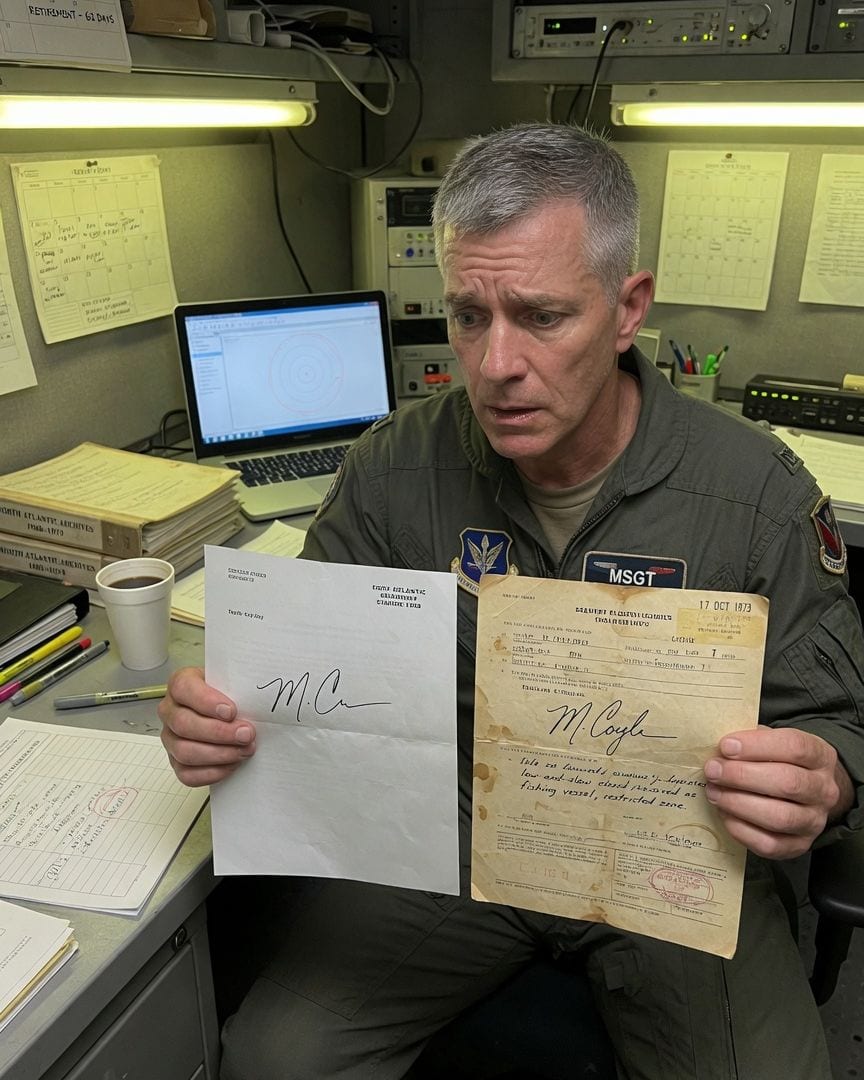
Master Sergeant Coyle was two months from retirement when his own signature appeared on a Cold War mission log from 1973, decades before he was born.
Master Sergeant Malcolm Coyle, two months from retirement, scanned the North Atlantic from his E-3 Sentry, its cabin humming through the perpetual twilight. His radar scope showed a silent, low-and-slow blip that vanished from fighter jets but remained on his screen, mirroring an identical ghost from the prior week. Digging through decades of archived logs, Coyle found a 1973 entry detailing the same impossible contact, stamped with his own squadron's seal. The duty officer's signature, with its distinctive flourish, was unmistakably his own—identical to his current papers—yet dated decades before he was even born. How could his hand have signed a lie from a time he didn't exist?
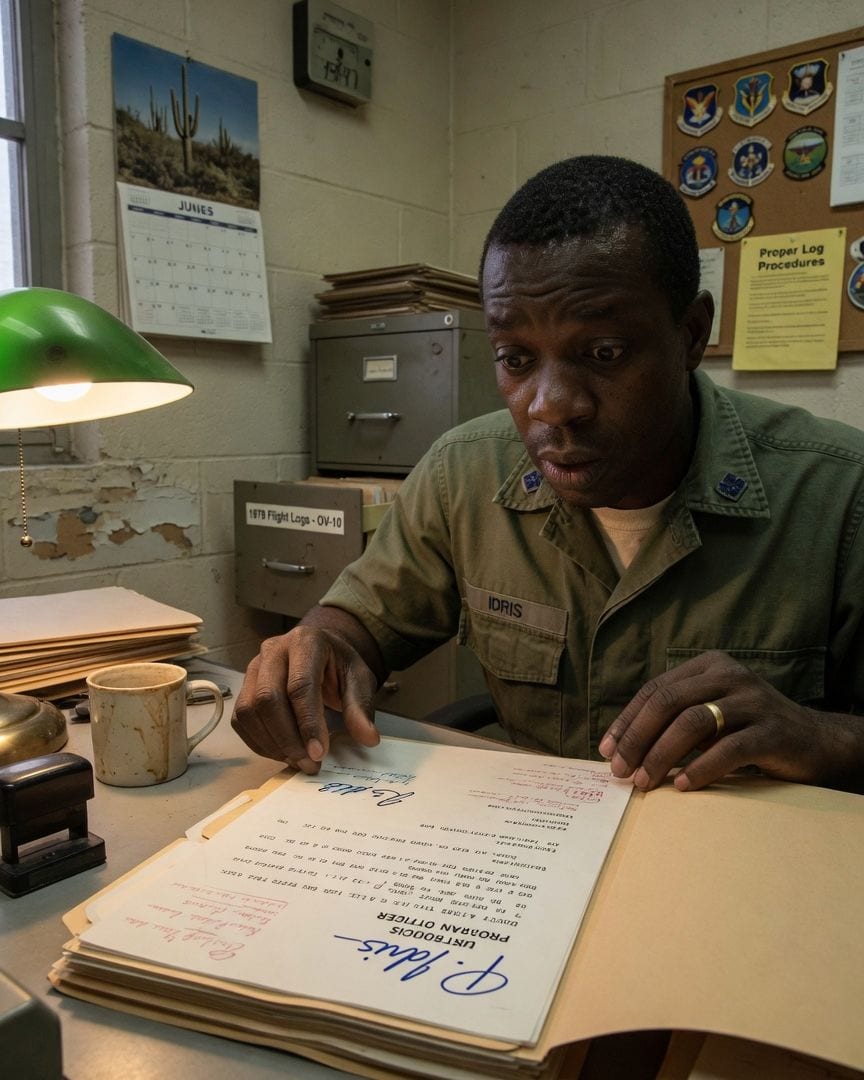
A pilot was grounded after seeing a silent disc, but his own signature appeared on a Cold War flight log for a patrol he never flew.
Warrant Officer Prosper Idris was on a lonely border patrol over the Arizona desert in 1979, the brutal sun matching the heat of his dwindling marriage. His twenty minutes of loiter fuel felt like an eternity when a solid, metallic disc, impossibly still and silent, rose from a dry lakebed ahead. After reporting the UFO and a terse debriefing, he was grounded for psychological evaluation. Weeks later, sifting through routine flight logs, Prosper found a report for his own OV-10, dated three weeks *after* his encounter, bearing his unmistakable signature for a patrol he had never flown. He stared at the perfectly rendered ink, a cold knot tightening in his gut, knowing this wasn't just paper.
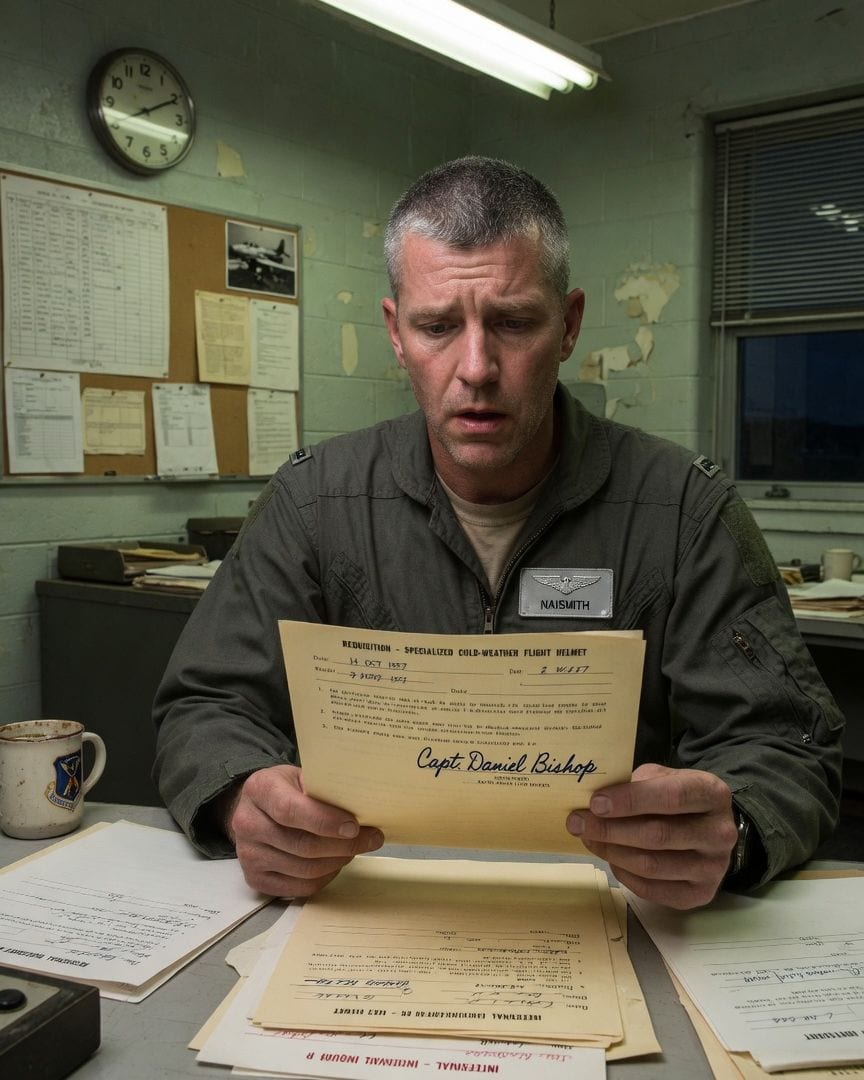
A Cold War Colonel reviews a missing pilot's file and finds Captain Bishop's signature on a form dated weeks after he vanished.
Colonel Ward Naismith faced the grim task of reviewing Captain Daniel Bishop’s personnel file, a routine chore for a man listed as Missing in Action. Bishop had vanished days after he and Naismith chased an impossible, silent disc over Lake Superior, leaving only an empty patch of air and a knot of unease in Ward's gut. Sifting through commendations, Ward found a requisition for flight gear and a maintenance sign-off, both dated *after* Bishop’s disappearance. The true chill came with the requisition for a specialized flight helmet, bearing Captain Bishop’s unmistakable signature, weeks after he was presumed lost. How could a man presumed lost have signed anything?
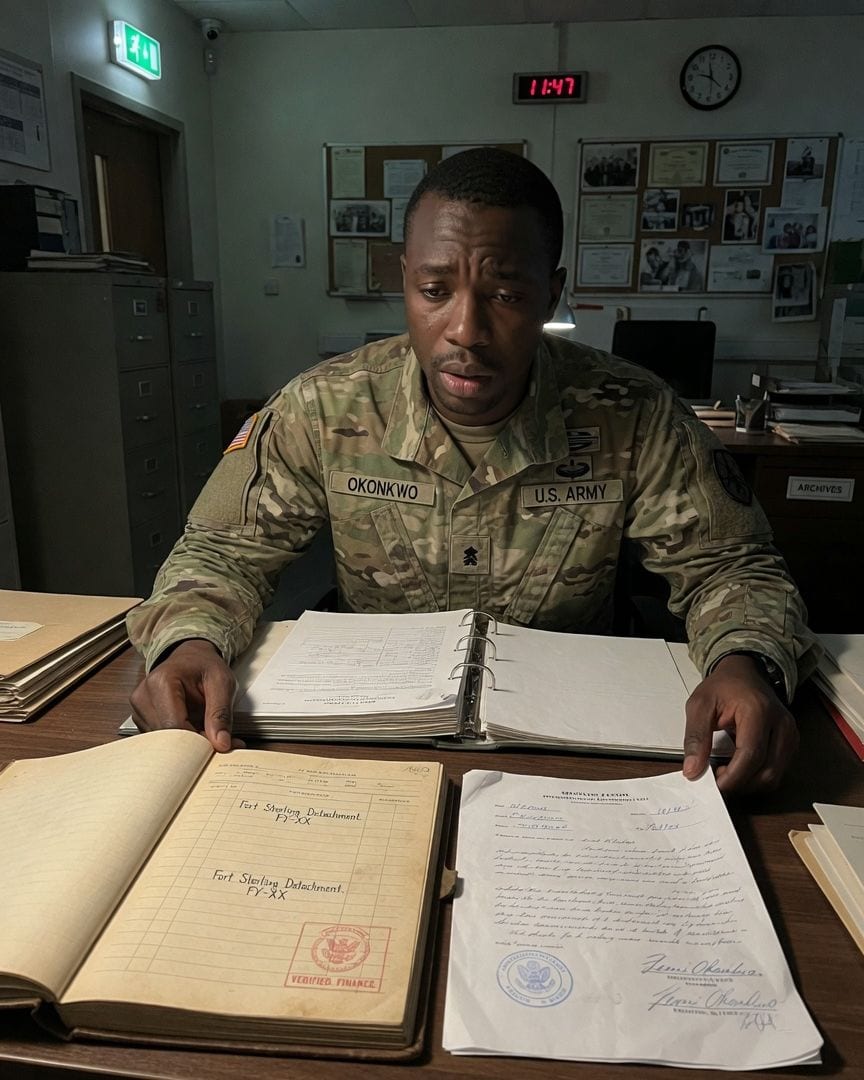
An old deployment ledger bore Specialist Femi Okonkwo's name, but the elegant signature was not his own.
Specialist Femi Okonkwo, an Air Force cargo hauler, stared at an earnings statement that contradicted his entire four-year enlistment. It listed nine months of jump pay and a mountain duty station in Colorado—places he’d never been, operations he’d never completed. Finance and HR records, seemingly impeccable, confirmed every detail of his impossible deployment. But when Femi finally retrieved the physical sign-in ledger, the faded blue ink of his supposed signature revealed the true, chilling discrepancy: the neat, elegant hand on the official document was unequivocally not his own. Who signed for Specialist Okonkwo’s impossible deployment, and why was it so meticulously verified?
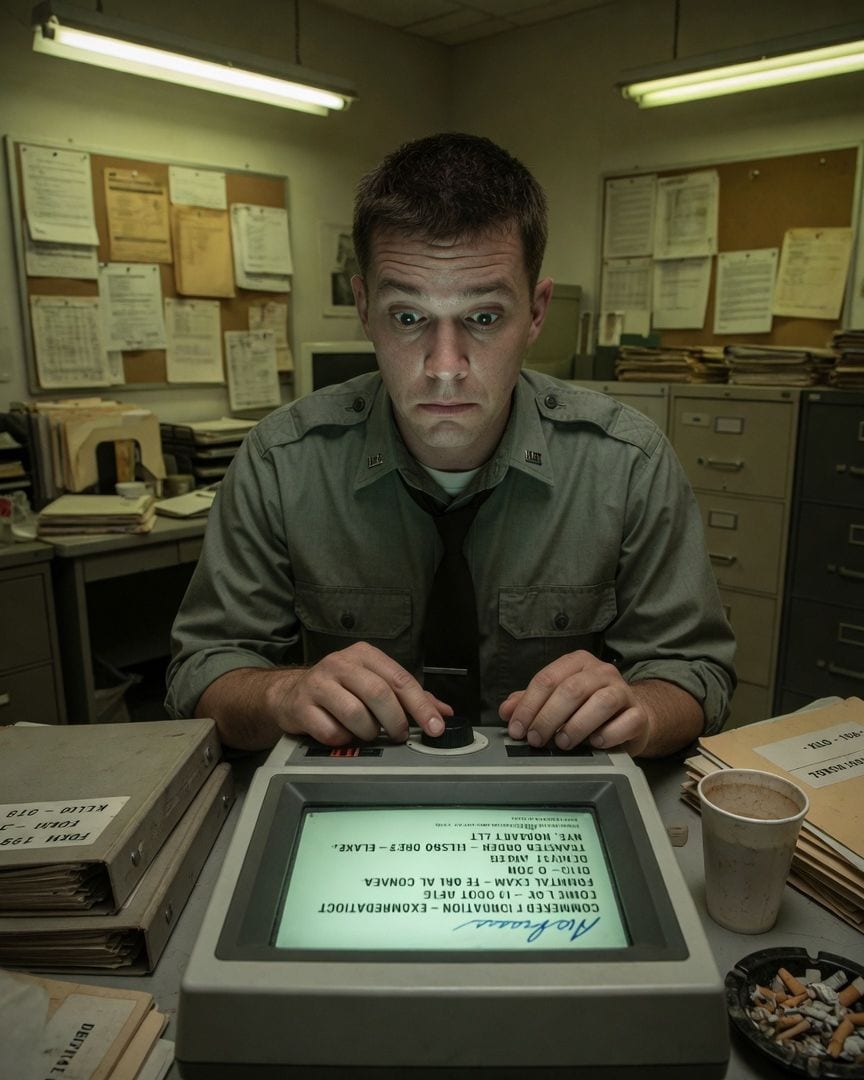
A missile commander watched his ten nuclear silos go dark. His own service record shows his signature on a future he's never lived.
Second Lieutenant Hobart Nye, a missile commander in Wyoming, had his quiet 0247 watch shattered by a security report: a massive, silent black triangle hovered over Launch Facility Kilo, casting a perfect shadow. Hobart watched his console's fault panel light up, signaling all ten nuclear missiles going dark in an impossible silence, followed by eleven minutes his security team could not remember. Official logs called it a "radio malfunction," but Hobart found a requisition for invisible-tracking sensors, signed by a base commander who was supposed to be off-base. The final, chilling discovery came when his own service record showed new entries—a dental check-up, a transfer to Alaska—all dated for a future he never lived, complete with his perfectly replicated signature.
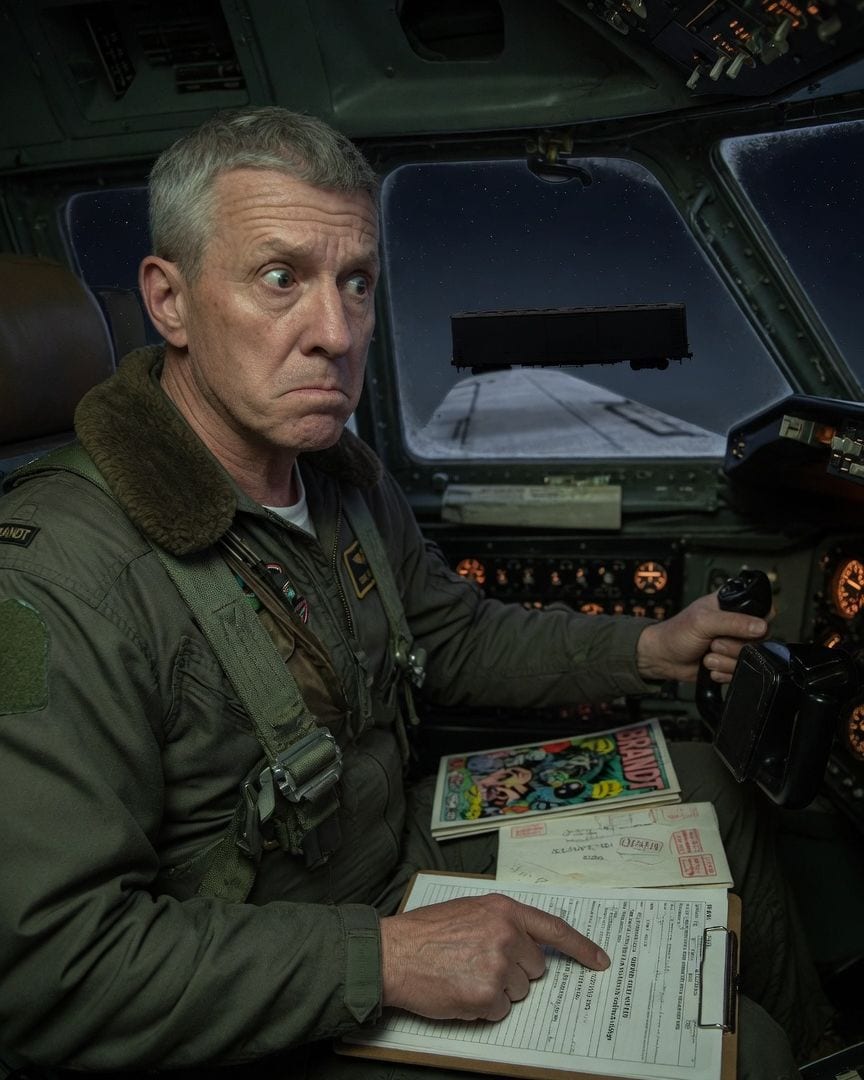
On his last Cold War flight, Major Brandt’s official report quoted words he never said, then claimed material recovery from a wing he knew was untouched.
Major Cyril Brandt, a seasoned pilot nearing retirement, undertook his final airborne alert leg in the B-47, the familiar hum of its engines a lullaby against the vast, dark sky over the Dakotas. Then, an impossible, featureless boxcar-thing appeared silently, thirty feet off his wingtip, vanishing as abruptly as it came nineteen minutes later. Three days later, the official incident report contained two chilling fabrications: a quote only his tail gunner uttered, attributed to Major Brandt, and a claim of material recovery from a wing he knew was untouched. The document was not just wrong; it was a deliberate, precise lie about an interaction that never happened, leaving the pilot with a cold dread.